See discussions, stats, and author profiles for this publication at: http://www.researchgate.net/publication/275967913
Experimental Study for Phycoremediation of
Botryococcus sp. On Greywater
ARTICLE in APPLIED MECHANICS AND MATERIALS · JANUARY 2015
Impact Factor: 0.15 · DOI: 10.4028/www.scientific.net/AMM.773-774.1312
CITATION 1
READS 86
8 AUTHORS, INCLUDING:
Paran Gani
Universiti Tun Hussein Onn Malaysia
11PUBLICATIONS 7CITATIONS
SEE PROFILE
Hazel B. Matias Peralta
Universiti Tun Hussein Onn Malaysia
22PUBLICATIONS 92CITATIONS
SEE PROFILE
Ab Aziz Abdul Latiff
Universiti Tun Hussein Onn Malaysia
24PUBLICATIONS 8CITATIONS
SEE PROFILE
Chin Ming Er
Universiti Tun Hussein Onn Malaysia
12PUBLICATIONS 8CITATIONS
SEE PROFILE
All in-text references underlined in blue are linked to publications on ResearchGate, letting you access and read them immediately.
Experimental Study for Phycoremediation of
Botryococcus
sp. On
Greywater
P.Gani
1*, N.M.Sunar
2, H.M.Matias-Peralta
3, A.A.Latiff
1, N.S. Kamaludin
1,
U.K. Parjo
2, Q. Emparan
1, C.M. Er
11Department of Water And Environmental Engineering, Faculty of Civil And Environmental
Engineering (FKAAS), University Tun Hussein Onn Malaysia (UTHM) 86400, Parit Raja, Batu Pahat,Johor, Malaysia
2Department of Chemical Engineering Technology, Faculty of Engineering Technology (FTK),
Universiti Tun Hussein Onn Malaysia (UTHM), 86400, Parit Raja, Batu Pahat, Johor, 86400, Parit Raja, Batu Pahat, Johor, Malaysia
3Department of Technology and Heritage, Faculty of Science, Technology and Human
Development (FSTPI) University Tun Hussein Onn Malaysia (UTHM) 86400, Parit Raja, Batu Pahat, Johor, Malaysia
1*[email protected], 2[email protected], 3[email protected], 1[email protected], 1[email protected], 2[email protected], 1[email protected],
Keywords: Botryococcus sp.; Phycoremediation; Greywater; Microalgae
Abstract. Greywater (GW) is identified as waste disposal from home activites that is discharging from laundry, bath and wash-basin. GW useful in irrigation of a garden and aids to reduce cost as well as maintain the environmental prosperity. This paper discussed the effectiveness of Botryococcus sp. to clean GW in phycoremediation treatment. This process involves as growing the Botryococcus sp. in the GW which is contributing to utilize supplements in GW for its grow. The results indicated that Botryococcus sp. is effective to reduce COD (88%), BOD (82%), TIC (76%), TC (58%), TN (52%), TOC (39%), Phosphate (37.5%) and pH (7%) for 100% concentration of GW. Meanwhile, for the 50% of GW concentration Botryococcus sp. capable to remove such as COD (83%), TIC (82%), BOD (68%), TN (67%), Phosphate (36.8%), TC (34%), TOC (31%) and pH (1.2%). Then, the study concludes that Botryococcus sp. can grow effectively in GW and be able to reduce the rate of nutrient in GW.
1. Introduction
Normally, GW contribute up to 70% of municipal wastewater volume [1]. Jefferson et al. [2] also found that, GW inclined to contain a few solids but less turbid if compared to domestic wastewater, recommendating that a lot of its pollutions are soluble. Cleaning activities from laundry, bath and wash-basin are mean source to GW. Soap and detergent is commonly alkaly where the pH of GW usually about 7-8 [2]. In addition, others wastewater contained high concentrations of nitrate, phosphate, and potassium but small amounts of nutrients could be detected in GW, and sometimes more than 5 mg/L [2]. GW has characteristics different from home to home based on the personal behavior of the population and the equipment used in the home. Besides that, GW is also contain high of microbes. Survey of various parametric studies that include microbial characteristic [3,4] show that kitchen sinks are often highly polluted effluents due to the presence of particles of food and oil as well as harmful to higher charges of salmonella in these streamsh. In addition, treatment and disposal of GW is an expensive and environmentally sensitive problem. The risk to health of chemicals when applied to land has been reviewed by Dean and Suess [5]. It also
contains pathogens human germs, bacteria, viruses, and parasites whereas sludge smells can lead to respiratory problems and death.
A technique wastewater for reuse is by cultivating microalgae in lakes and retention ponds. Therefore, aim of the study is to verify the efficiency of the Botryococcus sp. in phycoremediation process of GW. Other than that, to evaluate the growth of microalgae in GW by counting the cell using haemocytometer. By that, algae grow is assumed to remove the phosphorus and nitrate existing and may useful as alternative to avoid water contamination.
2. Materials and Methods
2.1 Sampling of Greywater
The GW samples were sampling from residential area located at Parit Raja, Johor, Malaysia. The samples were collected and transferred into a bottle. Once reach the microbiology lab, the samples were kept at 4˚C prior to be used for laboratory analysis.
2.2 The Preparation of Botryoccocus sp.
The Botryococcus sp. Colonies was provided by Microbiology Laboratory FTK, Universiti Tun Hussein Onn Malaysia. This ready for inoculation for preperation of treatment media. The inoculum was calculated by haemocytometer under light microscope. Algae inoculum of 1.0 x 10³ cell/mlwas inoculated to the treatment media. Then, clonical flasks was put in the indoor condition. The Botryococcus sp. cultivated in 7 samples for 17 days. The phycoremediation has to be classified into negative and positive. Flasks were put under the direction of natural light and gently shaking daily to make sure the algae are well mixed with sample while phycoremediation process. The volume of sample in the flask was 170 ml for each of them. The triplicate contains 50% of sample was diluted with 50% using distilled water. Meanwhile, 100% of concentration, 170 ml of GW is used for this process during 17 days. Negative control sample is prepared where contained 170 ml of distilled water.
2.3 Laboratory Test
The characteristics such as BOD, COD, pH, Total Nitrogen (TN), Total Organic Carbon (TOC), Total Carbon (TC) and Inorganic Carbon (IC) was carried out based on the standard method and examination of water and wastewater (2009). Dairy wastewater parameter was examined on the 0th day, 7th day, 11th day and 17th day of phycoremediation.
2.4 Microalgae growth measurement
Growth of Botryococcus sp. was measured using Hemocytometer to count the number of microalgae cell. The step to use this materials, firstly ensure the cover-slip and haemocytometer were clean and pipette cell mix 10μl at the edge of the cover slip and allow running under the cover slip. Then, visualize the haemocytometer grid under the microscope at low magnification (10-20X) and adjust the focus of the lenses until individual counting grids are visible.
3. Result and discussion
3.1 Raw characteristics of Greywater (GW)
Table 1 presents the parameter of raw greywater (GW), control sample and standard limits according to Environmental Quality (Sewage & Industrial Effluents Regulation, DOE, 2009.). All parameter in mg/l except for pH.
Table 1 Greywater Characteristic Data
Parameter COD,
mg/L
BOD, mg/L
pH TOC
mg/L TIC mg/L TC mg/L TN mg/L Phosphate mg/L Concentration (n=3)
183 224 7.4 64.9 32.15 54.82 19.30 12.7
Distilled water with
Botryococcus sp. (control)
4 6 6.86 3.74 2.49 2.78 2.78 1.9
Standard A (DOE,2009)
80 20 6 – 9 - - - - -
Standard B (DOE,2009)
200 50 5.5 - 9 - - - - -
[image:4.595.97.490.367.481.2]3.2Analysis of Chemical Oxygen Demand
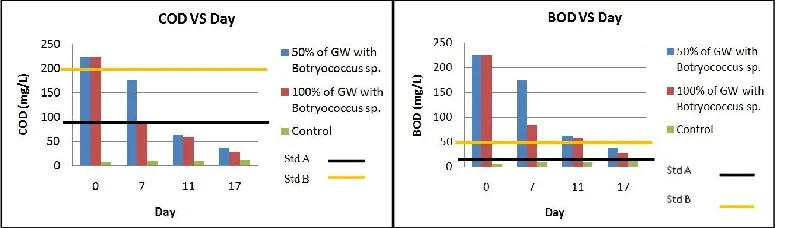
Figure 1Removal of COD and BOD during phycoremediation
Figure 1 provides the removal of Chemical Oxygen Demand (COD) for 50% and 100% concentration of GW on 0, 7, 11 and 17 days. It can be observed that both samples had a high COD concentration at the initial of the phycoremediation. Based on the trends produced, the Botryococcus sp. has reveal a great removal in COD concentration, which is the total reduction efficiency for both concentration were 83% and 88% respectively. It indicates both samples were slightly declined on 7th day and after that it drop drastically on day 15. From this view, COD removal by Botryococcus sp. maybe can be increased with additional day phycoremediation periods.
Meanwhile, BOD removal for 50% and 100% of greywater. The start concerntration for BOD is 224 mg/L. After initial day, BOD decreased to 175mg/l for 50% GW. The flow is similarly to 100% concentration from day 0 to day 7. After day 7, BOD for both concentration is slightly declined. Meanwhile, 100% GW indicates the lowest of BOD which is 33.33mg/L. This may because of to the increment of DO during photosynthesis activity of Botrococcus sp.
3.3 Analysis of pH
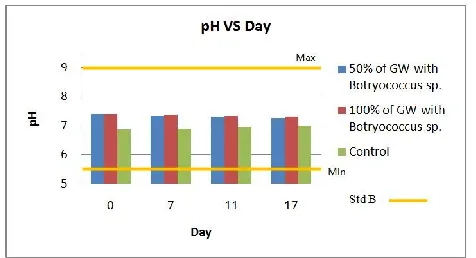
microalgae as nutrient resource. During oxidation process, normally CO2 is acidic when mixed with water. However, when photosynthesis occurred, CO2 was used to form a basic sugar rather than being permitted to shape carbonic acid. Thus, water reduced in acidic and at the same time pH was increase. Distinction in organic material has affected the grow of Botryococcus sp. Slow growth of microalgae was monitored in a pH-tolerant algae when the pH over than 9.5 [6].
Figure 2 pH during phycoremeditaion
[image:5.595.95.509.370.487.2]3.5 Analysis of TOC, TC and IC
Figure 3 Graph of TOC, TC & TIC in 50% and 100% concentration of GW during phycoremediation
Figure 3 shows the amount of TOC, TC and IC in 50% of GW. It indicates that TOC was the highest if differentiated to other elements. TOC reduced from 64.90 mg/L to 44.85 mg/L. The changes of TOC is as same as TC and TIC but TIC value is lower than TOC. In the meantime, TC is 5.63 mg/L at the end of phycoremediation process. However, most of the parameters show significant removal from day 0 to day 7 of treatment.
Meanwhile for 100% concentration, it can be viewed from the graph that there is a reduction in the value of TOC from 64.90 mg/L to 39.62 mg/L. TIC also reduced from 32.15mg/L to 7.86 mg/L and TC has reduced from 54.02 mg/L to 23.15mg/L. Normal organic carbon such as acetate or glucose are commonly favored by algae, but they also can take up various another compounds such as N and P [7].
3.6 Analysis of Nitrogen, Phosphate and Nitrate
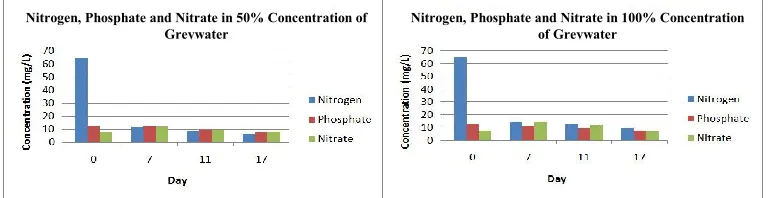
Figure 4 shows concentration of nitrogen, phosphate and nitrate for both 50% and 100%, respectively. All the data showed is almost the same flow of decrement. However, for 50% concentration, there is a slightly increase of phosphate on day 7. This is probably due to the sample have been contented with other microbe before treatment. Then, the phosphate also has been removed steadily on the 11th and 17th day of phycoremediation. In the meantime, 100%
concentration of GW showed a important reduction in the value of nitrogen and phosphate. Removal of nitrogen from 19.30 mg/L to 6.35 mg/L, phosphate reduced from 12.7 mg/L to 7.46 mg/L but nitrate has been increased from 7.4 mg/L to 7.86 mg/L. Basically, nitrogen is needed for algae cultivation. Research about nitrogen supply prove that organizing nitrogen metabolic in Botryococcus sp. is the nitrate absorbtion process.
Figure 4 Concentration of Nitrogen, Phosphate and Nitrate
4. Conclusion
This study reveals that Botryococcus sp. is suitable as phycoremediation agent to bio-transform the pollutant load into microalgae cell. The usage of Botryococcus sp. for bioremediation in GW was effectively reduce the COD where begining value was 183 mg/L and the last value for 50% GW after 17 days was 59 mg/L whereas for 100% GW was 33.33 mg/L. The pH level of the sample was decreased during the phycoremediation process. In addition, BOD concentration of raw GW before phycoremediation was higher up to 271 mg/L and drastically decreased from day 0 to day 7 for both concentrations. From overall finding, indicates a obvious difference of value by each parameters since the begining day until the end of phycoremediation. TOC, TC and TIC has decreased for each concentration.
Acknowledgement
The authors to thanks the support of any parties which is involved in this project especially Universiti Tun Hussein Onn Malaysia for providing the equipment research facilities to carry out this project and Geran Penyelidik Siswazah (GIPS).
References
[1] Friedler, E. (2004). Quality of individual domestic greywater streams and its implication for on-site treatment and reuse possibilities. Environmental Technology, 25(9), pp. 997-108.
[2] Jefferson, B., Palmer, A., Jeffery, P., Stuetz, R. & Judd, S. (2004). Grey water characterisation and its impact on the selection and operation of technologies for urban reuse. Water Sci. Technol. 50(2). Pp. 157-64.
[3] Eriksson, E., Auffarth, K., Henze, M. & Ledin, A. (2002). Characteristics of grey wastewater. Urban water. 25(9), pp. 997-1008.
[4] Lazarova, V., Hills, S. & Bricks, R. (2003). Using recycled water for non-potable, urban uses: a review with particular reference to toilet flushing. Water Supply. 3(4), pp.69–77.
[5] Dean, R.B. and Suess, M.J. (1985). The risk to health of chemicals in sewage sludge applied to land. Waste management and research. 3, pp. 251-278.
Nitrogen, Phosphate and Nitrate in 50% Concentration of Greywater
[6] Pendersen, M.F. and Hensen, P.J. (2003). Effects of high pH on the growth and survival of six marine heterotrophic protests. Mar. Ecol. Prog. Ser. 260. Pp. 33-41.
[7] Lee. K. And Lee, C.G. (2001). Effect of light/dark cycles on wastewater treatments by microalgae. Biotechnology Bioprocess Eng. Pp. 194-199.
[8] Banerjee, A., Sharma, R., Chisti, Y. & Banerjee, U.C. (2002). Botryococcus braunii: a renewable sources of hydrocarbons and other chemical. Critical Reviews in Biotechnology, 22(3), pp. 245-79.
[9] Lupi, F.M., Fernandes, H.M.L., Sa-Correia, I. & Novais, J.M. (1991). Temperatures profiles of cellular growth and exopolysaccharide synthesis by Botyrococcus braunii Kutz. UC 58. J. Appl.Phycol. 3., pp. 35-42.