IMPROVED DROOP CONTROL FOR PARALLEL INVERTER SYSTEM WITH LOAD
SAGER K ALSWED
A thesis report submitted in partial
fulfillment of the requirement for the award of the Degree of Master of Electrical and Electronic Engineering
Faculty of Electrical and Electronic Engineering Universiti Tun Hussien Onn Malaysia
ABSTRACT
ABSTRAK
TABLE OF CONTENTS
TITLE i
DECLARATION ii
DEDICATION iii
ACKNOWLEDGMENT iv
ABSTRACT v
ABSTRAK vi
CONTENTS vii
LIST OF FIGURES ix
LIST OF SYMBOLS AND ABBREVIATIONS xi
CHAPTER 1: Introduction
1.1 Introduction 1
1.2 Problem statement 4
1.3 Objective 4
1.4 Scope of project 4
CHAPTER 2: Literature review
2.1 Distribution generation 6
2.1.1 Benefits of distributed generating systems 7
2.2 Inverter 8
2.2.1 Voltage source inverter 9
2.2.2 Current source inverter 10
2.2.3 Three phase inverter 10
2.3 Control of inverter 12
2.3.1 PCM control 12
2.3.2 VCM control 12
2.4 Multilevel parallel inverters 13
2.4.1 Advantages and disadvantages of multilevel inverter 14
2.5 Control system 15
2.5.1 PI control 15
2.5.2 PID controller 16
2.6 Droop control 17
2.6.1 Review of the conventional droop control 17
CHAPTER 3: METHODOLOGY
3.1 Introduction 23
3.2 Droop control 23
3.2.1 Real power sharing 25
3.3 Power stage of inverter 27
3.4 Project block diagram 29
3.4.1 Case I 29
3.4.2 Case II 29
3.4.3 Case III 30
CHAPTER 4: RESULT AND ANALYSIS
4.1 Introduction 31
4.2 System design and simulation 31
4.3 Three phase inverter with droop control 32 4.3.1 The droop control design and simulation 33 4.3.2 Output of three phase inverter with 200 V dc source 35 4.3.3 Output of three phase inverter with 400 V dc source 36 4.4 Two parallel inverter with same dc source 38 4.4.1 Output of two parallel inverter with load 39 4.5 Two parallel inverter with different dc source 41
4.5.1 Voltage output 42
4.5.2 Current output 43
CHAPTER 5: CONCLUSION AND FUTURE RECOMMENDATIONS
5.1 Conclusion 47
5.2 Future recommendations 48
LIST OF FIGURES
1.1 Equivalent circuit of parallel-inverters-based microgrid 3 1.2 Power sharing through droop control method 3
2.1 Distribution generation technology 7
2.2 Renewable energy sources 8
2.3 General block diagram 9
2.4 Voltage source inverter (VSI) 9
2.5 Current source inverter (CSI) 10
2.6 Three phase half bridge inverter 11
2.7 Three phase full –bridge inverter 11
2.8 Block diagram of space vector pwm control of single voltage
source inverter 13
2.9 Main circuit of a microgrid formed by three parallel inverters 13
2.10 Block diagram of the PI controller 16
2.11 A block diagram of a PID controller in a feedback loop 17
2.12 Typical Microgrid Diagram 18
2.13 Equivalent model of voltage source inverter connected to an ac bus 18
2.14 The proposed control scheme 21
2.15 Example of control scheme using in three phase voltage source inverter 22 3.1 Two parallel inverters connecting to the load 24
3.2 Droop control method 25
3.3 Power stage of single phase inverter 27 3.4 Block diagram of the closed loop system 29
3.5(a) Project block diagram 29
3.5(b) Project block diagram 29
3.5(c) Project block diagram 30
4.1 Three phase inverter 32
4.2(a) Three phase inverter with 200 V dc source 32 4.2(b) Three phase inverter with 400 V dc source 33
4.3(b) The parameters of the controller 34 4.4 Three phase inverter with 200 V dc source 35 4.5(a) Inverter output voltage with 200 V dc source 35 4.5(b) Inverter output voltage with 200 V dc source 36 4.6 Three phase inverter with 400 V dc source 36 4.6(a) Inverter output voltage with 200 V dc source 37 4.6(b) Inverter output voltage with 200 V dc source 37 4.7 Two parallel inverter with 200 V dc source 38 4.8 Voltage output of each three phase inverter with 200(V) dc source 39 4.8(a) Current output of each inverter with 200(V) dc source 39 4.8(b) Current output of each inverter with 200(V) dc source 40
4.9(a) Current output of the R load 40
4.9(b) Current output of the R load 40
4.10 Two parallel three phase inverter with different value of dc source 42 4.10(a) Voltage output of three phase inverter with 200(V) dc source 43 4.10(b) Voltage output of three phase inverter with 400(V) dc source 43
4.11 Voltage output of the load 44
4.12 Current output of inverter 1 with 200 V dc source 44 4.13 Current output of inverter 2 with 400 V dc source 45
LIST OF SYMBOLS AND ABBREVIATIONS
AC Alternating current DC Direct current
VSI Voltage source inverter CSI Current source inverter DER Distributed energy resources DG Distributed generation
UPS Uninterruptible power supply WC Wireless control
RES Renewable energy system ASD Adjustable speed drive PCM Power control mode VCM Voltage control mode PMS Power management system EMC Electromagnetic compatibility CM Common mode
PI Proportional- integral
PID Proportional- integral -derivative PM Permanent magnet
PV Photo voltaic
PWM Pulse width modulation Self-inductance
E Electromotive force v Phase terminal voltages
Field terminal voltage
Real power Reactive power
CHAPTER 1
INTRODUCTION
1.1 Introduction
Distributed generation has attracted people’s attention greatly due to its reducing the emission of greenhouse gases, increasing the reliability of the system and alleviating the pressure of power transmission, but output power is affected by the environment, and when there is a fault in the power system, the distributed generation must be quitted [1] which has restricted its application.
The Distributed energy resources (DERs) based microgrid is able to deliver electric power to the grid and able to supply the local loads to ensure reliable power supply of some important and sensitive loads when the grid fails [10]. Most of the DERs need power electronics interfaces to be connected to the microgrid [8, 9]. Consequently, inverters or ac-dc-ac converters are adopted to connect the DERs to the local ac bus with the aim to share loads properly.
Voltage sources inverters are very interesting since they don’t need any external reference to stay synchronized [3], they can operate in parallel with other inverters by using frequency and voltage droops, forming autonomous microgrids [4]. When these inverters are required to operate in grid-connected mode, they often change its behavior from voltage to current sources [5]. To achieve flexible microgrids, which are able to operate in both grid connected and island mode.
In distributed generation (DG) systems, there may be more than one inverter acting in parallel. Therefore, distributed uninterruptible power supply (UPS) systems as well as the parallel operation of voltage source inverters with other inverters or with the grid, are sensitive to disturbances from the load or other sources and can easily be damaged by over current. Hence, careful attention should be given to system design and the control of parallel operation of inverters. When two or more inverters operate in parallel, the following features must be achieved: (1) amplitude, frequency and phase synchronization among the output voltages of inverters, (2) proper current distribution according to the capacities, (3) flexibility and (4) hot-swap feature at any time [6].
The conventional control strategies for the parallel-connected inverters can be classified into two types; active load sharing or current distribution. The droop control method for the parallel-connected inverters can avoid the communication mismatch of reference current. It is also defined as wireless control (WC) with no interconnection between the inverters. In this case, the inverters are controlled in such a way that the amplitude and frequency of the reference voltage signal will follow a droop as the load current increases and these droops are used to allow independent inverters to share the load in proportion to their capacities [7].
Figure 1.1 Equivalent circuit of parallel-inverters-based microgrid
[image:11.595.188.455.369.586.2]1.2 Problem statement
There is two type to connecting between parallel inverters are wire communication between inverters and droop control. For first type it has disadvantages if one of parallel inverter fail it will effect to the other, the cost of these connecting will be high so the droop control method for the parallel-connected inverters can avoid the communication mismatch of reference current. It is also defined as wireless control (WC) with no interconnection between the inverters. In this case, each inverter has different power and when connecting two parallel inverters to load, the output of voltage of inverter not stable and the inverters did not sharing the load. The inverters need controller to control and make the voltage stable and sharing the current to the load. The droop method controlled inverter by parameters for this control in such a way that the amplitude and frequency of the reference voltage signal will follow a droop as the load current increases and these droops are used to allow independent inverters to share the load in proportion to their capacities.
1.3 Objective
The main objectives of this project are:
1. To design two parallel inverter system of standalone mode. 2. To control two parallel inverters by using droop control method. 3. To control voltage and current for the inverters to load.
1.4 Scope of project
This project is improving droop control for parallel inverters. The scopes of this project are:
1. The parallel inverters with load will be designed in MATLAB.
CHAPTER 2
LITERATURE REVIEW
2.1 Distribution generation
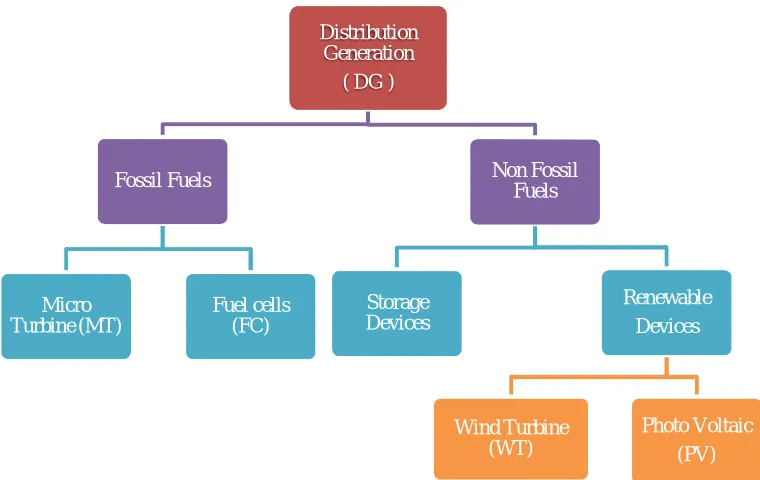
Distribution generations (DG) are electric power generators that produce electricity at a site close to customers or that are tied to an electric distribution system. Distributed generators include, but are not limited to synchronous generators, induction generators, reciprocating engines, micro turbines (combustion turbines that run on high-energy fossil fuels such as oil, propane, natural gas, gasoline or diesel), combustion gas turbines, fuel cells, solar photovoltaic, and wind turbines.
Figure 2.1: Distribution generation technology
2.1.1 Benefits of Distributed Generating Systems
Distributed Generation:
Has a lower capital cost because of the small size of the DG
May reduce the need for large infrastructure construction because the DG can be constructed at the load location.
If the DG provides power for local use, it may reduce pressure on distribution and transmission lines.
With some technologies, produces zero or near-zero pollutant emissions over its useful life.
With some technologies such as solar or wind, it is a form of renewable energy.
The main advantage of renewable energy systems (RES) is no fossil fuels involved because it is free like sun and wind. This decreases the operational cost of renewable energy systems and reduces operational risks. The major drawback is the initial investment in renewable energy systems, which is often larger than for non-RES. For instance, a gas turbine system may be built for 500 EUR per kW, while for a wind turbine the investment is more than 900 EUR per kW.
Distribution Generation
( DG )
Other disadvantages of RES are the specific requirements of the site and the unpredictability of the power generated. The availability of renewable energy (sun, wind, water) largely determines the feasibility of a renewable energy system and this may raise environmental issues. Figure 2.2 shows renewable energy sources. The unpredictability of RES also means a higher cost for balancing the electricity grid and maintaining reserve capacity e.g. in the event that the wind drops or increases above the operating area of wind turbines. DG and RES have advantages and disadvantages that might be energy-related, grid-related or environmental which need to be evaluated on a case-by-case basis.
Most of the distribution energy resources need power electronics interfaces to be connected to the microgrid [8, 9]. Consequently, inverters are adopted to connect the DERs to the local ac bus with the aim to share loads properly.
Figure 2.2: renewable energy sources
2.2 Inverter
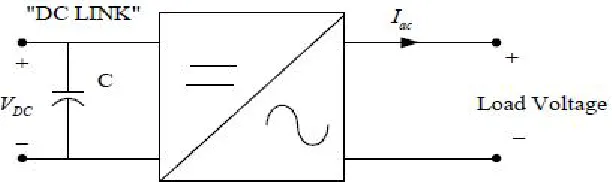
Power inverter, or inverter, is an electrical power converter that changes direct current (DC) to alternating current (AC). The converted AC can be at any required voltage and frequency with the use of appropriate transformers, switching, and control circuits.
commonly used to supply AC power from DC sources such as solar panels or batteries. Figure 2.3 shows the general block diagram.
Figure 2.3: General block diagram
2.2.1 Voltage Source Inverter
The type of inverter that most commonly used is voltage source inverter (VSI) where AC power provides on the output side function as a voltage source. The input DC voltage may be an independent source such as battery, which is called a ’DC link’ inverter. These structure are the most widely used because they naturally behave as voltage source as required by many industrial application, such as adjustable speed drives (ASDs), which are the most popular application of inverters. Figure 2.4 shows the voltage source inverter. Single phase VSIs are used in low range power application where the three phase VSIs is used in medium to high-power application. The main purposes of three-phase VSIs are to provide a three-phase voltage source, where the amplitude, phase and frequency of the voltage should be controllable [18].
[image:17.595.169.475.626.717.2]2.2.2 Current Source Inverter
Respectively, CSI the DC source appears as a constant current and the voltage is changing with the load. The protection filter is normally a capacitance in parallel with the DC source The main advantage of the current source inverter is that it increases the voltage towards the mains itself. Figure 2.5 shows the current source inverter [18].
Figure2.5: Current Source Inverter (CSI)
2.2.3 Three Phase Inverter
Figure 2.6: Three-Phase Half Bridge Inverter
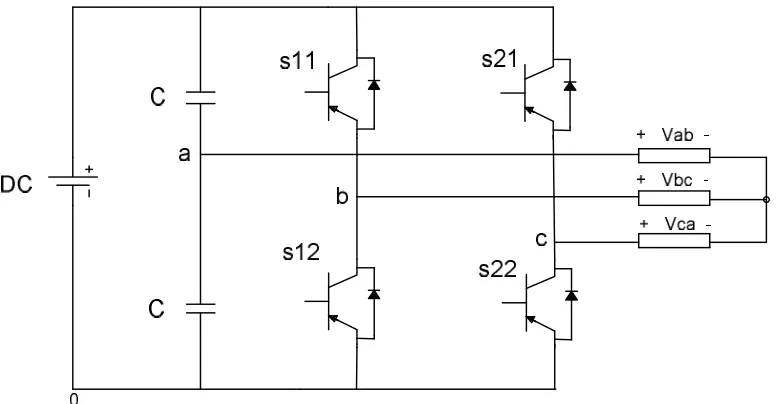
The three-phase dc/ac voltage source inverters are extensively being used in motor drives, active filters and unified power flow controllers in power systems and uninterrupted power supplies to generate controllable frequency and ac voltage magnitudes using various pulse width modulation (PWM) strategies.
Figure 2.7: Three-phase Full –Bridge Inverter
[image:19.595.178.464.448.591.2]2.3 Control of inverter
When interfacing distributed energy resources with the utility grid, a single inverter can typically operate in two modes: one is the grid-connected mode and the other is the isolated mode. Corresponding to these two modes, the controller has two distinct modes of operation: power-control mode (PCM) and voltage-control mode (VCM) [16].
2.3.1 PCM control
The grid-connected mode of operation requires that the power management system (PMS) shall not actively regulate the voltage; hence the logical choice of control is a form of current regulation. Here we use power flow control as a means of current regulation. The control calculates current references for the system by the measured voltage and desired power levels, as described in Figure 2.8, which shows the block diagram of the power control system, where the current references are produced by the outer power control loops.
2.3.2 VCM control
Figure 2.8: Block Diagram of Space Vector PWM Control of Single Voltage Source Inverter.
2.4 Multilevel parallel inverters
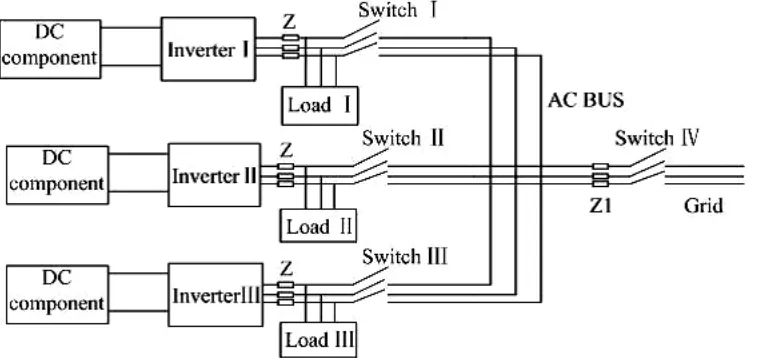
In the following will present a control method for multiple parallel connected inverters operating in the isolated mode. Figure 2.9 depict the main circuit of the system and the system parameters. The system comprises three inverters each of which can operate in the PCM mode or the VCM mode. The DC components in the microgrid could be a smaller-scale DC microgrid, or a DC voltage bus linking several distributed generation and energy storage units.
[image:21.595.133.513.554.733.2]In Figure 2.9, when the switch IV is on, all these three inverters can be connected to the grid. They can operate in PCM and their output power can be controlled respectively. While the switch IV is off, all these three inverters are operating in the isolated mode. Based on the single inverter control, we know that a single inverter can operate in two modes. When the inverter connects to the grid, the inverter can operate in the PCM mode. While the inverter disconnects from the grid, the inverter may need to maintain the bus voltage. When these three inverters all operate in the isolated mode, it is possible to selectively operate Inverter I in the VCM mode to maintain the AC bus voltage. If the AC bus voltage is constant, from the viewpoint of the other inverters, it is the same situation as the utility grid. So Inverters II and III can work in PCM and their control aim is still the PCM mode.
2.4.1 Advantages and disadvantages of multilevel inverter
A multilevel converter has several advantages over a conventional two-level converter that uses high switching frequency pulse width modulation (PWM). The attractive features of a multilevel converter can be briefly summarized as follows.
Staircase waveform quality: Multilevel converters not only can generate the output voltages with very low distortion, but also can reduce the dv/dt stresses; therefore electromagnetic compatibility (EMC) problems can be reduced.
Common-mode (CM) voltage: Multilevel converters produce smaller CM voltage; therefore, the stress in the bearings of a motor connected to a multilevel motor drive can be reduced. Furthermore, CM voltage can be eliminated by using advanced modulation strategies.
Input current: Multilevel converters can draw input current with low distortion.
One particular disadvantage is the greater number of power semiconductor switches needed. This may cause the overall system to be more expensive and complex
2.5 Control system
A control system is a device or set of devices to manage, command, direct or regulate the behaviour of other devices or systems. A control mechanism is a process used by a control system. There are many controller systems user in the inverter controller such as PI controller, PID controller and droop controller.
2.5.1 PI control
PI controller is proposed is to improve the performance of the soft switched inverter. The duty ratio of the inverter is controlled by PI controller. To provide optimal performance at all operating conditions of the system PI controller is developed to control the duty ratio of the inverter.
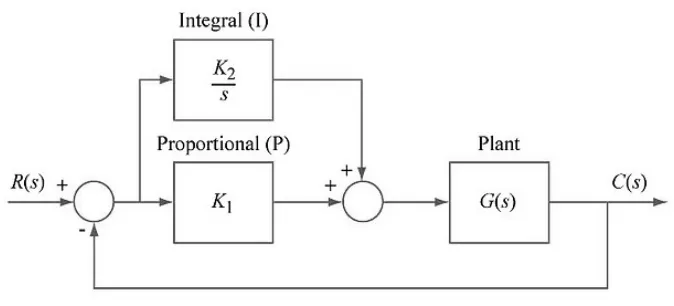
Figure 2.10 Block diagram of the PI controller.
2.5.2 PID controller
Proportional-integral-derivative controller (PID controller) is a generic control loop feedback mechanism (controller) widely used in industrial control systems. A PID controller calculates an "error" value as the difference between a measured process variable and a desired set point. The controller attempts to minimize the error by adjusting the process control inputs.calculation (algorithm) involves three separate constant parameters, and is accordingly sometimes called three-term control: the proportional, the integral and derivative values, denoted P, I, and D. Heuristically, these values can be interpreted in terms of time: P depends on the present error, I on the accumulation of past errors, and D is a prediction of future errors, based on current rate of change. The weighted sum of these three actions is used to adjust the process via a control element such as the position of a control valve, a damper, or the power supplied to a heating element.
use of the PID algorithm for control does not guarantee optimal control of the system or system stability.
Figure2.11: A block diagram of a PID controller in a feedback loop
2.6 Droop control
Droop control strategy is proposed to enhance the dynamic performance of the parallel inverters in microgrids without communication wire interconnections. A wireless controller is developed by taking the active and reactive current as the control variables, the droop control variables is taken to ensure the power sharing accuracy, and additional terms are added to the droop controller to enhance the dynamic performance.
2.6.1 Review of the conventional droop control
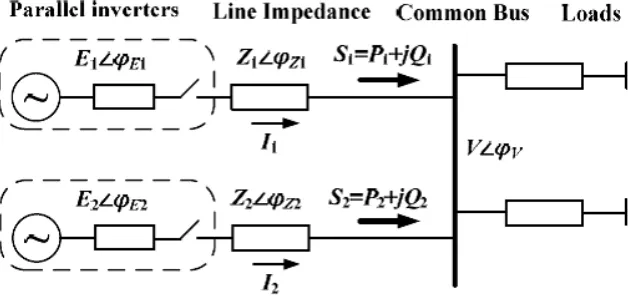
or need to be converted to DC form first, voltage source inverters are used for each of the micro sources. The inverters can be modelled as a voltage source connected to the ac bus through complex impedance, as shown in Figure 2.13
Figure 2.12: Typical Microgrid Diagram [17]
Figure 2.13: Equivalent model of voltage source inverter connected to an ac bus.
The active and reactive power can be expressed as. [13]
= ²[ ( cos − ) + sin ] (2.1)
[image:26.595.225.401.442.582.2]Where ∠ = + is the sum of inverter output impedance and line impedance for the overhead lines, the line impedance mainly exhibits inductive characteristic, that is X>>R, and hence ≈90º, then the equations (2.1) and (2.2) can be simplified as
= sin (2.3)
= ( ) (2.4)
In practical applications, the phase error δ of the voltage source and the ac
bus is usually small, then sin ≈ and cosδ≈1. In this way, it can be derived that the active power is predominantly dependent on the phase error δ, while the reactive
power mainly depends on the voltage amplitude E. At the same time, changing frequency causes dynamic change of the phase error δ. Consequently, the conventional droop control method is developed based on the decoupled control of the active power and reactive power via output frequency and voltage amplitude.
− =− . ( − ) (2.5)
− =− . ( − ) (2.6)
In equations (2.5) and (2.6), ω0 and U0 are the inverter output angular
frequency and voltage amplitude without load, P0 and Q0 are the reference of the
active and reactive power, kp and kq are the droop coefficients for the frequency and
voltage amplitude, respectively.
For a given operation point, only two droop coefficients kp and kq can be
2.6.2 Droop control strategy
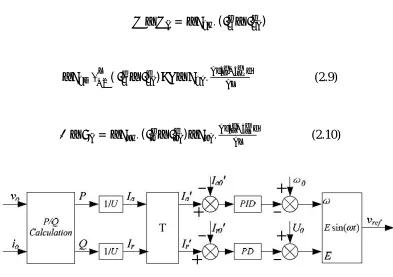
The droop control technique is commonly used in rotating interfaces of power sources. The (P, f) droop loop allows parallel connected generators to operate in a safe way sharing variations in the load/demand in a pre-determined way without any dedicated communication means. Similarly, the (Q, V) droop loop is used to minimize the circulation currents that would appear if the impedance between the inverters and a common load were not the same [19]. To limit the current spikes due to the initial phase error or grid fault, active current and reactive current are obtained in equation (2.7) as the control variables. In low voltage microgrids, the line resistance can’t be ignored, therefore, the active and reactive currents are coupled by line resistance and inductance. An orthogonal convert is taken to obtain the decoupled control variables as given by equation (2.8). It can be seen that the new control variables Ia’ and Ir’ are proportional to the inverter output voltage phase error δ and amplitude E respectively when δ is small. As mentioned in part 2.6.1, the conventional droop control method presents a decoupled characteristic between P, Q and δ, E at the expense of ignoring the line resistance. The proposed strategy decouples Ia’ and Ir’ with consideration of the line resistance, therefore, it is appropriate for microgrid use.
= = [ ( cos − ) + sin ]
[ ( cos − ) + sin ] (2.7)
′
′ = = (2.8)
Where = sin −cos
cos sin =
The Figure2.14, shows Ia0’and Ir0’ are the transformed active and reactive current reference, ω0 and U0 are the inverter output angular frequency and voltage
amplitude without load,
v
ref is the inverter output voltage reference which issynthesized by ω and E. Three phase instantaneous power theory [14] is used to calculate the inverter output active power P and reactive power Q. The matrix T is the orthogonal transformation in equation (2.8). The droop functions of the proposed strategy are given by equations (2.9) and (2.10).
− =− . ( − )
− .∫ ( − ) − . (2.9)
[image:29.595.119.512.260.537.2]− = − . ( − )− . (2.10)
Figure 2.14: The control scheme
Uabc Vdc
Ia &Ir calculation iabc
C L
Droop control PMW
w
E
Ia
Ir
[image:30.595.166.475.70.266.2]To the AC bus
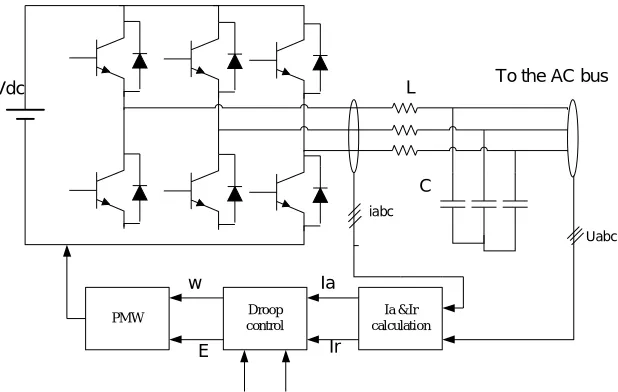
Figure 2.15: Example of control scheme using in three phase voltage source inverter
CHAPTER 3
METHODOLOGY
3.1 Introduction
In this chapter, it presents the block diagram and the flow chart of this project. Also it will prove the equation for droop controller to share the loading for two parallel inverters.
3.2 Droop control
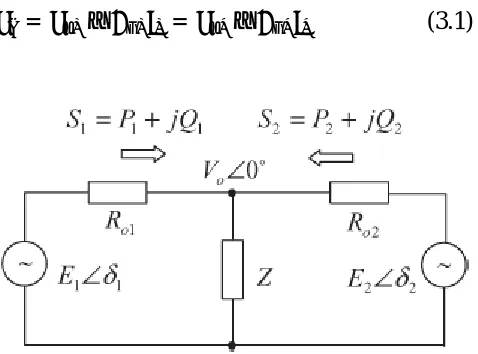
The analysis will be done for the Q − ω and P − E droop. The sketch of two inverters with resistive output impedances Ro1 and Ro2 operated in parallel is shown in Figure.
3.1. The line impedances are omitted because the output impedances of the inverters can be designed to dominate the impedance from the inverter to the ac-bus. The reference voltages of the two inverters are, respectively
=√2 sin( + )
Here, E1, E2 are the RMS voltage set-points for the inverters. The power ratings of the inverters are S∗
1 = E∗I∗1 and S∗2 = E∗I∗2. They share the same load
voltage.
[image:32.595.202.441.130.307.2]= − = − (3.1)
Figure 3.1 Two parallel inverters connecting to the load
The active and reactive powers of each inverter injected into the bus are
= (3.2)
= sin (3.3)
To share the loads of order the inverter, the normal droop controller
= ∗− (3.4)
= ∗− (3.5)
As shown in Figure. 3.2, is widely used to generate the amplitude and frequency of the voltage reference ri for Inverter I, where ω∗ is the rated frequency.
Note that, from equation (3.3), the reactive power Qi is proportional to− i for a small
power angle ( i) in order to make sure that the − loop is a negative feedback
loop so that it is able to regulate the frequency, the sign before iQi in equation (3.5)
is positive, which makes it a boost term. The droop coefficients i and i are
REFERENCES
[1]. IEEE Standard for Interconnecting Distributed Resources With Electric Power Systems, IEEE Standard 1547-2003, 2003
[2]. P.L.Villeneuve, “Concerns generated by islanding,” IEEE Power & Energy Magazine, May/June 2004, pp. 49-53
[3]. Godoy, Ruben Barros, et al. "Differential-evolution-based optimization of the dynamic response for parallel operation of inverters with no controller interconnection." Industrial Electronics, IEEE Transactions on 59.7 (2012): 2859-2866.
[4]. Rocabert, Joan, et al. "Control of power converters in AC microgrids." Power Electronics, IEEE Transactions on 27.11 (2012): 4734-4749.
[5]. R. Teodorescu and F. Blaabjerg, “Flexible control of small wind turbines with grid failure detection operating in stand-alone and grid-connected mode,” IEEE Trans. Power Electron., vol. 9, no. 5, Sept. 2004, pp 1323-1332.
[6]. López, Mariano, et al. "Current distribution control design for paralleled DC/DC converters using sliding-mode control." Industrial Electronics, IEEE Transactions on 51.2 (2004): 419-428.
[7]. Guerrero, Josep M., Lijun Hang, and Javier Uceda. "Control of distributed uninterruptible power supply systems." Industrial Electronics, IEEE Transactions on 55.8 (2008): 2845-2859.
[8]. J. M. Carrasco, et al., "Power-Electronic Systems for the Grid Integration of Renewable Energy Sources: A Survey," Industrial Electronics, IEEE Transactions on, vol. 53, pp. 1002-1016, 2006.
[10]. E. Barklund, et al., "Energy Management in Autonomous Microgrid Using Stability-Constrained Droop Control of Inverters," Power Electronics, IEEE Transactions on, vol. 23, pp. 2346-2352, 2008.
[11]. Younis, M. A. A., N. A. Rahim, and S. Mekhilef. "Distributed generation with parallel connected inverter." Industrial Electronics and Applications, 2009. ICIEA 2009. 4th IEEE Conference on. IEEE, 2009.
[12]. Mohr, Malte, and Friedrich W. Fuchs. "Comparison of three phase current source inverters and voltage source inverters linked with DC to DC boost converters for fuel cell generation systems." Power Electronics and Applications, 2005 European Conference on. IEEE, 2005.
[13]. Chung, Il-Yop, et al. "Control methods of inverter-interfaced distributed generators in a microgrid system." Industry Applications, IEEE Transactions on 46.3 (2010): 1078-1088.
[14]. Hu, Jie Feng, Jian Guo Zhu, and Glenn Platt. "A droop control strategy of parallel-inverter-based microgrid." Applied Superconductivity and Electromagnetic Devices (ASEMD), 2011 International Conference on. IEEE, 2011.
[15]. Ortega, R., et al. "A PI-P+ Resonant controller design for single phase inverter operating in isolated microgrids." Industrial Electronics (ISIE), 2012 IEEE International Symposium on. IEEE, 2012.
[16]. Yu, Xunwei, Zhenhua Jiang, and Yu Zhang. "Control of parallel inverter-interfaced distributed energy resources." Energy 2030 Conference, 2008. ENERGY 2008. IEEE. IEEE, 2008.
[17]. Liu, Quanwei, et al. "Droop control for parallel inverters in microgrids." Power Electronics and Motion Control Conference (IPEMC), 2012 7th International. Vol. 3. IEEE, 2012.
[18]. Salam, Zainal, Abdul Aziz, and MohdJunaidi. "The Design and Development of a High Perfomance Bi-directional Inverter For Photovoltaic Application." (2003). [19]. Simpson-Porco, John W., Florian Dörfler, and Francesco Bullo. "Droop-controlled
inverters in microgrids are Kuramoto oscillators." IFAC Workshop on Distributed Estimation and Control in Networked Systems, Santa Barbara, CA, USA. 2012. [20]. MOAWWAD, Ahmed, Vinod KHADKIKAR, and James L. KIRTLEY. "A New
![Figure 2.12: Typical Microgrid Diagram [17]](https://thumb-us.123doks.com/thumbv2/123dok_us/8767009.896973/26.595.225.401.442.582/figure-typical-microgrid-diagram.webp)