Materials Chemistly and Physics 141 (2013) 752-757
Contents lists available at SciVerse ScienceDirect
Materials Chemistry and Physics
. ' . . ( . 1 .
. . j o u r n a l h o m e p a g e : w w w . e l s e v i e r . c o m l l o c a t e / r n a t c h e m p h y s
Lao.sSro.4Coo.zFeo.g033~-SDC
carbonate composite cathodes for
low-temperature solid oxide fuel cells
Hamimah Abd. Rahman
a*b,c,Andanastuti ~ u c h t a r
b*c**,Norhamidi ~ u h a m a d
b.c.Huda Abdullah
aFaculty of Mechanical and Manufacturing Engineering, Universiti Tun Hussein Onn Malaysia, 86400 Batu Pohat,@hor. Malaysia b ~ u e l Cell Institute. Universiti Kebangsaan Malaysia, 43600 UKM Bangi, Selangor, Molaysia
CFaculLy of Engineering and Built Environment. Universiti Kebangsnan Malaysia, 43600 UKM Bangi, Selangor, Malaysia
H I G H L I G H T S
.
Cell performance is among first reported for LSCF-SDC carbonate composite system. Correlation between calcination temperatures and cathode properties are reported..
Low calcination temperature of cathode powder offer cell with excellent power density.This study proved LSff-SDCC has great potential as cathode material for LTSOFCs.
A R T I C L E I N F O A B S T R A C T
Article histow:
Received 30 August 2012
Received in revised form
13 May 2013
Accepted 30 May 2013
--
Keywords: Composite materials Sintering
Electrochemical properties Thermal expansion
Composite cathodes with ~.6Sro.~Coo.2Feo.s03-~ (LSCF6428) and samarium-doped ceria carbonate (SDCC) were developed and investigated for solid oxide fuel cell (SOFC) applications at low operating temperatures. The LSCF-SDCC (50 wt% LSCF:50 wt% SDCC) composite cathode powders were mixed by the ball-milling technique followed by calcination at 700.750. 800. and 850 "C for 2 h. To fabricate single SOFCs using LSCF-SDCC as the cathode. SDCC as the electrolyte, and NiO-SDCC as the anode. a single- step pressing and co-firing process was employed. The electrolyte-supported button cells were tested between 475 and 550 "C. The composite cathode exhibited well-matched TEC values with the SDCC electrolyte. Calcination at lower temperatures (700 and 750 "C) produced powders with surface areas of 10 m2 g-l-ll m2 g-'. Using LSCF-SDCC powders sintered at 700 and 750 "C to fabricate button cells resulted in power densities of 117.9 and 120.4 mW ~ m - ~ . respectively, at an operation temperature of 550 "C with the latter cathode yielding the lowest Rp value.
0 2013 Elsevier B.V. All rights resewed.
1. Introduction
High power output and long-term performance stability are the most important criteria for low-temperature solid oxide fuel cells (LTSOFC.). A low operating temperature ranging from 400 "C to 600 "C is needed to overcome problems associated with high- temperature operation, such as densification of electrodes, large differences among the thermal expansion coefficients (TECs) of cell components. rapid degradation of electrode and electrolyte
* Corresponding author. Department of Mechanical and Materials Engineering. Faculty of Engineering and Built Environment. Universiti lcebangsaan Malaysia,
43600 UKM Bangi, Selangor. Malaysia. Tel.: +60 389216520: fax: +60 389259659.
E-mail addresses: [email protected] (HAbd. Rahman), muchtar@ eng.ukm.my, [email protected] (A. Muchtar), [email protected]!un.my (N. Muhamad), [email protected] (H. Abdullah).
materials as well as the high cost of interconnection materials. For the last two decades, research on durability ofSOFC has been carried out in order to overcome the degradation problems [I]. The current technique for overcoming problems related to the use of high- temperature solid oxide fuel cells (SOFCs) while maintaining high power output is used to lower the operating temperature of SOFCs [2-41. Consequently, great efforts have been exerted to develop solid electrolytes with high ionic conductivity at low temperatures, especially doped ceria carbonate composite electrolytes [5-81.
Apart from using electrolytes with desirable properties, the electronic and ionic conductivities of cathodes can be enhanced by adding a second phase. Iiiros et al. asserted the addition of 20 wt%
Ago (high electronic conductivity) to Cao.9Lao,lMn03 perovsl<ite cathode (good oxygen ion conductivity) has been able to promote faster electrode dynamics and achieve higher performances of fuel cell 191. Other perovskite cathode,Lao.~Sro.4Coo2Feo.~O~-6 (LSCF6428)
0254-0584/$ - see front matter O 2013 Elsevier B.V. All rights reserved
HAbd. Rahman et al. / Materials Chemishy and Physics 741 (2073) 752-757
Fig. 1. TEM micrographs of (a) SDCC electrolyte and (b) NiO-SDCC anode powders calcined at 680 "C.
is reportedly compatible with doped ceria electrolytes such as electron microscopy (TEM) image in Fig. l(a). Initially, 50 wt% SDCC
samarium-doped ceria (SDC). In LSCF6428, improving the three- powder was ball milled (Fritsch Pulverisette 6, Germany) with
phase boundary (TPB) enables a more efficient chemical reaction to LSCF6428 powder in ethanol. The milling process was conducted at
occur, thereby enhancing the cell performance [2,10,11]. At the moment, fuel cells based on LSCF-carbonate salt composite cath- odes and composite electrolytes are said to have excellent and promising optimal performance. Thus, the application of these ma- terials in the development of LTSOFCs has gained considerable attention [8,12,13]. The presence of molten carbonate salt in LSCF composite cathodes enhances the ionic conductivity of the electrode close to the electrolyte interface and extends the TPB to the entire cathode surface, leading to the adequate performance of this SOFC system [14,15].
Cell performance depends on various parameters, particularly the cathode microstructure, gas diffusion activity, and thickness of the cathode substrate. The cathode microstructure can be manip- ulated by varying the composite cathode composition. The effect of the cathode composition on cell performance has been extensively studied 116-181. However, research on the relationship between the calcination or sintering temperature and the characteristics of the starting powders of carbonate cathodes is limited. As a result, this relationship needs to be understood because the starting powders significantly affect the performance and durability of the cathode and SOFCs. Therefore, the impact of the calcination tem- perature on LSCF carbonate composite cathodes in LTSOFCs must be studied in detail.
In the present study, composite cathodes with submicron LSCF6428 powder and nanosized SDC carbonate (SDCC) were prepared by the simple ball-milling technique. The calcination temperature range of 700 "C-850 "C was employed in the fabri- cation of the composite cathode LSCF-SDCC powders. The prop- erties of the composite cathode powders were studied in relation to the calcination temperature. The influence of the calcination tem- perature on the performance of button cells was also investigated.
2. Experimental procedure
2.1. Preparation of LSCF composite cathode powders
LSCF-SDCC composite cathode powders were developed by mixing commercial LSCF6428 powder (Sigma-Aldrich) with nanosized SDCC composite powder developed in-house. The par- ticle sizes of the LSCF6428 powder were 0.3 pm-0.6 pm. The SDCC composite electrolyte contained 20 wt% carbonate (Li2C03/ Na2C03). The procedure for the fabrication of SDCC electrolyte powder is described in our previous study [19]. The developed SDCC powder has nanosized particles as shown on the transmission
room temperature using a zirconia jar and balls as grinding media. After milling for 2 h at 550 rpm, the powders were dried overnight at 60 "C in an oven. The dried powders were thoroughly ground in an agate mortar and then calcined at 700,750,800, and 850 "C for 2 h at a heating rate of 10 "C min-' in air. Hereafter, the composite cathode powders are called LSCF-SDCC (700). LSCF-SDCC (750). LSCF-SDCC (800). and LSCF-SDCC (850).
2.2. Characterization of the powders
The phase structure and grain size were examined using an X-
ray diffractometer (Bruker D8 Advanced) with Cu
Ka
radiation(I = 1.5418
A)
at room temperature. The diffraction patterns wereobtained from the 28 range of 20"-80" at 0.02" scanning intervals. The resolution or spectral bandwidth of XRD was approximately 3%. A Micromeritics surface area analyser (model ASAP 2010, USA)
based on the Brunauer-Emmett-Teller (BET) principle using N2
gas was employed to measure specific surface areas. TECs were measured using cylindrical samples with alumina as the reference material. The cylindrical samples were heated in air at a rate of 5 "C min-' from room temperature to 800 "C using a dilatometer (Netzsch DIL 402C, Germany). The morphology of the calcined powders was studied under a field emission scanning electron microscopy (FESEM) system (Zeiss Supra 55VP, Germany).
h,,.?,,.
. ., , . .
,. , h
, .
. . ,A
, + , . . . . , , , ? , .SDC ,* .
20 M 40 5D 60 70 80
2e t degree
[image:2.601.316.553.535.705.2]754 HAbd. Rahman et aL / Materials Che mi* and Physics 141 (2013) 752-757
Table 1
Grain size a n d surface area of the LSCF-SDCC composite cathodes.
Calcination Surface Grain size (nm)
temperature ("C) area (m2 g-')
LSCF SDC
2.3. Fabrication of cells
Symmetrical cells of LSCF-SDCCISDCCILSCF-SDCC with a
diameter of 13 mm and a thickness of about 1.4 mm were uniaxially co-pressed. The green half cells were then sintered at 600 "C for 2 h. Electrolyte-supported button cells were produced by a single-step dry pressing and co-firing method. This study used electrolyte- supported button cell as it has been employed in other researches for LTSOFCs [20.21]. The anode material was a mixture of 60 wt% NiO commercial powder (particle sizes less than 50 nm; Sigma- Aldrich) and 40 wt% SDCC. The NiO and SDCC powders were ball milled in propanol medium, dried overnight, and then heated at 680 "C for 1 h (Fig. l(b)). The composite anode, electrolyte, and cathode powders were fed into a 25 mm-diameter die layer by layer and uniaxially co-pressed at approximately 46 MPa to form a but- ton cell. The thickness of the cathode layer for each button cell was about 0.4 rnm. The button cells were sintered in air at 600 "C for 2 h a t a heating rate of 2 "C min-'.
2.4. Electrochemical measurements
The electrochemical impedance was measured by a Solatron 1255 Frequency Response Analyser coupled to a 1286 Electro- chemical Interface. The impedance data were taken at frequencies ranging from 1 Hz to 100 kHz with an excitation potential of 100 mV. The impedance characteristics were measured in air over the temperature range of 475-550 "C. The sample was placed in a quartz sample holder fitted within a tube furnace. The temperature
of the sample surface was measured using a I<-type thermocouple placed directly above the sample surface.
The performance of the electrolyte-supported button cells was evaluated by collecting voltage-current data using an SOFC test machine (Chino Corporation. Japan). Silver paste coated on each side of the electrode and Pt gauze was used as the current collector. The effective working area of the cell was 0.87 cm2. The perfor- mance of the button cells was tested from 475 "C to 550 "C. Hydrogen was used as fuel and purified air as oxidant were applied at flow rates of 60 and 100 mL min-', respectively, under 1 atm pressure. For the performance test, three types of button cells with the following cell structures were investigated:
LSCF-SDCC (700)/SDCC/NiO-SDCC Cell A
LSCF-SDCC (750)ISDCCINiO-SDCC Cell B
LSCF-SDCC (800)/SDCC/NiO-SDCC Cell C
The difference between these button cells was the calcination temperature used in preparing the LSCF-SDCC composite cathode powder. The cell power density was calculated by multiplying the closed circuit voltage with the current density.
3. Results and discussion
3.1. Chemical compatibility and structure analysis
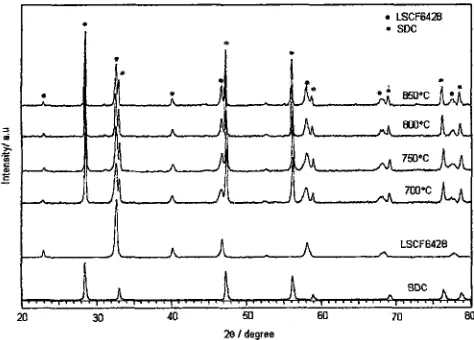
Fig. 2 shows the XRD patterns of the LSCF-SDCC composite
powders calcined at different temperatures. The LSCF-SDCC powders exhibited two main structure phases which belong to perovskite LSCF6428 and cubic fluorite SDC. The molten carbonate in SDCC electrolyte powder exists as an amorphous phase and does not influence the phase of the pure SDC. Therefore, only peaks related to SDC and LSCF6428 were observed from XRD for the composite cathode [8.21]. The XRD results confirmed that chemical reactions did not occur between LSCF and SDCC as no additional peak or secondary compound was identified. Similar findings have
[image:3.595.45.289.90.153.2] [image:3.595.132.463.480.710.2]HAbd Rahmon et aL / Materiak Chemb ;try and Physics 141 (2013) 752-757 755 been observed in previous studies [12,22-241. The grain sizes of the
particles were calculated using Schemer's equation:
where
D
is the grain size (nm), I is the radiation wavelength (0.15406 nm in this case. Cu target). 0 is the diffraction angle, and Plj2 is the corrected line width at half-peak intensity.The effect of the calcination temperature on the grain size and surface area of the powders is given in Table 1. Increased calcination temperature resulted in enlarged LSCF and SDCC crystallites. The BET specific surface area decreased from 10.9 m2 g-1-6.1 m2 g-' when the calcination temperature was increased from 700 "C to 850 "C. A similar relationship between the grain size and surface area was observed by Ghouse et al. [25]. The obtained surface areas were comparable with those of other composite cathodes in a previous research [26]. The increase in grain size was due to particle growth during the calcination, which contributed to the reduction in the surface area 1271. However, the increment in the grain size of the powders was able to be controlled at nano range through the application of the high energy ball-milling process. I t has been proven by several studied that high energy ball-milling can pro- mote the breaking down of particles to a much smaller size [28.29]. The LSCF-SDCC composite cathode demonstrates good chemical compatibility as well as the appropriate grain size and surface area. Hence, this cathode can produce porous composite cathodes at low calcination temperatures [2.23,30,31] for intermediate to low temperature SOFCs.
3.2. Thermal expansion and minostructural analysis
The technical TEC values for the LSCF-SDCC composite cathodes were measured at a low temperature range (100 "C-550 "C). Calcination temperature did not significantly influence the TECs of the composite cathodes.The LSCF-SDCC composite cathodes which were calcined at 700 "C-850 "Chad TEC values between 3.0 x
lo-'
and 3.6 x A difference of less than 10% was found between the
TECs of LSCF-SDCC and SDCC electrolyte (3.36 x Mechanical
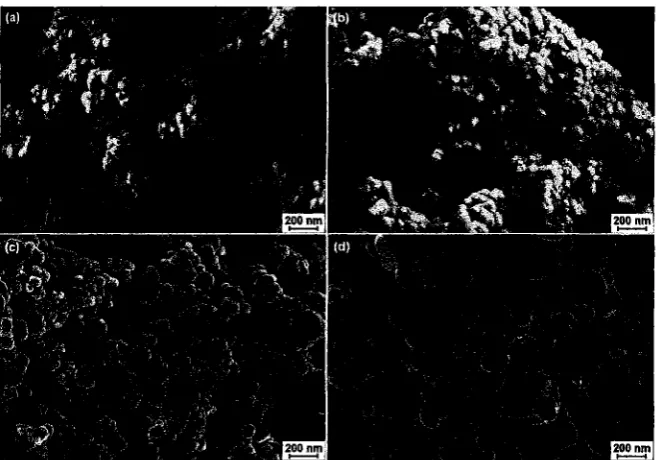
compatibility prevents delamination during processing or applica- tions at elevated temperatures 1321. Hence, the LSCF-SDCC com- posite cathode is expected to match SDCC electrolyte for the fabrication of SOFCs. Fig. 3 shows the morphology of the LSCF-SDCC composite cathode powders calcined at different temperatures. The calcination temperature significantly influenced the particle sizes of the composite cathode powders. High calcination temperatures allowed the growth of powder particles. These observed changes in particle size were consistent with the surface area data, that is. decreased surface area due to increased powder particle size [27,33]. Therefore, this study shows that low calcination temperatures can lead to the production of smaller partide sizes with higher specific surface areas.
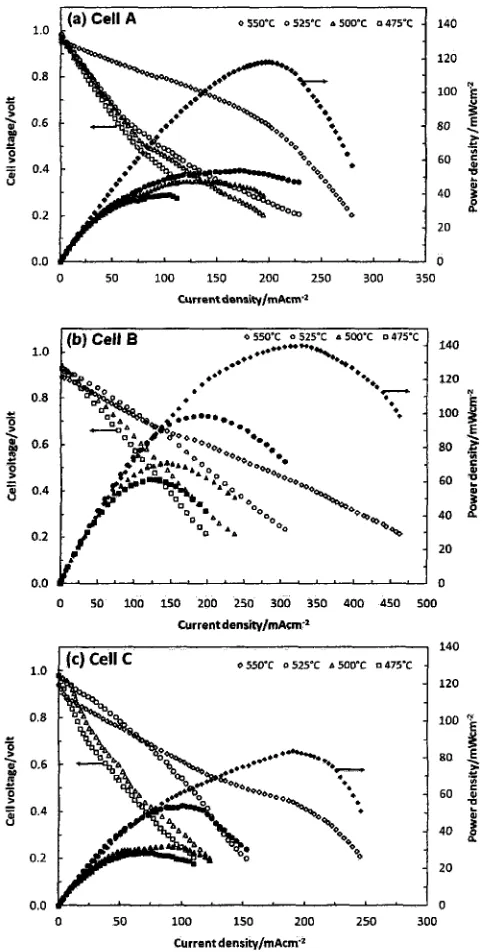
33. Performance of cells
The performance of the electrolyte-supported button cells was investigated from 475 "C to 550 "C. Hydrogen was used as fuel and air served as oxidant. Fig. 4(a)-(c) shows the plots of the cell voltage and resultant power densities as a function of the single- cell current density using LSCF-SDCC composite cathode pow- ders calcined at 700. 750, and 800 "C. The open circuit voltages (OCVs) of all button cells were lower than the theoretical values 1341 within the operating temperature. The OCVs ranging from 0.79 V to 0.93 V were comparable with the values in several pub- lications [5.17.31,35]. The low OCVs were due to the application of
ceria-based electrolytes, which perform electronic conduction in the SDC phase. Similar observations have been reported [17.35,36]. A composite electrolyte with a low density may cause gas crossover, which reduces cell performance. The existence of the carbonate phase in a composite electrolyte also lowers OCVs when volume changes occur during the transition from the molten to the solid phase of carbonate (361.
The output power and current densities for each cell inneases with an increased operating temperature. The current densities at 0.6 V for cells A. B, and C were 198.0. 201.5, and 119.3 rnA
respectively, at 550 "C. The power density at 0.6 V, 120.4 rnW cm-2 at 550 "C, was achieved by cell B, which was followed by cell A
[image:4.603.315.557.214.690.2]756 HAbd Rohman et oL / Materials Chemistry and Physics 141 (2013) 752-757
+- LSCF-SDCC (700) + LSCF.SDCC (750)
-+ KF-S0CC(SOO) 15 HZ
stability of SOFCs with this composite cathode are considered for further investigation in the future.
4. Conclusions
(117.9 m W c m 2 ) and cell C (71.8 mW ~ m - ~ ) . These results were higher than or comparable with some previous reports on single cells with LSCF composite cathode tests at equivalent temperatures, for example. 35 mW ~ r n - ~ at 550 "C and 55 mW cm-2 at 600 "C [17]. 27 mW c m 2 at 550 "C and 75 mW cm-2 at 650 "C [31],
92 mW cm-2 at 550 "C [5], 45 mW at 550 "C [16].
238 mW at 535 "C 1371, 700 mW cmP2 at 600 "C [38]. The
higher power densities acquired from cells A and B can be attributed to the finer particle sizes of the LSCF-SDCC composite cathode powders (Fig. 3). The higher surface areas of the powders (Table 1) increased the TPB within the elemode for a higher catalytic reac- tion, and the TPB increase enhanced the cell performance. Analo- gous trends have been reported in previous studies (4.39.401.
Fig. 5 illustrates the impedance data measured at 550 "C for the
different LSCF-SDCCISDCCILSCF-SDCC cells. The intercepts of the
c
>
75P:
50
25
impedance arcs with the real axis at high frequencies correspond to the ohmic resistance. R,, of the electrolyte and contact wires. The symmetrical cell with the LSCF-SDCC (800) cathode gave a higher Ro compared to the other composite cathodes at 550 "C. The
LSCF-SDCC cathodes with excellent chemical compatibility.
appropriate grain sizes, and higher surface areas were obtained by calcining composite powders between 700 and 850 "C. The influ- ence of the calcination temperature on the cathode resistances and the performance of button cells were also investigated. At 550 "C, power densities of 120.4 and 117.9 mW cmp2 (550 "C operating temperature) were obtained from a button cell using LSCF-SDCC
increment of % could be caused by the poor electrode/electrolyte
interface. In addition, all the spectra feature one dominating semicircle at low frequency, which is attributed to cathode polari- zation resistance, R,. This phenomenon indicates that diffusion and
O loo zoo soo 400 500 600 700 cathode powders calcined at 750 and 700 "C. respectively, even
z e t a when other factors were not optimized. The results signify the potential of LSCF-SDCC as a promising cathode with ceria car- Fig. 5. Impedance spectra of symmetrical cells w t h different LSCF-SDCC composite bonate composite for LTSOFCS.
cathodes measured ln air at 550 "C.
exchange of oxygen species is the main rate-limiting mechanism 12,411. The symmetrical cell with the LSCF-SDCC (750) cathode exhibited the lowest Rp (319.09 Q), followed by LSCF-SDCC (700)
and LSCF-SDCC (800) with values of 466.00
n
and 483.81respectively. The impedance results are consistent with the per- formance analysis. where the composite cathode LSCF-SDCC (750) with the lowest Rp generated the highest power density at 0.6 V and 550 "C of a button cell (Cell B).
In the present work. conductivity analysis was done for the LSCF-SDCC composite cathode, pure LSCF and SDCC electrolyte. At 550 "C, the SDCC electrolyte gave a good value of ionic conductivity which is 0.131 S cm-' as required for SOFC application [24]. As for cathodes, the LSCF-SDCC (750) composite has been identified to
provide higher conductivity, 9.53 x S cm-' compared with the
LSCF6428 (8.0 x S crr-') a t 550 "C. This result support that the electrochemical characteristics for the LSCF-SDCC55 (750) com- posite is appropriate and meets the criteria as LT-SOFC cathode material.
The performance of low-temperature cells does not only depend on the calcination or sintering temperatures of the cathode. Other factors such as the thickness of the cathode and electrolyte as well as the porosity of both components must also be optimized to achieve outstanding cell performance. Studies on the long-term
Acknowledgements
The authors acknowledge the Universiti Kebangsaan Malaysia (UKM) and the Malaysian Government for their sponsorship under
grants UKM-AP-TI<-08-2010 and UKM-RF-07-FRGS0260-2010. The
first author also acknowledges the Universiti Tun Hussein Onn Malaysia and the Malaysian Ministry of Higher Education for their support of the author's graduate studies.
References
[ I ] L Blum. U. Packbier, 1.V. Vinke, LGJ.D. Haart. Fuel Cells (2012). http://
dx.doi.org/lO.l002/fuce.201200151.
121 E.P. Murray. M.J. Sever. S.A. Barnett. Solid State lonics 148 (2002) 27-34. [3] S.C. Singhal. Solid State Ionics 135 (2000) 305-313.
141 L Song, S. Xueli. W. Zhongsheng, S. Juncai. Rare Metals 25 (2006) 213-217. [5] R. Chockalinga~n. 5. Basu. International Journal of Hydrogen Energy 36 (201 1)
14977-14983.
161 B.C.H. Steele, Solid State Ionics 86-88 (1996) 1223-1234.
[7] D. Waller, J.A. Lane, JA. IZilner, B.C.H. Steele. Solid State lonics 86-88 (1996) 767-772.
181 B. Zhu. Journal of Power Sources 114 (2003) 1-9.
19) Y. Kiros, X.R Liu, B. Zhu, Journal of New Materials for Materials for Electro- chemical Systems 4 (2001) 253-258.
[lo] C. Fu. K. Sun. N. Zhang, X Chen. D. Zhou. Electrochimica Acta 52 (2007) 4589- 4594.
Ill1 S. Lee. H.S. Song. S.H. Hyun. J. Kim. J. Moon. Journal of Power Sources 195 (2010) 118-123. . ,
[12] J. Raharjo. A. Muchtar, W.R.W. Daud, N. Muhamad. E.H. Majlan. Key Engi- neering Materials 471-472 (201 1) 179-184.
1131 Y. Zhao. D.-B. Xiong. H. Qin. F. Gao. H. Inui. B. Zhu, International Journal of Hydrogen Energy (201 1).
[I41 I.A. Amar. C.T.C. Petit. L Zhang, R. Lan, P.J. Skabara. 5. Tao, Solid State lonics 201 (2011) 94-100.
[IS] S.P. Simner. J.F. Bonnett. N.L Canfield, 1Z.D. Meinhardt. J.P. Shelton.
V.L. Sprenkle. J.W. Stevenson, Journal of Power Sources 113 (2003) 1-10. [16] Jarot Raharjo. Andanastuti Muchtar. Wan Ramli Wan Daud,
Norhamidi Muhamad. Edy Helyanto Majlan, Lao.6Sro,4Coo.2Feo.803_a-based
cathodes for SDC-carbonate composite, in: The 3rd International Conference on Fuel Cell 8 Hydrogen Technology (2011). Kuala Lumpur. Malaysia. 1171 Y. Liu. 5. Hashimoto. H. Nishino. K. Takei. M. Mori. Journal of Power Sources
164 (2007) 56-64.
1181 W.G. Wang. M. Mogensen. Solid State loniu 176 (2005) 457-462. [I91 H.A. Rahman. A. Muchtar, N. Muhamad. H. Abdullah, Ceramics International
38 (2012) 1571-1576.
[20] L. Fan. M. Ulen, C. Wang, B. Zhu, International Journal of Hydrogen Energy 37 (2012) 19388-19394.
[21] L. Zhang, R Lan. A. Kraft. S. Tao. Electrochemistly Communications 13 (2011) 582-585.
[22] HA. Rahman, A. Muchtar. N. Muhamad. H. Abdullah. Huda Abdullah. Key Engineering Materials 471-472 (2011) 268-273.
[23] Q. Xu. D.-p. Huang, F. Zhang, W. Chen. M. Chen. H.-x. Liu. Journal of Alloys and Compounds 454 (2008) 460465.
(241 B. Zhu. X. Liu. P. Zhou. X. Yang. Z. Zhu, W. Zhu. Electrochemishy Communi- cations 3 (2001) 566-571.
1251 M. Ghouse. Y. Al-Yousef, A Al-Musa. M.F. Al-Otaibi, International Journal of Hydrogen Energy 35 (2010) 9411-9419.
[image:5.595.47.283.65.215.2] [image:5.595.304.550.360.728.2]HAbd. Rahman et aL / Maten'als Chemistry and Physics 141 (2013) 752-757 757
1271 MN. Rahaman. Ceramic Processing and Sintering, second ed.. Marcel Dekker. New York, 2003.
128) D. Gao, J. Zhao, W. Zhou. R. Ran, Z Shao, Journal of Membrane Science 366 (2011) 203-211.
[29] M. Wang. K-D. Woo. C.-G. Lee. Energy Conversion and Management 52 (201 1) 1589-1592.
1301 V. Dusastre, JA. Kilner. Solid State Ionics 126 (1999) 163-174.
(311 J. Zhang.Y.Ji. H. Gao. T. He. J. Liu. Journal of Alloys and Compounds 395 (2005) 322-325.
[32] M. Letilly, A.LG.L Salle, Y. Piffard. M. Caldes, M. Marrony. 0. Joubert. Physi- cochemical compatibility study of Nd2NiO4, LSM and LSCF cathode materials with BIT07 electrolyte for SOFC, in: Fundamentals and Developments of Fuel Cells Conference, ZSW Publications. Nancy. France. 2008.
[33] Y.-M. Kim, 5.-W. Baek.J. Bae. Y.-S. Yoo, Solid State Ionics 192 (2011) 595-598.
1341 J.W. Fergus. R. Hui. X. Li. D.P. Wilkinson. J. Zhang. Solid Oxide Fuel Cells Ma- terials Properties and Performance. CRC Press. New York, 2009.
[35] Y.J. Leng, S.H. Chan. S.P. Jiang, KA. Khor, Solid State lonics 170 (2004) 9-15. 136) N. Zuo. M. Zhang. Z Mao. Z Gao. F. Xie. Journal of the European Ceramic
Society 31 (2011) 3103-3107.
[37] S. Zha. J. Cheng, Q. Fu, G. Meng. Materials Chemistry and Physics 77 (2002) 594-597.
[38] F. Han. R. Miicke. T.V. Gestel. A Leonide. N.H. Menzler. HP. Buchkremer. D. Stijver. Journal of Power Sources 218 (2012) 157-162.
[391 L BaquC. A Caneiro. M.S. Moreno, A. Serquis. Electrochemistry Communica- tions 10 (2008) 1905-1908.
[40] F. Tietz. A Mai. D. Stover, Solid State Ionics 179 (2008) 1509-1515. [41] H. Xiong. B.K. Lai. A.C Johnson. 5. Ramanathan. Journal of Power Sources 1 93