Journal of Chemical and Pharmaceutical Research, 2016, 8(6):463-467
Research Article
CODEN(USA) : JCPRC5
ISSN : 0975-7384
Walking Robot Stability Based on Inverted Pendulum Model
Zhen Chen
1and Xinya Chen
2*1Department of Electronic and Communication Engineering, Henan Institute of Technology, Xinxiang, 453003,
China
2
Department of Mechanical and Electrical Engineering, Henan Institute of Technology, Xinxiang, 453003, China _____________________________________________________________________________________________
ABSTRACT
A new kind of quadruped-imitating walking robot is designed, which is composed of a body bracket, leg brackets and walking legs. The walking leg of the robot is comprised of a first swiveling arm, a second swiveling arm and two striding leg rods. Each rod of the walking leg is connected by a rotary joint, and is directly controlled by the steering gear. The walking motion is realized by two striding leg rods alternately contacting the ground. Three assumptions are put forward according to the kinematic characteristics of the quadruped-imitating walking robot, and then the centroid equation of the robot is established. On this basis, this paper simplifies the striding process of the quadruped-imitating walking robot into an inverted pendulum model with a constant fulcrum and variable pendulum length. According to the inverted pendulum model, the stability of the robot is not only related to its centroid position, but also related to its centroid velocity. Takes two typical movement cases for example, such as walking on flat ground and climbing the vertical obstacle, the centroid position, velocity curves of the inverted pendulum model are obtained by MATLAB simulations. The results show that the quadruped-imitating walking robot is stable when walking on flat ground. In the process of climbing the vertical obstacle, the robot also can maintain certain stability through real-time control adjusted by the steering gears.
Keywords: walking robot, stability, inverted pendulum model, motion equation, simulation analysis
____________________________________________________________________________________________
INTRODUCTION
This paper studies a kind of quadruped-imitating walking robot, which walking motion is realized by two striding leg rods alternately contacting the ground. Three assumptions are put forward according to the kinematic characteristics of the quadruped-imitating walking robot. On this basis, the striding process of the robot is simplified into an inverted pendulum model with a constant fulcrum and variable pendulum length, and the factors affecting its stability are analyzed.
THE PRINCIPLE OF THE QUADRUPED-IMITATING WALKING ROBOT
The quadruped-imitating walking robot is composed of a body bracket, leg brackets and walking legs, and its principle is shown in Figure 1. Among them, the walking leg is comprised of a first swiveling arm, a second swiveling arm and two striding leg rods, wherein, all the leg rods are connected by rotary joints, and the rotary joints are driven by steering gears directly. The first swiveling arm, the second swiveling arm and the striding leg rod rotate at the speed ratio of 4:2:1, the two striding leg rods contact the ground alternately to complete the walking motion. The two striding leg rods at the same side are perpendicular. In order to control the steering of the quadruped-imitating walking robot, the leg bracket and the body bracket is connected by a rotary joint, which is driven by the steering gear.
Fig.1 The principle of the walking robot
The walking motion of the quadruped-imitating walking robot is realized by the fore and rear striding leg rods contact the ground alternately, so the centroid position of the robot is changing. Considering that the walking process of the quadruped-imitating walking robot is periodic, so takes one striding process for stability analysis.
A complete walking period includes two phases: four-leg supporting phase and two-leg supporting phase. The stability of the four-leg support phase is well, but the stability of the two-leg support phase is poor, so only the two-leg support phase is studied.
According to its kinematic characteristics, three assumptions are put forward. 1) The mass of each rod is concentrated in its centroid;
2) The contact process between the striding leg rod and the ground is realized by a rotation around a fulcrum, and the slippage is ignored;
3) Only consider about robots’ movement in the vertical and fore-and-aft direction, and ignore the movement in the left-right direction.
As shown in Figure 2, according to the motion principle of the quadruped-imitating walking robot, in accordance with the right-hand rule to establish its coordinate system, the touchdown point of right striding leg rod is defined as the coordinate origin O, the forward direction is X-direction and the vertical direction is Z-direction. Oi represents
the centroid of the rod i, i = 1, 2, …19, wherein, 1 and 11 are the first swiveling arms; 2 and 12 are the second swiveling arms; 3, 4, 13 and 14 are the striding leg rods; 5, 6, 7, 8, 15, 16, 17 and 18 are feet at the end of the striding leg rods, which are rubber and their mass are ignored; 9 and 19 are leg brackets; 10 is thebody bracket. (xi,
Fig.2 The coordinate system of the walking robot
According to the inverted pendulum model of the robot mentioned above, the position and velocity of the centroid can be simulated by using MATLAB software, and the simulation parameters of the robot are shown in table 1.
Table.1 Simulation parameters
Parameter name Symbol Value
The length of the first
l1 0.05 m swiveling arm
The half-length of the second
l2 0.08 m swiveling rod
The half-length of the striding
l3 0.07 m leg rod
The length of the leg bracket l4 0.225 m The length of the body
l5 0.45 m bracket
The angular velocity of the
ω 12 rpm
first swiveling arm
As the robot walks, the angle becomes smaller, and the distance between the centroid and the origin O decreases gradually, so the stability is pretty good.
[image:4.595.204.403.205.353.2]The stability of the quadruped-imitating walking robot is also related to the velocity of the centroid. The velocity curve of the centroid in the X-direction can be obtained by MATLAB simulation, as shown in Figure 5. When the centroid of the robot is on the negative half X-axis, the velocity of the centroid in X-direction increases to the maximum of 0.0465m/s rapidly, and then decreases gradually. When the centroid of the robot is moving to the above of the origin O, its velocity decreases to the minimum of 0.0345 m/s. In this process, the velocity of the centroid is positive, that is, the robot is moving towards the opposite direction of the robot trends to fall down, so the stability of the robot is good in this process.
Fig.4The velocity curve of the centroid in the X-direction
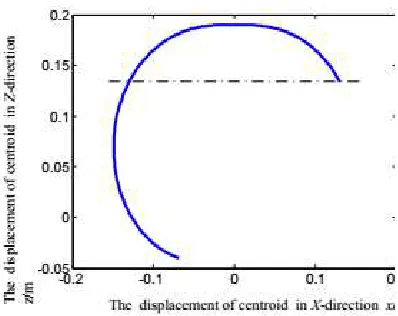
Fig 5.The centroid displacement curve of the robot when climbing the vertical obstacle
When the centroid of the robot is on the positive half X-axis, the velocity of the centroid in X-direction increases to the maximum of 0.0465m/s gradually, and then decreases rapidly, and the velocity of centroid is positive all the time. In this process, the two rear striding leg rods are moving on the positive half X-axis, that is, they are moving from origin O toward touchdown point A. According to the coordinate system shown in Figure5, the displacement curve of the end point of the rear striding leg rod can be obtained as shown in Figure 6 The displacement of the end point of the rear striding leg rod in X-direction changes from -0.16m to0.259m, and in Figure 5, the robot’s centroid position changes from 0 to 0.130m. That is, the centroid is on the left of the touchdown point A.
CONCLUSION
According to the kinematic characteristics of the quadruped-imitating walking robot, the striding process of the robot is simplified into an inverted pendulum model with a constant fulcrum and variable pendulum length, and the factors affecting its stability are analyzed.
[image:4.595.204.403.386.544.2]opposite to the direction of the tumble tendency of the robot, then the stability of the robot is better.
2)Through the analysis of the centroid position and velocity of the robot based on the inverted pendulum model, it is proved that the stability of the robot walking on flat ground is better than that climbing the vertical obstacle. In the process of climbing the vertical obstacle, the robot can also maintain its stability through real-time adjustment of the steering gears.
REFERENCES
[1]TianHai-bo, Fang Zong-de, Zhou Yong, ROBOT, 32(1), 2009,159-165.
[2]Sheng Tao, Wang Jian, Ma Hong-xu, CONTROL ENGINEERING OF CHINA, 15(6), 2008,703-706.
[3]Song Xian-xi, Modeling and Stability Analysis of Biped Robot, University of Science and Technology of China, Hefei, China, 2010.
[4]Zhong Lin-feng, Luo Xiang, Guo Chen-guang, Journal of Southeast University, 41(1), 2011, 89-94.
[5]Hu Jin-dong, Liu Guo-dong, Stable walking control in whole body coordination framework for biped humanoid robot, Wang Li-quan, Wang Hai-long, Chen Xi, Xu Jun-wei, RenMeng-xuan, Journal of Central South University (Science and Technology), 45(10), 2014, 3416-3422.
[6]Vukobratovic M, Frank A, Juricic D, IEEE Transactions on Biomedical Engineering, 17(1),1970, 25-36.
[7]Wisse M, Essentials of Dynamic Walking: Analysis and Design of Two-Legged Robots, (Netherlands: TechnischeUniversiteit Delft. 2004.)
[8]Dong-Oh Kang, Yun-Jung Lee, Seung-Ha Lee, etc., A study on an adaptive gait for a quadruped walking robot under external forces, Proceedings of the IEEE International Conference on Robotics and Automation, Piscataway, NJ, USA: IEEE, 1997: 2777-2780.