Gerard Higgins,1, 2 Weibin Li,3, 4 Fabian Pokorny,1 Chi Zhang,1 Florian Kress,2 Christine Maier,2 Johannes Haag,2 Quentin Bodart,1 Igor Lesanovsky,3, 4 and Markus Hennrich1
1Department of Physics, Stockholm University, 10691 Stockholm, Sweden 2
Institut f¨ur Experimentalphysik, Universit¨at Innsbruck, 6020 Innsbruck, Austria 3
School of Physics and Astronomy, University of Nottingham, Nottingham, NG7 2RD, United Kingdom 4Centre for the Mathematics and Theoretical Physics of Quantum Non-equilibrium Systems,
University of Nottingham, Nottingham, NG7 2RD, United Kingdom
Trapped Rydberg ions are a promising new system for quantum information processing. They have the potential to join the precise quantum operations of trapped ions and the strong, long-range interactions between Rydberg atoms. Combining the two systems is not at all straightforward. Ry-dberg atoms are severely affected by electric fields which may cause Stark shifts and field ionization, while electric fields are used to trap ions. Thus, a thorough understanding of the physical proper-ties of Rydberg ions due to the trapping electric fields is essential for future applications. Here we report the observation of two fundamental trap effects. First, we investigate the interaction of the Rydberg electron with the trapping electric quadrupole fields which leads to Floquet sidebands in the excitation spectra. Second, we report on the modified trapping potential in the Rydberg state compared to the ground state which results from the strong polarizability of the Rydberg ion. By controlling both effects we observe resonance lines close to their natural linewidth demonstrating an unprecedented level of control of this novel quantum platform.
PACS numbers: 32.80.Ee, 37.10.Ty, 32.70.-n, 32.60.+i
Trapped ions are one of the most mature implementa-tions of a quantum computer. The trapped ion approach has set several benchmarks with qubit lifetimes up to minutes [1], entanglement operations with error proba-bilities smaller than 10−3 [2, 3], and with up to 14 en-tangled qubits [4]. Trapped ions also assume a leading role in the implementation of quantum algorithms [5–8], quantum error correction [9–11], and quantum simula-tions [12–15].
The standard method to realize quantum information processing with trapped ions uses the common motion for entanglement operations between the ion qubits [16]. A current limitation of trapped ion quantum computa-tion is the limited storage capacity as it becomes more difficult to perform entanglement operations in large ion crystals due to the increasingly complex motional mode structure. Possible schemes to reach larger quantum sys-tems include segmented ion traps [17], ion-photon net-works [18], and, trapped Rydberg ions [19, 20].
Trapped Rydberg ions are a novel quantum system. Here, the outermost electron of an ion is excited into Rydberg states far away from the atomic core. Pairs of Rydberg ions are envisaged to couple strongly via electric dipole-dipole interaction. Quantum gates using Rydberg interactions may be realized independently of the ionic vibrational modes [21], thus Rydberg ions may be used in larger ion crystals for entanglement operations [19, 22]. A similar entanglement method has been demonstrated with neutral atoms [23–25]. In this sense trapped Ryd-berg ions promise to join the advantages of both tech-nologies: they combine the strong dipolar interaction be-tween Rydberg atoms with the precise quantum control and long storage times of trapped ions.
Combining these systems is by no means trivial. The
trapping electric fields will need to stay active while ex-citing ions to Rydberg states, else the strong Coulomb re-pulsion will quickly push the ions apart. Rydberg atoms, however, are extremely sensitive to electric fields which cause Stark shifts and may even ionize the Rydberg tron. In neutral Rydberg atom experiments any elec-tric fields are carefully compensated and so it seems at best far-fetched to excite an ion trapped in strong electric fields to a Rydberg state. Remarkably, trapped Rydberg ions have been realized [26] using single-photon excita-tion of 40Ca+ ions with vacuum ultraviolet laser light at 122nm. Also, selective manipulation of the ground state was combined with optical pumping via the Ryd-berg state [27].
Here we report on a two-photon Rydberg excitation of 88Sr+ ions. The wavelengths used for Rydberg
excita-tion (243 nm and 309 nm) are significantly easier to han-dle than the vacuum ultraviolet light used before [26]. In particular, the laser photons contain significantly lower energy, thus no surface charging of the trap electrodes is observed. Also, in a two-photon excitation the lasers can be sent from opposite sides which puts the ions in an effective Lamb-Dicke regime and thus avoids Doppler broadening of the resonances. These advantages allow us to achieve an unparalleled level of control and to in-vestigate the fundamental physical effects of the trap on Rydberg ions.
Modifications of the Rydberg properties due to the strong electric fields of the Paul trap have been pre-dicted [19, 20]. One of the expected effects is that the Rydberg electron will interact with the trapping electric quadrupole fields. While Rydberg S1/2- and P1/2-states
= quantization axis transfer 674nm
repump 1092 &1033
Photomultiplier tube
cooling 422 309nm
Rydberg step 2
243nm Rydberg step 1 z
y x
(a)
5S1/2
5P1/2 6P1/2 25S1/2
422nm
1092nm
243nm 309nm
674nm i
iii
ii
4D3/2 4D5/2
(b)
24D3/2Energy
88
Sr
+ [image:2.612.94.532.54.257.2]∆
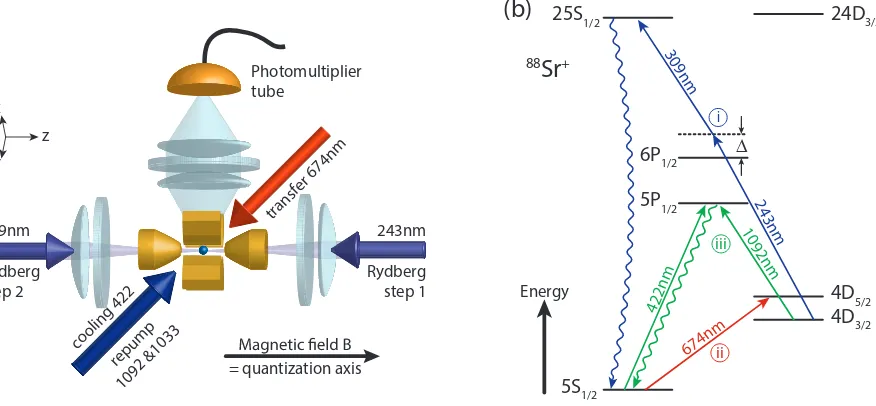
FIG. 1. Experimental setup. (a) An ion is trapped in a linear Paul trap and manipulated by laser beams for Doppler cooling and fluorescence detection (422 nm), repumping (1092 nm and 1033 nm), electron shelving (674 nm), and Rydberg excitation (243 nm and 309 nm). A magnetic field with B = (0.3564±0.0008) mT defines the quantization axis and is oriented parallel to the trap axis and the Rydberg excitation lasers. (b) Energy level scheme of88Sr+and detection sequence of successful Rydberg excitation. Before Rydberg excitation the Doppler cooled ion is initialized in the metastable 4D3/2 state via optical pumping.
(i) The Rydberg excitation lasers couple the initial 4D3/2state to a Rydberg S1/2- or D3/2-state, which then quickly decays in
multiple steps to the 5S1/2 ground state with 95% probability in<∼20µs. (ii) Rydberg-excited population which subsequently
decayed to the ground state is transferred to the metastable 4D5/2 state, allowing fluorescence detection to distinguish between
successful Rydberg excitations (population in 4D5/2→no fluorescence) and cases with no Rydberg excitations (population in
4D3/2→fluorescence) in the final step (iii). This sequence is typically repeated 100 times for each data point.
higher angular momentum states will be affected. We ex-perimentally investigate this fundamental effect, explore the different behavior of Rydberg S1/2- and D3/2-states,
and compare the experimental results to theoretical sim-ulations.
A further novel property of Rydberg-excited ions is that their trapping potential is modified compared to their ground state which can e.g. induce structural phase transitions in an ion crystal [28]. This effect is caused by the strong polarizability of the Rydberg state which be-comes polarized in the trapping electric fields. Depend-ing on the sign of the polarizability the induced dipole either weakens or increases the trapping electric field ex-perienced by the ion and thus modifies the confining po-tential. We observe a first signature of this effect investi-gating a single Rydberg resonance. In particular, we see the modified trapping potential as a line broadening for a Doppler cooled ion with a thermal population distribu-tion, as compared to a sideband cooled ion where most of the population resides in the motional ground state.
I. EXPERIMENTAL SYSTEM
A single 88Sr+ ion is confined in a linear Paul trap and excited to Rydberg S1/2- and D3/2-states by a
two-photon process as shown in Fig. 1. 243 nm laser light drives the first step from the metastable 4D3/2 state to
6P1/2, while tunable laser light at 304-309 nm excites the second step to reach Rydberg S1/2- and D3/2-states.
During Rydberg excitation the ion is confined in the electric fields of a linear Paul trap. Note that the Ry-dberg ions do not get doubly ionized by the trapping electric fields, as ions are generally held at the null of the electric quadrupole fields, at least given stray elec-tric fields leading to micromotion of the ion are properly compensated. For further details on the experimental setup and the micromotion compensation see Appendices A and B.
II. IONIC RYDBERG STATES IN A LINEAR PAUL TRAP
In the following we provide the theoretical background concerning the Rydberg excitation of a strontium ion held in a linear Paul trap. This will allow us to under-take a comparison between experimentally obtained and theoretically calculated excitation spectra. Specifically, it will enable us to identify and quantify the influence of the trapping fields on the Rydberg-ion level structure.
The electric potential of the Paul trap reads
Φ(r, t) =αcos Ωt(x2−y2)−β(x2+y2−2z2) (1)
Energy
mJ =
nD
3/2−3
2 −12 +12 +32
Static quadrupole shift
[image:3.612.56.296.56.153.2]RF quadrupole coupling
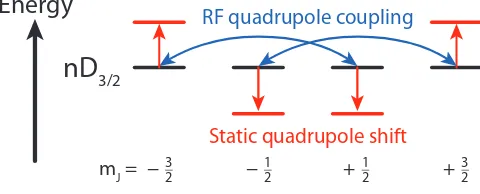
FIG. 2. Rydberg electron-quadrupole field interaction. Quadrupolar energy shifts and radio-frequency (RF) coupling due to the Rydberg electron-quadrupole field interactionHeQ
for a RydbergD3/2-state.
contrast to low-lying states, the weakly-bound Rydberg electron can exhibit a sizable coupling to the trap electric fields. To illustrate this, we write the coupling Hamilto-nianHeQ(r, t) as [20],
HeQ(r, t) =er2
−2
r
π
5β Y 0 2(θ, φ)
− r
8π
15αcos Ωt Y 2
2(θ, φ) + H.c.
#
, (2)
where θ and φ are polar and azimuthal angles with re-spect to the trap axisz, andYm
l (θ, φ) are spherical
har-monics.
For a Rydberg state|nLJmJi, withn, L, J the
prin-cipal, angular, and total angular quantum numbers, and
mJ the projection of J on the quantization axis (along
the trap z-axis), the quadrupole coupling is non-zero when J > 1/2, while it vanishes when J = 1/2 due to selection rules. This shows that there is no first order effect for Rydberg S1/2-states (L = 0 and J = 1/2).
However, the coupling becomes significant in Rydberg
DJ-states (J = 3/2 orJ = 5/2), as illustrated in Fig. 2.
Specifically, forJ = 3/2 and magnetic fieldBkzthe static part of the trap potential causes an energy shift to state |nD32mJi,
Es= 2 5(−1)
|mJ|−1/2βQ
3/2. (3)
where QJ = −ehnDJ|r2|nDJidenotes the
correspond-ing quadrupole transition moment. For n 1, its ap-proximate value is QJ ≈
ea20n2
2(2Ze+1)[5n
2+ 1−3L(L+ 1)],
with core charge Ze = 2 and Bohr radius a0. From
Eq. (3) it follows that the energy shifts for |mJ| = 1/2
and |mJ| = 3/2 have the same strength but opposite
signs, as depicted in Fig. 2.
The RF dependent part of Hamiltonian (2), on the other hand, couples different Zeeman states with ∆mJ=
±2, see Fig. 2. As the RF frequency is much smaller than the fine structure splitting (Ω/2π∼MHz), we restrict the coupling to within the same Zeeman manifold (for states with identical quantum numbers n, L and J). The RF
dependent part of Eq. (2) then assumes the form
HRF= ¯hCcos Ωt 3/2
X
mJ=1/2
|nLJ(mJ−2)ihnLJmJ|+ H.c.
,
where the constant C = −2QJα/5
√
3¯h is the effective Rabi frequency of the RF field.
In the current experiment, typical trap parameters are
α≈3×10⁸Vm−2,β ≈6×10⁵Vm−2and Ω≈2π18 MHz. This yields a static frequency shift |Es|/¯h ≈ 2π43 kHz and effective Rabi frequencyC ≈2π12 MHz in the Ry-dberg state |24D32mJi. Note that the latter is
compa-rable with the RF frequency,C ∼Ω. An emerging fea-ture is that Floquet sidebands will be populated [29], as the rotating wave approximation is not applicable in the quadrupole coupling HamiltonianHRF.
All subsequent calculations of the Rydberg spectra (shown in Figs. 3 and 4) are performed with coupling Hamiltonian of the form (2). We take into account the experimental trap geometry and laser parameters (see Appendix D for the laser-ion interaction). The laser ex-citation dynamics is described through a quantum master equation.
III. RYDBERG ELECTRON-QUADRUPOLE FIELD INTERACTION
According to the previous considerations Rydberg S1/2-states are expected to not interact with the
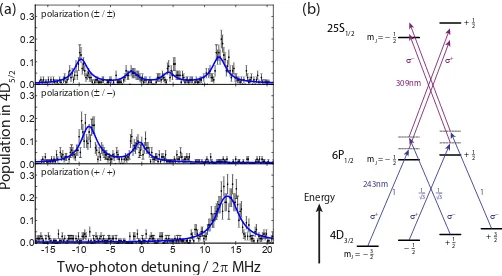
trap-ping electric quadrupole fields, thus we expect an ex-citation spectrum with a simple structure. The exper-imental results for 25S1/2 are shown in Fig. 3. Peaks in the 4D5/2 population result from the excitation of the ion to 25S1/2 Rydberg state at excitation energy (88081.84±0.04) cm−1 with respect to the ground state of Sr+ consistent with values reported in [31]. Depend-ing on the laser polarizations used, one, two or four peaks are observed. The observed resonance lines can be easily explained by the Zeeman splitting in the applied mag-netic field ofB= (0.3564±0.0008) mT where each of the four equally populated initial Zeeman levels couples to exactly one Rydberg level, see Fig. 3b. The simulation results corroborate this explanation. Relative amplitudes agree with the difference in Rabi frequencies due to the respective Clebsch-Gordan coefficients. Thus, the spec-troscopy of the Rydberg S-state can be fully explained by the Zeeman effect in the applied magnetic field. No effect of the trapping electric quadrupole fields on the S-state Rydberg electron is observed.
(a)
(b)
1 1
mJ = −3 2
−1 2
4D
3/2mJ = −1 2
6P
1/2mJ = −1 2
25S
1/2σ+ 243nm
σ−
σ+ σ−
σ+
309nm
σ−
+1 2
+3 2 +1
2
+1 2
1 √3 √31
Energy
Two-photon detuning /
2π
MHz
Popul
ation in 4D
5/2
0.0 0.1 0.2 0.3 0.0 0.1 0.2 0.3 0.0 0.1 0.2 0.3
10
0 20
-15 -10 -5 5 15
polarization (± / ±)
polarization (± / −)
[image:4.612.56.558.53.329.2]polarization (+ / +)
FIG. 3. Zeeman splitting in Rydberg S1/2-states. (a) Two-photon excitation spectra to state 25S1/2. The frequency of the
second Rydberg excitation laser at 309 nm is scanned while the frequency of the first Rydberg excitation laser at 243 nm is kept 2π160 MHz blue-detuned from the intermediate state resonance. The two-photon detuning is defined as the sum of the two UV-photon frequencies minus the frequency difference of the 25S1/2 and 4D3/2 states in the absence of a magnetic field
ω243+ω309−1¯h(E25S1/2−E4D3/2). Successful Rydberg excitation is signaled by a high probability for shelving the ion to state
4D5/2. The excitation spectrum shows four resonance peaks for both lasers in an equal superposition ofσ+andσ−polarization
(denoted as (±/±)), two peaks when the second step 309 nm laser is changed toσ−(±/−), and a single peak when both lasers are σ+ (+/+). Black dots are the measured data points with error bars due to quantum projection noise, blue lines are the
simulated Rydberg excitation spectra (Rabi frequencies Ω243= 2π0.47 MHz, Ω309= 2π49 MHz, dephasing of the Rydberg state
δω25S= 2π2.2 MHz). Off-resonant scattering from the intermediate state and spontaneous decay from the initial 4D3/2 state
each contribute to the background signal. (b) Allowed transitions for Rydberg excitation to 25S1/2. The Rydberg-excitation
beams are aligned with the direction of the applied magnetic field at the position of the ion, thus electric dipole transitions which preserve the magnetic quantum number (π-transitions) are not excited. With this constraint, only four non-degenerate transitions between the 4D3/2 and 25S1/2 Zeeman sublevels remain. As the frequency of the 309nm laser is scanned, each of
the four transitions comes into resonance at a different frequency.
[Eq. (2)] is included. Also, matching the positions of the AC-Stark shifted resonances in the simulation and the ex-perimental data allows the Rabi frequency of the 309 nm laser to be determined to within 10 %. Smaller devia-tions between the experimental data and the theoretical model may be explained by experimental imperfections and ion motion, such as imperfect polarization, motional sideband transitions, thermal broadening, and micromo-tion effects, which are not included in the simulamicromo-tion.
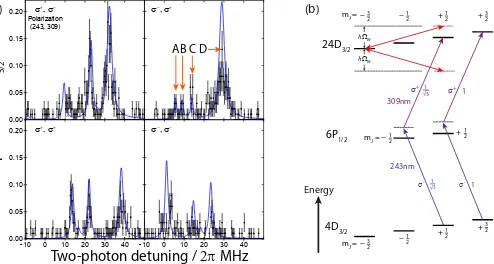
The observed resonance lines can be explained in sim-ple terms as depicted in Fig. 4b. Due to the RF cou-pling of the Rydberg electron-quadrupole field interac-tion, sidebands at ±Ω relative to neighboring Zeeman levels (∆mJ = ±2) become visible. For high Rabi
fre-quencies the lines are offset by AC Stark shifts. The res-onance frequencies can be identified by a diagonalization of the coupling Hamiltonian within the 24D3/2manifold,
see Appendix E. For instance forσ−/σ+polarizations for the first/second Rydberg excitation steps and the Rabi frequencies as in the matching simulation, we obtain four eigenfrequencies at 2π{5.8,9.2,14.1,29.0}MHz detuning with corresponding eigenstates
|Ai= +0.72|1
2,0i −0.69| 3 2,+1i
|Bi=−0.21|3
2,0i+ 0.98| 1 2,+1i
|Ci= +0.69|1
2,0i+ 0.72| 3 2,+1i
|Di= +0.97|3
2,0i+ 0.22| 1 2,+1i
where we use|mJ, ni =|24D32mJ, ni, with nbeing the
σ+, σ+
σ−, σ+
σ−, σ−
σ+, σ−
Polarization (243, 309)
0.00 0.10 0.15
0.05 0.20
0.00 0.10 0.15
0.05 0.20
Popula
tion in 4D
5/2
Two-photon detuning /
-10 0 102π
20MHz
30 40-10 0 10 20 30 40 mJ = −3
2
−1 2
4D
3/2mJ = −1 2
6P
1/224D
3/2243nm
σ+
309nm
+1 2
+3 2 +1
2
Energy
mJ = −3
2 −12 +12 +32
σ+
ℏΩRF
ℏΩRF
1
σ- 1
σ- 1
√3
1 √3
(a)
(b)
[image:5.612.66.560.52.316.2]AB C D
FIG. 4. Rydberg electron-quadrupole field interaction for Rydberg D3/2-states. (a) Excitation spectra and simulation results
for 24D3/2. The frequency of the second Rydberg excitation laser at 309 nm is scanned while the frequency of the first
Rydberg excitation laser at 243 nm is kept 2π160 MHz blue-detuned from the intermediate state resonance. The two-photon detuning is defined as the sum of the two UV-photon frequencies minus the frequency difference of the 24D3/2 and 4D3/2
states in the absence of a magnetic field, trap effects and AC Stark effects ω243+ω309−h1¯(E25S1/2−E4D3/2). The trapping
parameters are{ωaxial, ωradial 1, ωradial 2}= 2π{(254±3),(600±10),(760±10)}kHz, radio-frequency drive Ω = 2π18.153 MHz.
The experimental data (error bars due to quantum projection noise) largely match the simulation results (dark blue line) when the Rydberg electron-quadrupole field interaction is taken into account (simulation parameters Rabi frequencies Ω243=
2π0.09 MHz, Ω309 = 2π135 MHz, dephasing of the Rydberg stateδω24D = 2π4.1 MHz). (b) Energy level scheme explaining
the RF sidebands in the excitation spectra. Sidebands appear at±the RF trapping frequency Ω with respect to a neighboring Zeeman state ∆mJ =±2. The resonances are additionally shifted due to the AC Stark effect by the Rydberg excitation laser
at 309 nm.
in the top right panel of Fig. 4. In these states, the “ab-sorbing” states |mJ,−1i have negligible contributions,
since the Rydberg electron-quadrupole field interaction is further detuned, see Fig.4b.
IV. MODIFIED TRAPPING POTENTIAL IN THE RYDBERG STATE
The strong polarizability of the Rydberg state is ex-pected to modify the effective trapping potential of the ion. The change in the radial trapping potential of the Rydberg state compared to lower-lying states is [28]
Vadd=− α2+ 2β2Pn,Lρ2≈ −α2Pn,Lρ2, (4)
whereρis the radial center-of-mass coordinate of the ion, andPn,L is the polarizability of the Rydberg state with
quantum numbers n, and L. The polarizability scales as ∼ n7, thus the influence of V
add should increase for higher Rydberg states.
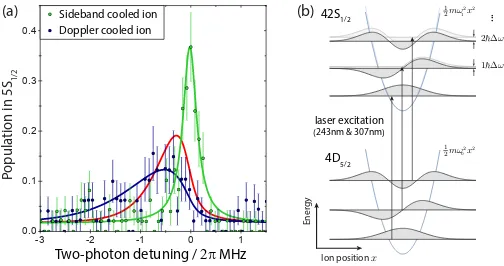
We now investigate the effect of the modified trap-ping potential by analyzing the Rydberg excitation spec-trum of state 42S1/2 (experimental excitation energy (88680.74±0.04) cm−1). The controlled preparation of the ion in a single Zeeman sublevel combined with driv-ing only a sdriv-ingle transition in the Rydberg excitation leads to the observation of a single Rydberg resonance as depicted in Fig. 5a. The details on state prepara-tion and detecprepara-tion of Rydberg excitaprepara-tion in this context are given in Appendix C. After Doppler cooling we ob-serve a linewidth of 2π(1.4±0.1) MHz, which is signifi-cantly broader than the expected natural linewidth cal-culated from quantum defect theory of 2π39 kHz. How-ever, with radial sideband cooling the observed linewidth is reduced to 2π300 kHz. This sideband cooled linewidth can be fully explained by natural and laser linewidths (≈2π200 kHz).
Popula
tion in 5S
1/2
Two-photon detuning /
02π
MHz
-3 -2 -1 1
0.4
0.3
0.2
0.0 0.1
(a)
(b)
2 x
0
2 mω
2 1
2 x
1
2 mω
2 1
42S
1/24D
5/2Ener
gy
Ion position x
1 ∆ω
2 ∆ω
laser excitation
(243nm & 307nm)...
[image:6.612.54.558.49.315.2]Doppler cooled ion
Sideband cooled ion
FIG. 5. Modified Rydberg trapping potential. (a) Observation of a single Rydberg resonance starting from the state 4D5/2mJ=−52 to the Rydberg state 42S1/2mJ=−12. The frequency of the second Rydberg excitation laser at 307 nm is
scanned while the frequency of the first Rydberg excitation laser at 243 nm is kept 2π20 MHz red-detuned from the interme-diate state resonance. The two-photon detuning is defined as the sum of the two UV-photon frequencies minus the frequency difference of the 42S1/2mJ=−12 and 4D5/2mJ=−52 statesω243+ω307−¯h1 E(42S1/2mJ=−12)−E(4D5/2mJ=−52)
. With sideband cooling we observe a single resonance with linewidth 2π(300±50) kHz mainly limited by the laser linewidths. With only Doppler cooling the resonance is shifted lower in energy, has smaller amplitude and asymmetric shape with
≈ 2π(1.4±0.1) MHz linewidth. The model curves represent a single resonance with 2π(300±50) kHz linewidth for the sideband cooled case, and a thermally broadened line with ∆ω=−2π20 kHz (red) [∆ω=−2π42 kHz (blue)] for the Doppler cooled case. No fit parameters were used in the model curve of the Doppler cooled ion resonance. The trapping parameters are
{ωaxial, ωradial 1, ωradial 2}= 2π{(872±5),(1660±30),(1720±30)}kHz, radio-frequency drive Ω = 2π18.153 MHz. (b) Energy
scheme of the motional state during Rydberg excitation. Due to the different trapping potential in the Rydberg state compared to the ground state the laser excitation is shifted out of resonance for higher motional quantum numbers.
we observe a reduced linewidth after radial sideband cool-ing (perpendicular to the laser propagation direction). This effect can be explained by the modified trapping potential in the radial directions. The polarizability of 42S1/2was calculated to beP42S= 2.9×10⁻³¹C2m2J−1. This was achieved by diagonalizing the electronic model potential [30], which yields radial wavefunctions and eigenenergies consistent with the Rydberg series previ-ously measured for Sr+ in free space [31]. As a result the radial trapping frequencies in the Rydberg state,ω1, should be smaller than the trapping frequencies in a low-lying state, ω0, by ∆ω = ω1−ω0 ≈ −2π20 kHz when the electric field gradient α = 8.3×10⁸Vm−2. Con-sequently, the motional energy levels are closer in the Rydberg state than in low-lying states, and the vibra-tional wavefunctions are modified, see Fig. 5b. When the Rydberg excitation lasers drive transitions between the low-lying state and the Rydberg state, the transition fre-quency is shifted depending on the initial motional state. In particular, the resonance frequency for phonon num-ber conserving transitions is shifted by n∆ω, when the
ion hasn radial phonons, see Fig. 5b. Since the wave-function in Rydberg and low-lying state are not perfectly orthogonal, the phonon number is not necessarily con-served during Rydberg excitation. Nevertheless, as the trapping potentials in our case are still very similar, so are the vibrational components of the wavefunctions. Thus, the Franck-Condon factors for the Rydberg excitation are approximately given by Kronecker-delta functions δn,m
and population should be mainly transferred to quan-tum states with the same motional quanquan-tum number. In principle, with sufficiently high resolution one should be able to identify individual lines separated by ∆ω with relative amplitudes due to the thermal population. In our experiment we cannot resolve the splitting for 42S1/2 since our lasers are broader than the shifts. Neverthe-less, we observe a red-shifted, asymmetrically broadened line due to thermal population of the two radial modes of motion, see Fig. 5a.
andhnyi= 9.5±0.8. The measured data in Fig. 5a seems
to deviate from this model for the theoretical value of ∆ω=−2π20 kHz. If we use ∆ω as a free fitting param-eter, we reach good agreement for ∆ω=−2π42 kHz.
The theory neglects coupling between the ionic motion in the three orthogonal directions. This may account for the difference between the theoretical prediction and the experimental results.
V. CONCLUSION
We have investigated several elementary trap effects of Rydberg ions, which will be essential for future appli-cations in quantum technologies. In particular, we have observed the effect of the Rydberg electron-quadrupole field interaction on Rydberg states with different sym-metries. While Rydberg S-states are unaffected by the Rydberg electron-quadrupole field interaction, Rydberg D-states interact with the trapping quadrupole fields. In the future the quadrupole moment of Rydberg D-states might lead to new types of interactions like quadrupole-charge, quadrupole-dipole or quadrupole-quadrupole in-teractions that could be used for directional coupling in quantum information tasks. Nevertheless, Rydberg S-states remain the less intricate system and might thus be easier to control.
Moreover, we have been able to deterministically con-trol the initial state for Rydberg excitation which has allowed us to investigate a single Rydberg resonance. The modified trapping potential in the Rydberg state has become visible as an increase in the Rydberg res-onance linewidth of a Doppler cooled ion compared to a sideband cooled ion. As predicted, the large polariz-ability of the Rydberg states in the electric fields of the Paul trap leads to different trapping potentials in low-lying and Rydberg-excited states, and to broadening of the resonances for a Doppler cooled ion. The resultant weaker or stronger localization of a Rydberg ion might be used in the future in quantum information processing to cut longer ion chains into smaller sub-units for localized quantum operations [32] or for implementing exotic inter-actions through vibrational mode shaping [33]. A side-band cooled ion instead is largely unaffected by the mod-ified trapping potential due to its precise localization. Thus, sideband cooling might be required for coherent Rydberg excitation and to avoid unwanted entanglement between the electronic state and the ion motion dur-ing Rydberg excitation. Alternatively microwave-dressed Rydberg states with zero polarizability could be used for realizing Rydberg quantum gates independently of the motional mode structure [21]. Such states would experi-ence the same trapping potential as low-lying states, thus sideband cooling would not be required. Such Rydberg gates would make trapped Rydberg ions a novel system for quantum information processing.
Appendix A: Rydberg excitation lasers
The 243 nm laser light for the first Rydberg-excitation step is produced in a commercial system, in which 970 nm infrared laser light from a diode-laser pumped tapered-amplifier system is frequency-quadrupled to 243 nm. Similar systems are used for the two-photon excitation of hydrogen [34]. Tunable 304-309 nm laser light for the second Rydberg-excitation step is produced in two stages. In the first stage two infrared photons, from a 1551 nm diode-laser fiber-amplifier system and a tun-able 998-1030 nm diode-laser pumped tapered-amplifier system, are combined by sum-frequency generation in a periodically-poled lithium niobate crystal [35, 36]. The resultant 608-618 nm laser light is frequency-doubled to produce tunable 304-309 nm laser light, which covers the wavelength range for excitation of Rydberg states from principal quantum number n=24 up to the second ion-ization threshold. The first Rydberg-excitation laser is frequency stabilized to ≈2π100 kHz linewidth (in-loop estimate) by locking the 970 nm fundamental to a refer-ence cavity. The second Rydberg-excitation laser is fre-quency stabilized also to≈2π100 kHz linewidth (in-loop estimate) by referencing 608-618 nm laser light to a cavity and applying feedback to the 998-1030 nm fundamental laser.
The lasers are sent from opposite sides along the trap axis. The counter-propagating beams significantly re-duce thermal effects in the two-photon Rydberg excita-tion. The effective Lamb-Dicke parameter for the two-photon transition is η = 0.044 at an axial trapping fre-quency of ωz = 2π872 kHz. Thus, after Doppler
cool-ing the ion resides within the Lamb-Dicke regime and Doppler broadening can be neglected.
The Rydberg-excitation lasers are sent through hydrogen-loaded, single-mode photonic crystal fibers. Such fibers offer laser mode cleanup and stable beam pointing while resisting ultraviolet solarization [37]. The lasers are focused by two commercial achromat lenses which image the 10µm diameter fiber core with unity magnification onto the ion. The laser beams are sent through holes in the end-cap electrodes and up to 120 nW (16.8 mW) of 243 nm (309 nm) laser light is focused to (5.1±0.8)µm ((6.8±1.7)µm horizontally, (4.9±1.0)µm vertically) beam waist at the position of the ion.
Appendix B: Ion trap
The ion is confined in a macroscopic linear Paul trap with titanium electrodes in a sapphire mount. The trap consists of four blade electrodes for radial con-finement and two end-cap electrodes with optical ac-cess holes for axial confinement. Since Rydberg atoms may be extremely sensitive to electric fields (polarizabil-ityPn ∼ n7) with nthe principal quantum number of
ef-fects of the fields to the stability of Rydberg ions. Using the “cross-correlation” and the “resolved sideband” tech-niques [38, 39] micromotion is minimized and the resid-ual electric field at the position of the ion is estimated to be (3+12−3 ) Vm-1. The trap electrodes are electroplated in gold (work function≈5.3 eV) to avoid the emission of photoelectrons if ultraviolet laser light hits the electrode surfaces (243 nm photons carry 5.1 eV energy). Photo-electron emission causes time-varying stray electric fields and thus worsens the residual electric field at the ion posi-tion. Due to the gold-coating, the micromotion compen-sation parameters do not change over weeks of working with the ultraviolet Rydberg-excitation lasers.
Appendix C: State preparation and detection of a single Rydberg resonance
A single isolated Rydberg resonance is accessible in the Rydberg excitation from the initial state 4D5/2 to the Rydberg state 42S1/2. This excitation scheme is in-teresting from a quantum information perspective, since 4D5/2may be used together with the 5S1/2 ground state to store an optical qubit. The Rydberg excitation could be used for entanglement operations between two such optical qubits.
For state preparation, a Doppler (or sideband) cooled ion is initialized in the 4D5/2mJ =−52 Zeeman sublevel.
First any population in 4D5/2 is returned to the ground state using the 1033 nm “repump” laser and the ion is Doppler cooled. The 674 nm “qubit” laser, which drives the 5S1/2↔4D5/2 transition, has a narrow linewidth (<2π600 Hz) which allows transitions between specific Zeeman sublevels to be individually addressed. By al-ternately driving the 5S1/2 mJ= +12→4D5/2mJ=−32 transition and removing population from 4D5/2using the 1033 nm “repump” laser, population may be optically pumped to the 5S1/2 mJ=−12 Zeeman sublevel. Next population is transferred from the initial 5S1/2 Zeeman sublevel to a specific 4D5/2 Zeeman sublevel using the narrow 674 nm “qubit” laser. The fluorescence detection lasers are then turned on to check whether the population transfer was successful.
The detection of successful Rydberg excitation from initial state 4D5/2is simpler than for 4D3/2, as the initial
state 4D5/2 can be directly distinguished from the final state 5S1/2 by fluorescence detection without any need for additional shelving pulses. The Rydberg excitation and detection sequence is as follows. (i) Both Rydberg lasers are turned on, coupling 4D5/2mJ=−52 via the in-termediate state 6P3/2mJ=−32to 42S1/2mJ =−12.
Ac-cording to quantum defect theory calculations 95% of the population in 42S1/2 quickly decays to the 5S1/2 ground state. (ii) Finally fluorescence detection is used to dis-tinguish between successful Rydberg excitations (popula-tion in 5S1/2→fluorescence) and cases with no Rydberg excitation (population in 4D5/2→no fluorescence).
Appendix D: Laser-ion interaction Hamiltonian
The Hamiltonian used to simulate the laser-induced two-photon transition to Rydberg S- and D-states includ-ing the magnetic field-induced Zeeman effect is [19–21],
H =He+HeQ(r, t) +HB+HL (D1)
He=
X
L
εL|LihL|, (D2)
HB=−
e
2mec
|Bz|(Lz+ 2Sz), (D3)
HL=
X
j
−er·ˆjEjcos(kj·R−ωjt), (D4)
where He, HeQ(r, t) = −eΦ(r, t), HB and HL stand for the Hamiltonian for the valence electron, Rydberg electron-quadrupole field coupling, Zeeman effect and laser-electron interaction. In the Hamiltonian,randme are the position and mass of the electron,Rthe center-of-mass position of the ion, andLthe multi-index quantum numberL={n, L, J, mJ}. εL is the energy in the elec-tronic state|Li. eand c are the elementary charge and speed of light in vacuum. Bz is a static magnetic field
parallel to thez-axis. Sz and Lz are thez-components
of the spin and angular momentum operators. Ej and
ˆ
jare the electric field and polarization of thej-th laser,
whose wave vector and frequency arekj andωj.
In the experiment, the first laser couples low-lying states |4D3
2mJi (denoted by |gmJi) and |6P
1
2mJi
(de-noted by|emJi) and the second laser couples the state
|6P12mJi and Rydberg state |RmJi. We neglect the
sideband transitions, as the two lasers are counter-propagating and the effective Lamb-Dicke parameterη <
0.1. Using the relevant electronic states as bases, the laser-ion interaction can be expressed as
HL=
X
M
¯
hΩ1,Mcosω1t|emJihgm0J|
+ ¯hΩ2,Mcosω2t|RmJihem0J|+ H.c
, (D5)
whereM={mJ, m0J} is a two-index number, and Rabi
frequencies Ω1,M=−eE1hemJ|r·ˆ1|gm0Ji/¯hand Ω2,M=
−eE2hRmJ|r·ˆ2|em0Ji/¯hdepend on respective electronic
states and laser polarization.
It shall be pointed out that both micromotion and the trap field mediated Rydberg electron-center of mass cou-pling are relatively weak [19, 20, 28]. Both effects are not experimentally resolved for low lying Rydberg states
Appendix E: Spectra of the Rydberg24D3/2 state
Here we provide a simple theory to explain the spectra shown in Fig. 4a. First, we note that electronic states will be completely specified once laser polarizations are given. This allows us to omit the labeling of the quan-tum numbermJ in the electronic low-lying states. The
two Rydberg states that are coupled by the quadrupole fields will be labeled by |R1i and |R2i for convenience. Upon applying rotating-wave approximations to the laser induced transitions, the Hamiltonian to describe the Ry-dberg excitation dynamics [see Eq. (D1)] becomes
HD= ¯h∆e|eihe|+
X
j
¯
h∆j|RjihRj|+HRF (E1)
+ ¯h
2 [Ωl|eihg|+ Ωu|R1ihe|+ H.c],
where we have assumed that the polarization is cho-sen such that state |ei couples to Rydberg state |R1i. ∆e= (Ee−Eg)/¯h−ω1and ∆j = (Ej−Eg)/¯h−ω1−ω2 (j = 1,2) give detuning of the electronic transition with respect to the laser frequencies, where the energy
Es=εs+E( B)
s (s=g, e,1,2) takes into account of both
the electronic energyεsand Zeeman shift E( B)
s .
As|∆e|is typically larger than other quantities in the
Hamiltonian, we can adiabatically eliminate state |ei, which yields
HD≈ −
¯
hΩ2 l 4∆e
|gihg|+ ¯h
∆1− Ω 2 u 4∆e
|R1ihR1|
+ ¯h∆2|R2ihR2|+ ¯
h
2 [Ω
0|R
1ihg|+ H.c.]
+HRF, (E2)
where Ω0 = −ΩlΩu/2∆e is the two-photon Rabi
fre-quency. Using the experimental parameters, we find that Ω2
u/4∆e ∼ 2π10 MHz and Ω0 ∼ 2π10 kHz while
|Ω2
l/4∆e|is in the sub-kHz range, which can be neglected.
We proceed by expanding the Rydberg states in terms of Floquet states|Rj, ki(k= 0,±1, . . .), wherekdenotes
quadrupolar excitations of the RF field. To explain the main peaks in Fig. 4, we only need to take into account
transitions|R1,0i → |R2,±1i, i.e. by absorbing or emit-ting one quadrupolar RF excitation. Eq. (E2) becomes
HD≈¯h∆1
X
j
|RjihRj|+
¯
h
2[Ω
0|R
1ihg|+ H.c.] +HF,
(E3)
where
HF=−
¯
hΩ2 u 4∆e
|R1ihR1|+ (E2(B)−E (B)
1 )|R2ihR2|
+X
k
k¯hΩ|R2, kΩihR2, kΩ|
+ ¯hC
2 [|R2,ΩihR1|+|R2,−ΩihR1|+ H.c.]. (E4) Hamiltonian HF is the key result. The eigenenergy of
HFdetermines the peaks shown in Fig. 4a. One example for theσ−/σ+ transition is given in Section III.
ACKNOWLEDGMENTS
We thank Michael Niedermayer for electroplating the trap electrodes, Hsiang-Yu Lo and Jonathan Home for advice on the second harmonic generation of 618 nm light, Yves Colombe for guidance with the fabrication of photonic crystal fibers for UV light, and Ana Pre-dojevi´c for feedback on the manuscript. The experi-ment started at the University of Innsbruck and moved in 2015 to Stockholm University. Some of the experi-mental results were first observed in Innsbruck and have been repeated and confirmed at Stockholm University. The research leading to these results has received fund-ing from the European Research Council under the Eu-ropean Union’s Seventh Framework Programme / ERC Grant Agreement No. 279508 (QuaSIRIO). IL acknowl-edges funding from the European Research Council under the European Union’s Seventh Framework Programme (FP/2007-2013) / ERC Grant Agreement No. 335266 (ESCQUMA) and the H2020-FETPROACT-2014 Grant No.640378 (RYSQ). WL acknowledges access to the Uni-versity of Nottingham HPC Facility.
[1] D. J. Wineland, C. Monroe, W. M. Itano, D. Leibfried, B. E. King, and D. M. Meekhof, “Experimental issues in coherent quantum-state manipulation of trapped atomic ions,” J. Res. Natl. Inst. Stand. Tech. 103, 259 (1998), quant-ph/9710025.
[2] C. J. Ballance, T. P. Harty, N. M. Linke, M. A. Sepiol, and D. M. Lucas, “High-fidelity quantum logic gates us-ing trapped-ion hyperfine qubits,” Phys. Rev. Lett.117, 060504 (2016).
[3] J. P. Gaebler, T. R. Tan, Y. Lin, Y. Wan, R. Bowler, A. C. Keith, S. Glancy, K. Coakley, E. Knill, D. Leibfried, and D. J. Wineland, “High-fidelity universal gate set for
9
Be+ ion qubits,” Phys. Rev. Lett.117, 060505 (2016). [4] Thomas Monz, Philipp Schindler, Julio T. Barreiro,
Michael Chwalla, Daniel Nigg, William A. Coish, Max-imilian Harlander, Wolfgang H¨ansel, Markus Hennrich, and Rainer Blatt, “14-qubit entanglement: Creation and coherence,” Phys. Rev. Lett.106, 130506 (2011). [5] J. Chiaverini, J. Britton, D. Leibfried, E. Krill, M. D.
[6] K. A. Brickman, P. C. Haljan, P. J. Lee, M. Acton, L. Deslauriers, and C. Monroe, “Implementation of Grover’s quantum search algorithm in a scalable system,” Phys. Rev. A72, 050306 (2005).
[7] S. Debnath, N. M. Linke, C. Figgatt, K. A. Landsman, K. Wright, and C. Monroe, “Demonstration of a small programmable quantum computer with atomic qubits,” Nature536, 63–66 (2016).
[8] Thomas Monz, Daniel Nigg, Esteban A. Martinez, Matthias F. Brandl, Philipp Schindler, Richard Rines, Shannon X. Wang, Isaac L. Chuang, and Rainer Blatt, “Realization of a scalable Shor algorithm,” Science351, 1068–1070 (2016).
[9] J. Chiaverini, D. Leibfried, T. Schaetz, M. D. Barrett, R. B. Blakestad, J. Britton, W. M. Itano, J. D. Jost, E. Knill, C. Langer, R. Ozeri, and D. J. Wineland, “Re-alization of quantum error correction.” Nature432, 602– 605 (2004).
[10] Philipp Schindler, Julio T. Barreiro, Thomas Monz, Vol-ckmar Nebendahl, Daniel Nigg, Michael Chwalla, Markus Hennrich, and Rainer Blatt, “Experimental repeti-tive quantum error correction,” Science 332, 1059–1061 (2011).
[11] D. Nigg, M. M¨uller, E. A. Martinez, P. Schindler, M. Hennrich, T. Monz, M. A. Martin-Delgado, and R. Blatt, “Quantum computations on a topologically en-coded qubit,” Science345, 302–305 (2014).
[12] A. Friedenauer, H. Schmitz, J. T. Glueckert, D. Porras, and T. Schaetz, “Simulating a quantum magnet with trapped ions,” Nat Phys4, 757–761 (2008).
[13] Julio T. Barreiro, Markus M¨uller, Philipp Schindler, Daniel Nigg, Thomas Monz, Michael Chwalla, Markus Hennrich, Christian F. Roos, Peter Zoller, and Rainer Blatt, “An open-system quantum simulator with trapped ions,” Nature470, 486–491 (2011).
[14] B. P. Lanyon, C. Hempel, D. Nigg, M. M¨uller, R. Ger-ritsma, F. Z¨ahringer, P. Schindler, J. T. Barreiro, M. Rambach, G. Kirchmair, M. Hennrich, P. Zoller, R. Blatt, and C. F. Roos, “Universal digital quan-tum simulation with trapped ions,” Science 334, 57–61 (2011).
[15] R. Islam, C. Senko, W. C. Campbell, S. Korenblit, J. Smith, A. Lee, E. E. Edwards, C.-C. J. Wang, J. K. Freericks, and C. Monroe, “Emergence and frustration of magnetism with variable-range interactions in a quan-tum simulator,” Science340, 583–587 (2013).
[16] J. I. Cirac and P. Zoller, “Quantum computations with cold trapped ions,” Phys. Rev. Lett.74, 4091 (1995). [17] D. Kielpinski, C. Monroe, and D. J. Wineland,
“Ar-chitecture for a large-scale ion-trap quantum computer,” Nature417, 709–711 (2002).
[18] C. Monroe, R. Raussendorf, A. Ruthven, K. R. Brown, P. Maunz, L.-M. Duan, and J. Kim, “Large-scale modu-lar quantum-computer architecture with atomic memory and photonic interconnects,” Phys. Rev. A 89, 022317 (2014).
[19] Markus M¨uller, Linmei Liang, Igor Lesanovsky, and Pe-ter Zoller, “Trapped Rydberg ions: from spin chains to fast quantum gates,” New J. Phys.10, 093009 (2008). [20] F Schmidt-Kaler, T Feldker, D Kolbe, J Walz, M M¨uller,
P Zoller, W Li, and I Lesanovsky, “Rydberg excitation of trapped cold ions: a detailed case study,” New J. Phys.
13, 075014 (2011).
[21] Weibin Li and Igor Lesanovsky, “Entangling quantum
gate in trapped ions via Rydberg blockade,” Appl. Phys. B114, 37–44 (2014).
[22] D. Jaksch, J. I. Cirac, P. Zoller, S. L. Rolston, R. Cˆot´e, and M. D. Lukin, “Fast quantum gates for neutral atoms,” Phys. Rev. Lett.85, 2208–2211 (2000).
[23] T. Wilk, A. Ga¨etan, C. Evellin, J. Wolters, Y. Miroshny-chenko, P. Grangier, and A. Browaeys, “Entanglement of two individual neutral atoms using Rydberg blockade,” Phys. Rev. Lett.104, 010502 (2010).
[24] L. Isenhower, E. Urban, X. L. Zhang, A. T. Gill, T. Henage, T. A. Johnson, T. G. Walker, and M. Saffman, “Demonstration of a neutral atom controlled-NOT quantum gate,” Phys. Rev. Lett. 104, 010503 (2010).
[25] Henning Labuhn, Daniel Barredo, Sylvain Ravets, Syl-vain de L´es´eleuc, Tommaso Macr`ı, Thierry Lahaye, and Antoine Browaeys, “Tunable two-dimensional arrays of single Rydberg atoms for realizing quantum ising mod-els,” Nature534, 667–670 (2016).
[26] T. Feldker, P. Bachor, M. Stappel, D. Kolbe, R. Ger-ritsma, J. Walz, and F. Schmidt-Kaler, “Rydberg ex-citation of a single trapped ion,” Phys. Rev. Lett.115, 173001 (2015).
[27] P. Bachor, T. Feldker, J. Walz, and F. Schmidt-Kaler, “Addressing single trapped ions for Rydberg quantum logic,” Journal of Physics B: Atomic, Molecular and Op-tical Physics49, 154004 (2016).
[28] Weibin Li and Igor Lesanovsky, “Electronically excited cold ion crystals,” Phys. Rev. Lett.108, 023003 (2012). [29] H Friedrich, Theoretical Atomic Physics, 3rd ed.
(Springer).
[30] Mireille Aymar, Chris H. Greene, and Eliane Luc-Koenig, “Multichannel Rydberg spectroscopy of complex atoms,” Rev. Mod. Phys.68, 1015–1123 (1996). [31] V. Lange, M. A. Khan, U. Eichmann, and W. Sandner,
“Rydberg states of the strontium ion,” Z. Phys. D18, 319–324 (1991), 10.1007/BF01426593.
[32] Weibin Li, Alexander W. Glaetzle, Rejish Nath, and Igor Lesanovsky, “Parallel execution of quantum gates in a long linear ion chain via Rydberg mode shaping,” Phys. Rev. A87, 052304 (2013).
[33] R Nath, M Dalmonte, A W Glaetzle, P Zoller, F Schmidt-Kaler, and R Gerritsma, “Hexagonal plaque-tte spin–spin interactions and quantum magnetism in a two-dimensional ion crystal,” New Journal of Physics17, 065018 (2015).
[34] N. Kolachevsky, J. Alnis, S. D. Bergeson, and T. W. H¨ansch, “Compact solid-state laser source for 1s-2s spec-troscopy in atomic hydrogen,” Phys. Rev. A73, 021801 (2006).
[35] A. Wilson, C. Ospelkaus, A. VanDevender, J. Mlynek, K. Brown, D. Leibfried, and D. Wineland, “A 750-mw, continuous-wave, solid-state laser source at 313 nm for cooling and manipulating trapped 9Be+ ions,” Applied
Physics B: Lasers and Optics105, 741–748 (2011). [36] Hsiang-Yu Lo, Joseba Alonso, Daniel Kienzler,
Ben-jamin C. Keitch, Ludwig E. de Clercq, Vlad Negnevitsky, and Jonathan P. Home, “All-solid-state continuous-wave laser systems for ionization, cooling and quantum state manipulation of beryllium ions,” Applied Physics B114, 17–25 (2014).
Optics Express22, 19783 (2014).
[38] D. J. Berkeland, J. D. Miller, J. C. Bergquist, W. M. Itano, and D. J. Wineland, “Minimization of ion micro-motion in a Paul trap,” Journal of Applied Physics 83,
5025–5033 (1998).