Journal of Chemical and Pharmaceutical Research, 2014, 6(5):985-989
Research Article
CODEN(USA) : JCPRC5
ISSN : 0975-7384
A novel FPGA segmentation method based on the improved ant
colony optimization
Fei Yang
School of Computer Science and Technology, Hubei
Polytechnic University, Huangshi, P. R. China
_____________________________________________________________________________________________
ABSTRACT
The performance of Field Programmable Gate Array (FPGA) is closely related with its own reasonable segmentation, and the routing of FPGA forms when different functions perform on the segmented FPGA to meet different demands. For this reason, a novel FPGA segmentation method is proposed based on the improved ant colony optimization. Experimental results suggest that the proposed approach is feasible and correct.
Key words: Field Programmable Gate Array; Segmentation Method; Ant Colony Optimization
_____________________________________________________________________________________________
INTRODUCTION
FPGA is a kind of Application Specific Integrated Circuit (ASIC). It is a kind of general user programmable device, first developed in 1984 by the Xilinx Group. FPGA and CPLD (Complicated Programmable Logic Device), both programmable logic devices, have resulted from PAL (Programmable Array Logic) and GAL (General Array Logic), et al. Compared with previous PAL and GAL, FPGA /CPLD owns bigger scale, and it can take the place of tens of or even thousands of IC chips. Such a FPGA /CPLD is actually a subsystem component. This kind of chips has been accepted by electronic engineering designers worldwide and widely applied in aerospace, communication, medical, industrial control and other fields, especially suitable for the sample development and small-lot production of products.
FPGA is flexible in construction. Its logic units, programmable interconnect and FO units are all programmable, can realize different function and meet kinds of design demand [1]. Due to its rapid speed, low consumption and wide application, FPGA is especially suitable for the design of complicated systems [2]. It can also realize dynamic allocation, reconstruction of on-line systems (changing the circuit function upon demands at different moment during the system operation to make the system own several space-related or time-related tasks), hardware softening and software hardening [3].
SEGMENTATION DESIGN OF FPGA
The Segmentation Design of FPGA is the precondition of the Routing problem [4]. The segmentation has decided the layout of modules on the chip and the location of different pins on the module, and the interconnection information among different pins provides reference for the routing through the netlist [5].
Symbol Meaning
L The number of columns for the channel
N
The average number of nets contained by each channelT
The number of tracks contained by channelsK
The maximum of segments occupied by a netD
The allowable maximum of nets with endpoints on the same column)
,
( l
x
h
The probability that net’s length isl
and its left endpoint isx
)
(l
f
The probability that net’s length isl
)
( x
g
The probability that net’s left endpoint isx
It is easy to get
∑
∑
= ==
=
L l L xl
x
h
x
g
l
x
f
l
f
1 1)
,
(
)
(
,
)
,
(
)
(
It is a FPGA that has been segmented. In the three tracks contained by the channel, the white circle represents segment points, so the first track has been segmented into two segments, the second three and the third two. Whether this kind of segmentation is reasonable or not depends on the probability that it has met the nets. The higher the probability is, the more reasonable the segmentation is.
Here is a brief description for
K
-segmentation problem.K
-segmentation design problem: givenK
T
N
L
,
,
,
andh
(
x
,
l
)
, design a kind of track segmentation to maximize the success probability ofK
-segment routing problem (that will be discussed in the next chapter). In other words, this kind of segmentation should meet nets as many as possible to completeK
-segment routing.THE PROPOSED APPROACH
This algorithm is based on the graph theory and solves FPGA from three stages, similar to the matching algorithm and minimal spanning tree. Besides, the second and third stages of the algorithm are the same as that of the matching algorithm. The following is some improvement on the first stage.
Similar to algorithms based on Kruskal, the segmentation problem is converted into one to find a forest that meets the following two special requirements in a K-partite graph: The weight sum is maximal, and any two vertexes of each tree do not belong to one part simultaneously.
The basic idea is to combine another classical algorithm (the Prim algorithm) of the minimal spanning tree with ant colony algorithms to generate an ant colony algorithm based on Prim algorithms to get better solutions.
Prim algorithms are mainly used to get the minimal spanning tree in a weighted connected simple graph.
(G
,
w
)
represents a weighted connected simple graph, then Prim algorithms proceed as below.
(1)Anyx0∈V G( ),l x( )0 =0, ( )l x = ∞ ≠(x x0),V0=
{ }
x0 , T0=x0andk=0.(2)Given∀ ∈x NG(xk−1)ΙVk−1andVk−1= −V Vk−1, if w x( k−1x)<l x( ) , take the place ofl x( ) with w x( k−1xk) .
Select xk∈Vk−1 , l x( )k =min ( ) :
{
l x x V∈ k−1}
. Suppose ek =uxk, u∈Vk−1 , so that w e( )k =l x( k) .LetVk =Vk−1U(xx), Tk =Tk−1+ek.
(3)Ifk< −v 1, turn to 2). Ifk= −v 1, stop.
However, in Prim algorithms, edges are selected based on the marking number of vertexes and whether their endpoints are selected ones or not. Two alternatives here: 1) first assign negative value to the weight of edges in the graph, and added a number (the value should be larger than the maximal absolute value of edge weights) to it, then find the minimal forest satisfying constraint 2 in the obtained graph, finally restore the original problem and get the optimal solution. 2) Modify control criteria for the algorithm.
The first stage turns into that anyx0∈V G( ),
l x
( ) 0, ( ) 0(
0=
l x
=
x x V
≠
0),
0=
{ }
x
0 ,T0 =x0andk=0. The second stage changes: given∀ ∈x NG(xk−1)ΙVk−1 and Vk−1= −V Vk−1, ifw x( k−1x)>l x( ), then take the place ofl x( )withw x( k−1xk).Select xk∈Vk−1 so that l x( k)=max ( ) :
{
l x x∈Vk−1}
. Suppose ek =uxk, u∈Vk−1 , so that w e( )k =l x( k) .LetVk =Vk−1U(xx), Tk =Tk−1+ek. The termination condition of this algorithm is the same as that of Kruskal
algorithms: no edges satisfying constraint 2 exist any more.
The improved Prim algorithm can be used to find the spanning tree with the maximal weight sum in the graph, and finally get the solution. However, the counterexample shows that neither the improved Prim algorithm nor Kruskal algorithm can obtain the optimal solution.
In a word, both Kruskal and Prim algorithms can be used to solve segmentation design of FPGA through transformation. They are so greedy that they try to add edges with maximal weights into the tree each time, so what they finally obtain is only a spanning tree with the maximal weight sum, but the desired is a forest. Therefore, they could not get the optimal solution because the selection of the first tree will influence the subsequent selections.
Ant colony algorithms can break down this deadlock. Due to their randomness, ant colony algorithms can achieve a nice result in solving TSP problems. Here, their great random search ability is combined with Prim algorithms to find the optimal solution to the problem.
In ant colony algorithms, the pheromone of ants starting from one vertex is stored in the edge, and in Kruskal algorithms, the selection of edges is only relevant with their weight value, so it is hard to combine Kruskal algorithms with ant colony algorithms.
Prim algorithms with the second improved alternative described in the above are adopted, namely obtaining the maximal tree through modifying control criteria of algorithms. First, list all candidates during the selection of each edge and label vertexes according to the labeling criteria in improved Prim algorithms, then select edges through ant colony optimization algorithms. When each ant has finished the construction of forests, ant colony optimization algorithms based on the Metropolis criterion are adopted to decide of which ant-passed edges the pheromone will be increased, and the iteration goes on until its number has reached the preset maximal one.
Since the above has analyzed the construction of
m
-partite weighted graph, the discussion here mainly focuses on how to find a forest in am
-partite weighted graph satisfying the following constraints: The weighted sum is maximal, and any two vertexes of any tree do not belong to one part simultaneously. The detailed implementation process is shown as below (relevant mathematical procedures will be shown in appendixes).Step one: initialization. As to each edge
e
ij,ζ
=
max
{ }
w
(
e
ij)
η
ij=
w
(
e
ij)
ζ
,
τ
ij=
0
.
05
(set the original pheromone concentration and visibility of each edge). Determine the ant numberm
.Step two: generate a satisfying maximal forest as to each ant through the combination of Prim algorithms and ant colony optimization algorithms.
Step three: update of pheromone.
Step four: termination conditions.
(1) Design Requirements. Network sharing platform for manufacturing resources aims to provide uniform ‘intermediary’ services for scattered manufacturing enterprises in a group, set up a bridge among each collaborative manufacturing enterprise and realize optimal utilization of manufacturing resources and information sharing. The design pf this platform should satisfy the following requirements:
dynamic management of manufacturing resources in a group and provide reliable manufacturing resource information for arranging and implementing manufacturing plans.
2) Timely publish manufacturing resource use and latest allocation situation on the internet so that related manufacturing enterprises can timely master the latest resource use conditions.
3) Users on each platform should have the communication channel on the platform.
4) Manufacturing resources owned by each member unit are covert to each non-member unit, so the platform should have good security mechanism, including validity verification for log-in and restricted use of system management function.
Development of the platform system should be able to promote sharing of various kinds of information in the group, timely know resource conditions of each enterprise, improve work efficiency and enhance harmony and consistency of decision-making.
RESULTS AND DISCUSSION
For the convenience of comparison, the instance data are obtained here through the experimental method and their parameters are the same as that in the paper.
L
=
100
(the maximal length of tracks is 100),m
=
50
(50 instance groups),n
=
50
(each instance group contains 50 instances at most). The detailed generation process of instances is: implement the following iteration as to each instance group: 1) different instance group contains different number of instances, select one number that obeys the normal distribution. 2) Randomly select the location of the left endpoint of the instance from number 1 to 99, suppose it isi
. 3) Randomly select one number from 1 to100
−
i
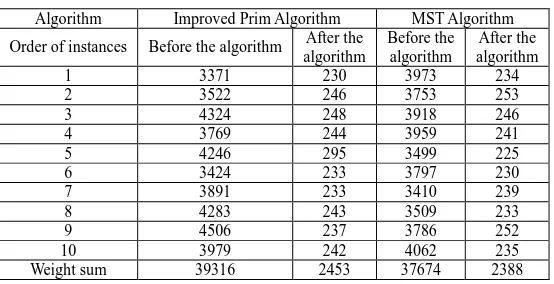
as the length of the instance. Return to step 2) after step 3) ends, and the iteration goes on until the number of generated instance is the same as that in step 1). An input instance is obtained in this way and it will be transformed into a 50-partite adjacent matrix. [image:4.595.169.446.463.605.2]The matrix is the input of the above-mentioned algorithm. After the implementation of the algorithm, edges that can be merged will be merged and the length sum of edge sets will be reduced greatly. The following is the experimental data.
Table 1 Net Length Comparisons
Algorithm Improved Prim Algorithm MST Algorithm
Order of instances Before the algorithm algorithm After the Before the algorithm algorithm After the
1 3371 230 3973 234
2 3522 246 3753 253
3 4324 248 3918 246
4 3769 244 3959 241
5 4246 295 3499 225
6 3424 233 3797 230
7 3891 233 3410 239
8 4283 243 3509 233
9 4506 237 3786 252
10 3979 242 4062 235 Weight sum 39316 2453 37674 2388
It can be seen from the comparison in Table 1 that, some data obtained here is even poorer than that of MST Algorithm, but most are better. The reason is that the moving of ants during the optimization process is stochastic. In a word, the experimental result is better.
CONCLUSION
Acknowledgements
This work was supported by the Science and Technology Research Foundation of Education Bureau of Hubei Province (No. B2013064).
REFERENCES
[1]Olawale Yakubu Adisa. Construction Management and Economics, 2010, 28(5): 509-526 [2]Shane Jennifer S. Journal of Management in Engineering, 2009, 25(4): 221-229
[3]M. Dorigo, L M Gambardella. IEEE Transaction on Evolutionary computations, 1997, 1(1): 53-66
[4]M. Dorigo, A. Colorni, V. Maniezzo. IEEE Transactions on Systems, Man, and Cybernetics, 1996, 26(1): 29-41 [5]L M Gambardella, E.D Tailard, M. Dorigo. Journal of the operational research society, 1999, 50(2), 1167-1176 [6]A. Colorni, M. Dorigo, V. Maniezzo. Belgian Journal of Operations Research, Statistics and computer Science, 1994, 34: 39-53