Munich Personal RePEc Archive
Effect of climate variables on yield of
major food-crops in Nepal -A time-series
analysis-Joshi, Niraj Prakash and Maharjan, Keshav Lall and Piya,
Luni
Graduate School for International Development and Cooperation,
Hiroshima University
March 2011
Online at
https://mpra.ub.uni-muenchen.de/35379/
1
Effect of climate variables on yield of major food-crops in Nepal
-A time-series analysis
-Joshi, Niraj Prakash (IDEC, Hiroshima University) Maharjan, Keshav Lall (IDEC, Hiroshima University) Piya Luni (IDEC, Hiroshima University)
Climate change influences crop yield vis-à-vis crop production to a greater extent in countries like Nepal where agriculture depends largely on natural circumstances. Plausible scenarios of climate change like higher temperatures and changes in precipitation will directly affect crop yields. Therefore, this study assesses the effect of observed climate variables on yield of major food-crops in Nepal, namely rice, wheat, maize, millet, barley and potato based on regression model for historical (1978-2008) climatic data and yield data for the food-crops. The yield growth rate of all the food-crops is positive. However, the growth rate for all crops, except potato and wheat, is below population growth rate during the period. Climate variables like temperature and precipitation are the important determinants of crop yields. Trend of precipitation is neither increasing nor decreasing significantly during this period. However, temperature is increasing by 0.7 0C during the period. Climate variables show some influences on the yield of these major food-crops in Nepal. Increase in summer rain and maximum temperature has contributed positively to rice yield. Also, increase in summer rain and minimum temperature has positive impact on potato yield. However, increase in summer rain and maximum temperature adversely affected the yield of maize and millet. Increase in wheat and barley yield is contributed by current trend of winter rain and temperature. Consideration of spatial variation in similar type of study in Nepal that will be helpful in identifying the region more vulnerable to climate change in terms of crop yield is highly recommended.
Keywords: Climate variables, temperature, rainfall, food-crops, Nepal
Introduction
Nepal is a developing country with majority (63.7%) of its population living under poverty (Joshi, Maharjan, & Piya, 2010; Alkire & Santos, 2010). Huge proportions of its population derive their livelihoods from farm and forest, which are highly dependent on natural phenomena. Besides, disaster prone nature of the country due to its rugged terrain, steep topography, and fragile geological conditions place Nepal among the countries having high degree of vulnerability to climate change. Such high degree of vulnerability poses threats on water resources, agriculture, forestry and biodiversity, and human (Maharjan, Joshi, & Piya, 2009). Agriculture has been a major concern in the discussions on climate change as food production is essential for sustaining and enhancing human welfare (McCarl, Adams, & Hurd, 2001; Schmidhuber & Tubiello, 2007).
Climate is a primary determinant of agricultural productivity, especially in the case of developing countries like Nepal where agriculture is basically dependent on natural circumstances against the controlled environmental condition in developed countries. Therefore, climate change would influence crop yield vis-à-vis crop production to a greater extent in developing countries. Plausible scenarios in climate change i.e., increasing temperature, changes in precipitation, climate extremes like drought, flood and landslides, and higher CO2 concentrations will directly affect crop yields. In general, temperature
2
increase will reduce yields and quality of food-crops thereby exacerbating vulnerability in food supply. Similarly, changes in precipitation patterns i.e., intensive rain concentrated in a particular month has a devastating effect on crop production (Abrol & Ingram, 1996; Adams, Hurd, Lenhart, & Leary, 1998; McCarl, Adams, & Hurd, 2001).
Despite such a high degree of vulnerability to climate change for agriculture vis-à-vis welfare in developing countries, there are limited researches conducted in case of developing countries (Boubacar, 2010; Holst, Yu, & Grun, 2010; You, Rosegrant, Fang, & Wood, 2005; Mendelsohn, 2009) and very few in the case of Nepal (Malla, 2008). The vast majority of such researches are done in developed countries (Kim & Pang, 2009; Carew, Smith, & Grant, 2009; Isik & Devadoss, 2006; Chen, McCarl, & Schimmelpfennig, 2004; Lobell & Asner, 2003; Stooksbury & Michaels, 1994). There are very limited literatures in the case of developing countries, which are going to be adversely affected by predicted climate change (Intergovernmental Panel on Climate Change, 2007; Isik & Devadoss, 2006; Lobell & Asner, 2003; Stooksbury & Michaels, 1994; Rosenzweig & Parry, 1994; Chen, McCarl, & Schimmelpfennig, 2004). Therefore, this study analyzes the effect of climate variables on yield of major food-crops in Nepal based on historical data. An understanding of the national impacts of recent climate trends on major food-crops would help to anticipate impacts of future climate changes on food self-sufficiency of the country.
Methodology
Temperature, precipitation, and solar radiation are the three most widely used climate variables to assess climate change and its impact. However, solar radiation has a closer positive correlation with maximum temperature. In general, higher solar radiation leads to a higher maximum temperature and lower solar radiation leads to a lower minimum temperature because of radiative cooling (Peng, et al., 2004). This shows the direct correlation between temperature and solar radiation. Therefore, to overcome the possible correlation among the independent variables, this study considers only temperature and precipitation. Rainfall is the most important form of precipitation in terms of meeting water requirement of agricultural crops. Daily mean air temperature is the widely used temperature variable to assess the effects of global warming on grain yield. The use of mean air temperature assumes no difference in the influence of day versus night temperature. However, the inclusion of minimum and maximum temperature in the assessment will capture differential effects of day and night temperature (Peng, et al., 2004) as well as climate extremities to some extent.
3
uncertainty on the extent of warming as well as other related changes (Intergovernmental Panel on Climate Change, 2007; Rosegrant, Ewing, Yohe, Ian Burton, & Valmonte-Santos, 2008). Thus, predictions of the yield changes in response to changes in climate variables, from regression models based on historical climatic and yield data for specific crops are relatively accurate (Boubacar, 2010; Isik & Devadoss, 2006; Lobell & Asner, 2003; Lobell & Field, 2007; Mendelsohn, Nordhaus, & Shaw, 1994; Lobell, Ortiz-Monasterio, Asner, Matson, Naylor, & Falcon, 2005). This can be done through application of production function as follows (Nicholls, 1997; Lobell & Field, 2007);
Here,
Yield is the observed trend in yield, m is the average yield change due to management and
other non-climatic factors (e.g. increased CO2), Climate is the observed trend in
temperature and rainfall, is the yield response to this trend, and is the residual error.
Detrending of the yield and climate variables and using the residuals to calculate quantitative relationships between variation in climate and yield can remove non-climatic influences such as adoption of new cultivars and changes in crop management practices (Lobell & Field, 2007; Nicholls, 1997; Lobell, Ortiz-Monasterio, Asner, Matson, Naylor, & Falcon, 2005). Detrending can be done by using the first-difference time series for yield and climate variables i.e., the difference in values from one year to the next.
Paddy, maize, millet, wheat, barley, and potato are the major food-crops of Nepal as these crops are used to meet the basic food requirement of its population (Subedi, 2003). Paddy, maize, potato and millet are the main food-crops cultivated during the summer season (from May to August), whereas wheat and barley are the main winter crops cultivated from November to February. Annex 1 shows the crop calendar of these major food-crops in Nepal.
4 Results and discussion
Trend of food-crops’ yield
[image:5.612.120.494.377.592.2]The yield trend of the food-crops based on the regression coefficient against time shows that time has significant (P-value < 0.00) effect on yield of all the food-crops. However, the trend of yields for the six major food-crops shows very different patterns (Figure 1). Potato has the highest regression coefficient against time variable. Yield of potato is growing by 0.26 ton/ha every year. Thus, yield of potato has increased from 5.5 ton/ha in 1978 to 13.3 ton/ha in 2008 contributing the yield growth rate of 3.32 percent. Except for the year 1985, during which the yield of potato declined sharply, potato yield has been continuously increasing. There is no relation with climate variables for such sharp decline in yield. Wheat also shows better performance in terms of yield growth. With the regression coefficient of 0.035 against time variable, yield growth rate of wheat is 2.32 percent. Yield growth rate of only these two crops is higher compared to population growth rate (2.3%) of the country. Yield of paddy and maize is also growing but the growth rate is well below the population growth rate. Yield of paddy and maize is growing at the rate of 1.7 and 1.49 percent respectively. Sharp decline in the yield of paddy and maize in 1982 can be linked to sharp decline in summer rain in the same year. Yield decline in paddy and maize is directly associated with summer rain (Figure 1, and Figure 2). Yield growth of barley and millet, which are also a minor food-crops are relatively stagnant, growing at the rate of below 1 percent.
Figure 1. Yield trend of major food-crops
Source: Ministry of Agriculture and Cooperatives, 2009; Ministry of Agriculture, 1990
Trend of climate variables
5
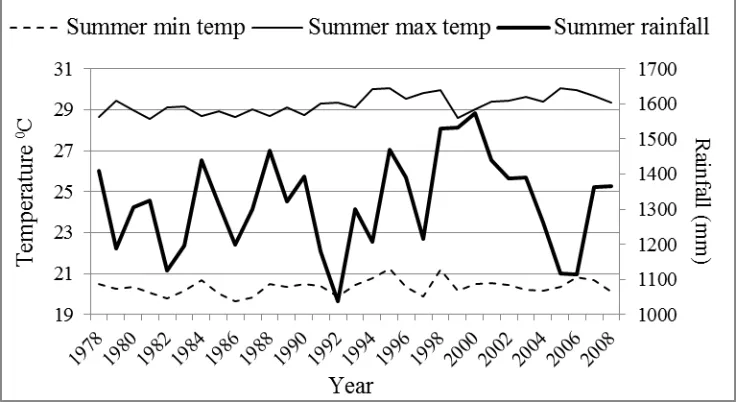
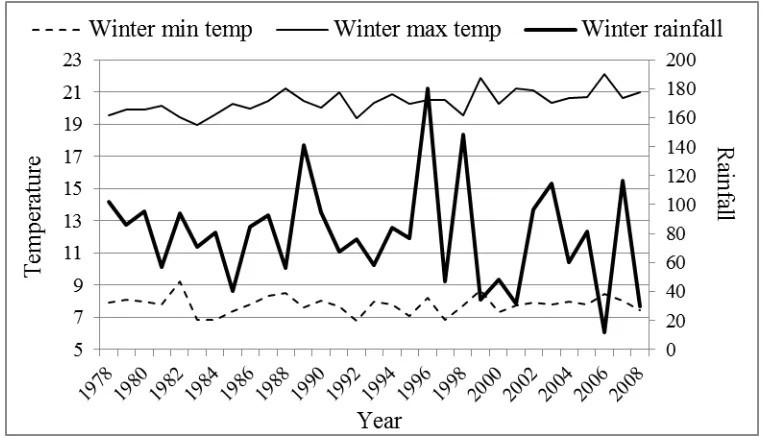
[image:6.612.122.492.166.367.2]season is considered. Accordingly, trend of minimum temperature, maximum temperature, and rainfall for summer and winter is presented in Figure 2 and 3 respectively. Here, only maximum temperature for winter and summer season shows significant (P-value < 0.00) increase over time, whereas minimum temperature and rainfall for both season show insignificant association with time variable.
Figure 2. Trend of total summer rainfall, and average summer minimum and maximum temperature
Note: Summer season includes months of May, June, July and August
Source: Raw data from Department of Hydrology and Meteorology (DHM), Nepal
Rainfall fluctuates over the years with less degree of predictability. However, it is in increasing trend for summer season, but in decreasing trend for winter. The coefficients suggest that summer rainfall is increasing by 2.2 mm every year whereas winter rainfall is decreasing by 0.63 mm every year. Rainfall in Nepal is concentrated in summer. Around 75 percent of rainfall occurs during this season. The positive coefficient for summer rainfall and negative coefficient for winter rainfall indicates that rain in summer is becoming more intense, which could hamper yield of summer food-crops due to water borne disaster like flood and landslides. However, still the relationship between rainfall and yield show positive correlation, i.e. yield will grow with increased rainfall and shrink with decreased rainfall.
6
temperature could hamper the yield of winter crops as frost frequency caused by decline in minimum winter temperature influence wheat yield adversely (Nicholls, 1997).
Figure 3. Trend of total winter rainfall, and average winter minimum and maximum temperature
Note: Winter season includes months of November and December of preceding year and January, and February of succeeding year
Source: Raw data from DHM, Nepal
Climate yield relationships
[image:7.612.115.497.122.340.2]Multivariate regression analysis of first difference in yield of the crops considered for this study is presented separately for both summer crops and winter crops in Table 1, and 2, respectively.
Table 1. Relationship between yield of summer food-crops and summer climate variables
Variable
Paddy Maize Millet Potato
Coefficient
P-value Coefficient
P-value Coefficient
P-value Coefficient P-value
Sumrain 0.012
(0.004) 0.01
*** -0.002
(0.002) 0.43
-0.001
(0.001) 0.56
0.003
(0.013) 0.79 Summintemp -0.15 (0.12) 0.25 0.07 (0.06) 0.32 0.02 (0.03) 0.55 0.21 (0.38) 0.58 Summaxtemp 0.06 (0.11) 0.61 -0.13 (0.06) 0.04** -0.04 (0.03) 0.19 -0.02 (0.35) 0.95
R2 0.40 0.18 0.08 0.07
Note:*** Significant at the 0.01 level, and ** significant at the 0.05 level, Sumrain – summer rainfall, Summintemp – summer minimum temperature, Summaxtemp – summer maximum temperature, figures in parentheses indicates standard error.
7
variables, such coefficient can be used to assess real effect of climate variables in change of yield of food-crops considered for this study (Nicholls, 1997). In addition, sign of coefficients give direction of movement of yield against change in climate variable. Climate variables show significant relations with paddy and maize only. The coefficient indicates that paddy yield increase significantly with increase in summer rainfall. Maize yield shows negative relation with summer maximum temperature, i.e., if summer maximum temperature increases yield of maize will decline sharply.
Table 2. Relationship between yield of winter food-crops and winter climate variables
Variable Wheat Barley
Coefficient P-value Coefficient P-value
Winrain 0.003 (0.004) 0.52 0.001 (0.002) 0.69 Winmintemp 0.04 (0.03) 0.15 -0.002 (0.02) 0.87 Winmaxtemp 0.008 (0.03) 0.78 0.01 (0.02) 0.54
R2 0.17 0.02
Note: Winrain – winter rainfall, Winmintemp – winter minimum temperature, Winmaxtemp – winter maximum temperature
Change in yield due to climate trend
Change in food-crops’ yield due to climate variables is calculated using coefficient of the climate variables for the respective crops and observed change in the climate variables during the study period i.e., Yi=(1i*R)+(2i*Tmin)+(3i+Tmax). Here, Yi is observed change in yield of ith crop due to climate variable, and 1i, 2i, and 3i, are coefficient of rainfall, maximum summer temperature, and minimum summer temperature respectively for ith crop. Similarly, R, Tmin, and Tmax are observed changes in rainfall, summer minimum temperature, and summer maximum temperature respectively during the study period.
8 Conclusion
This paper analyzed the impact of current climate trend on yield of six main food-crops in Nepal. These food-crops are divided into two groups based on their growing season, namely; summer and winter season crops. The impact is assessed for each crop based on the growing season of respective crop. Yield of potato, wheat, paddy, and maize is in growing trend, but fluctuates over the years, whereas yield of millet and barley, two minor cereal crops, is growing very steadily. In summer, each of the climate variables is in increasing trend, whereas in winter, rainfall and minimum temperature is decreasing. In summer, increase in rain and maximum temperature has contributed positively to yield growth of paddy. Similarly, increase in wheat and barley yield is contributed by current climate trends. However, increased summer rain and maximum temperature suppressed the yield growth of maize and millet, whereas negative impact of increase in summer maximum temperature outweighed positive impact of increased summer rain and summer minimum temperature in the case of potato.
This study thus concludes that food-crops grown in summer are adversely affected by the current trend of climate. Except for paddy, which has high water demand and thrives on water logging condition, other summer crops are adversely affected by increase in rainfall and maximum temperature. On the other hand, though rainfall is at declining trend in winter, increase in temperature has positively contributed to the yield growth of both winter crops. With this, we can recommend that any program dealing with minimizing adverse impact of climate change on food-crops production should first consider the crops like maize and potato, which are being affected at higher degree compared to other food-crops. Moreover, these two crops are important staple food in case of Nepal, especially in Mountain and Hills that are also exposed to higher degree of vulnerability to climate change. The main shortcoming of this study is treating the whole country as one basket despite the huge diversity existing within. Therefore, it is highly recommended to conduct similar studies considering the variation caused by ecological and administrative division of the country.
Acknowledgement
We are thankful to Global Environmental Leaders Education Program for Designing a Low- Carbon Society, Graduate School for International Development and Cooperation, Hiroshima University for providing research grant to accomplish this research.
References
Abrol, Y. P., & Ingram, K. T. (1996). Effects of higher day and night temperatures on growth and yields of some crop plants. In F. Bazzaz, & W. Sombroek (Eds.), Global climate change and agricultural production: Direct and indirect effects of changing hydrological, pedological and plant physiological processes (pp. 123-140). West Sussex, England: John Wiley & Sons Ltd.
9
Alkire, S., & Santos, M. E. (2010). Nepal: Country briefing. Retrieved August 8, 2010, from Oxford Poverty and Human Development Initiative (OPHI) Multidimensional Poverty Index Country Briefing Series: http://www.ophi.org.uk/wp-content/uploads/Nepal.pdf
Boubacar, I. (2010). The effects of drought on crop yields and yield variability in Sahel. The Southern Agricultural Economics Association Annual Meeting. Orlando FL: The Southern Agricultural Economics Association.
Carew, R., Smith, E. G., & Grant, C. (2009). Factors influencing wheat yield and variability: Evidence from Manitoba, Canada. Journal of Agriculture and Applied Economics, 41(3), 625-639.
Chen, C. C., McCarl, B. A., & Schimmelpfennig, D. E. (2004). Yield variability as influenced by climate: A statistical investigation. Climate Change, 66, 239-261.
Food and Agriculture Organization & World Food Programme. (2007). FAO/WFP food security assessment mission to Nepal. Rome: Food and Agriculture Organization & World Food Program.
Holst, R., Yu, X., & Grun, C. (2010). Climate change, risk and grain production in China. 2010 AAEA, CAES, WAEA joint annual meeting (p. 29). Colorado: Agriculture and Applied Economics Association.
Intergovernmental Panel on Climate Change. (2007). Climate change 2007: Synthesis report. Cambridge, UK: Cambridge University Press.
Isik, M., & Devadoss, S. (2006). An analysis of the impact of climate change on crop yields and yield variability. Applied Economics, 38, 835-844.
Joshi, N. P., Maharjan, K. L., & Piya, L. (2010). Poverty and food insecurity in Nepal: A review. Journal of International Development and Cooperation, 1-19.
Kim, M. K., & Pang, A. (2009). Climate change impact on rice yield and production risk. Journal of Rural Development, 32(2), 17-29.
Lobell, D. B., & Asner, G. P. (2003). Climate and management contributions to recent trends in U.S. agricultural yields. Science, 299(5609), 1032.
Lobell, D. B., & Field, C. B. (2007). Global scale climate-crop yield relationships and the impacts of recent warming. Environmental Research Letters, 2(1), 1-7.
Lobell, D. B., Ortiz-Monasterio, J. I., Asner, G. P., Matson, P. A., Naylor, R. L., & Falcon, W. P. (2005). Analysis of wheat yield and climatic trends in Mexico. Field Crops Research, 94, 250-256.
Maharjan, K. L., Joshi, N. P., & Piya, L. (2009). Sources of climate change, its impact, and mitigation issues in Nepal. International Conference on Climate Change, Livelihoods, and Food security. Jaipur, India: Institute of Development Studies.
10
McCarl, B. A., Adams, R. M., & Hurd, B. H. (2001). Global climate change and its impact on agriculture. Texas, USA: Texas A&M University.
Mendelsohn, R. (2009). The impact of climate change on agriculture in developing countries. Journal of Natural Resources Policy Research, 1(1), 5-19.
Mendelsohn, R., Nordhaus, W. D., & Shaw, D. (1994). The impact of global warming on agriculture: A Ricardian analysis. American Economic Review, 84, 753-771.
Ministry of Agriculture. (1990). Agricultural statistics of Nepal: 1990. Lalitpur, Nepal: Agricultural Statistics Division, Department of Food and Agricultural Marketing Services, Ministry of Agriculture.
Ministry of Agriculture and Cooperatives. (2009). Statistical information on Nepalese agriculture: 2008/09. Kathmandu, Nepal: Agri-Business Promotion and Statistics Division, Ministry of Agriculture and Cooperatives.
Nicholls, N. (1997). Increased Australian wheat yield due to recent climate trends. Nature, 484-485.
Peng, S., Huang, J., Sheehy, J. E., Laza, R. C., Visperas, R. M., Zhong, X., et al. (2004). Rice yields decline with higher night temperature from global warming. Proceedings of the National Academy of Science (PNAS), 101(27), 9971-9975.
Rosegrant, M. W., Ewing, M., Yohe, G., Ian Burton, S. H., & Valmonte-Santos, R. (2008). Climate change and agriculture: Threats and opportunities. Eschborn, Germany: German Technical Cooperation (GTZ).
Rosenzweig, C., & Parry, M. L. (1994). Potential impact of climate change on world food supply. Nature, 367(6459), 133-138.
Schlenker, W., & Roberts, M. J. (2008). Estimating the impact of climate change on crop yields: The importance of non-linear temperature effects. NBER Working Paper 13799, Massachusetts, USA: National Bureau of Economic Research.
Schmidhuber, J., & Tubiello, F. N. (2007). Global food security under climate change. Proceedings of the National Academy of Science (PNAS), 104(50), 19703-19708.
Stooksbury, D. E., & Michaels, P. J. (1994). Climate change and large-area corn yield in the Southeastern United States. Agronomy Journal, 86(3), 564-569.
Subedi, B. P. (2003). Population and environment: A situation analysis of population, cultivated land and basic crop production in Nepal in 2001. In Population monograph of Nepal Volume II (pp. 1-35). Kathmandu, Nepal: Central Bureau of Statistics.
11 Annex 1. Crop calendar for major food-crops
Jan Feb Mar April May June July Aug Sept Oct Nov Dec Season
Mountain (Rainfed)
Mai-P Mai-P Mai-H Mai-H Mai-H Summer
Mil-P Mil-P Mil-H Mil-H Summer
Pot-P Pot-P Pot-H Pot-H Pot-H Pot-H Summer
Whe-H Whe-H Whe-P Whe-P Winter
Bar-H Bar-H Bar-P Bar-P Winter
Hills (Partial irrigation/Rainfed)
Pad-TP Pad-TP Pad-H Pad-H Summer
Mai-P Mai-P Mai-H Mai-H Summer
Mil-P Mil-P Mil-H Mil-H Summer
Pot-P Pot-P Pot-H Pot-H Summer
Whe-H Whe-H Whe-H Whe-P Whe-P Whe-P Winter
Bar-H Bar-H Bar-P Bar-P Bar-P Winter
Hill (Irrigated)
Pad-TP Pad-TP Pad-H Pad-H Spring
Mai-P Mai-P Mai-H Mai-H Spring
Whe-H Whe-H Whe-H Whe-P Whe-P Whe-P Winter
Tarai (Rainfed)
Pad-TP Pad-Tp Pad-H Pad-H Pad-H Summer
Mai-P Mai-P Mai-H Mai-H Summer
Whe-H Whe-H Whe-P Whe-P Winter
Tarai (Irrigated)
Pad-Tp Pad-Tp Pad-H Pad-H Late-summer
Mai-P Mai-P Mai-H Mai-H Spring
Pad-Tp Pad-Tp Pad-H Pad-H Pad-H Spring
Mai-H Mai-H Mai-P Mai-P Winter
Mai-Maize, Mil-Millet, Whe-Wheat, Bar-Barley, Pad-Paddy, P-Plantation, Tp-Transplantation, H-Harvesting
Plantation/transplantation Crop growing phase Harvesting