I. EIBC'I'ROPHILIC AROMATIC SUBSTITUTION OP ME'1'ALIDCENES II. STEREOCHEMISTRY OF HAWOEN ADDITION
TO 4-t-Bt1'.1YlCYCIOHEXENE
III. LITHIUM AWMINtJM HYDRInE REDUC'l'ION OF CI8-2,6 -DIMETHYICYCIOHEXANONE
-Thesi.
byDonald Charles Gar.ood
In Partial Pulf11lment
otthe Requirements
For the Degree of
Doctor
of
PhilosophyCalifornia Institute
of
TechnologyPasadena,
cal1fornia
ACKNOWLEDOEMEN1'S
The author wishes
to
express his gratitude to The Upjohn Company and the National SCience FOundation forfellowships. He al80 wishes to thank Dr.
J.
H. Richards for his guidance and Dr. G. S. Hammond for many f'ruit:t'ul discussions. Thanks are also due Dr. H. O. Essler Who provided the 4-phenyl-l-butyl p-bromobenzenesulfonateABSTRACT
PART I.
The meohanism of electrophilic substitution of metal-locenes
was
investigated by the oompetitive acetylationot
terroceneand
ruthenocene and of ferroceneand
1~1'-d1-ethylferrocene. Solvolyses of CAl -ferrocenylalkyl
p'-bromo-benzenesultonates did not show any significant aryl partici-pat1on. These results lead to the hypothesis that direct interaction between the metal and the electrophl1e is of great importance in eleetrophll1c subst1tut1on reaotlons of metallocenes.
PART
II.
The brom1natlon and chlorinatlon of 4-i-butylcyclo-hexene have been shown
to
produce diequatortal dihalldes as well as dla.x1al dlhalides. '!be amount of dlequator1al dichloride produoed lnoreases with solvent polarity. The reaults are expla1ned in terms of two competIng mechanisms, the classioal, planar trans-additlon and a carbonlum lon process Whlch inoreases in importance in the more polar solvents.PART III.
tdthlum aluminum hydride reductIon of
I .
TAnLE 0:" CCmTBt:T.:)
PAGE
l~L_l~~~l'r~O.PllI L1 c; A;·lC;~l.; T! (; StrB!~~rI1't.:!r:i· 01:
O~~ IlrBTALLl)~~:~!"J~;S • • • • • • • • • • • • • •
•
1n~T;1.0DU;:;TION
·
. .
.
.
..
. .
.
.
. . .
.
.
.
.
Hl!;SUL'r:) • • • • •
•
•
•
• • ••
• • • It.
..
..
..
Comnetit1ve Aoetvlat1ons . . . . .. .. • • .. ... $
Acid
Strenct.hsu. .. .. .. • .. .. .. . .. . . . . •
10Solvolysi~ of w./errocenyl-l....alkyl
l2-:Jromobenzone sulfont:te 0 . . . . • • .. • .... 12
DlS~USSlor./
..
.
.
.
.
.
.
.
.
.
.
.
.
.
.
. .
..
Energetic8or
Electrophilie r.letalloceny1~~ubsti tution . . . • '" .. • • .. • .. ... 15 Hechanisms of Blectrophilj.c :·:ctallocenyl
:':ubstitutione • • • .. • .. .. .. • .. • • .. .... 7/
;lolnt1ve I~eact1v1ties oi'."orroceno
and
Ruthcnocene
. . .
34Alkyl Substituent Bffccts • • .. .. .. .. • .. .... 34
W-lerrocenyL'llkanolc Acids .. .. • .. .. • .. ... 37 Solvolyses of' w-f"orrocenylalkyl ;'ul:'onatcs.39
• • •
•
•
• • • • • • • • ••
• •.
.
.
.
.
.
.
.
. .
.,
.
.
.
. . .
.
ST~TCOCHSl'.n;;;T3.Y OI-' W\LO:1SH !\DDI'rIOH TO
1~~-3 UTY LeY CLOHB ':;.XS . . . . • • • • •
It;:'H.ODUCTl;Jti • • •
•
••
• • ••
• • • • • • • !>;echaniBtic Dnc1'i:round for ~'t('reocheI:}icalDtudios
. . . " . . . " ..
!}Olvent i.~ffect,s .. • .. • .. " .. • .. .. .. .. • .. ,-\.ddition
ot
Unsyrmnctrical :~e,)~~()ntG " . .. •Addition of UnS']Dll1etricnl ~'eat!:cnt[, in
Polar Solvents •• • • .. • .. • " .. • •
Addition or Un5Yl'lr16tricr:l ~{ea':ents in
l.:on-?olar !>olvents • • " • • .. .. .. .. ..
Halogen
Addition . . . .. .. .. • .. .. • ::tereochenistrv of Electro;)hilic ,dd1tion • •PrevlouG Id.ci'\s Goncern:i .. n,:~ I"ddi tion to
.,. ·d e ... n
;"l.gl .·JYc",em...:.... • .. .. .. .. .. .. .. • • .. • l'reviou6"u;.;t;cnti va '.:ork ... • .. .. • • ..
PAH'r
I I I .
I someri zation ~f' )t.:~::¥I!,~.-l, 2-:-DiI:talide s • • • .. Interference 0.), :~aaT"cnl hdaitJ.on • • • .. • •
4-.t.-:>utylcyclohexene as a
Substrctcf'or
"E"loctr-ophilic l\dditions .. • • • .. • • .. ...
RESULTS • • • • • • • • • • • • • • • • • • • DJ:SCUSSIJt • • • •
•
• • • • • • • • ••
••
•',"
r' n <; L~
102
104 105
106
112
Occurrence
or
I+'reer'adical
Add! t10n • '" .. • .. 112Stability of the D1ha11des Under the
Reaction Conditions • .. • • • • .. .. .. • ••
119Influence of the
jt,-Butyl Group ... • • • ...120
lilochanism and Stereochcnistry '" • • • .. • ... 120
!iearran.~;ol::1ents
during Chlorination ... "'.. 1::-'9
'"
.
.
'"..
.
.
..
.
.
'".
.
.
.
..
'"·
.
.
.
.
.
.
. . .
. .
.,.
..
.
. .
LITHIDll Ii.LtJi4INi.!T: UYJc~rJji. HJ.illUGI·lm~ Of;'
2, 6-i.Hl'·'E'fHY LGYCLOHEXi.!):JNE • '" .. .. '"
GTe--
. .
'".
....
.
.
'". .
'"..
'" ....
..
.
.
.
'"
'".
133
152
158
159
Lithium Aluminum Hydrido f~Gduction of Ketonas 159 Steric l!indrance in tbe . ;~monlfication of the
2,6-Dimethylcyclohexyl Acid
Phthalate~••
165
~::teric Acceleration of ~;olvolysce • .. • • • • 166
IiE~,a.JLTS • •
•
•
•
.. ...
.
.
..
••
.
..
.
..
.
.
..
·
. .
.
.
"
.
. .
.
.
.
.
".
.
.
.
Hwe
Deformation and Sterle Himlrancc • • • •Lithium Alumintl'll HydI1.de Reduction of
ili-2.b-Dimethy1cyelohexanone • • • • '" • • • •
.?oss1ble Isomerization of Alcohols DurinG
the Hydride Reduction .. • .. • " • • • • '" •
•
• • • •
•
•
• • ••
• • • • ••
• • • • • It • • • • • • • • • • • •
Part I
-I . nK., t ' d 's of Aelde in Ethtmol-'.",:ater • • • • • •
II. l~cetolysls Rates of W -Arylalkyl Dro5ylates
at
103.8
0.
.
.
.
..
.
..
.
..
.
.
..
.
. .
..
II!. Hydrolysis of 4-Arylbutyl r1roeylates in 80i;Acetone at 500 • .. .. • • •
·
.
...
..
..
..
.
IV. ::,lectrophile Bond ..Iir;tnncer...
..
.
..
..
....
..
V" pK/\ in ~;ator at 25.00
..
..
..
.
..
..
.
.
..
.
..
VI.i.clative itatas of' :301volY215,s of' VJ-"henyl-l-alkyl Ja-Toluenesulfonntcs and
,2-:';rOlno-benzenesulf'onates at 750 • •
•
• • • •.
., VII. :~cle.tive R.ates of ;)olvolysi~,or
W .... (2,4-J1mcthm=:rphenyl) -l-alkyl
.n-;'3romobenzene-culfonntcs at 75
0(59) ....
• ••
• • • ••
VIII. .~clative H.ntes of Acetol~.rtd,a of W -(l~-~\·!tb
oXY9henyl}.1-ldkyl 12-3I'omobenzencsul~'on,<)tf's
at
75
0(59)
..
..
.
..
..
.
..
.
.
.
..
..
..
.
.
I~.. 'I'etrfll:tns from Formolysin at 750 (5'), 36)•
•
••
•
••
•
• • • • • • • • ••
12
14
23
43
p .1\ ~ I I
PA(i3
J. In.i"rared :~tretehing Fr~qu~meics tor Dichloride.s • 108 II.
I I I .
Chlorination of 4-!=.-~:;utylcyelohexene
Dielect.ric Constants at 200 • • • • •
• •
• • •. lIZ
126
•
•
••
.,
.
nr.. Chromatograph of Aliquots 01' Chlorination inPentane .. •
..
,.
.
.
.
.
..
..
.
..
.
.
..
v.
Chromatof;rllphor
Allquots of. Dichloride..
.
.
..
..
It •
140
• 142
..
.
VI. Chromato[';rapt. of Aliquotn of Chlorination in
Cblorobenacn6 • •
..
.
..
•
•
..
..
.. ..
.
.
.
..
• • Ih4~8.t!t
...11
I ..I. Lithium
Aluminum
Hydride Heductionof
4-Substituted G~rclohex~.non0G
.. ..
.
• . . . It 161II. Lithium Aluminum Hydride Reduction 01'
3-Substituted Cyclohexanones • •
•·
.
..
.
... 162III. Lithium Aluminum Hydride !~nduction of 30me
2-Alkyl ~)ubst1tutNi Cyclohexanono5 nnd Gyelopentn-nones .. • • • .. • .. • • .. • • .. • • • • .. • • • 164
1
-I.
2
-1. nrmODUCTION
Since the 1n! tlal discovery of the aroutle behavior
ot terrocerM (1),
ithaa become
increasinglyapparent
thatthe metallocenea
or
the group VIIImetale
exhib1t str1king aromaticcharaoter.
Cyclopentadienyl
manganeae
tr1carbonylalso
hasaromatic
character8inoe
it maybe acetylated,
benzoylated,
alqlated, eultonated, and metalated (2,3,4) ..
The heat.ot
formation of' terrooeneand
n1ckelooene in-dicate a high r8eonance stabil1zationot
the metalloceneayetem although nicke.lOOtne 1s oons1derably lesa stable than
terrocene
(5,6).
'!'he aromatio stablll ty 01"ferrocene
1.further exemplified
bytta ta11ure
to
torm an
adduct withmaleic
anhydride (1).Al80, terrocene
i8not hydrogenated
1n the presenee ofplatinum
catalyst (1).Perr'Ocene
has been shownto
undergo Priedel-Craft. alkylation. (7)and
acylationa(1,6),
metalat1on. (9,10,11), and sultonationa(12), uaually with
remarkable ease.
N1tration and direct halogenat1on ot ferree.ne have been uneuooe •• tul largelybeeauae
ot the
Mnait1v1ty
ot
f'errocene
to the oxidizingcond1tiona ot these
reaotlons
and the resulting decompositionof the
orsanometall1ccompound (1,13,14).
Other evidence
tor
the h1Sh reactivity of themetal1o-cenes comes f"l-om an
examinationof the
conditions required3
-about acylation of ferrooene are al~num chlor1de (1). stannic ch loride (9,11). hydrogen fluoride (12), boron tri-fluoride (15,18), phoaphor1c acid (16,19,20), and
tri-nuoroaoet1c
anhydride (19). Reaction times are usuallyshort;
ten
to Sixtyminute.
generallysurfice
to completethe reaction.
A .1m1.lar eaee
ot
acylation is found among the reactions of heterocyclic compound.. Per example, l,2-dimethylindole1s acetylated by acetic anhydride at 1000 without a catalyst (21). In a manner similar to terracene (16), thiophene re-acts With
acetic
anhydride in the presence of85%
phos-phor1c acid
(22). Stannic
chloride also catalyzes the re-actionot
thiophene with acid chlorides in benzene solution(23) •
The acylation products of the metallooenes further
imply h1gh m.etallocene :reactivity. With acetyl chloride
and aluminum: chloride ferroeene gives small amount. of
1,2-d1acetylte:rrocene (24,25,26)
whereas benzene
g1vet
onlymonosubst1tution (27). Alec, both f'errocene and ruthenocene
give l,l'-diaoylated produots (1,28,29).
Compet1tive Friedel-Cratt. acetylat10ns of ferrocene and anisole, phenol, or benzene, reapect1vely I give only
acety1terrocene and no acetophenone. (18). However, in
4
-Perrccene may be mercurated to give d1eubatituted product (9,11). VariOU8 heterocyc11c compounds of h1gh
reactIV1ty are alao ea81ly mercurated (30). Pox- example, all f"our hydrogen.
ot
thiophene rna,. be auhat! tuted byretlux-ing in acetIc aold With mercuric acetate (31). Al though
toluene and benzene are allO meraurated at reasonable rate8, the reaotlon requires acid catalysIs and, furthermore, mono-wbati tution predominate. (32).
TNo additional electrophil1c substitutlons Which
re-flect the high reaotivity
or
metallooenea are to~latlon(16,18,33,34,35,)6,37,38,39)
and am1nomethylat1on (Mannichreaction). '!'hue, terrocene reacts With N-methylformanillde and phosphorus oxychloride to give about 70% 01' terrocene-carboxaldeh7de
(16,,33,34).
Some tel"rOcene 18 otten re-covered unreacted.On17
the more react1ve aromatic hydro-carbons behave in this manner- (33); for example" anthraceneg1 ves excellent yield.
or
the 9-aldehyde (40). Again, heterocyclIcaromatic oompounds are
similarly reactive. Treatment of lndole with N-methylforman111de and phosphorus oxychlor1de g1ves 54~ot
3-indcleoarboxaldehyde (41).5
-are generally longer than those required tor acylation. For cOtnpax-1son Wi th hetePO<ry'cl1c chemistry.. the am1no-methylation of' indole gives 4~ of' gram:1ne (42). The re-action 1e completed more rapidly than in the case of
f'erro-eene.
Perroeene
illsutne1ently
react1ve
80 that disubet1 tu-t10n may oceur in am1nomethylation. Thus, althoughre-action
of f'errocene
with N~thylro~l1deand
phosphorus oxychloride cannot be made to glve the clialdehyde (33), 19%of d1eubat1 tuted product haa been obtained from the reaction
of methylterroeene With methylenebisdimethylam1ne, formalde-hyde I and phosphoric acid in acetic acid at
90°
for sevenhOurs (
39 ) •
A p1naool :rear-ra.ngement in which an aryl gl"Oup mi-grates may be considered to be an electrophil1c aromatic
substitutIon 81nce the migration of an aryl group involves release
ot
electrons from the al"Yl group to the carbon1um ion center. '.the extent to Which a particular aryl group migrate. may be expected to parallel the reactivity of thataryl group toward. electroph111c aromatic subet1 tution.
'nma, 1 .. 2-diphenyl-l .. 2-d1terI''Oceny1ethaned101 undergoes a facile p1naeol re~angement 1n wh1ch the ferrocene nucleua m1grates (43). Th1s !'efSUlt implies the greater reactivIty
of teI"l"Ocene compared
to
benzene 1n eleotroph1l1e subati6
-SImilarly, aryl partIcipatIon In the lonizatlon o~ alkyl alde ohain eater. 1. an electrophI11c aromatI0
eub-atltution (44). In this conneotion the SOlvoly8i8
ot
2-terrocenylethyl toaylate in 80~ acetone-water proceeds
537
tImes raster than the phen:r1 derivative (45). Although otherdata 1"01' the solVOly8iS of 2-arylethy1 tosy-late. In 8~ acetone-water are 1acld.ng, !'rom the aval1able results for
2-phenylethyl and 2-aniaylethyl toay1ateIJ In
ethanol,
acetl0 ac1d, and formic acld (46) a modicum o~ aryl
partICipa-tion would
beexpected tor 2-phenylethyl
toay1ate1n 80%
acetone-water,
a eolvent or med1um
10lUzlng strength (47),whereas the
anisyl
derivative. and slm1larly reactive
com-pounds
wouldexhibIt rate
enhancementadue
to aryl partICi-pation. It is d1:ft1cult to predict whether the 2-anlsyl-ethyl toeylate wouldaolvo17ze
as :fast 8J!S 2-.ferrocenylethyltosy1ate a1nce
tor the
2-arylethyl syatemthe
plotof
logk against Y 1s
not a straight
11ne and enough polnts arenot
ava1lable to determine the curvature.ReactIons other than the
electroph1110 subst1tutlonspreviously
diacuBeed
provide further eVidence of the highreact1 vi ty
ot
metallocenea. An adjacent meta1100enenucleus greatly stab1lizes
a catIon. For
example. f"errooene-carboxaldehyde 1s eoluble ln aqueous acid apparently duemetallocenylcarb1ny1 7 metallocenylcarb1ny1
-carbonium lon. formed on hydrolysis of the corresponding
acetatee ve of" stabil1 ty comparable to the
triphenyl-methylcarbon1um ion
(45,48
II49 ) •
The eentral metal atom may be directly involved in the reactions 01' metallocenea
(45,48,49).
Nuolear magnetic resonance studles have shown that the metallocenes are pro-tonated on the metal (50). Eleetroph111c attack mayin-wIve cite.
01' high eleotron density in the metal atom. Treatments 01' the electronic structureor
the meta11ocene8 give more prec1se locationsto
the metal electron densitie.(51-57). The ltbtf1tt tr-eatment (51) indieate8 the presence
or
an equatorial helt 01' eleotrons around the metalcon-sistlng or the hybrid hag orb1tal and the original dxy and
<1x
2 _y2 orbitalsot
the metal. Other treatments imply that someot
these electrons are tied up With bonding to thecarbocycl1c rings (56) although to do 80 would place these
electrons
instrongly'
ant1bond1ng r1ng orbitals.However,
the hag orbital remains tree and 18 expected to be wellsu1ted to releaae
it.electrons
toan
electroph1le.The present work comprises an attempt to further
under-stand the electrophil1c suhat! tution of metal10cenes and to quantity their reactivity. Also, several interestIng
8
-2. RESULTS
2.1 Competitive Ac.~lationa
A competitive acetylatIon o~ equlaolar amounts of rerrocene and ruthenooene was oarried out in methylene chlorlde eolution using boron trifluoride catalyat. One equivalent
ot
aoetic anhydride was used per equlvalent of tatTOoene. The aeparat1.0not
ferracene, ruthe-noaene, and acetylated productswas
ea811y and cleanly accomplished by chromatography onalumina.
Acetylterrocenewas
lso1ated in ao.~ yield (baaed on .ferreeene) and84%
of' therutheno-cene was
recoveredu.n.reacted.
A very minute amount
of di-acetylferroceneva.
also obtained. It any unreaoted ferro-cene was present, at most there would have been traces only. Under the conditionsot
thi8 acetylatlon itwas
shown In.a separate run that ruthenoeene gives good yields (80-9096) of monoacetylruthenocene, but no diacetylruthenooene 18 formed(28,29).
IdentIfication ot the productswas
accomplished by meltIng point determination and ultraviolet spectra.About equal quantI tie.
ot
ferrocene and ruthenocene remain unaccounted tbr andmay
have been lost through decomposItion during reaotion. Some operatlonal losses may be expeoted,too.
Aqueous layers obtained during the work-up were- 9 ...
Perrocene and
l,l'-diethylferrocenewere
sim1larlyacetylated compet1 t1 vely. Chromatography on alumina gave
38~ ot
acetylferrocene
and 56~of acetylated
l,l'-diethyl-:terroeene. Again about
20~ ofthe
reactant.was
lostin
decompoe1t1on.
The ratio
ot3-acetyl-l,l'-diethylferrocene
to 2-acetyl-l,l'-diethylferrocene
was round
tobe
2
bychromatographic
separation
or the 1somers. The two 1somersare individually di8tingu1shable by ultrav10let spectra
(58)although
mixturesof
isomers oannotbe analyzed by
ultra-violet Bpectro8COPY since the absorption maxima are separated
by only 4jtm •
It
was
assumed in calculating relat1ve rate rat10s that
the rate of Friedel-crafts acety1at1on
may beexpressed
byequation
1.- d
~rt.l
= k{Met
1 • . .
(1)
where (Met
J
is the conoentration of the metallocene. For
competitive aoetylat1on.
ot twod1fferent metallocenea, the
rate constant rat10
will beg1ven
byequat10n
2.The assumpt10n that the ruthenocene not accounted for
i8 acety1ated
give. a
lower l1mit
for
the
rate
ratio
of
10
-In 1,1'-d1ethylterrocene there are
two che~cal1ydif-ferent types
of' posit1ons
wheresub8t1tution
canoccur;
the a-posItions and the ~-po8ition. (fig. I). Conslde~atlonof
the statisticalf'actors f'or
substItutions atvarious
positions compared
toa single positIon in
rerroeenegives
equatIon
3.
R_2~+2k~
5 kf'er
In
equat10n
3
the constanta
~and
k~are
the partial rate
constanta for substitut10n at a 8ingle a-
and ~-po.1tion,respectIvely, and kter 1a the part1al rate constant for a
fl1ng!e posItIon 1n
t'errocene.The rate constant ratIo, R,
is calculated from equation 2 using the amount of
aoetyl-terrocene and the total amount of acetylated d1ethylferrocene
obtained
toestimate the final concentrations
otferrocene
and 1, I' -diethylf"erroeene. The
experimental results
to-gether with an applioation of'
equation2 lead
toa value
tor
R of 1.7.Since
kA
was
experimentallydetermined
a8
equal to 2, part1al rate tactor. f'or the a- and
~positions of l,l'-d1ethylferrocene are calculated
tobe
1.4
and2.8.
respectivelY, relat1ve to asIngle
po8it1onin
.f'errooene.2.2 Aoid
Strengths
It waa thought that ferroeene might
act as
8base
11
-a
Fe
12
-acetic acid with p-toluenesultonlc acid was unsuccessfUl,
an observation Which implies that acetlc acid 1s a stronger base than ferrocene.
Any unusual polar ef't"ects 1n the metallocene system would be expected to ahow up 1n the dissociation constants
of ferroeene oarboxylic acids. Table I lists the results of a study of d1ssociat10n constants of ferrocenecarboxylic,
various W -fel'l'Ocenylalkanoic, 3-ferrocenoylpropion1c, benzoic, and phenylacetic acids in ethanol-water solvent
of
density0.8916
g/om
3
at
25°.
TABLE I
pKAtB 01' Acid. in Ethanol-Water
Ac1d
C1OH
9
FeCOOHCloH9FeC~COOH
cloH9Pe(CH2'2COOH
CloH9Fe(CH2'3COOH
CIOH9PeCO(CH2>2000H
C6HSCOOH
C6HSCH2COOH
2.3
Solvolysis of'W
-FerztOcenyl-l-a1kyl~-BromcbenzenelNltonates
pK A
6.61
6.~
6.S3
6.63
6.33
6.13
6.08
13
-further eluc1date the aromatic reactivity
o~the
metallo-cenes
theaolvolyaes
of' eo_terrocenyl
81dechain
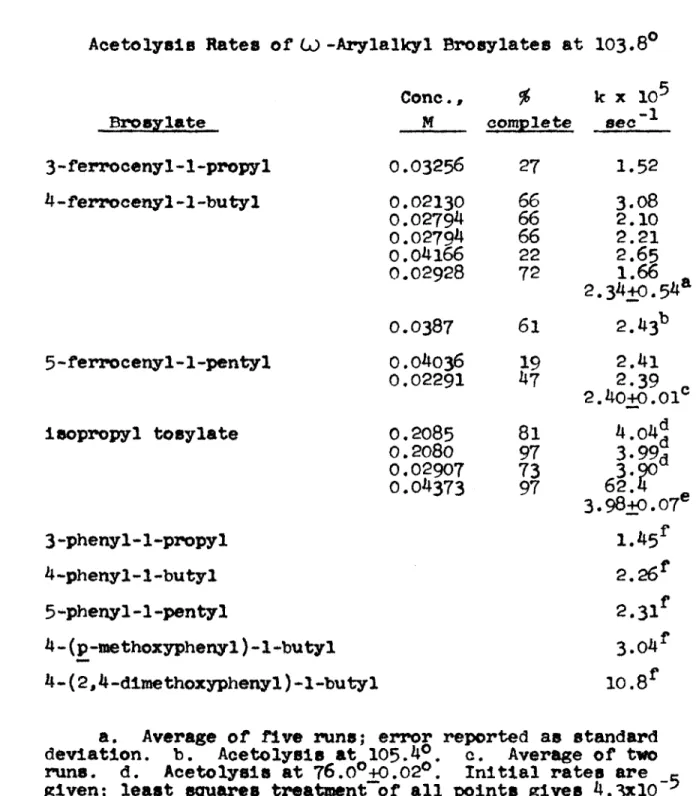
esterswere studied. Table II lists reaults
01'the acetolysle.
at 103.80
of
W -terrocenylalkylp-bromobenzeneeulfora tea.
Also, values for W -phenylalkyl and W-methoxyphenyla1kyl
p-bromobenzeneeultonatea
extrapolated fromthe data
01'Heck
and W1nstein
(59)
to103.8
0are included. The rate constants
were obta1ned
bya le ••
tsquare. treatment of the data from
each
run. Rates weretollowed
to about ~completIon
bypotentIometric titration
01'acid liberated and
were
first
order a8 tar aa
tollowedexcept in those cases where
oxida-tive decomposition
or
the reactant became
severe.It
wa.
not possible to tollow the aoetolY8is
rates tocompletion
sinoe
oxidation
01'the
8tartingmater1als and
produots be-oame excessiveat
50~oompletion.
Aoid liberated inthe
solvolysis
appear.
tobe oon.umed in
theoxidation
~aotion.Oxidation va. not
pttevented
by ascorbic acid nor by other ant1oxidant. but wae reduced bymaintaining
a slow stream01' oxygen-tree nitrogen (60)
through the
solvolysissolu-tion. Table II aleo
containsresult. for
the aoetolysis
14
-TABU II
Acetolys1s Rates
of W
-Arylalky1 Brosylates at103.8°
Cone.,
%
k x105
Bro ay late M complete
sec-1
3-ferrocenyl-l-propyl
0.03256 271.52
4-ferrocenyl-l-butyl
0.02130
663.08
0.02194
662.10
0.02794
662.21
0.04166
22
2.65
0.02928
12
1.66
a2.34
+0.54
0.0387
61
2.43
b5-ferrocenyl-1-pentyl
0.04036
19
2.41
0.02291
41
2.39
2. 40±(). 01
c1eopropyl tosylate
0.2085
81
4.04~
0.2080
91
3.99
d0.02907
13
3.~0.04313
97
62.3.98+O.01
e
3-pheny1-1-propyl
1.45
f4-phenyl-l-butyl
2.26f5-phenyl-1-pentyl
2.31
f4-(p-methoxyphenyl)-1-butyl
3.04f
4-(2,4-d1methoxypheny1)-1-butyl
10.Sf
a. Average of five run.,; error reported
a8standard
dev1ation.b. Acetolysis at 105.4°. c. Average of two
runs. d. Acetolysis
at76.0°+0.02°. Initial
ratesare
5
glvej
jleast squares
tl"8atment-ofall points gives
15
-Product studIe8 of the acetolysIs of'
4-ferrocenyl-l-butyl £-bromobenzenesulfonate
wereperformed. Although
extensive oxidat10noccurred only 4-ferrocenyl-l-butyl
acetate was obtained Wh1ch was identified by
in~aredspectroscopy and compar1son With an authentic sample.
However, in
one case asmall amount
ot
a non-polarterro-cene derivative was isolated by chromatography on alumina.
The In~ared
spectrum
ofthIs substance dIffered
fromthat
ofthe expected hydrocarbon, l,2-tetramethyleneferrocene
(61),
and alao was
notidentical to n-butylferrocene
(authentIc
samples ofboth hydrocarbons
wereprepared
forcomparison).
The 1n1'!-ared and ultravioletspectra
1n-dicated the absence of
functionalgroups
eitherconjugated
wi
th or separated from the rIng system. Due to the
emallamount of material Inltlally obtalned fUrther
characteriza-tion andIndentifIcat10n
was notpo.sible. Another
at-tempt
to Isolate this substance falled
toyield
anynon-polar substanoe on chromatography on alumina.
Prom
the acetolysis of 5-ferrocenyl-l-pentyl
p-bromo-benzenesulfonate only acetate ester was obtained. No
product study waa made of tb! aoetolysis of'
3-f'errocenyl-l-propyl p-bromozenenesulfonate.
Late in this
studyit was f'ound the hydrolY8ls in
"8~tT16
-t1tration procedure could be el1minated since the acid
liberated could be titrated to an indicator end po1nt.
S1nce
no
resultsror
4-phenyl-l-butylp-bromobenzene-sul.f"onate have been r-eported t'or this solvent,
4-l'errocenyl-l-butyl and 4-phenyl-4-l'errocenyl-l-butyl p-bromobrosylatee were
801-volyzed simultaneously to 50~ completion. The relNlts are given in Table III. No rate enhanoement was ob8erved for
the ferroeene derivative Which, in faot, hydrolyzed
some-what slower than the phenyl derivative.
terrocenyl
phenyl
TABLE III
Hydrolysis of' 4-Arylbutyl Broaylate8 in
80~ Acetone at 50°
Cone."
M
0.005270.01137
~ Co!ftJ)letion
50
61
3.
DISCUSSION2.49
3.15
3.1 Energetics
or,
EleotroPhl110 Metalloce!\yl Subatl tutlon A 8imple molecular orbital calculation suggests anexplanation for the h1gh react1 v1 ty
ot
metallooene.. The unperturbed ring. are approx1mated by cyolopentadienyl radioals and the ring in the tranSition atate for17
-the
oorrespondi~energy of the substituted ring is
3.854~.
There
1s a 108S 1ntotal
IT
-electron
energyon
gOing ~ theground state to transition state of
2~; however,there 1s
no 1088of
delocalizatlonenergy! The
corresponding change
~rbenzene involves
a 10S8or
total7r-electron energy
2.54~ and a 1088of deloca11zat1on energy
of
O.54~.Thi. com,ariaon maY' help explaIn the
extremereact! vi ty
ot
metallocenee.Certain expectatlons
derived rrom first princ1p1esregard1ng posaible intermedIates
andmechan18m8 of
meta11o-ceny1 electrophi11c
substItut10nmay be dIscussed although
the lack
ofadequate evidence does not
permitany but a
tentat1ve
oholce
of mechanIsm at thIs time.An
attacking
eleo~ph1le eventually bonds toone of
the
carbonatoms of the
carbocyclicring. displacing a
hydrogen. Such an
attacldng
species might be consideredto
approach the aromatic system from e1ther aide of the
plane of the
ringundergoIng IlUbati
tut1on.At
largeearbon-eleetrophl1e (C-E) dietances Cou1omb1c interaction
18 the predominant bOnding torce. No
specific point of
attack
1e discernible, and the relative energies
ofthe
different metallocene-electrophl1e systems
8Sa fUnction
of' the
central metal atom of the metallocene is solely
18
-eltes
ot
bondlng are a direct resultot
the above torcea,and 1n! t1al bonding may be to one or both ring. and/or to the metal.
Beet covalent bonding between the electrophile and a
rIng will be aohieved When maximum overlap ~th the ring
7T
-orbital OCCUl'8. 'l'hia require. that the attackingelec-troph11e come 1n with orientatIons which
are reaeonably
perpendicular to therinaa.
Extensive bondingmay, ot
course,
drastically dlatort the orbital geometry. It the ea.ential feature. of in1 tlal attack are preeerved 1n the intermediate etages ot the reaction, two Intermediate con-figurat10ns are possible, which are depicted in figures2 and
3.
In figure 2 the eleetrophlle is oppoalte
to the ring not undergoing attack (the bottom ring) and ln figure3
it is adjacent to this rIng.A bulky electrophlle allows the poaslbl11tiea
ot
sterle i11: eractions. '!'he structure represented in figure 3 haa the electrophlle poSitioned in the central region ot themetallocene system which region 1. more SUbject to ateric
restrictions than the more external region occupied by the electl-ophile in figure 2. The source
ot
these sterlerestrictions
atems from the
sterie interaction of a bulky electrophile with the central metal atom and the carbocyclic19
-E
M
H
Figure 2.
H
M
E
20
-the aterlcally
interactinggroups
i8reduced
a8the angle
between the C-E
bondand the
axialdireotion approaches 0°.
Conversely, sterie interaotions may
berel1eved
bya bending
away of the
C-E bondfrom the axial direction of the
metal-locene
system.In oontrast
to theabove ideas conoerning a bulky
electrcphile. for small and unencumbered eleotroph1lee the
structure repreaented
byfigure 3 may be the more
energeti-cally favored since an eapee1a11y stable 1ntermed1ate may
be formed it the electrophile bridges the
t~rings ae
shown ln
figure4. Bond1ng of the electrcph1le oceurs
withboth the metal-ring
bOndingorbltals and,
aadeplcted by
the
arrow
ln
figure
4,
m8¥also
lnvolve the electrone of
theequa torlal me tal orbi tala, hag and d +2 (51).
Notonly
are bondlng opportunities good but the charge of the
elec-troph1le becomes distributed over much of the aromat1c
system, thus turther reduo1ng the energy.
One may perfOrm
&simple Beometrio calculatlon
corres-pondlng
tothe
8itua tion in figure 4. From di fferent
values assumed tor the angle between the c&rbon-electroph1le
bond and the axial direction,
e,
and a knowledge of the
21
-+
M
) E
22
-o
a
=
0Msece
ME
=
OC
+crsin8
23
-TABLE IV
Electrophile
BondDistances
90
0 0
CE,A
ME,A
-1.69
0 1.69 1.225
1.70 1.3710 1.72 1.52
15 1.75 1.67
20 1.80
1.84
30
1.95 2.201.84
0 1.84 1.225 1.85 1.~
10 1.87 1.54
15
1.90
1.7120
1.96
l.~
30 2.12 2.
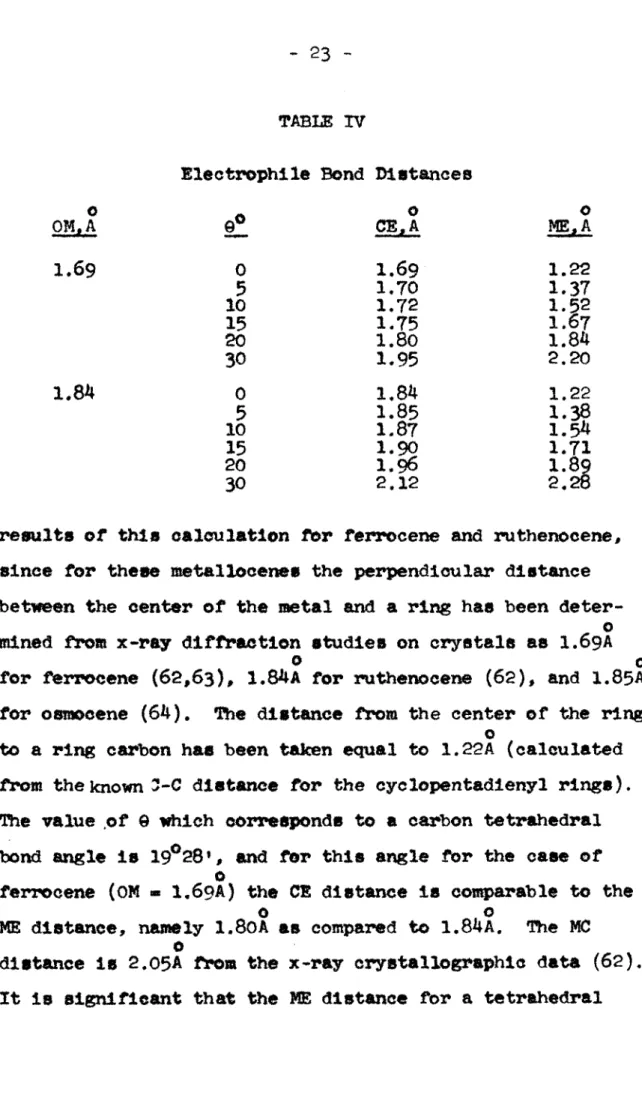
result. of this oalculation ror f"errocene and ruthenocene, since tor theee metallocenee the perpendicular distance
between the oenter
ot
the metal and a ring has beendeter-o
minedtroll
x-ray dIffraction studies on crystals as 1.69Ao
0tor f"erroeene
(62,63), 1.54A
tor ruthenocene (62), and 1.85A tor OBmOoene (64). The distance !'rom the center of the ringo
to a ring carbon haa been taken equal to 1. 22A (calculated
:from the known
'-C
distance tor the cyclopentadieny1 ringe). The value,ot
9 which correspondsto
a carbon tetrahedralbond angle i8 19°28', and tor this angle for the case
ot
«)
terrocene (OM.
1.69A) theex
distance 1.comparable
to theo
0ME distance, namely 1.BoA
aa
compared to 1.84A. The Me o24
-angle tor terrocene comparef3 favorably wit h the Pe-C
o
dIstance of l.84A for Iron pentacarbonyl. One concludes that geometrical .factors allow good bondIng between the ferrocene system and the electrophile since bond angles
and bond distances appear favorable.
In
ruthenocene and oemocene the situation1s less
o
0clear. The Me d1 stance. are 2. 21A ( 62) and 2.22 A, re
spec-tlvely. nata on the metal-carbonyl dIstances in carbonyl
derivatives i8 not available f'or compariaon. However, for
any value
ot Q
theCE
distance must be conSiderably longer than in terroeene Which meane that carbon-eleatrophilebond-ing i8 weaker for equatorIal bonding of the electroph1le to
the metal. Skewed cont1gurat1ons would allow the bonding
ot
the eleetroph1le to one .ring and the metal, but bondingto
the oppe8l te rIng would be correspondIngly reduced.There have been some results Which suggest the pos-sibility of an intermediate with the electrophile bonded to the oentral metal besides the solvolysis data mentioned
in the Introduotion. Perrocene appears to protonate at
the metal aa evidenced by nuclear magne~resonance studies
(50~66). Also, d1cyelopentad1enylrhen1um hydride i8 known
in which the hydride hydrogen is bonded to the central rhenium atom
(67,68).
This hydride may be protcnated torm1ng a stable ion whose saltsare
isolable. 'nle addi-tional hydrogen is &180 attached to the central metal1' 25 1'
-tr1methylenererrocene, an ester which has the reactive center favorably 81 tuated ro~ metal partioipation, was
notably raster than cyclopentyl to8ylate (49).
If
oneconsiders now
the electrophile structure, it18 seen that the aeylon1um 10n has a net electron density det'iclt
at the
aCTl carbon p-orbital andmay,
therei'oI'e, bond Wi th eleotron rich centers of the metallocene. The acylon1um 10n 1s l1near 1r effects of the aluminum tetra-chloride 10n, lfhlch may be paired With the acylonium ion,ax-e
neglected. Only twogroup.,
the carbonyloxygen and
an
al~lor
aryl group,are
bonded to the electrophilic carbon. On the other hand, a trigonal alkyl caz-bonlum ionhas three
group.,hydrogens and/or
alkyl group.,surrounding it and adding to the effective bulk. Ion pair formation 1n each oaae may also 1nereaee the effect1ve bulk. It seems reasonable to expect react10ns of the alkyl carbon-ium ion
to
be more euseeptlble to sterie hindrance than thoM of the acylon1um 10n. Alkylation of' f'errocene 1s well lmownto
be more d1f'tioult to accomplish than acyla-t10n (12,69,70). There are no good data to tell whether !-butylat1on 18 more difficultto
effect than ethylatlcnof ferrocene. However, Russ1an workers have performed
some y1eld stud1es wh1ch do not show any substantial dif-ferences between ll-alkylation and t-alkylat1on
(7).
26
-Figure
6.
H
M
Q
27
-:reasonably taci1e (38,71). Pol"lQ'latlon with N-methylform-anilide and phosphol'OUa oxy'Chlor1de OCCU1'8 even more readily, and only a tew hour. at a moderately
warm
temperatul'e are required tbr good71e1d8
of' aldehydes(16,18,33,34,35).
These eleetx'ophlllc reagents may be lese ster1eally crowdeddue to the abMnoe of lon-pairing. Also, the difference between alkYlation and aminomethylat1on or formylatlon may be due to thespeo1t1o role that the nitrogen may play 1n bonding
to
the central metal 'While the electroph1l10 carboninteracts
Withthe
ring afU'bons (fig.7).
3.2 Mechanisms
ot
EleaPrPphl!iC Metal}gceAYl Substltutl0~Although the mechanisms of electrophi11c wbet1 tut10n
of metallocenea have not a8 yet been worked out, the mechan-lmn of' Friedel-Craf'ts acetylation is probably similar
to
that for benzene. Certain deta1lsot
the benzene mechanismot
acylation With aluminum trichlorlde catalyst whichcon-cern
the nature ot the attacking electroph1le remain to be clearedup,
but the tol"DlUlat1onot
figure8
18 repreeenta-tive and probably the most l1kelyot
the mechaniam.tS (72).Ana1ogoua
to thebenzene meehaniem. ..
acetylation8ot
metal-loeenea catalyzed bi' boron trifluoride may proceed ae lnfigure
9.
Anotherpo.albl. mechaniem would replace
equation 9 with t'WO step. (tig. 19), and would introduce anR,
+_C=O AICI
3CI/
+
-RC 0 AICI
4-+
ArH
R"
c=o
/
Ar+
"H
28
-+
..
RCO AICI
4
....
...
R
"-
c=o
/
Ar+
"H
R",
c=o
Ar/
Figure 8.
-+
AICI
4+
H+
(4)
29
-H
+ -
~
M
+
AcB~Ac ~
+Ac8~Ac
. Q-H
~-2
.r--+--"(8 )
I
Ac
+-M
+
H8~Ac
(9)H
+-H BFaAc
HOAc
+
BF;
(10 )Ac
30
-B~Ac
:
H
~
~
Ac
~
/
+-+
H
BF;Ac
Figure 10.
(11)
31
-+ -
slow
+
Ac.BFaAc , ...
(13)
/
Ac
M
Q
(14 )
32
-namelY
that the leavingproton
bridges thearomatic system
8a in figure 11. '!'his latter mechan1sm involves
approach
of
theelectroph1le from
the top;the
transition statewould
resemble figure4.
If
thestepa
are reve:raible. any of these mechan1sma oould account tor the retardationot
acetylation and d1acetylat1on 1n the presence of ac1d
(73).
If
the steady atate a8sumption is madetor
theinter-mediate
I I (tig. 9), the ratewill
be given by equation. t~;~o
0dI k~3 IJ II
- dt
mk +k
I
[ca
3
c
+ -BF
3
0CCH
3]
-2
3
(15)'ftl1s result
Justities the use
ot equation
1for
calculating relat1ve rate8. It haa been suggested that metallocene1s
removed trom the acetylat10n react10n through
formationot
a
stable. non-acylsble complex
With the Lewisac1d catalyst
and
a proton source(73)
(fig. 12). It such 18 the caM, the method used tor obtaining relat1ve rates 18 cons1derably compromised since different metalloceneB may complex todif-fering degrees. "!'he rewIts 01' the
present
work show thatferrocene 1s not
88strong a
baae a8 solventacet1c
acid,but that when an acetic acid solution of terrooene ia
made
quite concentrated
1nberon tr1fluoride gaa a
purple coloredcomplex
involving ferroeene i8 tormed.'l'herefore.
the equil1b-rium of equation 16 (fig. 12) 18 important at suN'ic1ent1y33
-+
+-
-H
B~Ac
"" ..
M H BF3Ac
<::?
(16 )
34
-3.3
Relative Reactivities of ferreeeBe and Ruthenooene
Ruthenocene ~s
a weaker
baae
than
ferroeeneand as a
result i8 not removed from the acetylation reaction by
pro-tonat;1on to the
degree
thatferrocene
i8 (50,66). It pro-tonation of ruthenoeene in competitive acetylat10n with terrooene doesnot
occur extensively in relation toferro-cene,
then one mustexplain
otherwise thefact
that terro-cene i8 anorder
ot
magnitude morereactive.
Thegeometrio
resultdeveloped
in Sectlon3.1
provides
a basisfor
dis-cussing
this reaotivitydifference.
Pr-omTable
IVit is
seen that the perpendiaular d1IJtancebetween
the ringsin-creases as
thes1ze ot the metal 1ncreases. As far as
bonding to theringe
18 concerned, thi8 means that the electroph1le must bridge agreater expanse
in the heaviermeta1locenes..
It a bridged structure 18 to bemaintained
(fig. 4), ei
ther
the struc turewill
become skewed orbond-ing
tothe rings
willbe
weakened although bonding to thecentral metal may
beable
topart1ally
make up for the10S8
of
bonding energy. 'ftlemoat favorable situation exists for
ferrocene where bonding
to bothrings and metal may occur
simultaneously
Withfavorable bond angles being formed.
3. 4
Al~lSubeti,tuent
EffectsPurther
evidenoetor the participation of metal
or-bitals in e1eotroph111o metallocenyl substitution might
35
-It ring orbital.
are not
exclusively involved in the release of electl'OlUJ to the electrophile, then a reduced magnitude might be expected tor a _beti tuent effect. Complicating:taotor.
aria.,however.
It little charge separation 1.accom~l18hed 1n the transition state then little electron
releaee from ring au.b.t1t'-lenta 1s required. Eftecte
or
methyl aubst1tut1on in eol'V017ses of benzyol derivatives
beoomes more pronounced u the
solw17Besbecome more
l1m1tlng, and vel'l1 large factors may be round (see the dis-cus.,1on 1n ret.
49).
'!'he hydrolyse. 01' terrocenyloarblnyl acetate. 18 11m:ltlng (49). However. the hydrolysis ofmethyl (3-meth71terrocenyl)ctntbinyl acetate is
taster
than methyltelTOoenyloarblnyl acetate by a f"aotor 01'only three or
tour
(40).
It would appearthat considerable
metal orbital participation i8 involved.It
was
~und that l,lt-diethylferrooene is onlyalight17
more reactive than terrooene (a-position 1.4
t1me. more rapid, f3-poe1 tion 2.8). Toluene 1 s benzo)"la ted
(75) 110 t1me. more rap1d17 than. benzene With aluminum
trlohloride 1n benzoyl ohloride at
25°.
Aoetylation withal~num
trichloride at 0° indicates
tolueneto
be13.3
timee more reaotive than benzene (76). In eth71ene
chloride
solutionat 25°
etbylbenzene 1s benzoylated about100 time.
ta.ter
than benzene and i8 acetylated moN36
-to a 8ingle pos1tion in benzene 18 750! It is apparent that eleotron releaae tzom a ring ethyl in ferrocene during
acetylat10n 18 small when compared to benzene. Th1s ract
may be 1nterpreted
to
support the metal partio1pat1on hypoth-a18.The acetylation
of l.l'-d1ethylferrocenegives only
twice
as much f)-substitution as a-substitution. The acetJ'la-tion of1,1
1-dimethylterrocene
also
g1ves twice aa much
f! ...
subst1tut1on
whereas 1 .. 11-d118opropylterrocene gives four
to
five
times more ~-&JUb8t1tution (58). Probably the majorfactor operating
inthis
lattercase i$
sterlehindrance at
the a-position due
to
the increased bulk of the1sopropyl
group. ,S1mple
molecular
orbital approx1mations made tor substituenteffects 1n metallocenes
1ndicates that the a-position should be more reactive than the ~-poait1on inelectrophilic
substitution(78).
However.
ithaa been
found that the ~-pos1t1on18
more readily substituted(58,79).
'!'hi. i8 explained by the operation of ster1e h1ndrance at the a-pos1t1on due to the alkyl group.If the low seleotivity of 1~l'-d1alkylferroeene8
to-wards acetylation isnot
due entlrely to auric effect., then the product ratio indicates again the high reactiv1ty of metalloaenes in accord. with Brown's selectivity principle.The ,,-posl tion in ~rrooene may be likened to the R!£!. ...
poSl tion in benzene. and the a-pos1 t10n likened
to
the37
-gives a para/orb product ratio
or
323.
Sj.nce thecae
bond angle 1n
teF.l"Qeene
18 7rf1 and in benzene 1860°,
thestene ef":teet
ot
an ethyl
group amould be le88in terrocene
(58).
T.hua, since
the
product
ratio
for
1,1'-d1alkyl-terroeenea 18 considerably amaller than tor ethylbenzene,
the high
reactivity of terrocene
i8 endenced.3.5
W-Pemoewlalkano1e Ae1de
..
t.tbe pRA'. ot feft'Ocene carboxylio acid (24,58),
terrocene-l,l'-d!carb0x711c ac1d (1,24)
1,l'-d1methyl-2-terrocen71carboxyl1c
acid
(58),
and
1,lt-d1methyl-3-f"erro-oenyloarbOX711cacid
(58)have been determ:tned previouely
in solvents weh
a8water,
tl66%/f
ethanol, and
!t~"d1-methylformam1de
(14,24).
S1noe
markedsolvent dependency
is exh1b1 ted by acid strensth (81) and because the above WOl'kera report no accurate phys1cal propertiesot
theethanol-water solvents used, oomparj.son of previous results
with the aoid strengths of W -ferrocenylalkano1e acids aa
determined in this work i8 oons1derab17 hampered. However,
the data obtained tor the ~-terrocenylalkanolc acids are
internally
conn.tent
andrevealing
(see Tab Ie I).Al though
wealee:r
ac1d. than the correspondingbenzene
der1vatives, the 6J-terrocenylalkano1c ac1ds follow
the
same order of acid
atrensth
as tor the benzene series
all-tn
reterence58
the pKA value. reported tor
"66,,"
ethanol have b . . n obtained through an
erroneou8
conver81on38
-18 shown by a compar-180n
ot
value. in Table I with Table Vtor- the pKA'8 of benzene der1vat1v9S 1n
water at
25.0°.'1'ABIB V
P~ 1n Water at 25.0°
C
6
H
S
CH2COOH
C6HS (CH2 )2COOHC6H5(CH2)3COOH
4.31
4.66
4.76
Ref.
-82
83
83
In contrast to the oft quoted re8U1t of Woodward, Rosenblum,
and
Wh1t1ng(1) that the first
d18eoolat1on constantof
ferrocenedicarbOXJ"l1o acld 18 nearly 1dentical to that tor
benzoic
acid,the
difference between the strengthsof
terro-cenecarboxyl1c acid and benZOic acid obtained in the present vork 18 quite
larse.
l'errooeneoarboxy1lc ao1d has a pKA of6.6
whereas the pKAot
benzoic acid 18 6.1 (see Table I)oOlTeapondlng
to
a difference in energy of655
ca1/mole. A similar difterence was a1eo round between ferroceny1acet1cac1d
and phen11acetlc. The terrocene
derivedacids may
be .tabl11zed relativeto
the phenyl derivatives by metal in-teraction with the cax-boxyl group. Electron re lease to thecarboxyl carbon or hydrogen bonding of the hydroxyl to the
39
-carbocyolio rings of
rerrocene
are negatively charged which would result in an energyor
repulsion in the carboxylat.eanion. 0inee the dif-ference in ground state energies
ot
terroceneoarboxylle acid and
benzoicacid
cannotbo
ac-eurnt.cly Clesessed. a calculation or the amounts of charge separation 1s not poesible.3.6
2,gl!gJ,J'J'i',~ 9t: w~t.£!l!q!DX1..'!'J-alkx~ Ac:1aultcmat:esThe results of the solvolysis 01"
w.terroeenyl-l-alkyl arylsulfonatee will be examined in the following
sections in ternte of the posslbillty of the ocourrence of fcrroeenyl participat10n in the solvolysis reaction. Com-parisons between i."orrocenyl participation and phenyl and substituted phenyl partlcipat1.on wl1l be made. The latter two
fome
of Rl""Jl participation have been well studied by~11netein an.d oO'tlO1"kerf{
(44.
46,
59, $4)
and will be revim.,"Cdin the t"ollowing ooc1;ion prior to 8. compariEH')I'l with ferroeonyl systeMS.
PlUln:yl.
.PAr:t4eiR§tion
Heck and ~~1nstein (59) have used the following as
evidenoe for aryl participation in solvolysis of arylalkyl
arylsulfonatee! 1) rate enhancencnt of
4-~ryl-l-butylesters
relative to systems in which ring size effects prevent
-40-esters,
11) formation of tetralin derivatives among the
pl'oductsj 1i1) rate enhancement due to methoxyl substitution
on the pbenyl [;roups; 1v) reduced entropies of' activation
relative
~osolvolyses of n-alkyl esters whar@
participationcannot occur.
3.6.1.1
R.a~1 85 •..!
~U1mt.Qf AlJDr.l. Sl,de.Chain
!!l
Phenxl
2X1tdRI
The solvolysis rates of certain w-aryl .. l-elkyl
arylsultonate eaters vary with the len,sth of the alkyl
chain in a way which may be explained in terms 01- neigh-boring group part1c1ptttlon
(59).
Table VI shows the rela.tive rates of some W .. pbenyl.l .. alkyl arylsulfonotes. Except
for the formolysis of 2-phenyl.l .. ethyl nrylsulf'on8t$e, no
rate increases
tor
the phenyl derivative relative to the
a-alkyl ar
ylaulfonate5 arein evidence. Table VII contains
data
tor
a
aeriosot
CcJ-(2 ,4 , dimothoxyphenyl )
-l-alkyl-n-bromobonzenesultona:tes. Hore significant r8te increAsesore evident for all chain lengths below five
cerbons.Bl1d an eBpeeially lar~e relat.ive rate 1s found for the
formaly s1 s of 2 ... ( 2. 4-dimethoxyphEmy 1) -I-ethyl .R:-brcmobem~ene .... sulfonate (84). SimilaI' results. althoU{;;h lees pronounced,
are observed
inthe anitry'l
syatem~"(Table
VIII).- 41 ...
a decreasing inductive effect of the aryl group as
the
side chain leni;th inereaees and the tn ... 'l !;roup is
pro-gresei vely ret"1ovE'd .from the reaction center t 1i) differing
solvation eneI't~1es as the aryl g:roup is removed £rom the vicinity of the
reaction
center, and iil) participationof the aryl group in the ionization process. The phenyl group has an electron withdrawing 1nductiv(~ effect rela-tive to hydrogerl; and to tho extent that the inductive
effect is important. the ionization rate will increase
ne t.he phenyl group 1s removed f'rom tho ioniz1nE centor.
The sterle effect of
the phenyl E~OUP is to hindersolvation
of'
the roactioncenter.
This sterie effectdic-tates that removal of the phenyl group from the roaction
site with increasing ohaJ.n len;;th will increase the sol ... volys10 rate. Both the inductive Fmd Bterie factors .nre
expected to become
unimportantfor oh:lin
lengthsof three
or noro cDl"bons. At letast .for certnin chain len ';thn in sone solvents. phenyl part1.cipation does 1nfluencf:' the
solvolysis rate. The alkyl chain len;:th 1s critienl since
ring size must be proper to allow participation.
2-f~enyl-l-ethyl ~-toluencsulfonate
solvolyzcs
atapprm.:if.1atcly one-third the rote of
ethyl
.,2-toluenesulfonate in aoetio acid at 750 (Table Vl). This rate comparison42
-TABI.£ VI
~(.elativG
Rat9.§
9,£ ~~lvoly§is o.f_~ -P.henz\-l-a~jl-<rolucnesul.f'onlltes Md J1,-Bromobenzcnesulfonnte:::: at 750
---.,--
..
--._.--.----,---~Toluenesulfonate
eth~yl
2 ... phenyl-l-ethyl
g:-BrorJobanzenosulfonat.e
D.-butyl
ll.-propyl
2-phonyl-l-othyl
J-phenyl.l-propyl
4-phenyl-it-butyl
5-piu)nyl-l-pentyl
.';cOH
1 0.37
1
1.1
0.57
0.7?O.9(!
1.0
HC00H
1
1
-2.J!
4)
-TAilLE VII
Relative Retee
ot
Solvolysis of W -( 2.4.-J1methoxyphonyl). ~lkyl ~3romobenzene$Ultona~e8at 750 ('9)
!:D~b.n~e~sultonat!
.D.-butyl
Z-(2.4-d1methoxypbenyl).1-ethyl
J-(2.4-dimethoxyphonyl)-1-propyl
4-(2,4-d1methoxyphenyl).1-butyl
5-(2.4-dlmethoxyphonyl).1-pentyl
A.,on
1
423
HCOOH
-
11900
....
9.5
-44-TABLE VIII
i?elat1ve
Ratesof
Acetolysisof c.J-(4-methoxyphenyl).
l-alkyl
~Bromobenzenesulfonates nt75
0(59)
~Bromobenzenesulfonate
FlIP P
ll-butyl
2-(4-meth~~henyl)-1-ethyl*
3-(4-methoxyphenyl)-1-propyl
4-(4-methoxyphenyl) .. 1-butyl
.
..
*
~~ereferences
46. 59,
anda5.
:tel. Rate 1
53
0.77
4S
-group are determining influenoes on the
acetolysisrate.
In formic acid, however, the rate
~equenceis roversed.
Here the 2-pbenyl.l-ethyl
~toluenesulronntesolvolyzes
t,wice as East as the urumbst1 tuted etbyl .a-tolueneeulronnte"
a result which suggests
thatneighborin.g group
participation1s important. Other evidence such s£{ the formation of
re-arranged products and the magnitude of
.o.s·
(both criteriaare discussed
inthe
tollowinc
o9ctiona) support the
hypothe-sis of phenyl group p8I>t1c1pat.ion in the formolys1s
ot
2-phenyl.l-ethyl sulfonate esters.
Both the acetolysis and
formol:'fsisof 2 ... (
2,4.-dlmethoq.phenyl).l-ethyl
~bromobenzene8ulfonateexhibit marked rate
increases over the rates of.
n-butyland the corre6?Qnd1ng
5-aryl-l-pentyl esters.Aryl
p8rt1cip~tion is quite evidentin
this 2-arylethyl
derivative(84).
Tho relative rates
tor
the acetolysis and formolysisof the other ~.phenyl.l.Qlkyl sul£onatcs do not indicate
that phenyl participation 10 cecUM·ing. Por the
2,4-d1methoX'llphenyl aeries. on the other hand. aryl group
participation
accounts tor
the inCI~ace in solvolysis rateof 4-(2,4 dimethoxyphenyl)-l-butyl ,a-bromobensenesulfonate
ovor the
a-butyl
andS ..
aryl ... l-pcntyl esters (59). '?he participation OJ' an Qrth..2 methoxyl group in .3-( 2t4-dimethoxy ....
4.6
-rate increase observed fer thin derivf~tive (59) ..
The rate sequence n-a1kylsarylpentyl<arylbutyl<arylethyl (for aryl. substituted phenyl) 1s 1ndicDt1ve of ary"l group participation in the ethyl and butyl c01!lpoundn. The above
soquence is determined primarily by rin8 size effects
(59,
86, B7). For certnin f"avoreble s:lde-chain len;::ths. Dryl participation may occur wit.h a minimum of internal strn1nand unfavorable storie inter.::'ct1ons. '3'he rate effect 1s
genal'ally larger fOl" tho 2-aryl-l-ethyl systom than for the
4-al~1-1-butyl
system.
).6.1.2 ~gguc~ .99mpg~1tt.2D
.. in
.PJW1x,l,
§::Z~el.'1SThe nature of products produced from solvolysis
reactions often provides furthor support for the occurrence of neighborin~r, group paI'tic:i:p~tion. '~'he presence in the product mixture of rearrtmged product~.; (als') of' rearri1n:~~edBtart1n_; IDnterial!l) is the suprort1 va evidenclJ gerwrplly
80UCht. Evidence
or
this kind is neVf'r sufficient in itself,f'or if neiGhboring group part1eip.~tlon is defined as n r;1te
enhanceaent due to the involvement of the neL~hborin,~ r~rou'P
in the reaction, rcarranL'6t:lfmt may occur l;Ji.th or w1.thout
rate ermancement, i.e. atter the r.:,te dcterminint; step. If t hOY!ever, rate enhancement and mi,::;ration of' a likely
noiehbor1n[; group are concurrent t noighboring r~roup