2885
CONSTRUCTION PROFESSIONALS’ PERCEPTION OF A
WEB-BASED RECRUITING SYSTEM FOR SKILLED
LABOUR
AFOLABI, A. O.1, OYEYIPO, O. O.2, OJELABI, R. A.1 AND AMUSAN, L. M.1
1Department of Building Technology, Covenant University;
2Department of Quantity Surveying, Bells University of Technology
E-mail: [email protected], [email protected], [email protected], [email protected]
ABSTRACT
Globally, the construction industry is experiencing shortage of skilled labour to handle most of its construction projects. There is the need to develop a two-way collaborative technology that adequately connects the available skilled labour to the construction projects where they are needed and vice versa in order to reduce the shortage. By harnessing the strength of web-based technologies, this study intended to evaluate construction professionals’ perception of a web-based recruiting system for skilled labour. The study developed a web-based recruiting system using CSS, HTML, Javascript and MyQSL. System block design and a use case diagram was used to model the web-based systems which are presented in screen shots in this study. A total of one hundred (100) structured questionnaires were distributed to construction professionals in the attitudinal survey on the developed web-based system. The data obtained was analysed and presented using SPSS v21. Statistical tools such as stacked bars, mean score, analysis of variance (ANOVA) and Kruskall Wallis test were utilized. Based on the designed web-based platform, the study revealed that in recruiting skilled labour for construction projects, construction professional are mostly concerned with having the sufficient number of skilled labour which are readily available to the site location, properly screened and obtained through a low-cost recruiting process in order to improve their competitive advantage in the construction industry. The study identified lack of knowledge about using a web-based system, low IT training among skilled labour and inaccurate information supplied by worker as major drawbacks to using a web-based system for sourcing for skilled labour. The study revealed that there was a statistically significant difference in the drawbacks to the use of web-based recruiting system for sourcing for skilled labour among the construction professionals. The study recommended that there is need to increase ICT trainings among construction professionals and its ancillary stakeholders in order to utilize new innovative ICT tools in the construction industry. Innovative ICT tools can be used to complement traditional methods in use in the construction industry so as to enhance the delivery of construction projects.
Keywords:Construction Industry, Recruitment, Skilled Labour, Social media, Web-based systems.
1. INTRODUCTION
The inadequacies in the number of skilled labour available for craft works in the construction industry has become a global phenomenon. The survey by [1] emphasized that shortage of skilled labour continues to be a challenge for the construction industry. In the study by [2], about three-quarter of construction managers have experienced shortage in filling positions for artisans/skilled labour on their construction projects. [3] asserted that the demand for construction skilled labour force is far above the supply.
Researchers have identified decrease in use of traditional techniques, rise in entrepreneurship, poor image of the industry, unfriendly/harsh working conditions, inadequate training, low participation of women and globalization as contributing factors spurring the shortage in skilled labour experienced in the construction industry [4, 5, 6]. Other factors ensuring that the construction industry runs out of skilled labour includes the global explosion of human population and their housing needs [1, 7].
2886 the use of immigrant skilled workers to balance the equilibrium [7]. This study posits that the challenge may not only be about shortage but about connecting the available skilled labour to the construction sites where they are needed and vice versa. In the study by [9], construction managers mainly depended on recommendations from colleagues about artisans. This is mostly referred to as ‘word-of-mouth’ method which is most times inefficient as shortages are still reported. The study opined that the best solution would be to connect construction firms to a pool of skilled labour required and vice versa, the connection of skilled labourers to on-going construction projects in their location.
The construction industry is increasingly relying on information and communication technology to solve most of its dire challenges. This development requires that the construction industry integrates ICT in all of its processes including recruitment of its skilled labour. The notion of recruiting through web-based systems is not new to many private and public organization. [10] recorded that organizations make use of web-based technologies such as company website, online job board, social media platforms - LinkedIn, Twitter and Facebook in their recruitment processes. In the study by [11], the increase in the use of social media in order to search for jobs have become phenomenal. As such, in the United Kingdom, more than one-fifth of job seekers search Facebook for job placement while one-third of them use LinkedIn. By using social media, new and young graduates are building an online career presence for potential employers. Out of over 30,000 graduates surveyed worldwide, a study found that all the graduates in Europe would prefer an online recruitment strategy between them and their employer [12]. With this, more than forty-four (44) percent of employers in the United States are increasing their online presence in search of talented individuals by engaging their social networking sites (SNSs) as a human resource (HR) tool. More than one-third of the employers were engaging the SNSs platforms as recruitment advertising or interacting with potential employees while more than one-tenth of the employers were engaging SNSs platforms as screening tools [13].
The uniqueness of this research is the consideration of using web-based technologies in connecting potential skilled labour with their employers in the construction industry. The study would be able to contribute to the few body of knowledge available on the use of information and
communication technology (ICT) and recruitment process of skilled labour in the construction industry, especially in developing economies. The construction sector has a lot to gain from using web-based technologies in its recruitment process. Although, there is need for an attitudinal survey of construction professionals on their perception towards the concept.
Some of the common reasons companies make use of web-based technologies in their human resource processes include wider reach of potential candidates, faster route of communication between organizations and the pool of applicants, reduced cost of recruitment adverts, ease in accessing potential employees’ submitted information, reduced costs of communications, finding candidates and keeping ahead of competitors and reduced paperwork [14, 15]. In order to sort through a pool of diverse applicants and make concise selection through a faster route, large organizations in the United States have started resorting to the use of web-based technologies to achieve this goal [16]. However, there some associated drawbacks that are recorded in literature which include: large volumes of application leading to information overload, increased diversity in quality of candidates, lack of personalized response to applicants, issues related to
candidate confidentiality, unavailability of
computers and internet by applicant, discrimination based on candidates personal characteristics, accuracy of information and legal risks [11, 13, 17]. Nevertheless, the use of a web-based recruitment tool is considered more cost-effective on the long-run and has the potential of quickening the search for the right candidates to fill up positions than the traditional paper-based methods [18]. Therefore, the study intends to evaluate construction professionals’ perception of a web-based recruiting system for skilled labour. The following questions would guide this study:
What are the benefits of using a web-based
recruiting systems for sourcing for skilled labour in the project delivery process?
Is there a difference in the associated
drawbacks in utilizing a web-based recruiting system for sourcing for skilled labour in the project delivery process?
2. REVIEW OF RELATED LITERATURE
2887 and control systems [6]. Some other studies have considered the adoption and barriers to the uptake of such innovative ICT tools [21]. According to [22], the internet is a new competitive ground for organizations to thrive by helping them to rethink how they can increase effectiveness and efficiency in their business processes. As such, in the human resource sector, the internet has transformed the traditional functions of the HR manager. [23] opined that organization must not relax in their recruitment strategies, as choosing a quality employee has short-term and long-short-term benefits in achieving the firm’s objectives. [23] argued that organizations that often adopt web-based systems in their recruitment process believe that they are more likely to discover applicants with exceptional qualities required for the position compared to using the traditional recruitment strategies. [24] asserted that as at the year 2005, 96% of all companies in the United States used the internet for their recruitment needs with an expenditure of $ 7 billion.
In defining electronic human resource management (e-HRM), [25] defined it as a way of implementing HRM strategies, policies and practices in organizations through the conscious and direct support of and the full use of channels based on web technology. Generally, e-HRM is the planning, implementation and application of information technology for both networking and supporting at least two individual or collective actors in their shared performance of HR activities [26]. Web-based human resource management is more about automation that increases effectiveness and efficiency. Web-based human resource management eliminates the conventional human resource unit within an organization [27, 28]. Using the internet ensures that HR information is obtained easily, faster, collated, and delivered between employers and employees.
Previous web-based human resource systems that have been developed include: [15] who
utilized the Laravel Framework as a MVC (Model View Controller) design for the development of a web-based recruitment tool. The system helps to extract the needed information of eligible candidates, gives accurate output and HR can either select or reject a candidate with respect to some given query terms. [29] proposed system is a neural network web-based human resource management system model running on internet information (IIS) server with capabilities for Active Server Page (ASP) and Microsoft Access; while Hypertext Markup Language (HTML) are used for authoring web pages. [30] designed and developed a system that employed a 3-tier web architecture for recruitment of medical staff for some health institutions. There has been little or no study on the development of a web-based system for recruiting skilled labour in the construction industry.
3. METHODS
The study developed a web-based recruiting system for skilled labour to be utilized in the construction industry. In turn, the study
measured the perception of construction
2888
Figure 1: System block design of the web-based recruiting system
Figure 1 showed the system block diagram of the web-based recruiting system for skilled labour. The system has seven (7) main interfaces that ensures that users can adequately interact on the system. These interfaces lead to other interfaces that expounds on the web-based system. Figure 2 presented the use case diagram for the web-based system. This showed the users that can access and make use of the web-based
platform. Users such as construction
organizations, construction professionals, labour associations, skilled labour sub-contractors and skilled labourers. In addition, the screen shot of the web-based recruiting system were presented. The study been quantitative in nature adopted survey research design to elicit information on the perception of construction professionals on the
developed web-based recruiting system.
Construction professionals such as Builders, Architects, Quantity surveyors and Civil engineers are most times involved in recruiting skilled labour for their construction projects. Therefore, these set of professionals were selected to participate in this study. A questionnaire instrument was used in acquiring the attitudinal survey of construction professionals. A total of one hundred (100) questionnaires were circulated via emails and by hand, which resulted in seventy-three (73) questionnaires been retrieved and scrutinized to be free of errors, this represented a 73 percent response rate. The data collected were analyzed with the use of Statistical Package for
Social Scientists (SPSS) for statistical
[image:4.612.127.488.510.609.2]calculations.
Figure 2: Use case diagram of the web-based recruiting system
3.1.Implementation of a Web-Based Recruiting System for Skilled Labour
The web-based recruiting system is designed to be accessed via a browser connected to the internet. The name of the template web-based system was named ‘Ambixo’. Figure 3 showed an overview of the web-based system for
recruiting skilled labour with seven (7) main interfaces. Figure 3 showed the ‘About interface’ which gives a description to users the purpose of the web-based system. The web-based recruiting system helps connect skilled labourers to their
prospective employers. Construction
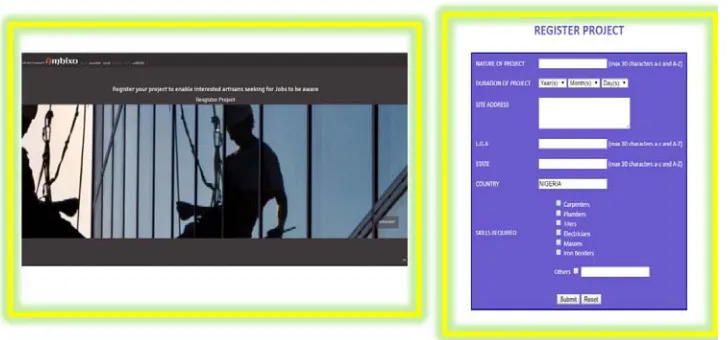
2889 plumbers, masons, painter etc.) and select based on submitted criteria requirement. Skilled labour associations and sub-contractors can also register skilled labourers with them on the system to make them eligible to be selected for construction projects that are within their location. Figure 4 showed the construction company registration interface. Construction professionals are able to register ongoing construction projects and provide details such as type of project, location, type of skilled labourer required on the project and duration of the project. This information would help skilled labourers and their associations to find construction sites that may be in need of their services within specified locations.
Construction firms and professionals on the other hand are able to search for required number of skilled labour based on registration of information that must have been supplied by skilled labourers. Figure 5 showed the skilled
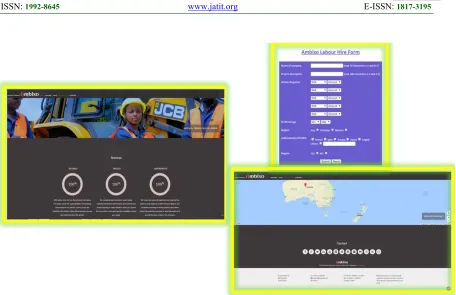
[image:5.612.116.490.364.544.2]labour registration interface. Skilled labourers are required to provide information such as trade, years of experience, location, contact number, language spoken and age of artisan. These information would help construction firms and professionals to select from the pool of registered skilled labourers. In a case where the artisan/skilled labourer is not IT literate, trade associations can help register their members on the platform. Figure 6 showed the database of skilled labourers available on the platform for selection. The skills include carpentry, plumbing, electrician, tiling, welding, heavy equipment operators, painting and masonry works. From Figure 7, construction firms and professionals are able to submit a query form of the required number and type of skilled labour needed on their construction sites. The query form helps the recruiters to streamline the requirement and those that meet the requirement are supplied for selection and they can therefore be contacted to report to the construction sites.
[image:5.612.122.495.580.717.2]2890
[image:6.612.95.527.316.498.2]Figure 4: Description of the web-based system
Figure 5: Construction company registration interface
Figure 6: Skilled labour registration interface
2891
Figure 8: Skilled labour recruiting interface
4. RESULT AND DISCUSSION
Based on the designed web-based recruiting system, the perception of construction professionals were thus sought on the challenges and benefits such platform had for the construction industry. This section presented the results and implication of the phenomenon observed in the study. This section consists of three (3) main sections which include the background information, benefits and perceived drawbacks in the use of web-based system for recruiting skilled labour for construction works.
4.1.Background Information
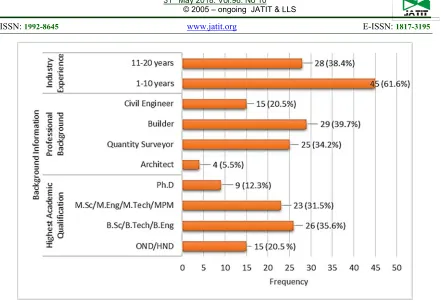
The background information showed the characteristics of the construction professionals that participated in the study. Figure 9 showed the summary of the background information of the respondents. From Figure 9, the highest academic
2892
Figure 9: Summarized background information
[image:8.612.90.306.529.670.2]Figure 10 showed the experience of using a web-based system/social media platform to source for skilled labour. The result showed that 14 (19%) construction professionals had in one time or the other used a web-based system/social media platform to source for skilled labour for their construction projects while 59 (81%) had never used a web-based system/social media platform to source for skilled labour. This result showed a low participation in the use of a web-based system/social media platform in sourcing for skilled labour.
Figure 10: Experience with a web-based system platform in sourcing for skilled labour
4.2.Benefits of Utilizing a Web-Based Recruiting System for Skilled Labour
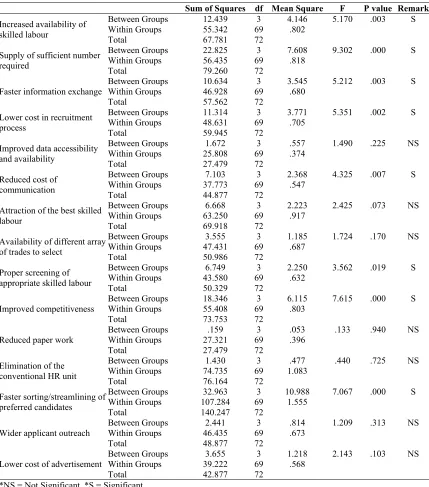
2893 number of skilled labour which are readily available to the site location, properly screened and obtained through a low-cost recruiting
[image:9.612.91.520.146.633.2]process in order to improve their competitive advantage in the construction industry.
Table 1: ANOVA test of benefits of using web-based systems for sourcing skilled labour
Sum of Squares df Mean Square F P value Remark
Increased availability of skilled labour
Between Groups 12.439 3 4.146 5.170 .003 S Within Groups 55.342 69 .802
Total 67.781 72
Supply of sufficient number required
Between Groups 22.825 3 7.608 9.302 .000 S Within Groups 56.435 69 .818
Total 79.260 72
Faster information exchange
Between Groups 10.634 3 3.545 5.212 .003 S Within Groups 46.928 69 .680
Total 57.562 72
Lower cost in recruitment process
Between Groups 11.314 3 3.771 5.351 .002 S Within Groups 48.631 69 .705
Total 59.945 72
Improved data accessibility and availability
Between Groups 1.672 3 .557 1.490 .225 NS Within Groups 25.808 69 .374
Total 27.479 72
Reduced cost of communication
Between Groups 7.103 3 2.368 4.325 .007 S Within Groups 37.773 69 .547
Total 44.877 72
Attraction of the best skilled labour
Between Groups 6.668 3 2.223 2.425 .073 NS Within Groups 63.250 69 .917
Total 69.918 72
Availability of different array of trades to select
Between Groups 3.555 3 1.185 1.724 .170 NS Within Groups 47.431 69 .687
Total 50.986 72
Proper screening of appropriate skilled labour
Between Groups 6.749 3 2.250 3.562 .019 S Within Groups 43.580 69 .632
Total 50.329 72
Improved competitiveness
Between Groups 18.346 3 6.115 7.615 .000 S Within Groups 55.408 69 .803
Total 73.753 72
Reduced paper work Between Groups Within Groups 27.321 .159 69 3 .053 .396 .133 .940 NS
Total 27.479 72
Elimination of the conventional HR unit
Between Groups 1.430 3 .477 .440 .725 NS Within Groups 74.735 69 1.083
Total 76.164 72
Faster sorting/streamlining of preferred candidates
Between Groups 32.963 3 10.988 7.067 .000 S Within Groups 107.284 69 1.555
Total 140.247 72
Wider applicant outreach
Between Groups 2.441 3 .814 1.209 .313 NS Within Groups 46.435 69 .673
Total 48.877 72
Lower cost of advertisement Between Groups Within Groups 39.222 3.655 69 3 1.218 .568 2.143 .103 NS
Total 42.877 72
*NS = Not Significant, *S = Significant
In order to have sufficient number and diversity in skill of workers, companies are turning to e-recruiting. From a total of 92% of firms that have adopted social media platforms for their e-recruitment in the United States, [31] reported that the adoption rate for LinkedIn, Facebook and Twitter as an e-recruiting tool is
2894 Companies are finding themselves in a tougher talent competition than they have in previous years, and they are already taking actions to reduce the risks. There has been an 85% increase in recruiting activities via social media since 2007 [32]. Web-based recruitment tools are now common and a wide range of companies use them with different integration levels [33]. This is most certainly the case of large companies, as well as most of small to medium-sized ones for recruiting professionals, executive and administrative staff. However, [34] argued that construction organizations could expand their internet recruiting strategies to include the skilled labor workforce to attract workers and obtain a competitive advantage. As this study posits, [35] added that this is an area that may have been overlooked by construction organizations to enhance recruitment of skilled labor.
The findings of this study is corroborated with the study by [14]. Their survey showed that the most common reasons of using online recruiting system in their recruitment were cost-effectiveness (75%), ease of use for candidates (64%), a larger candidate pool (53%), ease of use for the organization (52%), speed to hire (52%), and company policy (50%). The study by [14] showed that there was reduction in the recruitment costs, improvement in the efficiency of the recruitment process and that this form of recruitment could minimize the time taken to hire employees. In the use of web-based recruiting system, [35] noted that the number of entering applications may be extremely large and the problem turns toward selecting the ones that present the best quality potential. This can be solved by introducing the best selection tools on the web-based system that helps eliminate unqualified candidates for the skill needed. This study posits that in order to solve the incessant shortage in the availability of skilled labour needed for construction projects there is need for innovative ICT tools to be able to link the construction professionals to the available skilled labour in any location.
With an adequate and up-to-date database of construction skilled labour, construction professionals can draw up sufficient number that meet their requirement. All the benefits identified in the use of the web-based recruiting system bores down to improving
competitive advantage by construction firms. In order to attain this competitive edge, [36] noted that construction professionals have adopted the use of information and communication technology (ICT) in diverse construction processes. This competitive edge must be attained in fulfilment of consumer needs, avoiding extra costs and faster delivery times which the web-based system intends to deliver by reducing the time, cost of sourcing for skilled labour and obtaining the sufficient amount required for construction projects per time. The construction industry needs to respond to increased competition by attracting globally skilled talents, changes in both workforce attitudes and composition, shifts in the employer/worker relationship and rapid advances in HR technology. New kinds of technical knowledge, skills and abilities would require construction stakeholders to be flexible and willing to deal with the ever accelerating pace and often unpredictable changes in the construction industry.
4.3.Associated drawbacks in the use of a web-based system for recruiting skilled labour
2895
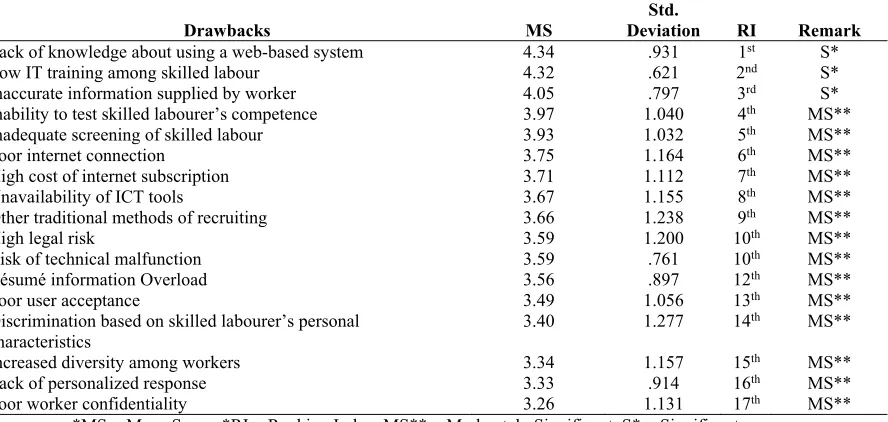
Table 2: Drawbacks in the use of a web-based system for recruiting skilled labour
Drawbacks MS
Std.
Deviation RI Remark
Lack of knowledge about using a web-based system 4.34 .931 1st S* Low IT training among skilled labour 4.32 .621 2nd S* Inaccurate information supplied by worker 4.05 .797 3rd S* Inability to test skilled labourer’s competence 3.97 1.040 4th MS** Inadequate screening of skilled labour 3.93 1.032 5th MS**
Poor internet connection 3.75 1.164 6th MS**
High cost of internet subscription 3.71 1.112 7th MS**
Unavailability of ICT tools 3.67 1.155 8th MS**
Other traditional methods of recruiting 3.66 1.238 9th MS**
High legal risk 3.59 1.200 10th MS**
Risk of technical malfunction 3.59 .761 10th MS**
Résumé information Overload 3.56 .897 12th MS**
Poor user acceptance 3.49 1.056 13th MS**
Discrimination based on skilled labourer’s personal characteristics
3.40 1.277 14th MS** Increased diversity among workers 3.34 1.157 15th MS**
Lack of personalized response 3.33 .914 16th MS**
Poor worker confidentiality 3.26 1.131 17th MS**
*MS = Mean Score, *RI = Ranking Index, MS** = Moderately Significant, S* = Significant The result of the study revealed that
construction professionals perceived that a lack of knowledge about a web-based system for recruiting skilled labour could be a major challenge in the successful implementation of the system. On the part of the skilled labour, construction professionals are of the opinion that the low IT training could hinder the system and for those that use the system there could be questions about the integrity of the information supplied by the skilled labour. This findings are corroborated with findings in [34]. [34] reported that the major obstacles to the use of web-based recruiting system for sourcing for skilled labour include attitude within the construction firm, usage limitations of the internet, lack of IT skills and limited computer and internet access by the skilled craft labor. The study sought to understand if there was any difference in the perception of the construction professionals towards the drawbacks of using web-based systems for sourcing for skilled labour. The study tested the hypothesis;
Ho: there is no significant difference about the drawbacks in the use of a web-based recruiting system for sourcing for skilled labour in the project delivery process.
H1: there is no significant difference about the drawbacks in the use of a web-based recruiting system for sourcing for skilled labour in the project delivery process.
2896
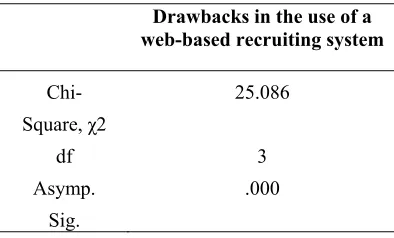
Table 3: Kruskal-Wallis Test on the drawbacks in the use of a web-based recruiting system for sourcing for
skilled labour.
Drawbacks in the use of a web-based recruiting system
Chi-Square, χ2
25.086
df 3
Asymp. Sig.
.000
One of the significant findings to emerge from the study by [37] is that, a key implementation challenge to e-recruitment was the cultural approach of the organization towards the innovative tool and the lack of knowledge about the tool within the Human Resource (HR) community. When construction professionals lack adequate knowledge about an innovative ICT tool, there is no doubt that it can create a form of bias towards such tool. Therefore, the need for training and education in order to increase awareness about new technologies in the construction industry.
The internet on the other hand is playing a great role on community development, as it provides an access to different information through search engines and allows interaction between the societies [10]. In the study by [34], construction organizations responded that they want more construction related job web sites that are specific to the construction industry and easy to locate in a search. Based on the responses, it appears that employers experience frustration in locating job-recruiting sites that meet their needs. This may be due to the lack of existing web-based recruiting skill labour sites or the inability to locate the sites during a search. It may also indicate that the existing internet recruiting sites used by the construction industry are insufficient or inadequate for listing job applicants.
Furthermore, in developing countries, the use of web-based recruiting systems may be restricted to individuals or location where the infrastructure to implement information and communication technologies (ICTs) exist, such as in urban centres. This is because ICT infrastructures in the town and cities is more pronounced, leaving many places especially rural
areas with no access to internet [10]. This would make many skilled labourers living in the rural parts unable to access the job information required in the urban centres. As shown in Figure 10, some construction professionals have engaged the use of social media or other web-based systems in sourcing for skilled labour on construction projects, therefore, the differences in the agreement on the drawbacks in the use of a web-based recruiting system for sourcing for skilled labour. The traditional recruitment approach may be a barrier which creates a fear of change (FOC) in the attitudes of some construction professionals towards the use of the ICT tool. While, some of the construction professionals that do not agree with the drawbacks to the use of a web-based recruiting system for sourcing for skilled labour may have participated in the use of such systems and found it rewarding. The key point to note in this study is, knowledge is crucial in increasing the user acceptability of a new technological tool.
5. CONCLUSION AND
RECOMMENDATION
The study evaluated construction professionals’ perception of a web-based recruiting system for sourcing for skilled labour. The study developed a web-based recruiting system which was modeled using a system block design and a use case diagram. The final web design templates were presented in pictorial screen shots. Based on the designed web-based platform, the study revealed that in recruiting skilled labour for construction projects, construction professional perceive that it would benefit the construction industry by increasing the availability of skilled labourers, supply of sufficient number of skilled labour required, lower the cost of recruitment process, reduce the cost of communication, ensure proper screening
of qualified candidates and improve
2897 Future research can be focused on the need to measure the cost-effectiveness of using a web-based system in sourcing for workforce in the construction industry. Furthermore, the use of web-based system can be integrated in other factors of production or resources in the construction industry including managing materials, plants and equipment, managing time etc. Aligned with any introduction of new technology is the requirement for increased awareness and new skill development. Training to input data and search the database of any new technology and becoming more aware of what any innovative ICT tool can offer should be a priority in trying to influence cultural change between employers and employees. This training involves technology-related training, courses or development as part of cultural change which can bring about alterations to attitudinal and behaviourial bias to innovative ICT tools in the construction industry. A crucial strategy in addressing the stiff cultural bias to new technologies by employees and potential employees is through continuous training and re-training about efficient and effective work delivery. Education is a fundamental element that brings the knowledge about ICT tools and new technologies to the users, up to the point where they can acquaint themselves with the new innovative ICT tool quickly and sufficiently. The world is already a ‘global town’ where construction professionals and skilled labour cannot afford to be left behind in the traditional approach of delivering construction projects. Through continuous professional development (CPD) courses or trainings, construction professionals can be abreast of latest ICT tools. While the hope that with the increase in many skilled labour’s affinity to social media, skilled labourers would soon catch up with the trend of being ICT compliant on several construction projects.
REFERENCES
[1] CIOB, Chartered Institute of Building, CIOB,
“Skills shortages in the UK construction
industry”, Chartered Institute of Building
Survey, 2008.
[2] B. O. Oseghale, J. O. Abiola-Falemu and G. E. Oseghale, “An evaluation of skilled labour shortage in selected construction
firms in Edo state, Nigeria”, American
Journal of Engineering Research, Vol. 4,
No. 1, 2015, pp. 156–167.
[3] A. Akindoyeni, “Nigerian Building
Craftsmen; which way forward?”, Text of
paper presented at the NIOB craftsmen’s summit at Yaba College of Technology, Lagos, 2005.
[4] J. Wells and D. Wall, “The expansion of employment opportunities in the building construction sector in the content of structural adjustment: some evidence from
Kenya and Tanzania”, Habitat
International, Vol. 27, No. 3, 2003, pp.
325-337.
[5] A. R. J. Dainty, S. G. Ison and D. S. Root, “Bridging the skill gap: A regionally driven strategy for resolving the construction
labour market crisis”, Eng., Constr. and
Arch. Mgt., Vol. 11, No. 4, 2004, pp.
275-283.
[6] A. Afolabi, O. I. Fagbenle and T. O. Mosaku, “IT Management of Building Materials’ Planning and Control processes Using
Web-Based Technologies”, In: Á. Rocha et al.
(eds.), Recent Advances in Information
Systems and Technology, Advances in
Intelligent Systems and Computing, Vol.
570, Chapter 2, Springer, Cham, 2017, pp. 12-19.
[7] A. Afolabi, I. Emeghe, O. Oyeyipo and R. Ojelabi, “Professionals’ preference for migrant craftsmen in Lagos State”,
Mediterranean Journal of Social Sciences,
Vol. 7, No. 1, 2016, pp. 501 – 508.
[8] K. T. Odusami and G. U. Ene, “Tackling the
shortage of construction skills in Nigeria”,
A paper presented at a 2-day national seminar organized by the Nigerian Institute of Quantity Surveyors, vision 20-2020: strategic industry development within National Development Goals in Abuja, 2011, pp. 1- 6.
[9] K. F. Zimmermann, “European Labour
Mobility: Challenges and Potentials”, De
Economist, Vol. 153, 2005, pp. 425 - 450.
[10] N. A. Mwasha, “An Over-view of Online Recruitment: The Case of Public and Private
Sectors in Tanzania”, European Journal of
Business and Management, Vol. 5, No. 32,
2013, pp. 11 – 21.
[11] Nigel Wright Recruitment, “The impact of social media on recruitment”, Nigel Wright
Recruitment, Report 2011.
2898 [12] A. Clements, “Social media and recruitment:
time for a coherent HR strategy?”, HR
Magazine, 16th February 2012.
http://www.hrmagazine.co.uk/hr/features/1 020862/social-media-recruitment-coherent-hr-strategy.
[13] H. Davison, C. Maraist and M. Bing, “Friend or foe? The promise and pitfalls of using social networking sites for HR decisions”,
Journal of Business Psychology, Vol. 26,
No. 2, 2011, pp. 153-159.
[14] E. Parry and S. Tyson, “Desired goals and
actual outcomes of e-HRM”, Human
Resource Management Journal, Vol. 21,
No. 3, 2008, pp. 335 - 354.
[15] V. V. Parkar, P. P. Shinde, S. C. Gadade and P. M. Shinde, “Utilization of Laravel Framework for Development of Web Based
Recruitment Tool”, Journal of Computer
Engineering, 2011, pp. 36 – 41.
[16] C. Crestone, “Cedar Crestone 2009–2010
HR Systems Survey White Paper HR
Technologies”, Service delivery approaches
and metrics 12th annual edition (Retrieved
December 5, 2017 from
http://www.cedarcrestone.com/research.ph p), 2010.
[17] I. Lee, “The evolution of e-recruiting: A content analysis of Fortune 100 career web
sites”, Journal of Electronic Commerce in
Organizations, Vol. 3, No. 3, 2005, pp. 57 −
68.
[18] B. Lin and V. S. Stasinskaya, “Data Warehousing Management Issues in Online
Recruiting”, Human Systems Management,
Vol. 21, No. 1, 2002, pp. 1 – 5.
[19] E. O. Ibem and S. Laryea, “e-tendering in the South African construction industry”,
International Journal of Construction
Management, Vol. 17, No. 4, 2017, pp. 310
– 328.
[20] A. Afolabi, D. Owolabi, R. Ojelabi and D. Aina, “Development of a web-based tendering protocol for procurement of construction works in a tertiary institution”,
Journal of Theoretical and Applied
Information Technology, Vol. 95, No. 8,
2017, pp. 1595-1606.
[21] E. B. Aduwo, E. O. Ibem, O. Uwakonye, P. Tunji-Olayeni and E. K. Ayo-Vuaghan, “Barriers to the uptake of E-procurement in
the Nigerian building industry”, Journal of
Theoretical and Applied Information
Technology, Vol. 89, No. 1, 2016, pp. 115 –
129.
[22] M. Salehi, “Investigating Website Success in
the Context of e-Recruitment: An Analytic
Network Process (ANP) Approach”, Lulea
University of Technology, 2009.
[23] K. Ghazzawi and A. Accoumeh, “Critical Success Factors of the E-Recruitment
System”, Journal of Human Resources
Management and Labor Studies, Vol. 2, No.
2, 2014, pp. 159 – 170.
[24] S. L. Lakshmi, “e-Recruitment: A boom to the organizations in the competitive world”,
Journal of Business and Management, 2011,
pp. 25 – 28.
[25] S. L. Fisher, “An Evidence-Based Review of E-HRM and Strategic Human Re-source
Management”, Proceedings of the Third
European Academic Workshop on
electronic Human Resource Management,
Bamberg, Germany, Vol. 570, 2010, pp. 33 - 51.
[26] F. B. Nivlouei, “Electronic Human Resource Management System: The Main Element in Capacitating Globalization Paradigm”,
International Journal of Business and
Social Science, Vol. 5, No. 2, 2014, pp. 147
– 159.
[27] A. Esakhani, “Information technology and
challenges facing human resource
management”, The fourth Conference on
Human Resource Development, Iran.
Tehran, 2010.
[28] P. W. Braddy, A. W. Meade and C. M. Kroustalis, “Organizational recruitment website effects on viewers’ perceptions of
organizational culture”, Journal of Business
and Psychology, Vol. 20, 2006, pp.
525-543.
[29] R. O. Akinyede and O. A. Daramola, “Neural Network Web-Based Human Resource
Management System Model”, International
Journal of Computer Networks and
Communications Security, Vol. 1, No. 3,
2013, pp. 75 – 87.
[30] O. O. Oluwagbemi and A. Akinsaya,
“Development of a medical staff
recruitment system for teaching hospitals in
Nigeria”, International Journal of Natural
and Applied Sciences, Vol. 6, No. 1, 2010,
pp. 116-124
[31] M. Sills, “E-recruitment: A comparison with traditional recruitment and the influences of social media: A qualitative and quantitative
review”, Unpublished thesis submitted to
Helsinki Metropolia University of Applied
2899 [32] S. Salmen, “What's Next - Die nächsten
Trends”, In B. H. Rath, & S. Salmen,
Recruiting in Social Web. Göttingen:
BusinessVillage GmbH, 2012, pp. 284. [33] J. Malinowski, T. Keim and T. Weitzel,
“Analyzing the Impact of IS Support on Recruitment Processes: An E-Recruitment
Phase Model”, Pacific Asia Conference on
Information System (PACIS) Proceedings,
2005, pp.977 - 988
[34] C. T. Hass, R. W. Glover, R. L. Tucker and R. K. Terrien, “Impact of the internet on the
recruitment of skilled labor”, A Report of
Center for Construction Industry Studies,
the University of Texas at Austin, 2001, pp. 1 – 56.
[35] C. Deillon, “The advantages and challenges of turning towards e-recruitment for small and medium sized businesses (SME)”,
Unpublished Thesis submitted to the Department of Informatics, University of
Fribourg, Switzerland, 2014, pp. 1 – 39.
[36] A. A. Oladapo, “The Impact of ICT on Professional Practice in the Nigerian
Construction Industry”, The Electronic
Journal on Information Systems in
Developing Countries, Vol. 24, No. 2, 2006,
pp. 1 – 19.
[37] M. Kerrin and P. Kettley, “e-Recruitment: Is
it delivery?”, The Institute for Employment
Studies, Report 402, 2003, pp. 1 – 98.
[38] A. O. Ogunde, O. Olaolu, A. Afolabi, J. Owolabi and R. Ojelabi, “Challenges
confronting construction project
management system for sustainable construction in developing countries: Professionals perspectives (a case study of
Nigeria)”, Journal of Building
Performance, Vol. 8, No. 1, 2017, pp. 1 –
11.