The Impact of E-learning system using Rank-based
Clustering Algorithm (ESURBCA)
D.Suresh
M.Phil (CS) Research Scholar SCSVMV University Enathur, Kanchipuram
S.Prakasam,
Ph.D Assistant ProfessorDepartment of CSA, SCSVMV University Enathur, Kanchipuram
ABSTRACT
E-learning is emerging as the new paradigm of modern education. Most of the e-learning systems have limitations such as scarcity of content, lack of intelligent search and context sensitive personalization problems, which are the challenging tasks for researchers. This motivated the author to take up this problem and the method implemented through this work suggests the instructors to use the combination of E-learning System Using Rank-Based Clustering Algorithm (ESURBCA) was designed. The main aim of the model developed is to get consistency in content delivery, quality content in learning materials, students self-learning concept, and performance improvement in their examination. A study has been conducted During June 2013 to September 2013, the author collected samples of 1631 from final year and Second year of BCA, B.SC and B.Sc-IT students were trained through e-learning system architecture and the objectives of this study is 1. To measure the effectiveness of E-learning System Using Rank-Based Clustering Algorithm (ESURBCA) among the students of Mercury College of arts and science And Sankara arts and Science College in concepts of Programming in JAVA Course. The newly designed E-learning System using Rank-Based Clustering Algorithm (EUSRBCA)shows an improvement over the existing systems with better results. From the various evaluations carried out, the performance of the system found to be good comparatively to other systems in e-learning domain.
1.
INTRODUCTION
The concept of e-learning is expected to develop as technology advances. In order to boost the gains of e-learning market, the learning components are developed [16] that interoperate and co-operate. The great advantages of e-Learning include liberating interactions between learners and instructors, or learners and learners, from limitations of time and space through the asynchronous and synchronous learning networks.
2.
RELATED WORK OF E-LEARNING
This section presents a literature survey of the approaches used in e-learning environments. [15]Describes learning styles as the preferred ways through which learners interact with and process information in learning environments. Different views of learning styles were and are still discussed in the literature. Behaviorism, a reductionist view of human behavior, dominated the field in the first half of the 20th century. It was called reductionist because it used a black box approach based on empiricism, but such a simplified view left much to be desired. Rogers points out that "learning includes goals, purposes, intentions, choice and decision-making, and it is not at all clear where these elements fit into the learning cycle" [12].online learning has advantages over traditional face-to-face education [8], concerns include time, labor intensiveness, and material resources involved in running Learning environments. The costly high failure rate of
[image:1.595.310.547.240.765.2]e-Learning implementations discussed by [2] deserves attention from management and system designers.
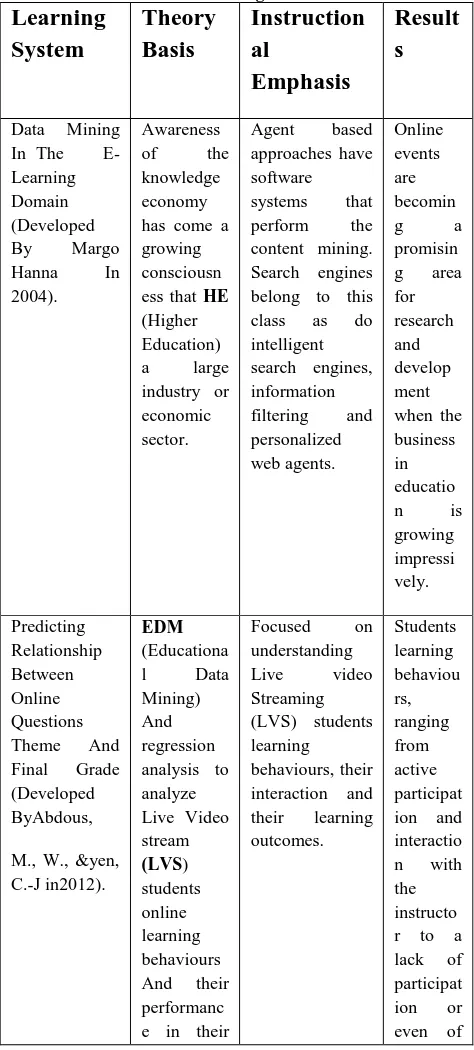
Table 1.1 Comparative study of existing Data mining based e-learning methods
Learning
System
Theory
Basis
Instruction
al
Emphasis
Result
s
Data Mining In The E-Learning Domain (Developed By Margo Hanna In 2004).
Awareness of the knowledge economy has come a growing consciousn ess that HE (Higher Education) a large industry or economic sector.
Agent based approaches have software systems that perform the content mining. Search engines belong to this class as do intelligent search engines, information filtering and personalized web agents.
Online events are becomin
g a
promisin g area for research and develop ment when the business in educatio n is growing impressi vely.
Predicting Relationship Between Online Questions Theme And Final Grade (Developed ByAbdous,
M., W., ¥, C.-J in2012).
EDM (Educationa l Data Mining) And regression analysis to analyze Live Video stream (LVS) students online learning behaviours And their performanc e in their
Focused on understanding Live video Streaming (LVS) students learning behaviours, their interaction and their learning outcomes.
course. attendan ce.
Mining Educational
Data to
improve students’ performance( Developed by M.abu Tair,Alaa M
Educational data mining (EDM) to improve graduate students performanc
e and
overcome the problem of low grade to graduate students.
Data preparation and
preprocessing of the data set and to get better input data for data mining techniques some preprocessing for the collected data before loading the data set to the data mining software. here we are used some data mining techniques such as association rules,
classification,clu steringand outlier detection used two ways i)Distance-Based Approach and ii)Density based approach.
Data mining can be used in higher educatio n particula rly to improve graduate students performa nce. Graduate students data collected from college of science technolo gy in khanyou nis.the data include 15years period(1 993-2007).
Using data mining for e-learning decision making(Devel oped by David Monk in2005)
Learners followed when offered the course in custom Virtual Learning Environme nt(VLE) which is structured by
Task, course material and learning resources. Quickly became
The custom VLE comprises a number of dynamic active server pages
(ASP) a
frameset, style sheet and GUI graphics. The course content is offered via Three view-materials, tasks and library resources.
The findings that indicate 80% of users accumul ate less than one hour a week with the course materials VLE with around two-thirds of all users acquiring less than
clear that students were spending little time with the course materials online and the time spent each pages was usually less than 20 seconds.
30 minutes
Data Mining - based E-learning system (DMBELS)
Developed by M.Prema and S.Prakasam in2013)
The method implemente d through this work suggests the instructors to use the combinatio n of the data mining based e-learning system (DMBELS) was designed. The main aim of the model developed is to get consistency in content delivery, quality content in learning materials, students self-learning concept, and performanc e
improveme nt in their examinatio
n. To
measure the effectivenes s of data mining technique based e-learning
The text based search engine is created, which is capable of extracting the documents from open source learning objects. Document retrieval is based
on the
occurrence of computer application based terminologies and keywords based on the user search text.
system (DMBELS) among the students of SCSVMV University in concepts of First Aid awareness course.
3.
ARCHITECTURE OF E-LEARNING
SYSTEM
In this work, architecture of e-Learning the combination of E-learning System Using Rank-Based Clustering Algorithm (ESURBCA). The Rank-Based Clustering Algorithm is capable of retrieving computer application based databases from the www and they are clustered based on the relativeness of the document to the user search. Clustering is based on page ranking which represents the level of relativeness for the retrieved clustered documents. Document retrieval is based on the occurrence of the computer application based terminologies and keywords based on the user search text.
[image:3.595.53.292.355.525.2]Fig 1.1 Architecture of E-Learning System using Rank-Based Clustering Algorithm
The below is the algorithm for Rank-Based Clustering Algorithm used in the Architecture of e-learning system Step1: Enter the searching text
Step2: Analyzed keyword and terminology from text
Step3: The relation set to identify the keyword from text
Step4: Through Word Net extract AlterNet keyword and terminology, store to the relation set list
Step5: The relation list, displayed related Docs from OSDBS
Step6: Extracted Docs stored to temporary folder
Step7: Doc list organizer rank and clustering the Docs on Rank based score
Step8: Rank score evaluation determinate was direct match keyword and found direct match terminologies.
4.
PERFORMANCE EVALUATION OF
E-LEARNING
Data mining-based e-learning system environment combined the pedagogical, communication and software tools integrated into one system that is used to promote learning. This helps to create an optimal knowledge building and learning environment for students.
A study has been conducted to measure the effectiveness of e-learning system using Rank-Based Clustering Algorithm among the students of Mercury College of arts and science And Sankara arts and Science College in concepts of Java programming course.
The purpose of the study was twofold: (i) to measure the effectiveness of E-learning System Using Rank-Based Clustering Algorithm (ESURBCA) (ii) To find the student effectiveness (test mark) of E-learning System Using Rank-Based Clustering Algorithm (ESURBCA) among the students of Mercury College of arts and science And Sankara arts and Science College in concepts of Java programming course based on their marks before and after the e-learning course. This paper presents how the collected data are analyzed through appropriate statistical techniques and the results of data analysis.
Fig 1.2 Rank-Based Clustering Algorithm
Rank-Based Clustering Algorithm
Course Database
Test Database
User Interface Screen
WWW
Searching Text
Analyzed keyword and terminology from text
Relation set to identify the keyword from text
Word Net extract AlterNet keyword and terminology, store to the relation set list
The relation list, displayed related Docs from OSDBS
Extracted Docs stored to temporary folder
Doc list organizer rank and clustering the Docs on Rank based score
Fig 1.3 Implementing the Architecture of E-Learning System forJava Programming
4.1 Performs Validation of E-learning
system
[image:4.595.52.284.391.583.2]To find the student effectiveness (test mark) of To measure the effectiveness of E-learning System Using Rank-Based Clustering Algorithm (ESURBCA) among the students of Mercury College of arts and science And Sankara arts and Science College in concepts of Programming in JAVA Course based on their marks before and after the e-learning course during June 2013 to September 2013, the author collected samples of 1631 from final year and Second year of BCA,B.SC and B.Sc-IT students trained through e-learning system architecture.
Table 1.2 Number of respondents based on Course
Details of the learners
Tot al B.S
C – CS
III B.S
C-IT
III BC
A
III B.S C – CS
II B.S
C-IT
II BC
A
II B.S C – CS
II
source of learni ng
Group A
(TTM)
126 94 126 65 128 131 134 804
Group B
(MAABE LS)
125 93 135 72 129 138 135 827
Total 251 187 261 137 257 269 269 163 1
4.2 Hypothesis Tested
4.2.1 Research Hypothesis (H1)
There will be a significant difference in the opinion and preferences of students between the traditional teaching method (TTM) and E-learning System Using Rank-Based Clustering Algorithm Null Hypothesis (Ho) there will not be a significant difference in the opinion and preferences of students between the traditional teaching method (TTM) and E-learning System Using Rank-Based Clustering Algorithm (ESURBCA) based on factors.
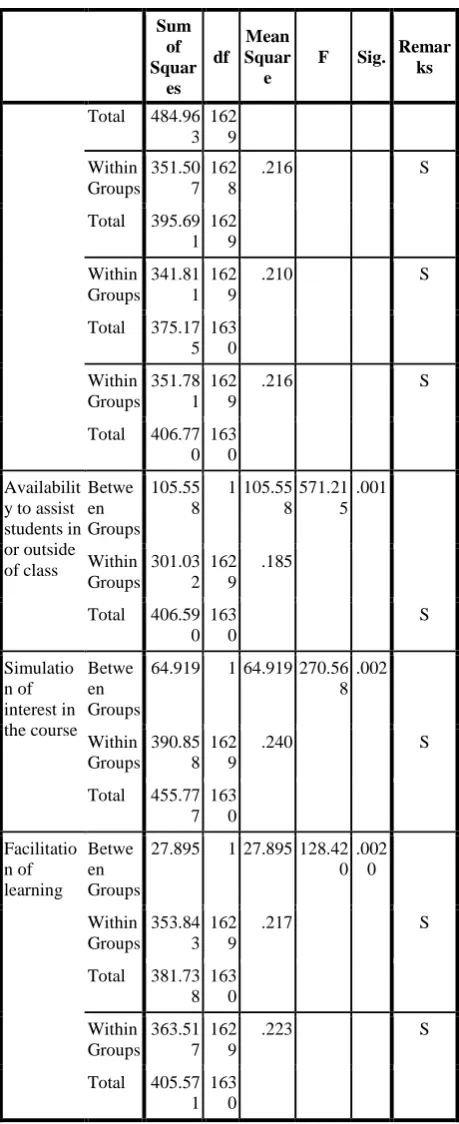
Normally ANOVA test requires the independent and dependent variables to test the significance. It is further classified into one-way and multi [MANOVA] analysis. The table 1.3 shows the significant difference in the opinion and
preferences of students between the traditional teaching method (TTM) and E-learning System Using Rank-Based Clustering Algorithm (ESURBCA) based on factors (ESURBCA) based on factors.
Table 1.3 ANOVA Table
Sum of Squar
es df
Mean Squar
e
F Sig. Remar ks
Feedback about the performan ce in the course
Betwe en Groups
76.293 1 76.293 370.36 2
.001
Within Groups
335.56 8
162 9
.206 S
Total 411.86 1
163 0
The instructors interest in your learning
Betwe en Groups
48.368 1 48.368 222.47 5
.001 2
Within Groups
353.94 0
162 8
.217 S
Total 402.30 7
162 9
Utilization of class time
Betwe en Groups
127.97 8
1 127.97 8
746.23 5
.002 1
Within Groups
279.19 8
162 8
.171 S
Total 407.17 5
162 9
The instructors overall organizati on of the course
Betwe en Groups
36.125 1 36.125 164.01 0
.001 4
Within Groups
358.58 7
162 8
.220 S
Total 394.71 2
162 9
Continuity from one class meeting to the next meeting
Betwe en Groups
113.90 6
1 113.90 6
631.77 7
.001 7
Within Groups
293.52 0
162 8
.180 S
Total 407.42 6
162 9
The instructors assessmen t of your progress in the course
Betwe en Groups
112.02 7
1 112.02 7
605.50 8
.002 8
Within Groups
301.20 2
162 8
.185 S
Total 413.22 9
162 9
Learning materials used in the courses
Betwe en Groups
66.353 1 66.353 258.05 0
.002 2
Within Groups
418.61 0
162 8
Sum of Squar
es df
Mean Squar
e
F Sig. Remar ks
Total 484.96 3
162 9
Within Groups
351.50 7
162 8
.216 S
Total 395.69 1
162 9
Within Groups
341.81 1
162 9
.210 S
Total 375.17 5
163 0
Within Groups
351.78 1
162 9
.216 S
Total 406.77 0
163 0
Availabilit y to assist students in or outside of class
Betwe en Groups
105.55 8
1 105.55 8
571.21 5
.001
Within Groups
301.03 2
162 9
.185
Total 406.59 0
163 0
S
Simulatio n of interest in the course
Betwe en Groups
64.919 1 64.919 270.56 8
.002
Within Groups
390.85 8
162 9
.240 S
Total 455.77 7
163 0
Facilitatio n of learning
Betwe en Groups
27.895 1 27.895 128.42 0
.002 0
Within Groups
353.84 3
162 9
.217 S
Total 381.73 8
163 0
Within Groups
363.51 7
162 9
.223 S
Total 405.57 1
163 0
Depending on the Feedback about the performance in the course, among the traditional teaching method (TTM) and E-learning System Using Rank-Based Clustering Algorithm (ESURBCA), there is significant difference exist among the learners. It is proved through the table 1.3 that significance is 0.001 which is less than 0.05. So the Null Hypothesis is rejected.
There is a significant difference between the traditional teaching method (TTM) and E-learning System Using
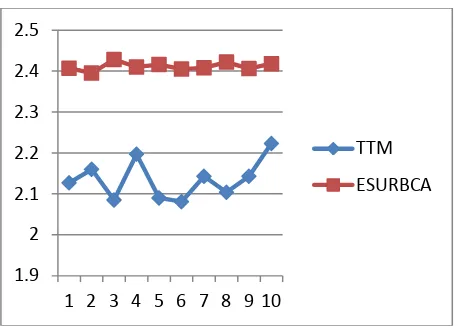
[image:5.595.52.282.68.631.2]Rank-Based Clustering Algorithm (ESURBCA), among the learners, in the following factors (Fig 1.3), Feedback about the performance in the course, The instructors interest in your learning, The instructors assessment of your progress in the course Utilization of class time, The instructors overall organization of the course, Continuity from one class meeting to the next meeting, Learning materials used in the courses, Availability to assist students in or outside of class was, Simulation of interest in the course was and Facilitation of learning , are in favour of E-learning System Using Rank-Based Clustering Algorithm (ESURBCA) method at the level of significance of 0.05.
Table 1.4 Mean Values
S.NO FACTORS TTM ESURBCA
1 Feedback about the performance in the
course 2.127 2.407
2 The instructors interest in your
learning 2.16 2.395
3 Utilization of class
time 2.085 2.428
4 The instructors overall organization of the
course 2.197 2.41
5 Continuity from one class meeting to the
next meeting 2.09 2.416
6 The instructors assessment of your
progress in the course 2.081 2.405
7 Learning materials
used in the courses 2.143 2.408
8 Availability to assist students in or outside
of class was 2.104 2.422
9 Simulation of interest
in the course was 2.143 2.406
10 Facilitation of
Fig 1.4 Effectiveness of ESURBCA
5.
CONCLUSION
The concepts of e-learning system have been outlined. E-learning is considered in the context of formally and systematically organized teaching and learning activities, in which the instructor and the learner(s) use ICT to facilitate their interaction and collaboration. The use of data mining based e-learning system will definitely impact the quality of the education that is delivered and the deliverability of information through knowledge and information sharing. The newly designed E-learning System using Rank-Based Clustering Algorithm (EUSRBCA)shows an improvement over the existing systems with better results. From the various evaluations carried out, the performance of the system found to be good comparatively to other systems in e-learning domain.
6.
REFERENCES
[1] Ajzen, I., & Fishbein, M. (1977). Attitude–behavior
relations: a theoretical analysis and review of empirical research. Psychological Bulletin, 84, 888–918.
[2] Arbaugh, J. B., & Duray, R. (2002). Technological and structural characteristics, student learning and satisfaction with web-based courses – An exploratory study of two on-line MBA programs. Management Learning, 33(3), 331–347.
[3] Aronen, R., & Dieressen, G. (2001). Improvement equipment reliability through e-Learning. Hydrocarbon Processing, 47–57.
[4] Bhattacherjee, A. (2001). Understanding information systems continuance: an expectation confirmation model. MIS Quarterly, 25(3), 270–351.
[5] Katz, Y. J. (2000). The comparative suitability of three ICT distance learning methodologies for college level instruction. Educational Media International, 37(1), 25– 30.
[6] Katz, Y. J. (2002). Attitudes affecting college students’ preferences for distance learning. Journal of Computer Assisted Learning, 18,2–9
[7] Lewis, C. (2002). Driving factors for e-Learning: an organizational perspective. Perspectives, 6(2), 50–54. Lin, Cathy S., Wu, S., & Tsai, R. J. (2005). Integrating perceived playfulness into expectation-confirmation model for web portal context. Information & Management, 42, 683–693.
[8] Piccoli, G., Ahmad, R., & Ives, B. (2001). Web-based virtual learning environments: a research framework and a preliminary assessment of effectiveness in basic IT skill training. MIS Quarterly, 25(4), 401–426.
[9] Wu, J. P., Tsai, R. J., Chen, C. C., & Wu, Y. C. (2006). An integrative model to predict the continuance use of electronic learning systems: hints for teaching. International Journal on E-Learning, 5(2), 287–302.
[10]Khairil Imran Ghauth and, Nor Aniza Abdullah, (2009) An Empirical Evaluation Of Learner Performance In E-Learning Recommender Systems And An Adaptive Hypermedia System, pp 141-152.
[11]Jonassen, D. H., Computers in the Classroom, Englewood Cliffs, NJ:Merrill, Keefe, J. W. (1987), in "Learning Style”.
[12]Peters, J., Jarvis, P. et al., Adult Education, San Francisco, CA, Ed Rogers, A., Teaching Adults, Buckingham: Open University Press
[13]Jemni, M., & Nasraoui, O. (2009). Automatic recommendations for e-learning personalization based on web usage mining techniques and information retrieval. Educational Technology & Society, 12(4), 30–42.
[14]Liang, G., Weining, K. & Junzhou, L. (2006). Courseware recommendation in e-learning system. Advances in Web Based Learning – ICWL2006, Springer Berlin/Heidelberg, 10-24.
[15]Kerkiri, T., Manitsaris, A. & Mavridou, A. (2007). Reputation metadata for ecommending personalized e-learning resources. Proceedings of the Second International Workshop on Semantic Media Adaptation and Personalization, Uxbridge, 110-115.
[16] Namuth, Fritz, King, & Boren, 2005 Principles of sustainable learning object libraries. Interdisciplinary journal of knowledge and Learning objects, 1,181-196. Available at http://ijklo.org/volume1/v1p181- 196Namuth.pdf
[17] Peters, J., Jarvis, P. et al., Adult Education, San Francisco, CA, Ed Rogers, A., Teaching Adults, Buckingham: Open University Press, 1996.
[18] M.Prema and S.Prakasam Effectiveness of Data Mining - based E-learning system (DMBELS) International Journal of Computer Applications (0975 – 8887) Volume 66– No.19, March 2013.
1.9 2 2.1 2.2 2.3 2.4 2.5
1 2 3 4 5 6 7 8 9 10
TTM