79 International Journal of Psychology Vol. 11, No. 2, Summer & Fall 2017
PP. 79-101
Iranian Psychological
Association
The Moderating Role of Personality Dimensions
in the Relationship between
Brain-Behavioral Systems and Multiple
Sclerosis Severity
Reza Abdi*, PhD
Department of Psychology Azarbaijan Shahid Madani University, Tabriz, Iran.
Gholam Reza Chalbianloo, PhD
Department of Psychology Azarbaijan Shahid Madani
University, Tabriz
Razieh Pak
M. A. in General Psychology Azarbaijan Shahid Madani University, Tabriz
Multiple Sclerosis (MS) is one of the neurological disorders that occur along with the degeneration of the myelin sheath. The aim of the present study was to investigate the moderating role of personality dimensions in the relationship between brain-behavioral systems and multiple sclerosis severity in individuals suffering from MS. This research was a correlational study in which 162 patients with MS were selected as statistical samples by the purposive sampling method in the City of Shiraz. Data were analyzed by Pearson’s correlation coefficient and moderated regression. The findings revealed that brain-behavioral systems
significantly predict MS severity (P <.01 and FChange= 5.66) and
only the neuroticism dimension as the moderator significantly increased the determined variance on MS severity (P<.01, β=.77,
and FChange= 54.22). Therefore, neuroticism was able to moderate
these relationships and increase their amounts.The obtained results
confirmed the moderating role of neuroticism in the relationship between reinforcement sensitivity and the severity of the extent of disability in MS.
80
Keywords: multiple sclerosis, brain-behavioral systems, personality dimensions
Multiple Sclerosis is the most prevalent autoimmune disease that disables the Central Nervous System (CNS), and emerges as a result of gliosis and axonal degeneration in the form of inflammation (Troster & Alexander, 2006); therefore, all the parts of the CNS are exposed to risk (Kikuchi, 2013). Inflammation and degeneration of the myelin sheath through astrocytes duplication not only affects the sensory and motor functions but also results in the incidence of psychopathological symptoms (Haussleiter, 2009). Lesions inside of or adjacent to the cortex bear significant impacts on the relationship between brain injury in MS patients and cognitive disorders; in addition, there is a relationship between cognitive disorders and psychological changes, such as apathy and depression, in this clinical population (Dennison, 2009). Although MS is rarely fatal in comparison to individuals suffering from other chronic diseases, it has a wide range of unpleasant and disabling symptoms (Harbige, 2007), and psychological problems are prevalent in MS patients (Haussleiter, 2009).
81
apathy, instability, impulsivity (Bruce, 2011), high rate of depression and distress (Nocentini & Caltagirone, 2012), anxiety (Ožura, 2010), reduced quality of life (Hopman, 2007; Hopman, 2009) and trouble with social roles (Mohr, 2004).
82
quality of life, problems in pursuing treatment, and intensifying the MS symptoms (Garfield, 2012). Yet, the main factor that causes anxiety in this clinical population has not been determined so far (Iova & Popescu, 2014), and no study has been conducted to explain whether brain-behavioral systems can predict the psychological symptoms of MS patients or not. A part of the present study is devoted to this subject and may thus lead to significant findings.
83
theories also suggest that understanding the relationship between personality and health is considered highly important; each of these five factors has affected health levels (Jackson, 2009). Therefore, it is expected that these factors moderate the relationship between the personality construct and the health levels. According to Diana, Grosz, and Mancini (1985), investigating the psychological aspects of MS patients in comparison to healthy people revealed that some psychological aspects were associated with disease severity; it can thus be suggested that their bases goes back to early childhood as personality patterns (Diana, Grosz & Mancini, 1985). All in all, the research indicates that there is a complex relationship between personality features and mood disorders/anxiety (Bruce, 2011), and MS severity.
84
increase one’s psychological knowledge about the predictive factors of MS severity but it also provides us with valuable information about preventive and psychological interventions. This research is attempting to answer the question of whether brain-behavioural systems contribute to the severity of MS symptoms and whether it is possible for personality dimensions to have mediating role?
Method
The research design of the present study is correlational in domain of fundamental-operational studies. The study population includes all the MS patients in the City of Shiraz; the statistical sample includes 162 MS patients who visited the MS Clinic and Association in Shiraz and these patients were selected through the purposive sampling method considering some inclusion and exclusion criteria.
NEO Five-Factor Personality Inventory
85
Jackson-5 scales Questionnaire
Jackson (2009) developed this questionnaire in order to measure the Revised Reinforcement Sensitivity Theory (r-RST) properly. It includes the subscale of the Behavioral Activation System (BAS), the Fight-Flight-Freeze System (FFFS), and the Behavioral Inhibition System (BIS). For each r-RST sub-scales, six articles are considered. Using the exploratory and confirmatory factor analyses, Jackson attempted to develop and test the new scales (Jackson-5 scales). The validity of this test has been reported from .74 to .83 (Jackson, 2009). In Iran, the validity of this test using the Cronbach’s alpha coefficient was between .72 and .88, and its retest coefficients were between .64 and .78 (Hasani, 2012).
Expanded Disability Status Scale
86
walking, and an individual with EDSS = 7 moves using a wheelchair (Rasouli Fard et al., 2013).
Research Procedure and Data Analysis
After regarding ethical considerations such as informed consent and personal information privacy, the patients with MS were invited to participate in this research. After one neurologist was approved for the diagnosis of MS in participants and the severity of the disability was determined by the Expanded Disability Status Scale (EDSS), the subjects completed two questionnaires.
Data analysis was performed by using Pearson’s correlation coefficient to investigate the relationship variables, and then the testing of the moderational role of personality factors in the relationship between the brain-behavioral systems and MS severity was determined using hierarchical regression analysis. Statistical analyses were conducted with the SPSS V.21 statistical software.
Results
87
Table 1
Descriptive Statistics (Mean and Standard Deviations) for the Variables of the Study (N=162)
Variables Mean Standard Deviations
Neuroticism 33.09 8.22
Extraversion 28.37 6.80
Openness 24.08 4.14
Agreeableness 28.54 5.58
Conscientiousness 35.28 6.29
Behavioural Inhibition System 21.17 3.11
Behavioural Approach System 26.71 2.19
Fight System 17.59 4.34
Flight System 19.99 4.69
Freeze System 20.45 5.33
EDSS 2.49 1.79
As showed in Table 1, among the components of brain-behavioral systems, the BIS, with an average of 26.71, and the Fight System (FS), with an average of 17.59, have the highest and the lowest averages, respectively. In addition, from the personality dimensions, conscientiousness, with an average of 35.28, and neuroticism, with an average of 33.09, have the two highest means and openness (O), with an average of 24.08, has the lowest mean.
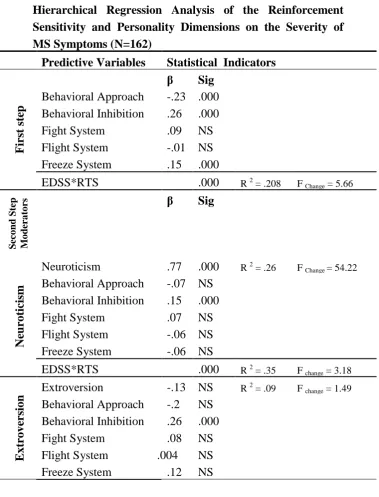
88 Table 2
Hierarchical Regression Analysis of the Reinforcement Sensitivity and Personality Dimensions on the Severity of MS Symptoms (N=162)
Predictive Variables Statistical Indicators
First
ste
p
β Sig
Behavioral Approach -.23 .000 Behavioral Inhibition .26 .000
Fight System .09 NS
Flight System -.01 NS Freeze System .15 .000
EDSS*RTS .000 R 2 = .208 F Change = 5.66
S ec o nd S tep M o dera to
rs β Sig
Ne
u
rot
icism
Neuroticism .77 .000 R 2 = .26 F Change = 54.22 Behavioral Approach -.07 NS
Behavioral Inhibition .15 .000
Fight System .07 NS
Flight System -.06 NS Freeze System -.06 NS
EDSS*RTS .000 R 2 = .35 F change = 3.18
E
xt
rove
rsion
Extroversion -.13 NS R 2 = .09 F change = 1.49 Behavioral Approach -.2 NS
Behavioral Inhibition .26 .000
Fight System .08 NS
89
EDSS*RTS .000 R 2 = .21 F Change = 5.54
Op
en
n
ess
Openness .16 NS R 2 = . 000 F change = .03 Behavioral Approach -.25 NS
Behavioral Inhibition .27 .000
Fight System .07 NS
Flight System .01 NS Freeze System .17 NS
EDSS*RTS .000 R 2 = .22 F change = 5.88
Agr
ee
ab
leness
Agreeableness -.23 23/0- R 2 = .29 F change = 5.65 Behavioral Approach -.24 NS
Behavioral Inhibition .24 NS
Fight System .01 NS
Flight System -.003 NS
Freeze System .1 NS
EDSS*RTS .000 R 2 = .22 F change = 5.12
C
onsci
en
ti
ousne
ss
Conscientiousness -.11 NS R2 = .01 F change = 2.1 Behavioral Approach -.2 NS
Behavioral Inhibition .26 0/000
Fight System .08 NS
Flight System .02 NS Freeze System .13 NS
90
In order to analyze the data presented in this study, the predictive and criterion variables as well as the dimensions of the mediator were set into the equation in consecutive stages. In the first stage, the components of reinforcement sensitivity were inserted into the equation and it was observed that the components of reinforcement sensitivity variable significantly (20.8%) predicted the variance of MS symptoms severity scores (P<.01 and FChange=5.66). In the next stage, each of the personality dimensions was set into the equation.
Neuroticism entered the analysis as the mediator and the determined variance rate in the criterion variable significantly increased to 35 percent (P< .01, β= .77, and FChange= 54.22). Extroversion entered into analysis as the mediator and the results showed that the explanatory power of the prediction variable increased by .9 percent and had reached 21 percent (P< .01, β=−.13, and F= 1.49). Openness entered the analysis as the mediator and variance in the criterion variable was determined as 22 percent (P< .86, β= .16, and F= .03). Agreeableness entered the analysis as the mediator and variance in the criterion variable was determined as 22 percent (P< .02, β= −.23, and F=5.56). Conscientiousness entered the analysis as the mediator and variance in the criterion variable was determined as 21 percent (P<.15, β= −.11, and F= 2.1).
91
confirmed and the mediatory effect of this component is proved (F = 5.66; df = 7, 151).
Discussion
Based on the findings of the present research, there is a significant relationship between neuroticism and the severity of MS symptoms. In addition, there is a significant relationship between brain-behavioral systems and the severity of MS symptoms, in which the neuroticism dimension is able to moderate this relationship and has increased its values. Among the components of brain-behavioral systems, the behavioral inhibition component has shown the highest significance power; this structure increases impulsivity and attention, the recollection of emotional states of anxiety, behavioral inhibition, passive avoidance, silence, and the experience of negative affections (Caseras, 2003). Similar results are obtained in the studies of (Gray, 1970; Heym, 2008; Kimbrel, 2010; Harnett, 2013), s in which anxiety is investigated. As a result, the active behavioral inhibition system corresponds to feelings of anxiety, worry, and mental rumination (Caseras, 2003).
92
score in this index may be exposed to the risk of being afflicted with some the psychiatric disorders. Usually these people have problems in planning, understanding, and feeling the real existence of the problem and the threat; they always feel negative emotions such as fear, anxiety, anger, sadness, and shame (Fathi Ashtiani, 2013). Two of the components of this index are anxiety and depression. Anxiety is defined as the sense of predicting future risks and anxious people are usually prone to worry and fear, and are nervous, terrified, and stressful. Individuals with depression are also prone to the feeling of sin, sorrow, hopelessness, and solitude; they are easily disappointed and helpless. Even those who obtain a low score in this component are not necessarily lively and happy (Diana et al., 1985). Symptoms of anxiety and depression are prevalent in MS patients, while it is not yet clear whether these symptoms reflect a mood disorder or whether they are physical manifestations of MS. Recent studies have shown that MS patients are at 50% risk of depression (Tröster Arnett, 2006). In addition, compared to many nervous disorders and other chronic diseases, this risk is much higher in the general population (Tröster & Arnett, 2006).
93
emotional distress (Vargas & Arnett, 2010). This is while anxiety and depression are considered as the components of the neuroticism index that affects health levels and are consistent with the findings of Benedict et al. (2001; 2008) and Bruce and Lynch (2011). Neurotic individuals are affected in a particular way with respect to their responses to the negative incidents in their lives. In addition, neurotic individuals have particular tendency toward developing a fear of new situations and they are prone to experiencing feelings such as helplessness and dependence (Bakker, Van Der Zee, Lewig, & Dollard, 2006). On the other hand, due to the unpredictability of disease attacks, the minds of MS patients are always involved with incidents and the uncontrollability of the attacks (Nocentini, Caltagirone & Tedeschi, 2012). These cases confirm the findings of the present research, which indicates that a lack of emotional stability has a correlation with the severity of disability in MS.
94
index refers to those individuals who are characterized by a predetermined order, goals, and strong wishes (Esmaeili, Hosseini, Sadeghi et al., 2013).
The majority of patients suffering from MS are afraid of disability and are not assured in relation to this disease. Several psychological disorders including anxiety and depression emerge in the aftermath of this disease (Askey-Jones, 2013). Multiple Sclerosis is considered as a life threatening disease by some individuals and it demands high adjustment; considering this, the life of many individuals are altered in a way such that psychological problems are added to physical issues. Therefore, psychological problems can strengthen the individual suffering from Multiple Sclerosis during one’s confrontation with stressful life events to some extent, although a noticeable number of individuals suffering from Multiple Sclerosis live with this disease through the employment of ample management and adaptation (Ožura, 2013). As a result, a wide range of various psychological experiences, inadvertent emotional experiences, memories, and thoughts relating to the other physical signs and other cases are reduced.
95
characteristics. The performance of similar studies is suggested in relation to other physical diseases.
Acknowledgement
I truly appreciate the participation of MS Association personnel and MS patients of Shiraz and Fasa County in data collection.
References
Askey-Jones, S., David, A. S., Silber, E., Shaw, P., & Chalder, T. (2013). Cognitive behaviour therapy for common mental disorders in people with multiple sclerosis: a bench marking study. Behaviour Research and Therapy, 51(10), 648-655. Alloy, L. B., Abramson, L. Y., Walshaw, P. D., Cogswell, A.,
Grandin, L. D., Hughes, M. E., & Hogan, M. E. (2008). Behavioral approach system and behavioral inhibition system sensitivities and bipolar spectrum disorders: Prospective prediction of bipolar mood episodes. Bipolar
Disorders, 10(2), 310-322.
Bakker, A. B., Van Der Zee, K. I., Lewig, K. A., & Dollard, M. F. (2006). The relationship between the big five personality factors and burnout: A study among volunteer counselors.
The Journal of Social Psychology, 146(1), 31-50.
Benedict, R. H., Priore, R. L., Miller, C., Munschauer, F., & Jacobs, L. (2001). Personality disorder in multiple sclerosis correlates with cognitive impairment. The Journal of
Neuropsychiatry and Clinical Neurosciences, 13(1), 70-76.
96
Cortical atrophy and personality in multiple sclerosis.
Neuropsychology, 22(4), 432.
Bruce, J. M., & Lynch, S. G. (2011). Personality traits in multiple sclerosis: association with mood and anxiety disorders. Journal of Psychosomatic Research, 70(5), 479-485.
Caseras, X., Avila, C., & Torrubia, R. (2003). The measurement of individual differences in behavioural inhibition and behavioural activation systems: a comparison of personality scales. Personality and Individual Differences, 34(6), 999-1013.
Charcot, J. M. (1889). Lectures on the Diseases of the Nervous
System (Vol. 3). New Sydenham Society.
Corr, P. J. (2004). Reinforcement sensitivity theory and personality. Neuroscience & Biobehavioral Reviews, 28(3),
317-332.
Corr, P. J. (2001). Testing problems in JA Gray’s personality theory: a commentary on. Personality and Individual
Differences, 30(2), 333-352.
Corr, P. J. (Ed.). (2008). The reinforcement sensitivity theory of
personality. Cambridge University Press. Apr. 10.
Dennison, L., Moss-Morris, R., & Chalder, T. (2009). A review of psychological correlates of adjustment in patients with multiple sclerosis. Clinical Psychology Review, 29(2), 141-153.
Diana, R., Grosz, A., & Mancini, E. (1985). Personality aspects in multiple sclerosis. The Italian Journal of Neurological
Sciences, 6(4), 415-423.
97
Neo Five-Big Personality Factors on Life Satisfaction in College Students. (2013). American Journal of Scientific
Research, 45-52. [Farsi]
Farahani, M. N., Alami. M. (2006). Comparing the Big Five personality traits and locus of control in patients with MS and healthy individuals. Journal of Birjand University of
Medical,12(1,2).
Fathi Ashtiani, A., Dastani, M. (2013). Psychological tests - to
evaluate personality and mental health. Publications Besat,
ninth edition. [Farsi]
Gray, J. A. (1970). The psychophysiological basis of introversion-extraversion. Behaviour Research and
Therapy, 8(3), 249-266.
Gray, J. A., & Mc-Naughton, N. (2000). The neuropsychologyof
anxiety: An enquiry into the functions of the
septohippocampal System (2nd Edition). New York: Oxford
Garfield, A. C., & Lincoln, N. B. (2012). Factors affecting anxiety in multiple sclerosis. Disability and Rehabilitation,
34(24), 2047-2052.
Garousi Farshi, M. T. (2001). A new approach in evaluating the
character (using factor analysis in the study of character).
First Edition. Tabriz: Daniel publishing and research community. [Farsi]
Garousi, F., Mirtaghi, M., Housing, A., & Ghazi Tabatabaei, M. (2001). The Application of Neo Personality Inventory Test (NEO) Analytical Investigation of Their Factor Structure and Features among University Students of Iran.
Scientific-Research Journal of Humanities, Alzahra
98
Grech, L. B., Kiropoulos, L. A., Kirby, K. M., Butler, E., Paine, M., & Hester, R. (2015). The effect of executive function on stress, depression, anxiety, and quality of life in multiple sclerosis. Journal of Clinical and Experimental
Neuropsychology, 37(5), 549-562.
Harbige, L. S., & Sharief, M. K. (2007). Polyunsaturated fatty acids in the pathogenesis and treatment of multiple sclerosis. British Journal of Nutrition, 98(S1), S46-S53. Harnett, P. H., Loxton, N. J., & Jackson, C. J. (2013). Revised
Reinforcement Sensitivity Theory: Implications for psychopathology and psychological health. Personality and
Individual Differences, 54(3), 432-437.
Haussleiter, I. S., Brüne, M., & Juckel, G. (2009). Review: Psychopathology in multiple sclerosis: diagnosis, prevalence and treatment. Therapeutic Advances in
Neurological Disorders, 2(1), 13-29.
Heym, N., Ferguson, E., & Lawrence, C. (2008). An evaluation of the relationship between Gray’s revised RST and Eysenck’s PEN: Distinguishing BIS and FFFS in Carver and White’s BIS/BAS scales. Personality and Individual
Differences, 45(8), 709-715.
Hopman, W. M., Coo, H., Edgar, C. M., McBride, E. V., Day, A. G., & Brunet, D. G. (2007). Factors associated with health-related quality of life in multiple sclerosis. The
Canadian Journal of Neurological Sciences, 34(02),
160-166.
99
Canadian Journal of Neurological Sciences, Journal
Canadien des Sciences Neurologiques, 36(05), 554-561.
Hasani, J., Salehi, S., Rasouli Azad, M. (2012). Psychometric Properties of Jackson's Five-Factor Questionnaire: Scales of Revised Reinforcement Sensitivity Theory. Research in
Psychological Health, 6(3), 60-73. [Farsi]
Iova, S., Popescu, C. A., Iova, A., Camelia, D., Mihancea, P., & Buzoianu, A. D. (2014). Personality traits in multiple sclerosis: association with mood and anxiety disorders in a Romanian patients’ sample. Advances in Environmental
Sciences, 6(4).
Jackson, C. J. (2009). Jackson-5 scales of revised Reinforcement Sensitivity Theory (r-RST) and their application to dysfunctional real world outcomes. Journal of Research in
Personality, 43(4), 556-569.
Johnson, S. L., Turner, R. J., & Iwata, N. (2003). BIS/BAS levels and psychiatric disorder: An epidemiological study.
Journal of Psychopathology and Behavioral Assessment,
25(1), 25-36.
Kimbrel, N. A., Mitchell, J. T., & Nelson-Gray, R. O. (2010). An examination of the relationship between behavioral approach system (BAS) sensitivity and social interaction anxiety. Journal of Anxiety Disorders, 24(3), 372-378. Kikuchi, H., Mifune, N., Niino, M., Kira, J. I., Kohriyama, T.,
100
Kurtzke, J. F. (1983). Rating neurologic impairment in multiple sclerosis an expanded disability status scale (EDSS).
Neurology, 33(11), 1444-1444.
Matthews, G., Deary, I. J., & Whiteman, M. C. (2003).
Personality Traits. Cambridge University Press.
McCrae, R. R., & Allik, I. U. (2002). The five-factor model of
personality across cultures. Springer Science & Business
Media.
McCrae, R. R., & Costa, P. T. (2004). A contemplated revision of the NEO Five-Factor Inventory. Personality and
Individual Differences, 36(3), 587-596.
Mohr, D. C., Classen, C., & Barrera, M. (2004). The relationship between social support, depression and treatment for depression in people with multiple sclerosis.
Psychological Medicine, 34(03), 533-541.
Nocentini, U., Caltagirone, C., & Tedeschi, G. (Eds.). (2012).
Neuropsychiatric Dysfunction in Multiple Sclerosis.
Springer Science & Business Media.
Ožura, A., Erdberg, P., & Šega, S. (2010). Personality characteristics of multiple sclerosis patients: A Rorschach investigation. Clinical Neurology and Neurosurgery,
112(7), 629-632.
Ožura, A., & Šega, S. (2013). Profile of depression, experienced distress and capacity for coping with stress in multiple sclerosis patients—A different perspective. Clinical
neurology and neurosurgery, 115, S12-S16.
101
Expanded Disability Status Scale on P300. Audiology, (22)2. [Farsi]
Roberts, S. B., & Kendler, K. S. (1999). Neuroticism and self-esteem as indices of the vulnerability to major depression in women. Psychological medicine, 29(05), 1101-1109.
Tröster, A. I., & Arnett, P. A. (2006). Assessment of Movement and Demyelinating Disorders.
Vargas, G. A., & Arnett, P. A. (2010). Positive everyday experiences interact with social support to predict depression in multiple sclerosis. Journal of the
International Neuropsychological Society, 16(06),