Munich Personal RePEc Archive
An Interpretation of An Affine Term
Structure Model for Chile
Juan Marcelo, Ochoa
November 2006
Online at
https://mpra.ub.uni-muenchen.de/1072/
An Interpretation of An Affine Term Structure
Model for Chile
J. Marcelo Ochoa
∗November, 2006
Abstract
This paper attempts to provide an economic interpretation of the factors that drive the movements of interest rates of bonds of different maturities in a continuous-time no-arbitrage term structure model. The dynamics of yields in the model are explained by two latent fac-tors, the instantaneous short rate and its time-varying central ten-dency. The model estimates suggest that the short end of the yield curve is mainly driven by changes in first latent factor, while long-term interest rates are mainly explained by the second latent factor. Consequently, when thinking about movements in the term structure one should think of at least two forces that hit the economy; tempo-rary shocks that change short-term and medium-term interest rates by much larger amounts than long-term interest rates, causing changes in the slope of the yield curve; and long-lived innovations which have persistent effects on the level of the yield curve.
JEL classification: C33, E43, E44, E2, G12.
Keywords: Affine term structure model, yield curve, Kalman filter,
∗I am grateful to R´omulo Chumacero for his insightful suggestions and comments and
1
Introduction
Affine no-arbitrage dynamic term structure models are “the model[s] of choice in finance” (Diebold, Piazzesi, and Rudebusch 2005). These models employ a structure that consists of a small set of factors that characterize the yield curve, providing a parsimonious representation of the yield curve. At the same time they impose restrictions to ensure that yield dynamics are consis-tent in the cross-section and in the time series dimension (Dai and Singleton 2000, Piazzesi 2003). Even though these models provide a useful statisti-cal description of the yield curve, they offer little insight of what the latent factors are, their relationship to macroeconomic variables, or the forces that drive its movements.
In this paper I attempt to provide an economic interpretation of the fac-tors that drive the movements of interest rates of bonds of different maturities in a continuous-time no-arbitrage term structure model. Following Jegadeesh and Pennacchi (1996) and Balduzzi, Das, and Foresi (1998), the model I use in my analysis assumes the existence of a stochastic discount factor, which is governed by two latent factors with a proper economic interpretation. The first latent factor is the instantaneous short-term interest rate, and the second factor is the time-varying stochastic mean of the instantaneous short rate, capturing the notion that short rates display short-lived fluctuations around a time-varying rest level. This model generalizes the continuous-time term structure model presented in Vasicek (1977), but it is nevertheless solvable in closed form. Under this framework, bond yields are linear or affine functions of the latent factors, with restrictions on the cross-sectional and time-series properties of the yield curve that rule out arbitrage strategies.
a rich set of bond prices with different maturities, which are unavailable in many emerging markets where there is a substantial number of ‘missing bond yields’. To overcome this problem, I rely on an extended version of the Kalman filter and maximum-likelihood to estimate the unobservable state variables and the model parameters using cross-sectional/time-series data of zero-coupon and coupon bond prices. Using this approach, I am able to es-timate the zero-coupon term structure even for days where bonds with only few maturities are traded, while at the same time the Kalman filter allows the state variables to be handled correctly as unobservable variables.1
The model estimates suggest that the instantaneous rate is more volatile and exhibits short-lived deviations from its time-varying mean, while the time-varying central tendency exhibits a weak reversion to its long-run value and a volatility less than half that of the short rate. According to the fac-tor loadings implied by the estimated parameters, the very short end of the yield curve is driven by the first latent factor, but as the term to maturity in-creases the central tendency starts driving the movements in the yield curve, playing an important role at explaining the evolution of long-term interest rates. Consequently, a shock to the first latent factor increases short-term and medium-term interest rates by much larger amounts than the long-term interest rates, so that the yield curve becomes less steep (i.e., experiences a decrease in its slope). Thus, it is reasonable to interpret this short-lived shock as a temporary positive shock to the economy which increases temporarily production possibilities. On the other hand, a shock to the time-varying mean translates into an increase in short-term and long-term yields, chang-ing the level of the yield curve. Therefore, a second source of shocks that moves the yield curve can be related to long-lived innovations which will induce a persistent change in the level of the yield curve, like a persistent (almost permanent) positive shock to productivity.
My work is more closely related to recent economics and finance pa-pers exploring the macroeconomic determinants of the unobservable factors, and to macro-finance modeling which explicitly incorporates macroeconomic variables into multi-factor yield curve models. For instance, Wu (2001) and Piazzesi (2005) relate monetary policy shocks to temporary changes in the factor that influences the slope of the yield curve (slope factor), since
mone-1Babbs and Nowan (1999) provide a generalization of the Kalman filter to estimate
tary policy surprises affect short rates more than long ones. Ang and Piazzesi (2003) examine the influences of macroeconomic variables and latent factors that jointly determine the term structure of interest rates. They find that inflation and real activity have a significant impact on medium-term bond yields (up to a maturity of one year), but most of the movements in long-term yields are still accounted for by the unobservable factors. While most of these papers agree on the effects of macroeconomic variables on the slope of the yield curve, there are still conflicting results when explaining the move-ments of the level of the yield curve. Diebold, Rudebusch, and Aruoba (2006) obtain more favorable results using a Nelson-Siegel model combined with a VAR-model for the macroeconomy. They find that inflation is closely related to the factor that influences the slope of the yield curve, while the factor that changes the level of the yield curve (level factor) is highly correlated with real activity. Using different modeling strategies, Rudebusch and Wu (2004) and Dewatcher and Lucio (2006) interpret the slope factor as the cyclical response of the central bank to changes in the economy. While Rudebusch and Wu (2004) argue that the level factor reflects market participants’ view about the inflation target of the central bank, Dewatcher and Lucio (2006) link this factor to long-run inflation effects.
The rest of the paper unfolds as follows. In Section 2 I present the continuous-time no-arbitrage term structure model. In Section 3 I present the state space formulation of the model and the estimation of the parameters by means of the Kalman filter. I also present an interpretation of the esti-mated parameters and discuss the reliability of the model-based yield curves obtained. In Section 4 I use impulse-response functions implied by the affine term structure model to discuss the sources of shocks that move the yield curve and their possible economic interpretation. Section 5 concludes.
2
A model of the term structure
Here I introduce the framework that I use for modeling the term structure of interest rates. First, I present several important relationships on asset pric-ing. Then, I present the solution to the no-arbitrage term structure model governed by two latent factors. Are two factors enough? Even though the work of Litterman and Scheinkman (1991) finds that almost all of movements in various US Treasury bond yields are captured by three unobservable fac-tors, the study of Diebold et al. (2006) finds that two factors may suffice to capture the time-series variation in yields at a monthly frequency, since the first two principal factors account for almost 99% of the movements of yield-curve variation. The third factor is found unimportant since it is related to heteroskedasticity, and yields exhibit little heteroskedasticity at monthly fre-quency. The third factor is more important at daily and weekly frequencies (Ang, Piazzesi, and Wei 2006).
2.1
Background issues on asset pricing
Let P(t, T) denote the price at time t of a zero-coupon bond maturing at time T. Assuming, without loss of generality, that the bond has a face value equal to one and its yield to maturity with continuous compounding is equal to R(t, T), its price can be written as,
P(t, T) = exp[−(T −t)R(t, T)] (1)
and the yield to maturity on this zero-coupon bond is equal to,
R(t, T) = −logP(t, T)
Using these results, one can define the instantaneous short rate as,
rt= lim
T→tR(t, T) =−Tlim→t
logP(t, T)
T −t (3)
Similarly, the price of a coupon bond payingτ coupons until the maturity date can be written as a portfolio of τ zero-coupon bonds,
Pc(t, T) = τ
X
i=1
CiP(t, t+i) (4)
= τ
X
i=1
Ciexp[−iR(t, t+i)]
where τ =T −t is also the time to maturity of the coupon bond (see Camp-bell, Lo, and MacKinlay 1997).
2.2
An affine term structure model
In an arbitrage free-environment and with a positive stochastic discount fac-tor equal to Λt, the price at datet of a zero-coupon bond paying one unit of account at time T can be expressed as,
P(t, T) = Et
ΛT
Λt
(5)
where Et is the expectation taken conditional on time-t information. Follow-ing the standard asset-pricFollow-ing theory, I assume that the stochastic discount factor is governed by the following process,
dΛt =−rtΛtdt−Λtλ′dWt (6)
where λ= [λ1, λ2]′ is a vector containing the market prices of risk which are
assumed to be constant over time.
Following the work of Jegadeesh and Pennacchi (1996) and Balduzzi, Das, and Foresi (1998), I assume that the short rate rt reverts toward a time-varying mean µt, whose dynamics is described by the following set of stochastic differential equations,
drt =κ1(µt−rt)dt+σ1dW1t (7a)
where κ1, κ2, σ1, and σ2 are constants, and Wt = [W1t, W2t]′ is a two-dimensional Brownian motion with a correlation coefficient equal to ρ. The coefficients κ1 and κ2 measure the speed of mean reversion of the two
vari-ables to their respective means, µt andθ,ρ measures the covariance between these two variables, while σ1 and σ2 are the volatilities of the short-term
interest rate and the stochastic mean, respectively. This model generalizes the continuous-time term structure presented in Vasicek (1977) by letting the short-rate revert toward a time-varying stochastic mean, and captures the notion that short-term rates display short-lived fluctuations around a time-varying rest level, or central tendency.2
Under the above assumptions and using Itˆo’s lemma, the price of a bond is characterized by the following partial differential equation,3
1 2
∂2P
∂r2σ 2 1 +
∂2P
∂µ2σ 2 2
+ ∂
2P
∂r∂µσ1σ2ρ+ ∂P
∂r
κ1
µ−r− λ1σ1
κ1 (8) + ∂P ∂µ κ2
θ−µ− λ2σ2
κ2
+∂P
∂t −rP = 0
subject to the boundary condition P(T, T) = 1. As shown in Langetieg (1980) and Cochrane (2005), the solution for the fundamental valuation equa-tion (8) is an exponentially linear funcequa-tion of the two latent variables,rt and µt, taking the following exponential-affine form,
P(t, T) = exp[A(τ) +B1(τ)rt+B2(τ)µt] (9)
where τ = T −t is the time to maturity of the bond and A(τ), B1(τ) and
B2(τ) are functions of the maturity, the parameters of the model and satisfy
the no-arbitrage condition in the bond market.
Equations (8) and (9) determine the solution for the functionsA(τ),B1(τ)
and B2(τ) in terms of a set of ordinary differential equations, which have a
2 The Vasicek (1977) model is of the form,
drt=κ1(µ−rt)dt+σdWt
where the instantaneous interest rate converges to a target level µ that is constant over time. Jegadeesh and Pennacchi (1996) and Balduzzi et al. (1998) show that a model with a time-varying target level outperforms the Vasicek model.
solution equal to,
B1(τ) =
exp(−κ1τ)−1
κ1
B2(τ) =
exp(−κ2τ)−1
κ2 −
exp(−κ1τ)−exp(−κ2τ)
κ1−κ2
A(τ) =
Z τ 0 1 2B 2
1σ21+B22σ22+B1B2σ1σ2ρ−B1λ1σ1−B2λ2σ2+B2κ2θ
ds
Using equation (2) and (9) we can write the yield of a bond maturingτ periods ahead as,
R(t, T) = −1
τ[A(τ) +B1(τ)rt+B2(τ)µt] (10) =a(τ) +b1(τ)rt+b2(τ)µt
where a(τ) = −A(τ)/τ, b1(τ) = −B1(τ)/τ and b2(τ) = −B2(τ)/τ. In this
model, bond yields are linear functions of the state variables, rt and µt. Therefore, it belongs to the family of affine term structure models, in which zero-coupon bond yields, their physical dynamics and their equivalent mar-tingale dynamics are all affine (constant-plus-linear) functions of an under-lying vector of state variables.4
Using equation (3), one can see that the instantaneous short rate is given by,
lim
τ→0R(t, t+τ) =rt (11)
and the long-term rate is equal to the mean of the stochastic time varying long-term factor θ adjusted by risk premia,
lim
τ→∞R(t, t+τ) =θ−
λ2σ2
κ2 −
λ1σ1
κ1 −
σ2 1 +σ22
2κ2 1
− σ1σ2ρ
κ2κ1
Notice that the time-varying mean of the first latent factor,µt, does not affect the short end of the yield curve, since its loading starts at zero for the instantaneous interest rate (i.e., lim
τ→0B2(τ) = 0). However, it does affect
yields of longer maturities, influencing the long-end of the term structure.
3
Estimation
3.1
Data
In this paper I use three types of instruments to estimate the yield curve; pure discount bonds, which make a single fixed payment at the maturity date; coupon bonds which make coupon payments at equally spaced intervals until the maturity date, in which the face value is also paid and, coupon bonds paying both, the face value and the coupon rate, in each coupon payment.
I use end-of-month price quotes for index-linked instruments issued by the Central Bank of Chile, which have both their coupon and principal payments linked to the Unidad de Fomento (UF), from January 1990 through March 2006. The UF is a unit of account that varies according to past inflation, and is not perfectly correlated with current inflation. For short-maturity instruments, UF-linked yields cannot be considered real yields, but as the maturity of the instrument increases these yields approximate real interest rates more closely (see Chumacero 2002).
The database contains 4,472 observations on pure-discount bonds (Pagare Reajustable del Banco Central), and semi-annual amortizing coupon bonds (Pagare Reajustable con Cupones and Bonos del Banco Central de Chile). Over the sample period, each month contains an average of twenty seven observations. In early years, however, the number of index-linked bonds out-standing is very small, resulting on a median of 8 monthly observations over 1990 and 1991. During these first two years, the maturity of coupon bonds, as well, is confined to values that range from fifteen to twenty semesters and zero-coupon bonds which have maturities of less than one year. As we move forward in time, the maturity of traded coupon bonds diversifies ranging from 1 month to 40 semesters (see Figure 1).
3.2
State space specification
To estimate the affine term structure model presented in section 2, I first derive the discrete-time dynamics implied by the continuous-time model in order to match the observation frequency data. Then, using the discrete-time equivalent model I present the state space model formulation of the term structure model.
describe the state variables can be expressed as, d rt µt =
−κ1 κ1
0 −κ2
rt µt + 0 κ2θ
dt+
σ1 0
0 σ2
dWt
or more compactly,
dXt= (AXt+b)dt+CdBt (12)
where Bt is a standardized Brownian motion with a covariance matrix equal to CC′ = σρσ′. Using the methods presented in Langetieg (1980) and
Bergstrom (1990), the equivalent discrete-time for this process is obtained from the solution to the system of stochastic differential equations (12). This solution implies the following equivalent discrete-time,
Xtk =Φ(ψ)Xtk−1 +c(ψ) +εtk (13)
where εtk is normally distributed with variance-covariance matrix equal to
V(ψ) and,
Φ(ψ) =eA(tk−tk−1)
c(ψ) = (eA(tk−tk−1)−I)A−1b
V(ψ) =
Z tk
tk−1
eA(tk−s)
CC′eA′(tk−s)
ds
The coefficients of this VAR(1) process, Φ(ψ) and c(ψ), and the dis-tribution of the innovation εtk depend on the parameters describing the exponential-affine model. 5
To complete the state space representation of the model, I present the measurement equation which relates the theoretical yields and the latent factors describing the model. At time tk, the data is comprised by Nk bond prices of different maturity denoted by Ptk = (P1k, P2k, . . . , PNk) for k = 1, . . . , T. The set of instruments contains both, zero-coupon and coupon bonds with maturities that vary over time. I assume that there are discrepan-cies between observed prices and their theoretical counterparts explained by exogenous factors such as non-synchronous trading, rounding of prices, and bid-ask spreads. Therefore, in the presence of measurement errors we need
5A derivation of specific expressions for the matricesΦ(ψ),c(ψ) andV(ψ) describing
to distinguish between the theoretical term structure given by (9) and ob-served prices. Assuming that measurement errors are additive and normally distributed, theoretical and observed prices are related by,
Ptk =Θ(ψ,Xtk) +vtk (14)
wherevtk ∼ N(0,Hk(ψ)) is the measurement error, the vectorψcontains the unknown parameters of the model, Xtk is a vector containing the two state variables of the model (i.e., X = (r, µ)′), and the i−th row of Θ(ψ,X
tk) is equal to,
Θi(ψ,Xtk) = exp[A(τi) +B1(τi)rtk+B2(τi)µtk] = exp[A(τi) +B(τi)′Xtk]
when the i−th bond is a zero-coupon bond and equal to,
Θi(ψ,Xtk) = τi
X
j=1
Cijexp[A(j) +B(j)′Xtk]
when the i−th bond is a coupon bond payingτi coupons until the maturity. The measurement equation (14) plus the transition system describing the state variables (13) form the non-linear state space model describing the term structure of interest rates.
3.3
Extended Kalman Filter
Even though the conventional Kalman filter cannot be used in the presence of non-linear measurement and/or transition equations, an approximate filter can be obtained by linearizing the non-linear measurement equation and then applying the extended Kalman filter presented in Harvey (1990). The original non-linear measurement equation (14) can be approximated using a Taylor expansion around the conditional mean of the state variables,
Ptk =d(ψ,Xtk|tk−1) +Z(ψ,Xtk|tk−1)Xtk +vk (15)
where Xtk|tk−1 is the conditional mean of the state variables given the
infor-mation set available at tk, d(ψ,Xtk|tk
−1) is an Nk-vector with the i−th row
given by
di =Θ(ψ,Xˆtk|tk
−1)−
∂Θ(ψ,Xˆtk|tk−1)
∂X′tk
and Z(ψ,Xtk|tk
−1) is an Nk×2 matrix with rows equal to
Zi = ∂P(
ˆ
Xtk|tk−1, τ)
∂X′tk .
Using the linear approximation of the measurement equation (15) and the transition equation (13), the parameters of the model can be estimated using the extended Kalman filter algorithm discussed in Harvey (1990). This algorithm consists of a sequence of two steps, a prediction and an update step. The prediction step yields the estimator of the state variables given by,
ˆ
Xtk|tk−1 =E(Xˆtk|Ξtk−1) =c(ψ) +Φ(ψ)Xˆtk−1 (16)
with a mean square error (MSE) equal to,
Ftk|tk−1 =E
h
(Xtk −Xˆtk|tk−1)(Xtk−Xˆtk|tk−1)
′ |Ξtk−1
i
=ΦFtk−1Φ
′+V
where the expectation is based on the available information up to time tk−1
represented by Ξtk−1.
In the update step, we use the additional information given by Ptk to obtain a more precise estimator of Xtk,
ˆ
Xtk =E(Xˆtk|Ξtk) (17)
=Xˆtk|tk−1 +Ftk|tk−1Z
′(ZF
tk|tk−1Z
′+H)−1hP
tk −Θ(ψ,Xˆtk|tk−1)
i
with a MSE matrix equal to,
Ftk =E
h
(Xtk −Xˆtk)(Xtk−Xˆtk)
′ |Ξtk
i
=Ftk|tk−1−Ftk|tk−1Z
′(ZF
tk|tk−1Z
′+H)−1ZF
tk|tk−1
Once we obtain estimates of the state variables (i.e.,Xˆtk) using informa-tion about the observed bond prices, we can evaluate the likelihood func-tion using the predicfunc-tion error decomposifunc-tion (see Harvey (1990) for details). Then, the log-likelihood function is given by,
T
X
k=1
logf(Ptk|ψ) = − n
X
tk=1 Nk
2 log(2π)− 1 2
n
X
k=1
log|Σk|− 1 2
n
X
k=1
where,
vtk =Ptk −Θ(ψ,Xˆtk|tk−1)
Σk=ZFtk|tk−1Z
′+H
3.4
Estimation results
I estimate the term structure model using the extended Kalman filter al-gorithm and assuming that prices are observed with an error. I aggregate bonds into five categories to obtain a parsimonious covariance matrix of the measurement errors. Each group is assumed to have the same measurement error, therefore, the covariance matrix of the measurement errors Hk(ψ) is a diagonal matrix with five different elements characterizing the variance of each group, hi. The first group contains discount bonds which have maturi-ties less or equal to one year. The remaining four groups comprise coupon bonds with maturities up to five years, between six and ten years, between eleven and fifteen years, and above sixteen years, respectively.
Unlike the standard practice, I treat the factorsrandµas unobservables, and do not approximate the instantaneous rate using an observed short-term interest rate or the time-varying mean using observed yields as in Chan et al. (1992), Longstaff and Schwartz (1992), and Balduzzi et al. (1998). While approximating latent factors with observable yields is convenient, note that yields of any finite-maturity depend on both factors, r and µ, as well as on the model parameters we are trying to identify.
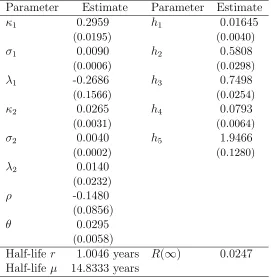
Table 1 presents the estimation results. With exception of the coefficient capturing the market price of risk of the central tendency, λ2, all
parame-ter estimates are significant at conventional values. Both, the instantaneous interest rate and the time-varying central tendency present statistically sig-nificant reversion toward its central tendency. However, the mean reversion and the volatility of the instantaneous rate are considerably higher than the coefficients estimated for its time-varying mean. Therefore, the short-term rate is more volatile and returns faster to its time-varying mean, while the central tendency exhibits a weak reversion to its long-run value and a volatil-ity less than a half that of the short-rate. The mean-reversion parameters imply a life of about 1 year for the short-rate, while the estimated half-life for the time-varying mean is 14.83 years (see Figure 3).
imbal-ances in the economy –those that are expected to dissipate over the short-run– work themselves through. In contrast, fluctuations of the first latent state variable rt around its time-varying mean reflect shorter-lived shocks. The model-based equilibrium real interest rate, which abstracts from both short-lived and long-lived shocks, is equal to R∞ = 2.47 percent in
semes-tral base or R∞ = 4.94 percent in an annual base. The estimate of θ, the
steady-state value of the short-rate and the central tendency, is statistically significant and equal to 2.95 percent in semestral base or 5.92 percent in annual terms.
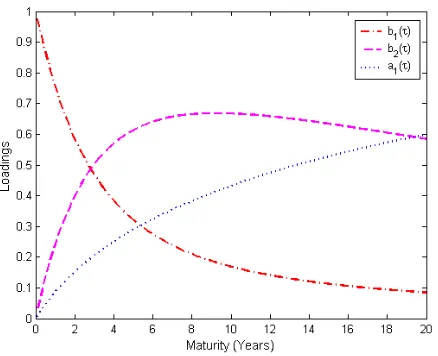
The estimated loadings of the two factors driving the yield curve provides an insight on how each factor dynamics translates into movements of the yield curve. In order to give an interpretation of the estimated factor loadings, note that one can rewrite equation (10) as,
R(t, t+τ) = a1(τ)R(∞) +b1(τ)rt+b2(τ)µt
where R(∞) = lim
τ→∞R(t, t+τ). Figure 2 depicts the loadings on the
long-term interest rate a1(τ), on the short-term interest rate b1(τ), and on the
time varying long-term rateb2(τ) along different maturities, calculated using
the estimates presented in Table 1. The very short end of the yield curve is driven by the first latent factor rt. The loading associated to the short-term interest rate b1(τ) starts at 1 and decays monotonically as the term
to maturity increases reaching a value close to zero at long maturities. In contrast, as the term to maturity increases, the central tendency µt becomes a central factor behind the movements of the long end of the yield curve as well as intermediate maturities.
model fits quite well the observed yield-to-maturity of zero and coupon bonds (see Figure 5).
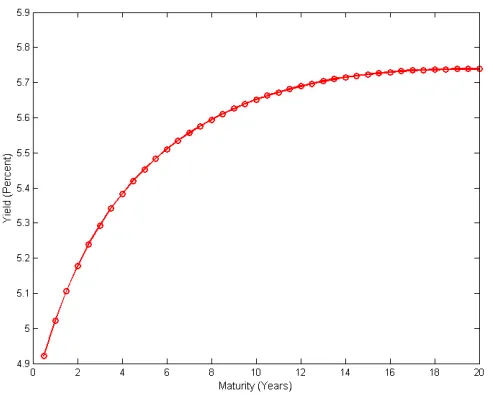
The model estimates also produce an average yield curve that is increasing and concave (see Figure 6). To understand why, note that the market price of risk of the short-term interest rate imply the following risk premia for a discount bond maturing in τ periods,6
λ1
σ1
P ∂P
∂r =−λ1σ1
1−exp(−κ1τ)
κ1
The sign of the risk premium es equal to minus the sign of the respective market price of risk, and the magnitude of the premium is an increasing function of bond maturity. The estimate ofλ1, the market price of risk of the
short-term interest rate, is negative and statistically significant. This implies that a bond’s interest rate risk premium is positive and increasing with bond’s maturity, suggesting that the yield curve is usually upward sloping.
Finally, the correlation between changes in the short rate and its time-varying meanρis negative and statistically significant. The correlation might be interpreted as a link between agents expectation of future economic condi-tions and changes in the short-rate. The intuition is straightforward. Suppose the economy is in a growth stage, and the monetary authority increases the short-term interest rate in an effort to avoid an overheating of the economy. Then, if movements in the short rate are pro-cyclical and agents believed that a hike in the short rate signals future adverse economic conditions, there is an incentive to sacrifice today’s consumption to buy long-term bonds that pays off in the bad times. This increase in the demand for long-term bonds will bid up their price and lower long-term yields, resulting in a negative cor-relation between r and µ. The model also implies that a downward sloping yield curve not only indicates good times today, but bad times tomorrow. Therefore, when agents expect a recession, short-term rates will increase, while long rates will decrease.7
6See Pennacchi (1991) and Jegadeesh and Pennacchi (1996) for a derivation.
7See Harvey (1988), Estrella and Hardouvelis (1991), Plosser and Rouwenhorst (1994),
4
Movements in the yield curve
The yield curve might move due to changes in announcements of unemploy-ment or inflation, changes in market participants’ risk aversion aroused from perceived changes in the prospects for continued economic growth, or due to changes in other economic variables (Bliss 1997). In the model presented above changes in the instantaneous interest rate and the its time-varying cen-tral tendency drive changes in interest rates of different maturities to varying degrees. Therefore, it is reasonable to think that these latent factors should capture the economic factors influencing interest rates and the changes in the underlying determinants of the term structure of interest rates. Here, I discuss how the term structure of interest rates changes in response to new information aboutrt and µt using impulse-response functions implied by the affine term structure model. Additionally, I attempt to provide an economic interpretation of these shocks.8
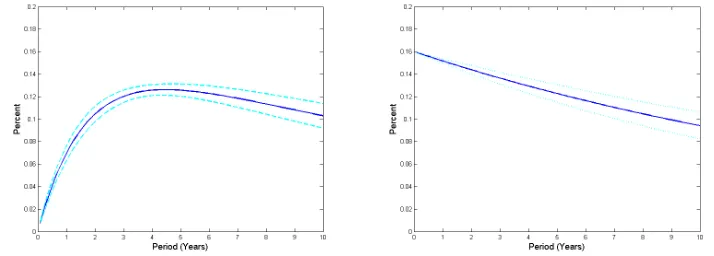
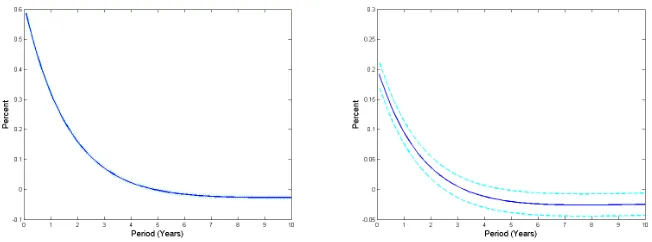
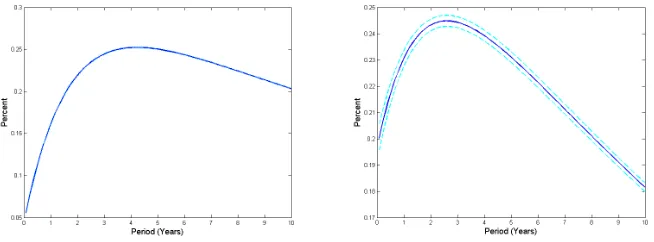
Let me start by analyzing the effect of one standard innovation of the instantaneous interest rate and how it translates into movements of the yield curve. The first two panels of Figure 7 exhibit the response of the instanta-neous short-rate rtand its time-varying mean µt to an innovation in the first latent factor. Figure 8 presents the impulse-response functions of selected yields, the term structure at its initial value, and one month and 5 years after a one standard deviation of rt. The results show that the instantaneous rate rt increases immediately after the shock and decays monotonically returning to its initial value. On the other hand, the central tendency µ decreases slightly due to the negative correlation between the two state variables, but the confidence intervals indicate that this response is not statistically signif-icant. As the loadings of each factor suggest, the shock to the instantaneous interest rate increases short-term and medium-term interest rates by much larger amounts than long-term interest rates. Consequently, the yield curve initially becomes less steep, presenting a decrease in its slope. The yield curve returns back to its initial position five years after the shock initiated (see Figure 8).
The movements in yields in response to this shock have an intuitive expla-nation. To better understand the following discussion, recall that the basic asset pricing model predicts that the price of a discount bond maturing inτ
8Appendix B contains the analytical derivation of the model-based impulse-response
periods is given by,
P(t, T) =βτ
Et
U′(ct +τ) U′(ct)
(19)
where U′(ct) is the marginal utility of consumption, 0 < β < 1 denotes the
subjective discount factor, and Et is the expectation conditional on infor-mation available at time t. Under this framework, interest rates reflect the rate at which people are willing to trade consumption today for consumption tomorrow (Altug and Labadie 1994).
A shock that temporarily increases short-term and medium-term yields can be interpreted as a temporary positive shock to the economy which in-creases production possibilities. Intuitively, after the realization of this shock agents will face an increase in their consumption, but considering that this gain will eventually die out, economic agents will save part of the output and invest into capital in order to smooth their consumption (den Haan 1995). Therefore, the expected growth rate of consumption is expected to be posi-tive in the short-term and medium-term, implying an initial increase in the slope of the yield curve. However, as agents start to dissave, interest rates will fall back to their long-term level and consumption growth will return to its steady-state level. This result is consistent with the results of Rendu de Lint and Stolin (2003) who find that a temporary productivity shock in a simple production stochastic growth model increases the one-period inter-est rate more than the τ-period interest rate, increasing the slope of term structure of interest rates.
The last two panels of Figure 7 exhibit the response of the two latent factors to an innovation to the central tendency, while Figure 9 depicts the impulse-response functions of the six-month, 5-year and 20-year yields as well as the term structure of interest rates at its initial level, and one month and 5 years after the shock to µt. An innovation to the central tendency increases immediately the time-varying mean µt, which reduces monotonically and slowly as one would expect given the estimated high persistence of this factor. The instantaneous interest ratertincreases quickly to catch up the new level the central tendency reached after the shock. After reaching a value near the central tendency, the instantaneous rate decreases slowly following the path of the central tendency.
interest rates start to increase, while long-term interest rates start to slowly fall as the long-run time varying mean falls back to its equilibrium level. As a consequence, initially the slope of the yield curve increases, but rapidly the term structure of interest rates exhibits a change in its level. Five years after the innovation, yields of all maturities change by almost identical amounts (see Figure 9). Slowly, the term structure of interest rates will move toward its initial position as the effect of the shock dies off. However, the high persistence of the time-varying mean makes this effect look as permanent, despite the fact that this variable is stationary.
In this case, this shock can be interpreted as a persistent (almost per-manent) positive shock to productivity. To understand why, suppose that the economy faces a shock that has no initial impact, but eventually grows to a permanent technology shock, whose path is perfectly anticipated by agents. A positive innovation permanently increases the level of expected future consumption, thereby the high expected levels of future consumption makes long-term bonds less attractive driving prices down and driving yields up.9 As the impact of the innovation materializes, agents will require a
higher return as an inducement to save, leading to an increase in yields of all maturities.
5
Final remarks
I show that when thinking about movements in the term structure, one should think in changes in at least two type of forces that hit the economy. First, shocks that are short-lived, which change the slope of the yield curve. Second, long-lived shocks that influence yields of all maturities and shift the level of the term structure of interest rates.
However, two questions remain unanswered. Is it reasonable to relate the effects of the short-lived shocks to the effects of inflationary pressures or monetary policy surprises as in Piazzesi (2005)or Wu (2001)?. Furthermore, can the long-lived innovations be related to changes in household consump-tion preferences, or percepconsump-tions about future economic prospects?. A second unanswered question is whether one can improve the understanding of the factors that lie behind the movements of the term structure by including macroeconomic variables explicitly to the model presented in the paper.
A
Model solution and state space
represen-tation
A.1
Model solution
As shown in Cochrane (2005), the partial equation that characterizes the price of a discount bond of maturity τ is given by,
1 2
∂2P
∂r2 σ 2 1 +
∂2P
∂µ2σ 2 2
+ ∂
2P
∂r∂µσ1σ2ρ+ ∂P
∂r
κ1
µ−r− λ1σ1
κ1 (20) +∂P ∂µ κ2
θ−µ− λ2σ2
κ2
+∂P
∂t −rP = 0
I assume that there is a solution for this fundamental valuation equation that is represented by,
P (t, T) = exp [A(τ) +B1(τ)rt+B2(τ)µt] (21)
Obtaining the partial derivatives of the solution (21) and replacing them back into the partial differential equation that characterizes the price of a discount bond (20) one obtains,
1 2B
2
1(τ)σ12+
1 2B
2
2(τ)σ22+B1(τ)B2(τ)σ1σ2ρ (22)
+B1(κ1(µt−rt)−λ1σ1) +B2(κ2(θ−µt)−λ2σ2)
−
dA(τ)
dτ +
dB1(τ)
dτ rt+
dB2(τ)
dτ µt
−rt= 0
Collecting terms and knowing that (22) must hold for all rt and µt we obtain the following system of ordinary differential equations,
0 = 1 2B
2
1(τ)σ21+
1 2B
2
2(τ)σ22+B1(τ)B2(τ)σ1σ2ρ−B1λ1σ1−B2λ2σ2+B2κ2θ−
dA(τ) dτ
0 = −B1(τ)κ1 −
dB1(τ)
dτ −1
0 = B1(τ)κ1 −B2(τ)κ2−
dB2(τ)
With boundary initial conditions, B(0) = 0 and A(0) = 0, the solution to this system of ordinary differential equations is equal to,
B1(τ) =
exp (−κ1τ)−1
κ1
B2(τ) =
exp (−κ2τ)−1
κ2 −
exp (−κ1τ)−exp (−κ2τ)
κ1−κ2
A(τ) =
Z τ
0
1 2B
2
1σ21+B22σ22+B1B2σ1σ2ρ−B1λ1σ1−B2λ2σ2+B2κ2θ
ds
which are the equations presented in the text.
A.2
State space representation
The equivalent discrete-time for the process (12) is given by,
Xtk =Φ(ψ)Xtk−1 +c(ψ) +εtk (23)
where εtk is normally distributed with variance-covariance matrix equal to
V(ψ) and,
Φ(ψ) = eA(tk−tk−1)
=
exp (−κ1∆t) κ2κ−1κ1 (exp (−κ1∆t)−exp (−κ2∆t))
0 exp (−κ2∆t)
c(ψ) = (eA(tk−tk−1)
−I)A−1b
=
"
θ1− κ2
κ2−κ1 exp (−κ1∆t) +
κ1
κ2−κ1 exp (−κ2∆t)
θ(1−exp (−κ2∆t))
#
V(ψ) =
Z tk
tk−1
eA(tk−s)
CC′eA′(tk−s)
B
Model-based impulse-response functions and
their standard errors
Using the discrete-time process describing rt and µt given by (13), one can obtain the following VAR(1) model,10
(Xtk −X¯) = Φ(ψ)(Xtk−1−X¯) +εt
where, X¯ = [I−Φ(ψ)]−1c, and εt ∼ N(0,V(ψ)).
This model can be written in vector MA(∞) form as,
Xtk =X¯ +εtk+Γ1εtk−1 +Γ2εtk−2 +· · ·
where Γ1 =Φ, Γ2 =Γ1∗Φ, and in general Γs =Γs−1∗Φ.
The consequence for Xtk+s of new information about about rt beyond that contained in Xtk−1 is given by,
∂E Xtk+s|rtk,Xtk−1
∂rtk
To calculate this magnitude note that one can write the variance-covariance matrix of εt as the product of a lower triangular matrix with ones along the principal diagonal, and a diagonal matrix with positive entries along the principal diagonal,
V =ADA′
with,
A=
1 0
V21V11−1 1
, D=
V11 0
0 V22−V21V11−1V12
The orthogonalized impulse response function is given by,
b h1,s =
∂E Xtk+s|rtk,Xtk−1
∂rtk
=ΓsA1
b h2,s =
∂E Xtk+s|µtk,Xtk−1
∂µtk
=ΓsA2
where Aj is the j-the column of matrix A. The Cholesky decomposition of the matrix the variance-covariance matrix of εt is given by V=PP′. Using this expression the impulse-response function is given by,
b h1,s =
∂E Xtk+s|rtk,Xtk−1
∂rtk
=ΓsP1 =ΓsA1
p
d11
b h2,s =
∂E Xtk+s|µtk,Xtk−1
∂µtk
=ΓsP2 =ΓsA2
p
d22
Since yields are an affine function of the vector of latent factors, the impulse response functions for a yield of maturity τ is given by,
b
z1,s =
∂E R(tk+s, T)|rtk,Xtk−1
∂rtk
= (−1/τ)B′∂E Xtk+s|rtk,Xtk−1
∂rtk
b
z2,s =
∂E R(tk+s, T)|µtk,Xtk−1
∂µtk
= (−1/τ)B′∂E Xtk+s|µtk,Xtk−1
∂µtk
The impulse-response functions are a nonlinear function of the parameters of the modelψ, therefore the standard errors forhj,sandzj,scan be calculated using the delta expansion of the asymptotic distribution of ψ, obtaining,
√
T hbj,s−hj,s
→N 0, ∂hj,s ∂ψ′
ψ=ψ❜
JT
∂hj,s ∂ψ′ ′
ψ=ψ❜
!
√
T (bzj,s−zj,s)→N 0, ∂zj,s ∂ψ′
ψ=ψ❜
JT ∂zj,s ∂ψ′ ′
ψ=ψ❜
!
To calculate this derivatives recall that, Γs = Γs−1∗Φ then the deriva-tive of the non-orthogonalized impulse-response with respect to the scalar ψi denoting some particular element of ψ is equal to,
∂Γs
∂ψi =
∂Γs−1Φ
∂ψi
= ∂Γs−1
∂ψi Φ+Γs−1 ∂Φ
∂ψi Then,
∂bhj,s
∂ψi =
∂Γs
∂ψiAj +Γs ∂Aj
∂ψi
In the case of the Cholesky decomposition one obtains,
∂hbj,s
∂ψi =
∂Γs ∂ψiAj
p
djj+Γs ∂Aj
∂ψi
p
djj +ΓsAj 1 2pdjj
Similarly, for the impulse-response functions of the yields the partial derivative is equal to,
∂zj,s
∂ψi = (−1/τ)B
′∂hbj,s
∂ψi + (−1/τ) ∂B′
References
Altug, S. and P. Labadie (1994). Dynamic Choice and Asset Prices. Aca-demic Press.
Ang, A. and M. Piazzesi (2003). A no-arbitrage vector autoregression of term structure dynamics with macroeconomic latent variables.Journal of Monetary Economics 50, 745–787.
Ang, A., M. Piazzesi, and M. Wei (2006). What does the yield curve tell us about gdp growth? Journal of Econometrics 131, 359–403.
Babbs, S. H. and K. B. Nowan (1999). Kalman filtering of generalized va-sicek term structure models.The Journal of Financial and Quantitative Analysis 34, 115–130.
Balduzzi, P., S. R. Das, and S. Foresi (1998). The central tendency: A second factor in bond yields. Review of Economics and Statistics 80, 62–72.
Berardi, A. and W. Torous (2005). Term structure forecasts of long-term consumption growth. Journal of Financial and Quantitative Analy-sis 40, 241–258.
Bergstrom, A. R. (1990). Continuous Time Stochastic Models and Issues of Aggregation Over Time, Chapter 20, pp. 1146–1212. Handbook of Econometrics. Elsevier Science Publishers.
Bliss, R. R. (1997). Movements in the term structure of interest rates.
Federal Reserve of Atlanta Economic Review Fourth quarter, 16–33.
Braun, M. and I. Briones (2006). The development of the Chilean bond market. Working Paper, IADB Research Department.
Campbell, J., A. W. Lo, and A. C. MacKinlay (1997). The Econometrics of Financial Markets. Princeton University Press.
Chan, K. C., A. Karolyi, F. A. Longstaff, and A. B. Sanders (1992). An empirical comparison of alternative models of the short term interest rate. Journal of Finance 47, 1209–1228.
Christiano, L. and M. Eichenbaum (1990). Unit roots in real GNP: Do we know and do we care? Carnegie-Rochester Conference Series on Public Policy 32, 7–62.
Chumacero, R. (2002). Arbitraje de tasas. Central Bank of Chile. Cochrane, J. (2005). Asset Pricing. Princeton University Press.
Cort´azar, G., L. Naranjo, and E. S. Schwartz (2003). Term structure esti-mation in low-frequency transaction markets: A kalman filter approach with incomplete panel data. Technical Report 1109, Anderson Gradu-ate School of Management, UCLA.
Dai, Q. and K. Singleton (2000). Specification analysis of affine term struc-ture models. Journal of Finance 55, 1943–1978.
den Haan, W. J. (1995). The term structure of interest rates in real and monetary economies. Journal of Economic Dynamics and Control 19, 909–940.
Dewatcher, H. and M. Lucio (2006). Macro factors and the term structure of interest rates. Journal of Money, Credit and Banking 38, 119–141. Diebold, F. X., M. Piazzesi, and G. D. Rudebusch (2005). Modeling bond
yields in finance and macroeconomics.American Economic Review 95, 415–420.
Diebold, F. X., G. D. Rudebusch, and B. Aruoba (2006). The macroecon-omy and the yield curve. Journal of Econometrics 131, 309–338. Estrella, A. and G. A. Hardouvelis (1991). The term structure as a
pre-dictor of real economic activity. The Journal of Finance 46, 555–576. Estrella, A. and F. S. Mishkin (1998). Predicting u.s. recessions: Financial
variables as leading indicators. The Review of Economics and Statis-tics 80, 45–61.
Fama, E. F. and R. R. Bliss (1987). The information in long-maturity forward rates. American Economic Review 77, 680–692.
Fern´andez, V. (2001). A nonparametric approach to model the term struc-ture of interest rates: The case of Chile. International Review of Fi-nancial Analysis 10, 99–122.
Hamilton, J. D. and D. H. Kim (2002). A re-examination of the predictabil-ity of economic activpredictabil-ity using the yield spread.Journal of Money Credit and Banking 34, 340–360.
Harvey, A. C. (1990). Forecasting Structural Time Series Models and the Kalman Filter. Cambridge, UK: Cambridge University Press.
Harvey, C. (1988). The real term structure and consumption growth. Jour-nal of Financial Economics 22, 305–333.
Herrera, L. O. and I. Magendzo (1997). Expectativas financieras y la curva de tasas forward en Chile. Central Bank of Chile Working Papers. Jegadeesh, N. and G. Pennacchi (1996). The behavior of interest rates
implied by the term structure of eurodollar futures. Journal of Money Credit and Banking 23, 426–446.
Kamara, A. (1997). The relation between default-free interest rates and expected economic growth is stronger than you think. The Journal of Finance 52, 1681–1694.
Labadie, P. (1994). The term structure of interest rates over the business cycle. Journal of Economic Dynamics and Control 18, 671–697. Langetieg, T. (1980). A multivariate model of the term structure. The
Journal of Finance 35, 71–97.
Lefort, F. and E. Walker (2000). Caracterizaci´on de la estructtura de tasas de inter´es reales en Chile. Revista de Econom´ıa Chilena 3, 31–52. Litterman, R. and J. Scheinkman (1991). Volatility and the yield curve.
Journal of Fixed Income 1, 49–53.
Longstaff, F. A. and E. S. Schwartz (1992). Interest rate volatility and the term structure: A two-factor general equilibrium model. Journal of Finance 47, 1259–1282.
McCulloch, H. J. and H.-C. Kwon (1993). U.s. term structure data, 1947-1991. Working Paper, Ohio State University.
Nelson, C. R. and A. F. Siegel (1987). Parsimonious modeling of yield curves. Journal of Business 60, 473–489.
Parisi, F. (1999). Predicci´on de tasas de inter´es nominal de corto plazo en Chile: Modelos complejos versus modelos ingenuos. Revista de Econom´ıa Chilena 2, 59–64.
Pennacchi, G. G. (1991). Identifying the dynamics of real interest rates ad inflation: Evidence using survey data. Review of Financial Studies 4, 53–86.
Piazzesi, M. (2003). Affine term structure models. prepared for the Hand-book of Financial Econometrics.
Piazzesi, M. (2005). Bond yields and the federal reserve. Journal of Polit-ical Economy 113, 311–344.
Plosser, C. I. and K. G. Rouwenhorst (1994). International term structures and real economic growth. Journal of Monetary Economics 33, 133– 155.
Rendu de Lint, C. and D. Stolin (2003). The predictive power if the yield curve: A theoretical assessment. Journal of Monetary Economics 50, 1603–1622.
Rudebusch, G. D. and T. Wu (2004). A macroeconomic model of the term structure, monetary policy, and the economy. Federal Reserve Bank of San Francisco Working Paper 2003-17.
Vasicek, O. A. (1977). An equilibrium characterization of the term struc-ture. Journal of Financial Economics 37, 339–348.
Wu, T. (2001). Monetary policy and the slope factor in empirical term structure estimations. Federal Reserve Bank of San Francisco Working Paper 2002-07.
Zu˜niga, S. (1999a). Estimando un modelo de 2 factores del tipo ‘exponential-affine’ para la tasa de inter´es chilena. Ana´alisis Econ´omico 14, 117–133.
Zu˜niga, S. (1999b). Modelos de tasas de inter´es en Chile: Una revisi´on.
Cuadernos de Econom´ıa 36, 875–893.
Table 1: Maximum Likelihood Estimates (1990:01 - 2006:03)
Parameter Estimate Parameter Estimate
κ1 0.2959 h1 0.01645
(0.0195) (0.0040)
σ1 0.0090 h2 0.5808
(0.0006) (0.0298)
λ1 -0.2686 h3 0.7498
(0.1566) (0.0254)
κ2 0.0265 h4 0.0793
(0.0031) (0.0064)
σ2 0.0040 h5 1.9466
(0.0002) (0.1280)
λ2 0.0140
(0.0232)
ρ -0.1480
(0.0856)
θ 0.0295
(0.0058)
Half-life r 1.0046 years R(∞) 0.0247 Half-life µ 14.8333 years
Note: The table reports maximum likelihood estimates of an affine term structure model described by,
drt=κ1(µt−rt)dt+σ1dW1t
dµt=κ2(θ−µt)dt+σ2dW2t
using monthly data on zero and coupon bonds for the 1990:01-2005:03 period. The estimates of the measurement equation error covariance matrixhi are multiplied by 102.
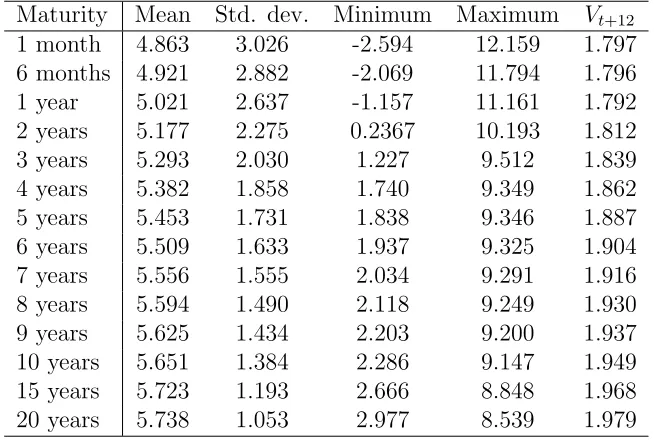
Table 2: Yield curve estimates descriptive statistics (1990:01-2006:03)
Maturity Mean Std. dev. Minimum Maximum Vt+12
1 month 4.863 3.026 -2.594 12.159 1.797
6 months 4.921 2.882 -2.069 11.794 1.796
1 year 5.021 2.637 -1.157 11.161 1.792
2 years 5.177 2.275 0.2367 10.193 1.812
3 years 5.293 2.030 1.227 9.512 1.839
4 years 5.382 1.858 1.740 9.349 1.862
5 years 5.453 1.731 1.838 9.346 1.887
6 years 5.509 1.633 1.937 9.325 1.904
7 years 5.556 1.555 2.034 9.291 1.916
8 years 5.594 1.490 2.118 9.249 1.930
9 years 5.625 1.434 2.203 9.200 1.937
10 years 5.651 1.384 2.286 9.147 1.949
15 years 5.723 1.193 2.666 8.848 1.968
20 years 5.738 1.053 2.977 8.539 1.979
Note: Descriptive statistics for model-based monthly yields at different maturities in annual base. The last column presents the variance ratio defined as,Vt+12= 1kvarvar((yytt+12−yt)
Figure 1: End-of-month available discount and coupon bonds over the sample period. A point represents a bond available for the corresponding maturity and time period.
[image:32.612.194.413.435.613.2]Figure 3: Estimated latent factors rt and µt in annual base over 1990:01-2006:03
[image:33.612.154.454.392.625.2](a) Yield-to-maturity on September, 1993 (b) Yield-to-maturity on March, 2002
Figure 5: Model-based yield to maturity (continuous line) and the observed yields of traded instruments (circle points) in annual base
[image:34.612.182.429.406.606.2](a) Response ofrtto a one std. dev. ofrt (b) Response ofµtto a one std. dev. ofrt
[image:35.612.124.481.386.514.2](c) Response of rtto a one std. dev. ofµt (d) Response ofµtto a one std. dev. ofµt
(a) Response of 6-month yield to a one standard deviation ofrt
(b) Response of 5-year yield to a one standard deviation ofrt
(c) Response of 10-year yield to a one standard deviation ofrt
(d) Response of 20-year yield to a one standard deviation ofrt
(e) Original yield curve (t0) and the
yield curve one month (t1) and 5 years
[image:36.612.141.467.136.257.2](t60) after a one standard deviation ofrt
(a) Response of 6-month yield to a one standard deviation ofµt
(b) Response of 5-year yield to a one standard deviation ofµt
(c) Response of 10-year yield to a one standard deviation ofµt
(d) Response of 20-year yield to a one standard deviation ofµt
(e) Original yield curve (t0) and the
yield curve one month (t1) and 5 years
(t60) after a one standard deviation of
[image:37.612.141.468.137.258.2]µt
Figure 9: Estimated impulse-response functions of selected yields and the yield curve to a one standard deviation ofµt(solid line) along with 95 percent