E-Learner’s Collective Intelligent System Framework:
Web Mining for Personalization in E-Learning 2.0
Ecosystem using Web 2.0 Technologies
Hasnat Ahmad Hussny
Deptt. of Computer ScienceUniversity of Agriculture Faisalabad, Pakistan
Ahmed Mateen
Deptt. of Computer ScienceUniversity of Agriculture Faisalabad, Pakistan
Muhammad Murtaza Nayyer
Faxinating Solutions 2700 Rue Modugno Saint Laurent, Quebec H4R 1Z9Montreal, Canada
Tasleem Mustafa
Deptt. of Computer ScienceUniversity of Agriculture Faisalabad, Pakistan
ABSTRACT
E-Learning 2.0 ecosystem has turn out to be a trend in the world nowadays. The term E-Learning 2.0 ecosystem was coined that came out during the emergence of Web 2.0 technologies. Most of the researches overlook a deep-seated issue in the e-learner’s foregoing knowledge on which the valuable intelligent systems are based. This research utilizes the e-Learner’s collective intelligence knowledge and extracts useful information for appropriate target courses or resources as a part of a personalization procedure to construct the e-Learner’s collective intelligent system framework for recommendation in e-learning 2.0 ecosystem. This research based on a novel web usage mining techniques and introduces a novel approach to collective intelligence with the use of mashup and web 2.0 technology approach to build a framework for an E-Learning 2.0 ecosystem. It is incorporated in predictive model efficiently based on back-propagation network (BPN). A prototype system, named E-learner’s Collective Intelligence System Framework, has been proposed which has features such as self-regulation, reusability, lightweight, end user oriented, and openness. To evaluate the proposed approach, empirical research is conducted for the performance evaluation.
General Terms
Information System Application, Artificial Intelligence, Automatic Service, E-Learner’s Knowledge Discovery.
Keywords
E-Learning 2.0, Ecosystem, Web Mining, Web 2.0 Technologies, Neural Network, Collective Intelligence, Mashup, Personalization, Recommendation.
1.
INTRODUCTION
The term E-Learning is widely used now a day it’s mean to comprise all form of electronically learning in which contents are delivered over the internet including rich internet applications. It is delivered in multiple formats and a collaboration of e-learner and expert in order to develop the content for a particular courseware [37]. E-Learning is grown up day by day and becomes a current and hot topic in research community but still faces difficulties, especially in its deployment [43]. In simple words E-Learning is the acquisition and use of knowledge delivered and aided by
electronic means [1]. However, in spite the maturity level of E-Learning since its origin, face many problems in its execution. The main challenging problem is to incorporate E-learning systems with third parties system [31]. To resolve out these issues, the research community has believed that an E-Learning 2.0 ecosystem is the next generation E-E-Learning [45] [9]. Currently, Web 2.0 has a strong influence on E-Learning. The term Web 2.0 is closely related with Tim O'Reilly is deliberated as a group of web applications that can be reused contents generated by users and initiate social collaboration [3]
Social networking sites are hallmark of Web 2.0 applications. These applications share a lot of functionality, services and contents with third parties [3]. A novel web usage mining techniques and introduces a novel approach to collective intelligence with the use of mashup and web 2.0 technology empowered recommendation in e-learning 2.0 ecosystem. Web 2.0 technologies in e-learning 2.0 ecosystem in direction to [12]:
E-learners are placed at the user centric and expedite apparently creation of new forms for cooperation, and feeding [10].
E-learner personalized the e-learning 2.0 ecosystem [40].
Ease and smooth learning environment [41].
Problems solved by using collaborative techniques [13].
By providing feedback.
Provide opportunities to e-learners to interact and share contents with others [41].
E-learning 2.0 ecosystems are more operative and effective [10].
Be responsible for flexibility and cost effective e-learning 2.0 ecosystems [12].
include social networking sites are shared in E-Learning ecosystems and mashups [8].
In this paper, we present our initial design for construct the E-learner’s Collective Intelligence System Framework. Our methodology is based on the novel web usage mining techniques along with introduce a novel approach to collective intelligence with the use of mashup and web 2.0 technology approach and incorporate artificial neural network to predict potential e-Learners’ pattern and need in future. The remainder of this paper is organized as follows. Section 2 describes the background and development of E-Learning and E-learning 2.0, Collective Intelligence, Classifying Intelligence and E-Learning 2.0 Ecosystem and artificial neural network. Section 3 explains the Collaboration of Collective Intelligence and Web 2.0 in detail. Section 4 provides an overview of the latest Web 2.0 technologies which can be used to integrate the process. Section 5 describes the collaboration web service for CI. Section 6 describes about the E-learner knowledge discovery layer which comprise of different layer in non-linear order discussed in detail and also describes about the E-learners Collective Intelligence System (ECIS) Framework. In section 7 discuss the performance evaluation. Finally, section 8 is the conclusion and future work.
2.
E-Learning and E-Learning 2.0
Background
E-Learning is one of the supreme essential learning inventions of the past three spans. E-Learning can finest be agreed in the comprehensive framework of consuming tools to encounter the world needs for knowledge [4]. Subsequent the victory of the internet and the joining potentials it accessible, eLearning was over glorified foremost to impractical prospects in the late 90s. At the spell, the publicity just outdid the prevailing knowledge.
Nowadays a noteworthy and remarkable evolution and enormous modifications occur in E-learning productiveness. Dondi and Delrio conveyed disquiets about first generation e-learning as follows [44]:
Learners are isolated, deficiency of educationalists opinion, learner cooperation and campus societal environment.
Lack of funds for organizations and students.
Ambiguity about e-learning quality and e-learning appraisal.
Lake of skills perquisite for e-learning deployment among coaching staff, technical staff, and scholars.
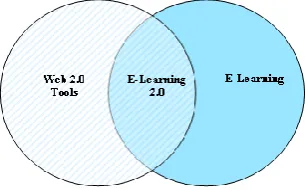
[image:2.595.351.504.77.172.2]Nowadays, the word E-Learning 2.0 is being castoff to define the e-Learning tendency that has arose and grew as a consequence of Web 2.0 tools, which has transported a main variation in the method folks use the Internet.
Figure 1 : Origin of the E-Learning 2.0
2.1
What is Collective Intelligence?
Collective intelligence is an active and hot area of study that heads the web. Scholars from the different study of field especially computer science have a great impact and made remarkable influence to this arena. When a collection of persons work together or participate with each other, intelligence or activities didn’t occur unexpectedly transpires, it is often known as collective intelligence (CI) [39].Application of CI to e-learner 2.0 ecosystem impacts it in the subsequent ways.
Retention rates are higher
Greater possibility of a consumer finalizing a transaction and discover material of concern
Boosting search engine rankings
2.2
Classifying Intelligence
Intelligence delivered by users can be separated into three main classifications which are direct intelligence, Indirect Intelligence and Higher level Intelligence. Direct intelligence which is gathered from the users. For example recommendations, ratings, reviews, bookmarks, user generated contents, voting, tags, and user interaction. Indirect intelligence is gathered by the user either on or off the application, which text is usually in unstructured form examples are wikis, contributions to online communities. Last is a higher level of intelligence which is gathered by using web mining methods [39].
Figure 2 : Classifying user generated information
2.3
E-Learning 2.0 Ecosystem
activities and play a key role in order to cooperate and communicate with others learning communities [6].
Figure 3 : E-Learning 2.0 Ecosystem [15]
Ecosystem is defined according to the Encyclopedia Britannica as a “complex of living organisms, their physical environment, and all their interrelationships in a particular unit of space" [11].
[image:3.595.56.298.111.247.2]E-learning 2.0 ecosystem the term used to define all the components prerequisite to deploy an E-learning solution. It is the great opportunity to build the next level E-Learning 2.0 ecosystem, giving better opportunities for obtaining the knowledge from educationalist by the new age group of learners.
Figure 4 : E-learning ecosystem components [44]
2.4
Artificial Neural Network (BPN)
[image:3.595.65.267.392.532.2]A back-propagation network (BPN) is a neural network approach that uses a supervised learning technique and feed-forward architecture. A Back Propagation Network is one of the best repeatedly used neural network methods for arrangement and forecast [46]. It is deliberated a progressive multiple regression investigation that can accommodate difficult and nonlinear information correlation. It was first defined by Werbos and further technologically advanced by Ronald, Rumelhart and Hinton. The facts for the back-propagation learning process can be found. Figure 5 displays the l – m – n (l denotes input neurons, m denotes hidden neurons, and n denotes output neurons) structural design of a Back Propagation Network model.
Figure 5 : Back-Propagation Network Architecture [27]
Let Ip = (Ip1, Ip2,…Ipl), p = 1, 2 . . . N be the pth arrangement among N input arrangements. Where wji and wjk are association weights between the ith input neuron to the jth hidden neuron, and the jth hidden neuron to the kth output neuron, correspondingly [36].
Output from a neuron in the input layer is
Output from a neuron in the hidden layer is
Output from a neuron in the output layer is
Where ∫ () is the sigmoid transfer function given by ∫(x)=1/1+e-x).
Back Propagation Network has been practical to numerous areas, such as examining bankruptcy and credit forecasts [42]. Back Propagation Network method to foretell e-Learners’ potential needs in the e-Learning 2.0 ecosystem.
3.
Collaboration of Collective Intelligence
and Web 2.0
(Linguistics Markup Language), APML (Attention Profiling Markup Language) and PMML (Predictive Model Markup Language). These languages describing numerous information which can be divided into the groups of [32]:
collaboration-based
explicit-based
implicit-based
Intelligence based.
The participation of user openly and independently covers the way for CI which permits applications to be constantly enriched to bottomless the correlation with the users. This sequence of development is recognized as the perpetual beta, where the application is not reached to a final version [39].
Generating collective intelligence is a problematic task with the formerly available massive amount of contents generated by the user on the Internet. It is becoming complicated when handle the bulky datasets [32].
The following are most probable challenges related with E-Learner’s Knowledge Discovery (EKD) on E-E-Learner’s datasets:
Isolation of Data.
Assorted Form of Data Types.
User Interface (Unavailability) Challenge.
4.
Web 2.0 Technologies
Web 2.0 technologies cannot be summarized and generalized but are in its place a complicated and constantly growing technology which can comprise server software, content based syndication, messaging procedures, and standards concerned with browsers with add-ons and plug-ins, and numerous client-applications [39] [13]. Some common and standard Web 2.0 technologies used in this paper contain.
4.1
Folksonomies
Folksonomies are classifications created through the process of users tagging items [39]. Tags generated by users are responsible for an ad hoc method of ordering items, in terms that’s significant to the user. This procedure of classification, generally identified as folksonomies, empowers users to gain information by means of terms that they’re familiar with. Folksonomies permits users to discover further users with similar interests [17].
4.2
XML & JSON
A common purpose language for making custom markup tags. Extensible Markup Language (XML) is a markup language that describes rules for converting documents in a presentation that is both human and machine readable. The design goals of XML highlight simplification, generalization, and usability over the Internet [18]. JSON or JavaScript Object Notation is a text based open standard language which is designed for human readable and lightweight data interchange. It is language independent, with parsers presented for numerous languages [26].
4.3
RSS or Atom Feeds
An expansion of XML permits the syndication, combination and announcement of data. The feed can hold titles, full text manuscripts, summaries, metadata, information and numerous multimedia contents [32].
4.4
SAX, DOM and XSL
Storing and sharing of information is not only essential, but so worthwhile facts and information are mined from the data. For this, in cooperation with data and various schema/DTD which explain the information are necessary. Simple API for XML and Document Object Model are APIs for reviewing the all-inclusive matters and content of the data. XML Path Language (XPATH) and XML Query Language (XQUERY) action as sifts considered as XSL which make over the XML manuscript and permit particular requests [32].
4.5
Rich Internet Applications
Permitting development and distribution of cross platforms RIA with immersive multimedia content. RIA includes plugins like Adobe Flash, Java, JavaFX and Microsoft Silverlight. These applications consume two methods which are Remote Method Invocations (RMI) and Remote Procedural Calls (RPC) to hosts to permit distributed inter-process communications. Web 2.0 technology based application allows this functionality consist of SOAP (Simple Object Access Protocol), REST (Representational State Transfer) and XML-RPC [32] [16].
4.6
Mashups (web application hybrid)
A mashup or web application that combines data from different sources to construct service into new and more powerful ones [19].
4.7
Web Services Description Language
(WSDL)
Collaborating services, the major part which define a way to interconnect and define the services and what type of services they compromise. Web Services Description Language Version 2.0 (WSDL 2.0), is a World Wide Web Consortium suggested XML language for defining Web services [5]. A WSDL description of a web service is responsible for a description which is machine readable and how this service can be utilized, what type of parameters it requires and what type of data it returns [20].
4.8
Web Services Choreography
Description Language (WSCL)
The Web Services Choreography Language (WSCL) is a World Wide Web Consortium applicant approval directed for combining interoperable, peer-to-peer alliances between any type of contributor irrespective of the associate platform or programming paradigm used by the application of the hosting environment [29][21].
4.9
Attention Profiling Markup Language
(APML)
The Attention Profiling Mark-up Language (APML) is an XML based transportable file layout comprising an explanation of the consumer’s ranked interests. XML, Instant Messaging (IM) dialogues, browser history, communications and other forms. The APML undertakings to create it easier for Web services to gather consideration data of distinct users to tailor for the requirements of distinct and ordinary users. Responsiveness information is retained up-to-date because APML is a lossy layout, which sustains only the present day tendencies and elegances of the consumer [22].
4.10
The Semantic Web: OWL And RDF
by World Wide Web Consortium with contribution from a huge number of investigators and industrial associates with the goal to distinct information from particular applications and creating it potential for the web to comprehend and fulfill the requirements of folks and machines to usage the Web content. The Semantic Web is not only anxious about the incorporation and grouping of information strained from varied sources, but also how the information communicates to real world entities so that both users and machines may recognize and investigate the content on the Web. The Web Ontology Language and Resource Description Framework attain this by distributing in languages especially deliberate for information rather than just manuscripts and the associations between them [32].
The Web Ontology Language is used by applications that requirement to process the content of data as a substitute of just presenting data to humans [2].MOWL (Multimedia Web Ontology Language) is an auxiliary modification by the World Wide Web Consortium which has been deliberate to smooth semantic collaborations with hypermedia contents. The Web Ontology Language and Multimedia Web Ontology Language are most commonly using Resource Description Framework and XML syntax.
The Resource Description Framework is a World Wide Web Consortium suggested addition and reconsideration of XML for theoretically telling and prototyping data effected in web resources. The essential goal is to classifying data using Web identifiers (using Uniform Resource Identifiers) and defines it as a subject, predicate and objective so that machine intelligence can pile conversation and use machine understandable data dispersed through the Web [30][35].Resource Description Framework simplification and potential for collaborative intelligence through distribution provides it great worth. Additional benefit to the Resource Description Framework is the Uniform Resource Identifiers can describe actual localities of the referenced data [32]. In this logic, the Resource Description Framework can also deliver a means for E-Learner indexing of the data which can be processed by the EKD (E-Learner Knowledge Discovery) procedure to recognize predominantly fascinating patterns.
4.11
Predictive Model Markup Language
(PMML)
PMML is a presentation and system self-determining interchange layout for statistical and data mining models [38]. It is an XML grounded language developed and maintained by the DMG (Data Mining Group) and permits model to be formed within one vendor’s application, and use other vendors’ applications to visualize, investigate, and evaluate. The PMML also describes the input and output layout of information and how to interpret the result in terms of data mining terminology. Intelligence sharing of that type is critical between collaborating CI servers. To increase the accuracy of classification different collaborative models can be used [33].
5.
Collaborating Web Services for CI
A well form of system must me designed and implemented to carry out EKD for CI in a way to provide coordination among contributing services. By using the combination of the Semantic Web and Web 2.0 technologies, a process is defined which can be used Web services to collaborate information for the sake to enhance recommendation. The whole procedure is shown in figure 6. The discovered patterns and knowledge which is extracted from EKD is used to route the e-learner. To begin collaboration the WSCDL web service is
[image:5.595.317.538.158.308.2]used which is responsible for determine information. The information can be available and gathered from different ways including tagging, blogs, forums and rating investigation to get APML based information. E-learner classification is depend upon on extracting former patterns and knowledge which are discovered by using the CI clusters that run the EKD process.[32]
Figure 6 : Collaborating Web services for CI [32]
6.
Research Methodology
6.1.1
E-Learner Knowledge Discovery (EKD)
Layer
E-learner Knowledge discovery process is based on a sequence of steps (with the feedback loops) that provides a roadmap to extract knowledge or patterns in large volumes of data [7]. To formalize the knowledge discovery process it is defined as drawing out and identify valid pattern or knowledge from the explicit and implicit e-learner generated data which can be used for further procedure in EKD layer. The whole process generally executed in a non-linear order which comprise of several layers. Each layer is described in detail.
6.1.2
Data Selection Layer
Data selection layer is the main layer which is protocol driven in which data is selected from different sources through rich internet applications, simple API for xml, different web services including JSON and contents generated by users implicit or explicitly which are further process to discover interesting pattern or knowledge by using web mining techniques.
6.1.3
Pre-Processing Layer
In pre-processing layer selected data are extracted to normalize and clean by using different techniques and remove the noise. Further in this layer duplicate records are eliminate and handling the missing data fields and reducing numerosity of the data. This data must be integrated and assembled into a consistent and comprehensive view, which is used for pattern discovery.
6.1.4
Web Mining Layer
Web mining is a hot research topic nowadays, advances in web mining area introduces different techniques and algorithms for drawing out hidden patterns in the large data sets. These methods and algorithms include dependence analysis, segmentation, classification, clustering, association rules and regression analysis, outlier and trend detection [14]. Data consists on different types which are classified as ratio scale, interval scale, nominal and ordinal. Depending on the type of data, different algorithms and techniques can be used to measure relationship. By comparing them, interesting patterns can be mined within the data sets [34].
6.1.5
E-learner Pattern Extraction
E-learner patterns are extracted after applying the web mining layer as input attribute to the predicative model layer to predict the pattern as output for knowledge extraction and interpretation layer.
6.1.6
Predictive Model Layer
[image:6.595.137.201.335.429.2]Predictive model is a process which is commonly used in predictive analysis to create or choose a statistical model to predict the future pattern or behavior. It is the area of data mining which is concerned with forecasting patterns or behavior [23] [24] [25].
Figure 7 : A predictive model makes a prediction based on the values for the input attributes.
The aim of predictive model is to build a mathematical model in which it takes input attribute and predicted attribute as output which is shown in figure 7. Decision trees, neural networks (BPN), regression,Bayesian belief networks, and so on are all examples of predictive models. The accuracy of predictive model is based on how well the model behaves or acts on formerly unseen data. Predictive model is used in supervised learning for which the training data set is available (A set of instances or examples) for which the predicted value is known [39].
6.1.7
Back-Propagation Network (BPN)
A well trained and predefined BPN model is essential in our proposed framework [27]. It is extremely important to train the BPN model for every new course otherwise it affects the accuracy of our ECIS framework which is designed for recommendation. E-learners patterns or behaviors are used to train the BPN model which are extracted out from several layers. A BPN technique is incorporated to facilitate this classification, according to patterns or behaviors of the e-learners which are extracted out. Our ultimate goal is to classify e-Learners into groups with similar patterns or behaviors. The extracted e-Learners patterns or behaviors are used to forecast e-Learners patterns or behaviors, for example such as their potential interest in course.
6.1.8
Knowledge Extraction Layer & Pattern
interpretation
After deploy a BPN technique predicted patterns or behaviors are used for further processing to extract knowledge and interpret the patterns.
6.1.9
Derived Intelligence
Intelligence is derived from knowledge extraction layer and web 2.0 technologies API to enhance the ECIS framework for recommendation in e-learning 2.0 ecosystem.
6.1.10
Utilization
The interpretation of extracted learner’s patterns and e-learner’s learned knowledge is utilized to provide accurate recommendation.
6.1.11
E-Learners Collective Intelligence System
(ECIS) Framework
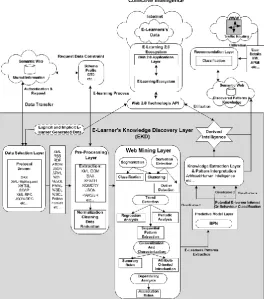
The proposed framework presented in this paper is shown in figure 8. We proposed an E-Learners Collective Intelligent System (ECIS) Framework to utilize the e-learners collective intelligence for particular courseware to enhance the recommendation and personalized e-learning 2.0 ecosystem. Our methodology is based on e-learner knowledge discovery layer which comprise of several layers that can be executed in a non-linear order. The first layer is acquisition of data (implicit and explicit e-learner generated data) the data does not collected from the collaborators, it comes from publicly accessible linked, data collected from Web crawlers and semantic information via RDF [28] then selection layer, pre-processing layer. Depending on the web mining model being used data is segmented and processed in different ways. The type of data is common among all the methods which come from semantic web and in the form of XML and JSON data.
[image:6.595.316.581.434.734.2]For collaboration setup used WSCDL web service in which data formats and dead-end are itemized so the collaborating web services for CI exactly identify what it is retrieving. The web service can also be used to determine data constraints by requesting the schema or profile information into a refined way for the web mining layer that is used to extract or mine the e-learners patterns or behavior then used the predictive model layer which is based on some algorithms like as decision tree, neural networks (BPN), regression, Bayesian belief networks, and so on. The aim of the algorithm is to construct a mathematical model that can predict the output attribute value given a set of input attribute values. So it incorporated in back-propagation network (BPN) to classify the potential e-learners patterns into groups with similar interest to interpret the pattern and extract the knowledge in knowledge extraction layer which is used to derived intelligence. Discovered patterns from both layers are used to store back on the semantic web. The patterns can be stored in any shape or format which is most suitable in consideration due to advantages it can be easily shared between applications, such as the PMML [32]. These store patterns are used to enhance the recommendation layer. We also use the collaborative web service for CI to Route the traffic for recommendation for particular courseware in e-learning 2.0 ecosystem.
User tracking information can also submit by using web service like as APML [32] which can be further processed with the pre-determined models to classify the e-learner into to a specific group and allow traffic routing for recommendation in e-learning 2.0 ecosystem. For example to classify a particular e-learner take a particular courseware and to suggest other courses or resources from Web services associated with that particular courseware.
This is the real power of our proposed ECIS framework to aid recommendation. The useful information for appropriate target courses or resources can play the key role to generate the models for classification depends on several trend regions. The ECIS framework will make recommendation about the preferences of an Learner on the basis of the other e-Learners collective taste information.
7.
Performance Evaluation
For the objective of associating the performance evaluation between the usual recommendation in conventional e-Learning and our recommended framework linking Back Propagation Network and web mining techniques and introduces a novel approach to collective intelligence with the use of mashup and web 2.0 technology approach to build a framework for recommendation in e-learning 2.0 ecosystem. A survey form was used to find out e-Learners’ degree of satisfaction with our recommended framework. The survey form was planned and designed out to inquire queries in eleven classifications: Correctness, Feature, and Circulation,
user friendly for the system, Performance, Well Compatible, Significance, Misperception, Ease of use, Support, and Consistency. This survey form used a five option point alike type scale to estimate the level of satisfaction with the recommended system. Replies on the scale scope from strongly like, like, no views, dislike, and strongly dislike.
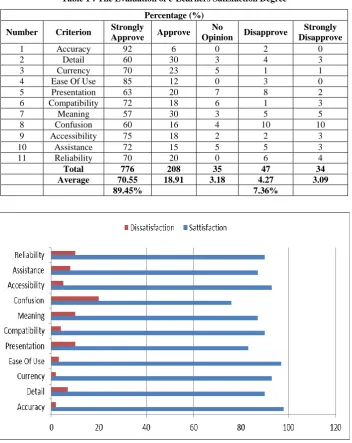
The survey form based method was used and integrated into the suggested recommendation framework for getting the sample records and datasets. All 1100 e-Learners were questioned to fill out the on-line survey form, and their responses were gathered and kept in the system. The outcomes are recorded in Table 1.
To create it stress-free to eye at the outcomes of the assessment, the assessing outcomes of “strongly liked” and “like” were combined as “Liked”, and the estimating results of “dislike” and “strongly dislike” were combined as “dislike”. The consequences of the survey form concerning the level of reader’s satisfaction are presented in figure 9. The results specify that above 90% “Satisfied” in terms of accurateness, feature, circulation, user-friendliness, sense, and support. In aggregate, 89.45% of the e-Learners believed that the E-learner’s Collective Intelligence system framework fulfilled their requirements the outstanding 7.36% readers believed that system was disappointing for their requirements. This survey pointed out that our recommended system was recognized by maximum number of the e-Learners.
8.
Conclusion And Future Work
An E-Learning 2.0 ecosystem has attracted the research community as the next generation E-Learning. The aim of our proposal is to propose E-learner’s Collective Intelligent System Framework for e-learning 2.0 ecosystem in order to find a better prediction and recommendation. Our method is based on a novel web usage mining techniques and introduces a novel approach to collective intelligence with the use of mashup and web 2.0 technology approach to build a framework for an E-Learning 2.0 ecosystem. It is incorporated in predictive model layer (BPN) to predict potential e-Learners’ pattern or behavior which is further processed in knowledge extraction layer to derived intelligence for better recommendation or decision support. This approach does not require many resources since the platform of Web 2.0 tools exist and many tools are free for use. Web 2.0 has greatly changed people’s life, including the learning habits and learning styles. ECIS framework has the features such as self-regulation, reusability, lightweight, end user oriented, and openness which are self-explanatory.
Table 1 : The Evaluation of e-Learners Satisfaction Degree
Percentage (%)
Number Criterion Strongly
Approve Approve No
Opinion Disapprove
Strongly Disapprove
1 Accuracy 92 6 0 2 0
2 Detail 60 30 3 4 3
3 Currency 70 23 5 1 1
4 Ease Of Use 85 12 0 3 0
5 Presentation 63 20 7 8 2
6 Compatibility 72 18 6 1 3
7 Meaning 57 30 3 5 5
8 Confusion 60 16 4 10 10
9 Accessibility 75 18 2 2 3
10 Assistance 72 15 5 5 3
11 Reliability 70 20 0 6 4
Total 776 208 35 47 34
Average 70.55 18.91 3.18 4.27 3.09
89.45% 7.36%
Figure 9 : The Comparison Chart of E-Learner Satisfaction Degree
9.
ACKNOWLEDGMENT
The authors appreciate Mr. Ahmed Mateen for his generous help with our research. We also gratefully thank for their valuable comments and constructive suggestions.
10.
REFERENCES
[1] A. Gunasekaran, Ronald D. McNeil and Dennis Shaul, “E-Learning: research and applications”, Industrial and Commercial Training, 2002, 34(2), pp. 44-53.
[2] Bechhofer, S. F. V. Harmelen, J. Hendler, I. Horrocks, D. Mcguinness, P. P. Schneijder and L. A. Stein. 2004. OWL Web Ontology Language Reference. Recommendation, World Wide Web Consortium (Available on-line with updates at http://www.w3.org/TR/owl-features/).
[3] Cormode, G. and B. Krishnamurthy. “Key Differences between Web1.0 and Web2.0”, February 13, 2008.
[4] Cohen, E. B. and M. Nycz. 2006. Learning objects and e-learning: an informing science perspective.
Interdisciplinary Journal of Knowledge and Learning Objects, 2(1) : 23-34.
[5] Chinnici, R., J. J. Moreau, A. Ryman and S. Weerawarana. 2007. Web services description language (WSDL) version 2.0 part 1: Core language. World Wide Web Consortium, Recommendation (Available on-line with updates at http://www.w3.org/TR/wsdl20-primer).
[6] C. G. and V. C. 2. “The use of Web 2.0 Technologies and Services to support E-Learning Ecosystem to develop more effective Learning Environments”, the Ninth IEEE International Conference on Advanced Learning Technologies", Australia/2008.
[7] Cisos, K. J., W. Pedrycz, R. W. Swiniarski and L. A. Kurgan. Data Mining A Knowledge Discovery Approach, Springer Publication, 2007. Available at: http://www.springer.com/978-0-387-33333-5.
http://www.ibm.com/developerworks/xml/library/x-mashups.html, last access May 6, 2009.
[9] Emory M. Craig, “Changing paradigms: managed learning environments and Web 2.0”. Campus-Wide Information Systems, 2007, 24 (3), pp. 152-161.
[10] Fiaidhi, J. and S. Mohammed. "Learning Agents Framework Utilizing Ambient Awareness and Enterprise Mashup", "the International Journal of Instructional Technology and Distance Learning", 2008, 6(3).
[11] Gerhard Wurzinger, V. Chang, et al. “Towards greater Flexibility in the Learning Ecosystem Promises and Obstacles of Service Composition for Learning Environments”, Australia.
[12] http://www.dontwasteyourtime.co.uk, Benefits of Collaborative Learning. Jul 8 .By David Hopkins.
[13] http://en.wikipedia.org/wiki/Web_2.0.
[14] Han, J., M. Kamber and J. Pei. 2011 Data Mining: Concepts and Techniques. Morgan Kaufmann Publishers, San Francisco, C.A., USA.
[15] http://mivanova.blogspot.ca/2007/11/elearning-10-ecosystem-and-elearning-20.html.
[16] http://en.wikipedia.org/wiki/Rich_Internet_application.
[17] http://en.wikipedia.org/wiki/Folksonomy.
[18] http://en.wikipedia.org/wiki/XML.
[19] http://en.wikipedia.org/wiki/Mashup_(web_application_ hybrid).
[20] http://en.wikipedia.org/wiki/Web_Services_Description_ Language.
[21] http://en.wikipedia.org/wiki/Web_Service_Choreography
[22] http://en.wikipedia.org/wiki/Attention_Profiling_Mark-up_Language.
[23] http://en.wikipedia.org/wiki/Predictive_modelling.
[24] http://www.gartner.com/it-glossary/predictive-modeling.
[25] http://searchdatamanagement.techtarget.com/definition/p redictive-modeling.
[26] http://en.wikipedia.org/wiki/JSON
[27] Hua, P., C. P. H. Li, K. K. Chen and M. Wua. 2009. Accessing e-Learners' Knowledge for Personalization in e-Learning Environment. Journal of Research and Practice in Information Technology, 41(4) : 295-318.
[28] Kuncheva, L. I. 2004. Combining Pattern Classifiers: Methods and Algorithms. Wiley, New Jersey.
[29] Kavantzas, N., D. Burdett, G. Ritzinger, T. Fletcher, Y. Lafon and C. Barreto. 2005. Web services choreography description language version 1.0. World Wide Web Consortium, Candidate Recommendation (Available on-line with updates at http://www.w3.org/TR/ws-cdl-10/).
[30] Klyne, G., J. J. Carroll, and B. McBride. 2008. Resource description framework (RDF): Concepts and abstract syntax. W3C Recommendation. (Available on-line with updates at http://www.w3.org/TR/rdf-concepts).
[31] Loma Uden and Ernesto Damiani, “The future of E-Learning: E-Learning ecosystem”, Proceedings of the first IEEE International Conference on Digital
Ecosystems and Technologies, Cairns, Australia, 2007, pp. 113-117.
[32] Lee, I. and C. T. Bruin. 2012. Geographic Knowledge Discovery from Web 2.0 Technologies for Advance Collective Intelligence. Slovenian Society Informatika 35, PP : 453-461.
[33] L. I. Kuncheva. Combining Pattern Classifiers: Meth-ods and Algorithms. Wiley, New Jersey, 2004.
[34] Miller, H. J. and J. Han. 2001. Geographic Data Mining and Knowledge Discovery: An Overview. Cambridge University Press, UK.
[35] Manglo, F. and E. Miller. 2004. Rdf primer (Available on-line at http://www.w3.org/TR/rdf-primer).
[36] Panda, S.S., D. Chakraborty and S. K. Pal. 2007. Flank wear prediction in drilling using back propagation neural network and radial basis function network. Applied Soft Computing, 8(2): 858-871.
[37] Price, C, “E-Learning Ecosystems: The Future of Learning Technology”, retrieved from http://www.cyberdent.ca/index.php?option=com_content &task=view&id=20&Itemid=9, last access May 6, 2009.
[38] Raspl, S. 2004. Workshop on Data Mining Standards, Services and Platforms the Tenth ACM SIGKDD International Conference on Knowledge Discovery and Data Mining (Available on-line at http://www.lac.uic.edu/workshops/dm-ssp04.htm).
[39] S. Alag. Collective Intelligence in Action. Manning Publications, 2008.
[40] Sclater, N. “Web 2.0, Personal Learning Environments, and the Future of Learning Management Systems”, 2008. http://www.igiglobal.com/Bookstore/Article.aspx?TitleId =42095.
[41] Selwyn, N. “Web 2.0 applications as alternative environments for informal learning a critical review”, paper for OECD-KERIS expert meeting, London, UK.
[42] Tsai, C.F. and J.W. Wu. 2008. Using neural network ensembles for bankruptcy prediction and credit scoring. Expert Systems with Applications, 34(4): 2639-2649.
[43] Tim L. Wentling, Consuelo Waight, James Gallaher, Jason La Fleur, Christine Wang and Alaina Kanfer, “E-Learning A review of literature”, retrieved from http://learning.ncsa.uiuc.edu/papers/elearnlit.pdf, last access May 6, 2009.
[44] Uden, L., I. T. Wangsa, et al. “The future of E-learning: E-learning ecosystem”, “the Inaugural IEEE International Conference on Digital Ecosystems and Technologies (IEEE DEST 2007)”.
[45] Vanessa Chang and Christian Guetl, “E-Learning Ecosystem (ELES) A Holistic Approach for the Development of more Effective Learning Environment for Small-and-Medium Sized Enterprises (SMEs)”, Proceedings of the first IEEE International Conference on Digital Ecosystems and Technologies, Cairns, Australia, 2007, pp. 420-425.
![Figure 5 : Back-Propagation Network Architecture [27]](https://thumb-us.123doks.com/thumbv2/123dok_us/8082322.782665/3.595.65.267.392.532/figure-back-propagation-network-architecture.webp)
![Figure 6 : Collaborating Web services for CI [32]](https://thumb-us.123doks.com/thumbv2/123dok_us/8082322.782665/5.595.317.538.158.308/figure-collaborating-web-services-for.webp)