http://dx.doi.org/10.4236/jmmce.2014.24034
Statistical Analysis for the Abrasive Wear
Behavior of Al 6061
Mohd Shadab Khan1, Zahir Hasan2, Yaqoob Ali Ansari1
1Department of Mechanical Engineering, Integral University, Lucknow, India 2Jahagirabad Institute of Technology, Jahangirabad, India
Email: [email protected], [email protected], [email protected]
Received 2 April 2014; revised 14 May 2014; accepted 3 June 2014
Copyright © 2014 by authors and Scientific Research Publishing Inc.
This work is licensed under the Creative Commons Attribution International License (CC BY).
http://creativecommons.org/licenses/by/4.0/
Abstract
In the present study, a mathematical model has been developed to predict the abrasive wear be-havior of Al 6061. The experiments have been conducted using central composite design in the design of experiments (DOE) on pin-on-disc type wear testing machine, against abrasive media. A second order polynomial model has been developed for the prediction of wear loss. The model was developed by response surface method (RSM). Analysis of variance technique at the 95% con-fidence level was applied to check the validity of the model. The effect of volume percentage of reinforcement, applied load and sliding velocity on abrasive wear behavior was analyzed in detail. To judge the efficiency and ability of the model, the comparison of predicted and experimental response values outside the design conditions was carried out. The result shows, good correspon-dence, implying that, empirical models derived from response surface approach can be used to describe the tribological behavior of the above composite.
Keywords
Abrasive Wear, Orientation, ANOVA
1. Introduction
many decades. It was observed by several authors [3]-[13] that the variation of friction and wear rate depends on interfacial conditions such as normal load, geometry, relative surface motion, sliding speed, surface roughness of the rubbing surfaces, type of material, system rigidity, temperature, stick slip, relative humidity, lubrication and vibration. Al 6061 is widely used in numerous engineering applications including transport and construction where, superior mechanical properties such as tensile strength and hardness are essentially required. This paper is in series with “Effect of Orientation and Applied Load on Abrasive Wear Property of Alumunium Alloy-Al 6061 and Brass 6040” [14] [15].
The objective of this work is to perform the statistical analysis for the abrasive wear behavior of Al 6061at different orientation and at different loadsand to form the equation wear.
2. Materials and Methods
In order to carry out the experimental work the following procedure is adopted: 1) specimen preparation; 2) ma-terials selection; 3) response surface methodology (RSM).
2.1. Specimen Preparation
The specimen for wear studies was cut from the Al alloy bar. The specimen cross section used was 1 cm × 1 cm with a length of 4.5 cm. The top and bottom surfaces of specimen were made planer by polishing against emery papers of appropriate grits. For the preparation of the surface to be used for wear studies, the final grit size of the emery paper was the same as the one to be used for the wear studies.
2.2. Material for Wear Studies
For wear study, the material selected is Al 6061 alloy. The wear studies were conducted against grinding disc for different load at different orientation. The selection of load and orientation discussed later.
2.3. Selection of Applied Load and the Position of the Specimen
For wear studies the following loads were selected 1) 5 N, 2) 10 N, 3) 15 N, 4) 20 N. For each load the orienta-tion of the specimen was kept at 0˚, 30˚, 45˚, 60˚ and 90˚respectively.
2.4. Response Surface Methodology (RSM)
RSM is a collection of mathematical and statistical techniques that are useful for the modeling and analysis of problems in which output or response is influenced by several input-variables and objective is to find the corre-lation between the response and the input-variables. Farias et al. [16] studied the sliding wear of austenitic stainless steels. They adopted to obtain an empirical model of wear rate as a function of applied load and sliding velocity using RSM. A polynomial model of second order type was proposed to represent the relationship be-tween wear loss and tribo test independent variables. In the present work, the input variables are angle of orien-tation (A) measured in degree and normal applied load (L) measured in Newtons and the output (response) is wear loss (W) measured in milligram (mg). A response surface model given in Equation (1) is usually expressed as:
2 2 2
1 1 2 1 3 2 4 2 5 3 6 3
Y = +A B X +B X +B X +B X +B X +B X + (1)
where A is constant of equation. B1, B2, B3, B4, … Bn are the unknown regression coefficients and X1, X2, … Xk are the input variables that influence the response Y, k is the number of input factors. The method of least square is used to estimate the coefficients of the second order model. The response surface analysis is then done in terms of the fitted surface. The degree of significance of the model was tested by analysis of variance (ANOVA) using the software MINITAB-15.
2.5. Design of Experiments (DOE)
Table 1.Important factors and their levels for abrasive wear.
S.N. Factors Notation Unit Levels
1. Orientation A Deg 0 45 90
2. Applied load L N 10 15 20
3. Result and Discussion
3.1. Development of Wear ModelCentral composite design of full factorial was used, a total of 14 experiments are conducted and regression coef-ficients were calculated as shown in Table 2.
By analyzing the estimated regression coefficients of CCD (Full Model-Uncoded Units) as shown in Table 3. The mathematical model of wear loss (W) can be expressed in term of the un-coded values of the independent variables in the Equation (2) given below:
5 2
4 2
0.779142 0.00168839 0.0166802 4.81743 10
3.02118 10 0.000106444
W A L A
L A L
−
−
= − × + × − × ×
− × + × × (2)
3.2. Analysis of Variance (ANOVA)
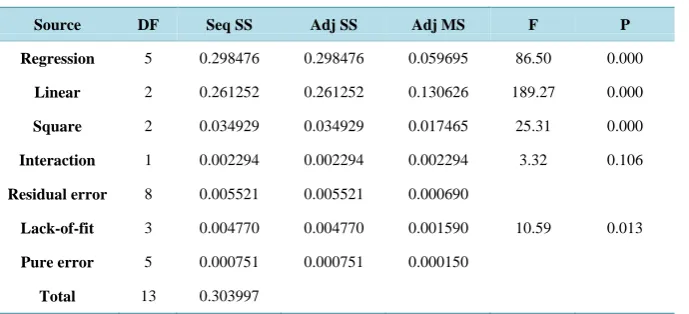
Analysis of variance (ANOVA) and the F-ratio test have been performed to check the adequacy of the model as well as the significance of the individual model coefficients. The ANOVA was carried out on the model for a confidence level of 95%. The results of ANOVA tables for wear loss are listed in Table 2 and Table 4. Table 2
presents the ANOVA table for the second order model propose for wear loss given in Equation (2). It can be ap-preciated that the P-value is less than 0.05 which means that the model is significant at 95% confidence level. Furthermore, the significance of each coefficient in the full model was examined by the t-values and P-values and the results are listed in Table 4. The larger values of t-test and smaller values of “P” indicate that the cor-responding coefficient is highly significant [17]. Hence, the results given in Table 4 suggest that the influence of load (L2) and orientation × load (A × L) are non-significant and therefore can be removed from the full model to further improve the model. By doing so, the full model for the wear loss is expressed in Equation (3).
5 2
0.779142 0.00168839 0.0166802 4.81743 10
W = − ∗ +A ∗ −L × − ∗A (3)
3.3. Analysis of Variance for Reduced Model
ANOVA was performed on the reduced model and the results are presented in Table 5 in coded units and Table 6 in un-coded units and found that the model is highly significant. Thus, Equation (4) represents the un-coded form of final empirical model for wear loss of Al 6061. It should be noted that the above equations are valid over the range of conditions 0˚ ≤ orientation (angle) ≤ 90˚ and 10 N < normal applied load < 20 N for abrasive wear of above composite against 400 grit size.
By taking regression coefficient values for reduced model, the full model for the wear loss can be reduced as:
5 5 2
0.770233 4.81481 10 0.0124067 4.97284 10
W = − × − ∗ +A ∗ −L × − ∗A (4)
3.4. Residual Plots for Wear Loss
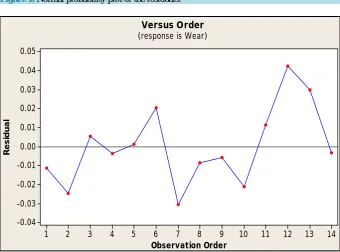
The regression model is used for determining the residuals of each individual experimental run. The difference between the measured values and predicted values are called residuals. The residuals are calculated and ranked in ascending order. The normal probabilities of residuals are shown in Figure 1. The normal probability plot is used to vary the normality assumption. As shown in Figure 1, the data are spread roughly along the straight line. Hence it can be concluded that the data are normally distributed [18].
Table 2. Analysis of variance for wear (full model).
Source DF Seq SS Adj SS Adj MS F P
Regression 5 0.298476 0.298476 0.059695 86.50 0.000
Linear 2 0.261252 0.261252 0.130626 189.27 0.000
Square 2 0.034929 0.034929 0.017465 25.31 0.000
Interaction 1 0.002294 0.002294 0.002294 3.32 0.106
Residual error 8 0.005521 0.005521 0.000690
Lack-of-fit 3 0.004770 0.004770 0.001590 10.59 0.013
Pure error 5 0.000751 0.000751 0.000150
[image:4.595.129.466.282.404.2]Total 13 0.303997
Table 3. Estimated regression coefficients for wear using data in uncoded units.
Term Coef
Constant 0.779142
Angle −0.00168839
Load 0.0166802
Angle × angle −4.81743 × 10⁻⁵
Load × load −3.02118 × 10⁻⁴
[image:4.595.131.467.426.551.2]Angle × load 0.000106444
Table 4. Estimated regression coefficients of wear (full model).
Term Coef. SE coef. T P Description
Constant 0.859688 0.01007 85.334 0.000 Significant
Angle −0.199233 0.01072 −18.577 0.000 Significant
Load 0.062033 0.01072 5.784 0.000 Significant
Angle × angle −0.097553 0.01561 −6.251 0.000 Significant
Load × load -0.007553 0.01561 −0.484 0.641 Non-significant
[image:4.595.129.467.580.673.2]Angle × load 0.023950 0.01314 1.823 0.106 Non-significant
Table 5.Estimated regression coefficients for wear (coded units).
Term Coef SE T P
Constant 0.85780 0.009986 85.902 0.000
Angle 0.19923 0.011531 −17.279 0.000
Load 0.06203 0.011531 5.380 0.000
Angle × angle −0.10070 0.015254 −6.602 0.000
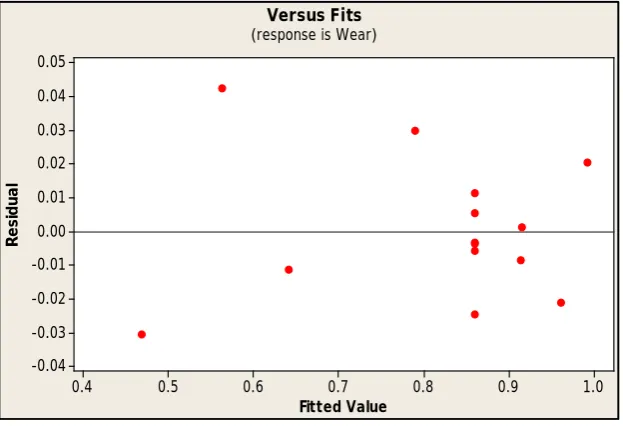
Figure 3 indicates the residuals versus fitted values, which shows only the maximum variation of −0.04 to
Table 6. Estimated regression coefficients for wear using data in uncoded units.
Term Coef.
Constant 0.770233
Angle 4.81481 × 10⁻⁵
Load 0.0124067
[image:5.595.127.468.450.702.2]Angle × angle −4.97284 × 10⁻⁵
Figure 1. Normal probability plot of the residuals.
Figure 2. Residual versus order of the data.
0.050 0.025 0.000 -0.025 -0.050 99 95 90 80 70 60 50 40 30 20 10 5 1 Residual Pe rc en t
Normal Probability Plot
(response is Wear)
14 13 12 11 10 9 8 7 6 5 4 3 2 1 0.05 0.04 0.03 0.02 0.01 0.00 -0.01 -0.02 -0.03 -0.04 Observation Order R e si d u a l Versus Order
3.5. Checking Adequacy of Mathematical Models
The goodness of fit of the mathematical models was also tested by coefficient of determination (R2) and adjusted coefficient of determination (R2 adj). The R2 is the proportion of the variation in the dependent variable ex-plained by the regression model. On the other hand, R2 adj is the coefficient of determination adjusted for the number of independent variables in the regression model. Unlike R2, the R2 adj may decrease if the variables are entered in the model that does not add significantly to the model fit. The R2 and R2 adj values of mathematical models are found 0.974 and 0.967 respectively which clearly indicate the very good correlation between the ex-perimental and the predicted values of the responses.
3.6. Validity of the Models
[image:6.595.143.455.278.491.2]The performance of the developed model was tested using five experimental data which were never used in the modeling process. The results predicted by the developed model were compared with the measured values and also average percentage deviation (φp) was calculated and presented in the Table 7. The results indicate that the model predicted wear loss has good validity with acceptable percentage deviation.
Figure 3.Residuals versus the fitted values.
Table 7. Comparison of the predicted and measured results.
Parameters Wear loss
A L Measured Predicted Deviation (%)
0 5 0.811 0.832 2.622
30 5 0.761 0.786 3.294
60 5 0.653 0.650 0.405
30 10 0.867 0.848 2.180
60 10 0.766 0.712 6.999
30 15 0.899 0.910 1.238
60 15 0.799 0.774 3.076
30 20 0.965 0.972 0.743
60 20 0.854 0.836 2.054
Avg. deviation 2.512%
1.0 0.9
0.8 0.7
0.6 0.5
0.4 0.05
0.04
0.03
0.02
0.01
0.00
-0.01
-0.02
-0.03
-0.04
Fitted Value
R
es
id
ua
l
Versus Fits
[image:6.595.128.468.532.723.2]4. Conclusion
The present study has used central composite design of experiments to develop a second-order polynomial equation for describing abrasive wear behavior of Al 6061. The relationship of abrasive wear loss with orienta-tion and applied load has been successfully obtained by using RSM at the 95% confidence level. This model is valid within the ranges of selected experimental parameters of orientation and applied load. The accuracy of the Response Surface Model was verified with three sets of experimental data which were never used in model-ing and average percentage deviation calculated as 2.512%. The results obtained are in accordance with the work done on Statistical Analysis for the Abrasive Wear Behavior of Bagasse Fiber Reinforced Polymer Com-posites [19].
References
[1] Rabinowicz, E. (1995) Friction and Wear of Materials. John Wiley and Sons, New York.
[2] Williams, J.A. (2005) Wear and Wear Particles—Some Fundamentals. Tribology International, 38, 863-870.
http://dx.doi.org/10.1016/j.triboint.2005.03.007
[3] Archard, J.F. (1980) Wear Theory and Mechanisms. In: Peterson, M.B. and Winer, W.O., Eds., Wear Control Hand-book, ASME, New York, 35-80.
[4] Tabor, D. (1987) Friction and Wear—Developments over the Last 50 Years, Keynote Address. Proceedings of Inter-national Conference on Tribology—Friction, Lubrication and Wear, London, 157-172.
[5] Oktay, S.T. and Suh, N.P. (1992) Wear Debris Formation and Agglomeration. ASME Journal of Tribology, 114, 379- 393. http://dx.doi.org/10.1115/1.2920897
[6] Saka, N., Liou, M.J. and Suh, N.P. (1984) The Role of Tribology in Electrical Contact Phenomena. Wear, 100, 77-105.
http://dx.doi.org/10.1016/0043-1648(84)90007-3
[7] Suh, N.P. and Sin, H.C. (1980) On the Genesis of Friction and Its Effect on Wear. In: Cheng, H.S. and Keer, L.M., Eds., Solid Contact and Lubrication, 39, ASME, New York, 167-183.
[8] Aronov, V., D’Souza, A.F., Kalpakjian, S. and Shareef, I. (1983) Experimental Investigation of the Effect of System Rigidity on Wear and Friction-Induced Vibrations. ASME Journal of Lubrication Technology, 105, 206-211.
http://dx.doi.org/10.1115/1.3254566
[9] Aronov, V., D’Souza, A.F., Kalpakjian, S. and Shareef, I. (1984) Interactions among Friction, Wear, and System Stiff-ness—Part 1: Effect of Normal Load and System Stiffness. ASME Journal of Tribology, 106, 54-58.
http://dx.doi.org/10.1115/1.3260867
[10] Aronov, V., D’Souza, A.F., Kalpakjian, S. and Shareef, I. (1984) Interactions among Friction, Wear, and System Stiff-ness—Part 2: Vibrations Induced by Dry Friction. ASME Journal of Tribology, 106, 59-64.
http://dx.doi.org/10.1115/1.3260868
[11] Aronov, V., D’Souza, A.F., Kalpakjian, S. and Shareef, I. (1984) Interactions among Friction, Wear, and System Stiff-ness—Part 3: Wear Model. ASME Journal of Tribology, 106, 65-69. http://dx.doi.org/10.1115/1.3260869
[12] Lin, J.W. and Bryant, M.D. (1996) Reduction in Wear Rate of Carbon Samples Sliding against Wavy Copper Surfaces. ASME Journal of Tribology, 118, 116-124. http://dx.doi.org/10.1115/1.2837065
[13] Chowdhury, M.A., Khalil, M.K., Nuruzzaman, D.M. and Rahaman, M.L. (2011) The Effect of Sliding Speed and Normal Load on Friction and Wear Property of Aluminum. International Journal of Mechanical & Mechatronics En-gineering IJMME-IJENS, 11, 45-49.
[14] Khan, M.S. and Hasan, Z. (2013) Effect of Orientation and Applied Load on Abrasive Wear Property of Alumunium Alloy-Al 6061. International Journal of Mechanical En-gineering & Technology (IJMET), 4, 80-87.
[15] Khan, M.S., et al. (2014) Effect of Orientation and Applied Load on Abrasive Wear Property of Brass 60:40. Journal of Minerals and Materials Characterization and Engineering, 2, 49-53.
http://dx.doi.org/10.4236/jmmce.2014.21008
[16] Farias, M.C.M., Souza, R.M., Sinatora, A. and Tanaka, D.K. (2007) The Influence of Applied Load, Sliding Velocity and Martensitic Transformation on the Unlubricated Sliding Wear of Austenitic Stainless Steels. Wear, 263, 773-781.
http://dx.doi.org/10.1016/j.wear.2006.12.017
[17] Majumder, A. and Goyal, A. (2008) Enhanced Production of Exocellular Glucansucrase from Leuconostoc Dextrani-cum NRRL B1146 Using Response Surface Method. Bioresource Technology, 99, 3685-3691.
http://dx.doi.org/10.1016/j.biortech.2007.07.027
Response Surface Methodology. International Journal of Advanced Manufacturing Technology, 20, 758-764.
http://dx.doi.org/10.1007/s001700200235
currently publishing more than 200 open access, online, peer-reviewed journals covering a wide range of academic disciplines. SCIRP serves the worldwide academic communities and contributes to the progress and application of science with its publication.
Other selected journals from SCIRP are listed as below. Submit your manuscript to us via either