Towards a Framework Empowering Software
Testing Process for Better Quality
Osama M. Abu Elnasr
College of Computers andInformation Sciences, Egypt.
Magdy Z. Rashad
College of Computers and Information Sciences, Egypt.Mohammed A.
Abo-Elsoud
College of Computers and Information Sciences,
Egypt.
Gamal M. Aly
College of Engineering,Egypt.
ABSTRACT
Software development frameworks are considered the engine that leads the development activities within software development organizations, so the main interest in this research is establishing a framework to effectively lead the development activities to enhance the software quality. The proposed framework relates each development phase with its available artifacts, software metrics can be extracted from its artifacts and relates the test practices and QA best practices during the SDLC. It provides an organized approach to handle miscommunication and poor team management that usually lead to team confusion. It also provides a way to disengage the ambiguity between the software fault and failure through establishing a clear relationship between the both concepts and developing automated models to predict the software correctness and measure its reliability.
Keywords
SDLC, QA, Static Analysis, Testing, Fault, Failure, Correctness, Reliability.
1. INTRODUCTION
Software development organizations seek to improve the quality of their software by continuous working to adapt their development models. Some still depend entirely on the traditional model and others moving strongly towards the agile methodologies with closed eyes about the advantages and disadvantages of the both models, despite their influence on the pillars of the software development process. There are great attempts in the research environment to bring the views and to create models combine the advantages of each model [1-5], other attempts seek to automate the verification activities in order to get a complete control of the behavior of the software and its related quality attributes [6-10].
Software measurement analysis, fault prediction and failure estimation techniques become rich area of research related to verification activities. By evaluating the attributes of the software, we can know its status, characteristics and behavior, [11,12]. The fault proneness [13-16], defect density [16-19], and failure radiation information [20] provide important guidelines to testing practitioners to prioritize their testing effort and assign verification and validation activities.
Most studies related to the research area are considered individual contributions that seek to automates some of the software development activities without concern for creating a framework that includes those contributions to building an integrated framework can be relied upon to manage the three elements of the development system; people, process and product [21-25]. The paper extends the work done by Yu BengLeau [1] and Milad Hanna [10]. Yu BengLeau [1] has
been introduced a review paper that explains the advantages and disadvantages of both traditional and agile methodologies and suggests improvements for current agile development for enhancing organizational project management. Milad Hanna [10] has been introduced a new scripting technique that facilitates the process of automating the execution phase through software testing in an industrial context.
The paper seeks to provide a framework that manages the stakeholders and draws the relationship between each process within the various phases of the system and the deliverables of them with clarifying entity responsible for the production and the beneficiary of its existence in order to structure the inner workings of the system. It sheds light on the pivotal role played by the applications of artificial intelligence to automate the software fault prediction process in a manner of errors spread, their location, and the extent of their impact on the development process and their related quality attributes. It also gives a broad interest to study the behavior of the software product through analyzing and reviewing the deliverables of each phase using what are known by the term software metrics which are used as a basis to build a system capable of monitoring the correctness of software product and its reliability.
The remainder of this paper is organized as follows; Section 2 highlights the problems associated with current area of research. Section 3 provides the full description of the proposed framework. Section 4 introduces the conclusion and the future work.
2. PROBLEM DESCRIPTION
In spite of the successive efforts to develop models of development, but it still suffers from foggy specification of the basic development components of the system ; people, process and product. There are still issues concerning the management of stakeholders, not to mention chaotic the overlapping among the development processes and their integration with each other to produce cost effective qualified software product, and other drawbacks such as:
Lack of a conceptual framework that provide a clear
distinction between software fault and failure, their causes, effects and their prediction and estimation models.
Lack of an organized approach to handle
miscommunication and poor team management that usually lead to team confusion.
Lack of the distinction between static analysis
Lack of a conceptual specification of the tasks of each development process, its interest, and its deliverables.
Fogginess to obtain information about the progress
of the development process until the late stages of the age of the system.
It becomes very important to develop a conceptual framework that brings the views between traditional development activities, agile practices and their related quality activities to get rid of the above mentioned challenges.
3. PROPOSED FRAMEWORK
The proposed framework relates each development phase with its available artifacts, software metrics can be extracted from its artifacts and relates the test practices and QA best practices during the SDLC.
Section 3.1 introduces the framework architecture and its stages. Section 3.2 introduces the four classification dimensions of the framework activities. Section 3.3 introduces the project organizational structure and the team formation and their roles. Finally, Section 3.4 introduces the full description of the framework's phases their activities and their classification.
3.1 Framework Architecture
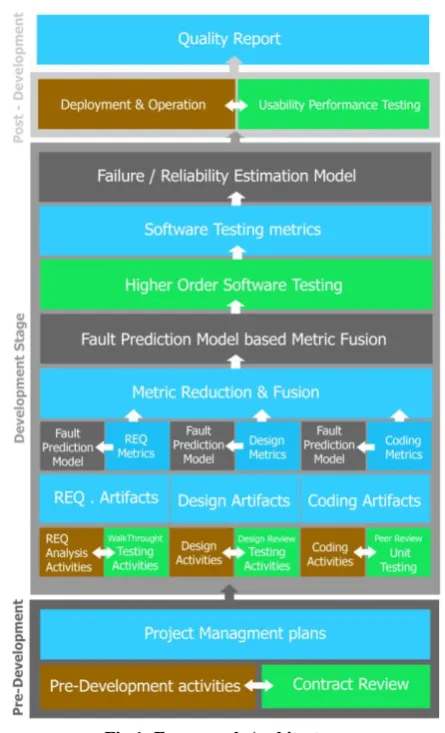
The framework architecture comprised into three distinct interleaved stages; the Pre-Development, Development and Post-Development stage. These three stages have a number of internal phases. Fig. 1 shows the framework components. 3.1.1 Software Pre-Development stage assure that the project commitments have been clearly defined considering a set of activities related to the project vision, resources required, the schedule and budget, project risk handling, business requirement and various project management plans through initiation and the planning phases.
3.1.2 Software development stage decomposed into six distinct, often overlapped / interleaved phases; requirement, design (High Level Design and Low Level Design) ,code and unit test, Pre-Testing, Test Execution (Higher Order Test) and Post-testing phases. For each phase in the development stage the possible created artifacts have been introduced to be able to monitor, review, predict and measure the progress of work done through these phases and assuring the quality of the produced release.
3.1.3 Software Post-Development stage concerned with managing the implementation of the produced release in the operational environment through deployment and operation phase.
3.2 Activities Classification's Dimensions
Software activities can be classified along the proposed framework into four dimensions; Management, Development, Review and Prediction and / or Estimation sector. [image:2.595.315.538.72.439.2]3.2.1 Management sector involves the development of project management plans (PMP) that provide a great control of the development activities and the introduction of managerial support actions that mainly prevent or minimize schedule and budget failures, continually changes in user requirements and identify and assess the risks resulting from the change one of the elements responsible for the software production through
Fig 1: Framework Architecture.
3.2.2 Development sector includes a set of processes that concerned with developing the various deliverables of the release / product and managing their delivery to review sector for auditing and reviewing its quality and be ready for redeveloping or modifying its construction until it reaches the desired level of quality.
3.2.3 Review / Measurement Analysis sector includes a range of verification activities such as walkthrough, design review, peer review and inspection. It also locates the associated metrics for each software artifact that reflect the behavior of the software created through the development stage.
3.2.4 Prediction/ Estimation sector includes the construction of a range of models designed to empower the software testing process for improving the quality of the product and so by focusing on reducing the effort required to determine the presence or eliminate errors in product or assess the readiness of the product for use.
During the prediction part, fault prediction models that predict either fault-prone modules or fault content of the software modules based on collected metrics has been established. The failure estimation part of this sector attempts to estimate the current level of reliability of the software while in execution and determines the readiness of the system to release. Thus, the number of failures becomes the goal of
estimation instead of faults. Fig.2 shows theclassification of
the fault prediction and estimation models and their
Fig 2: Fault prediction and failure estimation models and their implementation techniques.
3.3 Stakeholders Involvement
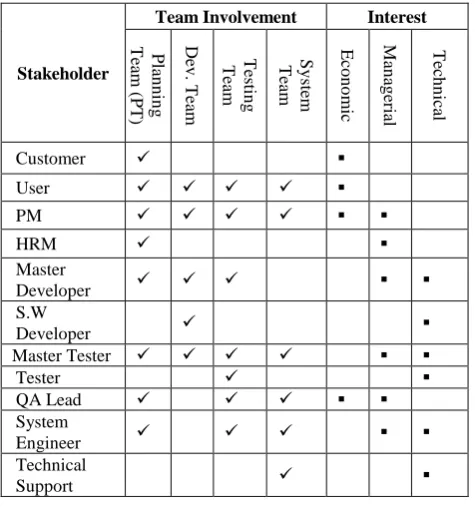
[image:3.595.48.286.403.657.2]During each stage within the proposed framework, several stakeholders may be participated in the software project. A stakeholder is someone who has interest in the success of the project. Depending on their roles, different stakeholders may have different interests in the software project and involved in different software teams, such as; Planning, Dev, Testing, and System team. Table 1 illustrates the most typical project organizational structure and teams' formation.
Table 1. Project organizational structure and Teams' Formation
3.4 Full description of the framework's
phases
The following section explains in details the full description of the framework's activities. For each phase of the framework, the phase purpose followed by phase processes, their classification, and their associated artifacts have been established.
3.4.1 Initiation Phase
It concerned with the project vision, resource, and scope. Its main purpose is studying the feasibility of the project and initiating the project request. Table 2 illustrates the initiation phase's processes, their classification, and their associated artifacts.
3.4.2 Planning Phase
It concerned with the development of Project Management Plans (PMP) and establishing various planning activities. Table 3 illustrates the planning phase's processes, their classification, and their associated artifacts.
3.4.3 REQ. Analysis Phase
It concerned with producing the requirement documents both user and system requirements and its related testing artifacts. Once these artifacts have been documented, the review process done using walkthrough approach to produce the requirement metrics that used as basis for feeding the fault prediction model. Table 4 illustrates the REQ. analysis phase's processes, their classification, and their associated artifacts.
3.4.4 Design Phase
It concerned with the development of System Design Document (SDD) and its related testing artifacts such as unit and integration testing templates. Once the prototype has been created, the review process done using design review that updates static analysis report and produce design metrics used as basis for feeding the fault prediction model. Table 5 illustrates the design phase's processes, their classification, and their associated artifacts.
3.4.5 Coding Phase
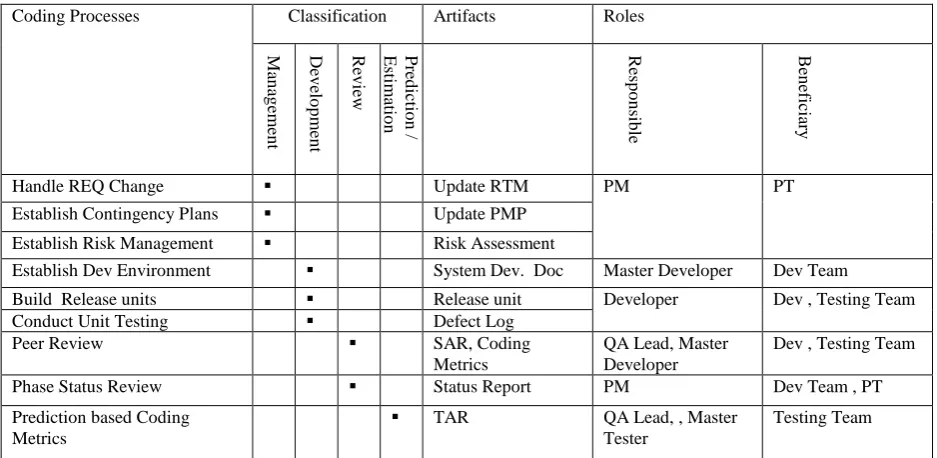
During the coding phase the creation of the software product is underway and parts of the software product, such as classes, modules and subsystems are created. Unit testing represent a dynamic testing approach that test individual components of the system independently. Once peer review activities have been conducted, code metrics used as basis for feeding the fault prediction model are generated. Table 6 illustrates the coding phase's processes, their classification, and their associated artifacts.
3.4.6 Pre-Testing Phase
During the Pre-Test phase, Test case reduction has been conducted to select the most obvious test cases, and construct the software metrics repository that feed the fault prediction
model that used mainly for managing the testing efforts.Table
7 illustrates the pre-testing phase's processes, their classification, and their associated artifacts.
3.4.7 Testing Execution Phase
After testing the individual components, a higher order test focus on the system as a whole and conducted as a series of testing issues that test the system from several perspectives including; Integration Test, Release Test, and Security Test. Table 8 illustrates the testing phase's processes, their classification, and their associated artifacts.
3.4.8 Post-Testing Phase
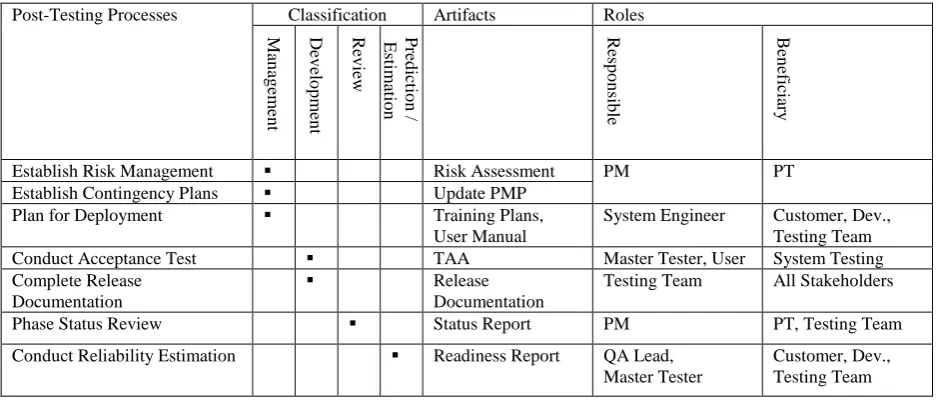
It concerned with assessing the readiness of the product to be released. Table 9 illustrates the post-testing phase's processes, their classification, and their associated artifacts.
3.4.9 Deployment and Operation Phase
It concerned with installing release into production environment, supporting its operation, reviewing its security and monitoring its performance. Table 10 illustrates the
deployment and operation phase's processes, their
classification, and their associated artifacts. Stakeholder
Team Involvement Interest
P
lan
n
in
g
Tea
m
(P
T)
De
v
. Tea
m
Tes
ti
n
g
Tea
m
S
y
ste
m
Tea
m
Eco
n
o
m
ic
M
an
ag
erial
Tec
h
n
ica
l
Customer
User
PM
HRM
Master
Developer
S.W
Developer
Master Tester
Tester
QA Lead
System
Engineer
Technical
Support
Case-based Reasoning Machine Learning
Swarm Approach Data Mining Fault-Prone Models
Defect Density Regression Analysis
Curve-Fitting Capture-Recapture Fault-content Models
Software Reliability Growth model (GRGM) Architecture based Reliability Assessment Method
Table 2. Initiation Phase's processes, their classification, and associated artifacts
Table 3. Planning Phase's processes, their classification, and its artifacts
Table 4. REQ. analysis Phase's processes, their classification, and associated artifacts
Initiation Processes Classification Artifact Roles
M
an
ag
em
en
t
De
v
elo
p
m
en
t
Re
v
iew
P
re
d
ictio
n
/
Est
ima
ti
o
n
Re
sp
o
n
sib
le
Be
n
eficia
ry
Initiate Business Case & Scope PSD PM, Customer PT
Establish Team Structure organizational chart PM, HRM PT
Identify Preliminary Risks Risk Assessment PM PT
Establish project Proposal Project Proposal PM, Customer PT
Establish Project Charter Project Charter PT PT
Contract Review Feasibility Report PM, Customer PT
Phase Status Review Status Report PM PT
Planning Processes Classification Artifacts Roles
M
an
ag
em
en
t
De
v
elo
p
m
en
t
Re
v
iew
P
re
d
ictio
n
/
Esti
m
ati
o
n
Re
sp
o
n
sib
le
Be
n
eficia
ry
Establish WBS WBS PM PT
Define Detailed Roles RAM PM, HRM PT
Estimate Efforts Staff Plans
Resource Plans
PM, HRM PT
Scheduling Schedule Plans PM PT
Develop PMP PMP PT All Stakeholders
Phase Status Review Status Report PM PT
REQ. Processes Classification Artifact Roles
M
an
ag
em
en
t
De
v
elo
p
m
en
t
Re
v
iew
P
re
d
ictio
n
/
Esti
m
ati
o
n
Re
sp
o
n
sib
le
Be
n
eficia
ry
Establish Risk Management Risk Assessment PM
PT
Establish Contingency Plans Update PMP
Develop Concept Of Operations
URD, AUT Dev Team All Stakeholders
REQ Analysis, Prioritization SRD, RTM Dev Team Dev Team
MTP formulation MTP Master Tester Testing Team
REQ Review REQ Metrics, SAR QA Lead, Master
Developer
Dev, Testing Team
Phase Status Review Status Report PM PT , Dev Team
Prediction based REQ. Metrics TAR QA Lead, Master
Tester
[image:4.595.64.534.516.728.2]Table 5. Design Phase's processes, their classification, and associated artifacts
Table 6. Coding Phase's processes, their classification, and associated artifacts
Design Processes Classification Artifacts Roles
M
an
ag
em
en
t
De
v
elo
p
m
en
t
Re
v
iew
P
re
d
ictio
n
/
Esti
m
ati
o
n
Re
sp
o
n
sib
le
Be
n
eficia
ry
Handle REQ Change Update RTM PM PT
Establish Contingency Plans Update PMP
Establish Risk Management Risk Assessment
Develop Security Plans Security Plans Master Tester Testing, System
Team
Develop Integration Plans Integration Plans System Engineer Testing, System
Team
Develop Architecture Design SDD Architect, Master
Dev, DB Admin
Dev, Testing, System Team
Interface Design Interface
Specification
Database Design DST
Develop Prototype Prototype
Test Case Design UTC, ITS Master Tester Dev, Testing Team
Design Review Design Metrics,
SAR
QA Lead, Master Developer
Dev, Testing Team
Phase Status Review Status Report PM Dev Team, PT
Prediction based Design Metrics
TAR QA Lead,
Master Tester
Testing Team
Coding Processes Classification Artifacts Roles
M
an
ag
em
en
t
De
v
elo
p
m
en
t
Re
v
iew
P
re
d
ictio
n
/
Esti
m
ati
o
n
Re
sp
o
n
sib
le
Be
n
eficia
ry
Handle REQ Change Update RTM PM PT
Establish Contingency Plans Update PMP
Establish Risk Management Risk Assessment
Establish Dev Environment System Dev. Doc Master Developer Dev Team
Build Release units Release unit Developer Dev , Testing Team
Conduct Unit Testing Defect Log
Peer Review SAR, Coding
Metrics
QA Lead, Master Developer
Dev , Testing Team
Phase Status Review Status Report PM Dev Team , PT
Prediction based Coding Metrics
TAR QA Lead, , Master
Tester
[image:5.595.64.533.455.684.2]Table 7. Pre-Testing Phase's processes, their classification, and associated artifacts
Table 8. Testing Phase's processes, their classification, and associated artifacts
Table 9. Post-Testing Phase's processes, their classification, and associated artifacts
Pre-Testing Processes Classification Artifacts Roles
M
an
ag
em
en
t
De
v
elo
p
m
en
t
Re
v
iew
P
re
d
ictio
n
/
Esti
m
ati
o
n
Re
sp
o
n
sib
le
Be
n
eficia
ry
Establish Risk Management Risk Assessment PM PT
Establish Contingency Plans Update PMP
Test Case Reduction Test Case
Repository
Master Tester Testing Team
Development's Metric Collection & Analysis
Metrics Repository QA Lead Testing Team
Phase Status Review Status Report PM PT, Testing Team
Prediction based Reduced
Metrics
TAR QA Lead, Master
Tester
Testing Team
Testing Processes Classification Artifacts Roles
M
an
ag
em
en
t
De
v
elo
p
m
en
t
Re
v
iew
P
re
d
ictio
n
/
Esti
m
ati
o
n
Re
sp
o
n
sib
le
Be
n
eficia
ry
Establish Risk Management Risk Assessment PM PT
Establish Contingency Plans Update PMP
Establish Testing Environment STD Master Tester Testing Team
Conduct integration Test Defect Log
TAR
Tester Dev, Testing Team
Conduct Release Testing
Conduct Security Testing
Phase Status Review Status Report PM PT, Dev, Testing,
System Team
Post-Testing Processes Classification Artifacts Roles
M
an
ag
em
en
t
De
v
elo
p
m
en
t
Re
v
iew
P
re
d
ictio
n
/
Esti
m
ati
o
n
Re
sp
o
n
sib
le
Be
n
eficia
ry
Establish Risk Management Risk Assessment PM PT
Establish Contingency Plans Update PMP
Plan for Deployment Training Plans,
User Manual
System Engineer Customer, Dev.,
Testing Team
Conduct Acceptance Test TAA Master Tester, User System Testing
Complete Release Documentation
Release
Documentation
Testing Team All Stakeholders
Phase Status Review Status Report PM PT, Testing Team
Conduct Reliability Estimation Readiness Report QA Lead,
Master Tester
[image:6.595.64.534.517.719.2]Table 10. Deployment and Operation Phase's processes, their classification, and associated artifacts
4. CONCLUSION
The framework introduces a completely integrated view of the development activities and their related artifacts treating the testing and QA practices as integral parts of the development process.
The framework promotes the efficiency of the stakeholders through the redistribution of their roles in the different teams. It introduces a new role relating the managerial and technical interest at development and testing levels to find a linkage between members of different teams in the project without the overlap in their roles, So that teams work all harmoniously tight proceeding according to system administrative work tightly in line with the plan developed for the project as a whole.
We aim to touch in our future studies the construction of a software quality improvement model based on the measurement analysis at various levels of the proposed activities classification's dimensions.
5. REFERENCES
[1] Yu BengLeau, WooiKhong Loo Wai Yip Tham, and Soo Fun Tan, "Software Development Life Cycle AGILE vs. Traditional Approaches", International Conference on Information and Network Technology (ICINT), 2012, pp. 162-167.
[2] Shikhamaheshwari, Dinesh Ch. Jain, "A Comparative Analysis of Different types of Models in Software Development Life Cycle", International Journal of Advanced Research in Computer Science and Software Engineering, Vol.2, No.5, 2012, pp.285-290.
[3] Kirti Nagpal,Raman Chawla, "Improvement of Software
Development Process: A new SDLC Model",
International Journal of Latest Research in Science and Technology, Vol. 1, No.3, 2012, pp.217-224.
[4] T.Rajani Devi, "Importance of Testing in Software Development Life Cycle", International Journal of Scientific & Engineering Research, Vol.3, No.5, 2012, pp.1-5.
[5] Jamie S. Gordon, Robert F. Roggio, " A Comparison of Software Testing Using the Object-Oriented Paradigm and Traditional Testing", Proceedings of the Conference for Information Systems Applied Research, San Antonio,
Texas, USA , Vol. 6, No.28, 2013.
[6] Rashdeep Kaur, Sunil Gulati," A framework for
Analyzing Software Quality using Hierarchical
Clustering", International Journal on Computer Science and Engineering (IJCSE), Vol.3, No.2, 2011, pp.854-860.
[7] T.M.H koshgoftaar, P.Rebours and N.seliya," Software Quality analysis by combining multiple projects and learners", software Quality Journal, Vol.17, 2009, pp.25-49.
[8] S.Shafi,S.M.Hassan,A.Arshaq,M.J.Khan,S.Shamail, "Software Quality Prediction Techniques: A comparative
Analysis ", 4th International Conference on Emerging
Technologies (ICET),, 2008, pp.242-246.
[9] Heena Kapila, Satwinder singh, "Analysis of CK Metrics to predict Software Fault-Proneness using Bayesian Inference", International Journal of Computer Applications (IJCA), Vol. 74, No. 2, 2013, pp. 1-4. [10] Milad Hanna, Nahla El-haggar and Mostafa Sami.
Article: Reducing Testing Effort using
Automation", International Journal of Computer
Applications, Vol. 81, No. 8, 2013, PP.16-21.
[11] Hilda B. Klasky, "A study of Software Mertics", M.S. thesis, Department of Electrical and Computer Engineering, Rutgers University, New Brunswick, New Jersey, 2003.
[12] Saddam H. Ahmed, Taysir Hassan A. Soliman , and Adel A. Sewisy, " A Hybrid Metrics Suite for Evaluating Object-Oriented Design", International Journal of Software Engineering, Vol. 6, No. 1, 2013, pp. 65-82. [13] D. Jeyamala, S. Balamurugan, A. Jalila, K. Sabari
Nathan, " Fault-prone Components Identification for Real Time Complex Systems Based on Criticality Analysis", International Journal of Computer Science and Informatics, Vol. 3, No. 2, 2013, pp. 17-23.
[14] Gurvinder Singh, Baljit Singh Saini , Neeraj Mohan, " A Systematic Literature Review on Software Fault Prediction based on Qualitative and Quantitative Factors", International Journal on Advanced Computer Theory and Engineering (IJACTE), Vol.2, No. 2, 2013, pp. 47-50.
Deployment and Operation Processes
Classification Artifacts Roles
M
an
ag
em
en
t
De
v
elo
p
m
en
t
Re
v
iew
P
re
d
ictio
n
/
Esti
m
ati
o
n
Re
sp
o
n
sib
le
Be
n
eficia
ry
Establish Risk Management Risk Assessment PM PT
Establish Contingency Plans Update PMP
Deploy Release in Operational Environment
Complete Release Technical Support System Testing
Conduct Training Plans RTR
USRR
User, System Team All Stakeholders
Support Release Operation
Review Release Security
[15] Shaik Nafeez Umar et al, " Software Testing Defect Prediction Model -A Practical Approach", International Journal of Research in Engineering and Technology (IJRET), Vol.2, No.5, 2013, pp. 741-745.
[16] Menka Gupta, PratimaGautam, " A Novel Approach for Identifying Software Fault Prediction in mining", International Journal of Technological Exploratoration and Learning (IJTEL), Vol.2, No.6, 2013, pp. 341-343. [17] Nirvikar Katiyar, Raghuraj Singh, " Prediction of
Number of Faults And Time To Remove Errors", International Journal of Computational Engineering Research, Vol.3, No.4, 2013, pp. 57-65.
[18] S.Kim, T.Zimmermann, E.J.W.Jr., and A.Zeller, "
Predicting faults from cached history",29th International
Conference on Software Engineering (ICSE), 2013, pp.489-498.
[19] T.J.Ostrand, E.J.Weyuker, and R.M.Bell, " Predicting the location and number of faults in large software system", IEEE Transactions on Software Engineering, Vol.31, No.4, 2005, pp. 340-355.
[20] Anshu Bansal, Sudhir Pundir, " A Review On Approaches and Models Proposed for Software Reliability Testing", International Journal of Computer & Communication Technology, Vol.4, No.2, 2013, pp. 7-9.
[21] J Prabhu and N Malmurugan, "Article: A Model for GUI Automated Testing Framework in Software System", International Journal of Computer Applications, Vol.64, NO.15, 2013,PP. 16-20.
[22] Rakesh Roshan, RabinsPorwal, Chandra Mani Sharma, "Review of Search Techniques in Software Testing ", international Journal of Computer Applications, Vol.51, No.6, 2012, pp.42-45.
[23] Dinesh Kumar Saini., "Article: Software Testing for Embedded Systems", International Journal of Computer Applications, Vol.43,No.17,2012,PP.1-6 .
[24] Anuja Jain M, Swarnalatha P, Muhammad Rukunuddin Ghalib and S Prabu. Article: Web-Based Automation Testing Framework", International Journal of Computer Applications, Vol. 45, No. 16, 2012, PP.1-5.
[image:8.595.328.529.89.503.2][25] Anudeep Ediga, " High Accuracy Prediction Framework for Predicting Defect Prone Software Components", International Journal of Information and Computation Technology, Vol.3,No.10, 2013, pp.985-992.
Table 11. Appendix A – Abbreviations
AUT Acceptance User Test
BA Business Analyst
DST Data Storage Design
GUI Graphical User Interface
HRM Human Resource Manager
ITS Integration Test Script
MTP Master Test Plan
PM Project Manager
PMP Project Management Plan
PSD Project Scope Document
PT Planning Team
QA Quality Assurance
RAM Responsibilities Matrix
RTM Requirement Traceability Matrix
RTR Release Troubles Report
SAR Static Analysis Report
SDD System Design Document
SRD System Requirement Document
STD System Testing Document
TAA Test Analysis Approval
TAR Test Analysis Report
URD User Requirement Document
USRR User Satisfaction Review Report
UTC User Test Case