Communication Theses Department of Communication
Spring 4-18-2011
Twitter's Impact on Sports Journalism Practice: Where a New
Twitter's Impact on Sports Journalism Practice: Where a New
Medium Meets and Old Art
Medium Meets and Old Art
Kyle Sears
Follow this and additional works at: https://scholarworks.gsu.edu/communication_theses
Recommended Citation Recommended Citation
Sears, Kyle, "Twitter's Impact on Sports Journalism Practice: Where a New Medium Meets and Old Art." Thesis, Georgia State University, 2011.
https://scholarworks.gsu.edu/communication_theses/74
This Thesis is brought to you for free and open access by the Department of Communication at ScholarWorks @ Georgia State University. It has been accepted for inclusion in Communication Theses by an authorized
administrator of ScholarWorks @ Georgia State University. For more information, please contact
MEETS AN OLD ART
by
KYLE SEARS
Under the Direction of Greg Lisby
ABSTRACT
This project aims to determine if and how the relatively new journalistic tool of Twitter is
impacting journalistic decision-making and news production as a legitimate tool amongst sports
writers. Using the methods of qualitative textual analysis and in-depth interviewing, this project
analyzes the words and tweets of nine journalists at prominent U.S. newspapers in an attempt to
fill a void in research among the topics of journalistic decision-making, sports journalism, and
Twitter and to answer questions that arise from the marriage of a certain type of journalism and a
particular new media platform.
MEETS AN OLD ART
by
KYLE SEARS
A Thesis Submitted in Partial Fulfillment of the Requirements for the Degree of
Master of Arts
in the College of Arts and Sciences
Georgia State University
Copyright by Kyle Sears
MEETS AN OLD ART
by
KYLE SEARS
Committee Chair: Greg Lisby
Committee: Marian Meyers
Carrie Packwood Freeman
Electronic Version Approved:
Office of Graduate Studies
College of Arts and Sciences
Georgia State University
I would like to thank the chair of my thesis committee, Dr. Greg Lisby, along with fellow
committee members, Dr. Marian Meyers and Dr. Carrie Packwood-Freeman, for their guidance
throughout this challenging writing process. I would also like to thank the chair of the
Department of Communication, Dr. David Cheshier, and graduate director among students with
an emphasis in mass communication, Dr. Mary Stuckey, for their leadership and support.
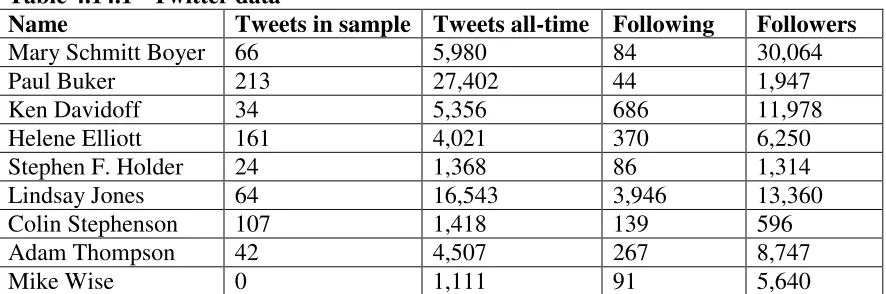
Additionally, I would like to thank the nine great journalists and kind people—Mary Schmitt
Boyer, Paul Buker, Ken Davidoff,Helene Elliott, Stephen F. Holder, Lindsay Jones, Colin
Stephenson, Adam Thompson and Mike Wise—who took the time to reply to an email from a
total stranger and participate in an interview despite their busy schedules. Last, but certainly not
least, I would like to thank my parents, Frank and Mary Sears, for their unending love and
ACKNOWLEDGEMENTS iv
LIST OF TABLES viii
1 INTRODUCTION 1
1.1 The “changing face of sports journalism” 1
1.2 A history of change 3
1.3 The “Twitter generation” 9
1.4 Asking questions about journalistic decision-making 13
2 LITERATURE REVIEW 19
2.1 Journalism and decision-making 19
2.2 The decision-making practices of sports journalists 22
2.3 Decision-making and new “journalisms” 24
2.4 Twitter and journalism 26
3 METHODS 36
3.1 Qualitative textual analysis 36
3.2 In-depth interviewing 37
3.3 The participants 41
4 RESULTS 43
4.1 When they began using Twitter 43
4.2 Why they began using Twitter 45
4.3 Why they continue to use Twitter 46
4.4 How they use Twitter 47
4.7 Other uses of Twitter 56
4.8 Benefits of the relationship between sports journalism and Twitter 58
4.9 Pitfalls of the relationship between sports journalism and Twitter 60
4.10 Twitter’s impact on journalistic decision-making 64
4.11 Twitter’s impact on the quality of sports journalism 66
4.12 The potential long-term impact of Twitter 68
4.13 Twitter and sports journalism as a unique marriage 69
4.14 A look at their Twitter feeds 70
5 DISCUSSION 80
5.1 Twitter’s three hallmarks 82
5.2 Twitter’s impacts on journalists 83
5.3 Twitter’s impacts on journalism 87
5.4 Looking toward the future of work on Twitter and journalism 90
5.5 Limitations and suggestions for future research 91
5.6 Conclusions 92
REFERENCES 94
APPENDICES 103
A Top 25 newspapers by circulations in the U.S. in 2010 103
B Preliminary 23-question interviewing script 105
C Mary Schmitt Boyer interview transcript from March 7, 2011 107
D Paul Buker interview transcript from February 27, 2011 114
G Stephen Holder interview transcript from March 2, 2011 136
H Lindsay Jones interview transcript from March 2, 2011 153
I Colin Stephenson interview transcript from March 2, 2011 166
J Adam Thompson interview transcript from February 28, 2011 180
1.1 The “changing face of sports journalism”
The phenomenon known as Twitter has taken hold of American culture in a relatively
short amount of time. Twitter is a microblogging service created in 2006 through which users
send 140-character messages, or “tweets,” responding to the queue “What’s happening?” One of
the professions that has certainly been impacted by tweeting, retweeting, hashtagging, and the
several other functions associated with the platform is journalism. Recent research presented at
the International World Wide Web Conference in May of 2010 suggested that Twitter’s uses
have begun to fit the definitions of more traditional media, such as websites, newspapers,
television, and radio, rather that social networking sites, such as MySpace and Facebook
(Gonsalves, 2010, para. 2). Sports journalism, in particular, seems to be a realm where Twitter
has assumed much influence as a journalistic tool, perhaps for such reasons as a highly
routinized news cycle and dedicated fan following. At a recent Association for Education in
Journalism and Mass Communication panel on “Social Media and the Future of Sports
Journalism,” Denver Post writer Lindsey Jones said, “Twitter has completely changed our beats.
I can’t remember what the job was like before it. The whole mentality has changed. Who cares
when you get it on the website? Twitter is what matters” (Schultz, para. 5). As evidenced by
Jones’ 11,000 followers and demanding schedule of tweeting from 8 a.m. to 9 p.m., Twitter has
become an integral component of sports journalism practice.
Twitter’s popularity among sports journalists begs the question, “If—and how—is this
new medium impacting this old art?” Among those who have attempted an answer is Eric
Changed.” In this post, Goodman (2010) suggests that “in today’s tech savvy world . . . the way
we receive our sports ‘news’ has changed drastically” (para. 1). He goes on to detail the war of
words that had taken place recently between Cincinnati Bengal wide receiver Chad Ochocinco
and New York Jet cornerback Darrell Revis through their respective Twitter accounts,
@OGOchoCinco and @revis24. The author compares this exchange to the more traditional way
of obtaining quotes from players via press conferences: “A heated Twitter exchange between two
opposing players is a lot more entertaining than reading dry copy about how Player A said such
and such after practice and then having to wait until the next day to read the opposing city’s
paper to see if Player B responds” (para. 6). Goodman’s sentiments about how the social media
platform Twitter is causing journalists to reevaluate their sources are on the mark. However,
there is another side to this “changing face of sports journalism,” as well—one that Goodman
fails to address (para. 3).
Twitter certainly has emerged as a valuable source for sports journalists due to the
number of athletes who maintain active accounts. But the platform has also emerged as an
equally valuable outlet for these journalists to provide their own content, whether they are
reporting on the banter of two NFL prima donnas or information of more relevance to the
sporting world. This is the second half of how Twitter is changing the face of sports journalism,
and Goodman has not been the only person to overlook it. Media companies across the board
previously made the same mistake—focusing on Twitter as a source and overlooking it as a
means of providing content—during the first few months of 2009. As their executives came to
realize this misjudgment, they began to craft and release social media policies in the latter
To substantiate Goodman’s claim that Twitter was a catalyst for “the changing face of
sports journalism” and that such a change was taking place not only in terms of sourcing, as he
asserted, but also in terms of content creation, a brief history is helpful. In order to provide that
history, news accounts have been selected according to a search of major world publications via
LexisNexis digital database for articles containing both the search terms “sports” and “Twitter”
over the course of a one-year period from January 1, 2009 to December 31, 2009.
As the year 2009 was ushered in, media coverage of the intersection of Twitter and sports
cast the relationship between the two as little more than an entertaining fad. The New York
Times ran an article, entitled, “All a-Twitter About Stars Who Tweet,” on January 5, explaining
the novelty of sports stars making use of Twitter. The piece juxtaposed two of media consultant
Kathleen Hessert’s clients. On one hand, NBA superstar Shaquille O’Neal made use of the
platform “to reach out to his fans,” while on the other hand, LPGA tour member Natalie Gulbis’
made use of it “to promot[e] her appearances, both professional and commercial” because “golf,
particularly women’s golf, sorely lacks media coverage” (Cohen, 2009, paras. 13-15). The
media’s fascination with Twitter as a source of information from athletes continued into the
months of May and June. O’Neal continued to be a focal point of this fascination, as a
Washington Times article, on May 26, included the text of two tweets posted to his account,
@The_Real_Shaq, while he experienced his first hailstorm: “Sounds like a bunch of rocks
coming out of the sky” and “Run aaaaaaaaghgn run aaaaaaaagh I’m scared” (Lemke, 2009,
paras. 1-3). On June 9, 37-year-old founder of athletetweets.com, David Katz, was quoted as
calling Twitter “the ultimate reality show for sports fans” (Fox, 2009, para. 12). Despite such
taking over sport?” (Ronay, 2009).
As the media gave attention to Twitter as a source of information regarding athletes over
the first half of the year, they also seemed to trivialize it. The aforementioned Washington Times
article read: “There is some question about whether Twitter’s content is too trivial to sustain
interest. A recent study from Nielsen Online revealed that only 40 percent of Twitter users in a
given month return as active users a month later” (Lemke, 2009, para. 21). Even The Guardian’s
seemingly serious question about Twitter taking over sport was downplayed by author Barney
Ronay’s claim that Twitter’s significance perhaps would be in “the end of certain bits in papers,
chiefly the celebrity sportsperson interview where either (a) a cheeky chap asks what brand of
marmalade a famous snooker player likes or (b) a heavily-eyebrowed über-hack tries to ‘really
get’ some ball-whumper or racket-flailer by asking about their childhood, using long words and
having a chin-stroking byline photo” (Ronay, 2009, para. 2). Whether or not the usefulness of
Twitter for sports journalism could be summed up as Ronay saw it—as a new site for product
placement and puff pieces—the media were not the only ones downplaying the platform’s
potential impact.
In addition, the Inquirer noted that “Twitter has burst on the scene so quickly that none of
the four major pro sports leagues has rules prohibiting athletes from participating” (Fox, 2009,
para. 16). This would soon change, however, as the leagues were among the first to recognize
the impact of Twitter not only as a source, but also as an outlet for content. On July 17, TheNew
York Times reported that the NBA was poised to become the first professional sports league with
one million followers, as it was also the second-biggest corporate account, behind only Whole
(Beck, 2009, para. 4). Also worth mentioning were earlier attempts at semi-journalistic uses of
Twitter by NBA Commissioner David Stern and NFL Commissioner Roger Goodell, as Stern
tweeted news about the All-Star weekend in February and Goodell tweeted news about the draft
in April (Lemke, 2009, para. 9). Additionally, professional tennis star Jim Courier live-tweeted
updates during changeovers at a mixed-doubles match against John McEnroe in May (Lemke,
2009, para. 24). The Washington Times offered University of Kansas professor Nancy Baym’s
analysis of Twitter: “It can be a very powerful and rewarding thing for the athlete and the fan to
have that kind of personal connection” (Lemke, 2009, para. 27). Though the journalist had yet to
be recognized as a participant in sports-related exchanges over Twitter, that perception would
soon change, as well.
With Twitter having been recognized in the media as a source—for fans and journalists
alike—the platform slowly began to be recognized as an outlet for journalistic content. One of
the earliest examples of professional sports journalism being practiced on Twitter was cable
network TNT’s coverage of the NBA playoffs in April. An article in Adweek on April 8 began:
“Turner Sports is following the lead of Time Warner sibling CNN by diving headlong into social
media” (Morrissey, 2009, para. 1). Turner set up Twitter accounts for NBA on TNT studio hosts
Ernie Johnson and Kenny Anderson, as well as reporter Craig Sager, in addition to NBA TV host
Rick Kamala and analysts Chris Webber, Gary Payton, Steve Smith, and Eric Snow. By the end
of April, tweeting by television sports analysts, announcers, and journalists had caught on, as
USA Today reported, “It was only in recent weeks that much twittering from announcers at sports
events appeared. Now the tweets are coming in torrents” (Hiestand, 2009a, para. 4). The article
among those who adapted Twitter’s format to their own journalistic purposes. Additionally,
CBS College Sports Network was identified as the latest adaptor, as it was set to have
announcers live-tweet from softball and baseball games the following weekend. With each
additional adaptor, Twitter was being looked upon more seriously as an outlet for professional
journalism to the point where, in August, St. John’s University became the first university to
award a media credential to someone who would cover one of its sports teams solely on Twitter
(Belson, 2009, para. 1).
As evidence of Twitter catching on in such a way, Washington Times staff reporter
Howard Kurtz asked his followers what they valued about the platform. Among the responses
was one from @Newsjunkie365 that summed up why Twitter and journalism have the potential
to be such a compatible pair: “Since Twitter my web surfing for news has greatly decreased.
Now the news comes to me” (Kurtz, 2009, para. 17). On July 30, the Philadelphia Inquirer ran a
front-page story, publicizing the notion that Twitter should be taken seriously, as “recent
evidence suggests that Twitter has gone from laughable to respectable” (Timpane, 2009, para. 4).
Among those who came to this realization were the media executives whose employees were
pioneering Twitter journalism, and this newly-gained sense of seriousness was accompanied by a
wave of regulation.
Early regulation of Twitter was primarily informal. For example, the NFL simply
pointed players to its preexisting guidelines on public comments to govern their use of Twitter.
Journalistically, companies such as ESPN seemed to initially operate on a case-by-case basis of
issuing restrictions on Twitter. During April’s NFL Draft, producer Jay Rothman banned
ban did not seem to apply to the following NFL Drafts, as ESPN insiders Adam Schefter
(@Adam_Schefter) and Chris Mortensen (@mortreport), who were featured on-air, often
tweeted teams’ picks anywhere from a couple of minutes to a few seconds before the picks were
formally announced onstage.
In a July 30 USA Today article, however, ESPN the Magazine senior writer Tim Keown,
citing a false report linked on another journalist’s Twitter account, brought to light the possible
negative repercussions of a lack of formal regulation: “Speculation is not a crime. . . . But from a
journalistic sense, it seems that Twitter—and whatever technology comes next—is becoming a
place that you can be wrong without consequences” (Emerick, 2009, para. 7). Exactly one week
later, USA Today ran an article detailing ESPN’s release of its new “Guidelines for Social
Networking” (Hiestand, 2009b). By late October, Canada’s national newspaper The Globe and
Mail was reporting on “the growing move to put a muzzle on Twitter,” citing the NBA,
professional tennis, and the Washington Post as case studies (El Akkad, 2009).
While ESPN’s social media guidelines were officially released on Wednesday, August 5,
they leaked a day earlier, allowing several employees to take parting shots at their employer on
Twitter before their accounts would be restricted. NBA analyst Ric Bucher summed up his
interpretation of the guidelines, tweeting that ESPN was “prohibiting tweeting info unless it
serves ESPN” (Hiestand, 2009b, para. 3). Journalist and noted on-air personality Kenny Mayne
offered the following response: “Was informed 2nd hand of Taliban-like decree against further
Twitter” (Hiestand, 2009b, para. 3). The preamble to the guidelines began by calling social
media “important new forms of content” and demanding the same standards “across TV, radio,
SportsCenter.com, and Page 2, which is a platform dedicated specifically to humor and
commentary. Following these two paragraphs, 12 “specific guidelines” were listed. Among their
purposes, the guidelines banned the use of personal websites and blogs, required permission to
engage in social networking, dictated that content must be limited to “ESPN sanctioned efforts,”
and discouraged discussing internal policies, defending work against those who challenge it,
practicing media criticism, and disparaging colleagues or competitors (Van Grove, 2009, paras.
11-23).
ESPN was just one of many media companies to release such guidelines in the latter half
of 2009. Several companies did so in response to specific actions, such as an AP reporter
criticizing McClatchy Newspapers on Facebook or Washington Post editor Raju Narisetti’s
appearing to favor healthcare reform on Twitter. These guidelines generally reminded employees
that social media content should be assumed to be public, while also positively reflecting the
employer and not displaying bias or representing information that would not be released on
another of the company’s platforms. TheNew York Times had established social media
guidelines as early as fall of 2008. However, those guidelines almost exclusively addressed
Facebook. In May of 2009, Craig Whitney, the Times’ standards editor, said that the
newspaper’s Facebook ethics guide should be consulted in reference to other social media and
that “it’s not likely there will be a Twitter-only policy developed” (Koblin, 2009, para. 21). In
late June, the AP released a policy that The News Media Guild called “perhaps the strictest it had
seen,” pointing to the following passage: “Monitor your profile page to make sure material
posted by others doesn’t violate AP standards: any such material should be deleted” (Kravets,
para. 10). In November, theLos Angeles Times revised its guidelines on social media that had
been originally released in March, referencing “a few new situations that have arisen in the last
several months,” perhaps drawing upon aforementioned examples (Edgar, 2009, para. 4).
1.3 The “Twitter generation”
While 2009 was certainly a crucial year in the marriage of Twitter and sports journalism,
in the early months of 2010, such guidelines were still being released, such as those added to
Reuters’ “Handbook of Journalism” in March (Bunz, 2010, para. 1). Also, in late April,
MLB.com ordered all of its beat writers to cease tweeting about all non-baseball topics, citing
not wanting such non-baseball tweets to show up on the website’s Twitter aggregator (Gleeman,
2010, paras. 1-4). In the light of such recent history, Twitter can better be seen as the mainstay
that has reporters managing their sources and content constantly for thirteen hours a day, as part
of the changed face of sports journalism.
Sports journalists on ESPN shows, such as “Around the Horn” and “Pardon the
Interruption,” make it clear on a daily basis that this is the “Twitter generation.” Alongside such
an acknowledgment, it becomes vital to acknowledge how exactly Twitter’s rise impacts the
practice of journalism, as radio, television, and the Internet have previously done. The primary
concern that has arisen, it seems, is how the use of Twitter is influencing journalistic
decision-making. For example, “Around the Horn” panelist Woody Paige of the Denver Post made the
following comment about fellow panelist Tim Cowlishaw of the Dallas Morning News: “I think
Cowlishaw’s so wrong he should have tweeted that information” (Wolff, 2010). Such a joke
means to be of the “Twitter generation.” Some, such as Paige, offer playful one-liners, while
others, such as Paige’s aforementioned colleague at the Post, Lindsay Jones, offer in-depth
analysis. Furthermore, others continue to underestimate the influence of the platform, as
Washington Post columnist Mike Wise did.
Those who may continue to dismiss the real, lasting impact of Twitter on the sports
journalism landscape should look no further than Wise and his so-called Twitter “experiment.”
Wise tweeted false information that NFL Commissioner Roger Goodell had reduced his
suspension of Pittsburgh Steelers quarterback Ben Roethlisberger from six games to five at 9:01
a.m. on August 30, 2010. Two hours and 59 minutes later, Wise followed with another tweet:
“As part of a bit on my show today, I tried to test the accuracy of social media reporting.
Probably not the best way to go about experiment” (MikeWiseguy, 2010). Thus he expressed
that he knowingly reported false information, which had already been picked up by several
media outlets citing Wise as the source. As a result of this experiment, Wise was suspended by
the Post for one month, and his case proved that information posted on a journalist’s Twitter
account holds the same gravitas as information posted on the Post’s website or printed in the
newspaper’s daily edition. In a statement made on his radio show the day after his infamous
tweet, Wise stated, “Sadly, I always believed that things said in stream of consciousness or typed
on a whim for shtick on a radio show would somehow disappear in the ether, fly away in
cyberspace. But everything I say and do on the air, on my Twitter, on TV or the Post has
ephemeral qualities” (Steinberg, 2010, para. 13). In his reaction to the Wise situation, Chicago
Tribune columnist Phil Rosenthal pointed out a key differentiation between Twitter and more
are being presented with a unique—and important—struggle between the informality of Twitter
as a platform and the formality of the expectations for journalistic content released through that
platform.
Wise revealed in his interview as part of this project how his situation reflected just how
big Twitter had become: “More people have read more about my suspension than they probably
ever will do if I ever won the Pulitzer Prize… I will never be on the Yahoo homepage just
because I won the Pulitzer Prize, but I was when I was suspended for screwing up on Twitter.
That’s sad, but it’s also the reality of things.” Though his is an exemplary case study of
journalism in the Twitter generation, he is certainly not alone in his journalistic experimentation
on Twitter. Some other interesting examples include Sports Illustrated senior NFL writer Peter
King giving away tickets to a Boston Red Sox game: “Anyone want 2 good seats to
Sox-Mariners today at 1:35 at Fenway? Swarmed with work. You’d have to come to Boston’s South
End to pick up (SI_PeterKing, 2010a). King also used Twitter to try and fill out his fantasy
football league: “Need 1 player in the only fantasy lg I’m in. You must be able to draft tonight at
9:15 pdt [sic], 12:15 am Eastern. Anybody?” (SI_PeterKing, 2010b). Another NFL writer,
ESPN’s Adam Schefter, called upon his Twitter followers to locate a prominent player, which is
a technique also known as crowdsourcing: “Serious question to test the power of Twitter: Has
anyone seen Darrelle Revis in the past 24 hours and if so where? Trying to track his
whereabouts” (AdamSchefter, 2010). Furthermore, Atlanta sports radio host and national college
football analyst David Pollack highlighted the interactivity of the platform by tweeting: “Anyone
got any football ?’s I shld have sometime [sic] to answer them” (davidpollack47, 2010). While
I’ve got 5 TVs on at once, seeing #cfb scores” (macontechtalk, 2010).
Sports journalists have also used Twitter as a sounding board for their personal theories
of what the Twitter generation means for their profession. Some examples include Atlanta
Braves beat writer for the Atlanta Journal-Constitution David O’Brien responding to a slew of
follower remarks regarding an erroneous in-game tweet: “Folks, just trying to update with quick
line b4 hurrying to clubhouse. It’s a Twitter comment, not a game story in paper or online.
Relax” (ajcbraves, 2010). ESPN personality Bob Ley, host of the network’s investigative
reporting show “Outside the Lines,” retweeted—which is a Twitter function equivalent to
quoting—the following from New York Times investigative reporter Don Van Natta Jr.: “The
appeal of #Twitter is simple and even a bit old-fashioned: It’s the urgent thrill of being the Town
Crier” (DVNJr, 2010). Later, on December 2, 2010, Ley reflected upon his use of Twitter as
FIFA announced the host countries for the 2018 and 2022 World Cups: “[C]onflicting media
reports all over… but.. [sic] the Twitter is proving invaluable at this moment” (BobLeyESPN,
2010). Additionally, eleven days after Ley’s tweet, ESPN and Baseball America writer Jerry
Crasnick offered the following question, suggesting that just under two years after Twitter hit the
pages of theNew York Times as a novelty used by athletes like Shaquille O’Neal and Natalie
Gulbis, it had irreparably ingrained itself into the practice of sports journalism: “Seriously, what
was sports journalism like in the days before we had to worry about ‘Fake Tweets?’” (jcrasnick,
2010).
The aforementioned tweets are just a small fraction lifted from the feed of a
Twitter-savvy sports fan over the course of a few months, but, taken together, they help illustrate the
such as that by Susan Robinson, who investigates another relatively recently developed
platform—the journalism weblog—as a “new form of postmodern journalism” by asking such
questions as: “Do blogs rate as journalism according to traditional standards? How are ‘truth,’
credibility, independence, and authorship established in the online environment? And finally,
how do journalists negotiate and (re)interpret traditional news frames and journalistic authority
in the online medium?” (Robinson, 2006, pg. 69). In the current journalistic landscape, such
questions could—and should—be asked of Twitter, rather than journalism blogs.
1.4 Asking questions about journalistic decision-making
In order to situate the journalistic decision-making that takes place in connection with the
Twitter accounts of sports journalists,this project will rely on a tradition of theory that asks
questions about the nature of communication that takes place between a producer and a
consumer—also known as public discourse. Historically, such public discourse theory can be
traced to seventeenth-century English poet John Milton and his concept of the “marketplace of
ideas” (Arnett et al., 2008, pg. 100). The marketplace of ideas is “a public forum where all may
speak, question, challenge, assent, and dissent” and a society evaluates “perspective[s] that might
ultimately provide a path to the truth” (Good & Dillon, 2002, pg. 26). Modeled after literal
marketplaces, or public fora, in which people gathered to debate their common affairs, today’s
marketplace, or common forum, is constituted by the media (Good & Dillon, 2002, pg. 26). This
project will attempt to build relevant theory related to the impact on that marketplace of mass
media usage of the new platform of Twitter. Methodologically, this project will employ a
seek to determine how journalists’ decision-making in the “Twitter generation” might be
defined, how that definition might differ from those of previous generations, and how this
process of redefining might be helpful in navigating the future of journalism on Twitter or any
other new media platforms that might arise.
Ultimately, this project asks the question, “Is the use of Twitter as a journalistic tool
impacting traditional journalistic decision-making and news practices, and if so, how is that
being done?,” as journalists engage with what New Yorker columnist Eric Alterman (2008)
evaluated just two years ago as “a fractured, chaotic world of news, characterized by superior
community conversation but a decidedly limited level of first-rate journalism” (pgs. 17-18). In
the midst of this world, a dichotomy exists between what might be called the professionalization
of news and citizen or “grassroots” journalism, which is often characterized by amateur,
independent reporting disseminated via new media. While professionals certainly use Twitter,
the platform itself would likely be viewed as a product of citizen journalism due to its openness
and interactivity. What, then, do the journalists who use Twitter aim to accomplish through its
use? Where do they side on this debate between professionalism and amateurism?
Such a debate is nothing new. In the first half of the 20th century, early media theorists
Walter Lippmann and John Dewey argued both sides of the same debate. Reflecting on the
failure of the democratic media in his book Public Opinion, Lippmann (1922) made an extreme
argument for the professionalization of journalism, calling for “intelligence bureaus,” which
would “assemble the facts in a way suited to the diplomatic problem up for decision” (pgs. 246).
This view might be called extreme because it is unclear whether the rationale for such
physical and social barriers at the other end, by scanty attention, by the poverty of language, by
distraction, by unconscious constellations of feeling, by wear and tear, violence, monotony”
which “combine with the obscurity and complexity of the facts themselves to thwart clearness
and justice of perception, to substitute misleading factions for workable ideas, and to deprive us
of adequate checks upon those who consciously strive to mislead” (pgs. 48-49).
Dewey (1927) countered Lippmann in the book The Public and Its Problems: “A class of
experts is inevitably so removed from common interests as to become a class with private
interests and private knowledge, which in social matters is not knowledge at all” (pg. 207). He
also offered a particularly apt analogy: “The man who wears the shoe knows best that it pinches
and where it pinches, even if the expert shoemaker is the best judge of how the trouble is to be
remedied” (pg. 207). In other words, while Lippmann advocated for his “intelligence bureaus,”
Dewey harkened back to something like Milton’s ideal marketplace in which every voice is
heard and considered. Perhaps another way to look at this debate is elitism versus pluralism.
However it is labeled, journalistic decision-making is often highly dependent upon which side of
the debate they claim, especially on a medium like Twitter.
In the latter half of the 20th century, an extension of theory questioning the nature of
public discourse in the form of journalism arose from a group of news production theorists.
These theorists included the likes of Michael Schudson, who, among his many arguments, sought
to clarify what he viewed as a misreading of the Lippmann-Dewey debate. Schudson argued that
Lippmann was not nearly as much of an elitist as he had been characterized. Rather, instead of
having experts replace the public, they “were to provide an alternative source of knowledge and
that journalistic practice must accommodate itself to a citizenry made up of some “rational,
intelligent, active, and constant participants in the political process” and some who do not hold
as dearly to these democratic ideals (pg. 223). He refers to such recognition as “the virtue of
schizophrenia,” which leads to both complication and opportunity (pg. 223).
Several of Schudson’s colleagues address other instances that drive decision-making
when it comes to producing news for what they view as a fractured public. Gaye Tuchman
(1978) introduced the notion of “the web of facticity” that serves to establish journalistic
authority by organizing information on a spectrum from fact to interpretation, much like a
newspaper is divided into sections and pages that at first contain factual information, then
specialized topics, and also opinions and editorials (pgs. 97-98). Over 30 years later, new media
technologies, such as Twitter, seem prone to upset this web, as bits of information from many
different points along this same spectrum are presented equally on a single platform.
Another news production theorist, Herbert J. Gans, offered a rationale for journalistic
decision-making, which, similarly to Tuchman’s “web of facticity,” would seem to be challenged
by Twitter. Gans (2004) argued that journalists’ decisions rest on the “twin bases” of efficiency
and power (pg. 334). Journalistic efficiency rests on staff, air time or print space, and production
time, while power is divided amongst source power, which is the stronger, and audience power,
which is the weaker (pg. 283). While Twitter is built to be an efficient medium, it is not
necessarily in the sense of journalistic efficiency, as it has little, if any, connection to revenue,
which is primarily based on advertising. Additionally, Twitter seems to undermine source power
and increase audience power, as information is less restricted to formal, professional
“gatekeeping,” which seems more directly echo the types of questions that drive this project.
How and why do certain ideas make it into the marketplace, and how and why are others left
out? Pamela J. Shoemaker and Tim P. Vos (2009) explained, “The basic premise of gatekeeping
scholarship is that messages are created from information about events that have passed through
a series of gates and has been changed in the process” (pg. 22). While gatekeeping has
traditionally focused upon editors’ decision-making, there are certainly many other gates through
which news messages pass, and perhaps Twitter represents one of the most recent gates to be
established, especially as it seemingly opens the door for writers to be more autonomous in their
work. Facing such changes, Shoemaker and Vos issue a call to which this project responds, a call
for scholars to “push their analytical tools to study the dynamic processes of both traditional and
online media in an increasingly fast paced world” (pg. 132).
Such scholarship that responds to this call is exemplified by the work of Bowman (2008),
who argued that new media have challenged the gatekeeper archetype of the journalist, which is
“to place information in a proper cultural perspective and to assist clients in understanding their
relationship to the sociopolitical process,” with an advocate archetype, which “need[s] to adopt
practices that assist disadvantaged groups to overcome socio-political barriers to change” (pg.
110). In other words, perhaps new media are asking journalists to become more involved with
their readers than to simply present the facts and let them decide for themselves, which Bowman
argued strays too far from “the core task of the journalist”—the gatekeeper model (pg. 110).
Perhaps this is one of many changes that result from what Shoemaker and Vos identify as “the
begs for further research into more such changes.
From Milton, to Lippmann and Dewey, to news production—and particularly
gatekeeping—theorists, the central questions remain of how and why decisions are made about
what information is allowed to enter the public marketplace. The increasing popularity of Twitter
certainly brings up many interesting, new possibilities regarding the answers to these questions.
Drawing from two more news production theorists, David Machin and Sarah Niblock, such
answers should be sought from what has heretofore been a mostly untapped source. Machin and
Niblock (2006) wrote that the answers cannot simply be had from an outsider’s view: “[W]hat
we see, hear, and read through TV, radio, online and the press is the end product of a
complicated process, subject to many influences and constraints normally invisible to the
audience” (pg. 41). Therefore, the authors pointed out, “There has been a limited quantity of
work from journalism academics on how journalists navigate their careers, and even less direct
research into how these influences might impact on news content by these practitioners” (pg. 42).
Shoemaker and Vos echo such sentiments in the closing words of their book: “It is our hope that
media professionals pay attention to gatekeeping scholarship. If audiences are dissatisfied with
the kind of news they get from the mass media, then journalists need to pay closer attention to
why the news takes it present form” (pg. 135). This project seeks to respond to this call, as well,
opening a dialogue between academic and professional realms regarding how a particular, new
The research questions that guide this project are “Is the popular use of Twitter as a
journalistic tool by sportswriters impacting traditional notions of journalistic decision-making
and news practices, and if so, how is that being done?” Therefore, to trace how previous theory
might relate to these questions, some combination of journalistic decision-making literature and
new media literature should be surveyed. The recent ascendancy of social media in the
communication and mass media landscape has not allowed adequate time for a vast wealth of
scholarship to be formulated regarding these media. Regarding this particular project’s research
agenda of investigating the decision-making of sports journalists who use Twitter for
professional purposes, it seems that there may be several related research trajectories available
from which previous work can be reviewed. The first of these is theory relating broadly to
journalistic decision-making. The second is theory relating specifically to sports journalism and
decision-making. The third is theory connecting new media journalism prior to Twitter—
primarily via blogs—to decision-making. The fourth and final research trajectory is theory
connecting Twitter to journalism practice, which has primarily been limited to non-scholarly,
review articles up until this point in time. The void amongst all of these trajectories is the
threefold connection between journalistic decision-making, sports journalism, and Twitter, which
is the goal of this project.
2.1 Journalism and decision-making
Journalistic decision-making is a rather broad, boundless subject to be studied.
Theoretically speaking, the standard for journalists has been the Society of Professional
seek truth and report it; minimize harm; act independently; and be accountable (SPJ Code of
Ethics, 2010). Early in 2010, in the SPJ’s bimonthly publication Quill, ethics committee
chairman Andy Schotz authored an editorial delineating the intended use of the code. He wrote,
“The SPJ Code of Ethics is a broad framework of principles and questions for journalists to
consider as they make decisions. This code purposely avoids specifics in many areas. News
organizations often go further in drawing boundaries for their employees” (pg. 30). This editorial
highlights the lack of formality that exists within journalism decision-making, which seemingly
allows for new developments in the field, such as Twitter, to impact the redrawing of the
relatively thin lines that do exist for journalists to follow.
Recent scholarly work related to this field seems to echo the sentiment that journalists
themselves are largely responsible for policing their own decision-making. Quinn (2007) argues
that journalists should not only be driven by such external guidelines as the SPJ code, but also by
“an internal view of professional ethics that utilizes an internalized moral psychology. . . based in
virtue” (pg. 168). In his view, journalists should be driven by virtue ethics, which emphasize the
importance of character above consequences (pg. 169). Such an ethical bent is preferable not
only because “consequentialistic and deontological theories. . . fail to offer the correct moral
judgment for all moral problems” but also because such a “habituated person who by disposition
is prone to make good decisions” is “suited to journalism because of the profession’s demands,”
which require quick thinking and moral clarity (pg. 184).
Similarly, Peck (2006) seeks to dispel a slant on John Stuart Mill’s principal of
utilitarianism that she sees as being typically taught to journalists and journalism students alike.
Therefore, Peck sees journalists who claim Mill and operate under a succeed-at-all-costs
mentality as misguided and lacking some basic moral guidelines that are necessary for
journalism as it should be practiced. Like Quinn, Peck ultimately suggests that the journalist’s
primary duty is to make responsible decisions that serve the public (pg. 211).
Furthermore, in relation to journalistic decision-making, one recent popular press work
bears mention, as well, if only because of Robinson’s aforementioned derivative work, which is
particularly influential for this project. In The Elements of Journalism: What Newspeople Should
Know and the Public Should Expect, Kovach and Rosenstiel (2007) list 10 guidelines that all
journalists must follow. These guidelines are as follows: a primary obligation to the truth; a
primary loyalty to the citizens; discipline of verification; independence from those they cover;
serving as an independent monitor of power; providing a forum for public criticism and
compromise; making the significant both interesting and relevant; keeping the news
comprehensive and proportional; exercising their personal conscience; and recognizing the rights
and responsibilities of citizens.
In view of the standards offered by Kovach and Rosenstiel, Robinson (2006), seeks to
compare them to new media journalism in order to see if “blogs on mainstream journalism sites
are a new form of postmodern journalism, or simply traditional news with traditional journalistic
values wrapped in a new package” (pg. 69). She finds that “the world of postmodern journalism”
is, in fact, “tapping at the door of the mainstream press,” which seek to “remain very much
framed in tradition” (pg. 81). In light of these works that connect the topics of journalism and
decision making, two key points that drive this project arise. The first, as voiced by Schotz,
Robinson says, new media is “tapping at the door” to potentially impact the mainstream press.
2.2 The decision-making practices of sports journalists
Virtually all aspects of sports journalism comprise a largely under-researched field
(Boyle, 2006, pg. 13). The lack of research in this area can largely be attributed to what Boyle
pinpoints as sports journalism’s “dismissal as a form of ‘nonserious entertainment’” which
“underestimate[s] the range of material now to be found under the heading of sports journalism”
(pg. 13). Additionally, Bernstein and Blain (2002) point out the importance of sports and sports
journalism: “For scholars interested in the media in particular, sport is important as a popular
content of the media, which can also shed light on a range of related issues central to media
studies. . . such as the vast field of representation and identity and globalization, as well as
aspects of political economy of the media” (pg. 1). Additionally, McChesney (1989) points out
the increasing seriousness that has come to be associated with sports writing due to “the
spectacular increase in sports revenues brought on by television rights payments and all the
attendant changes that increase brought for the world of sport” (pg. 67). He goes on to say that
the “real world” has invaded the sports page and that “some have even attempted to extend the
‘adversarial’ stance of the newsroom toward politicians, government officials, and criminals to
the relationship between sportswriters and athletes and sports promoters” (pg. 67).
Despite these attempts to more closely associate sports journalism with more serious
forms of journalism, there appears to be very little scholarship in the way of sports journalists’
decision-making. One exception is a chapter by Koppett (1994) in his book Sports Illusion,
decry for dismissing sports journalism. In outlining issues in the decision-making practices of
sports journalists, Koppett points to several incidents, such as the history of professional sports
teams paying sportswriters’ travel expenses, offering pressbox food, complimentary tickets, and
other “modest perks” (pg. 159). He then offers seven obligations in sports journalism: getting the
story right; observing confidentiality; recognizing privacy; rejecting “real” conflicts of interests,
such as accepting gifts of significant value and bribes; striving for honest evaluation, regardless
of who may be hurt; avoiding damage to anyone by careless, inaccurate, or vindictive evaluation;
and weighing as seriously and as solemnly as you can the relative claims of the public’s right to
know against common decency and the subject’s individual rights (pg. 161).
While Koppett offers something rare in academia—a set of moral guidelines particularly
for sports journalists—his final words on the topic serve to undermine the work of those
aforementioned authors who seek to have sports journalism taken seriously:
To a great degree, then, sports journalists and sports promoters really do have a
common interest: the generation of more and more entertaining material about
something that doesn’t really matter too much. Unlike his or her non-sports
colleagues, the sports reporter is likely to be swamped with too much information,
and must pay more attention to selecting sensibly than to digging out hidden facts.
And that’s where we find the ethical obligation that is valid in more areas of life
than just journalism: keep a sense of proportion (pg. 163).
Koppett’s minimization of the issue begs the question, “Why even study something that
‘doesn’t matter too much?’” What he fails to acknowledge is what authors such as Boyle,
games.
2.3 Decision-making and new “journalisms”
The impact of the Internet on journalism cannot be overestimated. For example, Deuze
(2003) offers a typology of four different “journalisms” that have developed out of the online
platform. Mainstream news sites generally feature “a selection of editorial content and a
minimal, generally filtered or moderated form of participatory communication” (pg. 208). Index
and category sites are often attributed to search engines, marketing research firms, or
enterprising individuals, which offer links to existing news sites elsewhere on the Web (pg. 209).
Meta- and comment sites are dedicated to news media and news issues in general, whether as
media watchdogs or extended index and category sites (pg. 210). Finally, share and discussion
sites facilitate “platforms for the exchange of ideas, stories, and so forth, often centered around a
specific theme” (pg. 211). Deuze goes on to say that “the function of (most of) these sites is still
the same as the main purpose of journalism according to its dominant liberal-progressive
definition in elective democracies worldwide: to provide citizens with the information that they
need to be free and self-governing” (pg. 211). Many scholars other than Deuze have studied and
continue to study how new “journalisms”—to use his terminology—have developed and
continue to develop in relation to new media platforms such as Twitter.
In addition to Deuze’s broad claim about journalists’ duty in the burgeoning world of
new media journalism, some scholars have made more specific claims. Perlmutter and Schoen
(2007) look at decision-making implications discussed by non-professional bloggers, identifying
logistically afford a code of ethics; and blogging does not need a code of ethics when it is
successfully being regulated without one (pgs. 44-46). Though a “Bloggers’ Code of Ethics” was
developed by the website CyberJournalist.net in 2003, its influence is unclear, as the code’s
preamble states, “These are just guidelines—in the end it is up to individual bloggers to choose
their own best procedures” (“Blogger’s Code of Ethics,” 2003). Perlmutter and Schoen suggest
that such structures either do not exist—or are not recognized—in the blogosphere in order to
continue to separate it from mainstream journalism.
Hayes et al. (2007) attempt to locate what might be deemed proper decision-making by
professional journalists within this blogosphere. They note the trickiness of such a move, though,
as attempts to define journalists by professional ethics or professional training are tenuous at
best, as was also discussed in the previous section on journalism and decision-making. Rather,
Hayes et al. point out that “one can argue that the proper starting point for any inquiry into roles
and values is with the content itself” (pg. 265). The authors state, “A philosophy of moral values
is shaped by the journalist’s or news organization’s need to be perceived by its audience as
contributing to public discourse by providing factual, reliable, timely, and meaningful
information” (pg. 265). Therefore, the authors point to characteristics of online content, such as
factualness, reliability, timeliness, and meaningfulness, as the starting point for determining how
professional journalists judge proper decision-making on new media, as opposed to more
traditional platforms.
Similarly, Robinson (2006) investigates how professional journalists using the new media
platform of blogs participate in a form of postmodern journalism, which is “nonlinear and
conversation, and features never-ending stories thanks in part to hyperlinks (pg. 78). Her
conclusion points to what has been deemed elsewhere as an “indirect sharing of responsibilities”
with journalists that defies journalistic norms (pg. 80). She writes:
Mainstream journalists counter the threat of independent news blogs by taking
them to task within their own blogs, thereby framing according to the dominant
journalistic system. When their own writing becomes suspect as deviating from
the norms, they justify by manipulating the truth and presenting many truths.
News is no longer framed by the typical notions of journalism set out by Kovach
and Rosenstiel and others (pg. 79).
Along with Robinson’s recognition that professional journalists’ actions on blogs and
interactions with other non-professional bloggers are changing typical notions about
journalism, all of the authors in this section indicate that new media “journalisms”—to
use Deuze’s terminology—are impacting traditional media values.
2.4 Twitter and journalism
When it comes to looking at the particular new media platform of Twitter, both academic
and professional trajectories of research are still blossoming. Academically, very little research
exists explicitly connecting Twitter to journalism. However, some research has been done in the
four years since Twitter was founded regarding perceptions of the microblogging site, people
who use the site, and the audience to the site. Professionally, a number of working journalists
have begun to explore what the use of social media practically means for the field of journalism
Twitter using theories of social construction and the diffusion of innovations to determine the
“public response” to the social medium from its emergence in 2006 through the beginning of
2009 (pg. 2). Reflecting on reactions to earlier communication technologies, the authors offer a
typology of three categories of response: positive to negative, continually positive, and negative
to positive (pg. 3). They then use grounded theory to organize themes presented through the
press over the three-year span. The most dominant theme presented was explanation of the new
technology. The theme of explanation could be divided into two subthemes, depending upon
whether the story focused on the brevity of Twitter and its 140-character limit or the speed of
Twitter and its instant dissemination of messages (pgs. 6-7). Additionally, amongst stories that
made some kind of subjective judgment, the themes were overwhelmingly positive and could be
organized into three subthemes: new sensibility, commercial use, and civic use. While very few
purely negative themes arose, skepticism and pessimism did arise around the subthemes of
information overload, acceptable practices, and unanticipated consequences (pg. 7).
Ultimately, Arceneaux and Weiss reveal that the public response to Twitter was
overwhelmingly positive and characterized the technology as one of several “new methods of
maintaining social bonds” in “the increasingly digitized world of the 21st century” (pg. 12). Not
only did the authors find very few negative judgments of Twitter, but they pointed out that the
majority of those negative judgments came from blogs, rather than mainstream media, which
was to be expected, as “blogs, in general, contain a wider variety of opinion on all subjects” (pg.
9). In addition, negative subthemes, such as frequent server outages and the lack of a viable
business model, perhaps reflect positively on Twitter, as users lament the possible loss of the
preponderance of positive press coverage revealed by this research suggests that the skepticism
over Twitter will not slow its diffusion and commercial adoption” (pg. 13).
Ahmad (2010) takes the question of Twitter’s place in the new media landscape for the
general public and applies it specifically to journalists. He raises the question in terms of the new
medium’s usefulness. The author offers a framework of four criteria that constitute usefulness:
providing information, offering critique, entertaining readers, and generating revenues (pg. 147).
Reflecting upon this framework, he provides an autoethnography of a period of a few weeks he
spent working at The Guardian newspaper of London, which results in what he deemed a
“practice-based anthropology of Twitter’s usage at a single news organization which, although
anecdotal and fragmentary, should provide theoreticians and media scholars with a glimpse at the
reporting and production process at arguably the world’s leading exponent of Web news
technology” (pg. 149).
Throughout his time at The Guardian, Ahmad observed Twitter being used as a tool for
both marketing and collaborative research. He describes journalists’ use of Twitter as reporters
and commentators “suppl[ying] a steady stream of live Twitter updates (including some
pictures)” which served “to produce a profoundly immersive experience” which “provided the
user with a remarkably rich sense of what happened as it unfolded” (pg. 151). Ultimately, he
suggests, Twitter was not working to replace traditional forms of journalism in any way. Rather,
it was supplementing these traditional forms (pg. 152). On the other hand, however, Ahmad
pointed out that Twitter’s adoption by journalists also leads to negative consequences, such as
notions of information capitalism and technological fetishism that cause the quality of their work
suggests, journalism becomes a tool for Twitter (pg. 154).
With Twitter having been established as a generally positively viewed technology for
maintaining social bonds and a potential tool for journalists, the question shifts from how Twitter
is viewed to what users actually get out of the experience of using Twitter. Chen (2010) employs
a uses and gratifications approach to determine if, as she puts it, “Twitter is just the chaotic noise
that some say or has the potential to gratify the basic human need to connect with other people”
(pg. 1). The author offers two categories of media gratifications, conceptualized by Cutler and
Danowski. Content gratifications offer value in the information of a media message, while
process gratifications offer value in the experience of using a particular medium (pg. 2).
Methodologically, Chen employs a sample of 317 people’s responses to a 21-question survey
detailing their uses of Twitter, gratifications received from Twitter, and demographic
information.
Through her research, Chen found that “the use of Twitter functions mediates the focal
relationship between active Twitter use and gratification of the need to connect with the other on
Twitter” (pg. 5). This finding not only suggests that Twitter is not just noise but gratifies the
human need for connection, but it also suggests that Twitter usage is in itself a type of process
gratification that offers some value for the user regardless of the media message. By extension,
then, if people use Twitter to gratify a need to connect with others, then journalism via Twitter
naturally becomes more of a public enterprise, as journalism is no longer just about the content,
but the process, as well.
Furthermore, Schrøder and Larsen (2010) explore the shifting cross-media news
including time available, the affordance of “public connection,” price, normative constraints, and
participatory affordances (pg. 527). “Public connection,” as defined by Couldry et al., involves
“a medium’s ability to satisfy through its content an individual’s need to both equip himself for
the role of citizen-member of the democratic order, and for the role of belonging as a
community-member in the broadest possible sense” (pg. 527). Worthwhileness differs from uses
and gratifications in that it deals with “socially produced, routinized meaning processes and
discursive practices” rather than “rational individualized needs for specific media materials” (pg.
528).
Schrøder and Larsen employ surveying as a method of determining cross-media patterns
of worthwhile news media, which was to be paired at a later time with a hybrid
quantitative-qualitative research design. Their survey of 1,031 members of the Danish population over the
age of 18 resulted in several findings. While television is reported as both the most worthwhile
and indispensible medium, the Internet finished second in both categories. Additionally, when
asked about the most important media for overview and depth reporting, television and the
Internet tied atop the overview category, while newspapers finished first for depth, followed by
television second, text-TV news third, and the Internet fourth (pgs. 529-30). While these findings
point to media such as newspapers on the decline as far as Danish users’ “perceived
worthwhileness,” the Internet is clearly on the rise as a worthwhile medium. The authors report
that its tie with television as the most worthwhile overview news medium “was a cause of slight
surprise, although the casting of Internet news as fast news, together with the well-known fact
that news sites are the ‘visit generator’ of the net should maybe have led us to anticipate this
media, such as Twitter, are on the rise amongst media deemed the most worthwhile by their
users.
Having considered theory related to users’ experiences with Twitter, it seems logical to
extend this discussion to the audience on the other end of such experiences. Marwick and boyd
(2010) explain how this audience “is often imagined or constructed by an individual in order to
present themselves appropriately, based on technological affordances and immediate social
context” and apply this idea of the “imagined audience” specifically to Twitter (pg. 2).
Depending upon whether a user’s profile is public or private, their tweets may be available to an
infinite number of people or very few people. Despite this number, the user is never entirely sure
of the exact audience to their tweets, so he or she must imagine that audience (pg. 4). Marwick
and boyd, who uses an all-lowercase spelling of her name in print, employ a Twitter-based
survey of 181 different users to investigate how users might view their audiences. Chief amongst
their findings is that Twitter constitutes a “networked audience,” which is made up of “real and
potential viewers for digital content that exist within a larger social graph” (pg. 16). For this
reason, the audience on Twitter is both potentially public and personal, and, as the authors write,
“Social contexts we used to imagine as separate co-exist as parts of the network. Individuals
learn how to manage tensions between public and private, insider and outsider, and frontstage
and backstage performances” (pg. 17).
Additionally, Marwick and boyd come to several secondary conclusions that shed light
on Twitter and user-audience relationships. For instance, Twitter users consider it inauthentic
when they perceive other users as consciously speaking to an audience (pg. 6). Furthermore,
The flattening of these audiences into one, known as “context collapse,” causes users to
participate in a practice deemed by twentieth-century Canadian sociologist Erving Goffman as
impression management, which is exemplified by users who create multiple accounts using
pseudonyms, nicknames, and fake names to obscure their real identities (pgs. 9-10). Finally, and
perhaps most surprisingly, when it comes to self-censorship, many users characterize Twitter as
a “professional” environment with potential professional costs where the “strictest standards”
apply (pgs. 12-13).
Professionally, the majority of review articles linking Twitter and journalism are
forward-thinking and open-minded when it comes to this type of interaction. For instance, Gordon (2009)
predicts that “the biggest mistake” in the history of online journalism will be media corporations
taking the Internet for granted as a one-sided means of communication (pg. 3). He demands such
corporations embrace Internet-oriented strategies, such as cross-promotion and adoption of
multiple platforms, including Facebook and Twitter. He advises them to set aside an outdated
fear of consumers clicking away from their sites and never returning. Schulte (2009) takes
Gordon’s prediction even a step further by pointing out that the converging of media
corporations and new media is leading to a “distribution revolution” in which journalists are
forced to think of distributive aspects of business that had never previously confronted them (pg.
23). As journalists become distributors, their employers face additional challenges, as well, as
evidenced by the recent publication of social media guidelines for reporters by major media
corporations, such as those outlined previously.
As the negotiations for the reigns of social media usage by media corporations take place
coverage of a lesser-known instance of the explosion of a building in downtown Bozeman,
Montana, in early 2009 as banner occasions for social media, specifically mentioning Twitter,
which serve journalistic purposes, such as informing and aiding readers in times of crisis, in new
and beneficial ways (Lowery, 2009, pg. 32). Among the ways Twitter can benefit journalists,
Farhi (2009) lists its conduciveness to news outlets providing scoops, as well as its helpfulness as
a tip sheet, displaying facts, sources, and story ideas in the work of other hybrid
producer-consumers (pg. 28). Additionally, Farhi lists several negatives associated with the social
medium, including its abundance of bad information, its 140-character limit, and an unproven
business model, though he asserts that such technology, no matter the brand name attached to it,
is here to stay (pgs. 30-31). Lowery also gives some practical lessons learned from her own
media corporations’ foray into the world of Twitter and Facebook, which include advice against
mixing professional and personal accounts, as well as automating headlines and links.
Jones (2010) provides the particular perspective of a sports writer and a self-described
“Twitter-holic” (para. 1). She recounts successes in using Twitter to obtain and collect informal
poll results, on-the-record sources for fan-based stories, suggestions for restaurants and running
routes in unfamiliar cities, and feedback from international fans as the team she covers, the
National Football League’s Denver Broncos, traveled to London for a game (para. 25). She also
recounts her struggles to keep up with the torrid pace of news production that Twitter journalism
represents (para. 26). Overall, however, she is overwhelming positive in affirming Twitter as a
legitimate news source: “Years ago it was the rush to be the first to the phone booth; now the