ScholarWorks @ Georgia State University
ScholarWorks @ Georgia State University
Middle-Secondary Education and Instructional Technology Dissertations
Department of Middle-Secondary Education and Instructional Technology (no new uploads as of Jan. 2015) Summer 8-11-2011
An Examination of Cognitive Presence and Learning Outcome in
An Examination of Cognitive Presence and Learning Outcome in
an Asynchronous Discussion Forum
an Asynchronous Discussion Forum
Tan M. Tran
Georgia State University
Follow this and additional works at: https://scholarworks.gsu.edu/msit_diss
Part of the Education Commons
Recommended Citation Recommended Citation
Tran, Tan M., "An Examination of Cognitive Presence and Learning Outcome in an Asynchronous Discussion Forum." Dissertation, Georgia State University, 2011.
https://scholarworks.gsu.edu/msit_diss/87
This Dissertation is brought to you for free and open access by the Department of Middle-Secondary Education and Instructional Technology (no new uploads as of Jan. 2015) at ScholarWorks @ Georgia State University. It has been accepted for inclusion in Middle-Secondary Education and Instructional Technology Dissertations by an authorized administrator of ScholarWorks @ Georgia State University. For more information, please contact
This dissertation, AN EXAMINATION OF COGNITIVE PRESENCE AND
LEARNING OUTCOME IN AN ASYNCHRONOUS DISCUSSION FORUM, by TAN MINH TRAN, was prepared under the direction of the candidate‟s Dissertation Advisory Committee. It is accepted by the committee members in partial fulfillment of the
requirements for the degree Doctor of Philosophy in the College of Education, Georgia State University.
The Dissertation Advisory Committee and the student‟s Department Chair, as representatives of the faculty, certify that this dissertation has met all standards of excellence and scholarship as determined by the faculty. The Dean of the College of Education concurs.
Stephen Harmon, Ph.D. William Curlette, Ph.D.
Committee Chair Committee Member
Wanjira Kinuthia, Ph.D. Karen Oates, Ph.D.
Committee Member Committee Member
Date
Dana Fox, Ph.D.
Chair, Department of Middle-Secondary Education and Instructional Technology
R.W. Kamphaus, Ph.D.
AUTHOR‟S STATEMENT
By presenting this dissertation as a partial fulfillment of the requirements for the
advanced degree from Georgia State University, I agree that the library of Georgia State University shall make it available for inspection and circulation in accordance with its regulations governing materials of this type. I agree that permission to quote, to copy from, or to publish this dissertation may be granted by the professor under whose direction it was written, by the College of Education's director of graduate studies and research, or by me. Such quoting, copying, or publishing must be solely for scholarly purposes and will not involve potential financial gain. It is understood that any copying from or publication of this dissertation which involves potential financial gain will not be allowed without my written permission.
All dissertations deposited in the Georgia State University Library must be used only in accordance with the stipulations prescribed by the author in the preceding statement.
The author of this dissertation is: Tan Minh Tran
2621 Lavista Rd. Decatur, Ga. 30033
The director of this dissertation is: Dr. Stephen Harmon Georgia State University
Tan Minh Tran ADDRESS
2621 Lavista Rd. Decatur, Ga. 30033 [email protected] EDUCATION
Ph.D. 2011 Georgia State University, Atlanta Instructional Technology
M.S.E.E. 1998 Georgia Institute of Technology Electrical Engineering
B.S.E.E. 1995 Georgia Institute of Technology Electrical Engineering
PROFESSIONAL EXPERIENCE
ABSTRACT
AN EXAMINATION OF COGNITIVE PRESENCE AND LEARNING OUTCOME IN AN ASYNCHRONOUS DISCUSSION FORUM
by Tan Minh Tran
Web-based learning progresses as access to the Internet grows. As learners and educators in virtual learning communities, we strive for ways to measure how well teachers teach and learners learn. While the literature is replete with articles and books discussing online learning from the perspective of social and teaching presence, there are few studies that examine the relationship between cognitive presence and learning effectiveness in an online environment. The purpose of this study was to examine the relationship between cognitive presence and learning outcome in an asynchronous discussion forum. Thus, this study examined performance in an online course in relation to student interaction and level of cognitive presence in the course.
The data were collected from students enrolled in 10 sections of an online class taught at a large public university in the Southeastern United States. The study was mixed-method in nature. It consisted both of qualitative content analysis and descriptive statistics with Pearson correlations between the dependent variable (student course module grades) and the independent variables (maximum levels of cognitive presence, number of messages and message lengths).
content at the beginning of the lesson, and a post test at the end, and then averaging these two to determine the student‟s grade. Doing so seems to ignore, or at least diminish the
fact that learning occurs over time. Student mastery of a content is a better indicator of learning than student progress. Thus, this study suggests that a more appropriate measure of student learning, in terms of cognitive presence, is the maximum level reached by every student, rather than the mean level of all students. The second theoretical contribution is that in on-line learning, a student displaying the cognitive presence
“Resolution” stage in a discussion may inhibit others from displaying that stage. When a
student has posted a message at the resolution stage during a discussion other students are more likely to respond with messages like “I agree” than they are to restate the resolution stage message. The “I agree” type message would not be coded at the resolution stage,
by Tan Minh Tran
A Dissertation
Presented in Partial Fulfillment of Requirements for the Degree of
Doctor of Philosophy in
Instructional Technology in
theDepartment of Middle-Secondary Education and Instructional Technology in
the College of Education Georgia State University
Copyright by Tan Minh Tran
ii
ACKNOWLEDGMENTS
I am dedicating this work in the loving memory of my beloved father, Dr. Man Tran, M.D. He inspired me to be the man that he was in terms of his commitment, dedication and love to Christ and his family.
iii
TABLE OF CONTENTS
Page
List of Tables ...v
List of Figures ... vi
Abbreviations ... vii
Chapter 1 INTRODUCTION ...1
Purpose ...5
Research Questions ...5
Statement of the Problem ...6
2 REVIEW OF THE LITERATURE ...8
Contextual Framework...8
Social Learning Theories ...9
Virtual Learning Communities/Asynchronous Discussion Forums ...12
Communities of Inquiry ...15
Learning Effectiveness and Student Performance ...17
Levels of Cognitive Presence...25
3 RESEARCH METHODOLOGY...29
Course Details ...30
Characteristics of the Participants ...33
Instructional Components ...37
Data Preparation...38
Steps for Coding ...41
Data Analyses ...47
Steps for Standardizing the Data...49
Summary ...50
4 RESULTS ...52
Quantitative Discourse (Using standardized data) ...52
Qualitative Discourse (Examples of Students‟ Posts) ...70
Cohen‟s K Results...73
5 DISCUSSION ...77
Research Question 1 ...77
Research Question 2 ...82
Research Question 3 ...83
Research Question 4 ...85
Additional Findings ...86
Summarizing the Findings ...89
Limitations of the Study...92
Recommendations for Future Research ...94
iv
v
LIST OF TABLES
Table Page
1 Previous Literature on Cognitive Presence in Various Phases ...26
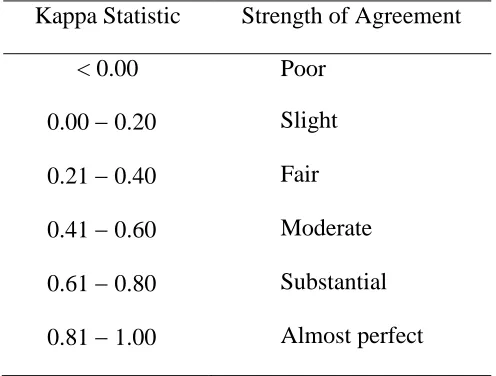
2 Landis and Koch Reliability Figures ...47
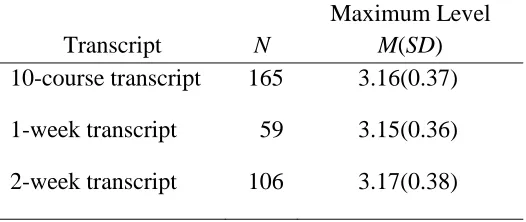
3 Minimums and Maximum of the Population (standardized data) ...53
4 Means and Standard Deviations of the Population I (standardized data) ...53
5 Means and Standard Deviations of the Population II (standardized data) ...55
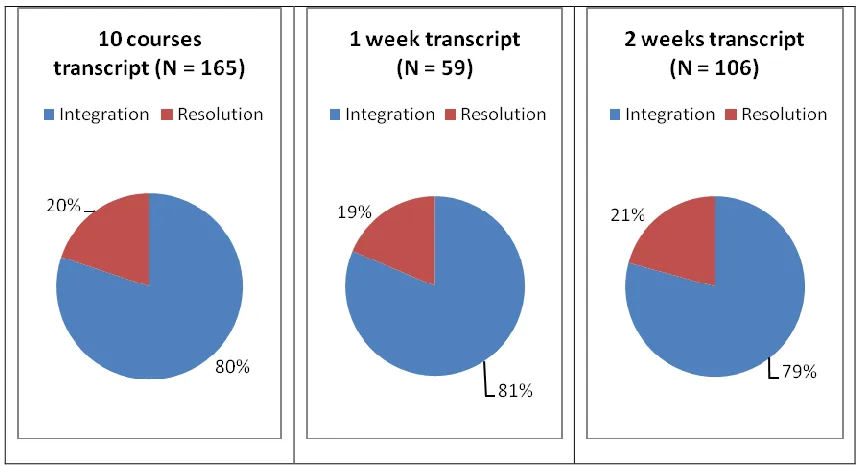
6 Summary of students that reached the “Resolution” stage ...59
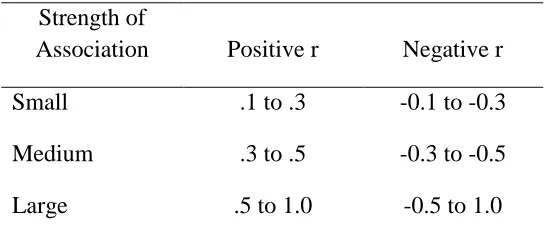
7 Ranges of Pearson Correlations ...59
8 Pearson Correlations and p values of the Population (standardized data) ...60
9 Pearson Correlations and p values of the Population (original data) ...61
10 Correlations between Maximum Levels of Cognitive Presence and Student Performance (standardized data) ...64
11 Correlations between Message Lengths and Student Performance (standardized data) ...64
12 Correlations between Maximum Levels of Cognitive Presence and Message Lengths (standardized data) ...65
13 Correlations between Number of Messages and Message Lengths (standardized data) ...65
14 Correlations between Student Performance and Number of Messages (standardized data) ...66
15 Correlations between Maximum Levels of Cognitive Presence and Number of Messages (standardized data) ...66
16 Inter-Rater Reliability (Cohen‟s κ) ...74
17 Landis and Koch Reliability Figures ...75
vi
LIST OF FIGURES
Figure Page
1 Sample IT 2010 Course Timeline for Summer2007 semester ...31
2 Computer Ethics Modules offered during 1-week or 2-week ...32
3 Computer Ethics Modules with student distribution ...33
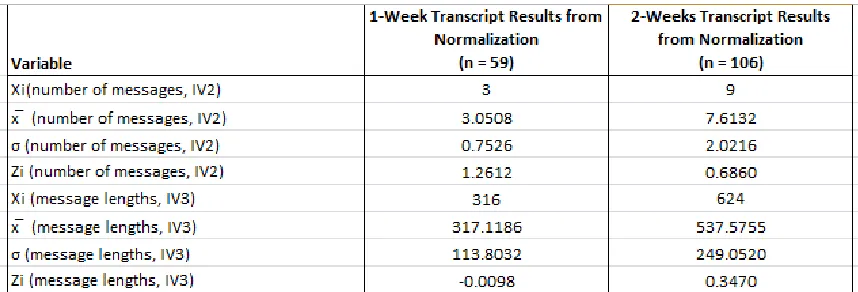
4 Standardizing the Number of Messages and Message Lengths ...49
5 Levels of Cognitive Presence at the “Resolution” or “Integration” level ...56
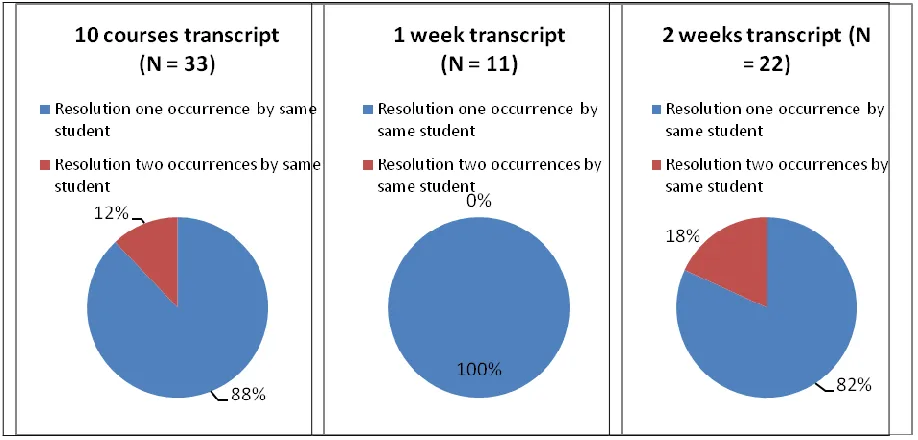
6 Occurrence at the “Resolution” level by the same student ...57
7 Distribution of students that reached the “Resolution” level/section ...57
8 Correlations for standardized and original Populations ...68
vii
ABBREVIATIONS
5076_020 Summer 2007, section 020 5076_035 Summer 2007, section 035 5079_030 Fall 2007, section 030 5079_035 Fall 2007, section 035 5081_025 Spring 2008, section 025 5089_005 Fall 2008, section 005 5089_015 Fall 2008, section 015 5089_020 Fall 2008, section 020 5089_025 Fall 2008, section 025 5089_030 Fall 2008, section 030
ALN Asynchronous Learning Network CAI Computer Assisted Instruction DSL Digital Subscriber Line
SCCI Sense of Classroom Community Index
CHAPTER 1 INTRODUCTION
Education occurs at any time and at any place in our daily lives, whether we are at home with our families, or while we‟re at a market in a public setting. Thus education can
be both a personal and public experience that can occur at any time or any place
regardless of the setting. The emergence of learning communities has helped to enhance the quality of education. The idea of developing a learning community is rooted in the observation that knowledge and learning are a natural part of the life of communities that share values, beliefs, languages, and ways of doing things (Bransford, Brown, &
Cocking, 1999). As access to the Internet and World Wide Web has continued to grow, Web-based learning has continued to expand. Millions of students all over the world and at various levels of education, whether in primary, secondary or higher education, participate in some form of web-based education (i.e., whether totally on-line or blended). In conjunction with the growth of the World Wide Web, virtual learning communities have begun to emerge. This growth forms the evolution of our field “instructional technology” which is defined as “the systemic and systematic application
of strategies and techniques derived from behavior and physical sciences concepts and other knowledge to the solution of instructional problems (Anglin, 1995).
message), discussion boards (which allow conversations to evolve and the community to develop over a period of time), and text messaging via cellular phones. Conversely, synchronous communication occurs when all parties involved in the communication are present at the same time (referred to as an event). Examples include a telephone
conversation, a company board meeting, an online chat-room event, and instant messaging.
Furthermore in this study, asynchronous discussion forums are the learning medium that we‟re interested in further exploring. We have a lot to learn about the use of
asynchronous technology for effective learning. Trying to integrate the properties of asynchronous online learning with the ability to create communities of learning and inquiry to meet the objectives of learning and promote effective student learning outcomes is a challenge in which educators are faced with. Central to this study is the model of the community of inquiry that constitutes three elements essential to the educational transaction. The three elements that make up the model of community of inquiry are: (1) teaching presence, (2) social presence, and (3) cognitive presence. These elements are necessary for developing an engaging online learning experience that will lead to the accomplishment of learning objectives (Garrison, Anderson, & Archer, 2000). Furthermore, we hope that the combination of these three elements will lead to effective student learning outcomes.
The first element in the community of inquiry model, teaching presence is the ability of the instructor to develop a close relationship with the learners in an online course while overcoming the lack of physical presence associated with the online
a new online instructor to establish teaching presence is to be available and responsive to the learners, whether it is via email or through some form of face-to-face meeting.
Social presence, the second element in the community of inquiry model, is the ability to incorporate personality and humanness into an online course (Anderson, Rourke, Garrison, & Archer, 2001). Establishing an environment of comfort and trust is important in developing social presence in a community of inquiry. Social presence also supports the affective objectives by making group interactions appealing, engaging, and thus intrinsically rewarding, leading to an increased academic, social, and institutional integration and resulting in increased persistence and course completion (Tinto, 1993).
The third element in the community of inquiry model, cognitive presence is defined as the extent to which the participants in any particular configuration of a community of inquiry are able to construct meaning through sustained negotiation (Garrison et al., 2000). This third element also comes with it some depth and presents an area of interest for further research in this study. For this reason, I will spend a more time describing this third element in the community of inquiry model. Garrison et al. (2000) discuss a practical inquiry model comprised of four phases in depth. The first phase in the element of cognitive presence represents the initiation phase of critical inquiry and is considered the triggering event. In an educational context, the instructor often
communicates learning tasks that become triggering events. The second phase of the model is exploration. In this phase, students are required to grasp the nature of the
resolution. This is the phase in which students come up with the resolution of the dilemma or problem, thus being able to apply the concepts learned in this phase to other settings outside of the current context of the learning environment. In summary, the practical inquiry model of Garrison et al. (2000) reflects the critical thinking process and the means to create cognitive presence.
(An in-depth look at the community of inquiry model will be examined in the literature review section of this paper.)
Using asynchronous online learning as a medium to deliver instructional content, to achieve an active, social community of learners, to meet the objectives of learning and promote effective student learning outcomes is a challenge that educators of today face. For the purposes of this study, learning effectiveness and student performance will be described synonymously. Student performance is a term that is open to many definitions. Picciano (2002) perhaps has the most comprehensive definition and thus defines student performance as the following “the successful completion of a course, course withdrawals,
grades, added knowledge, and skill-building are some of the ways that performance is measured, depending on the content of the course and the nature of the students. Courses may also have multiple performance outcomes, each of which might be measured
understood to be a multivariable phenomenon affected by study habits, prior knowledge, communications skills, time available for study, teacher effectiveness, etc.”
Purpose
The purpose of this study was to examine student performance in an online course in terms of student interaction and sense of cognitive presence. Data from multiple
independent variables (measures of interaction and cognitive presence) and dependent variables (measures of performance) were collected and subjected to analysis. This study explored the online asynchronous postings of a course taught in a large public university in the Southeastern United States. This study adds to the current literature examining the relationship between cognitive presence and higher order learning effectiveness online.
Research Questions
This study sought to answer four questions pertaining to the cognitive processes. The first question was, “What are the levels of cognitive presence exhibited by online learners during the online discussion?” To answer the first question, I examined levels of
cognitive presence.
The second question was, “What is the relationship between cognitive presence and student performance as assessed by the instructor?” More particularly, I looked at the students‟ performance on their Computer Ethics module assignments and correlated the students‟ grades with the students‟ levels of cognitive presence.
The third question was, “What is the relationship between message lengths and student performance as assessed by the instructor?” In examining the lengths of the
The final question was, “What is the relationship between cognitive presence and
message lengths?” To examine this final question, I related the students‟ levels of cognitive presence with the students‟ entire posts. I used quantitative content analysis to
address these questions.
Statement of the Problem
Web-based learning progresses as access to the Internet grows. So, as learners and educators in virtual learning communities, we strive for ways to measure how well
educators teach and learners learn. While the literature is replete with articles and books discussing online learning from the perspective of social and teaching presence, there are few studies that examine the relationship between cognitive presence and higher order learning effectiveness online. The purpose of this study was to examine the impact of cognitive presence on learning outcome in an asynchronous discussion forum. Thus, this study examined performance in an online course in relation to student interaction and sense of cognitive presence in the course.
CHAPTER 2
REVIEW OF THE LITERATURE
This literature review will examine five different areas. The first area focuses on the learning theories. The second area looks at existing literature on virtual learning communities/asynchronous discussion forums. The next area examines the research on the communities of inquiry model. Following that, the literature review examines the writings on learning effective/student performance. The final area looks at the research in one of the three elements of the communities of inquiry model, the element of cognitive presence. To start, the conceptual framework which binds these five areas of research will be discussed in the following section.
Contextual Framework
Becoming a “learning community” can be considered both a means and a goal for
online classes and not all classes are able to realize the full potential of this endeavor. It is difficult to establish a sense of a learning community in all classes because as Garrison et al‟s research (2001) suggests it takes a community of inquiry and its three
elementsteaching presence, cognitive presence, and social presence in order to achieve
this. The following sections explore the literature, i.e., the theory and the research, dealing with social support for learning and the development of virtual learning
promising features. This has led to considerable investigation into social interaction among discussion participants and its relationship to the development of learning communities in this medium.
Social Learning Theories
Social learning theory is one type of learning theory that is relevant to this study. Similarly, constructivism is a theoretical framework or an intellectual view which states that learning is an active and constructive process. Vygotsky‟s (1962) Social
Development Theory provides one of the foundations for constructivism. According to Vygotsky the learner constructs knowledge for themselves and that new information constructed is linked to previous knowledge. Furthermore in the learning environment, the instructor serves as a facilitator to the learning process. Vygotsky‟s Social
Development Theory posits that learning is social in nature, which is generally accepted by most contemporary educational researchers and theorists (Bransford, Brown, Cocking, 1999). These authors believed that education is both a personal and public learning experience (Bransford, Brown, Cocking, 1999). In their view, learning communities have emerged to enhance the value of education. Furthermore, the notion of developing a learning community is rooted in the observation that knowledge and learning are a natural part of the life of communities that share values, beliefs, languages, and ways of doing things (Bransford, Brown, & Cocking, 1999). These authors also stated that
knowledge is inseparable from practice, and practice is inseparable from the communities in which it occurs.To them social learning theories, therefore, must be addressed in any discussion of learning online. The fundamental basis for social learning theories
constructively. Such theories are dated, as early as the 1930s, starting with theorists Dewey (1938) and Vygostky (1962) as they both argued for a social view of learning. In Vygotsky, there was the previously discussed Social Development Theory where he theorized that learning is social in nature. This view supports Dewey‟s older research
and in fact Dewey posited that in a learning environment everyone experiences social control in life. Dewey saw that the instructor should be a member of the group, the most mature and also the most experienced member. The learners should be social and active participants in the group learning process.
Situated learning is a type of social learning theory present in educational environments. Lave (1998) argues that learning is situated in that it should be presented in authentic contexts, i.e., settings where there is social interaction and collaboration. This is different from most classroom learning activities today which involve abstract knowledge or learning that occurs out of context. Furthermore, in a situated learning environment the learners become involved in a “community of practice” where beliefs, knowledge, and behaviors are shared and acquired (Wenger, 1997). Often times, situated learning is regarded synonymously with constructivism learning or collaborative
learning. Also in this learning environment or learning community, a beginner evolves and becomes more active and participatory within the learning community and assumes the role of an expert Lave (1998). Additionally the role of the instructor is primarily to serve as a facilitator of the learning experience.
Other researchers have built on the theory above. The notion of learning
(Bransford, Brown, & Cocking, 1999). These authors assert that knowledge, in this view, is inseparable from practice, and practice is inseparable from the communities in which it occurs. Wenger (1997) explores the topic of communities and speaks specifically of learning communities in terms of "communities of practice.” He bases his ideas on extensive study of various workplaces as well as classroom communities. He believes that: (1) authentic communities of practice are characterized by mutual engagement, joint enterprise, shared repertoire, and negotiated meaning, (2) authentic learning
environments share such characteristics, and (3) all learning environments should work to develop them (Wenger,1997). An important part of Wenger's communities of practice is the idea that all learning is situated in practice and that all practice is essentially social in nature.
In summary, social theories of learning, while generally focusing on cognition and learning as situated and constructivist in activities, interactions, practice, and
Virtual Learning Communities/Asynchronous Discussion Forums
As access to the Internet and World Wide Web has continued to grow, Web-based learning has continued to expand. Instruction in the tradition classroom moves to
instruction via the Internet. Traditional learning communities become virtual learning communities. Virtual learning communities emerge from a blending of traditional learning communities and social learning theories. Theoretically, the idea of a virtual learning community grows from research on social presence and Wenger's (1997) studies of communities of practice. The research on social presence informs us that students perceive themselves as interacting socially in online courses and that they relate such perceptions to learning. These findings suggest that online courses might be better understood and investigated as communities of practice.
Other researchers have further explored the relationship between social presence or social interaction and the development of learning communities. Swan & Shea‟s (2005) literature review delves into this area. In this article these authors, among other literature cited, referenced the research conducted by Wegerif (1998), Brown (2001) and Rovai (2002) as the prominent research conducted in the area of social presence and the development of learning communities. I will now further examine these research articles.
Furthermore, Wegerif found that the individual success or failure of students enrolled in an online course at the Open University depended on their ability to cross a threshold “from feeling like outsiders to feeling like insiders” in that community. The research
conducted by Wegerif (1998) on social interaction can be best summed by this quote of his "In this paper I show, through an ethnographic study of a computer-mediated course, how social factors impacted upon the learning of students. I argue from this evidence that social factors, how participants in an ALN relate to each other, need to be taken into account in the design and development of computer-mediated courses."
Shea & Swan (2005) also mentioned Brown‟s (2001) research where Brown studied the processes through which community was formed in graduate courses in educational administration. He analyzed historical online course records and interviewed students and instructors to determine how community is formed in online courses. He found that the community building was formed in three stages. The first stage was making friends online because students needed to first become comfortable with responding to their classmates Brown (2001). The second stage was students had to become more involved in participating in thoughtful discussions together Brown (2001). The third and final stage was camaraderie which was achieved when students
incorporated personal discussion into their communication Brown (2001).
Brown (2001) also found that as students progress through each of these stages, they exhibited a greater degree of engagement in both the class and the online
that could include online learning, (2) a participant did not prioritize the class at a level that would allow the development of community or was for some reason “out of sync”
with it, or, (3) a participant did not want to be part of the community (Brown, 2001). Among the participants who did experience a sense of community, Brown (2001) identified three levels or stages in the development of feelings of belonging to a class community. The first level involved making online acquaintances usually through discovered similarities. The second level, community conferment, resulted from
engagement in a long-threaded discussion after which participating students felt a kinship with each other. The third level of community, camaraderie, was achieved after long-term and intense association with others through personal communication and also generally found only among students who had been through multiple classes together. .
Brown (2001) argues that his findings suggest ways in which the development of community can be supported by online course developers and facilitators. Such an argument is reiterated in the work of Rovai (2002). Shea & Swan (2005) highlighted Rovai‟s (2002) research where Rovai developed a Sense of Classroom Community Index (SCCI) to measure students‟ sense of community in both traditional face-to-face courses
media that matters the most in learning effectiveness. Rovai (2002) posited that “members of strong classroom communities have feelings of connectedness.”
This section cited examples of research where social presence contributes to the formation of communities of practice. Swan & Shea‟s (2005) research was noted as the contributing literature into this area. However, social presence is not the only variable essential in the formation of communities of practice. The community of inquiry model posits that social presence is just one of the three elements required, which transitions to the next section of discussion in this chapter.
Communities of Inquiry
Garrison et al. (2000) developed the community of inquiry model, which constitutes three elements essential to an educational transactioncognitive presence,
social presence, and teaching presence. Indicators (key words/phrases) for each of the three elements emerged from this study which was an analysis of computer-conferencing transcripts.
Cognitive presence. The first element of a community of inquiry is cognitive presence. Cognitive presence is defined as the extent to which the participants in any particular configuration of a community of inquiry are able to construct meaning through sustained negotiation (Garrison et al., 2000). It is composed of four phases of the
practical inquiry model.
The first phase of the model is reflective of the initiation phase of critical inquiry and is considered the “triggering event.” In an educational context, the instructor often
learning environment, any group member can add a triggering event to the learning discourse (Garrison et al., 2000).
The second phase of the model is “exploration.” In this phase, students are required to grasp the nature of the problem, and then move on to a fuller exploration of relevant information. This exploration can take place in the community of inquiry and can be characterized by brainstorming, questioning, and exchanging information (Garrison et al., 2000).
The third phase of the model is “integration.” In this phase, students are
constructing their personal meaning from the ideas generated in the exploratory phase. In terms of teaching presence, this phase is the most important for the instructor to assert his or her presence because students might have ideas that need the teacher‟s input (Garrison et al., 2000).
The final phase is resolution. This is the phase where students come up with the resolution of the dilemma or problem (Garrison et al., 2000).
Social presence. The second element of a community of inquiry is social
presence. Social presence is the ability of learners to project their personal characteristics into the community of inquiry, thereby presenting themselves as real people (Garrison et al., 2000). The use of emotion, caring, concern, recognizing others by name, or attending to a message posted by another person all demonstrate social presence. Social presence helps to build community. An example of a post that fosters a sense of community is one in which writer uses the pronouns “us” or “we.” Similarly social presence is defined as
Teaching presence. The third element of a community of inquiry is teaching presence. Teaching presence is defined as the design, facilitation, and direction of cognitive and social processes for the purpose of realizing personally meaningful and educational worthwhile learning outcomes (Garrison et al., 2000). Teaching presence is also the ability of the instructor to develop close proximity to the learners in an online course while overcoming the lack of physical presence associated with the online
learning medium (Garrison et al., 2000). In practice, one of the best and easiest ways for a new online instructor to establish teaching presence is to be available and responsive to the learners, whether it is via email or through some form of face-to-face meeting.
Asynchronous discussion forums have lots of exciting potential because it gives online learning communities with new and unprecedented learning opportunities. However, educators are often faced with difficulties on how to evaluate learning
effectiveness in such online communities. As Gunawardena, Carabajal, & Lowe (1997) noted, “The development of appropriate methodologies for evaluating the myriad, ever
changing forms of online learning presents a critical challenge to distance educators. The open-ended nature of online learning, the multiple threads of conversation, and the fluid of participation pattern calls for new ways of looking at evaluation,” which transitions to the next section of discussion in this chapter.
Learning Effectiveness and Student Performance
(classroom-based) instruction. Regardless of the learning environment, whether face-to-face or online, interaction is key (Sloan Consortium, 2002).
Student performance, at times may be used synonymously with learning
effectiveness, is a term that is open to many definitions. Picciano (2002) perhaps has the most comprehensive definition and thus defines student performance as the following “the successful completion of a course, course withdrawals, grades, added knowledge,
and skill-building are some of the ways that performance is measured, depending on the content of the course and the nature of the students. Courses may also have multiple performance outcomes, each of which might be measured separately through testing, written assignments, or the completion of individual and group projects. Many studies of student performance in face-to-face and online courses rely on student perceptions of their learning experiences including "how well" or "how much" they have learned. Ultimately, student perceptions of their learning may be as good as other measures because these perceptions may be the catalysts for continuing to pursue coursework and other learning opportunities. Student performance is well understood to be a
multivariable phenomenon that could be affected by study habits, prior knowledge, communications skills, time available for study, teacher effectiveness, etc.”
of student learning outcomes in online learning environments. In this study, I am interested in the blending of the definitions student performance and learning
effectiveness as it pertains to meeting the objectives of learning and promote effective student learning outcomes.
When online learning was first conceived and implemented, a majority of educators believed that it would not compare to face-to-face learning and interestingly many still doubt to this day. The comparison of online learning compared to face-to-face learning coupled with learning effectiveness is one area of research that is prominently cited by Swan (2003). Swan (2003) further explores into this area of research in her literature review. In this research the author, among other literature cited, looked at the research conducted by Russell (1999), Clark (1983), Kozma (1991) and Kulik et al (1985). I will now further consider these research articles.
As an example, Swan (2003) cited Russell‟s research on “no significance
difference.” Pertinent to the above age old argument, Russell (1999) designed a Web site titled “no significance difference” that presents the results of 300 plus research studies,
dating as far back as 1928, reporting no significant differences between the outcomes of students online versus students learning in the traditional classroom. In other words, the “no significance website” noted that historical research studies accumulated over-time
illustrated that student outcomes in distance learning courses were neither better nor worse than those in face to face courses.
Prominent discussion topics to Russell‟s (1999) comprehensive archive of “no significance difference” research studies, there can be found two distinct arguments made
argument comes from Clark (1983), where he viewed instructional media as “… mere vehicles that deliver instruction but do not influence student achievement any more than the truck that delivers our groceries causes changes in our nutrition." Clark‟s premise for the quote above was the following, he argued that media does not make a difference in learning but rather that instructional design does make a difference. In particular, Clark (1983) brought up issues found in studies of computer-assisted instruction (CAI) (Kulik et al., 1985) that compared CAI with traditional instruction and found that students learned faster from using CAI over traditional classroom. Clark (1983) posits that the CAI studied was designed with a solid instructional design base, while the traditional instruction to which it was compared to was not. Clark (1983) concluded by saying that as long as the quality of instructional design delivered over a distance was as good as the quality of traditional education, there would be no significant differences in learning between the two types of instruction. Other researchers tend to support Clark‟s research, one of which is Rovai‟s (2002) work as it provides evidence that it is the method and not the media that matters the most in learning effectiveness.
Clark‟s position, however, has been challenged by many in the educational
classroom don‟t have the time or the resources to do that. Thus Kozma (1991) posits that CAI can replace the individual teachers that are assigned to students. In summary, Kozma (1991) responded to Clark (1983) with his own article. Kozma (1991) argued that
Clark‟s view of media as "delivery trucks" creates an "unnecessary schism between
medium and method." Kozma (1991) believed that a continued and careful use of instructional media will enable learners to take advantage of its strengths to construct knowledge. In contrast to Clark (1983), he called for continued instructional media comparison studies because they do present better learning outcomes for students as opposed to traditional face-to-face learning environments. Thus when considering about the effectiveness of online learning outcomes, one comes across the arguments of “no significance difference” and the research of Clark (1983) which supports instructional
design while the research of Kozma (1991) calls for continued research in the instructional media.
research conducted by Shea, Fredericksen, Pickett, Pelz, & Swan (2001), Dziuban & Moskal (2001), Beaudoin (2001) are among the more notable research conducted in the area quality and quantity of student-to-faculty and student-to-student interactions as important elements in the design of online instruction and the achievement of student learning outcomes. I will now further examine these research articles.
As an example Picciano (2002) cited Shea, Fredericksen, Pickett, Pelz, & Swan‟s (2001) research in a survey of 3,800 students enrolled in 264 courses through the SUNY Learning Network (SLN). The findings of this research note that the relationships between the variables of satisfaction, interaction, and performance (grades) were as follows: (1) There was a strong correlation between course grades and interaction, (2) There was a strong relationship between course grades and student satisfaction of the course, (3) Students who had strong interactions amongst themselves and their instructor performed well in the class (Shea et al., 2001). Finally the authors cited their research as having the following theoretical contribution “The identification through empirical
research of these three factors – consistency in course design, contact with course instructors, and real communication through discussion is both supported by social constructivist theory and supports social constructivist notions of the importance of the development of knowledge building communities. It also can guide the development of asynchronous online courses…” (Shea et al., 2001).
Effectiveness at the University of Central Florida to over 50,000 students enrolled in fully web-based, blended (i.e., combination of web-based and face-to-face) and web-enhanced face-to-face courses. The fully web-based and blended web-based courses replace some or all face-to-face classroom time. The findings of their research noted that there were statistically significant correlations between the quantity and quality of the interaction and student satisfaction in all types of courses. Furthermore there was a stronger
correlation between the levels of interaction on fully web-based courses versus the levels of interaction to other blended web-based courses web-enhanced face-to-face courses. Dziuban & Moskal (2001) also see potential in blended learning as an pedagogical approach that combines the effectiveness and social elements of the classroom with the enhanced active learning possibilities that the online learning environment affords.
Pertinent to Picciano‟s (2001) review of the relationship between social presence
or social interaction and the development of learning communities is Beaudoin‟s (2001), research “Learning or Lurking? Tracking the „Invisible‟ Online Student.” Beaudoin (2001) examines the relationship between student interaction and learning. This research is unique in that it looks at whether or students are actively engaged on the online
discourse with their fellow students and instructor, while other research has been written about the social behaviors of the students on the online courses. In this study, an online master‟s level class was divided into three groups (a high interaction group, a moderate
the online discourse at it relates to their performance in the class “Because some choose
to be less participatory does not necessarily mean they are less engaged in meaningful learning. Indeed it could be argued that the “overactive” online students (i.e., those who
are constantly inputting words) do so at the expense of a more reflective and less visible learning process in which their silent peers are actually more fully engaged
As we have seen, the progression of previous research illustrates that we can indeed learn online through the various learning theories that have been examined. However, knowing that we can learn online in a virtual learning community or
asynchronously is just the beginning, which moves us to the qualities determine whether learning is actually occurring.
Henri (1992) presented the first content analysis framework for exploring online discussions and proposes that we look at five dimensions of the discussion: participative, social, interactive, cognitive, and metacognitive. Later on, Garrison and colleagues (2000) modified Henri‟s model by dividing it into three components: cognitive presence,
social presence, and teaching presence. From Garrison et al (2000) community of inquiry model, we can examine the research to draw correlations between these three components to determine their impacts on learners‟ performance or student learning outcomes. The
Levels of Cognitive Presence
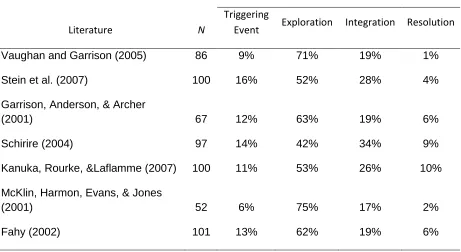
Some of the most current literature on the levels of cognitive presence in online learning environments emerges from a recent review of the literature conducted by Rourke & Kanuka (2009). In this article these authors, among other literature cited, reviewed seven studies relevant to the mean levels of cognitive presence that were published between the years of 2001 and 2007, suggesting that on the four levels of cognitive presence the most learning, ranging from 42% to 75%, occurs at the
“Exploration” level. The number of subjects from these seven studies ranged from 52 to
101.
The “Triggering Event” stage yielded a low of 6% as exhibited in the results of
As an example of one of the studies conducted on the levels of cognitive presence cited in Rourke & Kanuka (2009), I will discuss briefly the composition of the research conducted by Vaughan & Garrison (2005). The research by Vaughan & Garrison (2005) yielded the following mean levels of cognitive presence for each of the stages: (1) Triggering Event = 9 %, (2) Exploration = 71%, (3) Integration = 19% and (4) Resolution = 1%. The study contained N = 86 subjects and it focused on understanding how a blended learning approach can support the inquiry process (cognitive presence) in a faculty development context. The findings from this study
Table 1
Previous Literature on Cognitive Presence in Various Phases
Literature N
Levels of Cognitive Presence
Triggering
Event Exploration Integration Resolution
Vaughan and Garrison (2005) 86 9% 71% 19% 1%
Stein et al. (2007) 100 16% 52% 28% 4%
Garrison, Anderson, & Archer
(2001) 67 12% 63% 19% 6%
Schirire (2004) 97 14% 42% 34% 9%
Kanuka, Rourke, &Laflamme (2007) 100 11% 53% 26% 10%
McKlin, Harmon, Evans, & Jones
(2001) 52 6% 75% 17% 2%
Fahy (2002) 101 13% 62% 19% 6%
research on the face-to-face and online discussion forums indicates the following (1) a slightly higher percentage of triggering events occurred in face-to-face discussions; (2)
exploration was the dominant phase in both environments; (3) a noticeably greater percentage of comments were coded for integration in the online discussions; and (4) the
resolution/application phase was almost nonexistent in both forms of discussion
(Vaughan & Garrison, 2005). The results from this study (Vaughan and Garrison, 2005) suggest that an increased emphasis should be placed on teaching presence within a blended learning environment to ensure that participants achieve resolution in the inquiry cycle. Along the same lines Vaughan & Garrison (2005) suggested the following as a worthy topic for future investigation “would be to focus on high level learning processes and outcomes using blended learning designs.”
One other example of a study conducted on the levels of cognitive presence as cited in Rourke & Kanuka (2009) is the study conducted by Kanuka, Rourke & LaFlamme (2007). In the case study, with N = 100 subjects conducted by Kanuka, Rourke, & LaFlamme (2007), the distance learning 4th year university course was asynchronous based and delivered using the WebCT learning management system. Face-to-face contact between and among the students and the instructor was not allowed. The authors then created five groups of communication activities on the quality of
students‟ contributions to online discussion which were: (1) the nominal group technique,
(2) debate, (3) invited expert, (4) WebQuest, and (5) reflective deliberation Kanuka, Rourke, & LaFlamme (2007). Quality of discussion was represented as “cognitive presence,” a construct developed to investigate the role of critical discourse in higher or
postings of the students in an undergraduate university course were assigned to 1 of the 4 categories of cognitive presence. The research conducted by Kanuka, Rourke, &
LaFlamme (2007) yielded the following mean levels of cognitive presence for each of the four stages: (1) Triggering Event = 11%, (2) Exploration = 53%, (3) Integration = 26% and (4) Resolution = 10%. Additionally across the instructional methods, the authors found that the mode for the four phrases of cognitive presence was the highest WebQuest and Debate activities There were three advantageous qualities of these two activities, as the authors concluded the following “(1) They were well structured; (2) They provided
clearly defined roles and responsibilities for the students; and (3) They provoked the students to explicitly confront others‟ opinions” Kanuka, Rourke, & LaFlamme (2007).
This literature review in this chapter examined five different areas. The first area focused on the learning theories. The second area looked at existing literature on virtual learning communities/asynchronous discussion forums. The next area examined the research on the communities of inquiry model. Following that, the literature review examined the writings on learning effective/student performance. The final area looked at the research in one of the three elements of the communities of inquiry model, the
CHAPTER 3
RESEARCH METHODOLOGY
The purpose of this study was to examine performance in an online course in relation to student interaction and the sense of cognitive presence in the course. Data on multiple independent variables (i.e., message lengths, number of posts, presence) and dependent variables (i.e., measures of performance) were collected and analyzed.
Data on actual student participation in online discussions were collected during the duration of the Computer Ethics module of the IT 2010 course. The module
assignments consisted of questions that students were asked to respond to in an asynchronous discussion forum. (Questions from the Computer Ethics module can be found in Appendix H.). The data collected were based on asynchronous discussion forum posts from the Summer 2007, Fall 2007, Spring 2008, and Fall 2008 academic terms.
The methodology employed in this study was a descriptive analysis of interaction, cognitive presence, and performance data. The data was collected from students enrolled in an online module on Computer Ethics, which was part of an IT 2010 class taught at a large public university in the Southeastern United States. The IT 2010 course, Computer Skills for the Information Age, is a 3-credit hour elective course for undergraduate
included a 1-week or 2-week Computer Ethics module, depending upon the semester in which the course was administered. The entire course, designed to provide a forum for the presentation and discussion of issues in computer use, was structured around readings and weekly discussions. In addition to these readings and discussions, written
assignments were required, and these assignments were posted online and graded by the instructor.
Course Details
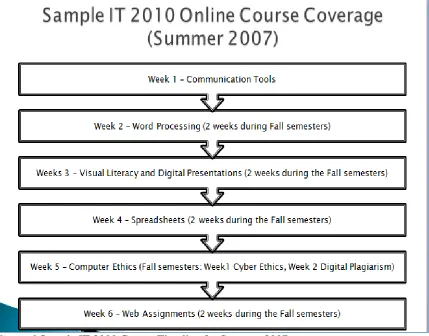
In addition to the Computer Ethics module that was offered in the IT 2010 online course, there were other modules offered in this course. The other main modules offered were:
a. Internet communication tools (electronic mail, instant messaging, search engines);
b. Word processing (MS-Word); c. Spreadsheets (MS-Excel);
d. Web Assignments/Development tools (Google Pages).
Figure 1.Sample IT 2000 Course Timeline for Summer 2007 semester.
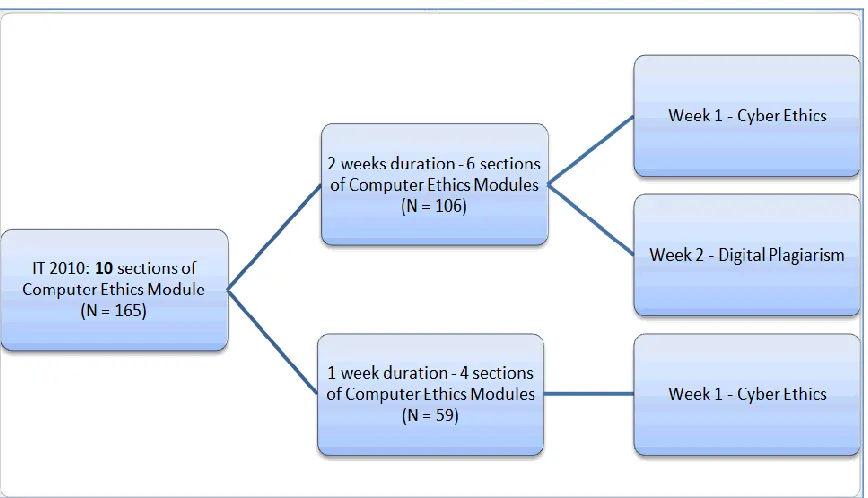
represented the number of sections and the number of students that comprised of the 1-week and 2-1-weeks modules of Computer Ethics.
Figure 2.Computer Ethics Modules offered during 1-week or 2-week.
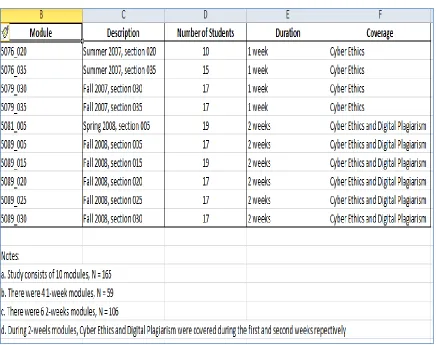
The Computer Ethics modules that were 1-week in length consisted of a total of four IT 2010 courses taught during the Summer 2007 and Fall 2007 semesters. There were a total of 59 students in these sections. Again during the 1-week duration sections, the coverage was on Cyber Ethics. The Computer Ethics modules that were 2-weeks in length consisted of six IT 2010 courses taught during the Spring 2008 and Fall 2008 semesters. During the 2-week duration sections, the coverage was on Cyber Ethics and Digital Plagiarism for the 1st and 2nd week respectively. Figure 3 below titled “Computer Ethics Modules with the number of students” consisted of the number of students in each
of the sections of the IT 2010 Computer Ethics online course modules.
for individual students in the 1-week modules were less than the number of messages and message lengths for individual students in the 2-week modules. Due to this difference, I
Figure 3.Computer Ethics Modules with student distribution.
looked at standardizing the number of messages and message lengths during the 1-week and 2-week course modules. More details about the process to standardizing the values for these two variables will be discussed later in this chapter. Additionally, I will compare the correlation calculation results using both the standardized versus original values for these two variables in this study.
Characteristics of the Participants
random sample of students taking this course in previous semesters, it was evident that
the students registered in the course recognized the importance of technologya
majority of the enrollees had access to computers and Internet technology in their homes or at other places, such as their work or at the public libraries. In addition, many of the past students were also professionally curious about an alternative pedagogical
experience such as web-based learning, using the Internet and other current technological tools.
Some of the former students who participated in the course balanced full-time jobs, families, parenthood, and higher education in a carefully planned day that includes rushing for subways and buses to meet the next commitment. They were a mature group of people who organized their daily lives around taking care of their families, making sure their children were safely transported to a babysitter or daycare facility, maintaining a home, and, as time permitted, completing homework assignments. Online courses that can be taken at any-time or in anyplace, such as the IT 2010 course, have a great deal of appeal to such students. These types of courses enabled students to fit under-graduate studies into their busy lives, eliminating the need to travel several times a week to the college campus. These non-traditional students in the course typified the mature, self-directed, and busy students who can take advantage of and benefit from online instruction.
The characteristics (see Appendix A) discussed above are based on a survey (see Appendix F) that students completed at the end of the Computer Ethics module.
student demographic information, also questions about the computer skills of the students and finally questions about the students‟ knowledge about Computer Ethics.
Three out of the nine questions were related to student demographics. Students were asked about their ethnicity, gender, and age. In the group of 165 students, all ten class sections combined, 71 students (43%) of the students responded to the question on their ethnicity. The highest racial group represented was the Caucasians at 53%. The next to lowest racial group represented was the Hispanics at 3%. Regarding the question gender, 65% of the 71 responders indicated that they were Female. Finally for the question on age, the age range between 18-22 years old had the highest distribution of 66% among the 71 responders.
The remaining questions on the survey were focused on the students‟ experience
with the use or exposure to computers or the Internet and there were also questions that focused on the students‟ knowledge about Computer Ethics. On the question of “How much time do you spend per week on the computer?” in the group of 165 students (all ten
class sections combined), 71 students (43%) responded. The majority of the students, 60 (85%), responded that they spend “More than 5 hours on the computer.” Related to the question of “Have you used the Computer for the following purposed?”, at least 40
students (56%) responded that they used the computer for multiple purposes ranging from Facebook to Google‟s search engine feature.
Students were then asked questions about topics related to Computer Ethics. The first question sought to know “How much time did you discuss the topic outside of class?” Given the fact that this Computer Ethics module was taught 100% on-line, I
anywhere but within the online learning environment. Students responded that they had discussed the topic outside of the learning environment. The discussions outside of the learning environment ranged from the maximum of 39 students (55%) who discussed the topic on “less than 6% of the class module” to a minimum of 5 students (7%) who
discussed the topic “between 51%-75% of the class module.” Students were then asked a “Yes” or “No” question on whether or not they had previous knowledge about the topic
of Computer Ethics. About 80 % of the 71 students who responded noted that they had heard of this topic. The last question on the survey asked the students if any of the following has happened to them. Listed below were the choices and the students‟
responses.
a. “Your PC has been hacked” – 5 students (7%) indicated that this happened; b. You have received spam mail – 68 students (96%) indicated that this happened; c. Your PC has been infected with a virus – 56 students (79%) indicated that this
happened;
d. You have been a victim of cyber-stalking – 8 students (11%) indicated that this happened;
e. You have been a victim of cyber-bullying – 5 students (7%) indicated that this happened;
f. You have been a victim of identity theft – 5 student (7%) indicated that this happened;
The students‟ responses to the end of module questionnaire gave some insights into the
characteristics of the students represented in the class, ranging from the student
Computer Ethics prior to starting the course module. The information helped to understand the students as well as to describe them in this study. However no analysis was being conducted against the variables, for example student demographics or student pre-class module knowledge on Computer Ethics, collected in the survey.
Instructional Components
A completely asynchronous model was used to deliver this course via a Website utilizing the Blackboard course management system (CMS). To connect to the
course‟sWebsite, most of the students used a commercial Internet and electronic mail (e-mail) provider, such as or BellSouth DSL or Comcast internet, in their homes or accessed wireless connectivity via public settings such as Starbucks or a library. Other students used Internet facilities available at the university.
to contribute to the discussions and/or ask a question of another student or the instructor. At the end of the week‟s discussion, the instructors summarized the topic, added
additional notes and comments, posted these notes to the Website for access by the entire class, and evaluated the students‟ assignments by giving the students a grade on for their participation or contributions to the discussions.
Techniques to encourage social presence and a sense of community were used throughout the course. Rourke and others (1999) provide an excellent review of some of the techniques that can be used to foster a sense of presence and community-building, including complimenting students, self-disclosure, warmth, and activities that build and sustain a sense of group commitment. In this course, many of these techniques were used, for example, first names were used in all online discussions. Discussion questions were designed to encourage students to relate the material to their experiences in their own schools and environments.
Data Preparation
assignments in the first three semesters was to see if there would be a difference in the grades assigned when the researcher graded the assignments versus when the instructors graded the assignments. Since there were no differences in the grades assigned by either the researcher or the instructors, the studies were to be grouped together into the overall study sample of N = 165 students for the 10 course modules that covered four different semesters, i.e., Summer 2007, Fall 2007, Spring 2008 and Fall 2008.
Data obtained from each the four semesters of the Computer Ethics module were coded simultaneously to ensure that there were no changes to the standards in coding. There were two primary coders and a third coder, whoserved as the “tie-breaker” if necessary. The method to train the primary coders and the involvement of the third coder, the “tie-breaker” coder will be discussed later in this chapter.
The set of constructed guidelines for the study builds on a series of content analyses described by Garrison et al. (2000, 2001), who analyzed online discussions based on a community of inquiry model that splits community-based learning into three overlapping areas: social presence, cognitive presence, and teacher presence. According to Rife, Lacy, and Fico (1998), content analysis is “the systematic assignment of
communication content to categories according to rules and the analysis of relationships involving these categories using statistical methods” (p. 2). Rife, Lacy, and Fico (1998)
Rife and colleagues (1998) define unit of analysis, or unit of contents, as “a discretely defined element of content. Thus it can be a word, sentence or paragraph, image, article, television program, or any other description of content based on a definable physical or temporal boundary or symbolic meaning” (p. 58). Rourke et al
(1999) described the unit of analysis as a discrete element of text that is observed,
recorded, and thereafter considered data. There are several types of units of analysis. One type is the “thematic unit,” which is defined by Budd, Thorp, and Donohue (1967) as a single thought or unit or idea unit that conveys a single item of information extracted from a segment of content. Another type is “syntactical unit,” which is defined by Garrison et al (2001) as identifying the theme by looking at a sentence, phrase, or paragraph. Garrison et al (2001) chose a syntactic unit of analysis as opposed to a thematic unit of analysis that they used to measure the entire message as opposed to individual paragraphs, sentences, or themes within a message. Further, they used human coders to clarify messages, and their study yielded a reliability figure of k = 0.74). Various sources (Rife and colleagues, 1998, Rourke et al, 1999, Budd, Thorp, and Donohue, 1967, Garrison et al, 2001) for the type of unit of analysis were considered for this study. For purposes of this study, I considered Garrison et al‟s (2001) suggestion and treated the individual student‟s post or message rather than at the individual sentences as the unit of analysis.
The set of constructed guidelines for this study focuses on cognitive presence, which is defined as “the extent to which learners are able to construct and confirm meaning through sustained reflection and discourse in a critical community of inquiry”
by Garrison et al. (2001), in which the authors identified each of the 4 cognitive presence categories as follows:
1. Triggering event: a message that evokes response(s).
2. Exploration: a message that presents facts, feelings, ideas, suggestions, unsupported conclusions, or unsupported contradiction/disagreement.
3. Integration: a message that includes tentative substantiation, combination of ideas, or synthesis.
4. Resolution: a message that indicates commitment to a resolution and includes real-world applications, testing of solutions, or defense of solutions.
Any value of “0” is considered non-cognitive.
The coding process into the levels described above involves developing a systematic procedure for assigning data into categories, for example, each of the four cognitive presence processes above would be placed into categories. An example of a triggering event is identified as a “sense of puzzlement.” An example of exploration would be “leaps to conclusion.” An example of integration would be “creating ideas or synthesis.” And an example of resolution would be “testing solutions.” (see Appendixes
B and C).
Content analysis can be performed either manually or through the use of computerized applications. In this study, manual content analysis for each course was performed by the coders, one of which also has taught, administered, or taken the online course. The coders were first trained to code online discussion messages using a rubric based on the model developed by Garrison et al. (2000) (see Appendix B).
Steps for Coding
There were two primary coders, this author and his partner, and a third coder who served as a “tie-breaker.” The two primary coders coded each set of transcripts during a joint session and sitting at separate tables to lessen the potential for looking at one another‟s codes.
Before coding the first transcript, 5076_020, the two primary coders met to review the “Transcript Code Sheet” document, which can be found in Appendix B.
According to that document, each of the four levels for Triggering Event, Exploration, Integration and Resolution were coded with sub-levels.
The Triggering Event, first level, stage has three sub-levels: a. Recognizing the problem;
b. Sense of puzzlement – asking questions;
c. Sense of puzzlement – massages that take the discussion in a new direction. Each of the three sub-levels within the Triggering Event level was coded with a code of 1A, 1B or 1C in the code sheet.
The Exploration, second level, stage has six sub-levels: a. Divergence – within the online community;
b. Divergence – within a single community; c. Information exchange;
d. Suggestions for consideration; e. Brainstorming;
f. Leaps to conclusion.
The Integration, 3rd level, stage has four sub-levels: a. Convergence – among group members;
b. Convergence – within a single message; c. Connecting ideas, synthesis;
d. Creating solution.
Each of the four sub-levels within the Integration stage was coded with a code of 3A, 3B, 3C or 3D in the code sheet.
The Resolution, 4th level, stage has three sub-levels: a. Vicarious applications to the real world;
b. Testing solutions; c. Defining solutions.
Each of the three sub-levels within the Resolution stage was coded with a code of 4A, 4B or 4C in the code sheet.
The practice coding round was conducted using the 5076_020 transcript. Also, before coding the first transcript, 5076_020, the two primary coders also reviewed the “Coding Explanations” document which can be found in the third appendix (see
Appendix C).
This document provided examples of codes, shown in codes below for each of the sub-levels, within any of the four sub-levels within the main levels of Triggering Event, Exploration, Integration and Resolution.
a. Recognizing the problem example – “When a student was vague and
identified the issue, but failed to discuss or develop their feelings toward the issue”;
b. Sense of puzzlement, asking questions example – “When a student asked a question that could warrant an answer, as in when there truly seemed to be a question asked and answered that could the student‟s feelings on the subject”;
c. Sense of puzzlement, messages that take discussion in a new direction example- “When a student‟s response seemed to be not on the issue of plagiarism/how to deal with plagiarism, but the student focused more on the presentation itself (i.e. style, appropriateness, what they learned from it”.
Within the Exploration (2nd) level, the examples of the codes for the six sub-levels were as follows.
a. Divergence, within the online community example – “When a student‟s response is in disagreement with a response that precedes it. When a student says something that differs from what the majority of the students have posted”;
b. Divergence, within a single message example – “When a student presents more than one somewhat developed response to an issue in a unified message. The messages in this category were usually well developed, and there may be some (although very little) overlap with brainstorming”;