© Associated Asia Research Foundation (AARF)
A Monthly Double-Blind Peer Reviewed Refereed Open Access International e-Journal - Included in the International Serial Directories.
Page | 12
A NEW TECHNIQUE FOR SOLVING ASSIGNMENT PROBLEM USING
RANKING EXPONENTIAL VALUE OF PENTAGON FUZZY NUMBERS
Prof. A. N. Mohamad,
Department of Mathematics and Modeling, College of Natural & Computational Sciences, Debre Berhan University, Ethiopia.
Gebrehiwot ,
Department of mathematics, College of Natural & Computational Sciences, Debre Berhan University Ethiopia.
Olana Abu,
M.Sc. (Algebra) Student, Department of Mathematics, College of Natural & Computational Sciences, Debre Berhan University, Ethiopia.
ABSTRACT
In the field of research several techniques are focused for solving Assignment Problems in
Fuzzification way. Fuzzy numbers has master role to solve real life problem especially
Assignment problem (AP), which finds many applications in allocation and scheduling, generally
it made on one – to – one basis and if there are more jobs to do than can be done, one can decide
which job to leave undone or what resource to add. But in this paper we introduce a new International Research Journal of Mathematics, Engineering and IT
ISSN: (2349-0322) Impact Factor- 5.489, Volume 5, Issue 5, May 2018 Website- www.aarf.asia, Email : [email protected] , [email protected]
© Associated Asia Research Foundation (AARF)
A Monthly Double-Blind Peer Reviewed Refereed Open Access International e-Journal - Included in the International Serial Directories.
Page | 13
technique for solving AP using cardinality of exponential value of Fuzzy Pentagon Number, and
we compare our result with previous scholars result in the same area.
Key Words: Exponential Number, Ranking of Pentagon Fuzzy Number, cardinality, Row reduction, Column Reduction
1. Introduction
Assignment problem (AP) is used in worldwide to solve real world problems. An AP
plays an important role in industry and other applications. AP is very often used in
solving problems of engineering and management studies
Ranking fuzzy numbers are used as an important tool in Decision Making. In Fuzzy
decision analysis, fuzzy quantities are used to determine the performance s of alternatives
in modeling real world problems. Various ranking procedures have been developed in
1976 , when the theory of fuzzy sets were first introduced by Zadeh [9] Ranking fuzzy
numbers were first proposed by Jain for decision making in fuzzy subsets. In this article
we introduce a new approach for ranking exponential value of pentagon fuzzy numbers
with Cardinality Concepts, using to solve Assignment Problem to get best optimal
feasible solution for AP.
2. Previous Research
Firstly the Ranking Fuzzy Sets, Subsets and Systems were introduced by Bortolan G.,
Degani, R. in 1989 [2]. Then Chen S. H. 2007 [3] discussed about Ranking Fuzzy Numbers
with Maximizing Set and Minimizing Set
Amith Kumar, Singh P, Kaur A. in 2010 [1] approached for Ranking of Generalized
Trapezoidal Fuzzy numbers to solve Assignment Problem
Salim Rezvani [4] tried Graded Mean Representation Method with Triangular Fuzzy
Numbers to solve Assignment Problem in 2010 and then he approached in Multiplication
© Associated Asia Research Foundation (AARF)
A Monthly Double-Blind Peer Reviewed Refereed Open Access International e-Journal - Included in the International Serial Directories.
Page | 14
introduced a new method for ranking in Perimeters of two generalized Trapezoidal Fuzzy
Numbers for solving Assignment problems
Salim Rezvani, M. Molani, and M. Ebrahimi (2013) et.al [7] developed a new Method for
Ranking area in two Generalized Trapezoidal Fuzzy Numbers to solve Assignment
Problem finally he solved Assignment Problem by Salim Rezvani in 2014 [8] by Ranking
Exponential Fuzzy Numbers by Median Value
3. Preliminaries and Basic concepts
3.1.Interval Number
Let ℝ , it is the set of real numbers and then the closed interval 𝑎, 𝑏 , it is said to be an
interval number, where 𝑎, 𝑏 ∈ ℝ, 𝑤𝑖𝑡ℎ 𝑎 ≤ 𝑏
3.2.Normal Fuzzy Set
A fuzzy set 𝐴 , it is the universe of discourse 𝑋 , and it is called Normal fuzzy set
implying that there exists at least one 𝑥 ∈ 𝑋, such that 𝜇𝐴 𝑥 = 1, 𝜇, it is any fuzzy
number in 0, 1
3.3.Distance between Two Interval Numbers
Let 𝑎 = 𝑎1, 𝑎2 , 𝑏 = 𝑏1, 𝑏2 , they are two interval numbers, and then the distance
between 𝑎 𝑎𝑛𝑑 𝑏, denoted by 𝑑 𝑎, 𝑏 , and defined by
𝑑 𝑎, 𝑏 = 𝑎1+ 𝑎2
2 + 𝑥 𝑎2− 𝑎1 − 𝑏1+ 𝑏2
2 + 𝑥 𝑏2− 𝑏1 0
−0.5 𝑑𝑥
3.4.Properties of fuzzy number and Fuzzy set (without proof)
To qualify as a fuzzy number 𝛼 and a fuzzy set 𝐴 𝑜𝑛 ℝ, must possess at least the
following three properties
a. 𝐴, it must be a fuzzy set
b. 𝛼𝐴, it must be a closed interval and for every 𝛼 ∈ 0, 1
© Associated Asia Research Foundation (AARF)
A Monthly Double-Blind Peer Reviewed Refereed Open Access International e-Journal - Included in the International Serial Directories.
Page | 15 3.5.The Generalized Fuzzy Number Conditions:
Generally, a general fuzzy number 𝐴, it is described as any fuzzy subset of the real
line ℝ, whose membership function 𝜇𝐴satisfies the following conditions:
a. 𝜇𝐴, it is a continuous mapping from ℝ to the closed interval 0, 1
b. 𝜇𝐴 𝑥 = 0 𝑓𝑜𝑟 −∞≤ 𝑥 ≤ 𝑎
c. 𝜇𝐴 𝑥 = 𝐿1 𝑥 , it is strictly increasing function on 𝑎, 𝑏
d. 𝜇𝐴 𝑥 = 𝐿2 𝑥 , it is strictly increasing function on 𝑏, 𝑐
e. 𝜇𝐴 𝑥 = 𝑊 𝑖𝑓 𝑥 = 𝑐
f. 𝜇𝐴 𝑥 = 𝑅1 𝑥 , it is strictly decreasing function on 𝑐, 𝑑
g. 𝜇𝐴 𝑥 = 𝑅2 𝑥 , it is strictly decreasing function on 𝑒,∞
Where 0 ≤ 𝑊 ≤ 1; 𝑎, 𝑏 ∈ ℝ; 𝑐, 𝑑 ∈ ℝ+
3.6.Generalized Exponential Fuzzy Number
We denote the generalized exponential fuzzy number (say)
𝐵 = 𝑎, 𝑏, 𝑐, 𝑑, 𝑒; 𝑤 𝐸𝑥𝑝 𝑤ℎ𝑒𝑛 𝑤 = 1
3.7.Integral Value of Graded Mean 𝒉 − 𝒍𝒆𝒗𝒆𝒍
Based on the integral value of graded mean ℎ − 𝑙𝑒𝑣𝑒𝑙, however, and this Exponential
fuzzy numbers denoted by𝑓𝐸 𝑥 always have a fix range as 𝑐, 𝑑 , and we define their
general forms as follows:
𝑓𝐸 𝑥 = 𝑓 𝑥 =
𝑤𝑒𝑥𝑝−
𝑏−𝑥
𝑏−𝑎 , 𝑓𝑜𝑟 𝑎 ≤ 𝑥 ≤ 𝑏
𝑤𝑒𝑥𝑝−
𝑐−𝑥
𝑑 −𝑐 , 𝑓𝑜𝑟 𝑏 ≤ 𝑥 ≤ 𝑐
𝑤, 𝑥 = 𝑐
𝑤𝑒𝑥𝑝−
𝑥 −𝑐
𝑑 −𝑐 , 𝑓𝑜𝑟 𝑐 ≤ 𝑥 ≤ 𝑑
𝑤𝑒𝑥𝑝−
𝑥 −𝑑
𝑒−𝑑 , 𝑓𝑜𝑟 𝑥 > 𝑒
Where 0 ≤ 𝑊 ≤ 1; 𝑎, 𝑏 ∈ ℝ; 𝑐, 𝑑 ∈ ℝ+
From this exponential fuzzy numbers, let us take monotonic functions are
𝐿1 𝑥 = 𝑤𝑒𝑥𝑝−
© Associated Asia Research Foundation (AARF)
A Monthly Double-Blind Peer Reviewed Refereed Open Access International e-Journal - Included in the International Serial Directories.
Page | 16 𝐿2 𝑥 = 𝑤𝑒𝑥𝑝−
𝑐−𝑥 𝑑 −𝑐
𝑅1 𝑥 = 𝑤𝑒𝑥𝑝−
𝑥 −𝑐 𝑑 −𝑐
𝑅2 𝑥 = 𝑤𝑒𝑥𝑝−
𝑥 −𝑑 𝑒−𝑑
3.8.Ranking of Pentagon Fuzzy Number
Let us take two pentagon fuzzy numbers denoted by
𝐴 𝑃 = 𝑎1, 𝑎2, 𝑎3, 𝑎4, 𝑎5 𝑎𝑛𝑑 𝐵 𝑃 = 𝑏1, 𝑏2, 𝑏3, 𝑏4, 𝑏5 , and then we have
𝐴 𝑃 = 𝐵 𝑃 ⟺ 𝑅 𝐴 𝑃 = 𝑅 𝐵 𝑃
𝐴 𝑃 ≥ 𝐵 𝑃 ⟺ 𝑅 𝐴 𝑃 ≥ 𝑅 𝐵 𝑃
𝐴 𝑃 ≤ 𝐵 𝑃 ⟺ 𝑅 𝐴 𝑃 ≤ 𝑅 𝐵 𝑃
Graphical Representation of Pentagon Fuzzy Number
1
0 𝑎 𝑏 𝑐 𝑑 𝑒
© Associated Asia Research Foundation (AARF)
A Monthly Double-Blind Peer Reviewed Refereed Open Access International e-Journal - Included in the International Serial Directories.
[image:6.612.104.533.156.574.2]Page | 17
Figure – 3: Graphical Representation of Pentagon Number
Now we want to prove two theorems for Cardinality of an exponential Pentagon fuzzy
number
3.9.Theorem – 1 for Cardinality of an exponential Pentagon fuzzy number
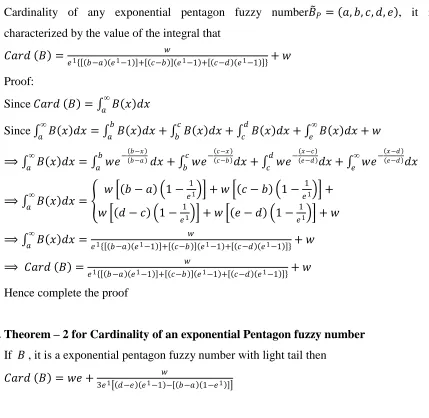
Cardinality of any exponential pentagon fuzzy number𝐵 𝑃 = 𝑎, 𝑏, 𝑐, 𝑑, 𝑒 , it is
characterized by the value of the integral that
𝐶𝑎𝑟𝑑 𝐵 = 𝑤
𝑒1 𝑏−𝑎 𝑒1−1 + 𝑐−𝑏 𝑒1−1 + 𝑐−𝑑 𝑒1−1 + 𝑤
Proof:
Since 𝐶𝑎𝑟𝑑 𝐵 = 𝐵 𝑥 𝑑𝑥𝑎∞
Since 𝐵 𝑥 𝑑𝑥𝑎∞ = 𝐵 𝑥 𝑑𝑥𝑎𝑏 + 𝐵 𝑥 𝑑𝑥𝑏𝑐 + 𝐵 𝑥 𝑑𝑥𝑐𝑑 + 𝐵 𝑥 𝑑𝑥𝑒∞ + 𝑤
⟹ 𝐵 𝑥 𝑑𝑥𝑎∞ = 𝑤𝑒−
𝑏−𝑥 𝑏−𝑎
𝑏
𝑎 𝑑𝑥 + 𝑤𝑒
− 𝑐−𝑥 𝑐−𝑏 𝑑𝑥 𝑐
𝑏 + 𝑤𝑒
− 𝑒−𝑑 𝑥 −𝑐 𝑑𝑥 𝑑
𝑐 + 𝑤𝑒
− 𝑥 −𝑑 𝑒−𝑑 𝑑𝑥
∞
𝑒
⟹ 𝐵 𝑥 𝑑𝑥𝑎∞ = 𝑤 𝑏 − 𝑎 1 −
1
𝑒1 + 𝑤 𝑐 − 𝑏 1 −
1 𝑒1 +
𝑤 𝑑 − 𝑐 1 − 1
𝑒1 + 𝑤 𝑒 − 𝑑 1 −
1
𝑒1 + 𝑤
⟹ 𝐵 𝑥 𝑑𝑥𝑎∞ = 𝑤
𝑒1 𝑏−𝑎 𝑒1−1 + 𝑐−𝑏 𝑒1−1 + 𝑐−𝑑 𝑒1−1 + 𝑤
⟹ 𝐶𝑎𝑟𝑑 𝐵 = 𝑤
𝑒1 𝑏−𝑎 𝑒1−1 + 𝑐−𝑏 𝑒1−1 + 𝑐−𝑑 𝑒1−1 + 𝑤
Hence complete the proof
3.10.Theorem – 2 for Cardinality of an exponential Pentagon fuzzy number
If 𝐵 , it is a exponential pentagon fuzzy number with light tail then
𝐶𝑎𝑟𝑑 𝐵 = 𝑤𝑒 + 𝑤
3𝑒1 𝑑−𝑒 𝑒1−1 − 𝑏−𝑎 1−𝑒1
Proof:
Since 𝐶𝑎𝑟𝑑 𝐵 = 𝑤
𝑒1 𝑏−𝑎 𝑒1−1 + 𝑐−𝑏 𝑒1−1 + 𝑐−𝑑 𝑒1−1 + 𝑤 (By theorem – 1)
Since the Exponential fuzzy number with light tail we have
𝐶𝑎𝑟𝑑 𝐵 = 𝑤𝑒 +1
3 𝐵 𝑥 𝑑𝑥
∞
𝑒 − 𝐵 𝑥 𝑑𝑥
𝑏
© Associated Asia Research Foundation (AARF)
A Monthly Double-Blind Peer Reviewed Refereed Open Access International e-Journal - Included in the International Serial Directories.
Page | 18
⟹ 𝐶𝑎𝑟𝑑 𝐵 = 𝑤𝑒 +1
3 𝑤𝑒
− 𝑥 −𝑑 𝑐−𝑑 𝑑𝑥
∞
𝑒 − 𝑤𝑒
− 𝑏−𝑥 𝑏−𝑎 𝑑𝑥 𝑏
𝑎
⟹ 𝐶𝑎𝑟𝑑 𝐵 = 𝑤𝑒 +1
3 𝑤 𝑒 − 𝑑 1 − 1
𝑒1 − 𝑤 𝑏 − 𝑎 1 −
1 𝑒1
⟹ 𝐶𝑎𝑟𝑑 𝐵 = 𝑤𝑒 + 𝑤
3𝑒1 𝑑−𝑒 𝑒1−1 − 𝑏−𝑎 1−𝑒1
Hence complete the proof
3.11.Proposed Approach
In this section we explain some important results by using one Numerical Example of
Fuzzy Assignment Problem solving by using the Concepts of Cardinality of Exponential
Pentagon Fuzzy Number we will get Very Useful Important Result that is mostly useful
for the proposed approach is proved
3.12. Numerical Example for Proposed Approach
Solve the following assignment problem of minimal cost by using above proposed
approach method
𝐵 =
0.2, 0.5, 0.3, 0.4, 0.1; 0.35 0.1, 0.2, 0.3, 0.5, 0.6; 0.21 0.1, 0.2, 0.3, 0.5, 0.6; 0.4 0.1, 0.2, 0.3, 0.4, 0.6, ; 0.51
0.1, 0.3, 0.4, 0.5, 0.6; 0.2 0.2, 0.4, 0.6, 0.8, 0.9; 0.5 0.2, 0.3, 0.5, 0.4, 0.1; 0.1 0.1, 0.2, 0.4, 0.1, 0.7; 0.5
0.2, 0.3, 0.5, 0.4, 0.1; 0.1 0.3, 0.4, 0.5, 0.6, 0.7; 0.28 0.2, 0.4, 0.7, 0.75, 0.8; 0.39
0.1, 0.2, 0.4, 0.6, 0.7; 0.3
0.1, 0.2, 0.3, 0.5, 0.6; 0.4 0.1, 0.15, 0.2, 0.25, 0.6; 0.48 0.1, 0.15, 0.2, 0.25, 0.6; 0.48 0.1, 0.2, 0.3, 0.4, 0.6, 0.25
Solution:
Since by theorem – 2, we have 𝐶𝑎𝑟𝑑 𝐵 = 𝑤𝑒 + 𝑤
3𝑒1 𝑑−𝑒 𝑒1−1 − 𝑏−𝑎 1−𝑒1
And also we have 𝐵 = 𝑏11 𝑏21 𝑏31 𝑏41 𝑏12 𝑏22 𝑏32 𝑏42 𝑏13 𝑏23 𝑏33 𝑏43 𝑏14 𝑏24 𝑏34 𝑏44 For example:
Let 𝑏11 = 0.2, 0.5, 0.3, 0.4, 0.1; 0.35 , in this case we have
𝑎 = 0.2, 𝑏 = 0.5, 𝑐 = 0.3, 𝑑 = 0.4, 𝑒 = 0.1 𝑎𝑛𝑑 𝑤 = 0.35 𝑤𝑖𝑡ℎ 𝑒1 ≈ 2.72
© Associated Asia Research Foundation (AARF)
A Monthly Double-Blind Peer Reviewed Refereed Open Access International e-Journal - Included in the International Serial Directories.
Page | 19
⟹ 𝐶𝑎𝑟𝑑 𝑏11 = 0.35 × 0.3 + 0.35
3×2.72 0.4−0.1 2.72−1 − 0.5−0.2 1−2.72
⟹ 𝐶𝑎𝑟𝑑 𝑏11 = 0.06
Similarly we can calculate
𝐶𝑎𝑟𝑑 𝑏12 = 0.07; 𝐶𝑎𝑟𝑑 𝑏13 = 0.04 𝑎𝑛𝑑 𝐶𝑎𝑟𝑑 𝑏14 = 0.1
𝐶𝑎𝑟𝑑 𝑏21 = 0.07; 𝐶𝑎𝑟𝑑 𝑏22 = 0.27, 𝐶𝑎𝑟𝑑 𝑏23 = 0.12 𝑎𝑛𝑑 𝐶𝑎𝑟𝑑 𝑏24 = 0.05
𝐶𝑎𝑟𝑑 𝑏31 = 0.12; 𝐶𝑎𝑟𝑑 𝑏32 = 0.04, 𝐶𝑎𝑟𝑑 𝑏33 = 0.26 𝑎𝑛𝑑 𝐶𝑎𝑟𝑑 𝑏34 = 0.05
𝐶𝑎𝑟𝑑 𝑏41 = 0.03; 𝐶𝑎𝑟𝑑 𝑏42 = 0.2, 𝐶𝑎𝑟𝑑 𝑏43 = 0.16 𝑎𝑛𝑑 𝐶𝑎𝑟𝑑 𝑏44 = 0.15
⟹ 𝐶𝑎𝑟𝑑 𝐵 = 𝐶𝑎𝑟𝑑 𝑏11 𝑏21 𝑏31 𝑏41
𝑏12 𝑏22 𝑏32 𝑏42
𝑏13 𝑏23 𝑏33 𝑏43
𝑏14 𝑏24 𝑏34 𝑏44
⟹ 𝐶𝑎𝑟𝑑 𝐵 = 0.06 0.07 0.12 0.03
0.07 0.27 0.04 0.2
0.04 0.12 0.26 0.16
0.1 0.05 0.05 0.15
Using Row Reduction and Column Reduction Operations by the following rules
a. In the effectiveness matrix, subtract the minimum element of each row from all the
elements of the row.
b. See if there is at least one zero in each row and in each column. If it is so, stop here
that is
c. Subtract the minimum element of the column not containing a zero element from all
the elements of the column
Following these above three rules we get the results, that is,
In the first row the minimum element is 0.04
In the second row the minimum element is 0.05
In the third row the minimum element is 0.04
In the fourth row the minimum element is 0.03 and then subtract each minimum element
© Associated Asia Research Foundation (AARF)
A Monthly Double-Blind Peer Reviewed Refereed Open Access International e-Journal - Included in the International Serial Directories.
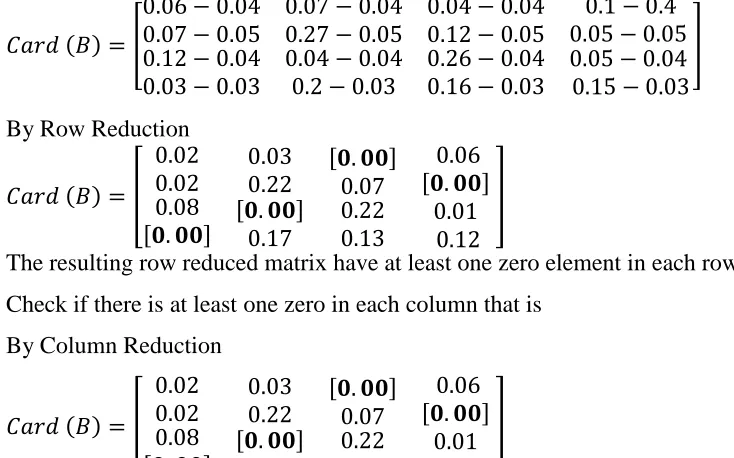
Page | 20 𝐶𝑎𝑟𝑑 𝐵 =
0.06 − 0.04 0.07 − 0.05 0.12 − 0.04 0.03 − 0.03
0.07 − 0.04 0.27 − 0.05 0.04 − 0.04 0.2 − 0.03
0.04 − 0.04 0.12 − 0.05 0.26 − 0.04 0.16 − 0.03
0.1 − 0.4 0.05 − 0.05 0.05 − 0.04 0.15 − 0.03
By Row Reduction
𝐶𝑎𝑟𝑑 𝐵 = 0.02 0.02 0.08 𝟎. 𝟎𝟎 0.03 0.22 𝟎. 𝟎𝟎 0.17 𝟎. 𝟎𝟎 0.07 0.22 0.13 0.06 𝟎. 𝟎𝟎 0.01 0.12
The resulting row reduced matrix have at least one zero element in each row
Check if there is at least one zero in each column that is
By Column Reduction
𝐶𝑎𝑟𝑑 𝐵 = 0.02 0.02 0.08 𝟎. 𝟎𝟎 0.03 0.22 𝟎. 𝟎𝟎 0.17 𝟎. 𝟎𝟎 0.07 0.22 0.13 0.06 𝟎. 𝟎𝟎 0.01 0.12
Therefore stop the iteration here, because row reduction and column reduction matrices
in each row and in each column they have only one zero element.
Examine the Row Reduction or Column Reductions for single 𝟎. 𝟎𝟎 and any other
zeros in their column or row respectively.
Now the rules of Assignment problem there may no row and no column without
assignment that is there is one assignment can be made in the current solution that is the
current feasible solution is an optimal solution
Now we have Optimal Minimal Cost is
[image:9.612.105.472.39.268.2]𝑏13× 1 + 𝑏24× 1 + 𝑏32× 1 + 𝑏42× 1 = 0.04 + 0.05 + 0.04 + 0.03 = 0.16 Units That is 𝐶𝑎𝑟𝑑 𝐵 = 0.16 Units
Table for Comparison of Assignment Problem Solving through Ranking with Different Approach for Same Numerical Example
Approaches Researchers
Results for Ranking using
Assignment Problem
Ranking of Generalized Trapezoidal Fuzzy
Numbers
AmithKumar, P.Singh A. Kaur
(2010) et. al
𝑅 𝐵 = 0.23
A new method for Ranking in Perimeters of two
© Associated Asia Research Foundation (AARF)
A Monthly Double-Blind Peer Reviewed Refereed Open Access International e-Journal - Included in the International Serial Directories.
Page | 21
A new Method for Ranking area in two
Generalized Trapezoidal Fuzzy Numbers
Salim Rezvani, M. Molani, and M.
Ebrahimi (2013) et.al. 𝑅 𝐵 = 0.2
Ranking Exponential Fuzzy Numbers by
Median Value
Salim Rezvani (2014) et.al 𝑅 𝐵 = 1
Proposed Approach
Ranking Pentagon Exponential Fuzzy Numbers
By Cardinality concepts Approach
Prof. A. N. Mohamad,
Gebreheiwot and Olana Abu
(2018)
𝑹 𝑩 = 𝟎. 𝟏𝟔
4. Result Discussion and Conclusion
In this article we choose assignment problem with fuzzy cost coefficient, for the uncertainties
factors in real life situations are presented as fuzzy pentagon numbers and we evaluate
cardinality concept. We convert the value ranking pentagon exponential fuzzy numbers by
cardianlity fuzzy pentagon numbers for fuzzy cost coefficients by using row reduction and
column reduction algorithm to solve assignment problem. We also compare our result with
other scholars what they done in solving fuzzy assignment problem. If any scholars need to
improve their result to get improve solution by using other ranking functions with different
ideas. Method other than row reduction and column reduction can also be used to solve
assignment problem, but using Fuzzification numbers or fuzzy variables might be more
effective to find better solution in fuzzy form.
5. References
1. Amith Kumar, Singh, P. Kaur, A, Kaur, P. RM approach for ranking of generalized fuzzy numbers, Fuzzy Information and Engineering, 2(1), pp: 37 – 47, 2010
2. Bortolan, G. Degani, R. A review of some methods for ranking fuzzy subsets, Fuzzy Sets and Systems 15(1), pp: 1 – 19, 1985
3. Chen, S. J. Chen, S. M, Fuzzy risk analysis based on the ranking of generalized trapezoidal fuzzy numbers, Applied Intelligence, 26, pp: 1 – 11, 2007.
4. Salim Rizwani, Graded Mean Representation method with triangular fuzzy numbers. Applied sciences 11(7), pp: 871 – 876, 2010.
© Associated Asia Research Foundation (AARF)
A Monthly Double-Blind Peer Reviewed Refereed Open Access International e-Journal - Included in the International Serial Directories.
Page | 22
6. Salim Rizwani, A new method for ranking in Perimeters of two generalized Trapezoidal Fuzzy Numbers A, Journal Physical Sciences, 16, pp: 45 – 57, 2012
7. Salim Rizwani, Moloni M. Ibrahimi, M. A new method for Ranking in areas of two generalized Trapezoidal fuzzy numbers, International Journal of fuzzy logic systems, 3(1), pp: 17 – 24, 2013
8. Salim Rizwani, Ranking Exponential Trapezoidal fuzzy numbers by Median value, Journal Physical Sciences, 5(3), pp: 515 - 523 – 26, 2014