A FRAMEWORK OF METHODS CLASSIFICATION FOR
MULTIPARTITE ENTANGLEMENT
1 SITI MUNIRAH MOHD, 2 BAHARI IDRUS, 3MURIATI MUKHTAR, 4HISHAMUDDIN
ZAINUDDIN
1,2
Industrial Computing Research Group, Faculty of Information Science and Technology, Universiti Kebangsaan Malaysia, 43600 Bangi, Selangor, Malaysia.
3
Center for Software Technology and Management, Faculty of Information Science and Technology, Universiti Kebangsaan Malaysia, 43600 Bangi, Selangor, Malaysia.
4
Laboratory of Computational Sciences and Mathematical Physics, Institute for Mathematical Research, University Putra Malaysia, 43400 UPM Serdang, Selangor, Malaysia.
E-mail: [email protected], [email protected], [email protected], [email protected]
ABSTRACT
Multipartite entanglement study carried out after bipartite entanglement as multipartite has a structure that is more useful for processing data in quantum information. In entanglement, two major studies were often focus is the measurement and classification of entanglement. Since a lots of measurements have been used to detect and quantify the entanglement in multipartite but it cannot distinguish the state specifically hence the classification is used to discriminate the state easily. Therefore, this study investigated the methods of classification of selected published works. This paper aims to recognize and describe the type of methods used by those works. As a result, a conceptual framework for classifying the multipartite entanglement was proposed based on previous works. This paper is expected to provide other alternative methods for classification.
Keywords: Multipartite Entanglement, Entanglement Measurement, Classification of Multipartite Entanglement, Local Unitary (LU), Stochastics Local Operations And Classical Communication (SLOCC)
1. INTRODUCTION
Entanglement nowadays becomes more important since fast development in quantum sciences especially in quantum information. Entanglement is a quantum correlation that exhibits the characteristics of nonlocal between two or more particles without considering the distance between them[1]. It plays crucial role in many fields in quantum information such as quantum teleportation[2], quantum cryptography[3, 4] and quantum computation[5].
Therefore one of the main objectives in the quantum theory of information to understand the non-local (entanglement) properties of the quantum states. This can done through the measurement and classification of entanglement. These both play a role complementary to each other. However, in bipartite entanglement especially pure states, measurement[6] and classification already complete[4] since it just involves with two qubit and only consider entangled states and separable states. Despite in
multipartite entanglement there are still issues that cannot be resolved due to it complex structure that very restrict[7, 8].
Measurement of entanglement used to identify either the state is separable or entangled. In addition, the measurement can also determine the strength of entanglement in each state. Mostly measurement in multipartite is extended from bipartite entanglement since the measurement in multipartite quite complicated to resolve[9].
operations and classical communication (SLOCC).
Several research[11, 12] have classified tripartite entanglement based on LU concept. In another way, other research[13] have classified the states under SLOCC concept. The LU concepts is the optimum classification[14] compare other classification. This classification become more complicated because the number of parameter local invariants increased rapidly due to the increment number of qubit. Hence, it is difficult to classify the states exactly since the richer structure of multipartite entanglement[9]. Besides, LU concepts not preserve the characteristics of entanglement for all condition[15] and some of the states exist in multipartite is not in LU equivalence classes[16]. According to LU issues, most of research shift to SLOCC concept to make the classification become simpler[14] since an invertible local operator (ILO) exist in SLOCC. The dissimilarity between LU (LOCC) and SLOCC can be described by mathematics notation as follows[17]: the two state are SLOCC equivalent if it can be transform by LOCC with non-zero probability. The two pure states ψ
and φ are in the n-partite of Hilbert space
1 2
n
n
Η = Η ⊗ Η ⊗L⊗ Η are LOCC equivalent if and only if (iff) it can be transform by LU[18],
1 2 n
U U U
ψ = ⊗ ⊗L⊗ φ
(1)
with U1⊗U2⊗L⊗Un are LU operators while
if ψ and φ are SLOCC equivalent, then there exist ILO relating them[19],
(1) (2) ( )n
F F F
ψ = ⊗ ⊗L⊗ φ
(2)
where F(1)⊗F(2)⊗L⊗F( )n are ILOs respectively represented by matrix vector.
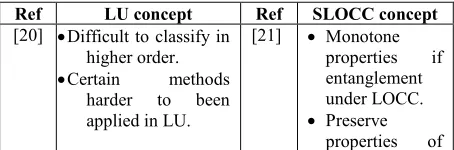
Table 1 below summarized the criteria between LU concept and SLOCC concept.
Table 1: Criteria of LU concept and SLOCC concept.
Ref LU concept Ref SLOCC concept
[20] • Difficult to classify in higher order. • Certain methods
harder to been applied in LU.
[21] • Monotone properties if entanglement under LOCC. • Preserve
properties of
entanglement. [15] Not preserve the
criteria of entanglement [4] Interconvertability.
[14] Finest classification for quantum entanglement.
[22] More easy to classify compare to LU.
[19] Particular case of SLOCC case.
[23] Used
ILO to perform the
transformation.
This research aims to determine the types of methods of classification used in several previous works based on LU concept and SLOCC concept and to propose a new framework of method classification on operational method. This study is expected to provide an alternative method of classification for multipartite entanglement. The new classification based on SLOCC is extended from LU concept with same basis provide a new approach to classify the states in multipartite entanglement.
The structure of the paper is as follow. In section 2, we describe the methodology used by using several search engines and specific keywords to determine the types of methods used in previous work. Section 3 discusses in detail a list of method classifications based on the LU concept and SLOCC concept and basis used for each. As a result, we have developed a framework to summarize the results from previous works and proposed a new framework for classification of multipartite entanglement. Lastly, in section 4, the conclusion for final findings for future research objectives.
2. METHODOLOGY
The classification for multipartite entanglement is intended to distinguish the state to the exact type either it fully separable state, biseparable state or genuine entangled state. In this research, all literature is secondary resources that indexed in Scopus, ProQuest, Springer, Sage journals and Association for computing Machinery (ACM) by using several keyword namely classification, multipartite and
[image:2.612.76.303.650.725.2]concept as the base of classification but with different method that used.
The facts from the previous work in all literatures were scrutinized in order to determine the particular method that used to classify the state in multipartite entanglement. Document analysis has been done for these methods. The analysis is organized in order from year 2000 till year 2014 by using Microsoft Word 2013. The result from this analysis is explained in the following sections. Henceforth, the conceptual framework for classification of multipartite entanglement was later designed and proposed results of the analysis from the previous works.
3. RESULTS AND DISCUSSION
This section discusses the result from document analysis that comprises methods that has been used. Following that, conceptual framework is proposed.
3.1 Methods Used in Previous Works
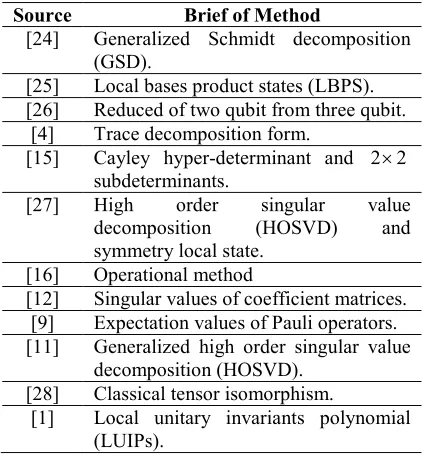
[image:3.612.318.527.271.735.2]Table 2 shows the methods of classification used in previous works base on LU concept.
Table 2: Methods of Classification by LU concept.
Source Brief of Method
[24] Generalized Schmidt decomposition (GSD).
[25] Local bases product states (LBPS). [26] Reduced of two qubit from three qubit.
[4] Trace decomposition form.
[15] Cayley hyper-determinant and 2 2×
subdeterminants.
[27] High order singular value decomposition (HOSVD) and symmetry local state.
[16] Operational method
[12] Singular values of coefficient matrices. [9] Expectation values of Pauli operators. [11] Generalized high order singular value
decomposition (HOSVD). [28] Classical tensor isomorphism.
[1] Local unitary invariants polynomial (LUIPs).
Based on Table 2, there was determined twelve methods of classification used under the LU concept. Some of the method is generalized from other method with the addition of variable or modification of the constraint that has been
used to make the existence method become easier to compute. Classification by LU concept is limited to tripartite entanglement (three qubits) since LU too restrict and not appropriate to extend in multipartite with n>4[29]. Whereas, Table 3 depicts the methods using SLOCC. Same as LU concept, the methods used to classify the states by SLOCC concept also generalized from existence method to a new methods that has been done with modification.
Table 3: Methods of Classification by SLOCC concept.
Source Brief of Method
[19] Invertible local transformation.
[30] Measurement of concurrence in
group theory.
[31] Duality of set separable state and
entangled state.
[32] Hyperdeterminant and singular value.
[21] Algebra equivalence and Legendre
transformation.
[33] Five-graded partially order structure.
[34] Singular value decomposition of
coefficient matrices.
[35] Amplitudes of states for matrix
equation.
[36] Equivalence-SLOCC (SEB).
[37] Freudenthal triple system (FTS).
[38] Reduced bipartite operator density.
[39] Rank of the coefficient matrices for
n-qubit.
[8] Locally ratio for homogen
polynomial.
[40] Asymptotic setting using the concepts
of degeneration and border rank of
tensor from algebraic complexity
theory.
[17] Rank of the coefficient matrix and
[image:3.612.83.296.436.664.2][41] Freudenthal triple system (FTS)
specific to certain state.
[13] Rank of the coefficient matrix for
arbitrary dimension.
Based on Table 2 and Table 3, there are a lot of method used to classify the state in both concepts. Generalized Schmidt decomposition [24] method and method LBPS[25] slightly same since both method is a straight forward generalization of product states that can be extended from bipartite case to tripartite case. Methods[1, 4] used local polynomial invariants as a main tool to classify the state because absolute value used to measure genuine multipartite entanglement. Method[1] can be implement in SLOCC concept to form special linear group (SLIPs) [8] that is constitute subset to LUIPs. Different with LIUPs, SLIPs, implement Schur-Weyl duality formula and can classify all classes of SLOCC.
Concurrence measure be used in some methods that are operational method [16], Cayley hyperdeterminant and 2 2×
subdeterminants[15], duality of set separable state and entangled state[31] and hyperdeterminant and singular value[32]. All these methods easily to compute in bipartite entanglement compare tripartite entanglement since it need additional variables to compute the measurement. Since local rank are not sufficient to discriminate the classes in higher order, concurrence measure used to simplify the classification of the state. Since method of Cayley hyperdeterminant does not describe exactly the properties of entanglement in the state, then classical tensor isomorphism method proposed to overcome the constraint. This method appliance Bourbaki approach of determining the rank of a vector in linear mapping[28].
The two methods slightly difference with other methods that reference in table as using separability criteria aid by positive partial transpose (PPT) as a tool to classify the state which expectation values of Pauli operators[9] and reduced bipartite operator density[38]. Even though the PPT criteria actually used in bipartite state but it can be generalized to multipartite pure state either theoretically or experimentally. Several methods[21, 36, 37, 41] used algebra concept such as algebra equivalence Jordan algebra and enumerative combinatoric to
differentiate the states.
Methods using coefficient matrix approach whether in term of singular value[11, 12, 27, 34] or the rank of the coefficient[13, 17, 39] have their own capability to distinguish the state. However, rank of coefficient easier to computer compare singular value operationally. Besides, rank of coefficient methods often used in SLOCC concept meanwhile singular value in LU concept. These all methods can be extended to mixed states.
Other methods just used standard methods such as local transformation[19], matrix equation[35] and reduction of three qubits[26] to classify the state.
Graph in Figure 1 depicted frequency of basis used in the selected previous works based on LU concept and SLOCC concept. For LU concept, basis with the lowest frequency is linear group (1 frequency) meanwhile the highest frequency is coefficient of canonical form (6 frequencies). Also for SLOCC concept, the lowest with one frequency are Schmidt decomposition, rank of coefficient matrix and asymptotic measure. Basis of special linear group is the highest frequency with value of six.
Figure 1: The Frequency of Methods Used based on basis for Classification in Multipartite
Entanglement
Based on the Figure 1, the most common basis used in LU concept is coefficient of canonical form but restrict to tripartite entanglement (3 qubits). The canonical form is[25]
, j,k ijk i
t ijk
where
A B c
ijk ≡ i ⊗ j ⊗ k with ,A Band C
are generic state shared by three parties. Differ in SLOCC concept, basis of special linear group with algebra concept represented by set of SL -invariant polynomial (SLIP)[8] in Hilbert space that shown in equation below
: n f Η →
that satisfies f(gψ )= f(ψ )
(4)
with ∀ ∈g G and ∀ψ ∈ Ηnwhere ψ
represent the state.
Each basis used has their own criteria that valid to certain classification to make the classification easier. Some of them cannot be used in higher dimension that involve more than 3 qubits since the computation become more complex in rich structure. Although the method can be implement in higher dimension, the states is partitioning to two qubits.
3.2 The Framework for Classification of Multipartite Entanglement
In designing a framework, the requirement in each concept has been identified to differentiate the feature between it. It is important since two concepts relate to each other.
Figure 2: The Framework of Classification of Multipartite Entanglement
Figure 2 above illustrate the framework of a classification for multipartite entanglement that summarizes all the methods used according to LU concept and SLOCC concept.
The domain of this research is quantum entanglement with a focus on the classification of multipartite entanglement (focus on tripartite entanglement). Classification of tripartite
M
E
T
H
O
D
S
:
S
LO
C
C
C
O
N
C
E
P
T
• Local inverse transformation
• Duality of set separable state and entangled
state
• Matrix equation and amplitudes of states
• Measurement of concurrence in group
theory
• Hyperdeterminant and singular value
• Local distillation operation
• Equivalence-SLOCC (SEB)
• Inductive method for qubit
• Reduced bipartite operator density
• Freudenthal triple system (FTS)
• Locally ratio for invariants homogen
polynomial
• Rank of the coefficient matrices
• Classification LU and SLOCC
Same operational method based on SLOCC concept from LU concept
• Local bases product states (LBPS)
• Local polynomial invariant
• Reduced of two qubit from three qubit
• Operational Method
• High order singular value decomposition
(HOSVD) and symmetry local state.
• Generalized high order singular value
decomposition (HOSVD)
• Invariant set in singular value for matrix
coefficient in pure state.
• Local unitary invariants polynomial (LUIPs).
• Cayley hyper-determinant and
subdeterminants.
• Set of invariants in terms of singular values
of coefficient matrices.
• Expectation values of Pauli operators.
M
E
T
H
O
D
S
:
LU
C
O
N
C
E
P
entanglement concepts divided to LU and SLOCC. Each method has been reviewed to understand the way of classification with respect to both LU and SLOCC concepts. Since measurement is one way to detect entanglement in a given state, therefore we analyzed methods that are related to measurement.
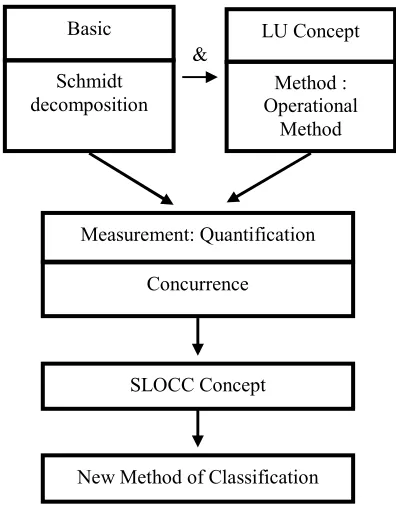
[image:6.612.92.290.224.478.2]Resulted from Figure 2, Figure 3 indicates the proposed framework of new classification for multipartite entanglement.
Figure 3: The Propose Framework of Classification of Multipartite Entanglement
Based on Figure 3, the research focuses deeper into tripartite entanglement. From the seven basis shown in Figure 1, the basis of Schmidt decomposition has been selected in this research because it is a very useful tool to detect entanglement with various application[23]. Alternatively, Schmidt decomposition will quantifies the level of degree of entanglement in quantum systems[7]. Schmidt decomposition basis for tripartite level can take two states orthogonal as a product in one parameter of the entanglements of the local basis. Since LU concept is a special case for SLOCC concept, the basis Schmidt decomposition is extended to SLOCC concept[19]. Operational method has been chosen to classify the state of tripartite entanglement since classification of LU classes
using operational method is not widely studied[16]. In this method, the measurement of concurrence used to classify the state as concurrence can be extended from bipartite entanglement to tripartite entanglement[42]. The combination between Schmidt decomposition and operational method by LU concept propose new classifications to identify whether the basis and methods used in the LU can be extended to SLOCC easily. This is because SLOCC concept has ILO criteria that facilitate the calculation and make it simpler. It is therefore expected that the new classification is given in a different way to classify the state of tripartite entanglement whereas in previous work, this classification has not been done by SLOCC concept.
4. CONCLUSION
The proposed framework propose a new method of classification in multipartite entanglement into a specific class of the state in multipartite entanglement based on SLOCC concept.
There is further research that needs to be done to create a model of classification based on the proposed framework and to test the effectiveness of the model compared to existing models to determine the capability of the new model to classify the state in multipartite entanglement.
ACKNOWLEDGEMENTS
This work is supported by the research grant provided by Malaysian Ministry of Higher Education code: FRGS/1/2011/SG/UKM/03/5 and ERGS/1/2013/ICT 07/UKM/02/2.
REFRENCES:
[1] Yu, N., Qiao, Y., & Sun, X., Characterization of multipartite entanglement, arXiv: quant-ph/1401.2627v1, 2014.
[2] Ryszard, H., Paweł, H., Michał, H., & Karol, H., Quantum entanglement, Reviews of Modern Physics, Vol. 81, No. 2, 2009, pp. 865-942.
[3] Bruss, D., Erdelyi, G., Meyer, T., Riege, T., & Rothe, J., Quantum cryptography: a survey, ACM Computing Surveys, Vol. 39, No. 2, 2007.
[4] Kraus, B., Local unitary equivalence and entanglement of multipartite pure states, Basic
Schmidt decomposition
&
LU Concept
Method : Operational
Method
SLOCC Concept
New Method of Classification Measurement: Quantification
Physical Review A, Vol.82,No. 3, 2010, pp. 032121.
[5] Raussendorf, R., & Briegel, H. J., A One-Way Quantum Computer, Physical Review Letters, Vol. 86, No. 22, 2001, pp. 5188-5191.
[6] Siti Munirah, M., Bahari, I., & Muriati, M.,
Separability criteria and method of
measurement for entanglement, AIP
Conference Proceedings, 2014, Vol. 1602, pp. 246-253.
[7] Chuang, I. L., & Neilsen, M. A. (2000).
Quantum Computation and Quantum Information. United Kingdom: Cambridge University Press.
[8] Gour, G., & Wallach, N. R., Classification of multipartite entanglement in all dimensions, arXiv:quant-ph/1304.7259v3, 2013.
[9] Zhao, M.-J., Zhang, T.-G., Li-Jost, X., & Fei,
S.-M., Identification of three-qubit
entanglement, Physical Review A, Vol. 87, No. 1, 2013, pp. 012316.
[10] Siti Munirah, M., Bahari, I., Muriati, M., &
Hishamuddin, Z. (2014). Pengukuran
keterbelitan multipartit: pengesanan dan pengkuantitian. CAIT-IC-2014-2. Technical report. Industrial Computing Research Group,
Faculty of Information Science and
Technology. Universiti Kebangsaan
Malaysia.
[11] Jun-Li, L., & Cong-Feng, Q., Classification of arbitrary multipartite entangled states under local unitary equivalence, Journal of Physics A: Mathematical and Theoretical, Vol.46,No. 7, 2013, pp. 075301.
[12] Zhang, T.-G., Zhao, M.-J., Li, M., Fei, S.-M., & Li-Jost, X., Criterion of local unitary equivalence for multipartite states, Physical Review A, Vol.88,No. 4, 2013, pp. 042304. [13] Shuhao, W., Yao, L., Jianlian, C., Junlin,
L., & Gui-Lu, L., Entanglement classification of arbitrary-dimensional multipartite pure states under stochastic local opreations and classical communication via the ranks of the coefficient matrices, 12th Asia Pacific Physics Conference, Japan, 2014.
[14] Di, Y.-M., & Cao, Y., LU Invariants and Canonical Forms and SLOCC Classification of Pure 3-Qubit States, Communications in Theoretical Physics, Vol.45,No. 4, 2006, pp. 596.
[15] Allan, I. S., & Choon-Lin, H., Condition for tripartite entanglement, Journal of Physics: Conference Series, Vol. 343,No. 1, 2012, pp. 012114.
[16] De Vicente, J. I., Carle, T., Streitberger, C., & Kraus, B., Complete Set of Operational Measures for the Characterization of Three-Qubit Entanglement, Physical Review Letters, Vol.108,No. 6, 2012, pp. 060501.
[17] Shuhao, W., Yao, L., Ming, G., Jianlian, C., & Junlin, L., Classification of arbitrary-dimensional multipartite pure states under stochastic local operations and classical communication using the rank of coefficient matrix, Journal of Physics A: Mathematical and Theoretical, Vol. 46, No. 10, 2013, pp. 105303.
[18] Bennett, C. H., Popescu, S., Rohrlich, D., Smolin, J. A., & Thapliyal, A. V., Exact and asymptotic measures of multipartite pure-state entanglement, Physical Review A, Vol. 63,No. 1, 2000, pp. 012307.
[19] Dür, W., Vidal, G., & Cirac, J. I., Three qubits can be entangled in two inequivalent ways, Physical Review A, Vol. 62, No. 6, 2000, pp. 062314.
[20] Zhang, T.-G., Zhao, M.-J., Li-Jost, X., & Fei, S.-M., Local Unitary Invariants for Multipartite States, International Journal of Theoretical Physics, Vol.52,No. 9, 2013, pp. 3020-3025.
[21] Miyake, A., Multipartite entanglement under stochastic local operations and classical communication, Int. J. Quantum Inf., Vol.02, No. 01, 2004, pp. 65-77.
[22] Eltschka, C., & Siewert, J., Quantifying
entanglement resources, arXiv:
quant-ph/1402.6710v, 2014.
[23] Ranto, B. (2013). Quantum Entanglement.
Master, Masaryk University.
[24] Acín, A., Andrianov, A., Costa, L., Jané, E., Latorre, J. I., & Tarrach, R., Generalized Schmidt Decomposition and Classification of Three-Quantum-Bit States, Physical Review Letters, Vol.85,No. 7, 2000, pp. 1560-1563. [25] Acín, A., Andrianov, A., Jané, E., &
Tarrach, R., Three-qubit pure-state canonical forms, Journal of Physics A: Mathematical and General, Vol. 34, No. 35, 2001, pp. 6725-6739.
[26] Sabín, C., & García-Alcaine, G., A classification of entanglement in three-qubit systems, The european physical journal D, Vol.48,No. 3, 2008, pp. 435-442.
[27] Liu, B., Li, J.-L., Li, X., & Qiao, C.-F., Local Unitary Classification of Arbitrary Dimensional Multipartite Pure States,
[28] Solomon, A. I., Ho, C. L., & Duchamp, G. H. E., Degrees of entanglement for multipartite systems, Journal of Physics A: Mathematical and Theoretical, Vol. 46, No. 7, 2013, pp. 075302.
[29] Nengkun Yu, Cheng Guo, & Duan, R., Obtain W-state from GHZ-state with
symptotic rate 1, arXiv:
quant-ph/1309.4833v2, 2014.
[30] Verstraete, F., Dehaene, J., De Moor, B., & Verschelde, H., Four qubits can be entangled in nine different ways, Physical Review A, Vol.65,No. 5, 2002, pp. 052112.
[31] Miyake, A., & Wadati, M., Multipartite
entanglement and hyperdeterminants,
Quantum Info. Comput., Vol.2,No. 7, 2002, pp. 540-555.
[32] Miyake, A., Classification of multipartite
entangled states by multidimensional
determinants, Physical Review A, Vol. 67, No. 1, 2003, pp. 012108.
[33] Miyake, A., & Verstraete, F., Multipartite entanglement in 2 x 2x n quantum systems,
Physical Review A, Vol.69,No. 1, 2004, pp. 012101.
[34] Lamata, L., León, J., Salgado, D., & Solano, E., Inductive classification of multipartite entanglement under stochastic local operations and classical communication,
Physical Review A, Vol.74,No. 5, 2006, pp. 052336.
[35] Dafa, L., Xiangrong, L., Hongtao, H., & Xinxin, L., The simple criteria of SLOCC
equivalence classes, arXiv:
quant-ph/0604160v1, 2006.
[36] Chen, L., & Chen, Y.-X., Classification of
GHZ-type, W-type, and GHZ-W-type
multiqubit entanglement, Physical Review A, Vol.74,No. 6, 2006, pp. 062310.
[37] Borsten, L., Dahanayake, D., Duff, M. J., Rubens, W., & Ebrahim, H., Freudenthal
triple classification of three-qubit
entanglement, Physical Review A, Vol. 80, No. 3, 2009, pp. 032326.
[38] Hayashi, M., & Chen, L., Classification of pure tripartite states by reduced bipartite
densities, arXiv:quant-ph/1102.0439v2,
2011.
[39] Li, X., & Li, D., Classification of General
n-qubit states under stochastic local operations and classical communication in terms of the rank of coefficient matrix,
Physical Review Letters, Vol. 108, No. 18, 2012, pp. 180502.
[40] Vrana, P., & Christandl, M., Asymptotic entanglement transformation between W and GHZ states, arXiv:quant-ph:1310.3244v1, 2013.
[41] Borsten, L., Freudenthal ranks: GHZ
versus W, Journal of Physics A:
Mathematical and Theoretical, Vol. 46, No. 45, 2013, pp. 455303.