RECENT METHODS AND TECHNIQUES IN VIDEO
WATERMARKING AND THEIR APPLICABILITY TO THE
NEXT GENERATION VIDEO CODEC
1
M.F.L. ABDULLAH, 2ALI A. ELROWAYATI, 3AZIZAH ABD MANAF, 4ZAKARIA S. ZUBI
1,2
Faculty of Electrical and Electronic Engineering, Universiti Tun Hussein Onn Malaysia
3
Advanced Informatics School, Universiti Teknologi Malaysia, 54100 Kuala Lumpur, Malaysia
4Computer Science Department, Faculty of Science, Sirte University, Libya
E-mail: [email protected], 2,[email protected], [email protected]
ABSTRACT
High efficiency video coding (HEVC) is the newest video coding generation of the ITU-T and ISO/IEC, which first appeared in January 2013. It has the advantage of reducing the bit rate by as much as 50 % when compared to H.264 while maintaining the same visual quality. In the last decade, authentication and copyright protection methodologies have become one of the essential items in order to protect video contents by embedding within an efficient video codec. Thus, the objective of this paper is to revise recent developments in the area of watermarking techniques for video coding schemes and their applicability to the new Standard HEVC. The results of this study provide motivation to achieve a higher embedding capacity and higher compression performance for HEVC compared to H.264/AVC especially, for low bit-rate coding.
Keywords: Digital Watermarking, Hiding Data, Video Watermarking, Video Coding, HEVC
1. INTRODUCTION
This High-speed interactive network applications and recent technological achievements with a variety of end user entities have developed the manner in which digital data is distributed. A wide range of video applications, easy access to video content and the possibility to make unlimited copies without loss of considerable fidelity have motivated the need to protect this material. Consequently, in the last decade, video compression standards have been improved to provide more compressed data along with better visual quality resolution. As a result, providing a security method with higher efficiency coding is a priority demand. Video digital watermarking integrated with these standards is a technology that can serve this purpose. A large number of video watermarking techniques have been proposed to embed copyright marks and other information in digital video, which can later be extracted or detected.
Digital video is a sequence of still images or frames. However, video watermarking techniques need to meet other requirements than those required in image watermarking schemes, such as video coding technologies, redundancy between sequences of frames and some particular video
attacks [1]. In addition, video watermarking techniques that use coding structure techniques as a core component in the watermarking schemes are the primary target for the goal of integrating watermarking and compression to reduce the complexity of video watermarking processing. Therefore, integrating watermarking requires an optimal implementation of the watermarking framework at the encoder to reach that goal.
Despite the success of these video codecs such as MJPEG2000, MPEG-2 and H.264 for the video coding and video watermarking, a new standard known as HEVC [2] with higher compression efficiency, is poised to replace them. In addition, the HEVC digital video has become more widespread in different applications; therefore the industry will need appropriate methods to protect and secure their productions based on HEVC.
in video watermarking based on coding structures techniques. Basics of HEVC encoder are explained, and applicability of different watermarking techniques in HEVC is also described in this section. Finally, possible future research directions are discussed for optimizing the existing different watermarking techniques integrated with HEVC standard.
2. DIGITAL VIDEO WATERMARKING
2.1 Overview on Digital Watermarking
Digital watermarking has been presented as a key to the problem of copyright protection of multimedia data in the next generation networks [3]. Essentially, nowadays with a broad range of video applications, Multimedia transmissions over wireless channels and the Internet requires that multimedia resources must be protected. Thus, video coding integrated with digital watermarking techniques can be efficiently employed to achieve this goal. However, digital video watermarking has many aspects that must be considered during the design of any digital video watermark schemes such as imperceptibility, robustness, capacity, complexity, synchronization, bit-rate control and error drift [4] [5] [6] [7].
[image:2.595.300.512.74.249.2]A watermarking system consists of two main components: a watermark embedding unit and a watermark extracting unit as shown in Figure1. The embedding unit adds the watermark component to the host data. The output of the embedding unit is the watermarked data. Attackers intend to do one of the following illegal actions such as modifying, copying, destroying or removing the watermark from the host data.
Figure 1: Main Units of Watermarking
2.2 Video Watermarking Techniques
[image:2.595.87.285.540.601.2]According to the work of watermarking embedding, video watermarking techniques are divided into three main groups or classifications, namely spatial domain, frequency domain and bit-stream domain as shown in Figure 2. Each group applies different methods. In this section, a brief review is covered with the current video watermarking techniques based on their watermarking domain.
Figure 2: Classification Of Watermarking Techniques
2.2.1 Spatial domain watermarking
The spatial domain watermarking techniques embed the watermark by modifying the pixel positions or pixel values of the host video. The main advantages of using this technique are the small time complexities and simplicity of implementation. However, these techniques have some disadvantages in providing robustness and meeting imperceptibility requirements [8].
Many methods for developing watermark techniques in the spatial domain have been proposed such as the Least Significant Bit (LSB) and Spread Spectrum Signal Correlation (SSSC) techniques. In the LSB method, the host frame is used to insert the watermark. The positions of the pixels are modified by generating a pseudo-random number based on a secret key. Another method in the spatial domain is SSSC. This method is based on adding a pseudo-random noise pattern to the luminance value frames in the spatial domain, and the correlation between the noise pattern and possibly watermarked video for each frame is computed. If the correlation exceeds a certain threshold then, the watermark is detected [9].
2.2.2 Frequency domain watermarking
The majority of video watermarking techniques have been used in the frequency transform domain in order to overcome the main disadvantages of the spatial domain. Further, analysis of the bands in the frequency domain is a prerequisite to enhance watermark robustness and imperceptibility. However, these techniques have some disadvantages in terms of complexity.
• Discrete Fourier Transform: A Discrete
Fourier Transform (DFT) is performed on the original video data. The watermark is embedded in optimal selected frequency bands of the DFT. An inverse Discrete Fourier Transform is performed onto the watermarked frequency domain to reconstruct the watermarked video [10]. For example, in [11] the authors proposed a 3D DFT-based robust watermarking scheme in which the watermark is embedded in 3D DFT coefficient blocks of the video scene. This technique enhances the robustness of the watermarking scheme against some common attacks. However, due to the complexity factor, it would be difficult to realize practically. To solve this problem, the authors in [12] proposed a video watermarking method based on the 1D DFT and Radon transform and an adaptive embedding approach to reducing the complexity. However, due to security issues, it would not be resistant to some types of attacks. Elbasi et al. [13], proposed a watermarking scheme based on a stochastic process, the Hidden Markov Model (HMM), and Artificial Neural Networks (ANNs). The proposed scheme decomposed a visible watermark into sub-images and embedded them into video frames. The method used the HMM model to select the best time for embedding and applied it to a dependency among the different parts of the watermark. Meanwhile, the neural network decides the best transform domain for each frame. In the detection unit, the watermark is extracted, in the same way, as the embedding phase and compared with an individual threshold. If it is detected, then all the parts are combined to recreate the original watermark. This method is robust against attacks. However, the computational cost is high.
• Discrete Cosine Transform: The Discrete
Cosine Transform domain (DCT) is a very promising technique used in video coding and used in many watermarking schemes. In this subsection, some proposed methods are discussed. The first method presented is that proposed in [14], where the watermark is embedded in the low band that has the perceptually significant portion of the Human Visual System (HVS) in order to be resistant to the compression process. However, due to the capacity factor, it would be difficult to extend. In [4], the author proposed a watermarking scheme based on the motion vector technique in MPEG. The DCT coefficients for
intra-frame and non-intra-intra-frame are modified according to the values of the motion vectors. This method could achieve robustness against image cropping operations and MPEG compression. However, it is vulnerable to format conversion. In another study [15], an optimal H.264 watermarking scheme was proposed. The Practical Swarm Optimization (PSO) approach has been applied to find optimal integer DCT coefficients of the I-frame for embedding the watermarking information based on Dither modulation. As mentioned by the authors, the I-frame is a useful criterion for applying the embedding watermarking information, and also the PSO-based approach is used to reduce complexity.
• Discrete Wavelet Transform: The Discrete
improve video watermarking schemes by offering a generalized motion compensated 2D+t+2D framework for watermark embedding. As mentioned by the authors, the proposed method shows better embedding distortion in terms of PSNR and flicker(flicker is a perceptual attribute of displays) metric. Recent work Wang et al. [19] proposed a method based on two stages. Firstly, obtain one level of DWT on a block of DCT coefficients for the compressed video. Secondly, embed the watermark into histogram bins of frames in the one-level DWT domain. The video data is partially decoded to obtain block discrete cosine transform (DCT) coefficients, which are subsequently used to construct a one-level DWT. This method reduces the computational cost and meets the real-time requirement in the compressed domain [19]. Some recent methods have been proposed based on hybrid transforms such as the DWT and SVD in [20] or DWT, DFT and the Singular Value Decomposition DWT- DFT-SVD domain in [21]. In [21] The watermarked video is obtained by inserting the singular values of DWT+DFT transformed sub-bands into singular values of DWT+DFT transformed sub-bands of reduced video frames. The method applies the particle swarm optimization technique to identify the robust pixels into which the watermark is to be inserted. As mentioned by authors, the PSNR values for the watermarked video are between 45 dB and 50 dB and the maximum correlation resulted in 0.9998. However, the computational cost of this method is still high.
2.2.3 Bit-Stream domain watermarking
The watermark is embedded into the compressed video bitstream. The advantage of this technique the computational cost is low. However, the disadvantage is that the compressed bit-rate constrains the size of the watermarked data. The strength of the embedded watermark is limited by the error rate of the decoder side, and the embedding process is constrained by the coding standard and the video compression method. The authors in [5], presented a video stream by inserting the watermark in the least significant bit form of Variable Length Coding (VLC) entropy coding. Fridrich et al. [22], proposed a watermarking scheme for JPEG. This system works based on the LSB watermarking technique. The AC coefficients of the DCT are paired, and the watermark inserted in the least significant bits of individual bytes using VLC code based on a priority mode. These schemes
take advantage of the video compression standard without re-encoding and full decoding. They have less complexity and a higher capacity for embedding the watermark. However, their disadvantages are that the behavior with noisy channels is worse, and the watermark information can be corrupted by adding random bits in the VLC code.
2.3 Recent Developments in Video
Watermarking Based on the Coding Structure Technique
Video watermarking techniques that use the coding structure method, as an essential component in watermarking schemes are primarily targeted with the goal of integrating watermarking and compression standards. The integration is used to reduce the complexity of the video watermarking processing, and this integrated watermarking requires an optimal implementation of the watermarking framework for the encoder to reach the goal. In this section, the combined schemes of watermarking and compression standards are discussed by using recent development methods. Figure 3 at the end of the paper illustrates a generic system for video watermarking based on coding structure techniques [23].
2.3.1 Watermarking techniques for MPEG
robustness against image cropping operations and MPEG compression; however it is vulnerable to format conversion. Su et al. [6], proposed real-time video watermarking technique based on embedding data in a variable length coding (VLC) entropy coding for MPEG-2 with control of the bit-rate. In [26], an adaptive real-time video watermarking scheme is implemented by modifying the relations of equal quantization step DCT coefficient pairs. However, both methods are not robust against specific attacks, for example, downscaling and transcoding. In addition, these methods are not resistant enough against video processing attacks and geometric distortion attacks. Vassaux et al. [27], embeds the watermarking into quantized DCT coefficient blocks of MPEG4. This method modifies some predefined pairs of quantized DCT coefficient blocks based on spread-spectrum techniques. Dividing the frame into blocks of equal size, a binary sequence is generated using a secret key and then added to the frame [27]. Zhang et al. [28], proposed a video watermarking method based on Motion Vectors (MVs). According to the HVS quality measurement, the motion vector value is optimized to select the best value to embed the watermark information. Then, different watermarks are embedded in the various parts of the motion vector. This technique enhances the robustness of the watermarking scheme [28]. Yan et al. [29], implemented a watermarking technique based on the game of life approach to scrambling the MPEG-4 motion vector adaptively. This work makes the watermarking method and the video coding integrated, and they achieve robustness against a compressed attack [29].
2.3.2 Watermarking techniques for the H.264
The H.264 standard is the codec with the highest performance in video data compression. In contrast to MPEG-2, H.264 offers almost double the compression rate for the same video quality [30] [31]. There is a considerable amount of interesting literature on different watermarking techniques [31] [32], [33] [34], [35], [36], [37], [38], [15], [39], [7], [40], [41], and [42] for H.264. A watermarking can be implemented in DCT Coefficients, in the motion vectors, in the entropy-coded part, or in a combination of the above. However, most of the reliable and robust watermarking techniques are applied in the DCT domain only [32] because in DCT domain, the error introduced by watermarking is not propagated into other macroblocks [7]. The H.264 standard design has different scheme units from other previous video standards such as MPEG. Firstly, the DCT transform is applied on 4x4 blocks instead of 8x8 or 16x16 blocks.
Coding (CAVLC) is a mode in H.264, which is computationally less expensive with a drawback in compression performance. The Motion Vector Difference (MVD) and adaptive bit substitution methods have been applied to embed watermarking information in macroblocks that have changed in MVD. As mentioned by the authors, the detection process works in the pixel domain and thus is robust to video format conversion. In [7], a compressed domain watermarking scheme was proposed to reduce the error propagation in H.264 macro-blocks. The system was designed according to Compression Influence Values (CIVs) techniques that are computed based on prediction dependency relationships amongst the various macro-blocks in video frames. Macro-blocks having the lowest CIVs are selected to embed the watermarking information. As mentioned by the authors, the reducing error drifts during compressed domain watermarking is achieved with less complexity. Bao et al. [40], proposed a watermarking scheme based on Region of Interest (ROI) in H.264/SVC. The watermark is embedded only in the ROI, where the most valuable contents of the video such as moving objects are protected, and the background is not changed. Thus, this technique enhances the robustness of the watermarking scheme against some common attacks with less complexity [41]. Ko et al. [41], built an error detection system based on fragile watermarking for H.264. The plan is designed to increase the error detection ratio. If the channel is attacked, errors will corrupt the watermark information because the watermark is fragile. For this reason, the decoder can detect the errors in macro-blocks easily since the fragile watermark is inserted into them [41].
3. WATERMARKING FOR THE HEVC
3.1 Overview On The HEVC Standard
HEVC is the newest video coding scheme of the ITU-T and ISO/IEC as of January 2013. It has the advantage of reducing the bit rate by as much as 50 % when compared to H.264 while maintaining the same visual quality [2]. For this reason, the HEVC video coding embedded with a suitable watermark is a priority objective today. Previous sections have already discussed recent developments in video watermarking techniques for various video coding schemes. This section gives an overview of HEVC, and finally the section discusses the applicability of these techniques in HEVC. The results will serve both researchers in this area, and system designers aiming to gain
robust techniques and reduce computational complexity.
The central architecture of HEVC is based on the same design as in the H.264 standard. Both methods utilize the following steps; a prediction step, a transformation step, a quantization of prediction residues step, and an entropy coding step [43]. The significant compression ratio improvement of HEVC compared to H.264 is achieved by adding new efficiency coding tools such as an adaptive loop filter, the sample adaptive offset, and a motion merge technique [44].
[image:6.595.306.503.413.571.2]The core unit of HEVC is the Coding Tree Unit (CTU) instead of the macro-block in H.264, which divides into smaller Coding Units (CUs) based on the frame partitioning structures. In addition, the CU splits into different block sizes, ranging from4×4to64×64[45]. Furthermore,The HEVC supports variable-size blocks selected according to the needs of encoders in terms of buffer size and computational requirements. The support of larger blocks than in previous standards is particularly beneficial when encoding high-resolution video content [2]. A generic block diagram of the HEVC encoder is shown in Figure4.
Figure 4: HEVC Video Encoder Block Diagram [2]
The current design of HEVC model (HM14.0) introduced the concept of the coding tree structure. A frame divides into Largest Coding Units (LCU), and each LCU can be further split into sub-coding units through a recursive quad-tree structure. Leaf code units can also be further partitioned into Prediction Units (PUs) of size
N
N 2
PU in which it resides [46] [47]. From the leaf node of the PU, the TU can be split into four sub-TUs (from32×32,16×16,8×8and4×4) recursively until the minimal allowable of Residual Quad-Tree Depth (RQT-Depth) is achieved.
In the HEVC intra coding, for one N×N
PU where N have a value from 32 down to 4, there exists only one TU of sizeN×N, whereas four
32
32× TUs are used when N = 64. The HEVC applied two types of transforms: the Integer Discrete Sine Transform (Int-DST) and the integer Discrete Cosine Transform (Int-DCT). The Int-DST is used for TUs while the DCT is utilized for TUs with sizes from down to [48].
3.2 Watermarking Techniques Applicable
To The HEVC Standard
In recent works [49] [50], the complexity of the HEVC codec scheme has been discussed. As mentioned by the authors, a higher efficiency video coding is achieved at the cost of computational complexity. Therefore, the new challenge for high-efficiency video encoding designers poses how to improve using a coding efficiency tool, without additional complexity.
Moreover, as HEVC digital video becomes more prevalent, the industry will need appropriate copyright protection and authentication methods in the near future. So the development of new methods is required to integrate robust watermarking techniques for different profiles of HEVC. However, a watermarking requirement adds another challenge to the video watermarking encoding designers. Therefore, in order to give the reader a clear idea of the state of the applicability of different watermarking techniques in the HEVC standard, Table1 at the end of the paper summarizes recent selected watermarking techniques versus applicability and limitations used in HEVC. Furthermore, Table1 presents a comparative analysis according to the robustness, capacity, imperceptibility and computational cost of different watermarking methods.
3.3 Invisible watermarking for the HEVC
To facilitate the classification of the different methods, we can categorize them based on the position where the watermarking data insert during the video coding.The four options are: before encoding, after quantization, during entropy coding and encoding process. Figure5 at the end of the paper illustrates a classification of watermarking techniques based on HEVC structure. According to option 2 in Figure5, we can cite the intelligent proposal of Chang et al. [53]. The proposed developed a new technique to categorize blocks based on certain intra prediction mode without any
error propagation in the I-frames HEVC streams. The proposed method embeds bits from 4×4 to
32
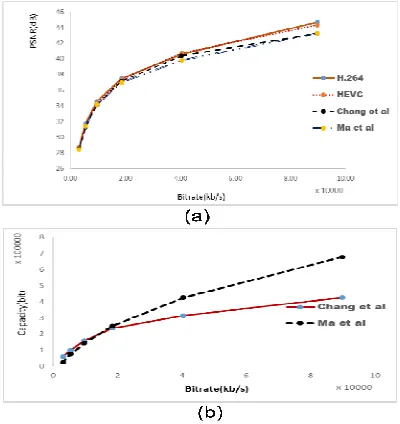
[image:7.595.309.509.280.492.2]32× transform blocks size of the HEVC. The experimental results for the PSNR (Peak Signal to Noise Ratio) and the embedding capacity for different bit-rates are given in Figure6 for comparison between those techniques. About the bitrate, the proposed method achieves higher embedding capacity and higher compression performance compared to H.264/AVC [54] for low bit-rate video error free coding. However, it is not robust against noisy channel or signal processing attacking.
Figure 6: Objective Data Hiding Performance Evaluation (a) PSNR vs. Bit-Rate and (b) Capacity vs.
Bit-Rate Plots for Tested Techniques on Video Test Named PeopleOnStreet with Size 2560x1600
4. CONCLUSION AND FUTURE
RESEARCH DIRECTIONS
Based on our literature, it can be deduced that the watermarking methods designed for those current video coding standards cannot be directly applied to the new video coding HEVC. Therefore, the HEVC structure has to be taken into account for designing new HEVC watermarking schemes. The improved methods can achieve a higher embedding capacity and higher compression performance compared to previous video coding standards such as H.264/AVC video coding.
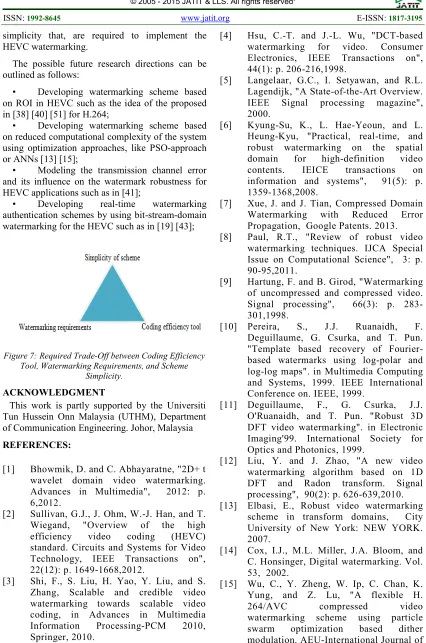
simplicity that, are required to implement the HEVC watermarking.
The possible future research directions can be outlined as follows:
• Developing watermarking scheme based on ROI in HEVC such as the idea of the proposed in [38] [40] [51] for H.264;
• Developing watermarking scheme based on reduced computational complexity of the system using optimization approaches, like PSO-approach or ANNs [13] [15];
• Modeling the transmission channel error and its influence on the watermark robustness for HEVC applications such as in [41];
[image:8.595.85.511.97.740.2]• Developing real-time watermarking authentication schemes by using bit-stream-domain watermarking for the HEVC such as in [19] [43];
Figure 7:Required Trade-Off between Coding Efficiency Tool, Watermarking Requirements, and Scheme
Simplicity.
ACKNOWLEDGMENT
This work is partly supported by the Universiti Tun Hussein Onn Malaysia (UTHM), Department of Communication Engineering. Johor, Malaysia
REFERENCES:
[1] Bhowmik, D. and C. Abhayaratne, "2D+ t wavelet domain video watermarking. Advances in Multimedia", 2012: p. 6,2012.
[2] Sullivan, G.J., J. Ohm, W.-J. Han, and T. Wiegand, "Overview of the high efficiency video coding (HEVC) standard. Circuits and Systems for Video Technology, IEEE Transactions on", 22(12): p. 1649-1668,2012.
[3] Shi, F., S. Liu, H. Yao, Y. Liu, and S. Zhang, Scalable and credible video watermarking towards scalable video coding, in Advances in Multimedia Information Processing-PCM 2010, Springer, 2010.
[4] Hsu, C.-T. and J.-L. Wu, "DCT-based watermarking for video. Consumer Electronics, IEEE Transactions on", 44(1): p. 206-216,1998.
[5] Langelaar, G.C., I. Setyawan, and R.L. Lagendijk, "A State-of-the-Art Overview. IEEE Signal processing magazine", 2000.
[6] Kyung-Su, K., L. Hae-Yeoun, and L. Heung-Kyu, "Practical, real-time, and robust watermarking on the spatial domain for high-definition video contents. IEICE transactions on information and systems", 91(5): p. 1359-1368,2008.
[7] Xue, J. and J. Tian, Compressed Domain Watermarking with Reduced Error Propagation, Google Patents. 2013. [8] Paul, R.T., "Review of robust video
watermarking techniques. IJCA Special Issue on Computational Science", 3: p. 90-95,2011.
[9] Hartung, F. and B. Girod, "Watermarking of uncompressed and compressed video. Signal processing", 66(3): p. 283-301,1998.
[10] Pereira, S., J.J. Ruanaidh, F. Deguillaume, G. Csurka, and T. Pun. "Template based recovery of Fourier-based watermarks using log-polar and log-log maps". in Multimedia Computing and Systems, 1999. IEEE International Conference on. IEEE, 1999.
[11] Deguillaume, F., G. Csurka, J.J. O'Ruanaidh, and T. Pun. "Robust 3D DFT video watermarking". in Electronic Imaging'99. International Society for Optics and Photonics, 1999.
[12] Liu, Y. and J. Zhao, "A new video watermarking algorithm based on 1D DFT and Radon transform. Signal processing", 90(2): p. 626-639,2010. [13] Elbasi, E., Robust video watermarking
scheme in transform domains, City University of New York: NEW YORK. 2007.
[14] Cox, I.J., M.L. Miller, J.A. Bloom, and C. Honsinger, Digital watermarking. Vol. 53, 2002.
Electronics and Communications", 65(1): p. 27-36,2011.
[16] Elrowayati Ali A., Z.Z.S., Abdulali Mohmed A., "Copyright Protecting Using Secure Watermarking Images in DWT Domain. 2012.
[17] El'Arbi, M., C.B. Amar, and H. Nicolas. "Video Watermarking Based on Neural Networks". in Multimedia and Expo, 2006 IEEE International Conference on. IEEE, 2006.
[18] Gaobo, Y., S. Xingming, and W. Xiaojing. "A genetic algorithm based video watermarking in the DWT domain". in Computational Intelligence and Security, 2006 International Conference on. IEEE, 2006.
[19] Wang, L., H. Ling, F. Zou, and Z. Lu, "Real-time compressed-domain video watermarking resistance to geometric distortions. IEEE MultiMedia", 19(1): p. 0070,2012.
[20] Ansari, R., M. Devanalamath, M. Hussain, and V.P. Prabha, Robust BPSO and Scene Change Based Digital Video Watermarking Algorithm in DWT-DFT-SVD Domain, in Security in Computing and Communications, Springer, 2013. [21] Dolatabadi, Z.S.S., A.B.A. Manaf, and
M. Zamani, "Using Three Levels DWT to Increase Robustness against Geometrical Attacks. International Journal of Advancements in Computing Technology (IJACT). ISSN": p. 2233-9337,2013. [22] Fridrich, J., M. Goljan, Q. Chen, and V.
Pathak. "Lossless data embedding with file size preservation". in Electronic Imaging 2004. International Society for Optics and Photonics, 2004.
[23] Bhowmik, D., "Robust Watermarking Techniques For Scalable Coded Image And Video. 2011.
[24] Hartung, F. and B. Girod. "Digital watermarking of MPEG-2 coded video in the bitstream domain". in Acoustics, Speech, and Signal Processing, 1997. ICASSP-97., 1997 IEEE International Conference on. IEEE, 1997.
[25] VASUDEVAN, S., "Implementation of fast residual quadtree coding and fast intra prediction in high efficiency video coding. EE Dept., University of Texas at Arlington, UMI dissertation publishing", 2013.
[26] Ye, D., C. Zou, Y. Dai, and Z. Wang, "A new adaptive watermarking for real-time MPEG videos. Applied Mathematics and Computation", 185(2): p. 907-918,2007. [27] Vassaux, B., P. Nguyen, S. Baudry, P.
Bas, and J.-M. Chassery. "Scrambling technique for video object watermarking resisting to mpeg-4". in Video/Image Processing and Multimedia Communications 4th EURASIP-IEEE Region 8 International Symposium on VIPromCom. IEEE, 2002.
[28] Zhang, J., J. Li, and L. Zhang. "Video watermark technique in motion vector". in Computer Graphics and Image Processing, 2001 Proceedings of XIV Brazilian Symposium on. IEEE, 2001. [29] Yan, L. and Z. Ping, "A survey of Video
Watermarking based on Motion Vector. 2014.
[30] Wiegand, T., G.J. Sullivan, G. Bjontegaard, and A. Luthra, "Overview of the H. 264/AVC video coding standard. Circuits and Systems for Video Technology, IEEE Transactions on", 13(7): p. 560-576,2003.
[31] Pröfrock, D., H. Richter, M. Schlauweg, and E. Müller. "H. 264/AVC video authentication using skipped macroblocks for an erasable watermark". in Visual Communications and Image Processing 2005. International Society for Optics and Photonics, 2005.
[32] Bhattacharya, S., T. Chattopadhyay, and A. Pal. "A survey on different video watermarking techniques and comparative analysis with reference to H. 264/AVC". in Consumer Electronics, 2006. ISCE'06. 2006 IEEE Tenth International Symposium on. IEEE, 2006. [33] Noorkami, M. and R.M. Mersereau, "A framework for robust watermarking of H. 264-encoded video with controllable detection performance. Information Forensics and Security, IEEE Transactions on", 2(1): p. 14-23,2007. [34] Qiu, G., P. Marziliano, A.T. Ho, D. He,
and Q. Sun. "A hybrid watermarking scheme for H. 264/AVC video". in Pattern Recognition, 2004. ICPR 2004. Proceedings of the 17th International Conference on. IEEE, 2004.
Processing, 2005. ICIP 2005. IEEE International Conference on. IEEE, 2005. [36] Mansouri, A., A.M. Aznaveh, F.
Torkamani-Azar, and F. Kurugollu, "A low complexity video watermarking in H. 264 compressed domain. Information Forensics and Security, IEEE Transactions on", 5(4): p. 649-657,2010. [37] Meerwald, P. and A. Uhl. "Robust
watermarking of H. 264-encoded video: Extension to SVC". in Intelligent Information Hiding and Multimedia Signal Processing (IIH-MSP), 2010 Sixth International Conference on. IEEE, 2010. [38] Dutta, T., A. Sur, and S. Nandi. "MCRD:
Motion coherent region detection in H. 264 compressed video". in Multimedia and Expo (ICME), 2013 IEEE International Conference on. IEEE, 2013. [39] Stutz, T., F. Autrusseau, and A. Uhl,
"Non-Blind Structure-Preserving Substitution Watermarking of H. 264/CAVLC Inter-Frames. 2014.
[40] Bao, J., J. Guo, and J. Xu. "A robust watermarking scheme for region of interest in H. 264 scalable video coding". in Instrumentation and Measurement, Sensor Network and Automation (IMSNA), 2013 2nd International Symposium on. IEEE, 2013.
[41] Ko, M.-G., J.-W. Suh, and J.-E. Hong. "Error detection scheme based on fragile watermarking for H. 264/AVC". in Acoustics, Speech and Signal Processing (ICASSP), 2011 IEEE International Conference on. IEEE, 2011.
[42] Grois, D. and O. Hadar, "Recent advances in watermarking for scalable video coding. Watermarking, Intech Open Access Publisher", 2012.
[43] Correa, G., P. Assuncao, L. Agostini, and L.A. da Silva Cruz, "Complexity scalability for real-time HEVC encoders. Journal of Real-Time Image Processing": p. 1-16,2014.
[44] Cai, Q., L. Song, G. Li, and N. Ling. "Lossy and Lossless Intra Coding Performance Evaluation: HEVC, H.264/AVC, JPEG 2000 and JPEG LS". in Signal & Information Processing Association Annual Summit and Conference (APSIPA ASC), 2012 Asia-Pacific. IEEE, 2012.
[45] Zhao, T., Z. Wang, and S. Kwong, "Flexible mode selection and complexity
allocation in high efficiency video coding. 2013.
[46] Tan, Y.H., C. Yeo, H.L. Tan, and Z. Li. "On residual quad-tree coding in HEVC". in Multimedia Signal Processing (MMSP), 2011 IEEE 13th International Workshop on. IEEE, 2011.
[47] Khan, M.U.K., M. Shafique, and J. Henkel. "An Adaptive Complexity Reduction Scheme with Fast Prediction Unit Decision for HEVC Intra Encoding". in IEEE International Conference on Image Processing (ICIP). 2013.
[48] Choi, K. and E.S. Jang, "Early TU decision method for fast video encoding in high efficiency video coding. Electronics letters", 48(12): p. 689-691,2012.
[49] Correa, G., P. Assuncao, L. Agostini, and L.A. da Silva Cruz, "Performance and computational complexity assessment of high-efficiency video encoders. Circuits and Systems for Video Technology, IEEE Transactions on", 22(12): p. 1899-1909,2012.
[50] Correa, G., P. Assuncao, L. Agostini, and L.A. da Silva Cruz, "Complexity scalability for real-time HEVC encoders. Journal of Real-Time Image Processing": p. 1-16.
[51] Xu, D., R. Wang, and Y.Q. Shi, "An improved reversible data hiding-based approach for intra-frame error concealment in H. 264/AVC. Journal of Visual Communication and Image Representation", 25(2): p. 410-422,2014. [52] Watson, A.B. "DCT quantization matrices visually optimized for individual images". in IS&T/SPIE's Symposium on Electronic Imaging: Science and Technology. International Society for Optics and Photonics, 1993.
[53] Chang, P.-C., K.-L. Chung, J.-J. Chen, C.-H. Lin, and T.-J. Lin, "A DCT/DST-based error propagation-free data hiding algorithm for HEVC intra-coded frames. Journal of Visual Communication and Image Representation", 25(2): p. 239-253,2014.
Figure 3: Generic Scheme For Video Watermarking Based On Coding Structure Techniques [23]
Figure 5: Classification Of Watermarking Techniques Based On Hevc Coding
Table 1: Summary Of Recent Selected Watermarking Techniques Versus Applicability And Limitations Used In Hevc Standard
Technique or
Method Domain Primary tool
Applicability in HEVC
Associated reference
Main Features
Advantages Disadvantages or Limitations
SSSC Spatial/Frequency Algebraic/ Transformed Yes [9] [12] [14] Less complexity Less robustness VLC Entropy coding Algebraic Yes [4] [5] [20] Less complexity Less robustness 3D DFT Frequency Transformed No [10] DFT none used in HEVC DWT-
DFT-SVD
Frequency Transformed No [19] [21] DWT none used in HEVC
Error Detection Model
Frequency Transformed Yes [41] Less complexity Imperceptibility problem ROI Spatial/Frequency Algebraic/Transformed Yes [38] [40] [51] Imperceptibility Less capacity Optimization Spatial/Frequency Algebraic/Transformed Yes [13] [15] Robust Less capacity and

![Figure 4: HEVC Video Encoder Block Diagram [2]](https://thumb-us.123doks.com/thumbv2/123dok_us/8910800.959194/6.595.306.503.413.571/figure-hevc-video-encoder-block-diagram.webp)