The Implementation of Electronic Intelligent Tag System
Based on Wireless Sensor Network
Kai Yu, Zhijun Xie, Jiangbo Qian, Guang Jin
College of Information Science and Engineering, Ningbo University, Ningbo, China Email: [email protected], [email protected], [email protected], [email protected]
Received 2012
ABSTRACT
Recently, Wireless Sensor Network (WSN) has been widely applied in many fields. In this paper, we design and im-plement a WSN-based Electronic Intelligent Tag System (EITS) to provide intelligent management of the modern su-permarkets. As a main transceiver, nRF24L01+ wireless module is used in this system, which will make it possible to achieve low-power and low-cost for EITS. This system fully embodies the advantages and characteristics of WSN. This paper will introduce the system architecture, hardware structure and software design in details; and put forward a spe-cific solution. Finally, we achieve the intelligent management of the mall based on wireless sensor network technology.
Keywords: Wireless Sensor Network; Electronic Intelligent Tag System; Architecture
1. Introduction
Electronic Intelligent Tag System (EITS) is a very typi-cal application of the Internet of Things (IOT) [1] in the business world. Electronic Intelligent Tag (EIT) is an electronic display device, which is placed on the shelf and can replace the traditional paper price tag [2]. Si-multaneously, it can process Real-time monitoring of environment factors such as temperature, light. The solu-tion of EITS can not only provide enterprises with fre-quent and effective promotional activities, but also pro-vide more management and optimize the performance of the commodity information, as well as other suppliers.
Wireless Sensor Network (WSN) is listed as the most influential technology in the 21st century and one of ten technologies to change the world [3]. WSN has broad application prospects, such as smart home, industrial automation, medical maintenance, et al, leading the de-velopment of emerging short-range wireless communica-tion technology [4].
Currently, EITS is beginning to spring up. Several well-known supermarkets have started to use the system in the United States [5]. The system uses RS485 wired communication, however, which has many defects such as its complex to wire, difficult to move, limited of communication distance et al. This article will take full advantage of the WSN, low-power, low-cost, flexible cloth mesh, to design an Electronic Intelligent Tag Sys-tem of a large-scale distribution network.
2. System Overall Architecture
WSN is a short-distance wireless communication
net-work with a great advantage of cost and power consump-tion. Especially, its flexible networking technology is the basis of the communication of EITS[6]. From the intro-duction of wireless sensor network technology, we know that EITS can monitor the warehouse and undertake wireless transmission of the temperature, humidity and sunshine about the warehouse or shelves. It could ensure that goods are in a suitable environment. Furthermore, the system can achieve real-time, accuracy and secure data transmission. Updating commodity prices in time will improve the efficiency of the shopping centers in various promotional activities.
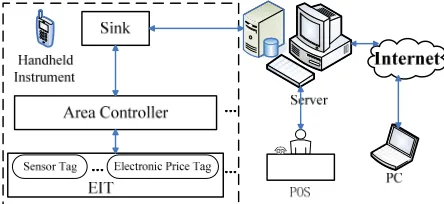
[image:1.595.311.533.605.707.2]The architecture of EITS based on WSN is shown in
Figure 1. The architecture consists of seven parts: Sink, Area Controller, EIT, Handheld Instrument, Server, Data Management Platform and Point of Sale (POS) terminals. Sink, which is also called gateway, is responsible for receiving and sending commands and tag information. It uplinks with the Server for data exchange, and it
downlinks with Area Controllers for information com-munication. Area Controllers, located in the middle layer of the Sink and EITs, store and transmit regional data. EIT is a terminal device of environment sensing and in-formation displays. The environment inin-formation relates to temperature and humidity, sunshine, Carbon dioxide. Its display contents include product name, price (original price, member price and promotional price), date of manufacture, et al. On the one hand, Handheld Instru-ment’s function is to modify the product information of EITs; on the other hand, it can easily get the sensing in-formation immediately. Server runs a variety of plat-forms and its main job is to process remote configuration and management of EITS. Finally, Data Management Platform can remotely control and manage the super-markets.
3. Hardware Architecture
The core hardware architecture of EITS includes EIT, Area Controller, Sink and Handheld Instrument. All of them will be described in the following.
3.1. Electronic Intelligent Tag
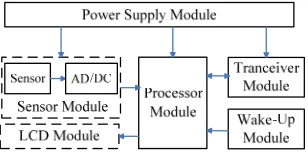
Electronic Intelligent Tag (EIT) locates in the bottom layer of EITS. It could sense the environmental informa-tion and display commodity-related informainforma-tion. EIT can be divided into Electronic Sensor Tag (EST), Electronic Price Tag (EPT), as well as Electronic Mixed Tag (EMT). The structure of the three tags is basically the same, the main difference of which is that whether it has Sensor Module and LCD Module or not. The structure of EIT is shown in Figure 2. The Sensor Module integrating vari-ous sensors, such as temperature, humidity, pressure, light, et al, is used to collect local environmental infor-mation. The LCD Module mainly displays price-related information of commodities, as well as local sensing in-formation. Wake-Up [7] Module triggers the processor external interrupt to wake up the sleeping EIT. In order to improve the mobility of EIT, the EIT uses the battery power supply.
[image:2.595.318.529.607.720.2]The Transceiver Module of EIT adopts low-cost and good performance nRF24L01+ [8] chip produced by Nordic company. The nRF24L01+ is a single chip 2.4 GHz transceiver with an embedded baseband protocol engine, suitable for ultra-low power wireless applications.
Figure 2. The structure of Electronic Intelligent Tag (EIT).
It has up to 126 RF channels to choose. We can operate and configure the nRF24L01+ through a Serial Periph-eral Interface (SPI). The chip also has the feature of automatic acknowledgment and automatic retransmission. As a result, low current consumption is the main feature of the chip, 26µA in Standby-I Module, even 900nA in Power down Module [9].
The EIT will take the 16-bit ultra-low power micro-controller MSP430 as the Processor Module. Further more, we choose MSP430F4132 [10] microcontroller here. Its current consumption has reached µA level. Be-nefiting from its 16-bit CPU and efficient RSIC instruc-tion system, the processor can achieve 125ns instrucinstruc-tion cycle at 8MHz. MSP430F4132 possesses SPI Module, communicating with nRF24L01+, and temperature sen-sor, directly sensing ambient temperature. The most im-portant characteristic is its LCD driving controller that can directly drive LCD displays by creating the ac seg-ment and common voltage signals automatically.
The EIT should own energy conservation so that bat-tery in tag can work for a desirable time, and the energy conservation algorithm should also be considered [11]. The EIT works on sleeping mode and wake-up mode periodically. It can change the operating mode automati-cally according to the strength of the received RF signal. Detecting the remaining voltage of battery is another function of the EIT [12]. When their voltage is below a certain threshold, the tags will automatically enter pow-er-down mode, and send feedback information to the managers.
3.2. Area Controller
[image:2.595.96.250.644.720.2]The structure of Area Controller, shown in Figure 3, consists of Processor Module, Wireless Communication Module and Power Supply Module. Processor Module uses 32-bit standard RISC processor based on the ARMv7-M, providing high density performance line and efficient code efficiency [13]. Here, this system will se-lect STM32F103VET6 [14], built-in to up to 512K bytes of Flash memory and 64K of SRAM, operating on 72MHz frequency. The processor has a wealth of periph-eral resources. For example, three transceivers could be
controlled by its three SPI interfaces respectively. Fur-thermore, the CPU can also be embedded operating sys-tem µC/OS-II, to provide efficient management and scheduling. For compatibility with the network commu-nication protocol of EITS, Wireless Commucommu-nication Module still uses the nRF24L01+ RF chip in receive mode, transmit mode and transceiver mode respectively. While, in order to achieve large-scale distribution net-works, the front-end of Transceiver Module adds a power amplifier to improve communications transmission ca-pacity. Area Controller can be powered over Ethernet or AC power.
3.3. Sink
The structure of Sink is shown in Figure 4. To reduce the cost of research and development, structure of Sink is similar with Area Controller. In other words, it is a scaled-down version of Area Controller. Processing and memory unit uses STM32F103VET6 based on the Cor-tex-M3 core. The communication unit uses nRF24L01+ and Power Amplifier as transceiver. Asynchronous communication between Sink and the Server can be im-plemented through RS232, RS485 or Ethernet.
3.4. Handheld Instrument
Handheld Instrument is a smart hand-held device, which can be used to extract the data of EIT as well as modify the display information of merchandise. The Handheld Instrument can not only wake up the electronic price tag and modify data, but also access the sensor date from sensor tag. With the TFT-LCD display, you can send operating instructions, check the accuracy of product information, and observe the feedback information and data. Power can be supplied by rechargeable lithium bat-tery. Figure 5 is the structure of Handheld Instrument.
4. Software Design of the EITS
[image:3.595.310.537.391.543.2]The system software design consists of two parts: em-bedded software and visualization management software. Embedded software is mainly used for collecting data, sending forwarding data, controlling energy consumption and monitoring the status of devices. Visualization man-agement software is operated by managers. They can
Figure 4. The structure of Sink.
control the purchase of goods, adjust commodity prices, monitor changes of the local environment, and check the history data in the supermarkets.
4.1. Communication Architecture
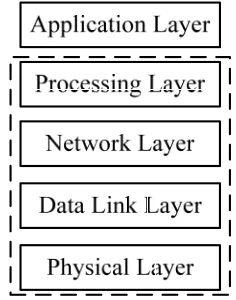
EIT, Area Controllers and Sink communicate with each other in the multi-hop manner, forming the cluster net-work structure [15]. Server provides the interface for the underlying communication and application software, and converts the sending and receiving packets in a standard format. The system can be divided into five layers, shown in Figure 6.
[image:3.595.363.481.571.721.2]The physical layer provides the signal modulation and wireless transceiver. The data link layer determines the pattern radio channel used and allocates the limited wireless communication resources [16]. The network layer is mainly responsible for routing generation and routing selection. Unlike traditional wireless communi-cation routing protocols, protocols of WSN depends on the specific application. Hence, the system will apply directed diffusion routing protocol. Processing Layer plays a role of processing and controlling information. Moreover, application layer refers to the monitoring and management software, detailed in next section.
Figure 5. The structure of handheld instrument.
[image:3.595.65.278.630.725.2]In recent years, due to such features as low cost, ease of deployment, increased coverage, and enhanced capac-ity, there are a growing number of new protocols for WSN. The concept of cross-layer design is based on ar-chitecture where different layers can exchange informa-tion in order to improve the overall network performance [17]. To maximize the lifetime of a wireless sensor net-work, mobile Sink [18] is a wise choice. In this way, the sink travels along nodes with few energy or large com-munication to balance the network for longer life.
4.2. Management Software of EITS
Management software of EITS, that is also called EITSV, is implemented. EITSV is designed to be an interface between users and the server. EITSV provides some tools to simplify deployment and visualization. It also makes it easy to connect to a database, to display products infor-mation, and to observe the status of EITs and Area Con-trollers as well as regional environment information. If an exception occurs, there will be alert notifications. All of display information, status information and control commands will be stored in database.
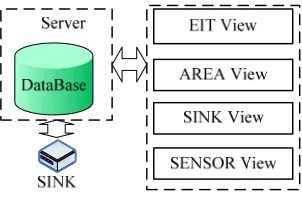
The structure of EITV, shown in Figure 7, consists of four parts: EIT View, AREA View, SINK View and SENSOR View. Merchandise information (name, pro-duction place, price, et al) and status information (re-gional environment, operating voltage, devices status, et al) will show to users through EIT View. EIT, owning the unique ID, can be identified by the system automati-cally. Whenever it joins into the network or leaves the network will be visualized. AREA View and SINK View are used to monitor operating status and load fluctuation of SINK and Area Controllers for intelligent ment. SENSOR View makes the sensing data manage-ment and analysis more conveniently, which will ensure that the entire system is in a secure environment.
5. Conclusions
[image:4.595.97.248.623.722.2]In this article, we take full advantage of wireless sensor network technology to give a whole solution for Elec-tronic Intelligent Tag System, providing intelligent man-agement for supermarkets. The EIT will replace the ex-isting paper tag to improve the efficiency of the malls.
Figure 7. The structure of EITV.
Sensing information of supermarkets will make super-markets more secure. This system has been applied in practical projects. The results show that the system has high efficiency, low labor costs and good reliability. Therefore, we should further popularize the EITS to ben-efit our supermarkets.
In the further work, this system will be extended to the whole supply chain, forming a supply chain management system. The commodity, environment, vehicle and re-lated persons could be managed more efficiently. In brief, the successful application of EITS will play an important role in promoting the development of the Internet of Things.
6. Acknowledgements
This work is supported by the Major Scientific & Tech-nology Specific Programs of Zhejiang Province for key industrial project (No. 2011C11042), the National Natu-ral Science Foundation of China (No. 60902097), the Natural Science Foundation of Zhejiang Province of China (No. Y1090571), the Natural Science Foundation of Zhejiang Province (Y12F020065).
REFERENCES
[1] L. Atzori, A. Iera and G. Morabito, “The Internet of Things: A Survey,” Computer Networks, Vol. 54, No. 15, May 2010, pp. 2787-2805.
doi:10.1016/j.comnet.2010.05.010
[2] J. G. Evans, R. A. Shober, S. A.Wilkus and G. A. Wright, “A Low-cost Radio for an Electronic Price Label Sys-tem,” Bell Labs Technical Journal, Vol. 1, No. 2, 1996, pp. 203-214.
[3] I. F. Akyildiz, W. Su, Y. Ankara Subramanian and E. Cayirci, “Wireless Sensor Networks: A Survey,” Com-puter Networks, Vol. 38, No. 4, 2002, pp. 393-422.
doi:10.1016/S1389-1286(01)00302-4
[4] W. W. Chang, T. J. Sung, H. W. Huang, W. C. Hsu, C. W. Kuo, J. J. Chang, et al., “A Smart Medication System us-ing Wireless Sensor Network Technologies,” Sensors and Actuators A: Physical, Vol. 172, No. 1, December 2011, pp. 315-321,. doi:10.1016/j.sna.2011.03.022
[5] P. De Mil, B. Jooris, L. Tytgat, R. Catteeuw, I. Moerman, P. Demeester and A. Kamerman, “Design and Implemen-tation of a Generic Energy-harvesting Foramework Ap-plied to the Evaluation of a Large-scale Electronic Shelf-labeling Wireless Sensor Network,” Eurasip Jour-nal on Wireless Communications and Networking, No. 343690, 2010.doi:10.1155/2010/343690
[6] L. Bissi, P. Placidi and A. Scorzoni, “A Configurable Mixed-signal Architecture for Label-free Smart Biosensor Applications,” IEEE Transactions on Instrumentation and Measurement, Vol. 58, No. 5, 2009, pp. 1333-1344.
doi:10.1109/TIM.2009.2012951
Alle-viate the Hidden Terminal Problem in Preamble Sampling WSNs,” Computer Networks, Vol. 56, No. 2, 2012, pp. 915-926.doi:10.1016/j.comnet.2011.11.011
[8] Nordic Semiconductor, “NRF24L01+ single chip 2.4GHz transceiver: Product specification v1.0,” September 2008, [Online].Available:
http://www.nordicsemi.com/eng/Products/2.4GHz-RF/nR F24L01P.
[9] W. Chen, X. Zhang and B. Liu, “Design of Wireless Temperature & Humidity Sensor Based on NRF24L01,” Advanced Materials Research, Vol. 403-408, 2012, pp. 1277-1280.
[10] Texas Instruments, “MSP430x41x2 Mixed Singnal Mi-crocontroller,” 2009, [Online]. Available:
http://www.ti.com/msp430/datasheet.
[11] N. A. Pantazis, D. J. Vergados, D. D. Vergados and C. Douligeris, “Energy Efficiency in Wireless Sensor Net-works using Sleep Mode TDMA Scheduling,” Ad Hoc Networks, Vol. 7, No. 2, March 2009, pp. 322-343.
doi:10.1016/j.adhoc.2008.03.006
[12] Y. Jiang, J. Liu and J. Li, “Intellignet Battery Monitor Based on MSP430 Microcontroller Unit,” Chinese Jour-nal of Scientific Instrument, Vol. 29, No. 5, 2008, pp. 1040-1043.
[13] Y. J. Li, Y. J. Fang and L. Chen, “A Kind of Sensor the Wireless Network Nodes Design and Implementation of the ARM,” Procedia Engineering, Vol. 15, December 2011, pp. 3567-3571.doi:10.1016/j.proeng.2011.08.668
[14] ST Microelectronics, “STM32F103xC STM32F103xD STM32F103xE,” September 2009, [Online]. Available: http://www.st.com/stm32.
[15] B. Wang, H. B. Lim and D. Ma, “A Coverage-aware Clustering Protocol for Wireless Sensor Networks,” Computer Networks, in press.
[16] W. Ye, J. Heidemann and D. Estrin, “Medium access Control with Coordinated Adaptive Sleeping for Wireless Sensor Networks,” IEEE/ACM Transactions on Net-working, Vol. 12, No. 3, 2004, pp. 493-506.
doi:10.1109/TNET.2004.828953
[17] L. D. P. Mendes and J. J. P. C. Rodrigues, “A Survey on Cross-layer Solutions for Wireless Sensor Networks,” Journal of Network and Computer Applications, Vol. 34, No. 2, 2011, pp. 523-534.doi:10.1016/j.jnca.2010.11.009