Technology (IJRASET)
Analysis of Harmonics in Distributed Generation
System with the help of D-STATCOM
Maneesh Yadav1, Ankur Chourasiya2
1
Assistant Professor, 2Assistant Professor, Department of Electrical and Electronics, Millennium Institute of Technology and Science
Abstract— Analysis of Harmonics in Distributed Generation System is done with the help of D-STATCOM connected with DG set. D-STATCOM is one of the advanced versions of shunt active power filter in distribution generation system. In recent years, few industries use devices such as rectifiers or converters, power supplies and other device to improve power quality that is sources of current harmonics. To overcome the above mentioned problem the Space Vector Pulse Width Modulation (SVPWM) control technique is suggested. By using this technique in conjunction with D-STATCOM the voltage stability of the system is improved. Space vector technique is implemented to control the distributed generation system. In this paper, we present extended simulations and discussions as well as experimental verification by using MATLAB.
Keywords— Voltage Regulation, Harmonics, Distributed Generation System, D-STATCOM, SVPWM.
I. INTRODUCTION
The advancement of semiconductor technologies, voltage-source converter-based solutions, such as static synchronous compensator (STATCOM), unified power flow controller (UPFC), distributed STATCOM (D-STATCOM), and active power filter (APF), become viable in practical applications [3], [6] and [13]. STATCOM technology has been extensively studied and developed in transmission systems to regulate voltage by adjusting its reactive power into the power system, whereas UPFC was designed to control real- and reactive-power flows between two substations. On the other hand, D-STATCOM and APF are suitable for power quality improvement of the distributed power system, such as harmonic compensation, harmonic damping, and reactive-power compensation. The concept of inverter-based RESs with functionality of VAr supporting was presented to accomplish voltage regulation locally. The proposed D-STATCOM realizes positive sequence admittance and negative-sequence conductance to regulate positive-sequence voltage as well as suppress sequence voltage. In [8], fundamental positive- and negative-sequence currents were separately controlled to improve the voltage regulation performances of the D-STATCOM. However, negative-sequence compensation may not work properly as the imbalanced source is nearby. A harmonic damping active filter was proposed to restore the voltage swell due to distributed generators [7]. However, discussions were limited in controlling positive-sequence voltage only.
A. Distributed Generation System
When the energy is generated and distributed using scale technologies closer to its end users, it is termed as Decentralised Generation. These generations are based mainly on renewable and also includes energy from wind turbines, photovoltaic cells, geothermal energy and micro hydro power plants. Onsite power generation has many benefits over the centralized power generation systems as it eliminates the costs associated with the transmission and distribution of power over long distances. These small scale technologies can yield power from 1KW to as much as 100 MW. Decentralized generation can take place at two scales.
1) At a local level, Site specific energy sources are used to generate electricity, constituting a Micro-Grid which is a cluster of generations serving a limited number of consumers. It can be either connected to the grid at a single point or can be totally independent of it.
2) At the second level, the same technologies are used at much smaller scale and are installed by an individual energy consumer. Such a system is called Distributed Generation. These sources can be individually connected to the grid, so that they can supply power to the grid when required – creating a prosumer, i.e. a producer and a consumer of electricity.
B. Benefits of Distributed Generation System
Decentralized generations are small and offer numerous benefits in comparison to the conventional centralized systems.
35% of the total available energy.
2) No high peak load shortages – Distributed generation systems can reduce the peak demand and offer an effective solution to the problem of high peak load shortages.
3) Linking remote and inaccessible areas – Distributed generation System can play a major role in providing power to remote and inaccessible areas. For a country like India, it offers a solution towards rural electrification.
4) Faster response to newer power demands – The micro-grid are small scaled and often require lower gestation periods, it enables faster and easy capacity additions when required.
5) Improved supply reliability and power management - It offers easy maintenance of power, voltage and frequency. It also offers the possibility of combining energy storage and management systems, with reduced congestion.
II. RESEARCH METHODOLOGY
In this research the D-STATCOM realizes positive sequence admittance and negative-sequence conductance to regulate positive-sequence voltage as well as suppress negative-positive-sequence voltage. In the modern era each and every country mainly concentrates on saving the energy in best and possible way in limited number of resources and also to draw maximum output from it. Due to increasing demand in the power sector there are number of non linear loads increasing. There is need of more and more Distributed generation system in congestion with Transmission and Distribution system (TDS) and also expansion of Smart Grid System. The expansion of grids requires the generation of electricity in few large units and should be concentrated. If there is any fault in Grids then the effect will be larger and uncontrollable. To avoid this special reserves are developed called “Spinning Reserve”. This protects against any single generating plant to fail, connected in the grid. The enormous amount of electrical energy transmitted from source to consumer end so there will be loss of energy during transmission. The loss of energy depends on the configuration of the network connected to the transmission and does not affect the distributed system. The distribution losses are different from the transmission losses and they are separately measured. It has the major drawback of the cogeneration or common heat and power transfer of energy. To overcome this, small generating units are installed spread throughout the network and the whole system is decentralized known as Distributed generation system. DGS has the ability to draw the energy from convention sources as well as Renewable sources. It is also gaining the importance in rural electricity. With the installation of DGS the transmission losses are reduced to a large extent in the case of Renewable energy DGS. But non-renewable DGS are not able to access the advantage attained in Renewable. The rising demands of energy made us to think alternative sources of energy. The need of electricity is more in rural areas. Our major portion of agriculture is mainly depended on the electricity, without it the use of new technology cannot be adopted. These are possible by following two methods:
A. To expand Transmission and Distribution system (TDS) B. To develop new Generating station
The concept of Decentralized generation comes into play to solve both the above mentioned issues. It enhances the living of rural population and also one of the major parts of our country. To achieve the rural electrification there should be an extension of grid to Smart Grid and also develop Distributed Generation System (DGS).The main focus is on Distributed Generation System (DGS) compared to Smart Grid. The extension of Smart Grid requires laying the infrastructure of Distribution network. But DGS requires the energy systems located at or nearby places which acts as Off – Grid Decentralized system. DGS is adopted in China, Philippines, and Cambodia as well as in Nepal. Now it is successfully installed and implemented. DGS are of two types: Conventional and Renewable, and also the hybrid type which has the combination of both. Conventional DGS are local generating system based on the Diesel, Natural gas, Fuel Oil, etc. sources of energy. Renewable DGS are wind, solar, hydro and biomass sources of energy.
III. SPACE VECTOR PWM
One of the most popular techniques for pulse width modulation (PWM) is Space Vector Pulse Width Modulation (SVPWM). In this technique the space vectors are representing the output voltages of the inverter. All the three phase voltages are represented as a vector which is rotating quantity. The rotating space vector came into existence from the concept of rotating Magneto Motive Force (MMF). The rotating MMF is present in the three phases Induction Machine (IM). The rotating space vector is given by:
Technology (IJRASET)
where and r, y and b represents the three phase vectors.
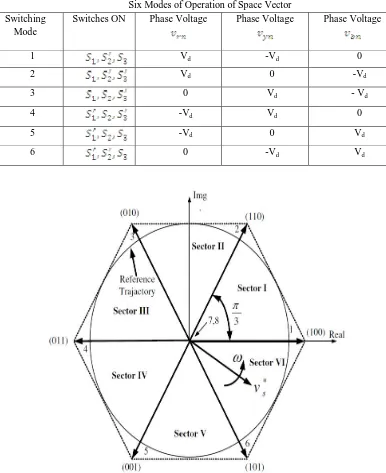
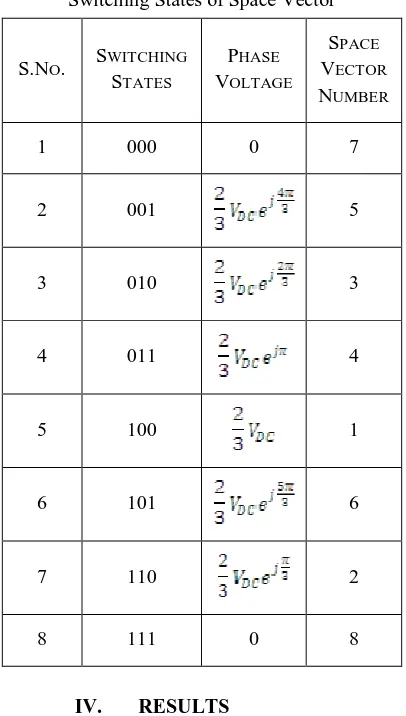
[image:4.612.114.500.223.696.2]There are eight possible outputs from which six are active switching states and two zero switching states. Active switching state is referred to the state in which power flow from source to load side. Zero switching state is on the other way i.e. no power flow from source to load side. The space vectors are represented in the form of hexagon spreading over 360 degrees and divided into six sectors displaced by 60 degrees as shown in fig.1. The six modes of operation of space vector are shown in Table I and switching states are shown in Table II.
Table I
Six Modes of Operation of Space Vector Switching
Mode
Switches ON Phase Voltage Phase Voltage Phase Voltage
1 Vd -Vd 0
2 Vd 0 -Vd
3 0 Vd - Vd
4 -Vd Vd 0
5 -Vd 0 Vd
[image:4.612.160.461.404.703.2]6 0 -Vd Vd
Switching States of Space Vector
IV. RESULTS
Results are shown here by evaluating the performance of the model. The output waveforms of voltage and currents are shown in fig.3 and fig.4 respectively. The voltage is able to maintain constant throughout the waveform even after the injection of harmonics at the supply and also on the point of common coupling. The model analysed by the THD response through the FFT analysis on the MATLAB function command shown in fig.5.
0 0.025 0.050 0.075 0.100 0.125
[image:5.612.223.426.96.454.2]-400 -300 -200 -100 0 100 200 300 400 Time (sec) V L o a d ( V ) Reference Va Vb Vc
Fig. 3 Output Voltage Waveform at Load
S.NO. SWITCHING
STATES PHASE VOLTAGE SPACE VECTOR NUMBER
1 000 0 7
2 001 5
3 010 3
4 011 4
5 100 1
6 101 6
7 110 2
[image:5.612.76.516.515.703.2]Technology (IJRASET)
0 0.025 0.050 0.075 0.100 0.125
-10 -5 0 5 10 Time (sec) I L o a d ( A ) Reference Ia Ib Ic
Fig.4 Output Current Waveform at Load
0 0.005 0.01 0.015 0.02 0.025 0.03 0.035 -5
0 5
FFT window: 2 of 50 cycles of selected signal
Time (s)
0 100 200 300 400 500 600 700 800 900 1000
0 0.02 0.04 0.06 0.08 0.1 0.12 0.14 Frequency (Hz)
Fundamental (50Hz) = 8.581 , THD= 0.62%
M
a
g
Fig.5 THD Response of the Output Signal for 2 cycles of Time Period
V. CONCLUSION
cooperative control of the D-STATCOM has been discussed. By establishing a low-frequency communication, the D-STATCOM can work together with both OLTC and SVC to regulate the grid voltage. Thus, the rated kilovolt–ampere capacity of the D-STATCOM can be significantly reduced. In addition, multiple D-D-STATCOMs are able to cooperatively provide reactive-power compensation under the help of the so called droop control.
REFERENCES
[1] Tzung-Lin Lee,Shang-Hung Hu and Yu-Hung Chan, “D-STATCOM With Positive- Sequence Admittance and Negative-Sequence Conductance to Mitigate Voltage Fluctuations in High-Level Penetration of Distributed-Generation Systems” IEEE TRANSACTIONS ON INDUSTRIAL ELECTRONICS, VOL. 60, NO. 4, APRIL 2013
[2] Ritwik Majumder, GargiBag, and Ki-Hyung Kim, “Power Sharing and Control in Distributed Generation With Wireless Sensor Networks” IEEE Transactions on Smart Grid, Vol. 3, No. 2, June 2012
[3] R. Gupta, A. Ghosh, and A. Joshi, “Multiband hysteresis modulation and switching characterization for sliding-mode-controlled cascaded multilevel inverter,” IEEE Trans. Ind. Electron., vol. 57, no. 7, pp. 2344–2353, Jul. 2010.
[4] T.L. Lee, S.-H. Hu, and Y.H. Chan, “Design of D-STATCOM for voltage regulation in microgrids,” in Proc. IEEE Energy Convers. Congr. Expo., 2010, pp. 3456–3463
[5] T. Senjyu, Y. Miyazato, A. Yona, N. Urasaki, and T. Funabashi, “Optimal distribution voltage control and coordination with distributed generation,” IEEE Trans. Power Del., vol. 23, no. 2, pp. 1236–1242, Apr. 2008.
[6] IEEE Standard for Interconnecting Distributed Resources with Electric Power Systems, IEEE Std. 1547.2-2008, 2008.
[7] H. Fujita and H. Akagi, “Voltage-regulation performance of a shunt active filter intended for installation on a power distribution system,” IEEE Trans. Power Electron., vol. 22, no. 3, pp. 1046–1053, May 2007.
[8] H. Akagi, “Active harmonic filters,” Proc. IEEE, vol. 93, no. 12, pp. 2128–2141, Dec. 2005.
[9] E. Twining, M. J. Newman, P. C. Loh, and D. G. Holmes, “Voltage compensation in weak distribution networks using a D-STATCOM,” in Proc. IEEE PEDS, 2003, pp. 178–183.
[10]R. C. Dugan, M. F. Mc Granaghan, “Electrical Power Systems Quality” 2nd Edition, McGraw-Hill, 2002.
[11]A.V. Jouanne and B. Banerjee, “Assessment of voltage unbalance,” IEEE Trans. Power Del., vol. 16, no. 4, pp. 782–790, Oct. 2001.
[12]Yong Hua Song and Allan T. Johns “Flexible AC Transmission Systems (FACTS)” IET Power and Energy Series, October 1999.
[13]N. G. Hingorani and L. Gyugyi, “Understanding FACTS: Concepts and Technology of Flexible AC Transmission Systems. New York: Wiley, 1999.
[14]C. Schauder, M. Gernhardt, E. Stacey, T. Lemak, L. Gyugyi, T. Cease and A. Edris “Development of a ±100 MVAr static condenser for voltage control of transmission systems,” IEEE Trans. Power Del., vol. 10, no. 3, pp. 1486–1496, Aug. 1995.