Technology (IJRASET)
©IJRASET: All Rights are Reserved
30
A Review : Interference Mitigation In Mobile Body
Sensor Networks
MR. Pankaj Mule
Department of Electronics and telecom Engineering, Dhole Patile College of Engineeriring, Pune, India
Abstract—In recent time mobile body sensor network known as a capable technology having a number of applications in health and well-being. For low power sensor network, main problem in wireless body network is that it disturbs the reliable transmission in WBSN is interference , but we can deal with this problem by allowing a body sensor network by changing its working frequency and its conduct power in response to changes in the observed interference . In this paper we study the influences of the variant of transmit power in the presence and absence of frequency adaptation and to improve the overall energy consumption and success rate of devices.
Keywords-MBSN, wifi , frequency.
I. INTRODUCTION
In the whole world there is an vast use of mobile body sensor network. In recent times Mobile Body Sensor Networks (MBSNs) known as a capable technology having a number of applications in health and well-being. MBSN is used in many areas like hospitals, sports, in military and also having environment application. In MBSN there is lot of problems due to interference in the network which reduces packet success rate, reliable transmission and timely data transfer, possible approach to deal with this problem is frequency adaptation schemes.
We are using here a IEEE 802.11 standard a wireless standard. It is a developed by IEEE for wireless LAN technology. It uses 2.4 Ghz band using either direct sequence spread spectrum or frequency hopping spread spectrum. 802.11 specifies an over the air interference between a nodes and base station.
A wireless sensor network can be called as a whole network of sensor nodes and wide area is as under and offers environmental information such as humidity and temperature about the tested area by wireless communication protocols[3]. The Wireless Sensor Network (WSN) has a wide range of potential applications and is an developing technology Just as mobile ad hoc networks, a WSN usually contain of a huge number of circulated nodes that organize themselves into a multi-hop wireless network[4].
II. LITERATURESURVEY
The exhausted literature study has been carried out on wireless data transfer problems and study of wireless system .
Pangun Park, Piergiuseppe Di Marco, Carlo Fischione, and Karl Henrik Johansson [1] was focused on reliable and timely data transfer in IEEE 802.15.4 wireless network. The IEEE 802.15.4 for wireless sensor networks which can support reliable, energy efficient, and timely packet transmission by a distributed and parallel tuning of the medium access control parameters. Such a tuning is tough, because accurate and simple models of the effect of these parameters on the probability of successful energy consumption, packet transmission, packet delay, and are not available. In this paper, a Markov chain is planned to model these associations by simple expressions without giving up the accuracy.
Ehsan Tabatabaei Yazdi, Andreas Willig and Krzyszt of Pawlikowski [2] This paper is related to orphan time in IEEE 802.15.4 Wireless sensor networks. The energy consumption is related to the duration time spent by end devices in orphan state in beacon-enabled IEEE 802.15.4 network. The latency skillful for performing a coordinator discovery process and a successful association is linked to such elements as beacon channel interference, massage signaling interval length, etc. for mitigating the total energy consumption of the end devices in Wireless Body Sensor Networks (WBSNs), different coordinator discovery schemes are introduce in this study. The main attention of this paper is to progress the overall success rate and energy consumption of end devices. However, the performance evaluation results reveal that the proposed passive coordinator discovery schemes have insignificant statistical difference in the overall success rate and energy consumption of the WBSN.
Technology (IJRASET)
©IJRASET: All Rights are Reserved
31
several different link configurations, they present the interference prediction algorithms to discover the impacts of WiFi/microwave oven on ZigBee communication Based on opinions of the Packet Error Rate.
Qian Hu and Zhenzhou Tang [4] published the paper on “An adaptive transmit power scheme for wireless sensor networks” in which they uses the MAC protocol, The MAC protocol for wireless sensor networks is dissimilar from traditional wireless MACs such as IEEE 802.11.This paper introduces an adaptive transmit power scheme built on S-MAC named ATPM (Adaptive Transmit Power MAC). In S-MAC, all the nodes transfer data with a permanent power level, no problem how near the involved nodes are. The planned ATPM can determine the distance between the transmitter and the receiver by calculating the received power, and then adaptively choose the appropriate transmit power level agreeing with the propagation model and distance. evaluate the performance of the proposed new protocol for Simulations to be done by which we can find out that ATPM can surely decrease energy consumption related with S-MAC.
Flavia Martelli, Roberto Verdone and Chiara Buratti, [5]focused on a novel Link Adaptation (LA) strategy, in which nodes choice the modulation scheme according to the channel quality and interference level. The novelty sets in the fact that in case of big Signal-to-Noise Ratio and low Signal-to-Interference Ratio due to which instead of falling it, nodes rise the bit rate, as mostly done in the works exist in the literature. The decrease of the bit rate, in fact, permits to reduce the time the channel is occupied and, therefore, the collision probability. Performance is weighed in terms of packet error rate and results achieved with and without LA are matched. Results show that the proposed strategy improves performance.
Mauro De Sanctis, Marco Monti, Marina Ruggieri and Ramjee Prasad [6] had published a paper on “A Collaborative Coexistence Mechanism for IEEE 802.15.3 and 802.15.4 WPANs”, and focused on a novel collaborative coexistence mechanism between 802.15.3 and 802.15.4 WPANs, here named 978-1-4244-5213-4/09/ $26.00 ©2009 IEEE 395 Alternating Wireless Activity (AWA, patent pending) which does not require any modification to these standards. It controls and synchronizes the access to the network of the devices associated to the LDR and HDR WPANs. Its functionalities are positioned in a common protocol layer over the LDR and HDR MAC sub layers, and, hence it can be used with every
PHY.
Hongliang Ren and Max Q.-H. Meng, [7] focused on localization method which is made on the information almost by present wireless links among communicating nodes, without earning extra hardware costs. A coupling -power tuning is viable for most present off-the-shelf transceivers which provide great amount of information about RSS and which is used for the indications of the planned particle filtering algorithm.
Michael Timmers, Sofie Pollin, Antoine Dejonghe, Liesbet Van der Perre and Francky Catthoor[8] Interest in wireless technology has experienced an explosive growth over the last decades. Recent advances in processor design\ have enabled the use of wireless transceivers in small portable devices and even sensors. The finalization of a range of standards has eased the development of applications using those wireless functionalities. As a result, the spectrum is getting filled by heterogeneous devices, standards and applications. This is especially the case for the Industrial, Scientific and Medical (ISM) bands that are unlicensed and hence host the most diverse range of networks.
Bart Braem, Benoˆıt Latr´e, Chris Blondia, Ingrid Moerman, Piet Demeester [9] focused on a new method in which communication
of multihop wireless body area networks: the Wireless results. Autonomous Spanning tree Protocol or WASP. This protocol incorporates slotted medium access and the automatic setup of the different routes.
III. PROPOSEDMETHODOLOGY
In our project we focus on how to reduce orphan time, successful packet transmission, reduce consumption of energy by both coordinator and sensor nodes and timely data transmission and also one more modification is secure data transmission. For this we have use frequency adaptation and coupling power in which it adjust the frequency and coupling power high or low of the sensor nodes by using this methodology we can achieve all this.
We focus on the beacon-enabled mode of IEEE 802.15.4 in which time is subdivided into subsequent super frames. Coordinator transfer beacon packets which is start with each super frame followed by an active and an inactive period. The 2.4 GHz band is sub-divided into 16 non-overlapping frequency channels. By physical layer of the IEEE 802.15.4 standard. Transition starts on the PAN. PAN picks one of the channel When the PAN coordinator in the beacon enabled mode starts a PAN.
Technology (IJRASET)
©IJRASET: All Rights are Reserved
32
contain the value of SO and BO selected by the coordinator. If the first beacon has been initiate the device enters the association process and creates itself known to the coordinator. Then the device has to pay attention to all other beacon frames for maintaining synchronization with the coordinator. If at any time for some reason device has to fails for receiving four consecutive beacons, at that time it will go through the orphan state. Now the device again want to find the condition but for opposing the initialization procedure it have to know the parameters like the values of So and Bo, but not the existing frequency as perhaps the frequency might have be changed by the coordinator for interference.
IV. SYSTEMMODELANDADAPTATIONSCHEMES A. MBSN And Interferer Deployment
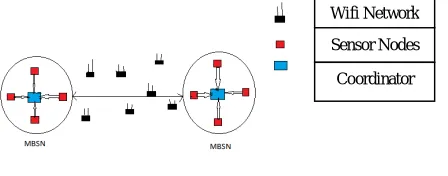
The situation preferred for this paper purposes to copy situations in which a human carrier
travels in a densely populated urban environment. A set of sensors are linked to the coordinator by a star topology. The coordinator is placed at the center of sensors and the sensors are around the coordinator placed equidistantly from coordinator at one meter. The network travels from one side of ground to the other in straight line and at a continual speed of 5 km/h, is known as usual pedestrian speed. In this field we install fixed WiFi interference source. The concentration of the interference sources and the strength of the channel use of these interference sources are wide-ranging – we mention to the number of Wifi sources located in the
[image:4.612.219.443.283.371.2]ground by the symbol Δ and to the interference strength of one interferer as a percentage by λ, respectively
Figure. 1: Node Deployment B. MBSN Operation
The whole mobile body sensor network is made up of one coordinator and four sensor nodes, and the network controls in beaconed mode. The devices first companion to the coordinator and then sends data packets intermittently with a period of one second. A fixed delivery is used to control the size of the data packet among 64 and 102 bytes. Not sure that Time Slots (GTS) are chosen to the end devices, for this they try to transmit their data packets during the Contention Access Period (CAP) stage. This is better for interference-prone settings as the CSMA mechanism can guard the devices at least against certain interference. Success rate is fully depend on the percentage of successfully data packets transmitted from end devices and that are successfully receive by the coordinator and acknowledged by the coordinator. Ten trial can be allowed if data are not received by the coordinator. Now need to maintain synchronization after associating the end device. If, by any means the end device is unable to receive four consecutive beacon massages, it changes its state to an orphan state. As explained above, to find out the beacon nodes transmitted from coordinator the orphan node scans the whole channels. In this paper show that the end device is located at a one meter of distance from its respective coordinator. The only ways that an end device fails to find out a beacon message are: (i) If to run on a channel having less interference the coordinator vagaries its frequency channel (ii) While the beacon is being sent, the end device is still switched off or it is in a transitional phase (switching channels or in between changing its state from TX to RX) as a result of time synchronization errors; (iii) If due to interference from neighboring WiFi sources the beacon packet is rejected.
C. Types Of. Frequency Adaptation Schemes
There are two types of schemes which are we discuss here and used in this paper. First is Adaptation scheme and second is Lazy scheme.
1) No Adaptation Scheme: Here the initial channel is randomly picks by its coordinator and stay on these channel it never changes. This scheme does not requires any measurement. At the time when a device become orphaned, it does not scan all the channels but stay on these channel and when it finds the next beacon it resumes its operation.
2) Lazy Scheme: The second scheme is the lazy scheme. The common idea is that the MBSN stops on the similar channel as long as it is good enough. Channel swapping happens only when the measured channel energy (outside own transmissions) exceeds a
Wifi Network
Sensor Nodes
Technology (IJRASET)
©IJRASET: All Rights are Reserved
33
threshold. More specifically, in the lazy measurement scheme the coordinator takes RSSI measurements on all channels during the inactive periods of each super frame. The coordinator collects the last ten RSSI readings for each channel and represents the channel quality of each channel by the maximum of those readings. However, a channel switch is only carried out if the maximum RSSI value of the current channel exceeds a threshold of -90 dBm, and if there is another channel with a lower maximum RSSI value.
V. SUMMARY
The improvement in wireless network is depending on to increase the rate of packets transition, to reduce the time require for transmission, and secure data transfer. In this paper for improvement in wireless network study some paper related to wireless network and combine operation. This paper gives the information of frequency adaptation schemes, coupling power and orphan time. The main concept of this project work is to design & simulation of a wireless network to show how we can increase packet transmission rate, how to reduce orphan time ,secure data transmission and improve the wireless network and gives graphical result by using NS2 software.
REFERENCES
[1] Pangun Park, Piergiuseppe Di Marco, Carlo Fischione, and Karl Henrik Johansson, “Modeling and Optimization of the IEEE 802.15.4 Protocol for Reliable
and Timely Communications” IEEE Transaction on Parallel and Distributed Systems, VOL. 24, NO. 3, March 2013, pp. 550-564.
[2] Ehsan Tabatabaei Yazdi, Andreas Willig and Krzyszt of Pawlikowski , “Shortening Orphan Time in IEEE 802.15.4: What can be Gained?” IEEE international
conference , 2013
[3] Wenqi (Wendy) Guo, William M. Healy, and Mengchu Zhou” An Experimental Study of Interference Impacts on ZigBee-based Wireless Communication
Inside Buildings”, International Conference on Mechatronics and Automation, Aug 2010, pp.1982-1987
[4] Q. Hu and Z. Tang, “An adaptive transmit power scheme for wireless sensor networks,” in Ubi-media Computing (U-Media), 2010 3rd IEEE International
Conference on, 2010, pp. 12–16.
[5] Flavia Martelli, Roberto Verdone and Chiara Buratti, “Link Adaptation in IEEE 802.15.4-Based Wireless Body Area Networks” in WiLAB, DEIS University
of Bologna, Italy, 2010 21st international symposium` on personal, indoor and mobile radio communications workshops,2010,pp.117-121
[6] Mauro De Sanctis, Marco Monti, Marina Ruggieri and Ramjee Prasad, “A Collaborative Coexistence Mechanism for IEEE 802.15.3 and 802.15.4 WPANs”,
2009, pp.395-399
[7] Hongliang Ren and Max Q.-H. Meng, “Power Adaptive Localization Algorithm for Wireless Sensor Networks Using Particle Filter”, IEEE transations on
vehicular technology, VOL. 58, NO. 5, JUNE 2009, pp.2498-2508
[8] Michael Timmers, Sofie Pollin, Antoine Dejonghe, Liesbet Van der Perre and Francky Catthoor, “Exploring vs Exploiting: Enhanced Distributed Cognitive
Coexistence of 802.15.4 with 802.11”, 2008, pp.613-616
[9] Bart Braem, Benoˆıt Latr´e, Chris Blondia, Ingrid Moerman, Piet Demeester, “Improving Reliability in Multi-hop Body Sensor Networks”, The Second International Conference on Sensor Technologies and Applications, 2008, pp. 342-347.
[10] M. Bertocco, G. Gamba, A. Sona, “Assessment of Out-of-Channel Interference Effects on IEEE 802.15.4 Wireless Sensor Networks”, IEEE International
Instrumentation and Measurement Technology Conference, may 2008 .
[11] Bart Braem, Benoˆıt Latr´e, Ingrid Moerman, Chris Blondia, Elisabeth Reusens, Wout Joseph, Luc Martens, Piet Demeester,”The Need for Cooperation and Relaying in Short-Range High Path Loss Sensor Networks” International Conference on Sensor Technologies and Applications 2007 pp. 566-571
[12] Bart Braem, Benoit Latre, Ingrid Moerman, Chris Blondial, Piet Demeester “The Wireless Autonomous Spanning tree Protocol for Multihop Wireless Body
Area Networks” IEEE 2006
[13] Jin-Shyan Lee “Performance Evaluation of IEEE 802.15.4 for Low-Rate Wireless Personal Area Networks” IEEE Transactions on Consumer Electronics, Vol.
52, No. 3, AUGUST 2006 pp.742-749
[14] Prasanna Ranganathan, Aravind Ranganathan, Kenneth Berman and Ali Minai,” Discovering Adaptive Heuristics for Ad-Hoc Sensor Networks by Mining
Evolved Optimal Configurations” 2006 IEEE Congress on Evolutionary Computation Sheraton Vancouver Wall Centre Hotel, Vancouver, BC, Canada, july 2006 pp.16-21.