comment
reviews
reports
deposited research
interactions
information
refereed research
Research
Interkingdom gene fusions
Yuri I Wolf, Alexey S Kondrashov and Eugene V Koonin
Address: National Center for Biotechnology Information, National Library of Medicine, National Institutes of Health, Rockville Pike, Bethesda, MD 20894, USA.
Correspondence: Eugene V Koonin. E-mail: [email protected]
Abstract
Background:Genome comparisons have revealed major lateral gene transfer between the three primary kingdoms of life - Bacteria, Archaea, and Eukarya. Another important evolutionary phenomenon involves the evolutionary mobility of protein domains that form versatile multidomain architectures. We were interested in investigating the possibility of a combination of these phenomena, with an invading gene merging with a pre-existing gene in the recipient genome.
Results:Complete genomes of fifteen bacteria, four archaea and one eukaryote were searched for interkingdom gene fusions (IKFs); that is, genes coding for proteins that apparently consist of domains originating from different primary kingdoms. Phylogenetic analysis supported 37 cases of IKF, each of which includes a ‘native’ domain and a horizontally acquired ‘alien’ domain. IKFs could have evolved via lateral transfer of a gene coding for the alien domain (or a larger protein containing this domain) followed by recombination with a native gene. For several IKFs, this scenario is supported by the presence of a gene coding for a second, stand-alone version of the alien domain in the recipient genome. Among the genomes investigated, the greatest number of IKFs has been detected in Mycobacterium tuberculosis, where they are almost always accompanied by a alone alien domain. For most of the IKF cases detected in other genomes, the stand-alone counterpart is missing.
Conclusions: The results of comparative genome analysis show that IKF formation is a real, but relatively rare, evolutionary phenomenon. We hypothesize that IKFs are formed primarily via the proposed two-stage mechanism, but other than in the Actinomycetes, in which IKF generation seems to be an active, ongoing process, most of the stand-alone intermediates have been eliminated, perhaps because of functional redundancy.
Published: 4 December 2000
GenomeBiology2000, 1(6):research0013.1–0013.13
The electronic version of this article is the complete one and can be found online at http://genomebiology.com/2000/1/6/research/0013 © GenomeBiology.com (Print ISSN 1465-6906; Online ISSN 1465-6914)
Received: 5 June 2000 Revised: 11 September 2000 Accepted: 6 November 2000
Background
Comparative genome analysis has revealed major lateral gene transfer between the three primary kingdoms of life, Bacteria, Archaea, and Eukarya [1-4]. The best recognized form of lateral gene flux is the transfer of numerous genes from mito-chondria and chloroplasts to eukaryotic nuclear genomes [5]. Far beyond that, however, the role of lateral gene exchange, along with lineage-specific gene loss, as one of the principal factors of evolution, at least among prokaryotes, is obvious
archaeal and bacterial hyperthermophiles [8,9], whereas certain parasitic bacteria, for example, chlamydia and spiro-chetes, appear to have acquired significantly more eukaryotic genes than free-living bacteria [10-12].
Another evolutionary trend that is predominant in eukaryotes, but is important also in bacteria and archaea, involves the evo-lutionary mobility of protein domains that combine to form variable multidomain architectures [13-18]. Domain fusion is one of the foundations of most forms of regulation and signal transduction in the cell. Examples include prokaryotic transcriptional regulators, most of which consist of the DNA-binding helix-turn-helix domain fused to a variety of small-molecule-binding domains [19], the two-component signal transduction system that is based on fusions of histidine kinases with sensor domains and of receiver domains with DNA-binding domains [20], and the sugar phosphotrans-ferase (PTS) systems that include complex fusions of several enzymes [21]. In the evolution of eukaryotes, domain fusion takes the form of domain accretion, whereby proteins from complex organisms (such as animals) that are involved in various forms of regulation and signal transduction tend to accrue multiple domains that facilitate the formation of complex networks of interactions [22].
We were interested in exploring the possibility of a meeting between these two major evolutionary phenomena - lateral gene exchange and gene fusion - which would result in the formation of multidomain proteins in which different domains display distinct evolutionary provenance. In partic-ular, we sought to identify fusions between domains origi-nating from different primary kingdoms - Bacteria, Archaea and Eukarya - which we term interkingdom gene (domain) fusions (IKFs), and obtain clues to the pathways of IKF origin through comparative genome analysis. We show that, although IKF in general is a rare phenomenon, one bacterial lineage, the Actinomycetes, displays a significantly increased frequency of such events; we also propose a probable mecha-nism for IKF formation.
Results and discussion
To identify IKFs, all protein sequences encoded in the ana-lyzed genomes were compared to the non-redundant protein
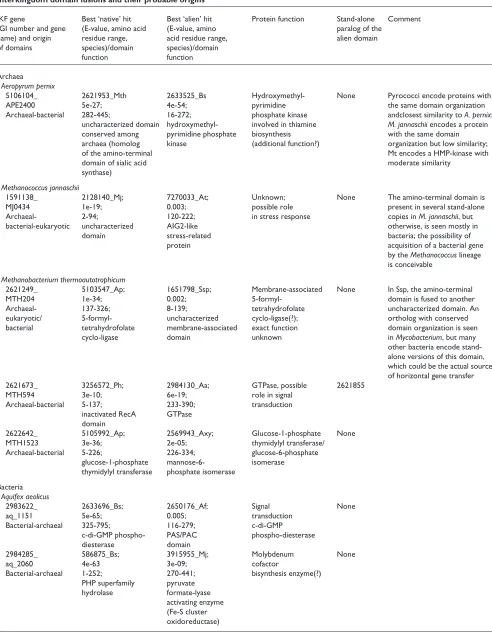
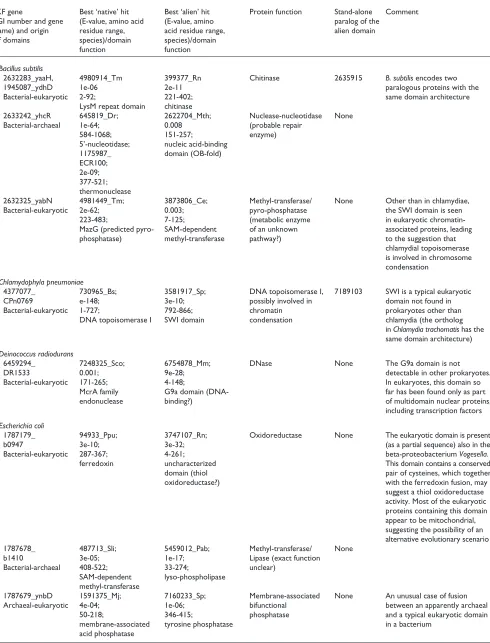
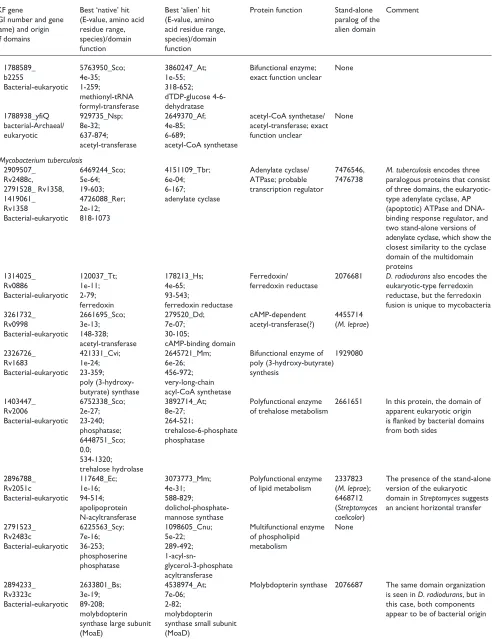
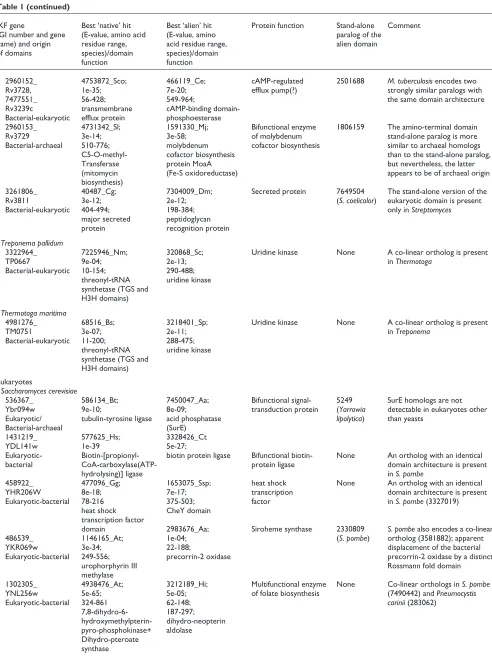
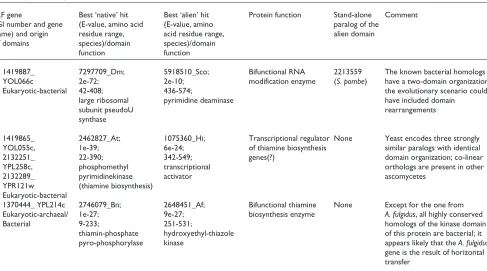
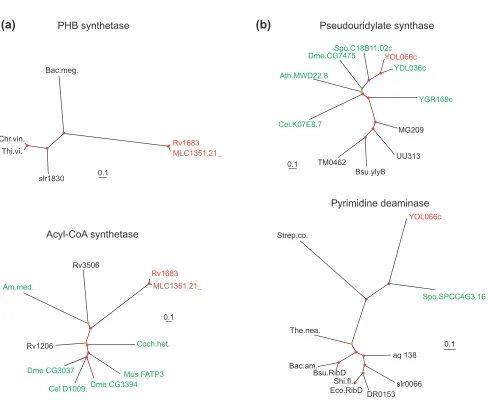
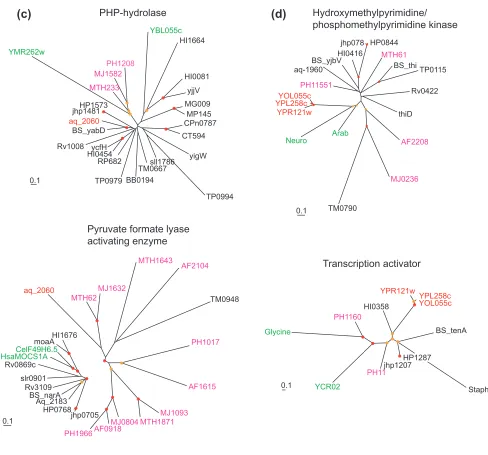
database, and those proteins in which distinct parts showed the greatest similarity to homologs from different primary kingdoms were identified (see the Materials and methods section). In most cases, the reported alignments were highly statistically significant, leaving no doubt that true homologs were detected (Table 1). On the few occasions when the data-base search statistics in themselves were not fully convincing (for example, the OB-fold nucleic acid-binding domain in the Bacillus subtilisprotein YhcN and the methyltransferase domain in the YabN protein, also from B. subtilis), the homologous relationship was validated by detection of the salient sequence motifs known to be involved in the corre-sponding protein functions (data not shown). Such motif analysis was performed for all analyzed domains in order not only to validate homology, but also to distinguish between active and inactivated forms of enzymes. Figure 1 shows multiple alignments of two domains involved in an IKF, illustrating the conservation of the characteristic functional motifs and the specific similarity between each of the domains of the IKF protein (in this case from Aquifex aeoli-cus) and their archaeal and bacterial homologs, respectively. In several cases, the chimeric origin of a gene was obvious at a qualitative level because no homolog of the alien domain with comparable sequence similarity was detected in the recipient superkingdom (Table 1, Figure 2a,b). For the rest of the candidate IKFs, phylogenetic tree analysis was per-formed to corroborate the origin of the invading domain by horizontal transfer; statistically significant grouping of a candidate IKF domain with homologs from the donor superkingdom provides such evidence (Figure 2c,d). The overall number of confirmed IKFs is relatively small - 37 in 21 compared genomes (about 0.1% of the genes) - compared to the total number of likely interkingdom gene transfers. For completely sequenced bacterial genomes this has been conservatively estimated as 1-2% of the genes, with a greater fraction (2-10%) detected in archaea and hyperthermophilic bacteria ([23], and K.S. Makarova, L. Aravind and E.V.K., unpublished observations). Examination of the clusters of orthologous groups (COGs) of proteins from complete genomes [6], in which multidomain proteins are split into the constituent domains if the orthologs of the latter are present as stand-alone forms in some of the genomes, shows that IKFs constitute only a small fraction of all fusions of
Figure 1
comment
reviews
reports
deposited research
interactions
information
refereed research
PHP-hydrolase
* * * *
aq_2060 ----MIDTHCHLDLLKKEDREEAFKDERLEYLINVGFDRKTIKNAIEFAKNY (0)DKVYIAIGFHPHEADKVTDKDLD (4)LAEENPKVRAIGEIGLDFYKNYSDKKKQEEIFRK (0)QIQIAKELGLPVVI HP1573 ---MFIDTHCHLDHKDYENDLEEVLKESLEKGVTQCVIPGADMKDLNRAIEI (4)EGVFFAIGAHPYDVESFDESLFE (0)KFVGHQKCVAIGECGLDYYRLPELNERENYKSKQ (6)QIEFSIQHNKPLII jhp1481 ---MFIDTHCHLDHKDYENDLDEVLKESLEKGVTQCVIPGADMKDLNRAVGI (4)EGVFFAIGAHPYDVESFDEGLFE (0)KFVSHQKCVAIGECGLDYYRLPELSERENYKSKQ (6)QIEFSIQHNKPLII BS_yabD ---MLFDTHAHLNAEQYDTDLEEVIERAKAEKVERIVVVGFDRPTITRAMEM (4)DFIYAAIGWHPVDAIDMTEEDLA (3)ELSAHEKVVAIGEMGLDYHWDKSPKDIQKEVFRN (0)QIALAKEVNLPIII Rv1008 ----LVDAHTHLDACGARDADTVRSLVERAAAAGVTAVVTVADDLESARWVT (5)RRVYAAVALHPTRADALTDAARA (3)RLVAHPRVVAVGETGIDMYWPGRLDGCAEPHVQR (5)HIDLAKRTGKPLMI ycfH --MFLVDSHCHLDGLDYESLHKDVDDVLAKAAARDVKFCLAVATTLPGYLHM (7)DNVVFSCGVHPLNQNDPYDVEDL (1)RLAAEEGVVALGETGLDYYYTPETKVRQQESFIH (0)HIQIGRELNKPVIV HI0454 --MFIVDSHCHLDALDYENLHKNISDVVEKAHARDVKHLLAIGVTLSRFEQA (7)NNVSLACGVHPLDFEEEPYDAER (2)RLAQDPKVIAIGEIGLDYYYSADNKAAQQAVFGS (0)QIDIANQLDKPVII RP682 ---MLIDSHCHLNLLTNFSSCGSITISSKNIKTTNSSCFFDTKMYDTVFLDS (33)KNVFASVGVHPCEVNDKKRLITD (4)ELTNHQKIIGIGETGLDYYHQPYNKKLQRDSFIA (0)HISAASATNLPIIV BB0194 (12)FFDKLIDTHVHFYELKKRSLDVNYIINECFKNGFSYFLDVGLHPSDFNDRKD (5)SNVFLTAGIHPLNLSDHFKDDIK (3)KILISENVVAVGEMGLDYFKADNKKFQIKALEE- (0)QLYLADKYKRPVIL TP0979 --MQIFDTHAHIGLIHPDPVERLRVVQEARRASVTRIMSICNSLHDFAAVYE (5)PSVYHAVGVSPSEVMAPGKDWID (3)KSLQLPQVVALGETGLDYCKKYGDKRSQIGLFIT (0)QLDIASKAKKPVII TM0667 ----MVDTHAHLHFHQFDDDRNAVISSFEENNIEFVVNVGVNLEDSKKSLDL (4)DRIFCSVGVHPHDAKEVPEDFIE (3)KFAKDEKVVAIGETGLDFFRNISPAEVQKRVFVE (0)QIELAGKLNLPLVV sll1786 --MHLVDTHVHINFDVFAADLDQLQHRWRQAGVVQLVHSCVKPQEFDQIQSL (4)PELFFAVGLHPLDAEDWQDNTAG (4)YAKADDRVVAIGEMGLDFFKADNRDHQIEVFRA- (0)QLAIARELNKPVII TP0994 (17)SCLHFSVGVRPAPEPIAHPETAL (9)LCAEQAPYRALGECGLDRHWNGPQVACKARKGSG (16)QLSIAKAQNLPLII yigW MEYRMFDIGVNLTSSQFAKDRDDVVACAFDAGVNGLLITGTNLRESQQAQKL (4)SSCWSTAGVHPHDSSQWQAATEE (3)ELAAXXEVVAIGECGLDFNRNFSTPEEQERAFVA (0)QLRIAADLNMPVFM MG009 --MEYFDAHCHLNCEPLLSEIEKSIANFKLINLKANVVGTDLDNSKIAVELA (4)DLLKATIGIHPNDVHLVDFKKTK (6)LINNRNFISCIGEYGFDYHYTTEFIELQNKFFEM (24)EILTRLKPTQPVIF MP145 --MEYFDAHCHLNCEPLLEQHEKSLANFRLIGLKANVVGTNLTNSQIAVNLA (4)DLLKAGVGIHPNDVQLFDLKAAQ (6)VSTHRSFISCIGEYGFDYHYTKDYITQQEQFFLM (24)EVLKRLKPKQPVVF CT594 --MEIVDAHVHLSSEEFIEDFGDV--- (0)VLRGKTAGVTRVVNVTTTKAELL (36)RAAEGGKLAAIGEVGLDYLFAVQASEQERQKEVL (2)YLQLALQHELPLVV CPn0787 --MDLADAHVHLSDDAFEEDINSVLQRAQDSGVSLVVNVTTTEKELNRSFAY (5)KIRFCHVGGTPPQDVDQDIEEDY (4)AAAHSKKLAAIGEVGLDYCFATEEGIARQKEVLQ (1)YLALSLECELPLVV yjjV LICRFIDTHCHFDFPPFSGDEEASLQRAAQAGVGKIIVPATEAENFARVLAL (4)QPLYAALGLHPGMLEKHSDVSLE (5)LERRPAKVVAVGEIGLDLFGDDPQFERQQWLLDE (0)QLKLAKRYDLPVIL HI0081 --MHFFDTHTHLNYLQQFTGEPLSQLIDNAKQADVQKILVVAVKEADFKTIQ (7)DNLCYGLGLHPLYIQEHAENDLI (5)LKNRDTNCTAVAEIGLERAIPDLLTDELWAKQCH (4)QLYLAKQFNLPVNI HI1664 (5)GKEMLFDSHLHLDQLSDENIQQTLAHSKIIGMLAVSTNLNSAKKLLNLKQTY (1)KKLYIAAGFHPEQQLPSLEEQKK (4)IDEHHSSISAIGEVGLPHYSKRENPNLDYVPYIE (4)FILIAKKWDLPLNL YBL055c (44)LTDPMFHGIYNGKQYHPADYVKLLERAAQRHVKNALVTGSSIAESQSAIELV (8)LKLYHTIGVHPCCVNEFADASQG (42)AKPHDTSFRSIGEIGLDYDRFHYSSKEMQKVFFE (5)SCLNDKLSSYPLFL MJ1582 (1)RDVKYVDAHCHIEDKAFNKNRDEVIERAKKEDVIIVTSGASLGGCLRALELR (2)YNIYLTLGYHPSRVKADDKVIEK (4)IKNNEYEILAIGEIGMDIKDENYKRQEEIFKK-- (0)FLSLAEELNKPIVV MTH233 (1)GGIIIIDVHCHLDFKDFNRNREEVIERARSKLRAVIDSGVGLGGNRRALELA (4)GFICPTMGFHPVDASKARQDLIG (5)IESNIDLIVAVGETGMDFHHTRDEEGRRRQEETF (2)FVELAAEHEMPLVV PH1208 ----MIDAHAHLEFYKRDYESIIGEAKEKLDGIIDSITEYRKAHVWKSWELL (4)GFLYPTLGYHPNEAKRGNWEKVK (5)ILEHKDEIYGIGEIGLDYYHAKTSKERENQRIIF (2)FLNIAQELRLPVVI YMR262w -MNKLVDAHCHVITDPDNTFCGDDGGSQGTLRCVMSSNPYDWNNLKKLAGRS (3)NDICVGFGVHPWYSHLFYVGSRR (36)REFNDTLVSVIGEIGLDKLFRLPANGFYMQNEKA (18)FWRLARHTSKPISI Consensus75% ....hhDsHsHlp..t.tp..tth..t....th...h..hs..t..tth..h t.lhhshGhHP.p.ptht.t.ht hh.tptplhAlGEhGLDahht... .ltlutphphPlll * *
aq_2060HMRDAEEETIRILREEGAYE (0)VGGVMHCFTGSYETMKKAVDMG---FFISYSGILTYKNAESVREVAKRTPTSRILLETDSPFLAPEPV (0)RGKPNKPTNIFYTAQVLAELLPNTSLEDVDRMTTQNAKLAFNL(203) HP1573 HIREASFDSLNLLKNYPK-- (0)AFGVLHCFNA-DGMLLELSDR---FYYGIGGVSTFKNAKRLVEILPKIPKNRLLLETDSPYLTPHPF (0)RGTRNSPTYIPLIAQKIAEIINIETEELASLSTHNAQMLFSFP jhp1481 HIREASFDSLNLLKSYPK-- (0)AFGVLHCFNA-DSMLLELSDR---FYYGIGGVSTFKNAKRLVEILPKIPKNRLLLETDSPYLTPHPF (0)RGTRNSPTYIPLIAQKIAEIIHIETEELASLSTHNAQTLFNFP BS_yabD HNRDATEDVVTILKEEGAEA (0)VGGIMHCFTGSAEVARECMKMN---FYLSFGGPVTFKNAKKPKEVVKEIPNDRLLIETDCPFLTPHPF (0)RGKRNEPSYVKYVAEQIAELKEMTFEEIASITTENAKRLFRIN Rv1008 HNRQADRDVLDVLRAEGAP- (0)DTVILHCFSSDAAMARTCVDAG---WLLSLSGTVSFRTARELREAVPLMPVEQLLVETDAPYLTPHPH (0)RGLANEPYCLPYTVRALAELVNRRPEEVALITTSNARRAYGLG (4) ycfH HTRDARADTLAILREEKVTD (0)CGGVLHCFTEDRETAGKLLDLG---FYISFSGIVTFRNAEQLRDAARYVPLDRLLVETDSPYLAPVPH (0)RGKENQPAMVRDVAEYMAVLKGVAVEELAQVTTDNFARLFHID (8) HI0454 HTRSAGDDTIAMLRQHRAEK (0)CGGVIHCFTETMEFXKKALDLG---FYISCSGIVTFKNAEAIREVIRYVPMERLLVETDSPYLAPVPY (0)RGKENQPAYTREVCEYVATLKGVSAEAFAQITTQNFERLFKIR (2) RP682 HTREADEDTIDILTSAMHNS (0)FSGLIHCFASSKNLAAKMLDIG---LYISVSGIITFKNATNLQEIVKYIPLDRLLIETDSPYLAPTPM (0)RGKQNEPAFVRYVAEKVAELKNITSQEVENVTTHNFKILFSKF (7) BB0194 HIRDAYDDVYNIVRSLNFL- (0)NRGILHCYSGTYEHAKKFIDLG---FKVSFSGNITFKNAQPLRILVGKLNINDLLIETDSPFLAPVPL (0)RGKINSPLFLGYVCLEIARIKNCSVNDVAFAVYNSFKDLLLLH (1) TP0979 HNRGAGQDILDILSERIPD- (0)QGGVFHCYSEDAEYARMALDLP---VYFSFAGNLTYRNARNLHETVLALPLDRILVESESPFMSPATY (0)RNKRNRPAHTVETVEFMAELLDMDMLELADQLWKNSCACFHLP (2) TM0667 HIRDAYSEAYEILRTESLPE (0)KRGVIHAFSSDYEWAKKFIDLG---FLLGIGGPVTYPKNEALREVVKRVGLEYIVLETDCPFLPPQPF (0)RGKRNEPKYLKYVVETISQVLGVPEAKVDEATTENARRIFLEV sll1786 HCRDAAQTMRQVLTDFQAES (2)VAGVMHCWGGTPEETQWFLDLG---FYISFSGTVTFKKAEGIQASAQMVPPDRLLVETDCPFLAPVPQ (0)RGKRNEPAFVRHVAEAIAALRHVPLETLAQQTTTNARNLFKLP (3) TP0994 HSRDAFEPTLRCLDSVGW-- (0)RKGVMHCFSYGVVEAHAFLERGLYIS-CAGTLTYAKTTSELLARDALIRSIPLDRLLLETDTPYLAPVPH (0)RGTHNRPEYVRHTYALVANILGISEKALAQHVFANCCALFEAQ (16) yigW HCRDAHERFMTLLEPWLDKL (0)PGAVLHCFTGTREEMQACVAHGI----YIGITGWVCDERRGLELRELLPLIPAEKLLIETDAPYLLPRDL (4)SSRRNEPAHLPHILQRIAHWRGEDAAWLAATTDANVKTLFGIA (1) MG009 HCFSQDINIAKKLLSLKDLN (2) IFFSIPGIVTFKNAQALHEALKIIPSELLLSETDSPWLTPSPF (0)RGKVNWPEYVVHTVSTVAEIKKIEIAEMKRIIVKNAKKLF WH-MP145 HCFSEDTNTALKLLTLREVG (2) VYFSIPGIVTFKNAKNLQAALSVIPTELLLSETDSPYLAPVPF (0)RGKTNWPECVVHTVQTIADIKQVPLAEIKQAIVHNAKKLF W--CT594 HCRGAFEDFFHILDHVYRVD (3)KPGMLHCFTGTYEEATELLARD---WYISISGIVTFKNAKSLQDLVEKISLERLLVETDAPYLAPTPL (0)RGKRNEPANIVHTLARIAEIKGISVYELQDAVSTNVQRWLRGS CPn0787 HCRGAFNDFFRMLDQYYHND (3)RPGMLHCFTGTLEEAQELISRG---WFISISGIVTFKNAQDLRDLVVELPLEHLLIETDAPFLAPVPY (0)RGKKNEPAHVLHTINAVANVKGMFPQELAALAYKNVLR FLHG-yjjV HSRRTHDKLAMHLKRHDLP- (0)RTGVVHGFSGSLQQAERFVQLG---YKIGVGGTITYPRASKTRDVIAKLPLASLLLETDAPDMPLNGF (0)QGQPNRPEQAARVFAVLCELRREPADEIAQALLNNTYTLFNVP HI0081 HSRKTHDQIFTFLKRIPLS- (0)KLGVVHGFSGSYDQAKRFVDLG---YKIGVGGTITYERANKTRQAIAKLPLDALVLETDSPDMPVFGF (0)QGQPNRPERIVESFKALCTLRNEPAELIKKLTWENACQIF S--HI1664 HIVHNDVEIALELLQKHNI- (0)QRAHFHWFKTDEKSFQKFFS---TPYFASLTPDILWNSKTQYVAQHLSLNRLMIETDSPWQHEGFE (0)AGISEQLL---AVLQKLAELKSLPLHSVQKQILLNTQQFYRL -YBL055c HMRSACDDFVQILERFIAGF (26)RKLVVHSFTGSAIDLQKLLNLS---PNIFIGVNGCSLRTEENLAVVKQIPTERLLLETDAPWCEIKRT (40)VKGRNEPCNMEQVAIVVSEVKDVDLATLIDTTWKTTCKIF GE-MJ1582 HARGFERKIFDIAKDK---- (0)VDIMFHCYSGDVELAKEIGK---EGHLISISTLVCFSEHHKKLVESLDLEYLTTETDSPYLSPI-- (0)KGTKNEPKNVKLVIEEIAKIKEMEVEEVKDVIYKNTCKFFKRR (1) MTH233 HARDAEERALETVLEYRV-- (0)PEVIFHCYGGSIETARRILD---EGYYISISTLVAFSEHHMELVRAIPLEGMLTETDSPYLSPF-- (0)RGKRNEPAFVEEAVRAIARIKDMDLEDVDSITTANAERVFGL -PH1208 HARMAEREAFNIIQKFD--- (0)VNAYFHSYTGPVELAKEISE---NGHFIGIVTGIVFIPEVRKVAEKMDIEGLLAETDSPYMSPY-- (0)KGIKNKPWFVKIVLEELSKIKEIPIEEVEEIIDGNIKKFFSI -YMR262w HDVKCHGKLNDICNEELLTY (0)VKICLHSYTGSKETLLGQWLKKFPPDRIFVSLSKWINFKDPEEGDALVRSLPSTCILTETDYPIDNPDP- (0)SYQKALTEQLQYLNAQIARAWDETLDASQAALRVYENFQKFIK H.RpstpchhphLpph.... ..shhHsassshp.htthhph...hhhshuh.hshppupphpthlthlPhptLLlETDuPahsPhsh +GppNpPt.l.hshphlAplhthshtpltphhhpNspphath.
Pyruvate formate-lyase activating enzyme * * *
aq_2060 (275)CNLHCVFCQRERERNFWVKGHWVWVDRD (18)VVFCGYGEPTLRFSALKEIAKWVK (6)VDTNGLM (5)KEKLKELKGIVDTF--SVSLNAPDPETYN (3)RPAQKDAFEKVIEFIK (9) MJ1632 (44)CNFKCKYCFFKPLSCKKYSVDEILNKIL (10)ILIAG-GEPTLQNDLSELTKLLKD (6)LSTNGYY (0)LKDMLDKLEVDEI---HIDLKAYDENKHI (3)SCSNKKVLDCISYIGK (9) MTH62 (44)CNFRCRYCFFKPSGCMNHSPDRIADLIQ (10)VLIAG-GEPTLQEDLPELTEILAG (5)ISPNGTR (0)-RDVLWMSTFHEV---HVDLKALDEEKHI (3)GESNREVLECIEEFSG (4) MTH1643 (167)CNLRCPQCQNSQVAFTSQGNLLDPHETA (14)VTISG-GECTLNRTWLSTTIRAIR (9)VDTNGTI (4)YLDELLDSGMNRI---GIDLKGLRPETFM (0)EISGLHDEKTARVYLE (1) AF2104 (13)CTLDCEYCHRKSIPPQDLPLEVLDRVNG (4)YVIYGYGEPLLYPDFFKRIEGFDG (3)ISTNGML (29)ALEVLRKLGERGI---AEVVVTKDNLELL (9)HGSGMLATNVVASNPA (11) TM0948 (84)CKFLCAYCWNYFRNLRPKRAGDFLSPEE (16)FRISG-AEPILGRRSAEHVRKVIE (7)LETNGLM (2)FDPSLVDLFVNLNVLIRVSVKGWDEESFE (9)FRYQLKALEHLHGKVH (0) PH1017 (28)CNLKCEMCFKQYWEDKEGDMDWDLFLKI (12)IYFGGIGEPSVHPRFMDMVREVKR (6)MSTNGVL (4)ILEEFVKLGVDVV---YFSMDAIPTPSNI (4)HITSKVVESRIKKLVE (11) AF1615 (14)CQLSCLMCPKSCFSDEWIAKDMNMETFR (9)AHLQGWGEPLLNPNIGEMVDIAAK (5)LTTNGLL (1)DHHIDSILKLDLL---AVSVASGDARQH- (0)ERVRGCSLEKLAGNIK (67) MJ1093 (37)CNIACKFCRRSLGKEACEHRPGVALSVL (21)VGIAGPGDSLFNKETFETLKIIDE (8)LSTNGLL (3)YYKKLADLNVKTV---TVTVNAIDPEILK (19)KILIENQIDGIKKAYD (5) MTH1871 (37)CNIHCKFCTRDINECERRP--GVTGRLM (20)IGVAGPGDALANEETFEFFKKASK (8)MSTNGLL (3)RADELAELGINTV---TVTVNAVDPEIGE (19)EVLSRNQLEGIEKLAE (5) MJ0804 (49)CNLNCIYCYSRLKTVKRGIYGNLEEAET (0)VTISQYGEPLLDLEGVKKAIEFCK (7)LQTNGTL (4)IIKELKDLGLDLI---MISLSSFSREKYK (0)LLTGKDYFNRVLNNIK (8) AF0918 (45)CNLRCIFCYSRVAQLKGTAPKPGYYGSL (4)ITISQYGEPFVVGTSRVVEIIRKL (10)IQTNGTL (0)LEPEILGSEADIV---MISLDAGSRESYA (0)EITGKDFFERVVKNIE (8) PH1966 (66)CNHDCIFCYSNVAVKLGKAPKPGYYGWD (4)ITISQYGEPLLSPRIVEVNKMLRK (8)LQTNGSL (1)TRELWEKLDFDLV---MISLNAADREKHR (0)RIANADTFEQVVNALK (10) HP0768 (20)CNFRCQYCMPATPLNFFDNEELLPLDNV (14)IRITG-GEPLLRKGLDEFIAKLHA (8)LSTNGFL (3)MAKDLKNAGLAQV---NVSLDSLKSDRVL (0)KISQKDALKNTLEGIE (9) jhp0705 (20)CNFRCQYCMPTTPLDFFDDEELLPLDNV (14)IRITG-GEPLLRKGLDEFIAKLHA (8)LSTNGFS (3)MAKGLKDAGLSRV---NVSLDSLKSDRVL (0)KISQKDALKNTLEGIE (9) aq_2183 (20)CNLRCNFCMPPGKEYNFLPKRQLLTPEE (15)VRLTG-GEPLLREDLEEIIQRISK (8)LTTNGVF (3)RLKALKEAGLKRI---TVSVHSLNPEKNQ (5)SVNLGEVFEVIIRAKE (5) BS_narA (26)CNFRCTYCMPAELFGPDYPFLKKEELLS (19)IRLTG-GEPLMRKDMPELIKKLAR (8)MTTNGSL (3)YAKRLKEAGLKRV---TISLDSLEDERFK (5)GVSVSKVLEGIEAAKQ (5) Rv0869c (48)CNLRCSYCMPERGLRWLPGEQLLRPDEL (15)VRFTG-GEPLLAHHLDEVVAATAR (8)LTTNGVG (3)RAGALAEAGLDRV---NVSLDSIDRAHFA (0)AITRRDRLAHVLAGLA (10) Rv3109 (36)CNLRCRYCMPEEHYTWLPRQDLLSVKEI (14)VRITG-GEPLIRPDLPEIVRTLSA (12)ITTNGVL (3)RVDGLKAAGMKRI---TVSLDTLQPERFK (0)AISQRNSHDKVIAGIK (10) slr0901 (36)CNLRCHYCMPVDAIFLEQSSYLSCQEYG (13)VRLTG-GEPLLRRNFTEIVRAIGQ (7)LTTNGIV (0)LDRHLDTLGENNVLDLNVSLDSLNAKTFS (0)EITHRNCLNTILRNLE (9) moaA (23)CNFRCTYCLPDGYKPSGVTNKGFLTVDE (15)VRLTG-GEPSLRRDFTDIIAAVRE (8)VTTNGYR (3)DVASWRDAGLTGI---NVSVDSLDARQFH (0)AITGQDKFNQVMAGID (10) HI1676 (32)CNFRCTYCLPDGYQPEANKPSFLTLKEI (13)IRLTG-GEPTLRKDFISIAESITN (8)VTTNGYR (3)DVADWKKAGITSI---NVSVDSLDPKMFH (0)QITGINKFDDVMRGID (10) HsaMOCS1A (79)CNLRCQYCMPEEGVPLTPKANLLTTEEI (14)IRLTG-GEPLIRPDVVDIVAQLQR (8)VTTNGIN (3)LLPQLQKAGLSAI---NISLDTLVPAKFE (0)FIVRRKGFHKVMEGIH (10) CelF49H6.5 (83)CNFRCLYCMPAEGIPLKPKDKMLSNSEV (14)VRLTG-GEPTIRNDLVQIVEGISS (8)ITTNGLV (3)FLPKLKDAGLTKI---NISIDSLDREKFA (0)KMTRRDGFDKVWKAIE (9) Consensus75% CNh+C.aCh.p.h...t.thh... ltlsG.GEPhlp.ph.chhtthtp loTNGhh hhttltphshstl...tlSlsuhs.cph. ...
aq_2060 IVSAVDYDGVDMKKTEELAKSLGA (11) MJ1632 EIDTVLIPNIVDLDEIEKIAKFLS (59) MTH62 EVSTVLVPGFVDLDEIEGIAEFLS (61) MTH1643 SWNAFRYLSENHRDIFMGLGVPYS (71) AF2104 RITVEKVLGLDESILVEAIKDCSR(185) TM0948 FWVAVVYDLFREKGLKELEKRLPI (13) PH1017 IGVEVVATKENYKQLPEMAIYLRN(183) AF1615 VEKAVEQAGKRAEELGIGFIAKPR(101) MJ1093 KINTVLIPEINMNHVVDIAKELKD (82) MTH1871 KVNSVLIPGLNDEHIVDIAREVKK (73) MJ0804 IVRSIYIPGFNDNELLNLAKELNN (93) AF0918 VVRTVFMPGINDEELERIAEIASQ (91) PH1966 VVRTVFMPGINDEDIPKIAELAAS (89) HP0768 KLNTVVIKSVNDDEILELLEYAKN(143) jhp0705 KLNTVVMKGVNDDEILELLEYAKN(143) aq_2183 KVNSVIIKGFNDDEILDLARFFKN(140) BS_narA KINMVVQKGVNEKDILPMARYFKE(151) Rv0869c KVNAVLDPTTGREDVVDLLRFCLE(154) Rv3109 KIDTTVMRGANHDELADLIEFART(160) slr0901 KLNTVVMREINDREIFDLIEYAKR(135) moaA KVNTVLMRDVNHHQLDTFLNWIQH(146) HI1676 KVNSVLMKNLNDKEFEQFLAWVKD(146) HsaMOCS1A KVNCVVMRGLNEDELLDFAALTEG(147) CelF49H6.5 KLNVVVLKHQNENEIVDFVNLTKG(148) hlssVhh.shsccclhchhthhtp
(a)
Table 1
Interkingdom domain fusions and their probable origins
IKF gene Best ‘native’ hit Best ‘alien’ hit Protein function Stand-alone Comment (GI number and gene (E-value, amino acid (E-value, amino paralog of the
name) and origin residue range, acid residue range, alien domain of domains species)/domain species)/domain
function function
Archaea Aeropyrum pernix
5106104_ 2621953_Mth 2633525_Bs Hydroxymethyl- None Pyrococci encode proteins with
APE2400 5e-27; 4e-54; pyrimidine the same domain organization
Archaeal-bacterial 282-445; 16-272; phosphate kinase andclosest similarity to A. pernix; uncharacterized domain hydroxymethyl- involved in thiamine M. jannaschii encodes a protein conserved among pyrimidine phosphate biosynthesis with the same domain archaea (homolog kinase (additional function?) organization but low similarity;
of the amino-terminal Mt encodes a HMP-kinase with
domain of sialic acid moderate similarity
synthase) Methanococcus jannaschii
1591138_ 2128140_Mj; 7270033_At; Unknown; None The amino-terminal domain is
MJ0434 1e-19; 0.003; possible role present in several stand-alone
Archaeal- 2-94; 120-222; in stress response copies in M. jannaschii, but
bacterial-eukaryotic uncharacterized AIG2-like otherwise, is seen mostly in
domain stress-related bacteria; the possibility of
protein acquisition of a bacterial gene
by the Methanococcuslineage is conceivable
Methanobacterium thermoautotrophicum
2621249_ 5103547_Ap; 1651798_Ssp; Membrane-associated None In Ssp, the amino-terminal
MTH204 1e-34; 0.002; 5-formyl- domain is fused to another
Archaeal- 137-326; 8-139; tetrahydrofolate uncharacterized domain. An
eukaryotic/ 5-formyl- uncharacterized cyclo-ligase(?); ortholog with conserved bacterial tetrahydrofolate membrane-associated exact function domain organization is seen
cyclo-ligase domain unknown in Mycobacterium, but many
other bacteria encode stand-alone versions of this domain, which could be the actual sources of horizontal gene transfer
2621673_ 3256572_Ph; 2984130_Aa; GTPase, possible 2621855
MTH594 3e-10; 6e-19; role in signal
Archaeal-bacterial 5-137; 233-390; transduction
inactivated RecA GTPase domain
2622642_ 5105992_Ap; 2569943_Axy; Glucose-1-phosphate None
MTH1523 3e-36; 2e-05; thymidylyl transferase/
Archaeal-bacterial 5-226; 226-334; glucose-6-phosphate glucose-1-phosphate mannose-6- isomerase
thymidylyl transferase phosphate isomerase Bacteria
Aquifex aeolicus
2983622_ 2633696_Bs; 2650176_Af; Signal None
aq_1151 5e-65; 0.005; transduction
Bacterial-archaeal 325-795; 116-279; c-di-GMP
c-di-GMP phospho- PAS/PAC phospho-diesterase
diesterase domain
2984285_ 586875_Bs; 3915955_Mj; Molybdenum None
aq_2060 4e-63 3e-09; cofactor
Bacterial-archaeal 1-252; 270-441; bisynthesis enzyme(?)
PHP superfamily pyruvate hydrolase formate-lyase
comment
reviews
reports
deposited research
interactions
information
refereed research
Table 1 (continued)
IKF gene Best ‘native’ hit Best ‘alien’ hit Protein function Stand-alone Comment (GI number and gene (E-value, amino acid (E-value, amino paralog of the
name) and origin residue range, acid residue range, alien domain of domains species)/domain species)/domain
function function
Bacillus subtilis
2632283_yaaH, 4980914_Tm 399377_Rn Chitinase 2635915 B. subtilisencodes two
1945087_ydhD 1e-06 2e-11 paralogous proteins with the
Bacterial-eukaryotic 2-92; 221-402; same domain architecture
LysM repeat domain chitinase
2633242_yhcR 645819_Dr; 2622704_Mth; Nuclease-nucleotidase None
Bacterial-archaeal 1e-64; 0.008 (probable repair
584-1068; 151-257; enzyme)
5’-nucleotidase; nucleic acid-binding 1175987_ domain (OB-fold) ECR100;
2e-09; 377-521; thermonuclease
2632325_yabN 4981449_Tm; 3873806_Ce; Methyl-transferase/ None Other than in chlamydiae, Bacterial-eukaryotic 2e-62; 0.003; pyro-phosphatase the SWI domain is seen
223-483; 7-125; (metabolic enzyme in eukaryotic
chromatin-MazG (predicted pyro- SAM-dependent of an unknown associated proteins, leading phosphatase) methyl-transferase pathway?) to the suggestion that
chlamydial topoisomerase is involved in chromosome condensation
Chlamydophyla pneumoniae
4377077_ 730965_Bs; 3581917_Sp; DNA topoisomerase I, 7189103 SWI is a typical eukaryotic
CPn0769 e-148; 3e-10; possibly involved in domain not found in
Bacterial-eukaryotic 1-727; 792-866; chromatin prokaryotes other than
DNA topoisomerase I SWI domain condensation chlamydia (the ortholog
in Chlamydia trachomatishas the
same domain architecture) Deinococcus radiodurans
6459294_ 7248325_Sco; 6754878_Mm; DNase None The G9a domain is not
DR1533 0.001; 9e-28; detectable in other prokaryotes.
Bacterial-eukaryotic 171-265; 4-148; In eukaryotes, this domain so
McrA family G9a domain (DNA- far has been found only as part
endonuclease binding?) of multidomain nuclear proteins,
including transcription factors Escherichia coli
1787179_ 94933_Ppu; 3747107_Rn; Oxidoreductase None The eukaryotic domain is present
b0947 3e-10; 3e-32; (as a partial sequence) also in the
Bacterial-eukaryotic 287-367; 4-261; beta-proteobacterium Vogesella.
ferredoxin uncharacterized This domain contains a conserved
domain (thiol pair of cysteines, which together
oxidoreductase?) with the ferredoxin fusion, may
suggest a thiol oxidoreductase activity. Most of the eukaryotic proteins containing this domain appear to be mitochondrial, suggesting the possibility of an alternative evolutionary scenario
1787678_ 487713_Sli; 5459012_Pab; Methyl-transferase/ None
b1410 3e-05; 1e-17; Lipase (exact function
Bacterial-archaeal 408-522; 33-274; unclear)
SAM-dependent lyso-phospholipase methyl-transferase
1787679_ynbD 1591375_Mj; 7160233_Sp; Membrane-associated None An unusual case of fusion
Archaeal-eukaryotic 4e-04; 1e-06; bifunctional between an apparently archaeal
50-218; 346-415; phosphatase and a typical eukaryotic domain
membrane-associated tyrosine phosphatase in a bacterium
[image:5.609.61.551.99.742.2]Table 1 (continued)
IKF gene Best ‘native’ hit Best ‘alien’ hit Protein function Stand-alone Comment (GI number and gene (E-value, amino acid (E-value, amino paralog of the
name) and origin residue range, acid residue range, alien domain of domains species)/domain species)/domain
function function
1788589_ 5763950_Sco; 3860247_At; Bifunctional enzyme; None
b2255 4e-35; 1e-55; exact function unclear
Bacterial-eukaryotic 1-259; 318-652;
methionyl-tRNA dTDP-glucose 4-6-formyl-transferase dehydratase
1788938_yfiQ 929735_Nsp; 2649370_Af; acetyl-CoA synthetase/ None bacterial-Archaeal/ 8e-32; 4e-85; acetyl-transferase; exact
eukaryotic 637-874; 6-689; function unclear
acetyl-transferase acetyl-CoA synthetase Mycobacterium tuberculosis
2909507_ 6469244_Sco; 4151109_Tbr; Adenylate cyclase/ 7476546, M. tuberculosisencodes three
Rv2488c, 5e-64; 6e-04; ATPase; probable 7476738 paralogous proteins that consist
2791528_ Rv1358, 19-603; 6-167; transcription regulator of three domains, the
eukaryotic-1419061_ 4726088_Rer; adenylate cyclase type adenylate cyclase, AP
Rv1358 2e-12; (apoptotic) ATPase and
DNA-Bacterial-eukaryotic 818-1073 binding response regulator, and
two stand-alone versions of adenylate cyclase, which show the closest similarity to the cyclase domain of the multidomain proteins
1314025_ 120037_Tt; 178213_Hs; Ferredoxin/ 2076681 D. radioduransalso encodes the
Rv0886 1e-11; 4e-65; ferredoxin reductase eukaryotic-type ferredoxin
Bacterial-eukaryotic 2-79; 93-543; reductase, but the ferredoxin
ferredoxin ferredoxin reductase fusion is unique to mycobacteria
3261732_ 2661695_Sco; 279520_Dd; cAMP-dependent 4455714
Rv0998 3e-13; 7e-07; acetyl-transferase(?) (M. leprae)
Bacterial-eukaryotic 148-328; 30-105;
acetyl-transferase cAMP-binding domain
2326726_ 421331_Cvi; 2645721_Mm; Bifunctional enzyme of 1929080
Rv1683 1e-24; 6e-26; poly (3-hydroxy-butyrate)
Bacterial-eukaryotic 23-359; 456-972; synthesis poly (3-hydroxy- very-long-chain
butyrate) synthase acyl-CoA synthetase
1403447_ 6752338_Sco; 3892714_At; Polyfunctional enzyme 2661651 In this protein, the domain of
Rv2006 2e-27; 8e-27; of trehalose metabolism apparent eukaryotic origin
Bacterial-eukaryotic 23-240; 264-521; is flanked by bacterial domains
phosphatase; trehalose-6-phosphate from both sides
6448751_Sco; phosphatase 0.0;
534-1320; trehalose hydrolase
2896788_ 117648_Ec; 3073773_Mm; Polyfunctional enzyme 2337823 The presence of the stand-alone Rv2051c 1e-16; 4e-31; of lipid metabolism (M. leprae); version of the eukaryotic
Bacterial-eukaryotic 94-514; 588-829; 6468712 domain in Streptomycessuggests
apolipoprotein dolichol-phosphate- (Streptomyces an ancient horizontal transfer
N-acyltransferase mannose synthase coelicolor)
2791523_ 6225563_Scy; 1098605_Cnu; Multifunctional enzyme None
Rv2483c 7e-16; 5e-22; of phospholipid
Bacterial-eukaryotic 36-253; 289-492; metabolism phosphoserine
1-acyl-sn-phosphatase glycerol-3-phosphate acyltransferase
2894233_ 2633801_Bs; 4538974_At; Molybdopterin synthase 2076687 The same domain organization
Rv3323c 3e-19; 7e-06; is seen in D. radiodurans, but in
Bacterial-eukaryotic 89-208; 2-82; this case, both components
molybdopterin molybdopterin appear to be of bacterial origin
synthase large subunit synthase small subunit
[image:6.609.63.555.101.740.2]comment
reviews
reports
deposited research
interactions
information
refereed research
Table 1 (continued)
IKF gene Best ‘native’ hit Best ‘alien’ hit Protein function Stand-alone Comment (GI number and gene (E-value, amino acid (E-value, amino paralog of the
name) and origin residue range, acid residue range, alien domain of domains species)/domain species)/domain
function function
2960152_ 4753872_Sco; 466119_Ce; cAMP-regulated 2501688 M. tuberculosisencodes two
Rv3728, 1e-35; 7e-20; efflux pump(?) strongly similar paralogs with
7477551_ 56-428; 549-964; the same domain architecture
Rv3239c transmembrane cAMP-binding domain-Bacterial-eukaryotic efflux protein phosphoesterase
2960153_ 4731342_Sl; 1591330_Mj; Bifunctional enzyme 1806159 The amino-terminal domain
Rv3729 3e-14; 3e-58; of molybdenum stand-alone paralog is more
Bacterial-archaeal 510-776; molybdenum cofactor biosynthesis similar to archaeal homologs C5-O-methyl- cofactor biosynthesis than to the stand-alone paralog,
Transferase protein MoaA but nevertheless, the latter
(mitomycin (Fe-S oxidoreductase) appears to be of archaeal origin
biosynthesis)
3261806_ 40487_Cg; 7304009_Dm; Secreted protein 7649504 The stand-alone version of the
Rv3811 3e-12; 2e-12; (S. coelicolor) eukaryotic domain is present
Bacterial-eukaryotic 404-494; 198-384; only in Streptomyces
major secreted peptidoglycan protein recognition protein Treponema pallidum
3322964_ 7225946_Nm; 320868_Sc; Uridine kinase None A co-linear ortholog is present
TP0667 9e-04; 2e-13; in Thermotoga
Bacterial-eukaryotic 10-154; 290-488; threonyl-tRNA uridine kinase synthetase (TGS and
H3H domains) Thermotoga maritima
4981276_ 68516_Bs; 3218401_Sp; Uridine kinase None A co-linear ortholog is present
TM0751 3e-07; 2e-11; in Treponema
Bacterial-eukaryotic 11-200; 288-475; threonyl-tRNA uridine kinase synthetase (TGS and
H3H domains) Eukaryotes
Saccharomyces cerevisiae
536367_ 586134_Bt; 7450047_Aa; Bifunctional signal- 5249 SurE homologs are not Ybr094w 9e-10; 8e-09; transduction protein (Yarrowia detectable in eukaryotes other Eukaryotic/ tubulin-tyrosine ligase acid phosphatase lipolytica) than yeasts
Bacterial-archaeal (SurE)
1431219_ 577625_Hs; 3328426_Ct
YDL141w 1e-39 5e-27;
Eukaryotic- Biotin-[propionyl- biotin protein ligase Bifunctional biotin- None An ortholog with an identical
bacterial CoA-carboxylase(ATP- protein ligase domain architecture is present
hydrolysing)] ligase in S. pombe
458922_ 477096_Gg; 1653075_Ssp; heat shock None An ortholog with an identical
YHR206W 8e-18; 7e-17; transcription domain architecture is present
Eukaryotic-bacterial 78-216 375-503; factor in S. pombe(3327019)
heat shock CheY domain transcription factor
domain 2983676_Aa; Siroheme synthase 2330809 S. pombealso encodes a co-linear
486539_ 1146165_At; 1e-04; (S. pombe) ortholog (3581882); apparent
YKR069w 3e-34; 22-188; displacement of the bacterial
Eukaryotic-bacterial 249-556; precorrin-2 oxidase precorrin-2 oxidase by a distinct
urophorphyrin III Rossmann fold domain
methylase
1302305_ 4938476_At; 3212189_Hi; Multifunctional enzyme None Co-linear orthologs in S. pombe
YNL256w 5e-65; 5e-05; of folate biosynthesis (7490442) and Pneumocystis
Eukaryotic-bacterial 324-861 62-148; carinii(283062)
7,8-dihydro-6- 187-297; hydroxymethylpterin- dihydro-neopterin pyro-phosphokinase+ aldolase
[image:7.609.59.551.85.741.2]evolutionarily mobile domains (Figure 3). Generally, the small number of identified IKFs compared to the total number of inferred horizontal transfer events and the total number of domain fusions could be compatible with a random model of domain fusion subsequent to lateral gene transfer.
However, the distribution of IKFs among genomes is dis-tinctly non-random, suggesting that such a simple model may be incorrect. Specifically, 12 IKFs were detected in
Mycobacterium tuberculosisand 10 were found in the yeast
Saccharomyces cerevisiae, but only a small number or none was identified in each of the other bacterial and archaeal genomes (Figure 2, Table 1). The excess of IKFs in Mycobac-terium is particularly notable, given that the fraction of genes horizontally transferred from archaea and eukaryotes in the mycobacterial genome is only slightly greater than that in most of the other bacteria, and considerably lower than that in the hyperthermophilic bacteria Aquifex and
Thermotoga(K.S. Makarova, L. Aravind and E.V.K., unpub-lished observations). Similarly, whereas the overall number of domain fusions in M. tuberculosisis greater than in most other bacteria, the difference is insufficient to account for the over-representation of IKFs; furthermore, the cyanobac-terium Synechocystissp. has an even greater overall number
of fusions but does not have any detectable IKFs (Figure 3). At present, we cannot provide a defendable biological expla-nation for the comparatively high frequency of IKF in
Mycobacterium. It is tempting to interpret this trend in terms of adaptation of this bacterium to its relatively recently occupied parasitic niche, but examination of the individual IKF cases does not offer immediate clues in mycobacterial biology. The yeast IKFs clearly represent rela-tively recent horizontal transfers distinct from the gene influx from the mitochondria following the establishment of endosymbiosis because, under the protocol of IKF detection used here, only those alien domains were identified that have no counterparts in other eukaryotes.
Most of the IKFs are unique, but B. subtilis, M. tuberculosis
and yeast each also encode families of two to three paralo-gous IKFs, which apparently have evolved by duplication subsequent to the respective fusion events (Table 1). Strik-ingly, the same IKF, the three-domain uridine kinase, is shared by Treponema pallidumand Thermotoga maritima
(Table 1). Given that these two bacteria are not specifically related and that Borrelia burgdorferi, the second spirochete whose genome has been sequenced, encodes a typical bacte-rial uridine kinase, the presence of a common IKF in Tre-ponemaand Thermotogacannot be realistically attributed
Table 1 (continued)
IKF gene Best ‘native’ hit Best ‘alien’ hit Protein function Stand-alone Comment (GI number and gene (E-value, amino acid (E-value, amino paralog of the
name) and origin residue range, acid residue range, alien domain of domains species)/domain species)/domain
function function
1419887_ 7297709_Dm; 5918510_Sco; Bifunctional RNA 2213559 The known bacterial homologs YOL066c 2e-72; 2e-10; modification enzyme (S. pombe) have a two-domain organization;
Eukaryotic-bacterial 42-408; 436-574; the evolutionary scenario could
large ribosomal pyrimidine deaminase have included domain
subunit pseudoU rearrangements
synthase
1419865_ 2462827_At; 1075360_Hi; Transcriptional regulator None Yeast encodes three strongly YOL055c, 1e-39; 6e-24; of thiamine biosynthesis similar paralogs with identical
2132251_ 22-390; 342-549; genes(?) domain organization; co-linear
YPL258c, phosphomethyl transcriptional orthologs are present in other
2132289_ pyrimidinekinase activator ascomycetes
YPR121w (thiamine biosynthesis) Eukaryotic-bacterial
1370444_ YPL214c 2746079_Bn; 2648451_Af; Bifunctional thiamine None Except for the one from Eukaryotic-archaeal/ 1e-27; 9e-27; biosynthesis enzyme A. fulgidus, all highly conserved
Bacterial 9-233; 251-531; homologs of the kinase domain
thiamin-phosphate hydroxyethyl-thiazole of this protein are bacterial; it
pyro-phosphorylase kinase appears likely that the A. fulgidus
gene is the result of horizontal transfer
The following complete genomes were analyzed. Archaea: Aeropyrum pernix(Ap); Archaeoglobus fulgidus(Af); Methanococcus jannaschii(Mj);
Methanobacterium thermoautotrophicum(Mth); Pyrococcus horikoshii(Ph); Bacteria: Aquifex aeolicus(Aa); Borrelia burgdorferi(Bb); Bacillus subtilis(Bs);
Chlamydophila pneumoniae(Cp); Deinococcus radiodurans(Dr); Escherichia coli(Ec); Haemophilus influenzae(Hi); Helicobacter pylori(Hp); Mycobacterium
tuberculosis(Mt); Mycoplasma pneumoniae(Mp); Rickettsia prowazekii(Rp); Synechocystis sp(Ssp); Thermotoga maritima(Tm); Treponema pallidum(Tp). No
IKFs were detected in the genomes that are not shown in the table. Additional species name abbreviations: At, Arabidopsis thaliana; Axy, Acetobacter
xylinus; Bn, Brassica napus; Ce, Caenorhabditis elegans; Cvi, Chromatium vinosum; Gg, Gallus gallus; Hs, Homo sapiens; Mm, Mus musculus; Rn, Rattus
[image:8.609.64.551.96.367.2]to vertical inheritance of this gene from a common ancestor. It thus probably reflects horizontal transfer of the gene encoding the three-domain protein subsequent to its emer-gence in either the spirochetes or the Thermotogales.
Two evolutionary issues pertaining to IKFs need to be addressed, namely the mechanism(s) of their origin and the selective forces responsible for their preservation. From general considerations, it seems likely that IKFs have
comment
reviews
reports
deposited research
interactions
information
refereed research
Figure 2 (and following page)
Examples of phylogenetic trees supporting the contribution of interkingdom horizontal gene transfer to the emergence of interkingdom domain fusions. The names of proteins from different primary kingdoms are color-coded: black, bacterial; pink, archaeal; green, eukaryotic; the domains involved in the apparent IKF are shown in red. Red circles show nodes with bootstrap support >70%, and yellow circles show nodes with 50-70% support. The bar unit corresponds to 0.1 substitutions per site (10 PAM). (a) IKF: Rv1683 (gi| 7476858) from M. tuberculosis. Fusion of a bacterial poly(3-hydroxy-butyrate) (PHB) synthase and eukaryotic very long chain acyl-CoA synthetase. Note the absence of eukaryotic homologs in the PHB synthase tree and of bacterial homologs other than the two from M. lepraein the acyl-CoA synthetase tree. (b) IKF: yeast YOL066c (gi|6324506). Fusion of a eukaryotic pesudouridylate synthetase with a bacterial pyrimidine deaminase. Note the absence of eukaryotic homologs, other than that fromS. pombe, in the pyrimidine deaminase tree. (c)IKF: aq_2060 (gi|2984285) from Aquifex aeolicus. This protein is a fusion of a PHP superfamily hydrolase of apparent bacterial origin and a pyruvate formate-lyase activating enzyme of archaeal origin. (d)IKF: yeast YOL055c (gi|1419865), YPL258c (gi|2132251) and YPR121w (gi|2132289) from S. cerevisiae. Fusion of a eukaryotic phosphomethylpyrimidine kinase and a bacterial transcriptional activator. Species abbreviations: Bac.meg., Bacillus megaterium; Chr.vin., Chromatium vinosum; Thi.vi., Thiocystis violacea; Am.med., Amycolatopsis mediterranei; Coch.het., Cochliobolus heterostrophus; Dme, Drosophila melanogaster; Cel, Caenorhabditis elegans; Mus, Mus musculus; Spo, Schizosaccharomyces pombe; Ath, Arabidopsis thaliana; Strep.co., Streptomyces coelicolor; The.nea., Thermotoga neapolitana; Bac. am, Bacillus amyloliquefaciens; Shi.fl., Shigella flexneri; Hsa, Homo sapiens.
0.1
YGR169c
MG209
UU313 Bsu.ylyB
TM0462
Cel.K07E8.7 Ath.MWD22.8
Dme.CG7475Spo.C18B11.02cYOL066c
YDL036c
Pyrimidine deaminase
Acyl-CoA synthetase
0.1 aq 138
slr0066 DR0153 Eco.RibD
Shi.fl. Bsu.RibD Bac.am. The.nea. Strep.co.
YOL066c
Spo.SPCC4G3.16
0.1 slr1830
Thi.vi. Chr.vin.
Bac.meg.
Rv1683 MLC1351.21_
0.1
Coch.het.
Mus FATP3 Dme CG3394 Cel D1009.
Dme CG3037
Rv1206
Am.med.
Rv3506
Rv1683 MLC1351.21_
(b)
[image:9.609.61.549.82.487.2]evolved via a two-step process, which involves lateral trans-fer of the complete gene coding for the IKFs alien portion, followed by domain fusion. This scenario rests on the assumption that the acquired foreign gene is selectively advantageous, because otherwise it would have been inacti-vated by mutations before recombination could take place. Under this mechanism, the alien portion of an IKF is likely to be present in the recipient genome also as a stand-alone gene. A clear-cut case of such a duplication of a horizontally transferred domain has been noticed in Chlamydia, whose genomes encode the SWI domain, implicated in chromatin condensation, both as a stand-alone protein and as the carboxy-terminal portion of topoisomerase I [10]. Apart
from this case, the IKFs fall into two readily discernible classes, namely those from Mycobacterium and all the rest.
M. tuberculosis (the only complete genome of an actino-mycete available) possesses considerably more IKFs than any other bacterial or archaeal species (see above), and typi-cally, the alien portions of these proteins show high level of similarity to the homologs from the donor superkingdom (eukaryotes). Most significantly, there is also, with a single exception, a stand-alone counterpart in the mycobacterial genome; in some cases, such a counterpart is seen only in a closely related species, M. leprae, and in one case, it is found in Streptomyces, a distantly related actinomycete (Table 1). In the other genomes, the IKFs are generally less similar to
Figure 2 (continued)
0.1
CPn0787 CT594
yigW
TP0994 sll1786
TM0667 BB0194 TP0979
RP682 HI0454ycfH Rv1008
BS_yabD
aq_2060
jhp1481HP1573
YMR262w
MTH233 MJ1582
PH1208
YBL055c
HI1664
HI0081 yjjV MG009
MP145
PH1017
AF1615
MJ1093 MTH1871 MJ0804
AF0918 PH1966
jhp0705 HP0768 Aq_2183 BS_narA Rv3109 slr0901 Rv0869c
HsaMOCS1ACelF49H6.5
moaAHI1676
aq_2060
MTH62 MJ1632
MTH1643
AF2104
TM0948
0.1
0.1
Rv0422
thiD
AF2208
MJ0236
TM0790
Arab Neuro
YPR121w YPL258c
YOL055c
PH11551 aq-1960
BS_yjbVHI0416
jhp078 HP0844 MTH61
BS_thiTP0115
0.1
BS_tenA
Staph jhp1207
PH11
YCR02 Glycine
PH1160 HI0358
YPR121w
YPL258c YOL055c
(d)
(c)
PHP-hydrolase
Hydroxymethylpyrimidine/
phosphomethylpyrimidine kinase
Transcription activator
Pyruvate formate lyase
activating enzyme
[image:10.609.62.550.89.544.2]the apparent donor and, with a few exceptions, stand-alone versions of the alien domains are missing (Table 1). The hypothesis that seems to be most compatible with these observations is that IKFs indeed evolve via a stand-alone, horizontally transferred intermediate, but in the case of ancient IKFs, these intermediates are typically eliminated during evolution, perhaps because their function becomes redundant with the formation of the IKF. The IKFs identi-fied in actinomycetes appear to result from relatively recent gene fusion events so that the original, stand-alone trans-ferred genes are still present in the genome.
The IKFs include a variety of protein functions. Only some of these are well understood such as, for example, those of the bifunctional nucleotide and coenzyme metabolism enzymes that are particularly abundant in yeast (Table 1). In other cases, the function of an IKF-encoded protein could be predicted only tentatively on the basis of the functions of its constituent domains (Table 1). The selective advantage of the
formation of multidomain proteins, at least as far as enzymes are involved, lies in the possibility of effective cou-pling of the reactions catalyzed by the different domains [16]; this may be generalized also for functional coordination of non-enzymatic domains. Fusion may result in the addi-tion of a regulatory funcaddi-tion to an enzymatic one. For example, it appears most likely that the RNA-binding TGS domain [24] in the uridine kinases of Treponema pallidum
and Thermotoga maritimais involved in autoregulation of translation. The unusual aspect of the IKFs appears to be the compatibility of evolutionarily distant domains.
Examination of the phyletic distribution of the multidomain architectures of IKFs may help in pinpointing the evolutionary stage at which the fusion (but not necessarily the preceding horizontal gene transfer) has occurred. For example, the fusion of the SWI domain with topoisomerase belongs after the radia-tion of Chlamydia from other bacterial lineages, but before the radiation of Chlamydia pneumoniae and Chlamydia
comment
reviews
reports
deposited research
interactions
information
[image:11.609.86.521.90.376.2]refereed research
Figure 3
Overall numbers of domain fusions estimated using the COGs and interkingdom domain fusions encoded in completely sequenced genomes. The data for estimating the overall number of domain fusions were from the current COG release [6], which does not include several bacterial and archaeal species (for example, Aeropyrum pernixand Deinococcus radiodurans) that have been analyzed in the present work (Table 1). Accordingly, the data for these genomes are not shown in the figure. Species name abbreviations: Af, Archaeoglobus fulgidus; Mj, Methanococcus jannaschii; Mth, Methanobacterium
thermoautotrophicum; Ph, Pyrococcus horikoshii; Sc, Saccharomyces cerevisiae; Aa, Aquifex aeolicus; Tm, Thermotoga maritima; Ssp, Synechocystis sp.; Ec, Escherichia coli; Bs, Bacillus subtilis; Mtu, Mycobacterium tuberculosis; Hi, Haemophilus influenzae; Hp,
Helicobacter pylori; Mg; Mycoplasma genitalium; Mp, Mycoplasma pneumoniae; Bb, Borrelia burgdorferi; Tp, Treponema pallidum; Ct, Chlamydia trachomatis; Cp, Chlamydophila pneumoniae; Rp, Rickettsia prowazekii.
0
20
40
60
Af
Mj Mth Ph Sc Aa Tm
Domain fusions in COGs
IKFs
Ssp Ec Bs Mtu Hi Hp Mg Mp Bb Tp Ct Cp Rp
80
trachomatis (Table 1). The majority of IKFs detected in the yeast S. cerevisiae are also present in Schizosaccharomyces pombe and/or other ascomycetes (Table 1, and data not shown), but not in any other eukaryotes, and accordingly, they should have evolved at a relatively early stage of fungal evolu-tion, but not before the fungal clade diverged from the rest of the eukaryotic crown group.
Finally, it should be noted that formation of some of the IKFs might have required more complex rearrangements of the contributing proteins than simple domain fusion. Figure 4 shows the domain architectures of proteins that contribute domains to two IKFs. In each case, a simple fusion between genes encoding the respective individual domains is insuffi-cient to explain the emergence of the IKF. For example, the uridine kinase example mentioned above (Figure 4a) should have involved isolation of the TGS-HxxxH domains of thre-onyl-tRNA synthetase before or concomitantly with their fusion with the uridine kinase. The specific molecular mecha-nism could have involved selective duplication of the upstream portion of the threonyl-tRNA synthetase gene. Simi-larly, the sialic acid synthase homologous domain, which is fused to hydroxymethylpyrimidine phosphate kinase in A. pernixand pyrococci, appears to have been derived from two-domain proteins that additionally contain a helix-turn-helix DNA-binding domain (Figure 4b). These hypotheses of a complex mechanism of gene fusion involved in the emergence of IKFs are based on a limited sample of sequenced genomes. An alternative possibility is that, before the postulated hori-zontal transfer event, the recipient domain(s) has been encoded by a stand-alone gene; such genes that do not contain the fused alien domain may yet be discovered in newly sequenced genomes. In fact, a stand-alone version of the sialic acid synthase homologous domain is seen in Methanobac-terium, although it is considerably less similar to the IKF than the version fused to the HTH domain (Figure 4b).
The identification of IKFs underscores the complexity of the evolutionary process as revealed by comparison of multiple genomes. In and by itself, this phenomenon may not have a unique biological significance, but it reveals the overlap between two major evolutionary trends, horizontal gene transfer and protein domain rearrangement, and shows that domains, rather then entire proteins (genes), should be con-sidered fundamental units of genetic material exchange.
Materials and methods
Protein sequences encoded in 21 complete genomes of archaea, bacteria and the yeast Saccharomyces cerevisiae
were extracted from the Genome division of the Entrez retrieval system [25]. Each protein encoded in these genomes was used as the query in a comparison against the non-redundant protein sequence database (National Center for Biotechnology Information, NIH, Bethesda, USA) using the BLASTP program [26]. For each query, the set of local
similarities detected by BLASTP was automatically (using a Perl script written for this purpose) screened for putative IKFs, that is situations in which the query did not have full-size homologs outside its immediate taxonomic group (for example, the Proteobacteria for Escherichia coli) and in which different regions of the query showed the greatest similarity to proteins from different primary kingdoms. The pseudocode for the script follows:
Let 0be {h1,h2,... hN) <- hits for the query 3
Lq<- query length
TSq<- query superkingdom
TFq<- query family for each p< Lq{
No<- 0
TSbestL<-
TSbestR<-
for each hin 0by decreasing score {
TSh<- hit superkingdom
TFh<- hit family
if(TFh== TFq){ next h}
Ph(p) <- position of hrelative to p
if(Ph(p) == overlap) { if(TSh!= TSq){ next h}
No<- No+ 1
if(No>= maximum allowed No){ exit } }elsif(Ph(p) == left) {
if(TSbestLnot empty){ next h}
TSbestL<- Tsh
}elsif(Ph(p) == right) {
if(TSbestRnot empty){ next h}
TSbestR<- Tsh
} }
if(TSbestL!= TSbestR){
report 3as a candidate to IKF exit
} } exit
least 50%. Additional iterative database searches were per-formed using the PSI-BLAST program [26,29] in order to predict functions of the individual domains of the identified IKFs in cases when these were not immediately clear.
Additional data
The following additional data are included with the online version of this paper: the Perl script used to screen local sim-ilarities for putative IKFs.
References
1. Doolittle WF: Lateral genomics.Trends Cell Biol1999, 9:M5-M8. 2. Doolittle WF: Phylogenetic classification and the universal
tree.Science1999, 284:2124-2129.
3. Koonin EV, Mushegian AR, Galperin MY, Walker DR: Comparison of archaeal and bacterial genomes: computer analysis of protein sequences predicts novel functions and suggests a chimeric origin for the archaea. Mol Microbiol 1997, 25: 619-637.
4. Ochman H, Lawrence JG, Groisman EA: Lateral gene transfer and the nature of bacterial innovation.Nature2000, 405:299-304. 5. Gray MW: Evolution of organellar genomes. Curr Opin Genet
Dev1999, 9:678-687.
6. Tatusov RL, Galperin MY, Natale DA, Koonin EV: The COG data-base: a tool for genome-scale analysis of protein functions and evolution.Nucleic Acids Res 2000, 28:33-36.
7. Tatusov RL, Koonin EV, Lipman DJ: A genomic perspective on protein families.Science1997, 278:631-637.
8. Aravind LR, Tatusov L, Wolf YI, Walker DR, Koonin EV: Evidence for massive gene exchange between archaeal and bacterial hyperthermophiles.Trends Genet1998, 14:442-444.
9. Nelson KE, Clayton RA, Gill SR, Gwinn ML, Dodson RJ, Haft DH, Hickey EK, Peterson JD, Nelson WC, Ketchum KA, et al.: Evidence for lateral gene transfer between Archaea and bacteria from genome sequence of Thermotoga maritima.Nature1999, 399:323-329.
10. Stephens RS, Kalman S, Lammel C, Fan J, Marathe R, Aravind L, Mitchell W, Olinger L, Tatusov RL, Zhao Q, et al.: Genome sequence of an obligate intracellular pathogen of humans: Chlamydia trachomatis.Science1998, 282:754-759.
11. Subramanian G, Koonin EV, Aravind L: Comparative genome analysis of pathogenic spirochetes - Borrelia burgdorferiand Treponema pallidum.Infect Immun 2000, 68:1633-1648.
12. Wolf YI, Aravind L, Koonin EV: Rickettsiae and Chlamydiae: evidence of horizontal gene transfer and gene exchange.
Trends Genet1999, 15:173-175.
13. Doolittle RF: The multiplicity of domains in proteins.Annu Rev
Biochem1995, 64:287-314.
14. Enright AJ, Ilipoulos I, Kyrpides NC, Ouzounis CA: Protein inter-action maps for complete genomes based on gene fusion events.Nature1999, 402:86-90.
15. Galperin MY, Koonin EV: Who is your neighbor: new computa-tional approaches in funccomputa-tional genomics.Nat Biotechnol2000, 18:609-613.
16. Marcotte EM, Pellegrini M, Ng HL, Rice DW, Yeates TO, Eisenberg D: Detecting protein function and protein-protein interac-tions from genome sequences.Science 1999, 285:751-753. 18. Marcotte EM, Pellegrini M., Thompson MJ, Yeates TO, Eisenberg D:
A combined algorithm for genome-wide prediction of protein function.Nature1999, 402:83-86.
19. Aravind L, Koonin EV: DNA-binding proteins and evolution of transcription regulation in the archaea.Nucleic Acids Res1999, 27:4658-4670.
20. Grebe TW, Stock JB: The histidine protein kinase superfamily.
Adv Microb Physiol1999, 41:139-227.
21. Saier MH Jr, Reizer J: The bacterial phosphotransferase system: new frontiers 30 years later.Mol Microbiol 1994, 13:755-764. 22. Koonin EV, Aravind L, Kondrashov AS: The impact of
compara-tive genomics on our understanding of evolution.Cell2000, 101:573-576.
23. Makarova KS, Aravind L, Galperin MY, Grishin NV, Tatusov RL, Wolf YI, Koonin EV: Comparative genomics of the Archaea (Euryarchaeota): evolution of conserved protein families, the stable core, and the variable shell.Genome Res1999, 9: 608-628.
24. Wolf YI, Aravind L, Grishin NV, Koonin EV: Evolution of aminoa-cyl-tRNA synthetases - analysis of unique domain architec-tures and phylogenetic trees reveals a complex history of horizontal gene transfer events.Genome Res1999, 9:689-710. 25. National Center for Biotechnology Information
[http://www.ncbi.nlm.nih.gov/Entrez/Genome/org.html]
26. Altschul SF, Madden TL, Schaffer AA, Zhang J, Zhang Z, Miller W, Lipman DJ: Gapped BLAST and PSI-BLAST: a new genera-tion of protein database search programs. Nucleic Acids Res 1997, 25:3389-3402.
27. Thompson JD, Higgins DG, Gibson TJ: CLUSTAL W: improving the sensitivity of progressive multiple sequence alignment through sequence weighting, position-specific gap penalties and weight matrix choice.Nucleic Acids Res1994, 22:4673-4680. 28. Felsenstein J: Inferring phylogenies from protein sequences by
parsimony, distance, and likelihood methods.Methods Enzymol 1996, 266:418-427.
[image:13.609.67.276.86.341.2]29. Altschul SF, Koonin EV: PSI-BLAST - a tool for making discov-eries in sequence databases.Trends Biochem Sci1998, 23:444-447. 30. BOXSHADE [http://www.ch.embnet.org/software/BOX_form.html] comment reviews reports deposited research interactions information refereed research Figure 4
Multidomain architectures of interkingdom fusion proteins and their homologs (examples). (a) The three-domain uridine kinase; (b)the sialic acid synthase homologous domain fused to hydroxymethylpyrimidine phosphate kinase. Domain name abbreviations: TTRS, threonyl-tRNA synthetase; UDK, uridine kinase; TGS and H3H, amino-terminal domains of TTRS; HMP-PK, hydroxymethylpyrimidine phosphate kinase; SISH, sialic acid synthase homologous domain; HTH, helix-turn-helix DNA-binding domain. Different shades represent distinct sequence families of each domain. Species name abbreviations: Tp, Treponema pallidum; Tm, Thermotoga maritima; Mth, Methanobacterium thermoautotrophicum; Mj, Methanococcus jannaschii; Ap, Aeropyrum pernix; Ph, Pyrococcus horikoshii; Pa, Pyrococcus abyssii.