Technology (IJRASET)
IOT based E-Farming
Prof. Ajay Katkar1, Mangesh Matke2, Bhagyashri Kokate3, Chandrakala Lavhare4, Rohan Pawar5
1,2,3,4,5
Dept. E&TC Engineering,Savitribai Phule Pune University, Maharashtra, India
Abstract: Over the years, our farmers depend on local knowledge for improved farming system. Such knowledge (Local Knowledge) refers to skill and experience gained through oral tradition and practice over many generations. Acquisition of such primitive skill by our farmers has not helped to improve agricultural field. Agricultural information are always meant to get to farmers via extension workers, Community libraries, Radio, Television, Film Shows, Agricultural pamphlets, State and local Government Agricultural Agencies Etc. Farmers in their effort to access these agricultural knowledge and information from available sources, for better farming system and improved agricultural field, are confronted with certain constraints. IOT Based E-farming (IOT) are currently receiving significant attention due to their unlimited potential. An Internet of Things is a collection of nodes organized into a cooperative network. Each node consists of processing and controlling capability. Whenever there is any System in action constant or periodic monitoring is required. According to the parameters monitored proper action must be taken. If such system is at remote location or congested places, it becomes hard to monitor and take corrective action. Thus the Internet of Things comes into picture.
Keywords: Raspberry pi2 model, Atmega8 Microcontroller, Soil Moisture Sensor, Temperature Sensors, Water Level Detector, Router etc.
I. INTRODUCTION
In Agriculture, There a lot of farmers who have to wake up early in the morning to start the water supply to the farm and even water supply is started they just guess how much water farm is needed and if they think water supply is enough then they switch off the button. And these things are so time consuming and not well for farm. In our Project, We will controlling all things on internet and this project will be very perfect for farm because in our project if the temperature is getting high then water supply will automatically start when temperature of soil will be good then water supply will automatically stop and we will see all farm live through a link. In this Project we will use mobile also to see live farming and we can also use Arduino instead of Raspberry Pi. Now Current Condition of farm takes lot of human effort and also not giving accurate solution these systems we can see on internet and there is no need of human this system totally operating automatically. In this Project, the entire Farming experience can be taken over internet. In this project the system itself is capable of taking decisions for farming without interference of human as well as the system can be monitored via internet as well as controlled. The system is also capable of detecting the mud neutrality in percentage, which many give an approximate idea of quality of the plant. The whole system will be visible over internet using webcam. All things are going to operate automatically.
II. PRINCIPLE
The basic principle of this paper is “sensing of moisture level of soil and regulating water sully on priority bases”. A novel study has also been done using temperature sensor and water level detector which send sends the information about moisturizer level to the water pump through raspberry model. And this whole system will be monitored via webcam. Farmer can browse this entire system online.
III. ARCHITECTUREREVIEW
A. Block Diagram
Technology (IJRASET)
Fig 1: Block Diagram of e-farming
B. Working
As soon as the system will start, it will detect the difference between the outside temperature and the temperature near the mud below side of the plant. By exact calculations it will start the water supply in from the water source. The whole system will be monitored via webcam. All the sensors will be connected to a system which will be 24/7 online. Due to this the system will have the server with webpage which can be controlled from local network.
C. Circuit Diagram
The following fig 2 shows the circuit diagram of IOT based e-farming.
Fig 2: Circuit Diagram of e-farming
[image:3.612.189.432.404.611.2]Technology (IJRASET)
Raspberry pi, 16*2 LCD Display, Web camera, Temperature sensor, router, Soil sensor, Water pump, Water level detector, laptop/mobile, Cat 5 cable, Power adapter etc.
B. Softwares used
Putty, apache, python, embedded coding, php, html etc.
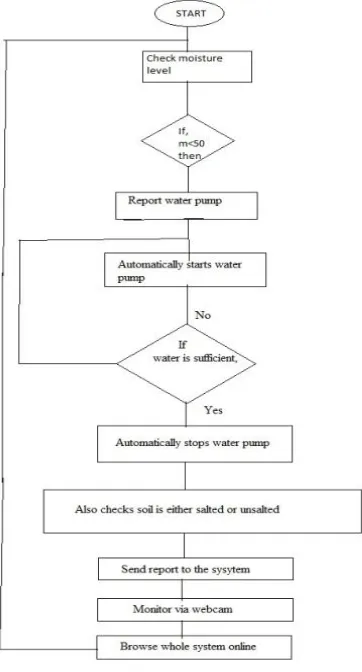
C. Algorithm
Step 1: Start the methodology. Step 2: Check moisture level.
Step 3: If moisture level is low, reports to the water pump. Step 4: Automatically starts the water pump.
Step 5: If water is sufficient to the farm, then automatically stops the water flow from water pump. Step 6: Also checks the soil is either salted or unsalted.
Step 7: Send report to the system.
Step 8: Whole system is monitored via webcam.
Step 9: Browse whole system by online.
[image:4.612.195.376.322.658.2]D. Flowchart
Fig 3: Flowchart of system
V. CONCLUSION AND FUTURE SCOPE
Technology (IJRASET)
Minimizes water waste and improves plant growth. The project is intended for small gardens and residential environment. By using advanced soil moisture sensor, the same circuit can be expanded to large agricultural fields. The circuit is designed to work
automatically and hence, there is no need for any human intervention. You Can see your Live Streaming of Farm from anywhere.
1) This automation system will be used for disabled and people at long distance and farms
2) The system increases the crop productivity and reduces farmer’s workload.
3) There is efficient usage of water.
4) The time consumed is less therefore giving more throughputs.
5) Controls the growth of weeds, saving the fertilizer.
6) Erosion of soil could be stopped totally by using this type of a system.
7) Leads to development of a cost effective irrigation control system.
B. Future Scope
In Future work, an exhaustive research about the e-agriculture should be done. It aimed to analyze the new technology for reliable transmission which improves the efficiency of the E-agriculture product. It includes some new algorithm for enhancing the agriculture product and environment services.We can change the programming as per as requirement for the crops. We will implement this project on large scale.In this project we have required power supply, so in future we will implement this system using solar panel. In future we can also use wireless sensors.
VI. ACKNOWLEDGMENT
Behind every endeavour, there are people who make it happen. The making of this project is the result of many invisible hands helping in every way and express our deepest gratitude to all of them. First and foremost, we would like to express our profound sense of gratitude and we are indebted to our guide Prof. AJAY KATKAR, Department of Electronics and Telecommunication Engineering, all teaching & non-teaching staff, and my batch mates without whom the success of this project would have been partially not possible. We would like to express our deep gratitude to our principle sir Dr. S. M. Shendokar who motivates us for our project. We also wish to express our sincere thanks to the Prof. A. B. Wani, Head of Department, Electronics and Telecommunication Engineering, Bharati Vidyapeeth’s college of Engineering, Lavale, Pune for this invaluable guidance.
REFERENCES
[1] The Study and Application of the IOT Technology in Agriculture by Ji-Chun Zhao, Jun-feng Zhang, YU Feng from Computer Science and Information
Technology (ICCSIT)
[2] Study about IOT’s Application in “Digital Architecture” Construction by Weimei Zhang from Electrical and Control Engineering (ICECE)
[3] Rafael Muñoz-Carpena and Michael D. Dukes, Automatic Irrigation Based on Soil Moisture for Vegetable Crops, IFAS Extension, 2005.
[4] K.N.Manjula B.Swathi and D.Sree Sandhya , Intelligent Automatic Plant Irrigation System.
[5] G. Vellidis , M. Tucker, C. Perry, C. Kvien, C. Bednarz, “A Real-Time Wireless Smart Sensor Array for Scheduling Irrigation”, National Environmentally
Sound Production Agriculture Laboratory (NESPAL), 2007.
[6] Constantinos Marios Angelopoulos, Sotiris Nikoletseas , Georgios Constantinos A Smart System for Garden Watering using Wireless Sensor Networks,
MobiWac ,October 31–November 4, 2011.
[7] R.suresh, S.Gopinath, K.Govindaraju, T.Devika, N.Suthanthira Vanitha, GSM based Automated Irrigation Control using Raingun Irrigation System,