PERCEPTIONS OF GRADUATE STUDENTS ON USING WIKIS IN A
STATISTICS CLASS: A CASE STUDY
Umawathy Techanamurthy1, Baharom Mohamad2, Mohamad Hisyam Mohd. Hashim2, Dorothy DeWitt1, Norlidah Alias1
1
Faculty of Education, University of Malaya 2
Faculty of Technical Education, University Tun Hussein Onn
Abstract. Wiki is an emerging technology being adopted in higher education. Among the uses of wikis in education are as a substitute for a course website, a communication medium between students and as an environment for writing collaborative assignments. However, there has been little research on the adoption of Wiki technology among Malaysian postgraduates. The participants of this research were pre-service academic staffs of Malaysian Polytechnics and Community Colleges taking their Masters in Technical and Vocational Education course. The purpose of this case study was to explore, understand and explain the various ways in which participants reflect on their very recent experiences in writing collaborative assignments in a Wiki. The Statistics in Technical Education Research for a Masters course for pre-service academic staffs was chosen as literature mentioned that statistics instruction should be similar to the way statistical practice is conducted collaboratively. For the purpose of this study, participants completed a wiki based group assignment. Data was collected from interviews, blog posts, Wiki log history and field notes. It was found that the possible educational advantages of wikis have not been fully utilized because of inadequate participation.This was because students faced problems when using the Wiki made them resort to discussing face-to-face first to divide their tasks. They resorted to the traditional way of completing group assignments but facilitated by technology. Hence, the potential educational benefits of wikis have not been fully exploited because of limited participation. However, several implications for implementing more effective wiki based learning were drawn from the interview data. On a positive note, students found wikis useful for sharing knowledge anytime as long as there was an Internet connection and they could critically assess change during peer editing. A conceptual model was developed based on the constructs from Technology Acceptance Model (Davis, 1987) and the Wiki Diffusion Model (Hester & Scott, 2008) to illustrate the findings of this study. This study is short-term and small-scale, so generalisable conclusions should not be made. This study was intended to be an initial pilot study to explore, understand and explain the various ways the participants used the Wiki rather than a defined program to use.
1 Introduction
researches have been conducted to find out how Learning Management Systems have found its way in Malaysian universities (Saad, 2005 and Masrom, 2007). In today’s Web 2.0 world, Wikis have
emerged as a tool that may complement or replace the use of traditional course management systems as a tool for disseminating course information. Because of a wiki’s collaborative nature, it allows
students to participate in the process of course management, information sharing, and content creation (Frydenberg, 2008). A Wiki or WikiWikliWeb (wiki wiki) is Hawaiian for “quick” (Godwin-Jones,
2003; Augar, Raitman and Zhou, 2004; Lamb, 2004; McKiernan, 2005a and Long, 2006) and is a technology that allows students to produce group projects collaboratively (Putnik, Ivanovic, Budimac and Bothe, 2013). Although the wiki was introduced more than a decade ago, its use is relatively new in academia (Fountain, 2005, Evans, 2006, Chao, 2007). Despite all the interest about the benefits of Web 2.0 technologies, it was found that newer technologies, such as Wikis and Blogs are only used by a relatively small proportion of students, and nowhere near as frequent as some commentators have been suggesting (Kennedy, Dalgarno, Gray, Judd, Waycott, Bennett, Maton, Krause, Bishop, Chang and Churchward, 2007). Moreover, it should be noted that most studies about Wikis in the literature were conducted in countries with English as the first language which have higher Internet penetration rates than Malaysia. The likelihood of Wiki success amongst Malaysian postgraduates also has not been investigated adequately.
2 Purpose of Study
The aim of this research is to provide an in-depth qualitative case study to explore, interpret and explain the several ways in which participants reflect on their very recent experiences in writing documents collaboratively in a Wiki environment in a Statistics in Technical Education Research classroom in a local university in Malaysia. It is also a survey to ascertain out how they comprehend the advantages of the class Wiki compared to traditional methods of functioning on a group task and how they really utilized it to finish their group task. Moreover, research that tackles educational benefits and drawbacks of using wikis as a collaborative learning tool is still rather limited (Elgort, Smith and Tolland, 2008), and the study aims to further contribute to the body of evidence on using wikis in higher education which will pave way for better use of wikis in the future in this university. The research findings are relevant for anyone who is interested in understanding the impact of implementing new technologies in educational settings especially for pre-service academic staffs.
3 Problem Statement
Wiki experiences or likelihood of Wiki success amongst pre service academic staffs also have not been investigated adequately.Besides that, most studies of technology integration focussed on in service academic staffs. Divaharan(2011) highlighted that it is essential for pre-service academic staffs to gain exposure on a tool before it is used by the pre-service academic staffs as part of their technology integrated classrooms in the future.
4 Research Questions
The focus of this study is to investigate the participants’ experiences using their class Wiki. The
following sub questions cluster around this main research question:
1. How are the initial attitudes of the participants towards having to adopt Wiki in their Statistics classroom?
2. What are the perceived advantages of the Wiki?
3. What are the perceived complexities encountered by the participants while using the Wiki?
5 Literature Review
Moore and Benbasat (2001) drew on Rogers Diffusion of Innovation Theory as well as Technology Acceptance Model to develop eight constructs measuring users’ perceptions of adopting
an information technology innovation: voluntariness, image, relative advantage, compatibility, ease of use, result demonstrability, trialability, and visibility.
Wiebrands (2006) reported the experiences of using Wiki in an academic library environment by analyzing the advantages and disadvantages of wiki technology and the problems experienced training library staff in using the Wiki. Next, Yeh and Lahman (2007) conducted a phenomenological study to understand students’ perceptions of using asynchronous online discussion as a learning tool. The data
gathered about the interviewees’ perceptions of the asynchronous online discussions such as purposes, group size, tools for learning, advantages/disadvantages, and the instructor’s role in using
asynchronous online discussion as a learning tool. Schaffert, et al., (2006) suggested ways in which wikis can be useful in project knowledge management, including brainstorming and exchange of ideas, coordination of activities, coordination and records of meetings, and serving as a notepad for common information items.
and immediate access to the most recent version of the document which enables members to collaboratively build on each other’s work. Korfiatis et al.(2006) suggests that the final document is the outcome of a “community process involving certain social interactions embedded in the content modification”. Robertson (2008) used a wiki to support problem based, and group based learning and
assessment in a blended learning approach (wiki plus face to face contact) for vocational teachers participating in a teacher training program at RMIT University, Melbourne, Australia.
6 Method
6.1 Participant
The participants are from a classroom of 22 pre service academic staffs who were novice Wiki users in a Statistics in Technical Education Research classroom. These pre service academic staffs will become teaching staff in Malaysian Polytechnics and Community Colleges after completing their studies. The Statistics in Technical Education Research module was also chosen as statistics instruction should resemble statistical practice which is viewed as being collaborative in nature (Ben-Zvi, 2007) and (Roseth, Grafield and Ben-(Ben-Zvi, 2007). All the participants have completed their first degree in various fields such as Electrical Engineering, Mechanical Engineering, Civil Engineering and Information Communications and Technology before continuing their Masters in this university. At the time of data collection, the participants were in their second semester of their studies. A hands on training to use the Wiki was provided to the participants three times throughout the semester by the researcher as the trainer. The researcher setup the class Wiki on a free Wiki platform (Wikispaces) and prepared the training materials which covered details on how to use the Wiki step-by-step since all participants were novice Wiki users. Participants were divided into six groups to complete their wiki project. The group number is related to the respective group’s space in the class Wiki.
6.2 Data Collection
An exploratory case study approach was used to find out the participant’s experience in using Wiki
in an educational setting (Merriam, 2001). The methods used to collect data were as follows:
i. Observation of the training sessions where the class of participants was taught how to use the Wiki for the first time by the researcher. All these moments were videotaped (interactive);
field notes (non-interactive) and the video of the training sessions as the available information provides meaningful answers to the research questions and validate interview data;
iii. Individual and focus group interviews were conducted with the participants’ right after the training at the beginning of the semester and at the end of the semester after they have completed the module (interactive). A semi-structured interview, rather than a structured interview, was considered best for this research. The interviews in this research were also conducted via e-mail and Instant Messaging interviewing saved time and cost and ensure conveniently and flexibly-timed appointments for the interviewees.
6.3Data Analysis Procedures
Firstly, face to face interview data were transcribed. Next, the researcher, saved the collected digital data (i.e. blog posts and comments, observations, and interview forms, e-mail and Instant Messaging Interviews) into .rtf (Rich Text Format) extension to be imported into Nvivo 2.0 software. Pseudonyms were assigned based on the names filed out by the participants in the Interview Consent Form. Next, transcripts and blog posts were read in order to identify categories and themes with a focus on the phenomena being researched. Using NVivo’s Coder Window, it was quick to generate
codes by highlighting the text on screen. The findings were written descriptively based on the interview excerpts. Ongoing ideas were noted from time to time. Next, themes were developed, given tentative titles, and grouped with demonstrative quotes from participants' interviews along with preliminary interpretations. This process was iterative: as analysis progressed themes were clarified, refined and added to. The blog posts and interview activities were in Malay and translations were made by the researcher into English as necessary.
The findings were validated by triangulating methods as data was collected from various sources. Member checking, which involved e-mailing participants to check the accuracy of facts and observations, took place as data collection transitioned into data analysis. Crosschecking helped the researcher maintain reflexivity by encouraging self-awareness and self-correction. After the initial write-up of the study, feedback on some of the findings was sought in the field from the some of the participants. They were also asked to comment on whether the researcher’s interpretations rang true
7 Findings
The themes captured for the experience of using the class Wiki for the pre-service lecturers in the Statistic classroom will be discussed in sequence of the research questions. Firstly, it was the
Outcomes of the Computer Skills Survey followed by Initial Attitudes towards Wiki Adoption in their Statistics classroom. The next themes were the Observed Relative Advantages followed by Observed Complexities encountered with Wiki use. Based on the findings, there is a flow of data from their participants’ first encounter with the Wiki, their Wiki usage experience followed by their future Wiki
use.
Outcomes of the Computer Skills survey showed that none of the participants gained Internet access from the Computer Labs, the library at the campus or at cybercafés or at their residence with
broadband connection. They used the Internet to complete their assignments, use search engines such as Yahoo and Google, to check and reply e-mails, playing computer games, chat real time using instant messaging applications and reading online news and reading blogs. Only one respondent had his own blog and a few participants read other people’s blogs. Most of them spent a lot of time in a
week social networking using their respective Friendster and Facebook accounts. All of them have used the most famous online encyclopedia (Wikipedia) for information seeking but none has contributed to it.
7.1 Initial Attitudes towards Wiki Adoption
Next, during the training session, participants were excited and eager and participated in the ice-breaker session by editing their own group page by adding details about themselves. Prior to this, they did not know that they could not have their own Wiki since the only Wiki they knew was Wikipedia and were ecstatic when they found they could actually edit the Web just by clicking the Edit this Page button.
That’s how I felt. I could do something on the Web! I feel that other people can open and see
my work. It feels like a Web Designer! That makes me proud and happy! (Amran)
7.2 Observed Advantages
When asked about the advantages of Wikis, they noted that they could now access their work from any computer and do everything online. This also enables participants to work on their own pace and they can do their work bit by bit without waiting for others to start.
Anytime, anywhere as long as there is Internet, there is no need to wait till tomorrow to meet up to edit, by then, the idea would have been forgotten! (Zamri)
We did (our work) little by little, part by part. There was no need to rush. There was no need to find time. No need to plan. Whenever you have the time, you just do it! (Nor)
Besides that, all the group work in at one place, there is also no need to email files to and fro or send files via virus prone USBs. Wikis also allow for group project work to be critically assessed by team members since the team direction is based on the contribution on the space on the Wiki and peers are seen as valuable sources of information. Moreover, since one can work on a Wiki, there is no need to be physically present and gathered to do group work or be online at the same time. This saves time and costs. Participants highlighted that they perceived the wiki as a savior.
Actually, we did the concept map early in the morning. John stays in the hostel, but, we need to finish our work. At that time, we really needed the wiki(laughs). I can’t remember what time it was, but it was in the morning, pre-dawn, about 3 – 4 a.m. At that time, wiki was our savior (laughs). (Amran)
Lenny, an Information Technology graduate, posted on the class blog that she could save now on her handphone credit as she could discuss on the Wiki as compared to sending text messages to her friend instead. In addition to that, Siti highlighted on the class blog that by using Wiki, she no longer needs to transfer files via USB drives which are virus prone. Her team members added that by using a wiki, they can also see the assignments of other group members to gain ideas. Most often than not, other groups may want to see the pages of other groups as peers are often seen as valuable sources of information. Moreover, through the Wiki history, no one can cheat about their Wiki contribution since every participant’s contribution is tracked. Participants also highlighted that they were able to
7.3 Observed Complexities
Having noted all the positive attributes about the wiki which the students found appealing, it must be pointed out that there were aspects about the wiki with which the students clearly were not comfortable. I shall categorize them as the complexities faced by the participants while they were using the wiki. Many participants complained about the formatting problem they faced in the Wiki. This made them to format their work properly in Microsoft Word first, and then transfer it to the Wiki. The other main technical hitch that disturbed participants were the inability to edit the wiki page simultaneously, which was detected during the first training session observation, as there were many reports of this problem as every group member was trying to edit their wiki group page simultaneously during the ice breaker exercise as highlighted by Zamri:
It was quite difficult because I edited and then it went missing. So I got worried. Apparently you cannot edit at the same time. It was weird because I knew I had saved, but when I viewed, it was not there. (Zamri)
He then informs his friends beforehand about the time he will be editing his work to avoid any conflicting edits. Wu, Vassileva, Zhu, Fang and Tan (2013) designed a visual feedback dialog box to increase users' awareness of task conflict to promote user participation, gain better conflict resolution and improve group performance. Another disadvantage was the lack of Internet access for some participants. Laughton(2010) asserted that it only takes an internet connection to maximize the usage of wikis in most cases. Alya, who is staying at a rented premise, which has Internet access highlighted that some of her group members do not have Internet access at home:
We must remember that not all Master students are staying at rented premises (where there is usually Internet access available), some are staying in the hostel and they are unable to get their wireless access at times. So, it’s difficult to enter the wiki. The only time they have is during lab sessions where they get to open their wiki. Once they are back in their hostel, the wireless strength is not so good so they don’t get to enter wiki straightaway. So, we only get
to discuss using the wiki in the lab. (Alya)
8Discussion
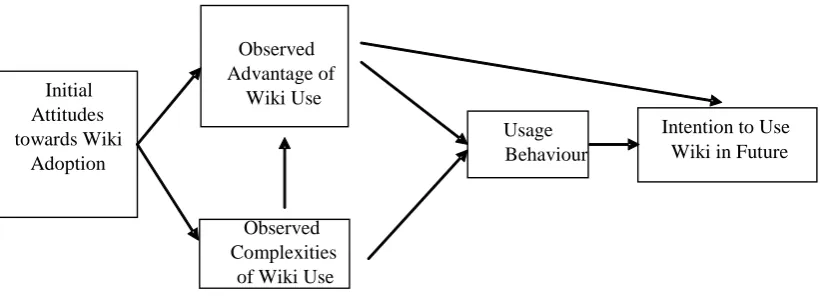
[image:9.595.73.485.351.504.2]The next step was to develop a conceptual schema that ties the data together and answers the research question.The conceptual model developed is named the Wiki Adoption Experience Model which explains the flow of the Wiki experience experienced by the participants in this study. Complexity is determined as the degree to which an innovation is perceived as being difficult to apply and has a negative relationship towards the adoption process as known by the participants in this survey. Complexity, however, can be likened to the construct of Perceived Ease of Use from TAM as noted by Moore and Benbasat (2001). At first glimpse, this model adopts the structure of the Technology Acceptance Model by Davis (1989). Nevertheless, it uses two of the constructs of Diffusion Innovation Theory adapted to Wikis which are the Advantage and Complexity constructs by Hester and Scott (2008). The sequence of Usage Behavior and Behavioral Intention constructs has been changed since the work concentrated on the Intention to use the Wiki in the future which was influenced by the other preceding constructs.
Figure 1: Wiki Adoption Experience Model
When participants were acquainted to the Wiki for the first time, they were really excited as it was new to them. When they used the Wiki to do their assignment, they observed its advantages compared to the traditional way of working on a collaborative work. However, they also faced technical complexities during the use of the Wiki such as formatting problems and the inability to edit the Wiki simultaneously. They only used the Wiki to upload the assignment and did some peer editing on it to complete their group work which enabled a sense of community among them. However, most of the time participants preferred working face to face.
Participants who are pre service academic staffs of Malaysian polytechnics or Community Colleges, however, did not consider using Wikis in the future, citing lack of technical skills to set up a
Usage Behaviour Initial
Attitudes towards Wiki
Adoption
Observed Advantage of
Wiki Use
Intention to Use Wiki in Future
Observed Complexities
Wiki. However, there were some enthusiastic participants who would like to use in future depending on the subject they will be teaching and if it is necessary for them to use a Wiki. They felt that they were ready to test out new educational technologies other than Wiki as long as it is interesting and eases their workload. Participants also provided feedback for future Wiki implementations that will be useful for future researchers and the developers of the Wiki tool that are working very hard to reduce the Wiki complexity.
9 Recommendations
Based on the findings that have been analyzed and discussed, the researcher has a few recommendations for different audiences, potential Wiki instructors and for future research. It is urged that the institution studied in this study improves its broadband services in the campus and in the hostels since the current bandwidth is a barrier for students to maximize the potential of Wiki. The institution can also incorporate their current learning content management system (LCMS) with a Wiki functionality to generate more interest on Wiki. Laughton (2010) suggested that wikis can be investigated as a beneficial substitute for learners as they will get the convenience of working with their peers.
Instructors that plan to use the Wiki in the future are recommended to provide motivation to students via constant feedback to them. They also have to explain to students the importance of collaborative group work and make it a requirement for the course. Next, the evaluation criteria must also include peer evaluation so that non-contributing members will be penalized and at the same time the successful contributors are given reinforcement by being appreciated. For future research, it is recommended that a comparative study be conducted to determine the perceived usefulness of group wikis across different subject modules. Accordingly, it is recommended that a study to investigate the attrition rates for students using online technologies and an evaluation of its effectiveness. Accordingly, it is recommended that a tool is developed to measure the strength of collaboration based on the available wiki log history. Further inquiry may also refer to other facets of the learning process such as: learners’ motivation to take part in the institution of the wiki, or learners' motivation
to employ any other Web 2.0 application.
10 Conclusion
level of enthusiasm of previous publications which mention the value of Wikis which can boost collaborative learning skills. The potential educational benefits of wikis have not been fully exploited because of limited participation. This was also observed in Neumann and Hood (2009) when they found that using wiki improved student engagement with other students, intellectual engagement and class attendance, but not performance on assessment compared to working individually.
As a conclusion, this study found that despite introducing the Wiki as a tool to facilitate collaboration, the practice among participants remained the same as before. Collaboration and cooperation will not simply occur because wikis are introduced to one’s practice as asserted by
References
Augar, N., Raitman, R. and Zhou, W., (2004). “Teaching and learning online with
wikis”. Proceedings of the 21st Australasian Society for Computers in Learning in Tertiary Education (ASCILITE) Conference, Perth: December 5-8, 95-104. Retrieved September 9, 2007, from
http://www.ascilite.org.au/conferences/perth04/procs/pdf/augar.pdf
Ben-Zvi, D. (2007). “Using Wiki to Promote Collaborative Learning in Statistics
Education”, Technology Innovations in Statistics Education: 1(1), Article 4. Retrieved November 5, 2007, from http://repositories.cdlib.org/uclastat/cts/tise/vol1/iss1/art4
Callahan, S. (2006). Why people don't use collaboration tools. Retrieved September 6, 2007, from http://www.anecdote.com.au/archives/2006/09/why_people_dont.html
Chen, H.L., Cannon, D., Gabrio, J. Leifer, L. Toye, G. & Bailey, T. (2005). “Using
wikis and weblogs to support reflective learning in an introductory engineering design course”. Proceedings of the 2005American Society for Engineering Education Annual Conference & Exposition, Portland, Oregon: June12-15. Retrieved January 2, 2008
fromhttp://riee.stevens.edu/fileadmin/riee/pdf/ASEE2005_Paper_Wikis_and_Weblogs.pdf
Davis, F. D. (1989). “Perceived usefulness, perceived ease of use, and user acceptance of information technology”. MIS Quarterly, 13, 319–340.
Divaharan, S.. (2011). Learning new technology tools in pre-service teacher education: A model for instructional approach. In G. Williams, P. Statham, N. Brown & B. Cleland (Eds.), Changing Demands, Changing Directions. Proceedings ascilite Hobart 2011. (pp.352-363).
http://www.ascilite.org.au/conferences/hobart11/procs/Divaharan-full.pdf
Elgort, I. (2007). “Using wikis as a learning tool in higher education”. ICT: Providing choices for learners and learning. Proceedings ascilite Singapore 2007. Retrieved September 6, 2008 from
http://www.ascilite.org.au/conferences/singapore07/procs/elgort.pdf
Elgort, Smith and Toland (2008).Is wiki an effective platform for group course work? Australasian Journal of Educational Technology2008, 24(2), 195-210. Retrieved October 6, 2008 from
http://www.ascilite.org.au/ajet/ajet24/elgort.html
Fountain, R. (2005). “Evaluation tools”. Dossiers technopédagogiques. Retrieved September 6, 2008 from
Godwin-Jones, R. (2003). “Blogs and Wikis: Environments for On-line Collaboration”. Journal of Language Learning & Technology, 7(2). 12-16. Retrieved August 29, 2007 from
http://llt.msu.edu/vol7num2/pdf/emerging.pdf
Frydenberg, M. (2008). “Wikis as a Tool for Collaborative Course Management”. MERLOT Journal of Online Learning and Teaching. 4(2), June 2008 Retrieved September 7, 2007 from
http://jolt.merlot.org/vol4no2/frydenberg0608.htm
Hester, A.J. and Scott, J.E.(2008). A Conceptual Model of Wiki Technology DiffusionHawaii International Conference on System Sciences, Proceedings of the 41st AnnualVolume , Issue , 7-10 Jan. 2008 Page(s):32 - 32Digital Object Identifier 10.1109/HICSS.2008.10
Jones, P. (2007). “When a wiki is the way: Exploring the use of a wiki in a
constructively aligned learning design. In ICT: Providing choices for learners and learning. Proceedings ascilite Singapore 2007. Retrieved September 26, 2008 from
http://www.ascilite.org.au/conferences/singapore07/procs/jones-p.pdf
Kennedy, G., Dalgarno, B., Gray, K., Judd, T., Waycott, J., Bennett, S., Maton, K., Krause, K.L., Bishop, A., Chang, R. and Churchward A. (2007). “The net generation are not big users of Web 2.0 technologies: Preliminary findings”. ICT: Providing choices for learners and learning. Proceedings ascilite Singapore 2007. Retrieved September 18, 2007 from http://www.ascilite.org.au/conferences/singapore07/procs/kennedy.pdf
Korfiatis, N.T., Poulos, M. and Bokos, G. (2006). “Evaluating authoritative sources using social networks: an insight from Wikipedia”. Journal of Online Information Review, 30(3) pp. 252-262
Lamb, B. (2004). “Wide Open Spaces: Wikis, Ready or Not”. EDUCAUSE Review, vol. 39, no. 5 (September/October 2004): 36–48. Retrieved September 7, 2007
fromhttp://connect.educause.edu/Library/EDUCAUSE+Review/WideOpenSpacesWikisReadyo/40498
McKiernan, G. (2005). “Wikis: Disruptive technologies for dynamic Possibilities”. [Powerpoint presentation]. Retrieved September 2, 2007 from http://www.ticer.nl/05carte/ Retrieval date: 2 September 2007
Laughton, P. (2011).The use of wikis as alternatives to learning content management system. Vol. 29 No. 2, 2011. pp. 225-235. Emerald Group Publishing Limited. 0264-0473. DOI 10.1108/02640471111125186
Long, C., (2006). “Getting Wiki With It”. NEA Today. Retrieved October 20, 2007 fromhttp://www.nea.org/neatoday/0610/feature2.html
Nanayakkara, C. (2004). “Model of User Acceptance of Learning Management Systems: a study withinTertiary Institution in New Zealand” (2) The International Journal of Learning, Volume 13, Issue 12, pp.223-232.
Neumann, D.L. and Hood, M. (2009). The effects of using a wiki on student engagement and learning of report writing skills in a university statistics course. Australasian Journal ofEducational Technology 2009, 25(3), 382-398
Pearce, J. (2007). “What is a Wiki?”. Retrieved December 19, 2007
fromhttp://www.scienceofspectroscopy.info/edit/index.php?title=Using_wiki_in_education
Putnik, Z., Ivanovic, M., Budimac, Z. & Bothe, K. (2013). Analysis of students' behaviour based on
participation and results achieved in Wiki-based team assignments.. In K. I. Diamantaras, G. Evangelidis, Y. Manolopoulos, C. K. Georgiadis, P. Kefalas & D. Stamatis (eds.), BCI (pp. 179-186), : ACM. ISBN: 978-1-4503-1851-8
Robertson, I. (2008). “Learners' attitudes to wiki technology in problem based, blended learning for vocational teacher education”. Australasian Journal of Educational Technology, 24(4), 425-441. Retrieved October 3, 2008 from http://www.ascilite.org.au/ajet/ajet24/robertson.html
Roseth, C.J., Garfield, J.B. and Ben-Zvi, D. (2007). “Collaboration in Learning and Teaching Statistics”. Journal of Statistics Education. 16(1). Retrieved March 3, 2008 from
www.amstat.org/publications/jse/v16n1/roseth.htm
Saad, S.(2005). “Open Source Updates in Malaysia”. MIMOS Berhad, 6th Asia OSS Symposium Activities. Retrieved July 15, 2008 from www.asia-oss.org/sep2005/materials/economies/Malaysia_Sep6_1200.pdf
Schaffert, S., Bischof, D., Buerger, T., Gruber, A., Hilzensauer, W. & Schaffert, S. (2006). Learning with semantic wikis. Proceedings of the First Workshop on Semantic Wikis – From Wiki To Semantics (SemWiki2006), Budva, Montenegro: June 11-14, 109-123. Retrieved November 12, 2007 from http://www.wastl.net/download/paper/Schaffert06_SemWikiLearning.pdf
Wu, K., Vassileva, J., Zhu, Q., Fang, H. and Tan, X. (2013). Supporting group collaboration in Wiki by increasing the awareness of task conflict. Aslib Proceedings: New Information Perspectives. Vol. 65 No. 6, 2013. pp. 581-604Emerald Group Publishing Limited. 0001-253X. DOI 10.1108/AP-05-2013-0046
Yeh, H., & Lahman, M. (2007). Pre-service teachers’ perceptions of asynchronous online discussion on blackboard. The Qualitative Report, 12(4), 680-704. Retrieved September 30, 2008 from