Towards Enhancing the Compilation of Al-Hadith Text in Malay
Andrew Bimba
1, Maizatul Akmar Ismail
2, Norisma Idris
3, Salinah Jaafar
4, and Rohana Mahmud
5 Quran and Hadith Research Group;1, 2, 3, 5
Faculty of Computer Science and Information Technology;
4
Academy of Malay Studies; University of Malaya, 50603 Kuala Lumpur, Malaysia
Abstract.
The statement and conducts of Prophet Muhammad (SAW), was memorized, written down and later passed by his companions from one generation to another. Later, as the authenticity of the text became threatened, Islamic scholars from Muslim nations collected thousands of these narratives and distinguished the true wisdom from fabricated ones. However, statements are still attributed to the Prophet by individuals with no knowledge of al-Hadith. Currently, with the existence of the internet and the popularity of social media, the threat to the access and existence of fake al-Hadith is more likely than ever. Our first step to handling this challenge is to develop a tool that will enhance the process of compiling authentic al-Hadithfrom various sources. Due to the sensitive nature of al-Hadith text the tool must be reliable. To achieve this reliability a well-structured relational database with a user interface was designed and developed to store a l-Hadith text in Malay Language. These development will enhance the compilation process, by ensuring data is stored appropriately. Subsequently, the tool will serve as a reference guide to the general public, who wish to verify the authenticity of al-Hadith in Malay text. Furthermore, it provides computer scientist with an opportunity to extract, analyze and perform inference on the data.
Keywords: Database, Al-Hadith, Sahih, Snad, Isnad, Mastn
1.
Introduction
Al-Hadith, a collection of conducts and sayings of Prophet Muhammad (SAW), serves as part of the major source of guidance for Muslims. In recent years, they have been a rapid increase of data globally. Access to this data has also become easier with the increase in popularity of phones and tablets. Currently, there are several sources of al-Hadith on the internet and in several books written by Islamic scholars. Unfortunately, these various sources of information, exposes Muslims to both authentic and fabricated al-Hadith. We are therefore faced with the challenge of distinguishing between true and fabricated al-al-Hadith. Overcoming this obstacle will enable Muslims to have access to, and determine the authenticity of al-Hadith. The first step towards addressing this problem is to develop a uniform and well-structured storage for these texts. This will offer an opportunity for computer scientist to re-analyze, extract and enable automated inference and querying of the data. For analyzing data, making proper inference and developing most user interaction applications, there is a need for data in some structured format. This data when structured makes it easier to analyze and extract knowledge.
With the discovery of false al-Hadith in al-Hadith literature, Mustalah (Science of Al-Hadith) was established to distinguish between authentic and fabricated Hadith (Hasan, 1994; Khan, 2013). The al-Hadith scholars made extensive verifications to the two main parts of al-Hadith, sanad or isnad (chain of reporters) and mastn (text), according to laid down principles (Hasan, 1994). These lead to the classification of al-Hadith based on five different classes which includes 1) reference to a particular authority; 2) links of isnad - interrupted or uninterrupted; 3) the number of reporters involved; 4) the nature of the text and isnad; 5) the reliability and memory of the reporters (Hasan, 1994; Rashid, 2012; Yahaya & Hasan, 2014). These classes are important to distinguish between authentic and fabricated al-Hadith.
As at the time of this writing, we have not come across any system which provides individuals with access to authentic al-Hadith in Malay. However, some works have been done in other languages such as Arabic, English, and Indonesian Malay etc. Our main objective is to develop a tool that will enhance the process of compiling authentic al-Hadith from various sources. The tool proposed is a web based system,
Corresponding author. Tel.: +601 79676375 fax: +601 79579249
with a well-structured relational database. In the next section, we will discuss the classification of al-Hadith, some existing works on the compilation of al-Hadith and our approach. Subsequently, in section 3 we discuss the al-Hadith compilation system and explain the system development in section 4. Finally, we conclude our discussion of the project in section 5.
2.
Related Works
Al-Hadith is said to have been transmitted orally, by a reliable chain of narrators. To protect the Hadith from false information and forgery, Umar Ibn Abdul-Aziz ordered the official compilation of al-Hadith in a book (Ali-Agan, 2012). Since then, most classical al-Hadith scholars were accustomed to compiling the al-Hadith text by hand. Unfortunately, this resulted in a lack of research related to electronic compilation of Hadith text (Azmi & Badia, 2010). An exception to using this approach was M.M al-Azami (1991).
Prototype CD-ROM discs were used by M.M al-Azami (1991), to compile al-Hadith. The material contained seven collections of al-Hadith, and selected text in ten different languages, resulting to seventy-five thousand hadith in total (Marston, 2014). His work laid the foundation for other institutions to venture into this field. Al-Hadith text was computerized by these institutions, and basically provided searching and browsing capabilities. Unfortunately, these commercial institutions are not interested in sharing this knowledge, but are more concerned with the monetary aspect (Azmi & Badia, 2010). As a result, only few research publications have been made in this area.
Recently, other researchers have applied techniques to analyse al-Hadith text. Jbara (2010) used classification algorithms to discover knowledge within al-Hadith text, by assigning the text to a predefined class. Also in the same year, Azmi & Badia (2010) developed an application to automatically generate a narration tree for al-Hadith text. The application uses shallow parsing, domain specific grammar and annotated al-Hadith text to recognize a narrators name and create the tree. In the next section, we will outline our approach to compiling al-Hadith text.
3.
Our Approach to Al-Hadith Compilation
Hadith Text
Book/Chapter Topic
Translated Malay Text Original Arabic
Text
Authenticity Reporter
[image:2.595.131.465.445.630.2]Lesson
Fig 1: Structure of Compiled Hadith Text
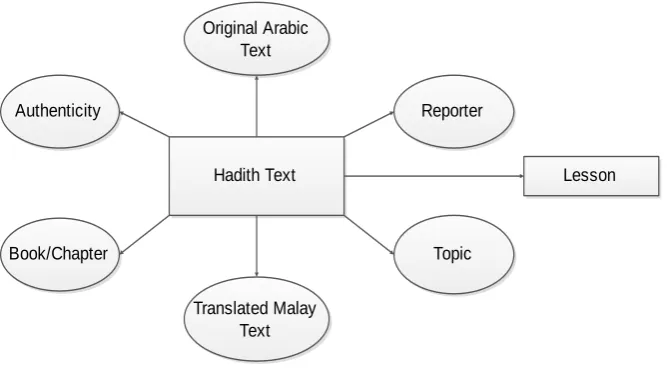
authentic), Hasan (good), da’if (weak). Each al-Hadith text was categorized based on the topics they addressed, for example, solat (prayers). As shown in figure 1, the structure of each compiled al-Hadith text comprises of the original Arabic text, translated Malay text, the reporter, topic, book/chapter, the authenticity and the lesson derived from the al-Hadith as shown in figure 1. The first step taken to provide access to this well-structure al-Hadith text is by providing an appropriate data warehouse. In figure 2, a sample of the compiled al-Hadith text is shown. The figure shows the various attributes within the manually compiled authentic al-Hadith text. The highlighted data within the text is saved in the database, as the preceding attribute in italics, as shown in figure 2.
The next section details the design and development of the al-Hadith compilation tool.
Fig 2: Sample Compiled Hadith Text with Highlighted Attributes
4.
System Development
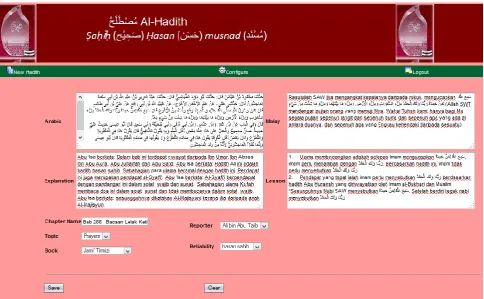
A web based tool is proposed, to enhance the compilation process of authentic al-Hadith in Malay. Due to the sensitive nature of al-Hadith text the tool must be reliable. To achieve this reliability a well-structured relational database with a user interface was designed and developed to store al-Hadith text.
4.1
Database Design
Chapter Bab 266 : Bacaan Lelaki Ketika Mengangkat Kepalanya Daripada Rukuk
Original Arabic Text ٦٢٢ َع اَنَثَّدَح :َلاَق ُّيِسِلاَيَّطلا َدُواَد وُبَأ اَنَثَّدَح :َلاَق َن َلَْيَغ ُنْب ُدوُم ْحَم اَنَثَّدَح ِنَمْحَّرلا ِدْبَع ْنَع ،يِّمَع يِنَثَّدَح :َلاَق ُنوُشِجاَملا َةَمَلَس يِبَأ ِنْب ِ َّاللَّ ِدْبَع ُنْب ِزيِزَعلا ُدْب
عِفاَر يِبَأ ِنْب ِ َّاللَّ ِدْيَبُع ْنَع ،ِجَرْعَلأا َلاَق بِلاَط يِبَأ ِنْب ِّيِلَع ْنَع اَنَّبَر ُهَدِمَح ْنَمِل ُ َّاللَّ َعِمَس َلاَق ِعوُكُّرلا ْنِم ُهَسْأَر َعَفَر اَذِإ َمَّلَسَو ِهْيَلَع ُ َّاللَّ ىَّلَص ِ َّاللَّ ُلوُسَر َناَك ُدْعَب ءْيَش ْنِم َتْئِش اَم َءْلِمَو اَمُهَنْيَب اَم َءْلِمَو ِضْرَ ْلأا َءْلِمَو ِتاَوَمَّسلا َءْلِم ُدْمَحْلا َكَلَو . َلاَق يِفَو باَبْلا ْنَع ِنْبا َرَمُع اَو ِنْب ساَّبَع ِنْباَو يِبَأ ىَف ْوَأ يِبَأَو َةَفْيَحُج يِبَأَو ديِعَس َلاَق وُبَأ ىَسيِع ُثيِدَح يِلَع ثيِدَح نَسَح حيِحَص ُلَمَعْلاَو ىَلَع اَذَه َدْنِع ِضْعَب ِلْهَأ ِمْلِعْلا ِهِبَو ُلوُقَي ُّيِعِفاَّشلا َلاَق ُلوُقَي اَذَه يِف ِةَبوُتْكَمْلا لاَو ِعُّوَطَّت َلاقو ُضْعَب ِلْهَأ ِةَفوُكْلا ُلوُقَي اَذَه يِف ِة َلََص ِعُّوَطَّتلا َلَو اَهُلوُقَي يِف ِة َلََص ِةَبوُتْكَمْلا َلاَق وُبَأ ىَسيِع اَمَّنِإَو ُلاَقُي ُّيِنوُشِجاَمْلا ُهَّنَ ِلأ ْنِم ِدَلَو ِنوُشِجاَمْلا .
266. Daripada Reporter Ali bin Abu Talib berkata: Translated Malay Text Rasulullah SAW jika mengangkat kepalanya daripada rukuk, mengucapkan ءْيَش ْنِم َتْئِش اَم َءْل ِمَو اَمُهَ نْ يَ ب اَم َءْلِمَو ِضْرَْلْا َءْلِمَو ِتاَوَمَّسلا َءْلِم ُدْمَْلْا َكَلَو اَنَّ بَر ُهَدَِحَ ْنَمِل ُهَّللا َعَِسَ (Allah SWT
mendengar pujian orang yang memuji-Nya. Wahai Tuhan kami, hanya bagi-Mu segala pujian sepenuh langit dan
sepenuh bumi, dan sepenuh apa yang ada di antara duanya, dan sepenuh apa yang Engkau kehendaki daripada sesuatu).
Explanation
Abu ‘Isa berkata: Dalam bab ini terdapat riwayat daripada Ibn Umar, Ibn Abbas, Ibn Abu Aufa, Abu Juhaifah dan Abu Sa'id. Abu Isa berkata: Hadith Ali ini adalah hadith Authenticity [hasan sahih.] Sebahagian para ulama beramal dengan hadith ini. Pendapat ini juga merupakan pendapat al-Syafi'i. Abu ’Isa berkata: Al-Syafi’i berpendapat dengan pandangan ini dalam solat wajib dan sunat. Sebahagian ulama Kufah membaca doa ini dalam solat sunat dan tidak membacanya dalam solat wajib. Abu Isa berkata: sesungguhnya dikatakan Majisyuni kerana dia daripada anak Al-Majisyun.
Faedah dan Pengajaran Hadith :
Lesson
1. Ulama membincangkan adakah selepas Imam mengucapkan ُهَدَِحَ ْنَمِل ُهَّللا َعَِسَ, imam perlu menambah dengan اَنَّ بَر ُدْمَْلْا َكَلَو. Berdasarkan hadith ini, imam tidak perlu menyebutkan ُدْمَْلْا َكَلَو اَنَّ بَر.
2. Pendapat yang tepat ialah imam perlu menyebutkan ُدْمَْلْا َكَلَو اَنَّ بَر berdasarkan hadith Abu Hurairah yang
diriwayatkan oleh Imam al-Bukhari dan Muslim “Sesunguhnya Nabi SAW menyebutkan ُهَدَِحَ ْنَمِل ُهَّللا َعَِسَ.
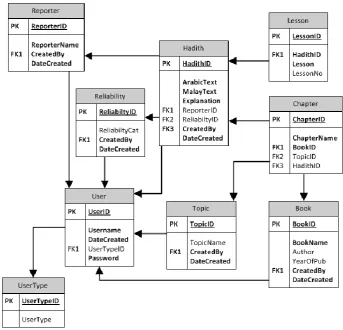
A structured database was used to effectively store the compiled authentic al-Hadith. The main entities which include the al-Hadith text, lessons, reporters, al-Hadith reliability, book chapters and users were linked appropriately as shown in figure 3. The al-Hadith table stores the main Arabic text, the Malay text and the explanation of the al-Hadith. The link to the reporter of that al-Hadith is represented by its ID. Subsequently, the reliability of that al-Hadith and the user who saved the text are stored using their ID’s. This allows for minimal storage of data, since the foreign keys (ID’s) are represented as integers. To ease the process of storing the al-Hadith text, various lookup tables were implemented. These tables contain the reliability categories, reporter names, topics and books. At the commencement of al-Hadith compilation, these tables can be populated, thereby saving time to input them along with the other al-Hadith text. This will also reduce error, while storing the al-Hadith text. To ensure accountability, the user table is included. The table will allow the system admin to track all data input into the database, by providing details of the user and time. The well-structured relational database for storing the compiled authentic al-Hadith was then implemented using MySQL database management system.
Fig 3: AL-Hadith Text Entity Relationship Diagram
4.2
Al-Hadith Compilation System
Fig 4: al-Hadith Compilation System User Interface
5.
Conclusion
The statement and conducts of Prophet Muhammad (SAW), was memorized, written down and later passed by his companions from generation to generations. Later, as the authenticity of the text became threatened, Islamic scholars from Muslim nations collected thousands of these narratives and distinguished the true wisdom from fabricated ones. However, statements are still attributed to the Prophet, by individuals with no knowledge of al-Hadith. Currently, with the internet and popularity of social media the threat to the access and existence of fake al-Hadith is more likely than ever. These challenge, leads us to ensure the community has access to authentic al-Hadith. We developed a well-structured relational database to store authentic al-Hadith in Malay, which have been extensively analyzed by respected Islamic scholars. These development will enhance the compilation process, by ensuring data is stored appropriately. Subsequently, the tool will serve as a reference guide to the general public, who wish to verify the authenticity of al-Hadith in Malay language. Furthermore, it provides computer scientist with an opportunity to extract, analyze and perform inference on the data. In future, this data can be used more efficiently in other applications such as, al-Hadith verification, an online encyclopedia of authentic al-Hadith and in knowledge discovery.
6.
Acknowledgements
We gratefully acknowledge the support of Amirrudin Kamsin, Abdullah Gani, Ishak Suliaman, Aznul Qalid Md Sabri, Zaidi Razak, Mohd Yamani Idna Idris, Noorzaily Mohamed Noor, Mohd Hairul Nizam Md Nasir, Khadher Ahmad, Sedek Ariffin, Mustaffa Abdullah, Ainuddin Wahab Abdul Wahid, Suad Awab, Mohd Jamil Maah, Mohd Yakub Zulkifli Mohd Yusoff, for their substantive comments and constructive criticisms given. This work was supported by the University of Malaya under the GrantRP003C-14HNE
7.
References
[1] S.Hasan. An introduction to the science of al-Hadith. Al-Quran Society. 1994, 58.
[3] R. Begg. Al-Hadith as a means of routinizing charisma.Religion and Theology. 2012, 19:1-2.
[4] I. A. Khan. Moderation vis-a-vis Authentication of al-Hadith.Islamic Perspective. 2013,9 (1).
[5] E. Mariani. Al-Hadith On-line Writing Islamic Tradition.ISIM newsletter. 2002,9 (1).
[6] A. Basit. A Critical Review of al-Hadith.The Global Muslim Community at a Crossroads: Understanding Religious Beliefs, Practices, and Infighting to End the Conflict. 2012, 27.
[7] Mariani, E. al-Hadith On-line Writing Islamic Tradition.ISIM newsletter. 2002,9 (1).
[8] A. I. Ali-Agan. The Preservation of al-Hadith. Ilorin Journal of Religious Studies. 2012, 2 (1): 39-52
[9] A. M. Azmi and N. Badia. An Application for Creating an Ontology of al-Hadiths Narration Tree Semantically and Graphically. The Arabian Journal for Science and Engineering. 2010, 35: 2C
[10] M. M. Al-Azami. A Note on Work in Progress on Computerization of al-Hadith. J. of Islamic Studies, Oxford. 1991, 2 (1): 86–91.
[11] S. R. Marston. Ḥadīth. The Oxford Encyclopedia of the Islamic World. Oxford Islamic Studies Online, http://www.oxfordislamicstudies.com/article/opr/t236/e0286 (accessed 30-Oct-2014).
[12] Jbara, K. Knowledge Discovery in al-Hadith Using Text Classification Algorithm. Journal of American Science. 2010, 6(11).