© 2016, IRJET ISO 9001:2008 Certified Journal
Page 846
Employee Management System
Vivin.S
1, Swathy.S
2, Sruthi.C
3Font Size 12
1
UG Scholar, Dept. of Electronics and Communication Engineering, SNS College of Technology,
Coimbatore-641035, Tamil Nadu, India
2
UG Scholar, Dept. of Electronics and Communication Engineering, SNS College of Technology,
Coimbatore-641035, Tamil Nadu, India
3
UG Scholar, Dept. of Electronics and Communication Engineering, SNS College of Technology,
Coimbatore-641035, Tamil Nadu, India
---***---Abstract -
The primary epitome of the system is to allowthe up-gradation and combination od smart card system and smart monitoring system together that can monitor the position of a particular person. This combination can be achieved via the use of radio frequencies and its applications. This system has developed into a drastic advancement in the field of radio frequencies. The two important parameters are RF-ID trans-receiver and tags. The employee will have wear an identity card equipped with RF-ID. The trans-receiver form the bridge between the database and the employee the active RF-ID trans-receiver transmits radio frequencies up to a certain distance and creates an electro magnet area depending upon the wavelength of the trans-receiver. The RF-ID tag is a passive device that takes up power from the electromagnetic charge and transmits the identification serial number to the trans-receiver. The latter then transfers the identification serial number along with the unique identification number if he trans-receiver to the master system containing the database. Thus the trans-receiver is programmed with Structured Query Language (SQL) to avoid collision of identification numbers. This can be implemented via a monitoring system.
Key Words: RF-ID, RF-ID Tag, RF-ID trans-receiver, SQL, Radio frequencies, database, webpage, node, master system.
1.INTRODUCTION
RF has been conquering the communication fir for almost a century, since then the usage of radio frequencies have been in the raising scale. Radio frequency identification is the most important advancement of radio frequencies. Radio frequency identification has been use for various advancements of communications as such. The project employee management system deal with using the radio frequency identification for monitoring the position of employee and also the ease of attendance management
for the organization. The RF-ID tag inherited in the identity card of the employee serves to transmit the unique identification serial code to the trans-receiver. The RF-ID tag is powered by electro-magnetic charge. The trans-receiver adds the identification code and sends the information to the master system wirelessly.
2. LIST OF MODULES
i. Arduino ATMEGA 328 ii. Raspberry PI 2 iii. RFID Reader iv. RF Module
v. 900 SIM GSM Module
3. LITERATURE SURVEY
i. ATTENDANCE CONTROL SYSTEM BASED
ON RFID TECHNOLOGY
Nurbek Saparkhojayev, Selim Guvercin
This system offers low range possibilities and low cost, Radio Frequency Identification . It has advantages like Price, size, memory capacity and their capability and the disadvantage is that it has no advancements
ii. MAINTAIN STUDENT RECORD IN COLLEGE
DATABASE USING RFID
Ajinkya Nanavati, Amit Hanwate, Sunil Ithape
© 2016, IRJET ISO 9001:2008 Certified Journal
Page 847
iii. RFID TECHNOLOGY BASED ATTENDANCE
MANAGEMENT SYSYTEM
Sumita Nainan, Romin Parekh, Tanvi Shah
In this system a digital camera is used. It is Cost and time effective and fast, fully automated, reliable, accurate but is a very Complicated method.
iv. STUDENT MANAGEMENT SYSTEM BASED
ON RFID TECHNOLOGY
Unnati A. Patel
It has Benefactor of improved efficiency at lowered costs. It has increased effectiveness and it is Cost ineffective.
v. BIOMETRIC AUTHENTICATION
D. Zhang and A.K. Jain.
Application graphical user interface (GUI) is designed using Visual Basic 6.0.3and Microsoft Access is used as the database provider. It is Cost effective and it has a Lack of efficiency.
vi. RFID+Exam Cram
E.Zeisel and R. Sabella,
It uniquely identifies the objects and also makes proper security for the person concerned. It is a very Simple method and it is cost ineffective.
vii. SECURITY AND PRIVACY ASPECTS OF
LOW-COST RADIO FREQUENCY IDENTIFICATION SYSTEMS Security in Pervasive Computing, 2003
S.A. Weis, S.E. Sarma, S.R. L. Rivest and S.D. W. Engels RFID systems for automatic object identification. It helps in Easy identification of objects. It is a very Complicated method.
viii. RFID BASED LIBRARY MANAGEMENT SYSTEM.
M.Dhanalakshmi and U. Mamatha
Radio Frequency Identification (RFID) is a new generation of Auto Identification and Data collection technology which helps to automate business processes and allows identification of large number of tagged objects
like books, using radio waves Identification (RFID) is a new generation of Auto Identification and Data collection technology. It is a Simple and accurate method and is Cost ineffective
ix. RADIO FREQUENCY IDENTIFICATION
(RFID) APPLICATIONS: A BRIEF INTRODUCTION. ADVANCED ENGINEERING INFORMATICS
K.Domdouzis, B. Kumar and C. Anumba
It plays a good role in student attendance marking so that reducing paper base-work of college staff, saving the time of attendance marking. Simple and inaccurate system.
x. INTERMEC, “ABCS OF RFID: UNDERSTANDING AND USING RADIO FREQUENCY IDENTIFICATION” white paper, (2009).
Fastest growing and most beneficial . Used in resource optimization, quality customers’ care, enhanced accuracy, efficient business processes, and effective business and healthcare processes.it is a Complicated method
xi. INTRODUCTION TO RFID TECHNOLOGY
APPLICATION NOTES
To produce a model for mobile technology implementation of hospital patients’ movement process. Resource optimization, increased efficiency. It is a Cost ineffective method.
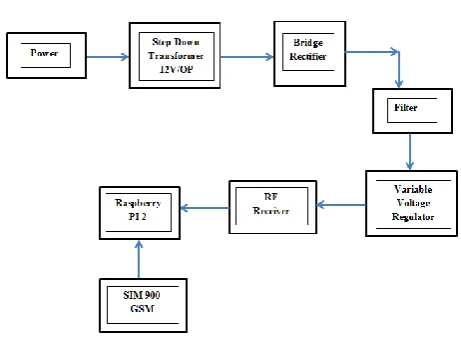
4. BLOCK DIAGRAM
i. NODES
© 2016, IRJET ISO 9001:2008 Certified Journal
Page 848
ii. MASTER SYSTEMFig. 2 Master System
3. WORKING PRINCIPLE
The system uses radio frequencies for automatic identification and recognition. The use of RF-ID technology has greatly benefitted the system design. The primary epitome of the system is to identify the position of the personnel within an organization and constantly monitor their movement inside the organization. The RF-ID technology is used to identify the personnel as each and every individual employee will have to bear an RF-ID Tag which can be doubled up as the physical identity card of the employee. The RF-ID Tag is considered as the passive component of the system as the RF-ID Tag takes up power form the active device which is the Id Reader. The RF-ID tag consists of a copper wore that is wound and contains an antenna and an IC that helps thee tag to take up power from the RF-ID Reader and work.
The RF-ID reader on the other hand as the active device transmits the electromagnetic device over to a certain distance depending upon the operating frequency of the RF-ID Reader. The RF-ID Tag becomes active once it enter into the vicinity of the electromagnetic felid, the tag becomes alive and transmits the unique hexadecimal code of the tag to the RF-ID Reader and the reader adds up the unique code of the reader along with the code of the tag to the ATMEGA 328 Arduino Microcontroller. The microcontroller on the other hand if it is bust with any task, the transfer of data from the reader to the ATMEGA 328 takes place and then the Arduino stacks the data in a queue and then initiates the data transfer between the node and the master system via the radio frequencies by the RF Module.
The RF module consists of a transmitter and a receiver that operates at the same frequency so that the information can be sent and received without any sort of data loss and intervention. The communication link is more reliable in the case of a single transmitter and receiver pair. But as the addition of RF modules inside the same system can cause the RF network to collapse. The system here is designed to house multiple transmitters and a single receiver, the communication link is established between the multiple transmitters that transfers information to a single receiver, thje probability of two or more transmitter to initiate a data transfer to the master system simultaneously is very likely to happen, in that case the system prioritizes the earliest ping and then sends initiates the message transfer and so on, at the same time the data on the other nodes are stacked in a queue and can then transfer the data in a prioritized manner. The Arduino is programmed in such a way to turn the other nodes RF Transmitter OFF as the link established by the other transmitters can interfere with the data transmission and the loss data is also likely to happen, to prevent the loss of data during the transmission of data from one node to the master system, the other nodes RF transmitter are turned OFF for the split second to establish a popper connection between the nodes and the master system.
© 2016, IRJET ISO 9001:2008 Certified Journal
Page 849
connected to the 900 SIM GSM Module that can push a text message to notify the employee who have not pinged their cards for daily attendance. One of the nodes can also be programmed to maintain the daioly attendance records of the employees of the organization.
4. RESULTS
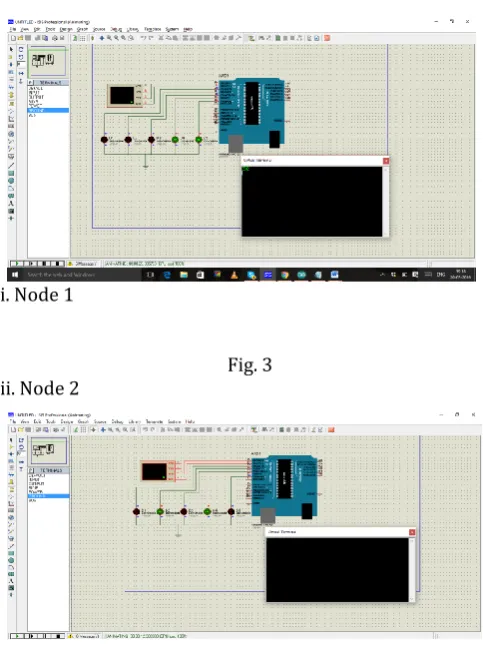
[image:4.595.36.278.196.522.2]i. Node 1
Fig. 3 ii. Node 2
Fig. 4
iii. Graphical User Interface
Fig. 5
Fig. 6
5. CONCLUSIONS
RFID is a deviceful solution for
management system in various organizations.
Meanwhile, the price of RFID tags is higher when
compared to barcodes. This system is flexible,
which means that it may be extended by adding
more modules. We will be replacing existing
system with improved quality system and the
algorithm used has shown stable and reliable
results. RFID technology definitely promises an
increased effectiveness and improved efficiency.
In the long run, with reducing unit tag and
reader costs, several streams will be able to
leverage the benefits of RFID technology.
RFID technology continues to develop
and the time has come for us to avail ourselves
of its promise and convenience. Measures are
taken to reduce the complexity and cost of the
RFID tags. The study has identified and
explained the key benefits of RFID technology.
REFERENCES
[1] Ajinkya Nanavati, Amit Hanwate ,Sunil Ithape , H. Raisoni Institute of Engineering and technology, Pune, India.Maintain student record in college database using RFID.
© 2016, IRJET ISO 9001:2008 Certified Journal
Page 850
[3] K. Domdouzis, B. Kumar and C. Anumba, 2007,“RadioFrequency Identification (RFID) applications: A brief introduction.”, Advanced Engineering Informatics, Vol. 21.
[4] Nurbek Saparkhojayev and Selim Guvercin, Department of Systems Analysis and Management, L.N.Gumilyov Eurasian National University, Astana, 010008, KazakhstanEngineering Faculty, Suleyman Demirel University, Almaty, 040900, Kazakhstan. [5] Sumita Nainan, Romin Parekh, Tanvi Shah, 2013,
Department of Electronics & Telecommunication Engineering, NMIMS UniversityMumbai, Maharashtra. RFID technology based attendance management system. IJCSI International Journal of Computer Science Issues, Vol. 10, Issue 1. [6] Unnati A. Patel Assistant Professor, M.Sc. (IT)
Department, ISTAR, V.V.Nagar, Gujarat, India. Student management system based on RFID technology.
[7] S. A. Weis, S. E. Sarma, R. L. Rivest, and D. W. Engels, 2003 ,“Security and Privacy Aspects of Low-Cost Radio Frequency Identification Systems.” Security in Pervasive Computing. [8] E. Zeisel & R. Sabella, (2006), “RFID+”, Exam Cram, ISBN: 0 -7897-3504-0
[9] D. Zhang and A.K. Jain, 2004 “Biometric Authentication”, Proc. First International Conference on Biometric Authentication (ICBA), Hong Kong: SpringerVerlag.
[10] (2008),Application Notes, “Introduction to RFID Technology” CAENRFID: The Art of Identification.