© 2016, IRJET | Impact Factor value: 4.45 | ISO 9001:2008 Certified Journal
| Page 1800
Voiced/Unvoiced Classification by Hybrid Method Based On Cepstrum
and EMD
Bhumika Nirmalkar
1, Dr. Sandeep Kumar
2Department of Electronics and Telecommunication
Rungta College of Engineering and Technology Bhilai, India
[email protected]
Department of Electronics and Telecommunication
Rungta College of Engineering and Technology Bhilai, India
[email protected]
---***---Abstract
:This paper introduces an enhanced cepstrum andEMD based hybrid method for the voiced/un-voiced (V/UV) classification by simulation using MATLAB. Voicing choices are made utilizing a feature voiced/unvoiced characterization calculation taking into account factual investigation of cepstral peak, energy and zero crossing rates. Execution investigation on an extensive database shows in terms of classification accuracy and error. This algorithm is likewise appeared to be robust to large verity of voiced signals as compared to traditional cepstrum and EMD based classifiers.
Keywords— Cepstrum, EMD, Hybrid method voiced/unvoiced classification, cepstral peak, Energy, zero crossing rate, MIR database.
1.
Introduction
Speech being a natural mode of communication for humans can provide a convenient interface to control devices. Some of the speech recognition applications require speaker-dependent isolated word recognition. Current implementations of speech recognizers have been done for personal computers and digital signal processors. However, some applications which require a low-cost portable speech interface cannot use a personal computer or digital signal processor based implementation on account of cost, portability and scalability. Human speech is the foundation of self-expression and communication with others. In the past, ranges of speech based
communication technologies have been developed. Speech is an acoustic signal produced from a speech production system. Producing speech sounds, the air flow from lungs first passes the glottis and then throat and mouth. Depending on speech sound the speech production can be broadly categorized into three activities:-Voiced speech, unvoiced speech, Silence region.
© 2016, IRJET | Impact Factor value: 4.45 | ISO 9001:2008 Certified Journal
| Page 1801
While speech processing applications like multi rate speech coder[1,2],language identification[3],speech signal modeling[4]require classification of the speech signal in to voiced, unvoiced and silences regions, there are some prominent application like pitch frequency estimation[5,6], identification of the glottal closure instants(GCIs)[7],which require knowledge of only the voiced regions of the speech signals.
In this paper hybrid method for voiced/unvoiced classification has been simulated using MATLAB. Performance of this scheme has been compared with
existing algorithms in terms of voiced/unvoiced
classification accuracy and error rate.
The rest of the paper is organized as follows. In Section II, a
review like comparative study on different
voiced/unvoiced classification algorithm is described. In section III Close description of the implementation of enhanced hybrid voiced/unvoiced speech classifier is given. In Section V, the results of the performance analysis are presented. Concluding remarks are given in Section VI.
2.
Literature review
In [8] a cepstrum-based pitch detection using a new statistical voiced/unvoiced classification. In this method voicing decision are made using multi feature voiced unvoiced classification based on statistical analysis of cepstral peak, zero crossing rate and energy of short time segment of speech signal. The performance was improved under noisy conditions. In [9] robust voiced/unvoiced speech classification using empirical mode decomposition and periodic correlation model. This method analyzes the signal by nonlinear and non stationary signal which is used as a filter for additive noise in speech signal. The use of EMD improves the classification performance and efficiency is noticeable. In[10] pitch detection algorithms and voiced/unvoiced classification for noisy speech. This algorithm is based on cepstral analysis; time auto co-relation, spectral temporal auto co-relation (STA) and average magnitude difference function. All of the algorithms of voiced/unvoiced classification give good performance for clean speech. In[11] a new method for voiced/unvoiced classification based on epoch extraction. This method uses zero frequency filtered speech signal is used to extract the epochs. Features of this method are depends on excitation source information. This method was better than the normalized cross correlation based voiced/unvoiced classification. In[12] a new method of voiced/unvoiced classification based on clustering. Their algorithm is based on analysis of cepstral peak, zero crossing rate, and autocorrelation function (ACF) peak of
short-time segments of the speech signal by using some clustering methods The advantage of this clustering based method is getting rid of determining a threshold. So it is
highly speaker independent. better satisfactory
© 2016, IRJET | Impact Factor value: 4.45 | ISO 9001:2008 Certified Journal
| Page 1802
(VMD). This method does not require prior information of the pitch. It’s provided better accuracy and performance of voiced and unvoiced classification. In[20] voiced/unvoiced classification in compressively sensed speech signals. This method is based on compressive sensing (CS)/Sparse coding for detection of voiced/unvoiced classification. the sparse vector contains the source characteristics of the speech signals, if a suitable dictionary is chosen. Using an information theoretic based criterion the behavior of sparse vector is quantified. An adaptive threshold selection scheme used for final voiced/unvoiced classification. This method selected (voiced) region, which can be used for application of speaker verification. In[21] voice and unvoiced classification using fuzzy logic. This algorithm is based on features Zero crossing rate, Short time energy for classification of voice, unvoiced and silence. This method successfully classified the speech signals.
3.
Problem identification
Cepstrum is the conventional and convenient method for voiced/unvoiced classification although it is best suitable for classification of voiced signal only. There are some limitations of cepstrum of Voiced classification as it does not give sharp spectrum of signal and it is best suitable for static signal only. EMD is used for voiced/unvoiced classification which is an advanced method but it is most suitable for unvoiced signal classification. Also EMD is highly nonlinear method i.e. it is very time consuming. Thus we can conclude that none of the method is more reliable when it comes to voiced/unvoiced classification for both voiced and unvoiced signals.
The solution of the problem is that cepstrum is best suitable for the voiced classification and EMD is best suitable for the unvoiced classification because of its decomposing nature. This leads to the realization of a hybrid method which carries property of both methods of voiced/unvoiced classification i.e. cepstrum and EMD to overcome the problem of voiced/unvoiced classification. In this hybrid method we can take advantage of advantages of both methods as cepstrum has some advantages that it is non-decomposing in nature and comparatively simpler then the available method. EMD gives sharp spectrum and it is more suitable for dynamic signals also.
4.
Methodology
A hybrid method for voiced/unvoiced classification based on cepstrum and EMD will be used. For voiced/unvoiced
[image:3.595.310.561.138.312.2]Classification signals will be taken from suitable well defined source.
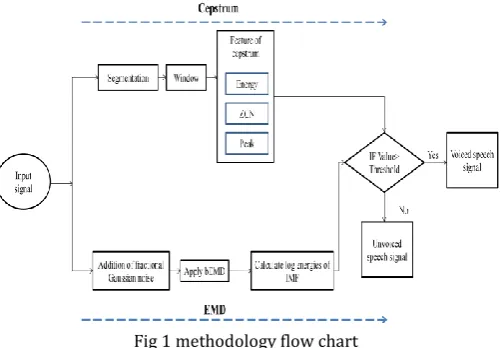
Fig 1 methodology flow chart
The entire work is mix of cepstrum and EMD method thus generating a hybrid method. In cepstrum module signals will be segmented by segmentation method. In segmentation speech signal must be segmented into several frames for the ease of analysis. Then it will be passed through hamming window. If w = hamming (L) returns an L-point symmetric Hamming window in the column vector w. L should be a positive integer. The coefficients of a Hamming window are computed from the following equation.
w(n) = 0.54− 0.46 cos (2π(n/N)) ,0≤n≤N (1)
The window length is L=N+1.Each frame has to be multiplied with a hamming window in order to keep the continuity of the first and the last points in the frames. After that feature of cepstrum will be calculated. Since A zero-crossing is a point where the sign of a mathematical function changes in feature of cepstrum energy, zero crossing number and peak will calculate. After that threshold extraction will be performed. As per our algorithm if cepstral peak value exceeds the threshold level then section is marked as voiced otherwise unvoiced. In EMD method, combine speech signal and fractional Gaussian noise (fGN) to the complex signal after that apply
bivariate EMD. Fractional Gaussian noise (fGn) is a
© 2016, IRJET | Impact Factor value: 4.45 | ISO 9001:2008 Certified Journal
| Page 1803
If sub band log energies IMF will exceeds the threshold level then section is marked as voiced otherwise unvoiced.
5.
Result and discussion
A hybrid method has been generated with is evaluated with compare to the conventional methods i.e. cepstrum and EMD. The speech signals are taken from the MIR database. Out of 1000 speech signals selected 10 speech signals has been analyzed. In this experiment the speech material is sampled at 16 kHz and segmented into frame of length 256 with -3ms sifting. The silence part is removed. Approximately 187 each frames are used to evaluate the accuracy and bit rate each frame is accurately labeled for voiced/unvoiced. The performance of the proposed method is measured in terms of the error rate and accuracy. The performance of the proposed algorithm is compared with the EMD and cepstrum based method. For evaluation of error rate and accuracy parameter were calculated for signals from the data base. The error rate is obtained by, performing the XOR operation between the actual classification and classification obtained from cepstrum. The sum of the result obtained from the XOR operation is divided by the total length of the signal similar operation has been performed with EMD and derived Hybrid algorithm. The result obtained has been sown in table I.
TABLE 1:The error rate of the hybrid algorithm at different speech signals by comparison with cepstrum and EMD.
S. N
Cepstru
m EMD Hybrid
deviation w.r.t. cepstrum deviatio n w.r.t. EMD
1 0.32796
0.3817 2 0.3010 8 -0.089278 -0.26783
2 0.25134
0.3817
2 0.3172 0.207629
-0.20340
3 0.59893
0.6149 7 0.5721 9 -0.046732 -0.07476
4 0.57219
0.5989 3 0.5401 1 -0.059395 -0.10890
5 0.46277
0.6170 2 0.4148 9 -0.115404 -0.48718
6 0.38172
0.4731 2 0.3494 6 -0.092313 -0.35386
7 0.60638
0.6702 1 0.5638 3 -0.075466 -0.18867
8 0.43316
0.6096
3 0.4492 0.035707
-0.35714
9 0.47059
0.6203 2
0.4812
8 0.022211
-0.28889
10 0.34177
0.5874 2 0.3269 1 -0.045455 -0.79688
Table I Demonstrate the error rate of the hybrid algorithm at different speech signals by comparison with cepstrum and EMD. The overall voiced/unvoiced classification accuracy with hybrid method is always better than the existing algorithm .Since in our whole operation the 100% in constitute of error and accuracy i.e
Accuracy of the result + Error of the result = 1 (2)
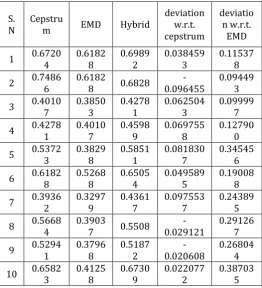
The accuracy is obtained by subtracting the values of the error from table I by factor 1 and corresponding values has been show in table II.
TABLE2:The accuracy of the hybrid algorithm at different speech signals by comparison with cepstrum and EMD.
S. N
Cepstru
m EMD Hybrid
deviation w.r.t. cepstrum deviatio n w.r.t. EMD
1 0.6720
4 0.6182 8 0.6989 2 0.038459 3 0.11537 8
2 0.7486
6
0.6182
8 0.6828
-0.096455
0.09449 3
3 0.4010
7 0.3850 3 0.4278 1 0.062504 3 0.09999 7
4 0.4278
1 0.4010 7 0.4598 9 0.069755 8 0.12790 0
5 0.5372
3 0.3829 8 0.5851 1 0.081830 7 0.34545 6
6 0.6182
8 0.5268 8 0.6505 4 0.049589 5 0.19008 8
7 0.3936
2 0.3297 9 0.4361 7 0.097553 7 0.24389 5
8 0.5668
4
0.3903
7 0.5508
-0.029121
0.29126 7
9 0.5294
1 0.3796 8 0.5187 2 -0.020608 0.26804 4
10 0.6582
3 0.4125 8 0.6730 9 0.022077 2 0.38703 5
Table II Demonstrate the accuracy of the hybrid algorithm at different speech signals by comparison with cepstrum and EMD. MATLAB 15.0 is used for our calculation choose MATLAB as our programming environment as it offers many advantages. It contains a variety of signal processing and statistical tools, which help users in generating a variety of signals and plotting them. MATLAB excels at numerical computation, especially when dealing with matrices of data.
[image:4.595.302.565.290.579.2] [image:4.595.31.305.483.793.2]© 2016, IRJET | Impact Factor value: 4.45 | ISO 9001:2008 Certified Journal
| Page 1804
voiced/unvoiced classification. The principle advantages of the proposed algorithm are that is it works with less error rate and with more accuracy.
6.
Conclusion
In this work an improved voiced/unvoiced classification algorithm is has been obtained. This paper present voiced/unvoiced classification based on combining features of two most popular conventional methods of voiced/unvoiced classification i.e. EMD and Cepstrum. Experimental result gives on speech database shows the superiority of the obtained Hybrid method over existing methods. The use of the proposed method for real world speech processing applications will be more reliable as both of these methods has their shortcomings. On carefully observing the error table it is evidently clear that the generated Hybrid method is giving much better result.
References
[1]B. Yin, E. Ambikairajah, F. Chen, Voiced/unvoiced
pattern-based duration modeling for language identification, in: IEEE Proceedings of the International Conference on Acoustics, Speech and Signal Processing, Taipei, Taiwan, 2009, pp. 4341–4344.
[2]E. Paksoy, J. Carlos de Martin, A. McCree, C.G. Gerlach, A. Anandakumar, W.M. Lai, V. Viswanathan, An adaptive multi-rate speech coder for digital cellular telephony, in: IEEE Proceedings of the International Conference on Acoustics, Speech and Signal Processing, Phoenix, USA, vol. 1, 1999, pp. 193–196.
[3]A.M. Kondoz, Digital Speech: Coding for Low Bit Rate Communication Systems, Wiley, England, 2004.
[4]P. Sircar, R.K. Saini, Parametric modeling of speech by
complex AM and FM signals, Digital Signal Processing 17 (6) (2007) 1055–1064.
[5]B. Resch, M. Nilsson, A. Ekman, W.B. Kleijn, Estimation
of the instantaneous pitch of speech, IEEE Transactions on Audio, Speech and Language Processing 15 (3) (2007) 813–822.
[6]D. Joho, M. Bennewitz, S. Behnke, Pitch estimation using models of voiced speech on three levels, in: IEEE Proceedings of the International Conference on Acoustics, Speech and Signal Processing, Honolulu, USA, vol. 4, 2007, pp. 1077–1080.
[7]P.A. Naylor, A. Kounoudes, J. Gudnason, M. Brookes, Estimation of glottal closure instants in voiced speech using the DYPSA algorithm, IEEE Transactions on Audio, Speech and Language Processing 15 (1) (2007) 34–43.
[8] Ahmadi, S., &Spanias, A. S. (1999). Cepstrum-based pitch detection using a new statistical V/UV classification algorithm.Speech and Audio Processing, IEEE Transactions on, 7(3), 333-338.
[9] Molla, M. K. I., Hirose, K., &Minematsu, N. (2009). Robust voiced/unvoiced speech classification using
empirical mode decomposition and periodic
correlation model. In INTERSPEECH (pp. 2530-2533)
[10] Verteletskaya, E., Sakhnov, K., &Šimák, B. (2009). Pitch
detection algorithms and voiced/unvoiced
classification for noisy speech. In Systems, Signals and Image Processing, 2009.IWSSIP 2009. 16th International Conference on (pp. 1-5). IEEE.
[11] Dhananjaya, N., &Yegnanarayana, B. (2010). Voiced/nonvoiced detection based on robustness of voiced epochs. Signal Processing Letters, IEEE, 17(3), 273-276.
[12] Radmard, M., Hadavi, M., &Nayebi, M. M. (2011). A new method of voiced/unvoiced classification based
on clustering. Journal of Signal and Information
Processing, 2(04), 336.
[13] Molla, M. K. I., Hirose, K., Roy, S. K., & Ahmad, S. (2011,). Adaptive thresholding approach for robust voiced/unvoiced classification. In Circuits and Systems (ISCAS), 2011 IEEE International Symposium on (pp. 2409-2412). IEEE.
[14] Jain, P., &Pachori, R. B. (2013). Marginal energy density over the low frequency range as a feature for voiced/non-voiced detection in noisy speech signals. Journal of the Franklin Institute, 350(4), 698-716 .
[15] Sharma, P., &Rajpoot, A. K. (2013). Automatic identification of silence, unvoiced and voiced chunks in speech.Journal of Computer Science & Information Technology (CS & IT), 3(5), 87-96.
[16] Senturk, Z., Yetgin, O. E., &Salor, O. (2014).
Voiced-unvoiced classification of speech using
autocorrelation matrix. In Signal Processing and
Communications Applications Conference (SIU), 2014
22nd (pp. 1802-1805). IEEE.
[17] Faycal, Y., &Bensebti, M. (2014). Comparative
© 2016, IRJET | Impact Factor value: 4.45 | ISO 9001:2008 Certified Journal
| Page 1805
voiced/non-voiced classification.Int. Arab J. Inf.
Technol., 11(3), 293-299.
[18] Molla, M. K. I., Hirose, K., &Hasan,(2015) M. K.
Voiced/non-voiced speech classification using
adaptive thresholding with bivariate EMD. Pattern
Analysis and Applications, 1-6.
[19] Upadhyay, A., &Pachori, R. B. (2015).Instantaneous voiced/non-voiced detection in speech signals based
on variational mode decomposition.Journal of the
Franklin Institute.
[20] Abrol, V., Sharma, P., & Sao, A. K. (2015). Voiced/nonvoiced detection in compressively sensed speech signals. Speech Communication, 72, 194-207.