The Effect of Group Composition on Student Musical Self-Efficacy in the Middle School String Classroom
by Tiffany Ou
Thesis
In partial fulfillment toward a Master’s Degree in Music Education
University of Michigan
Thesis Committee:
Associate Professor Dr. Michael Hopkins, Chair Associate Professor Dr. Kate Fitzpatrick
Acknowledgements
I would like to extend my thanks to the many people who have supported me in completing this thesis. First, my committee chair Dr. Michael Hopkins, whose guidance and feedback have been invaluable from start to finish. I would also like to thank Dr. Kate Fitzpatrick and Dr. Colleen Conway, who both helped to shape the original idea for this project. Thanks also to Dr. Julie Skadsem for contributing her time and expertise to my thesis committee.
A special thanks to my students for their participation in this study, and for bringing their kind and creative selves to our orchestra classroom each day. I am grateful to be their teacher.
Abstract
The purpose of this study was to determine the effect of group composition on student musical self-efficacy in the middle school string classroom. Middle school string students (N = 73) participated in a group composition curricular unit. Student’s self-efficacy scores were collected, using a one-group, pre-test-post-test experimental design. Composition in this study was focused in the group setting, using a Theme and Variations form. The Self-Esteem of Musical Ability (SEMA) scale was adapted from prior research (Schmitt, 1977; Randles, 2010; Zelenak, 2011) and was used to measure student self-efficacy before and after the composition project. A musical background survey (MBS) about student’s musical and compositional experiences was administered, and a Post Composition Project Survey (PCPS) was also used.
The research questions were:
1. How does participating in a group composition activity influence student musical self-efficacy?
2. How do selected variables (grade level, past musical experiences, gender) interact with the influence of a group composition activity on students’ musical self-efficacy? 3. What is the relationship between Composition Satisfaction Score and musical
Table of Contents
Chapter I: Introduction ... 1
Introduction ... 1
Purpose Statement ... 3
Self-Efficacy ... 4
Group Composition ... 5
Chapter II: Literature Review ... 7
Children’s Compositional Techniques ... 7
Individual composing. ... 7
Group composing. ... 10
Processes for Composition in the Secondary Ensemble Classroom ... 13
Self-Efficacy Research in General Education ... 19
Self-Efficacy Research in Music Education ... 22
Studies focused on music performance and improvisation. ... 22
Studies focused on music composition. ... 23
Synthesis ... 27
Chapter III: Method ... 28
Description of Participants ... 28
IRB, School, and Parent Permissions ... 29
Teacher Research ... 30
Description of the Instruments ... 30
Development of the instruments. ... 30
Procedure ... 32
Main study. ... 32
Description of the composition unit. ... 32
Chapter IV: Results ... 38
Musical Background Survey (MBS) ... 39
SEMA Pre- versus Post- Test Data (All Participants) ... 39
Selected Variables that Interact with a Group Composition Activity to Influence Students’ Musical Self-Efficacy ... 43
Grade level. ... 44
Past musical experiences (MBS)... 45
Post Composition Project Survey ... 49
Post Composition Survey Comments... 49
Chapter V: Summary, Discussion, and Implications for Future Research ... 50
Summary... 50
Discussion ... 51
How does participating in a group composition activity influence student musical self-efficacy?... 51
How do selected variables (grade level, past musical experiences, gender) interact with the influence of a group composition activity on students’ musical self-efficacy? ... 53
What is the relationship between CSS and musical self-efficacy score? ... 55
Limitations of the Study ... 57
Implications for Further Research ... 57
Suggestions for Middle School Orchestra Directors... 58
Appendix A: Self-Efficacy in Music Ability Scale (SEMA) ... 62
Appendix B: Musical Background Survey (MBS) ... 65
Appendix C: Parent Permission Letter ... 66
Appendix D: IRB Exemption Letter ... 68
Appendix E: Post-Composition Project Survey ... 70
Appendix F: Simple Gifts Notated Melody ... 71
Appendix G: Simple Gifts Playlist (Spotify) ... 72
Appendix H: Simple Gifts Final Performance Score... 73
Appendix I: Post-Composition Project Survey Written Comments (Coded) ... 77
List of Tables
Table 1. Musical Background Survey ... 39
Table 2. SEMA Pre-Test and Post-Test Responses ... 40
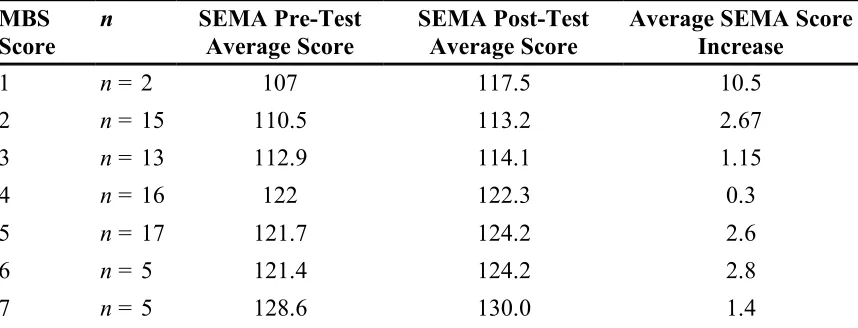
Table 3. MBS Scores with SEMA Pre- and Post- Averages ... 45
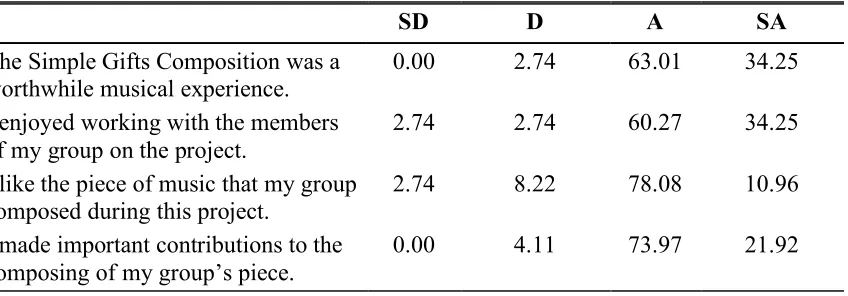
Table 4. Post-Composition Project Survey Frequencies ... 48
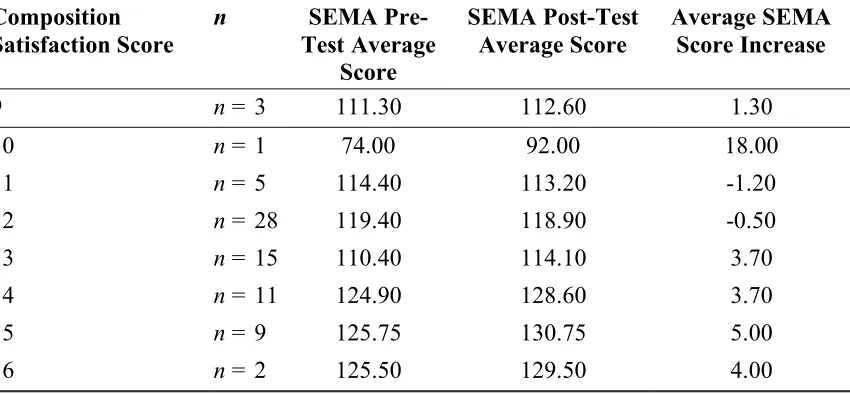
Table 5. Composition Satisfaction Scores with Average SEMA Increase ... 49
List of Figures Figure 1. Student Group Variation Composition Example One ... 38
Figure 2. Student Group Variation Composition Example Two ... 38
Figure 3. SEMA Change Pre- Post Based on Grade ... 44
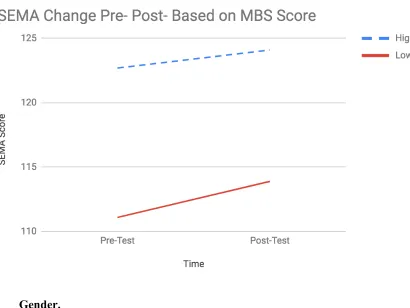
Figure 4. SEMA Change Pre- Post- Based on MBS Score ... 46
Chapter I: Introduction
Introduction
Self-efficacy is the thought process through which students assess their abilities to accomplish specific tasks (Bandura, 1977). Bandura’s social cognitive framework states that thoughts and actions are caused by the interaction of cognition, behavior, and environment; these thoughts help students to form their self-efficacy. Those who have high self-efficacy are able to understand and visualize solutions to problems. The concept of self-efficacy has been widely researched in recent years, and researchers have found that the beliefs students hold about their abilities to succeed at academic tasks can powerfully influence their performance (Pajares, 1996; Bandura 2007, 2012). Self-efficacy can also affect self-regulation (Zimmerman & Bandura, 1994) and self-concept (Bong & Skaalvik, 2003). Students who believe that they can succeed at a task are likely to show greater interest, resilience, and effort when they encounter challenges (Pajares, 1996).
The concept of self-efficacy can be applied to student’s beliefs of their music knowledge and ability. Music education researchers have studied self-efficacy in student musical
performance. Researchers have found that musical self-efficacy has a positive influence on performance achievement (McPherson & McCormick, 2000). Researchers in the field have also developed scales to measure musical self-esteem (Schmitt, 1977; Randles, 2010; Zelenak, 2011). Self-efficacy differs from self-esteem because self-efficacy refers to the judgements of personal capability, while self-esteem refers to judgements of self-worth (Bandura, 1997). Prior
Research has shown that mastery experience is the strongest influencer of self-efficacy beliefs (Bandura, 1986). Mastery experience is defined as the result of one’s own previous attainment in a related task or area (Bandura, 1997). When a student completes a task, they naturally interpret the results obtained and judge their own competence according to their interpretation. When students believe that their efforts have been successful, or when they believe that their efforts have produced a desired result, this experienced mastery has long-lasting effects on their self-efficacy. Creative experiences like composition have been shown to increase student self-efficacy (Randles, 2010).
Composition has been a part of the national music standards for music students in
instrumental ensembles since 1994 (Consortium of National Arts Education Associations, 1994). As part of the “Creating” category of the current National Association for Music Education’s standards, students in secondary ensembles should be able to “compose and improvise ideas for melodies, rhythmic passages, and arrangements for specific purposes that reflect characteristic(s) of music from a variety of historical periods studied in rehearsal” (National Association for Music Education, 2014, p. 1).
Despite this national standard, not all teachers incorporate composition - especially teachers of secondary ensembles (Strand, 2006; Hopkins, 2013; Deemer, 2016). This is in part due to demanding performance schedules at the secondary level (Gillespie & Hamann, 1998; Hopkins, 2013). Secondary ensemble directors who do not include composition may not be allowing their students to achieve their full musical potential. Researchers studying group
performing, reading, and listening to music, much of the music learning we engage in in the secondary ensemble rehearsal is “reproductive.” Students are asked to recreate the sounds written by a composer or modeled by a teacher. Composition encourages alternative forms of musical thinking from those used in traditional music performance by encouraging students to use “divergent” thinking instead of “convergent” thinking (Stringham, 2016).
Composing projects in the secondary ensemble can take on different forms. Individual, or “concurrent-style” composing is when students concurrently engage in side-by-side, individual composition (Kaschub, 2009). In contrast, “collaborative-style” composition involves students working together to create music together. There are many benefits to this style of group composition: students are presented with opportunities for dialogue, negotiation, compromise, and social development (Luce, 2001). Researchers have found that the quality of the group’s collaboration during these creating experiences influences the success of their compositions (MacDonald, et al. 2000, 2002; Miell & MacDonald, 2000). Musical self-efficacy may also be enhanced by positive collaborative group composition projects (Hopkins, 2015).
Researchers in music education have studied musical self-esteem (Schmitt, 1977),
musical self-concept (Randles, 2010), and musical self-efficacy (Zelenak, 2011). However, there has been little research on the impact of group composing experience on student self-efficacy in a middle school setting.
Purpose Statement
was focused in the group setting, using a Theme and Variations form. The SEMA scale was adapted from prior research (Schmitt, 1977; Randles, 2010; Zelenak, 2011) and was used to measure student self-efficacy before and after the composition project. A musical background survey (MBS) about student’s musical and compositional experiences was administered, and a Post Composition Project Survey (PCPS) was also used.
The research questions were:
1. How does participating in a group composition activity influence student musical self-efficacy?
2. How do selected variables (grade level, past musical experiences, gender) interact with the influence of a group composition activity on students’ musical self-efficacy? 3. What is the relationship between Composition Satisfaction Score and musical
self-efficacy score?
Self-Efficacy
result of observing peers engage in activities, are also influential but have less influence than mastery experiences. Verbal persuasions (the judgements and opinions of others) and
physiological states (levels of physical arousal and emotional mood) are also factors to consider. All four of these sources contribute to an individual’s self-efficacy beliefs.
Self-efficacy research in general education has grown in recent years. Studies have been conducted about self-efficacy beliefs in math performance (Betz & Hackett, 1983; Pajares and Kranzler, 1994; Pajares, 1996; Chen & Zimmerman, 2007) and in writing performance
(McCarthy, Meier, & Rinderer, 1985; Pajares & Johnson, 1994). These studies supported Bandura’s finding that mastery experiences were the strongest influence of the four sources of self-efficacy. This past research in educational self-efficacy serves as foundational evidence for this study.
This study used Randles’ (2010) SEMA tool, found in Appendix A. This scale, modified from Schmitt’s (1979) original SEMA scale, is a 43-item music-specific self-esteem measuring tool. The test-retest reliability of the SEMA was reported as .91 (Schmitt, 1979). Austin (1990) reported this scale to reliably measure music self-esteem, based on a factor analysis of results for a large sample. In addition to the SEMA scale, a musical background survey was administered that contains questions about students’ involvement with various aspects of music (years studied, other instruments played, past experiences with composition, etc.). These tools will be described in more detail in Chapter III.
Group Composition
Chapter II: Literature Review
There are many ways for secondary ensemble teachers to approach composition projects. It is important to review studies of the way children choose to create music on their own and in groups. In addition, the inclusion of composition projects to a performing ensemble can be approached in many ways. The constructs of self-efficacy and musical self-efficacy have also been studied by past researchers, and this literature provides an important backdrop to this study.
I will begin by reviewing the literature on children’s compositional techniques both individually and in groups. I will then review research that has examined group processes for composition in the secondary ensemble classroom. Then, I will examine past literature about self-efficacy in general education. I will conclude by reviewing research examining self-efficacy in music education, with a focus on studies that have examined the impact of composing on students’ musical self-efficacy.
Children’s Compositional Techniques
Individual composing.
To explore how we can incorporate creative composition in the classroom, it is helpful to understand the processes and techniques children naturally use. Kratus (1989) studied the
amount of time that children (N = 60) of various ages, sexes, and proficiency levels spent composing a melody. Students were given instructions to make up a song that had never been heard before, using white keys only and beginning on C. The participants were given 10 minutes and were then asked to record the same composition twice in a row. The researcher listened to recordings of each student’s process and labeled each five-second interval as either
The seven-year-olds devoted most of their composition time to exploration and spent relatively little time on development, repetition, and silence. For the nine-year-olds, exploration was the process used most often, and approximately one-half of their time was divided between development and repetition. The 11-year-olds divided their time more evenly among exploration, development, and repetition and most often used the development process. (Kratus, 1989, p. 10)
Kratus found that repetition was key to students being able to produce the same newly-composed melody twice. Students who were able to play their melody the same or almost the same both times spent on average 49% of their time on repetition. The researcher found that as children get older, they spend less time in the “exploration” stage of composing. Kratus’ findings suggest that “all 60 students were able to approach a creative musical task in a meaningful way” (Kratus, 1989, p. 18), and that “teachers need not to wait until their students’ understanding of music is highly developed before introducing creative activities” (Kratus, 1989, pp. 18-19). This suggests that music teachers should be incorporating music composition projects to curriculum, even before they might think students can create something substantial.
engaging students in metacognitive activities can raise the depth and scope of their awareness, and encourage them to begin to think like a composer” (Younker, 2000, p. 24). The author found that students of all ages explored timbre, edited tempi, and created melodies with rhythmic structure. Through this study, the author concluded that our field should move to involve students in making music to the same degree that we have involved students in becoming excellent performers.
Individual composition projects also provide students with opportunities to connect their musical experiences with their life outside of the music classroom. Stauffer (2002) studied the compositional techniques children used to make connections between their musical and non-musical life experiences. Stauffer conducted a case study of six sixth-grade composers who were participants in a separate, longitudinal study of child composers. These students were in their third year of the longitudinal study, which offered classes in composition and computer music. In analysis of the students’ commentary about their work, the researcher found four primary
write in similar styles that they had seen in their ensemble classes (i.e. canons, or pieces imitating orchestral instrument balance). Stauffer’s findings of student’s lives impacting their compositions are robust and varied, showing that composition can be an excellent outlet for communication. As educators, we aim to support students in their development in and out of the classroom. This study reveals that through composition, students are naturally inclined to write pieces that allow them to share their life experiences.
Group composing.
While individual composition projects allow students to share their individual knowledge and experiences, group composition encourages students to create together and practice
strategies for problem solving. Wiggins (1994) shadowed the group composition experiences of two fifth-grade students in a general music class over five months. The researcher purposely chose two students with contrasting personalities to observe their interactions with peers as they completed group composition tasks. Through each of the composition problems assigned, the two focal students were both inclined to see the bigger picture of each piece: “‘Let’s put these in some kind of order’”; “‘First you have to get everybody to decide on one choice – like fast music or slow music – or the topic’” (Wiggins, 1994, pp. 240-241). Wiggins also counted 25 comments across three composition projects that reflected their ability to judge their own part in
As teachers, we aim to teach students to communicate effectively both through with their words to their musical teammates, but also by expressing with their instruments. Morgan (1998) wrote that “children working in groups on music composition might establish a common
understanding of the task by projecting their thoughts and ideas directly onto musical
instruments rather than verbalizing them” (p. 55). This form of communication can be a more effective way for students to express their ideas than describing them in words. Teachers can help their students develop the ability to express their ideas, thoughts, and feelings through their instruments. The researcher presented a variety of composition projects with primary school students that all collectively found verbal interaction was not related to group composition productivity. In each study, the ability to communicate through instruments was more influential on group composition success, rather than student’s self-reported interest in music class or belief in group gender composition.
success that students feel in a positive group collaboration like this one help students learn that communicating ideas and talking through conflict can all help the group creation process.
Burland & Davidson (2001) studied the social processes involved with group musical composition. The researchers aimed to research how friendship, intelligence, and gender groupings of students would influence group composition collaboration and the quality of their interactions. The researchers used five groupings: friendship, non-friendship,
matched-intelligence, mixed-matched-intelligence, and random, at two differing school sites (one known for its musical offerings and one that offered few musical opportunities). Three composition sessions of approximately two hours each took place, and compositions were created on percussion
Processes for Composition in the Secondary Ensemble Classroom
While composition is often found in elementary general music classrooms based in Orff-Schulwerk or Kodaly pedagogy, composition is less often used in the secondary instrumental ensemble. Gould (1963) wrote, “often the instrumental music curriculum, which should lead in the education of the creative person, falls into the snare of substituting technical achievement for creativity” (p. 59). He studied a classroom that began a group activity called Ensemble
Improvisation that met for one hour, three times a week for one semester, to go through a series of ensemble exercises incorporating group composition. The researcher used an evaluating panel to determine answers to the following questions:
(a) Creativity - Can ensemble improvisation lead students to a specific technique of creativity? (b) Heuristic Function. Are students placed in the position of having to think of music as creators? In order to improvise well, to create successfully, do they have to seek new knowledge and skills? (c) Skills. Does ensemble improvisation by virtue of its demands on the player lead to the development of increased listening and playing skills? (d) Style. Does ensemble improvisation foster greater awareness of differing musical styles? (e) Relationship to Large Group Performance. Will these students become more effective participants in their school bands and orchestras as a result of the experience gained in the study? (Gould, 1963, p. 60)
All panel members agreed on “yes” answers in all five categories, with some qualifications. They felt the improvisations were lacking in expressive intensity and structural unity, and that for the “creativity” technique, it would be difficult to ascertain the amount of transfer to formal
instrumental classroom will encourage the student to further study in music and will develop the aesthetic decision-making ability of the music student.
Another approach to composition in a secondary music classroom is to work with a professional composer. Kaschub (1997) worked with sixth grade general music classes and a high school choir class. Both projects involved a professional composer being partnered with students, allowing students to generate musical ideas while not limiting them to their younger musical knowledge set. The high school choir students were paired with a choral composer to learn about the music creation process and hopefully have more buy-in to the created piece since they had the opportunity to weigh in on the musical decisions made. The sixth grade students worked with a folk musician to create a folk song about their middle school experience. The focus of both composition projects was that of revision – students would be involved in the creation process but not directly responsible for creating all of the content. In both projects, a number of composition process issues occurred: in the high school choral composition, the composer was a conservatory trained professional who had little experience working with young musicians. The teacher needed to act as a ‘translator’ to help the students and composer
did not want to see their ideas revised, and working with a large group of students made for many opinions that took a long time to discuss. The author writes that while the projects were both large undertakings, “One of the greatest benefits to come from engagement in
compositional activities is the aspect of future learning… the students readily identified
compositional techniques which they had encountered in their composition work in other pieces of music and more quickly learned to sing new music as they studied its construction from the perspective of the composer and reflected on how those compositional choices needed to be executed by the performer” (p. 27). Kauschub’s research demonstrates an example of a group compositional process that successfully incorporates professional composers.
It is important also to consider the importance of what students would consider to be culturally relevant, self-reflective music composition. Allsup (2003) examined the notion of democracy and composition in an ethnographic study of nine high school band students, ages 14-17. The author notes that band and orchestra programs provide diverse activities for students, including pep bands and jazz ensembles, but this study was “an attempt to expand this normative view of instrumental music education” (Allsup, 2003, p. 24). He goes on to add, “Missing in the formal education of our players are opportunities to create new music that is culturally
meaningful and self-reflective” (Allsup, 2003, p. 24). The students met weekly after school for 11 sessions, each two-and-a-half hours long. Allsup collected data through philosophical inquiry, collaborative inquiry, and participant observation, using a tape recorder to document
adopted it often without talking. The second group was far more cerebral about the process, first debating form, tonality, style, and tempo. The author notes that their inability to generate musical ideas collectively made the process of group composition more difficult, unlike the first group. Allsup concludes that “when students are given space to explore freely, to work democratically, they will create (from one of their musical worlds) a context about which they are familiar, conversant, or curious” (Allsup, 2003, p. 35).
and share a series of interviews with students that demonstrate “the need for an interpersonal relationship between teachers and students, rather than a top-down approach to classroom behaviour and learning” (Hoffman & Carter, 2013, p. 146). They found that by empowering students to take charge of their music classroom structure, the shared ownership of their musical learning and engagement increased. The authors raise important questions to consider: “Might music educators believe that there exists a correct versus an incorrect way of communicating in a music classroom setting? Are students encouraged to create music as well as replicate
pre-existing music? Do music students find relevant connections between music performed in their school ensembles and the music performed, heard, and created in their communities?” (Hoffman & Carter, 2013, p. 147). In considering the importance of composition in the secondary
classroom, it is imperative to consider under-represented student populations. These findings show important benefits to support underrepresented populations through the addition of composition to the music curriculum.
Teachers may find success in using a more structured compositional style for this kind of creative group assignment. Hopkins (2013) examined composition in middle school orchestra in a case study with two veteran string teachers. In the study, two seventh-grade classrooms at different schools participated in Theme and Variations composing projects. Using a Theme and Variations “provides a secure structural framework, while also providing many opportunities for distinctive musical choices to be made by students” (p. 29). By employing the Theme and Variations framework, students were given appropriate amounts of both scaffolding and
chaotic and confusing atmosphere during a composing project in a classroom. Despite both valuing composition, they expressed concerns about having enough curricular time,
wonderments about if their students were ready for such a composing project, and how the limited instrument skills of the middle school-aged student might impact their ability to compose. One of the two teachers did note that the composition project affected her rehearsal planning in preparation for upcoming performances. However, both teachers described benefits in students’ level of engagement, the switch of the teacher role from director to facilitator, and the showcasing of students’ musical ideas, deeper connections to the music, and benefits in their performance skills. Hopkins concluded that while teachers expressed concerns about student’s ability to compose and about student behavior in a potentially chaotic setting, “these concerns did not materialize over the course of the study, and both teachers seemed pleasantly surprised at how successful their students were with the project” (p. 40).
school ensemble setting. While important skills like negotiation and compromise are practiced, it is suggested that teachers should actively facilitate discussions to keep students on task. Hopkins (2015) notes that “If the purpose of an education in music is to provide opportunities for students to express themselves, make sense of the world through the use of their imagination, and reflect on their actions, thoughts, and feelings (Veloso & Carvalho, 2012), then collaborative composing clearly has an important place in secondary music classes” (p. 421).
Self-Efficacy Research in General Education
McCarthy, Meier, & Rinderer (1985) explored self-efficacy in the context of writing, seeking to see how student self-evaluation of their writing ability affected quality of the
composition. They examined self-efficacy through the lens of Bandura’s social learning theory, defining self-evaluation as assessment of self-efficacy. To aid in their study of self-efficacy, the researchers identified three other psychological variables chosen by Bandura as connected to self-efficacy – “anxiety,” “locus of control,” and “cognitive processing of information”
(McCarthy et al., 1985, p. 466). In studying anxiety, the researchers found that individuals with more writing apprehension will be less effective writers. “Locus of Control” refers to
belief in their internal locus of control, and who are deep information processers would be better writers than those with more anxiety, less belief in their internal locus of control, and those who are shallow information processers. In the study, the researchers assessed expository essays of college freshmen (N = 137) early in the fall term, and again near the end of the term. On the same day as the essay was written, they asked students to fill out a Self-Assessment of Writing questionnaire, and questionnaires measuring of levels of anxiety, perceptions of locus of control, and an inventory that assesses their deep or shallow cognitive processing. Four judges from the English department then analyzed the students’ written performance, with a high interrater reliability (r = .92). The authors used step-wise regression analyses to analyze the data and found that strength of perceived efficacy was the only statistically significant measure; students with a strong sense of efficacy wrote better essays. These findings indicate that there is a strong
relationship between students’ evaluations of their own general writing skills and the overall quality of their written products. The authors also recommend further research in process versus product, to find if writers with strong self-efficacy behave differently as writers from those with weak self-efficacy.
Shell, Murphy, and Bruning (1989) studied the relationship between self-efficacy and outcome expectancy beliefs and achievement in reading and writing. They studied white, middle-class undergraduate students (N = 153) in a teacher preparation program and provided the
participants with a questionnaire with self-efficacy and expectancy instruments. The researchers constructed two measuring instruments for assessing writing self-efficacy. One was designed to measure confidence in accomplishing various writing tasks, and the other was designed to assess confidence in specific writing skills (i.e. grammar, usage, composition, etc). Reading was
holistically graded sample. To analyze the data, Shell et al. used a multiple regression analysis to examine the relation between individual self-efficacy and reading and writing achievement. They used the SPSSx “MANOVA” program for the analysis, designating the DRP and writing scores as dependent variables and self-efficacy scores as the independent variables. They calculated the canonical correlation to identify relations between the data sets. The researchers found a
significant positive relationship between reading outcome expectancy and reading achievement (r = .25, p = .007) and also found a “higher but nonsignificant correlation between writing
outcome expectancy and writing achievement (r = .17 vs. r = .13)” (Shell et al., 1989, p. 96). The results indicate that students’ reading and writing outcome beliefs are related to performance for both reading and writing.
Pajares & Johnson (1994) researched the relationships between self-confidence about writing, expected outcomes, writing apprehension, general self-confidence, and writing
performance in undergraduate preservice teachers (N = 30) over one semester. In the study, the researchers asked students who were enrolled in a teacher preparation class to participate in two 30-minute essays. They then obtained Pearson Product-Moment correlations to assess the relationships among the variables. They also used two-tailed t-tests to determine what change, if any, occurred in students’self-efficacy in their writing skills, writing apprehension, and writing performance from the beginning to the end of the term. They used the writing self-efficacy instruments developed by Shell et al. (1989) and found a significant relationship between confidence in one’s writing ability and writing performance. However, they found that writing apprehension was unrelated to performance. Pajares & Johnson used a regression model of the above variables and found that students’ beliefs in their own writing skills and the
correlated with writing self-confidence, expected outcomes, apprehension, and performance, but did not predict writing performance in the regression model.
Self-Efficacy Research in Music Education
Studies focused on music performance and improvisation.
McPherson and McCormick (2006) researched students participating in the Australian Music Examinations Board (AMEB). In the day prior to their examination, students were asked to complete a questionnaire about their personal attitudes about their examination. The
questionnaire posed topics of confidence percentages (0% to 100%) in the different testing categories (pieces, sight-reading, aural skills, etc). McPherson and McCormick concluded that just like any other habit of conduct, personal beliefs of competence need to be practiced and developed. The researchers concluded that self-efficacy theory should be further researched in regards to music education. Because self-regulation is a large part of music skill development, self-efficacy plays a very large role that needs to be further researched.
Coulson and Burke (2013) explored students’ perceptions of creativity in their
improvisation, and how music educators can successfully include improvisation curriculum to help foster creativity. The authors used data from students’ written work, along with field notes from classroom discussions after improvisation lessons. Participants in this study included students from second to fourth grades (N = 118). Improvisation lessons using barred percussion instruments took place, with limitations for structure (i.e. specific given rhythms, or using notes only in the pentatonic scale). In the improvisation lesson debriefs, the fourth graders expressed difficulty in anticipating the sound of each bar before playing. However, the students commented that it was easy to improvise because there was no set melody that had to be played. In
using many different notes and rhythms would help with creativity. Students also showed that in order for a piece to be creative, they believed it should contain aspects that made it unique from other pieces of music. The researchers also found that students believed they would be able to improvise with more confidence if their teachers gave them time to explore sounds before playing in front of the group. The authors note, “As the ability level of students increased, less structure was needed to ensure their success. Students eventually progressed to create more cohesive patterns with less reliance on the teacher. Fourth-grade students seemed to be able to produce more creative, original music when they were more comfortable with their musical ability” (Coulson & Burke, 2013, p. 439). The insight from student’s perceptions of creativity in this study can help to shape our curricular choices as music educators.
In Hewitt’s (2015) study about self-efficacy, self-evaluation, and music performance, middle and high school band students (N = 240) indicated their level of self-efficacy for performing a certain musical excerpt before performing it, and then self-evaluated their performance immediately after playing. The author found that there is a strong and positive relationship between self-efficacy and high self-evaluation. Hewitt also notes that there was a strong negative relationship between self-evaluation calibration bias and music performance, showing that as students increased their abilities, they became less confident in their self-evaluation.
Studies focused on music composition.
There has been a research interest in the last decade about the effects of composition regarding self-efficacy and creativity. Priest (2006) examined the relationship between students’ self-assessments of their musical compositions as compared to experts’ assessments. The
for elementary education. As part of the course, each student completed three composition assignments on soprano recorder, and then self-administered informational feedback. Each composition assignment had a structure: the first composition was to be between 20-60 seconds long, using at least three pitches; the second composition was to fit the rhythm of a poem, using at least five pitches; and the third composition required students to use a triple or compound meter, using at least five pitches. Students’ third compositions were then used to assess
compositional creativity, to sort students into high-, middle-, and low-creativity groups. Using Chi-square analyses of the informational feedback, statistically significant differences were found between the three different creativity groups. Priest noted that students’ self-reported data generally matched the expert’s assessments of their creativity levels: “the students in each creativity group rated themselves in a similar way when asked to give themselves a score
(controlling feedback) on creativity and craftsmanship” (Priest, 2006, p. 57). Priest explains that students in the high-creativity group were more likely to engage in critical analyses and express optimism than those in the low-creativity group. In addition, he notes that the most successful composers were more able to negotiate relationships between macro and micro parameters, e.g. “‘I used varying lengths of sound to create a piece that I felt sounded musical’” (Priest, 2006, p. 59). The less successful composers were much more limited in focus, citing specific attributes e.g. “‘I am having a difficult time switching from the F#s to Es’” (Priest, 2006, p. 59). Priest’s findings suggest that student’s self-image was congruent with their creativity when composing. The author goes on to suggest that it may be helpful to offer students opportunities to compose in mixed groups with high- and low-creativity students.
programs, Randles states that “research exploring the intersection of creative music making, identity (including self-concept; Bandura, 1977), and motivation theory (Covington, 1984) is necessary” (Randles, 2010, p. 10). He goes on to note that composition is an excellent way to put power into student musicians’ own hands, instead of performing music where the student has an obligation to the composer. Using the Self-Esteem of Music Ability (SEMA) scale along with a background questionnaire regarding student involvement with various aspects of music, the researcher studied high school band students (N = 77). For twelve weeks, students were given open-ended opportunities to compose music using Garageband software. To analyze data, the researcher used Pearson product-moment correlations with the pre-treatment data, focusing on selected factors including grade, gender, and private lesson experience. Randles notes that while most of the literature previous to this study regarding self-concept and composition had been qualitative, his work provided a new, quantitative way to look at identity and music composition. Randles’ SEMA scale (Appendix A) will be used in this study.
Zelenak (2011) examined the use of the Self-Assessment in Music Ability (SEMA) tool, as previously developed by Schmitt (1979). The author found that the way that students think about themselves and about the task at hand are just as important as the time devoted to
questions about general self-efficacy, and music-specific questions about their performance history and class participation. Zelenak found his MPSES tool able to measure self-efficacy in a way that exhibited academic and writing self-efficacy.
In an experimental study, Hogenes, et al. (2016) studied the relationship between music composition activities and engagement in music education. They studied randomized groups of fifth and sixth grade classes in a pre-test, post-test, follow-up design. Eighteen weekly lessons of 45 minutes each were implemented, with an experimental group (n = 66) participating in musical composing activities, and a control group (n = 65) focusing on reproductive, teacher-centered music making. They then tested students musically through a singing assessment, a listening assessment, and a musical engagement questionnaire with Likert-type scales. Hogenes, et al. (2016) found that the music education style that emphasized “production” by composition showed greater effects in student’s engagement than music education with an emphasis on “reproductive” music making. No significant difference was found in regard to singing
improvement, though the authors note that both the experimental (compositional, “productive” music education) and control (“reproductive” music education) groups improved in singing despite the control group spending much more class time singing. This may imply that the compositional curriculum that the experimental group participated in also helped them improve their singing in a non-traditional way. Hogenes, et al. (2016) found that “productive music education is evidently more engaging for students than reproductive forms of music education. However, productive music education requires teachers to have different pedagogical, didactical, organizational, and reflective skills than reproductive music education. For example, using forms of cooperative learning and differentiated instruction. This has consequences for teacher
Synthesis
Past literature about children’s compositional techniques and about composition
processes in the secondary ensemble suggests a need for more data about the measured impact of composition in the secondary instrumental classroom. While there is a research base in general education self-efficacy and some research in musical self-efficacy, there is not yet much research that demonstrates how composition projects can affect students’ musical self-efficacy. Self-efficacy measuring tools have been developed in general education subjects and in music
education, and the SEMA scale (Schmitt, 1979; Randles, 2010; Zelenak, 2011) can reliably used in this study because of its use in past studies. It is notable also that the large majority of our classes is “reproductive,” teacher-centered music making (Hogenes, et al., 2016) and the past literature notes a necessary shift to “productive,” student-centered music making. One can expect that students who usually only play music by other composers will potentially feel empowered by a scaffolded group composition assignment with a feasible premise. As music educators, we try to increase the number of “mastery experiences” (Bandura, 1977) our students can achieve in music, and the past research shows that such a project might be an effective way to do so.
Chapter III: Method
The purpose of this study was to determine the effect of group composition on student musical self-efficacy in the middle school string classroom. The research questions are:
1. How does participating in a group composition activity influence student musical self-efficacy?
2. How do selected variables (grade level, past musical experiences, gender) interact with the influence of a group composition activity on students’ musical self-efficacy?
3. What is the relationship between Composition Satisfaction Score and musical self-efficacy score?
Description of Participants
The students were split into two separate class periods by instrumentation and grade level, but not by musical ability. Although the study included two separate class periods, both classes were equal in level, and received the same instruction from the same teacher. They were therefore treated as one group for this study. Approximately 50% of students studied their instruments privately outside of their school music instruction. The described school’s mission statement was to be “an inclusive community of students, families, and educators engaged in achieving high academic and social standards with respect for diversity in a positive school climate.” The orchestral program mission printed in the handbook stated, “The mission of our orchestra class is to create a safe, supportive, and musical learning environment where students can learn and grow as musicians and as individuals. Above all, the mission of this program is to provide joy and an appreciation of music through innovative music engagement and performance opportunities” (Ou, 2016). Both of these missions aligned with the described project at hand: to provide students with a safe, inclusive environment that encouraged student creativity and autonomy.
IRB, School, and Parent Permissions
I obtained parental permission for students participating in the study, in a parent
permission letter (Appendix C). It was explained to students and parents that participation in this study in no way affected their class grade, and that they had the option to opt out at any time. I also obtained permission from my school principal to run the study. The University of Michigan Institutional Review Board (IRB) issued a notice of exemption for the study, as it was considered to be research conducted in a commonly accepted educational setting involving normal
Teacher Research
Following the action research paradigm of Roberts (1994) and Rowland (1996), I was both the researcher and the teacher of the students in this study. Given my relationship to students, I was able to know information about student musical ability that would otherwise be impossible for an outside researcher to obtain. This was helpful in forming similar-level composition groups, but being the teacher researcher may have also cause limitations to the study. All data collection was administered through Qualtrics to avoid having the teacher-student relationship jeopardize the validity of the data. I did not ask any of the survey questions to students face-to-face.
Description of the Instruments
Development of the instruments.
Self-esteem of music ability scale (SEMA).
Self-efficacy and self-esteem scales are based off of Bandura’s social cognitive framework. The scale used in this study was developed originally by Schmitt (1979) and has been used by Austin (1990), Randles (2010), and Zelenak (2011), and can be found in Appendix A of this document. The test-retest reliability of the instrument is .91 (Schmitt, 1989, p. 82). The SEMA uses a Likert-type scale with 43 questions. The SEMA was also piloted with high school students from the same district prior to the study’s start.
included participants from the middle school age through college undergraduates. Most of the scales used in past research used Likert-type responses (Schmitt, 1977; Randles, 2010; Zelenak, 2011).
Musical background survey (MBS).
This survey was administered before the composition unit began. This instrument collected background information about the student’s grade, gender, how many years they had played their orchestra instrument, whether or not they played any other instruments, and whether they took private lessons outside of their school music instruction. The MBS was based off the survey tool used in Hopkins’ 2015 study, and can be found in Appendix B of this document. This tool was first piloted with high school students (N = 60) from the school that many of this
study’s students will attend. The students who took the pilot of the Musical Background Survey were therefore of a similar demographic, and the pilot helped to clarify some of the wording that was then used in the final survey tool.
Post-composition project survey (PCPS).
This survey was administered after the composition project was completed. The survey is based off of Hopkins’ (2015) Creative Music Project Exit Survey and asked students four
questions on a Likert-type scale about whether they found the experience to be worthwhile, whether they enjoyed working with their group members, whether they liked the piece of music their group composed, and whether they felt they made important contributions to the composing of their group’s piece. There was one open-ended question that asked students to describe what they learned from the project in 1-2 sentences. This survey was also administered via Qualtrics, and can be found in Appendix E of this document.
Procedure
Main study.
A single-group, pre-test-post-test experimental design was used in this study. All students in the class participated in the composition project between the months of August and December, 2018. The project culminated in a performance of their compositions at their regularly scheduled orchestra concert in December 2018. Students participated in a musical background pre-survey (MBS) and a pre-test using the SEMA tool, and then a post-test using the same SEMA tool. The Post Composition Project Survey was administered after the project. All surveys were
administered digitally using Qualtrics.
Description of the composition unit.
appropriate boundaries for the middle school-aged musician. In introducing the TAV concept, students participated in a 10-week composition unit, participating in composing activities for 30-45 minutes, once a week.
In Week 1 of the composition unit, the MBS and the pre-unit SEMA were administered. Students were then asked to play “Twinkle Twinkle Little Star” from a notated handout, and were asked to look at the music to make observations about its musical form. Students worked in their stand partner pairs to brainstorm a list of any possible factors that could be varied (i.e. tempo, time signature, key signature, articulations, etc). As a class, we listened to an audio recording of Mozart’s 12 Variations in C Major K. 265, a piece of music that uses the “Twinkle” theme as the basis for variations. As a class, we discussed what variation techniques were heard, and students added new ideas to their variation brainstorm lists.
In Week 2, we introduced the NoteFlight software (noteflight.com) to learn the basics of how to notate music with the program. Students used school-owned MacBook laptop computers and were each issued their own NoteFlight Learn login. They were asked to create a new musical document, and to set it up with a title, 4/4 time signature, D Major key signature, and clef of their orchestra instrument. They were then asked to write a one-octave D Major scale in whole notes, ascending and descending without repeating the top pitch. Then, after inputting a system break onto the next line, they were asked to write variations of their D Major Scale. They were asked to reference their “Twinkle Variations” brainstorm list for ideas, and were encouraged to write as many different variations on the scale that they could think of. This exercise served two purposes: to have students experiment with variation ideas with the strict pitch limitations of a scale, while also having them get comfortable with NoteFlight software. They were also
In Week 3, as a class, using NoteFlight on the SmartBoard (teacher inputting notation for the class to see), we completed a class variation on Twinkle, Twinkle Little Star using student ideas. This helped students to foresee potential challenges in composing – common middle school composition errors include incorrect number of beats in a measure, or unplanned dissonances. As a class, we worked on inputting the melody with variations, and then talked through how to compose an accompanying bass line and an accompanying harmony line. We discussed ways to use trial-and-error with NoteFlight’s playback feature, and also learned how to change the clef of a line and transpose up and down octaves as needed so that it could be played by different instruments. As a class, we played through our collaborative variation as a bare-bones example of what an orchestral arrangement could sound like.
In Week 4, students received and played through the notated melody of “Simple Gifts” in the key of D Major (Appendix F). D Major was selected because it is an accessible key for all string musicians. This song was chosen because of its 4/4 meter, relative simplicity, and its AABA form that is accessible but provides interest. After the original melody was learned, students were assigned to input the melody themselves on NoteFlight. They were permitted to look at the notated melody on the handout, and were asked to duplicate it themselves in
NoteFlight. This allowed them to practice using the software and its keyboard shortcuts, and also helped them to understand the form. For this first day, they were required only to notate the first 8 measures of the piece, but were encouraged to complete the full piece if they were able to do so.
the teacher, and were based on approximate quartet voicing (with some modifications to account for personnel, i.e. some groups had three violinists instead of a violist, and some groups had a bassist instead of a cellist). For the purposes of this study, the teacher assigned groups to help balance for instrumentation and generally equal levels of musicianship. In their Composition Groups, they brainstormed ways to vary “Simple Gifts” from what they had heard in the recordings and come up with their group’s consensus of top ideas.
With their composition groups, they were asked to choose two or three ideas that were significantly different from each other to explore (i.e. using only 16th notes, changing the time signature to 3/4, using eighth notes on beats 3 and 4, etc.). They were then sent to work in their groups to explore these variation ideas without notating them yet. By the end of the work period, they were asked to be able to play through their variation ideas (melody only) on their
instruments.
In Weeks 7 and 8, principles of how to write an accompanying bass line were reviewed, and students were asked to keep that line rhythmically simple (half notes). However, they were encouraged to explore moving the melody to different instruments to see what balance they preferred. Together the class reviewed what harmonies could sound like, and students were also introduced to an additional “Color Part” that could be added (percussion, etc.). Elemental compositional style (i.e. Orff-Schulwerk compositional style) was helpful in helping students efficiently and easily write complementary lines. Group work rules were clearly spelled out by the teacher, encouraging all students to be participating the whole time, whether that be inputting notation or trying out melodic ideas on their instruments. Students all had access to NoteFlight outside of class and some students chose to work on their compositions at home, though there was no requirement to do so. By the end of the Week 8 work period, the groups were mostly done writing their variations and were asked to practice what they had written to be able to perform for the rest of the class.
In Week 9, the class received a packet of scores including each group’s variations. Each group’s composition was played by the class, followed by a class discussion about what they liked about it. From there, the class voted on their favorite variation ideas to be used in the final performance version. The teacher then used the top voted ideas to prepare a final performance version of the piece that included the theme with five variations (Appendix H). The teacher used the compositions directly created by students, making minor changes to combine some group’s work that had been similar.
In Week 10, the final parts were distributed and the piece was rehearsed. The final
was explained to the audience by the teacher and students. Two days after the concert, the post-test SEMA was administered.
Chapter IV: Results
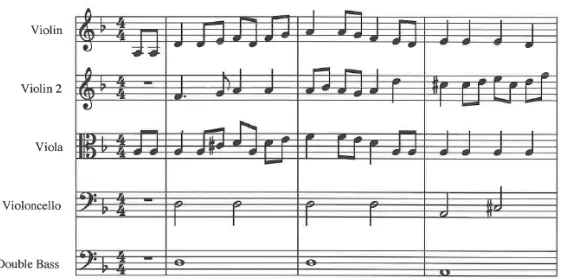
[image:44.612.70.365.297.506.2]The purpose of this study was to determine the effect of group composition on student musical self-efficacy in the middle school string classroom. Students participated in a group composition unit, using a Theme and Variations form. A Self-Esteem of Musical Ability (SEMA) scale was used to measure student self-efficacy before and after the composition project. A Musical Background Survey (MBS) and a Post Composition Project Survey (PCPS) were also administered. Figures 1 and 2 show examples of student group composition projects.
Figure 1. Student Group Variation Composition Example One.
[image:44.612.84.365.561.701.2]Musical Background Survey (MBS)
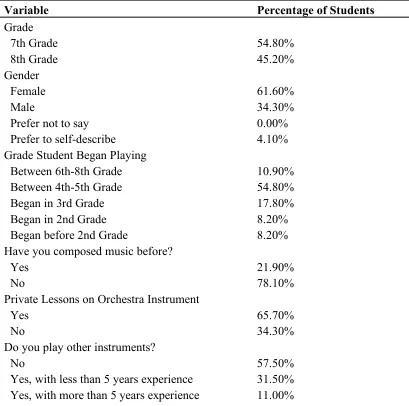
[image:45.612.68.477.183.589.2]The responses to the MBS were scored to provide background information about the student participants. The range was 1-7 (M = 3.90, SD = 1.55). Table 1 shows MBS responses.
Table 1. Musical Background Survey.
Variable Percentage of Students
Grade
7th Grade 54.80%
8th Grade 45.20%
Gender
Female 61.60%
Male 34.30%
Prefer not to say 0.00%
Prefer to self-describe 4.10%
Grade Student Began Playing
Between 6th-8th Grade 10.90%
Between 4th-5th Grade 54.80%
Began in 3rd Grade 17.80%
Began in 2nd Grade 8.20%
Began before 2nd Grade 8.20%
Have you composed music before?
Yes 21.90%
No 78.10%
Private Lessons on Orchestra Instrument
Yes 65.70%
No 34.30%
Do you play other instruments?
No 57.50%
Yes, with less than 5 years experience 31.50% Yes, with more than 5 years experience 11.00%
SEMA Pre- versus Post- Test Data (All Participants)
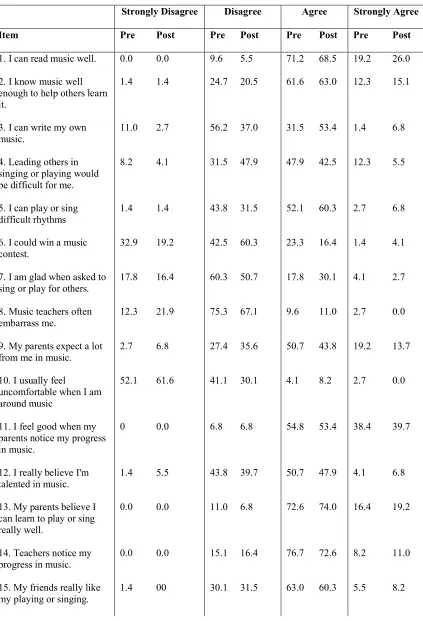
Table 2. SEMA Pre-test and Post-test Responses (All data in percentages)
Strongly Disagree Disagree Agree Strongly Agree
Item Pre Post Pre Post Pre Post Pre Post
1. I can read music well. 0.0 0.0 9.6 5.5 71.2 68.5 19.2 26.0
2. I know music well enough to help others learn it.
1.4 1.4 24.7 20.5 61.6 63.0 12.3 15.1
3. I can write my own
music. 11.0 2.7 56.2 37.0 31.5 53.4 1.4 6.8
4. Leading others in singing or playing would be difficult for me.
8.2 4.1 31.5 47.9 47.9 42.5 12.3 5.5
5. I can play or sing
difficult rhythms 1.4 1.4 43.8 31.5 52.1 60.3 2.7 6.8
6. I could win a music contest.
32.9 19.2 42.5 60.3 23.3 16.4 1.4 4.1
7. I am glad when asked to
sing or play for others. 17.8 16.4 60.3 50.7 17.8 30.1 4.1 2.7
8. Music teachers often
embarrass me. 12.3 21.9 75.3 67.1 9.6 11.0 2.7 0.0
9. My parents expect a lot
from me in music. 2.7 6.8 27.4 35.6 50.7 43.8 19.2 13.7
10. I usually feel
uncomfortable when I am around music
52.1 61.6 41.1 30.1 4.1 8.2 2.7 0.0
11. I feel good when my parents notice my progress in music.
0 0.0 6.8 6.8 54.8 53.4 38.4 39.7
12. I really believe I'm
talented in music. 1.4 5.5 43.8 39.7 50.7 47.9 4.1 6.8
13. My parents believe I can learn to play or sing really well.
0.0 0.0 11.0 6.8 72.6 74.0 16.4 19.2
14. Teachers notice my
progress in music. 0.0 0.0 15.1 16.4 76.7 72.6 8.2 11.0
15. My friends really like
16. My music teachers
don't expect much of me. 23.3 23.3 69.9 72.6 6.8 4.1 0.0 0.0
17. I come from a musical
family. 31.5 24.7 31.5 35.6 26.0 24.7 11.0 15.1
18. I could lead the class if my music teachers asked me to take their place.
32.9 23.3 49.3 56.2 17.8 16.4 0.0 4.1
19. Kids laugh at me when I make mistakes in music.
37.0 31.5 53.4 60.3 8.2 8.2 1.4 0.0
20. I'd be glad if teachers asked me to play or sing for programs.
11.0 11.0 38.4 35.6 42.5 46.6 8.2 6.8
21. I believe I could become a professional singer or player.
19.2 17.8 37.0 45.2 39.7 27.4 4.1 9.6
22. Kids notice my progress in music and give me credit for what I can do.
5.5 8.2 28.8 27.4 64.4 58.9 1.4 5.5
23. Music is all right for others but not for me.
45.2 43.8 50.7 50.7 2.7 4.1 1.4 1.4
24. I will not be good enough to be in choir or band in college.
12.3 15.1 53.4 46.6 27.4 30.1 6.8 8.2
25. I enjoy playing for
others. 5.5 4.1 32.9 27.4 53.4 54.8 8.2 13.7
26. I expect a lot of myself
in music. 1.4 2.7 15.1 19.2 52.1 57.5 31.5 20.5
27. People my age admire
my musical ability. 8.2 8.2 46.6 47.9 42.5 41.1 2.7 2.7
28. I have a rough time learning in music class.
19.2 23.3 71.2 68.5 6.8 6.8 2.7 1.4
29. I find myself helping my friends with their music.
2.7 6.8 54.8 45.2 41.1 43.8 1.4 4.1
30. I am glad my family likes to listen to me perform.
2.7 4.1 15.1 12.3 54.8 56.2 27.4 27.4
31. Music is harder for me
32. I am not able to make
progress in music. 41.1 38.4 54.8 60.3 2.7 1.4 1.4 0.0
33. At least one member of my family says I am really good in music.
0.0 2.7 13.7 8.2 57.5 57.5 28.8 31.5
34. I would like to have a professional career in music.
19.2 9.6 49.3 53.4 24.7 28.8 6.8 8.2
35. Usually I enjoy
practicing music. 0.0 1.4 9.6 9.6 72.6 72.6 17.8 16.4
36. I like it when music teachers give me hard music to learn.
4.1 0.0 17.8 19.2 60.3 54.8 17.8 26.0
37. If my friends chose a music leader, they would probably pick me.
17.8 20.5 63.0 53.4 19.2 24.7 0.0 1.4
38. Other students sometimes ask me to play or sing with them.
9.6 11.0 53.4 42.5 37.0 43.8 0.0 2.7
39. I expect to play or sing in performing groups after high school.
9.6 9.6 41.1 43.8 41.1 38.4 8.2 8.2
40. No one pays much attention to my musical activities at home.
27.4 21.9 63.0 63.0 8.2 13.7 1.4 1.4
41. I don't have even one friend who would say I am any good at music.
31.5 31.5 63.0 61.6 2.7 5.5 2.7 1.4
42. My teacher thinks I can do well in music.
0.0 0.0 4.1 5.5 83.6 75.3 12.3 19.2
43. Compared with other students, I think I am talented.
9.6 9.6 46.6 49.3 38.4 37.0 5.5 4.1
samples t-test revealed the change was not significant t (72) = -1.910, p = .06. Negatively worded items were reverse-coded in the data analysis.
In comparing the pre- versus post-test SEMA data, certain items showed larger changes in frequency. One of the biggest changes was in the item “I can write my own music.” In the pre-test 67.2% of students answered “Strongly Disagree” or “Disagree,” while 32.9% of students answered “Strongly Agree” or “Agree.” In the post-test for this same item only 39.7% reported to “Strongly Disagree” or “Disagree” (with only 2.7% reporting to “Strongly Disagree”) and 60.2% of students chose “Strongly Agree” or “Agree.”
Another item that showed a larger change was “Leading others in singing or playing would be difficult for me.” In the pre-survey 39.7% disagreed that being a musical leader would be difficult, but in the post-survey 52% disagreed. In the same statement, 60.2% agreed or strongly-agreed on the pre-survey that leading others musically would be difficult, but that number dropped to 48% on the post-survey. Also, the item “I usually feel uncomfortable when I am around music” had 52.1% “Strongly Disagree” response, and 2.7% “Strongly Agree”
response in the pre-test. In the post-test these numbers changed to 61.6% “Strongly Disagree” and 0% “Strongly Agree.”
Selected Variables that Interact with a Group Composition Activity to Influence Students’
Musical Self-Efficacy
Grade level.
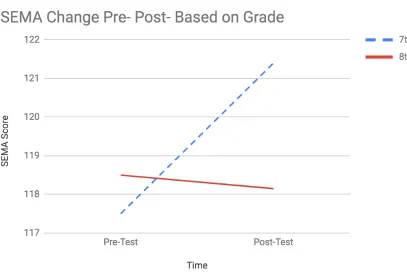
To determine if there was a difference between seventh and eighth graders on the change in SEMA from pre- to post-test, a mixed ANOVA was used. This test showed an increase in the pre- to post-SEMA scores for the seventh-grade students surveyed, while the eighth data showed a slight decrease.
[image:50.612.86.493.408.686.2]SEMA scores for seventh-graders (n = 40) improved from pre-test (M = 117.48 SD = 16.04) to post-test (M = 121.43 SD = 16.86). In contrast, SEMA scores for eighth-graders (n = 33) decreased slightly from pre-test (M = 118.52 SD = 13.63) to post-test (M = 118.15 SD = 13.98). A mixed ANOVA found there was a significant interaction between grade level and change in musical self-esteem from pre-test to post-test F (1, 71) = 4.40 , p = .04, partial eta squared = .06. Figure 3 shows SEMA score change for seventh and eighth students.
Past musical experiences (MBS).
MBS scores ranged from 1-7, with 7 being the highest possible score, with the majority of students in the middle of that range. In general, SEMA scores (pre- and post-) were higher with higher MBS scores. In addition, each average MBS score showed an increase in SEMA score from pre- to post-test, but that increase varied between each MBS score level.
[image:51.612.75.504.321.485.2]A moderate relationship was found between the SEMA Pre-test scores and MBS scores (r = .37, p = .001). A moderate relationship was also found between SEMA post-test scores and MBS scores (r = .32, p = .005). Table 3 shows MBS scores with SEMA pre- and post- averages.
Table 3. MBS Scores with SEMA Pre- and Post-Test Averages
MBS Score
n SEMA Pre-Test
Average Score
SEMA Post-Test Average Score
Average SEMA Score Increase
1 n = 2 107 117.5 10.5
2 n = 15 110.5 113.2 2.67
3 n = 13 112.9 114.1 1.15
4 n = 16 122 122.3 0.3
5 n = 17 121.7 124.2 2.6
6 n = 5 121.4 124.2 2.8
7 n = 5 128.6 130.0 1.4
SEMA pre-test scores for high MBS students (M = 122.56, SD = 13.92, n = 43) were significantly higher than those for low MBS students (M = 111.33, SD = 13.94, n = 30), t (71) = -3.39, p = .001. SEMA post-test scores for high MBS students (M = 124.19, SD = 15.81, n = 43) were significantly higher than those for low MBS students (M = 113.87, SD = 13.34, n = 30), t (71) = -2.92, p = .005. While both SEMA post-test scores were higher than the pre-test scores, neither high MBS nor low MBS students showed a significant difference from SEMA pre- to post-test. Figure 4 shows the SEMA change pre- and post- for High MBS and Low MBS.
Figure 4. SEMA Change Pre- Post- Based on MBS Score
Gender.
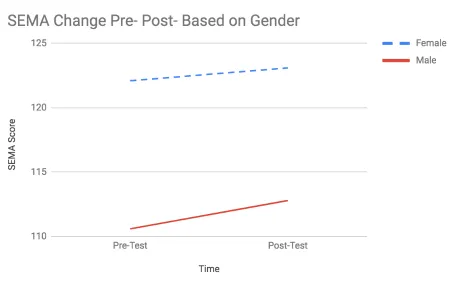
average score was significantly higher for both pre- and post-tests with females than males. Their average SEMA post-test increase was about the same.
SEMA pre-test scores for female students (M = 121.53, SD = 12.93, n = 45) were
[image:53.612.79.529.349.651.2]significantly higher than those for male students (M = 110.62, SD = 14.81, n = 26), t (69) = 3.25, p = .002. SEMA post-test scores for female students (M = 123.27, SD = 14.22, n = 45) were significantly higher than those for male students (M = 113.00, SD = 13.66, n = 26), t (69) = 2.97, p = .004. While both SEMA post-test scores were higher than the pre-test scores, neither female nor male students showed a significant difference from SEMA pre- to post-tests. Figure 5 shows SEMA change pre- and post- for male and female participants.
Figure 5. SEMA Change Pre- Post- Based on Gender.
The PCPS (Appendix E) contained 4 questions on a Likert-type scale, and one open-ended question asking students to reflect on what they learned in the group composition process. Table 4 shows frequencies for each PCPS question.
Table 4. Post-Composition Project Survey Frequencies. (All data in percentages)
SD D A SA
The Simple Gifts Composition was a
worthwhile musical experience. 0.00 2.74 63.01 34.25 I enjoyed working with the members
of my group on the project.
2.74 2.74 60.27 34.25
I like the piece of music that my group composed during this project.
2.74 8.22 78.08 10.96
I made important contributions to the composing of my group’s piece.
0.00 4.11 73.97 21.92
Students were assigned a “Composition Satisfaction Score” (CSS) based on their
Table 5. Composition Satisfaction Scores with Average SEMA Increase.
Composition Satisfaction Score
n SEMA
Pre-Test Average Score
SEMA Post-Test Average Score
Average SEMA Score Increase
9 n = 3 111.30 112.60 1.30
10 n = 1 74.00 92.00 18.00
11 n = 5 114.40 113.20 -1.20
12 n = 28 119.40 118.90 -0.50
13 n = 15 110.40 114.10 3.70
14 n = 11 124.90 128.60 3.70
15 n = 9 125.75 130.75 5.00
16 n = 2 125.50 129.50 4.00
Post Composition Survey Comments
Chapter V: Summary, Discussion, and Implications for Future Research
Summary
This research question of this study was to determine the effect of a curricular uni