2018 International Conference on Computer Science and Software Engineering (CSSE 2018) ISBN: 978-1-60595-555-1
Image Dehazing Algorithm Based on Multi
Mixed Prior Theory
Zhe Li*, Jianzeng Li and Qi Hu
ABSTRACT
In order to eliminate the prior blind area and improve the clarity of the fogging image, an image dehazing algorithm based on the multi mixed prior theory is proposed. First, the pixel area of the image is partitioned by dual constraints. Then the atmospheric transmittance of the dual constrained region is obtained by using the multi mixture priori theory. Finally, the guided filter algorithm is used to optimize the transmittance map. The experimental results show that compared with the traditional algorithm, the algorithm has a better visual effect and higher evaluation indexes. The algorithm proposed in this paper has a good restoration effect for fog image restoration.
INTRODUCTION
Image dehazing is a process to reduce the impact of fog, haze, sand and other low visibility imaging environment on the image degradation and improve the quality of image information [1]. It mainly solves the problems of blurred image feature information, low contrast, gray concentration, color distortion and so on [2]. At present, image dehazing methods are mainly divided into two categories [3]: image restoration and image enhancement. Based on image restoration, the algorithm of dehazing is based on the degradation mechanism of images, and a physical model of image degradation is established by using prior knowledge or hypothesis, and a clear image is restored with pertinence. Compared with image enhancement algorithm, it has more pertinence, better blurring effect and more complete information preservation. Therefore, it is of great significance to its research.
____________________________
In the field of image restoration, the scholars have accomplished a lot of work: Tan [4] proposed a contrast priori restoration algorithm. Statistics shows that fog free image has higher contrast than foggy image. According to this prior condition, we first maximize the contrast of foggy image, and then combine the atmospheric light value to suppress the pixel value of restored image. Finally, we use Markoff model to further optimize the restoration effect. The algorithm has a certain applicability. Because the physical model of image degradation is not considered, the color of the restored image is easy to be saturated and the distortion is obvious. Fattal [5] proposes a reflectivity priori restoration algorithm. It is found that the surface reflectivity is not related to the transmittance of light. According to this prior condition, the transmittance map is estimated. Then the atmospheric scattering model is introduced to get the restored image. The algorithm introduces the physical model to solve the problem of distortion better, but because the restoration process needs enough physical color information support, so when the color information is less, the processing effect is poor. He [6] proposes a restoration algorithm based on Dark Channel Prior (DCP). Statistics found no fog image of the great outdoors, in addition to the sky, white scenery high brightness area, exist in the local area in most of the image of some pixels have very low values in a channel, according to the prior conditions of transmission ratio, and the use of soft matting algorithm (soft matting) to improve the. Although the algorithm is novel and unique, and has strong robustness, the algorithm is poor in real time because of the complexity of the soft matting algorithm. In document [7-10], an improved algorithm is proposed on the basis of literature [6]. In the transmittance estimation stage, bilateral filter [7] and median filter [8] are used to replace the minimum value filtering. In the phase of transmittance map refinement, bilateral filter [9] and guided filter [10] are used instead of soft matting algorithm. These improvements improve the robustness and real-time performance of the algorithm to some extent. However, due to the lack of DCP in the processing of high brightness regions, the further development of such algorithms is restricted. Zhu proposes a restoration algorithm based on the Color Attenuation Prior (CAP). There are lots of Statistics found that the fog image outdoors, poor brightness and saturation concentration of fog and the arbitrary area pixels is proportional to the prior condition to establish the linear model about the depth of field, and the correlation coefficient in the model after the training, the depth map is obtained indirectly transmittance map. The algorithm is simple, effective and real-time. The subjective visual effect of restored image is better. It solves the defect of DCP algorithm in high brightness area, but it has poor effect on the heavy fog area because of the defect of the depth of field model.
To solve these problems, an image dehazing algorithm based on multi mixed prior theory is proposed in this paper. Firstly, the pixel regions of the image are partitioned by dual constraints. Secondly the atmospheric transmittance of the dual constrained region is obtained by using the multi mixture priori theory. Thirdly, the guided filter algorithm is used to optimize the transmittance map, and finally, the experimental verification is carried out.
MULTI MIXED PRIOR THEORY
Theoretical Explanation
DCP and CAP have a better recovery effect, and can better compensate for the prior blind area of their own, so we propose a mixed prior theory to estimate the atmospheric transmittance. To solve the problem that the single prior estimation method has the effect of the prior blind region on the robustness of the restoration algorithm.
Firstly, an effective region segmentation method is applied to segment the highlight area and dense fog area of fuzzy image. Then, according to the characteristics of each area, we use DCP and CAP mixture to get atmospheric transmittance map, and remove the prior blind area.
DCP does not been applied to highlight areas, but compared to other prior algorithms, the processing of fog area is better. While the CAP is not suitable for the region, it can solve the problem of distortion of the highlighted area restoration and complementary characteristics of DCP and CAP; a priori is similar, and the algorithm implementation ideas are basically the same, can be realized high.
The size of the dark channel value can approximately describe the fog concentration in the image. The greater the fog concentration is, the greater the brightness is. The brightness channel value can directly indicate the brightness of the image. The greater the value is, the greater the brightness is. In this paper, we use the dual constraint condition composed of dark channel map and brightness channel graph to divide the highlight area and dense fog area of the image, which has certain theoretical basis.
The values of the I2 and I3 regions are well understood. According to the
characteristics of each region, the I2 area is only DCP, and the I3 area is only
CAP. The I4 region is mixed with a priori, and the ratio of the two priors is
reasonably adjusted by the coefficient, so as to further optimize the recovery
effect. The proportion of the I1 area is low in the whole image, which is
Calculation of Atmospheric Transmittance Based on Multi Mixed Prior Theory
Step 1: The dark channel map and the depth image of the blurred image are calculated respectively.
(x) {r,g,b}
( ) min ( min ( ))
dark y c c
I x I y
∈Ω ∈
= (1)
0 1 2
(x)
( ) min ( ( ) ( ) ( ))
r s
y v
d x θ θI y θ I y ε y
∈Ω
= + + + (2)
In the formula, Ic is a color channel blurred image in the RGB color space, and
(x)
Ω is an area with x as the center. Iv and Is respectively denote the luminance channel map and saturation channel map in HSV color space. ε random variable represents the random error of depth image. θ0 , θ1, and θ2 are the linear coefficients.
Step 2: In order to identify the highlight area and fog area effectively, a double constraint region segmentation method is proposed in this paper to redefine the area of pixels.
2 3 4 ( ) ( ) , ( ) ( ) ( ) , ( ) ( ) ( ) ( ) , ( ) ( ) ( ) , ( ) v v dark dark dark dar v v k
I x I x I x
I x I x I x
I x
I x I x I x
I x I x I x
α β
α β
α β
α β
1 > >
> ≤ = ≤ > ≤ ≤ (3)
In the formula, I1 is the high brightness heavy fog area, and I2 is the non high brightness heavy fog area. I3 is the high brightness non dense fog area, and I4 is the non high brightness non dense fog area. α and β are the region dividing thresholds.
Step 3: In order to improve the robustness of atmospheric transmittance estimation, a hybrid priori strategy is proposed to estimate atmospheric transmittance.
( )x dark( )x ntcolor( )x
t =mt + (4)
2 3 4
0 ( ) ( )
1 ( ) ( )
0 ( ) ( ) ( ) ( ) I x I x
I x I x m
I x I x I x I x λ 1 ∈ ∈ = ∈ ∈ (5) 1
In the formula, m and n are mixed prior coefficients, and tdark( )x is coarse transmittance obtained by dark original color prior. tcolor( )x is color attenuation prior to coarse transmittance.
(x) {r,g,b}
1 min ( min ( )
( ) c )
dark
y c
I t
A y
x ω
∈Ω ∈
= − (7)
( )
( ) d x,y
color
t x, y =e−η (8)
In the formula, ω is the fidelity coefficient and η is the atmospheric scattering coefficient.
ALGORITHM IN THIS PAPER
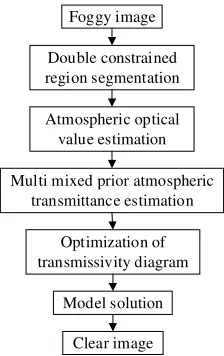
Step 1 Double constrained region segmentation. First, we obtain the dark channel and luminance channel map. Then we set the threshold in the two channel diagrams to constrain the dense fog area and highlight area. Finally, we divide the four pixel regions by two constraints.
Step 2 Atmospheric light value estimation. The pixel position of the first 0.1% of the brightness in the dark channel is recorded and the pixel value of the corresponding position is found from the fog image as the atmospheric light value.
Step 3 Atmospheric transmittance estimation. For the four pixel regions obtained from step 1, an atmospheric transmittance estimation method based on mixed prior is proposed to improve the robustness of the transmittance estimation.
Step 4 Optimization of transmissivity diagram. The guidance filter algorithm is used to filter the rough atmospheric transmittance map, so as to improve the clarity of the edge details of the transmittance image.
Step 5 Model solution. In the low visibility imaging environment, the atmospheric scattering model is defined as:
( ) ( ) ( ) (1 ( ))
I x, y =J x, y t x, y +A −t x, y (9)
In the formula, I is a blurred image. J is the restored clear images. t x, y( ) is atmospheric transmittance, and A is the estimated atmospheric light. A and
( )
t x, y are replaced by the atmospheric scattering model, and the restored clear image is obtained. In order to avoid the image distortion caused by too large or too small atmospheric transmittance, the parameters are introduced to restrict the image distortion.
EXPERIMENTAL VERIFICATION
Experimental Setup
Experimental platform: Lenovo notebook computer R720-15IKB; CPU: Inter (R) -Core (TM) i7-7700HQ 2.80GHz;
Memory: 8G;
Operation system: Win10 64 bits;
Programming environment: Matlab R2015a;
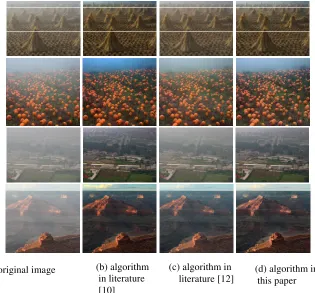
Data sets: General fuzzy test images are derived from the home page of Fattal, He, Xu, Zhu and others, as shown in Figure 2.
Double constrained region segmentation
Atmospheric optical value estimation
Multi mixed prior atmospheric transmittance estimation
Optimization of transmissivity diagram
Foggy image
Model solution
Clear image
[image:6.612.241.353.246.424.2]Figure 1. Algorithm flow chart.
[image:6.612.113.477.406.635.2]Figure 2. General test image.
TABLE I. PARAMETER SETTINGS.
main parameter value
The filter radius of the guided filter 60
Variance increment of guided filter 3
10−
The filter radius of minimum value filter 15
Atmospheric scattering coefficient 1
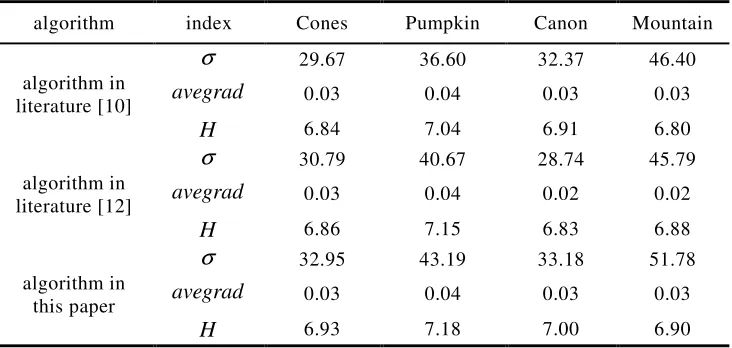
Considering that the clear image have more contrast, more information and clearer texture details than the foggy image[11], the standard deviation, average gradient and information entropy are introduced to objectively evaluate the image restoration effect.
The whole experiment process: follow the principle of control variables, in the same experimental environment. Using the literature [10] algorithm, the literature [12] algorithm and the algorithm of this paper to restore the image of the data set. Through the comparative analysis of two aspects of the subjective vision and objective index of the reconstructed image, the rationality and superiority of the algorithm are verified.
Experimental Result
[image:7.612.139.454.303.596.2]The results of the experiment are as follows:
Figure 3. Image restoration effect diagram. (a) original image (b) algorithm
in literature [10]
(c) algorithm in literature [12]
TABLE II. TIMINGS FOR DIFFERENT METHODS.
algorithm index Cones Pumpkin Canon Mountain
algorithm in literature [10]
σ 29.67 36.60 32.37 46.40
avegrad 0.03 0.04 0.03 0.03
H 6.84 7.04 6.91 6.80
algorithm in literature [12]
σ 30.79 40.67 28.74 45.79
avegrad 0.03 0.04 0.02 0.02
H 6.86 7.15 6.83 6.88
algorithm in this paper
σ 32.95 43.19 33.18 51.78
avegrad 0.03 0.04 0.03 0.03
H 6.93 7.18 7.00 6.90
The experimental results are analyzed as follows:
Comparing (b), (c) and (d) in Figure 3, it is found that restoration algorithm based on multi mixture priori can improve can better improve the distortion of the dark original color prior to the bright region and the deficiency of the color attenuation prior to the thick fog treatment. The results of the restored image are improved obviously.
From the analysis of Table II, the results are compared with the three objective indexes. This algorithm is better than the algorithm in literature [10] and the algorithm in literature [12].
The whole experiment from two aspects of the subjective and objective verified by Multi mixed prior theory has certain advantages, the proposed algorithm has strong robustness.
CONCLUSION
REFERENCES
1. Xiao J S, Gao W, Zou B Y, et al. Image dehazing based on Sky-Constrained Dark Channel Prior[J]. Acat Electronica Sinica, 2017, 45(2):346-352.
2. Liu J P, Huang B K, Wei G. A fast effective single image dehazing algorithm[J]. Acat Electronica Sinica, 2017, 45(8):1896-1901.
3. Wu D, Zhu Q S. The latest research progress of image dehazing[J].Acta Automatic Sincia, 2015, 41(2): 221-239.
4. Tan R T. Visibility in bad weather from a single image[C]// Computer Vision and Pattern Recognition, 2008. CVPR 2008. IEEE Conference on. IEEE, 2008:1-8.
5. Fattal R. Single image dehazing[J]//ACM Transactions on Graphics(TOG), 2008, 24(3):410-425.
6. He K, Sun J, Tang X. Single image haze removal using dark channel prior[C]//Computer Vision and Pattern Recognition, 2009. CVPR 2009. IEEE Conference on. IEEE, 2009:1956-1963.
7. Xu H, Guo J, Liu Q, et al. Fast image dehazing using improved dark channel prior[C]// International Conference on Information Science and Technology. IEEE, 2012:663-667. 8. Gibson K B, Võ D T, Nguyen T Q. An investigation of dehazing effects on image and
video coding[J]. IEEE Transactions on Image Processing A Publication of the IEEE Signal Processing Society, 2012, 21(2):662.
9. Wang Y F, Yin C L, Huang Y M, et al. Image haze removal using a bilateral filter[J]. Journal of Image and Graphics, 2014, 19(3):386-392.
10. He K, Sun J, Tang X. Guided image filtering[J]. IEEE Transactions on Pattern Analysis & Machine Intelligence, 2013, 35(6):1397-409.
11. Li J T, Zhang Y J. Improvements of image haze removal algorithm and its subjective and objective performance evaluation[J]. Optics and Precision Engineering, 2017, 25(3):735-741.