R E S E A R C H
Open Access
An alternating iteration algorithm for solving
the split equality fixed point problem with
L-Lipschitz and quasi-pseudo-contractive
mappings
Meixia Li
1*, Xueling Zhou
2and Haitao Che
1*Correspondence: [email protected]
1School of Mathematics and Information Science, Weifang University, Weifang, P.R. China Full list of author information is available at the end of the article
Abstract
In this paper, we are concerned with the split equality common fixed point problem. It is a significant generalization of the split feasibility problem, which can be used in various disciplines, such as medicine, military and biology, etc. We propose an alternating iteration algorithm for solving the split equality common fixed point problem with L-Lipschitz and quasi-pseudo-contractive mappings and prove that the sequence generated by the algorithm converges weakly to the solution of this problem. Finally, some numerical results are shown to confirm the feasibility and efficiency of the proposed algorithm.
MSC: 47J25; 47J20; 47H09
Keywords: Split equality common fixed point problem; Alternating iteration algorithm; Weak convergence
1 Introduction
Throughout this paper, we always assume thatH1,H2andH3are real Hilbert spaces with
inner product·,·and induced norm · . LetCandQbe nonempty closed and convex subsets ofH1andH2, respectively. LetA:H1→H2be a bounded linear operator andI
denote the identity operator. The split feasibility problem (SFP) is to find
x∈C such that Ax∈Q, (1.1)
which is first introduced by Censor and Elfving [8] in finite-dimensional Hilbert spaces for modeling inverse problems. The applications of the split feasibility problem are very com-prehensive such as CT in medicine, intelligence antennas and the electronic warning sys-tems in militarily, the development of fast image processing technology, etc. [5,7,9,34].
To solve the problem (1.1), Byrne [4] proposed the CQ algorithm which generates a sequence{xn}by
xn+1=PC
xn–ξA∗(Axn–PQAxn)
, (1.2)
and proved the sequence generated by (1.2) converges to the solution of (1.1), whereA∗
is the adjoint operator ofA,ξ∈(0, 2/L) andLdenotes the largest eigenvalue of the ma-trixATA. Furthermore, many authors studied the problem (1.1) and proposed some al-gorithms for solving it, please see [3,6,22,25,26,32,33,35] and the references therein. Particular cases of the CQ algorithm are the Landweber and projected Landweber meth-ods for obtaining exact or approximate solutions of the linear equationsAx=b.
In [18,19,24,30,31,34], a lot of algorithms were proposed for solving a multiple-sets split feasibility problem (MSFP), which is to find
x∈
p
i=1
Ci such that Ax∈ r
j=1
Qj, (1.3)
wherep,r≥1 are integers,{Ci}pi=1and{Qj}rj=1are nonempty closed convex subsets ofH1
andH2, respectively. Whenp=r= 1, then MSFP (1.3) is known as SFP (1.1).
Since every closed convex subset of a Hilbert space is the fixed point set of its associating projection, the problem (1.1) and (1.3) are all special cases of the so-called multiple-set split common fixed point problem (MSCFP) which is to find
x∈
p
i=1
Fix(Si) such that Ax∈ r
j=1
Fix(Tj), (1.4)
wherep,r≥1 are integers,{Si}pi=1:H1→H1and{Tj}rj=1:H2→H2are nonlinear operators
andFix(Si) andFix(Tj) are the sets of fixed points ofSiandTj, respectively. In particular,
ifp=r= 1, then MSCFP (1.4) reduces to the split common fixed point problem (SCFP) [11,20,27,29] to find
x∈Fix(S) such that Ax∈Fix(T), (1.5)
whereS:H1→H1andT:H2→H2are nonlinear operators.
It is easy to see from [10,15] that the above problems are the special cases of the follow-ing problem:
find a pointx∗∈Xthat solves IP1
and such that
the pointy∗=Ax∗∈Ysolves IP2,
where IP1 and IP2 are inverse problems, which is called the split inverse problem (SIP). Furthermore, we find that the equilibrium problem (EP) and the split variational in-equality problem (SVI) are also special cases of SIP from [10,11,15,21].
As the further extension of the split feasibility problem, Moudafi [22,23] introduced the split equality feasibility problem (SEFP) to find
whereA:H1→H3andB:H2→H3are two bounded linear operators. Obviously, ifB=I
andH3=H2, then (1.6) reduces to (1.1), which can be extended to be the split common
fixed point problem (SCFPP); see [11] and the references therein. This kind of split equality feasibility problem (1.6) allows for asymmetric and partial relations between the variables
xandy.
To solve the split equality feasibility problem (1.6), Moudafi [23] proposed the following alternating CQ algorithm:
⎧ ⎨ ⎩
xn+1=PC(xn–γnA∗(Axn–Byn)),
yn+1=PQ(yn+γnB∗(Axn+1–Byn)).
(1.7)
Under suitable conditions, he proved the weak convergence of the sequence{(xn,yn)}to a
solution of (1.6) in Hilbert spaces. About the study of algorithms and theories for solving (1.6), the reader can also see [14,17] and the references therein.
In [23], Moudafi studied the split equality common fixed point problem (SECFP), which is to find
x∈Fix(S), y∈Fix(T) such that Ax=By, (1.8)
and proposed the following iterative algorithm:
⎧ ⎨ ⎩
xn+1=S(xn–λnA∗(Axn–Byn)),
yn+1=T(yn+βnB∗(Axn+1–Byn)).
(1.9)
He proved the weak convergence of the sequences generated by scheme (1.9) under the condition thatSandTare firmly quasi-nonexpansive mappings. The study of the problem (1.9) not only has theory interesting, but also has practical background. In [1,2], Attouch et al. propose the inertial Nash equilibration processes, which is the link with decision sci-ences and game theory. The problem can be modeled as the following convex optimization problem:
minf(x) +g(y) +μQ(x,y),x∈X,y∈Y , (1.10)
whereX,Y are real Hilbert spaces,f :X→R∪ {+∞},g:Y→R∪ {+∞}are closed con-vex proper functions acting, respectively, on the spacesX andY, Q:X×Y →R+ is a nonnegative quadratic form which couples the two variablesxandy, andμis a positive parameter. Letf(x) =x–z2,g(y) =y–v2, andQ(x,y) =Ax–By2, wherez∈fix(S),
v∈fix(T) andS,T are operators. Then the optimization solution of the problem (1.10) is the solution of (1.8).
Furthermore, Chang, Wang and Qin [13] modified the iterative scheme (1.9) and pro-vided a unified framework for solving this problem without using the projection. The framework is as follows:
⎧ ⎪ ⎪ ⎪ ⎪ ⎪ ⎨ ⎪ ⎪ ⎪ ⎪ ⎪ ⎩
un=xn–γnA∗(Axn–Byn),
xn+1=αnxn+ (1 –αn)[(1 –ξ)I+ξS((1 –η)I+ηS)]un,
vn=yn+γnB∗(Axn–Byn),
yn+1=αnyn+ (1 –αn)[(1 –ξ)I+ξT((1 –η)I+ηT)]vn,
where S: H1→H1 andT:H2→H2 are two L-Lipschitz and quasi-pseudo-contractive
mappings withL≥1,Fix(T)=∅. They proved that the sequence{(xn,yn)}generated by
the above modification (1.11) converges weakly to a solution of problem (1.8).
In this paper, we propose an alternating iterative algorithm which modifies the iterative scheme (1.11). In the process of calculatingvn, we usexn+1instead ofxn. And we modify
the directionsA∗(Axn–Byn) andB∗(Byn–Axn), which can make full use of the current
information of the iterative points. Details please see Theorem3.1in Sect.3. Furthermore, we prove that the sequence generated by the algorithm weakly converges to a solution of the split equality common fixed point problem (1.8). Numerical results show that the feasibility and efficiency of this algorithm by comparing the algorithm proposed in this paper with the algorithm in [13].
2 Preliminaries
In this section, we recall some concepts, definitions and conclusions, which are prepared for proving our main results. We writexnxandxn→xto indicate that the sequence
{xn}converges weakly and strongly tox, respectively.
Definition 2.1([28]) A mappingT:C→Cis called
(i) quasi-nonexpansive, ifFix(T)=∅and
Tx–x∗≤x–x∗, for allx∈Candx∗∈Fix(T); (2.1)
(ii) quasi-pseudo-contractive, ifFix(T)=∅and
Tx–x∗2≤x–x∗2+Tx–x2, for allx∈Candx∗∈Fix(T). (2.2)
A mappingPCis said to be metric projection ofH1ontoCif for every pointx∈H1, there
exists a unique nearest point inCdenoted byPCxsuch that
x–PCx ≤ x–y, for ally∈C. (2.3)
The corresponding property of the mappingPCcan be seen from [16]. Furthermore, the
demiclosedness principle plays an important role in our arguments.
A mappingT:H→His called demiclosed at the origin if for any sequence{xn}which
weakly converges tox, and the sequence{Txn}strongly converges to 0, thenTx= 0.
To establish the main results, we need the following technical lemmas.
Lemma 2.1([12]) Let H be a real Hilbert space,then the following conclusions hold:
x–y2=x2+y2– 2x,y, ∀x,y∈H, (2.4)
αx+ (1 –α)y2=αx2+ (1 –α)y2
–α(1 –α)x–y, ∀x,y∈H,α∈[0, 1]. (2.5)
Denote
K:= (1 –ξ)I+ξT(1 –η)I+ηT. (2.6)
If0 <ξ<η< 1
1+√1+L2,then the following conclusions hold:
(i) Fix(T) =Fix(T((1 –η)I+ηT)) =Fix(K).
(ii) IfT is demiclosed at0,thenKis also demiclosed at0.
(iii) In addition,ifT:H→His quasi-pseudo-contractive,then the mappingKis quasi-nonexpansive,that is,
Kx–u∗≤x–u∗, ∀x∈Handu∗∈Fix(T) =Fix(K). (2.7)
3 Main results
In this section, we assume that
(i) H1,H2andH3are real Hilbert spaces.A:H1→H3andB:H2→H3are two
bounded linear operators,A∗andB∗are their adjoint operators, respectively. (ii) S:H1→H1andT:H2→H2are all L-Lipschitz and quasi-pseudo-contractive
mapping withL≥1,0 <ξn<ηn< 1
1+√1+L2,∀n≥1,Fix(S)=∅, andFix(T)=∅. Our objective is to solve the split equality common fixed point problem to find
x∗∈Fix(S), y∗∈Fix(T) such that Ax∗=By∗. (3.1)
Theorem 3.1 Let H1, H2,H3 and A,B, S,T are assumed as above.Assume that{αn}
is a non-increasing sequence which satisfies 0 <β≤αn≤θ < 1,whereβ andθ are real
numbers.For arbitrary x0∈H1,y0∈H2,let{xn},{yn},{un}and{vn}be generated by ⎧
⎪ ⎪ ⎪ ⎪ ⎪ ⎨ ⎪ ⎪ ⎪ ⎪ ⎪ ⎩
un=xn–γn[(xn–Kxn) +A∗(Axn–Byn)],
xn+1=αnxn+ (1 –αn)Kun,
vn=yn–γn[(yn–Gyn) –B∗(Axn+1–Byn)],
yn+1=αnyn+ (1 –αn)Gvn,
(3.2)
where
K:= (1 –ξn)I+ξnS
(1 –ηn)I+ηnS
,
G:= (1 –ξn)I+ξnT
(1 –ηn)I+ηnT
.
Assume S and T are demiclosed at0,and{γn}is a non-decreasing sequence which satisfies
γn∈
ε, 1 1 +c–ε
, c=maxA2,B2 ,
whereεis small enough.Then the sequence{(xn,yn)}generated by the algorithm weakly
Proof Choosep∈Fix(S),q∈Fix(T) andAp=Bq. By the algorithm of Theorem3.1, we have
un–p2
=xn–γn
(xn–Kxn) +A∗(Axn–Byn)
–p2
=xn–p2+γn2(xn–Kxn) +A∗(Axn–Byn)2
– 2γn
xn–p, (xn–Kxn) +A∗(Axn–Byn)
≤ xn–p2+γn2
1 +A2xn–Kxn2+γn2
1 + 1
A2
A∗(Axn–Byn)2
– 2γnxn–p,xn–Kxn– 2γn
xn–p,A∗(Axn–Byn)
. (3.3)
We have
–2xn–p,xn–Kxn
= –2xn–p2– 2xn–p,p–Kxn
= –2xn–p2+xn–p2+Kxn–p2–Kxn–xn2
≤–Kxn–xn2, (3.4)
–2Axn–Ap,Axn–Byn=Byn–Ap2–Axn–Ap2–Axn–Byn2. (3.5)
Combining (3.4) and (3.5), then (3.3) can be written as
un–p2
≤ xn–p2+γn2
1 +A2xn–Kxn2+γn2
1 +A2Axn–Byn2
–γnKxn–xn2+γnByn–Ap2–γnAxn–Ap2
–γnAxn–Byn2. (3.6)
Similarly, we can obtain
vn–q2
≤ yn–q2+γn2
1 +B2yn–Gyn2+γn2
1 +B2Axn+1–Byn2
–γnGyn–yn2+γnAxn+1–Bq2–γnByn–Bq2
–γnAxn+1–Byn2. (3.7)
Adding (3.6) and (3.7), byAp=Bq, we have un–p2+vn–q2
≤ xn–p2+yn–q2–γnAxn–Ap2+γnAxn+1–Ap2
–γn
1 –γn
1 +A2Kxn–xn2
–γn
1 –γn
–γn
1 –γn
1 +B2Gyn–yn2
–γn
1 –γn
1 +B2Axn+1–Byn2. (3.8)
ByKandGbeing quasi-nonexpansive and Eq. (2.5), we can write xn+1–p2
=αnxn+ (1 –αn)Kun–p2
=αn(xn–p) + (1 –αn)(Kun–p) 2
=αnxn–p2+ (1 –αn)Kun–p2–αn(1 –αn)Kun–xn2
≤αnxn–p2+ (1 –αn)un–p2–αn(1 –αn)Kun–xn2. (3.9)
Similarly, we can obtain
yn+1–q2
=αnyn+ (1 –αn)Gvn–q 2
≤αnyn–q2+ (1 –αn)vn–q2–αn(1 –αn)Gvn–yn2. (3.10)
Adding (3.9) and (3.10), combining (3.8), we have
xn+1–p2+yn+1–q2
≤αn
xn–p2+yn–q2
+ (1 –αn)
un–p2+vn–q2
–αn(1 –αn)
Kun–xn2+Gvn–yn2
≤ xn–p2+yn–q2– (1 –αn)γnAxn–Ap2
+ (1 –αn)γnAxn+1–Ap2
– (1 –αn)γn
1 –γn
1 +A2Kxn–xn2
– (1 –αn)γn
1 –γn
1 +A2Axn–Byn2
– (1 –αn)γn
1 –γn
1 +B2Gyn–yn2
– (1 –αn)γn
1 –γn
1 +B2Axn+1–Byn2
–αn(1 –αn)
Kun–xn2+Gvn–yn2
. (3.11)
Letting
Γn(p,q) =xn–p2+yn–q2– (1 –αn)γnAxn–Ap2.
From (3.11),{αn}and{γn}being non-increasing, we can get the following inequality:
Γn+1(p,q)≤Γn(p,q) –αn(1 –αn)
Kun–xn2+Gvn–yn2
– (1 –αn)γn
1 –γn
– (1 –αn)γn
1 –γn
1 +A2Axn–Byn2
– (1 –αn)γn
1 –γn
1 +B2Gyn–yn2
– (1 –αn)γn
1 –γn
1 +B2Axn+1–Byn2. (3.12)
From (3.12) andγn∈(ε,1+1c–ε),c=max{A2,B2}, we have Γn+1(p,q)≤Γn(p,q)
and
Γn(p,q)≥
1 – (1 –αn)γnA2
xn–p2+yn–q2≥0.
Therefore, the sequence{Γn(p,q)}is a non-increasing sequence and lower bounded by 0.
As a result,{Γn(p,q)}converges to some finite limit. Suppose that isΓ(x∗,y∗). Hence, we
know that the sequences{xn}and{yn}are bounded. Lettingn→ ∞and taking the limit
in the two sides of (3.12), we obtain
Kun–xn →0; Kxn–xn →0; Axn–Byn →0;
Gvn–yn →0; Gyn–yn →0; Axn+1–Byn →0.
(3.13)
Now, let us prove that{xn}and{yn}are asymptotically regular, from (3.13), we can obtain
lim
n→∞xn+1–xn=nlim→∞αnxn+ (1 –αn)Kun–xn
= lim
n→∞–(1 –αn)xn+ (1 –αn)Kun
= lim
n→∞(1 –αn)Kun–xn= 0.
Similarly, we have
lim
n→∞yn+1–yn= 0.
From (3.13), we have
lim
n→∞un–xn=nlim→∞γn(xn–Kxn) +A ∗(Ax
n–Byn)
≤ lim
n→∞
γnxn–Kxn+γnA∗(Axn–Byn)
≤ lim
n→∞
xn–Kxn+γnAAxn–Byn
= 0. (3.14)
Similarly, we can obtain
lim
n→∞vn–yn= 0. (3.15)
Combining (3.13), (3.14) and (3.15), we can get
lim
n→∞Kun–un=nlim→∞
Kun–xn+xn–un
= 0,
lim
n→∞Gvn–vn=nlim→∞
Gvn–yn+yn–vn
= 0.
Since{xn}and{yn}are bounded sequences, there exist weakly convergent subsequences,
say{xnj} ⊂ {xn}and{ynj} ⊂ {yn}such thatxnjx∗andynjy∗. The Opial property
guar-antees that the weakly subsequential limit of{(xn,yn)}is unique. So we havexnx∗and
yny∗.
On the other hand, from (3.14) and (3.15), we can obtainunx∗andvny∗. SinceK
andGare demiclosed at 0 and by (3.16), we haveKx∗=x∗andGy∗=y∗, which imply that
x∗∈Fix(K) andy∗∈Fix(G), that is,x∗∈Fix(S) andy∗∈Fix(T) from Lemma2.2(i). Furthermore, sinceAxn–BynAx∗–By∗, by using the weakly lower-continuity of the
squared norm, we have
Ax∗–By∗2=lim inf
n→∞ Axn–Byn 2≤ lim
n→∞Axn–Byn
2= 0. (3.17)
consequently,Ax∗=By∗. The proof is completed.
4 Numerical examples
In this section, we give an example to show some insight into the behavior of the algorithm presented in this paper. The whole codes are written in Matlab 7.0. All the numerical re-sults are carried out on a personal Lenovo Thinkpad computer with Intel(R) Core(TM) i7-6500U CPU 2.50 GHz and RAM 8.00 GB.
Example4.1 LetH1=H2=H3=R5.S(x) =15sinx,T(x) =101 sinx.A∈R5×5,B∈R5×5are
as follows: A= ⎛ ⎜ ⎜ ⎜ ⎜ ⎜ ⎜ ⎝
0.6674 0.4429 0.1642 0.0410 0.1124 0.9138 0.8919 0.1286 0.1953 0.9165 0.5186 0.0535 0.4354 0.6849 0.2078 0.6941 0.7589 0.9198 0.0316 0.0625 0.3730 0.9534 0.1759 0.3807 0.2593
⎞ ⎟ ⎟ ⎟ ⎟ ⎟ ⎟ ⎠ , B= ⎛ ⎜ ⎜ ⎜ ⎜ ⎜ ⎜ ⎝
0.4654 0.2709 0.1099 0.3647 0.0556 0.8159 0.4763 0.0070 0.4048 0.3070 0.3713 0.6759 0.6937 0.9897 0.7612 0.1701 0.5584 0.5488 0.5779 0.1563 0.2222 0.1778 0.9335 0.6102 0.8083
⎞ ⎟ ⎟ ⎟ ⎟ ⎟ ⎟ ⎠ .
The problem is to findx∗∈Fix(S),y∗∈Fix(T) such thatAx∗=By∗. In the experiments, we takeαn=13+21n,ξn= (1 – (12)n)∗ 1
1+√1+L2,ηn= (1 – (
2 3)n)∗
1 1+√1+L2, whereLis not higher than the minimum value of the Lipschitzian constants ofSandT. In this example, we setL=√5. Setγn=min{1+1λA,
1
1+λB}/1.01. The stopping criterion is
Axn–Byn ≤10–6.
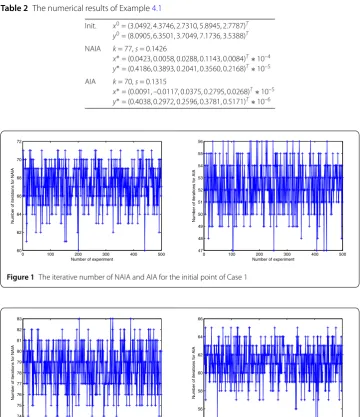
In the following tables and figures, we denote the non-alternating iteration algorithm in [13] and the alternating iteration algorithm in this paper for solving split equality common fixed point problem by “NAIA” and “AIA”, respectively. And we set “k”, “s”, “x∗” and “y∗” to express the number of iteration, CPU time in seconds and the final solution, respectively. Init. denotes the initial points. The numerical results can be seen from Tables1and2.
Table 1 The numerical results of Example4.1
Init. x0= (0.8263, 0.7819, 0.4906, 0.1597, 0.5815)T
y0= (0.4197, 0.3410, 0.2918, 0.4596, 0.3053)T NAIA k= 65,s= 0.1250
x∗= (0.3636, 0.7099, 0.8712, 0.5159, 0.4564)T∗10–5
y∗= (0.4151, 0.6644, 0.8149, 0.5041, 0.4949)T∗10–5
AIA k= 58,s= 0.1121
x∗= (0.1219, –0.1458, 0.0677, 0.0801, 0.1676)T∗10–5
[image:10.595.117.480.205.623.2]y∗= (0.1093, 0.0727, –0.0224, 0.0301, –0.0147)T∗10–5
Table 2 The numerical results of Example4.1
Init. x0= (3.0492, 4.3746, 2.7310, 5.8945, 2.7787)T
y0= (8.0905, 6.3501, 3.7049, 7.1736, 3.5388)T NAIA k= 77,s= 0.1426
x∗= (0.0423, 0.0058, 0.0288, 0.1143, 0.0084)T∗10–4
y∗= (0.4186, 0.3893, 0.2041, 0.3560, 0.2168)T∗10–5
AIA k= 70,s= 0.1315
x∗= (0.0091, –0.0117, 0.0375, 0.2795, 0.0268)T∗10–5
[image:10.595.117.479.425.651.2]y∗= (0.4038, 0.2972, 0.2596, 0.3781, 0.5171)T∗10–6
Figure 1The iterative number of NAIA and AIA for the initial point of Case 1
Figure 2The iterative number of NAIA and AIA for the initial point of Case 2
Case 1. x0=rand(5, 1),y0=rand(5, 1);
Case 2. x0=rand(5, 1)∗10,y0=rand(5, 1)∗10;
Figure 3The iterative number of NAIA and AIA for the initial point of Case 3
Figure 4The iterative number of NAIA and AIA for the initial point of Case 4
Case 4. x0=rand(5, 1)∗1000,y0=rand(5, 1)∗1000,
separately in Example4.1, the results can be found in Figs.1–4.
From Tables 1 and2 and Figs. 1–4, we can see that the iterative number and CPU time of the alternating iteration algorithm in this paper are smaller than that of the non-alternating iteration algorithm in [13].
5 Conclusions
In this paper, we study the split equality common fixed point problem and propose an al-ternating iteration algorithm for solving this problem. We prove the weak convergence of the iteration sequence generated by the alternating iteration algorithm. At the same time, we solve a numerical example using the non-alternating iteration algorithm presented in [13] and the alternating iteration algorithm proposed in this paper. From the numerical re-sults, we can see that the alternating iteration algorithm is superior to the non-alternating iteration algorithm with respect to the iterative number and CPU time for the example. Certainly, more examples are needed for validation.
Acknowledgements
We thank the anonymous referees and the editor for their constructive comments and suggestions, which greatly improved this article.
Funding
[image:11.595.119.478.83.400.2]Availability of data and materials
All data generated or analysed during this study are included in this manuscript.
Competing interests
The authors declare that they have no competing interests regarding the present manuscript.
Authors’ contributions
All authors contributed equally to the writing of this paper. All authors read and approved the final manuscript.
Author details
1School of Mathematics and Information Science, Weifang University, Weifang, P.R. China.2College of Mathematics and
Systems Science, Shandong University of Science and Technology, Qingdao, P.R. China.
Publisher’s Note
Springer Nature remains neutral with regard to jurisdictional claims in published maps and institutional affiliations.
Received: 29 March 2019 Accepted: 6 September 2019 References
1. Attouch, H., Bolte, J., Redont, P., Soubeyran, A.: Alternating proximal algorithms for weakly coupled minimization problems. Applications to dynamical games and PDE’s. J. Convex Anal.28, 39–44 (2008)
2. Attouch, H., Redont, P., Soubeyran, A.: A new class of alternating proximal minimization algorithms with costs-to-move. SIAM J. Optim.18, 1061–1081 (2007)
3. Bauschke, H., Borwein, J.: On projection algorithms for solving convex feasibility problems. SIAM Rev.38, 367–426 (1996)
4. Byrne, C.: Iterative oblique projection onto convex sets and the split feasibility problem. Inverse Probl.18, 441–453 (2002)
5. Byrne, C.: A unified treatment of some iterative algorithms in signal processing and image reconstruction. Inverse Probl.20, 103–120 (2004)
6. Cegielski, A., Reich, S., Zalas, R.: Weak, strong and linear convergence of the CQ-method via the regularity of Landweber operators. Optimization (2019).https://doi.org/10.1080/02331934.2019.1598407
7. Censor, Y., Bortfeld, T., Martin, B., Trofimov, A.: A unified approach for inversion problems in intensity-modulated radiation therapy. Phys. Med. Biol.51, 2353–2365 (2006)
8. Censor, Y., Elfving, T.: A multiprojection algorithm using Bregman projections in a product space. Numer. Algorithms 8, 221–239 (1994)
9. Censor, Y., Elfving, T., Kopf, N., Bortfeld, T.: The multi-sets split feasibility problem and its applications for inverse problems. Inverse Probl.21, 2071–2084 (2005)
10. Censor, Y., Gibali, A., Reich, S.: Algorithms for the split variational inequality problem. Numer. Algorithms59, 301–323 (2012)
11. Censor, Y., Segal, A.: The split common fixed point problem for directed operators. J. Convex Anal.16, 587–600 (2009) 12. Chang, S.: Some problems and results in the study of nonlinear analysis. Nonlinear Anal.30, 4197–4208 (1997) 13. Chang, S., Wang, L., Qin, L.: Split equality fixed point problem for quasi-pseudo-contractive mappings with
applications. Fixed Point Theory Appl.2015, Article ID 208 (2015)
14. Che, H., Li, M.: A simultaneous iterative method for split equality problems of two finite families of strictly pseudononspreading mappings without prior knowledge of operator norms. Fixed Point Theory Appl.2015, Article ID 1 (2015)
15. Gibali, A.: A new split inverse problem and application to least intensity feasible solutions. Pure Appl. Funct. Anal.2, 243–258 (2017)
16. Goebel, K., Reich, S.: Uniform Convexity, Hyperbolic Geometry, and Nonexpansive Mappings. Dekker, New York (1984) 17. Li, M., Kao, X., Che, H.: A simultaneous iteration algorithm for solving extended split equality fixed point problem.
Math. Probl. Eng.2017, Article ID 9737062 (2017)
18. Liu, B., Qu, B., Zheng, N.: A successive projection algorithm for solving the multiple-sets split feasibility problem. Numer. Funct. Anal. Optim.35, 1459–1466 (2014)
19. Masad, E., Reich, S.: A note on the multiple-set split convex feasibility problem in Hilbert space. J. Nonlinear Convex Anal.8, 367–371 (2007)
20. Moudafi, A.: A note on the split common fixed-point problem for quasi-nonexpansive operators. Nonlinear Anal.74, 4083–4087 (2011)
21. Moudafi, A.: Split monotone variational inclusions. J. Optim. Theory Appl.150, 275–283 (2011)
22. Moudafi, A.: A relaxed alternating CQ-algorithm for convex feasibility problems. Nonlinear Anal.79, 117–121 (2013) 23. Moudafi, A.: Alternating CQ-algorithm for convex feasibility and split fixed-point problems. J. Nonlinear Convex Anal.
15, 809–818 (2014)
24. Qu, B., Chang, H.: Remark on the successive projection algorithm for the multiple-sets split feasibility problem. Numer. Funct. Anal. Optim.38, 1614–1623 (2017)
25. Qu, B., Liu, B., Zheng, N.: On the computation of the step-size for the CQ-like algorithms for the split feasibility problem. Appl. Math. Comput.262, 218–223 (2015)
26. Qu, B., Xiu, N.: A new halfspace-relaxation projection method for the split feasibility problem. Linear Algebra Appl. 428, 1218–1229 (2008)
27. Reich, S., Tuyen, T.: A new algorithm for solving the split common null point problem in Hilbert spaces. Numer. Algorithms (2019).https://doi.org/10.1007/s11075-019-00703-z
29. Tang, Y., Liu, L.: Several iterative algorithms for solving the split common fixed point problem of directed operators with applications. Optimization65, 53–65 (2016)
30. Wang, X.: Alternating proximal penalization algorithm for the modified multiple-set split feasibility problems. J. Inequal. Appl.2018, Article ID 48 (2018)
31. Xu, H.: A variable Krasnoselski–Mann algorithm and the multiple-set split feasibility problem. Inverse Probl.22, 2021–2034 (2006)
32. Xu, H.: Iterative methods for the split feasibility problem in infinite-dimensional Hilbert spaces. Inverse Probl.26, 5018–5034 (2008)
33. Yang, Q.: The relaxed CQ algorithm solving the split feasibility problem. Inverse Probl.20, 1261–1266 (2004) 34. Yao, Y., Chen, R., Marino, G., Liou, Y.: Applications of fixed point and optimization methods to the multiple-sets split
feasibility problem. Appl. Math.2012, 359–373 (2012)