R E S E A R C H
Open Access
Extra-gradient methods for solving split
feasibility and fixed point problems
Jin-Zuo Chen
1, Lu-Chuan Ceng
1*, Yang-Qing Qiu
1and Zhao-Rong Kong
2*Correspondence: [email protected] 1Department of Mathematics, Shanghai Normal University, Shanghai, 200234, China Full list of author information is available at the end of the article
Abstract
The purpose of this paper is to study the extra-gradient methods for solving split feasibility and fixed point problems involved in pseudo-contractive mappings in real Hilbert spaces. We propose an Ishikawa-type extra-gradient iterative algorithm for finding a solution of the split feasibility and fixed point problems involved in
pseudo-contractive mappings with Lipschitz assumption. Moreover, we also suggest a Mann-type extra-gradient iterative algorithm for finding a solution of the split feasibility and fixed point problems involved in pseudo-contractive mappings without Lipschitz assumption. It is proven that under suitable conditions, the sequences generated by the proposed iterative algorithms converge weakly to a solution of the split feasibility and fixed point problems. The results presented in this paper extend and improve some corresponding ones in the literature.
MSC: 47J25; 47H09; 47H10; 65J15
Keywords: Ishikawa-type iterative algorithm; Mann-type iterative algorithm; extra-gradient methods; split feasibility problems; fixed point problems; pseudo-contractive mappings
1 Introduction
LetH andH be two real Hilbert spaces andC⊂H andQ⊂H be two nonempty
closed convex sets. LetA:H→Hbe a bounded linear operator with its adjointA∗. Let
S:H→HandT:H→Hbe two nonlinear mappings.
The purpose of this paper is to study the following split feasibility and fixed point prob-lems:
Findx∗∈C∩Fix(T) such thatAx∗∈Q∩Fix(S). (.)
We useto denote the set of solutions of (.), that is,
=x∗:x∗∈C∩Fix(T),Ax∗∈Q∩Fix(S).
In the sequel, we assume=∅.
A special case of the split feasibility and fixed point problems is the split feasibility prob-lem (SFP):
Findx∗∈Csuch thatAx∗∈Q. (.)
We useto denote the set of solutions of (.), that is,
=
x∗:x∗∈C,Ax∗∈Q.
The SFP in finite-dimensional Hilbert spaces was first introduced by Censor and Elfv-ing [] for modelElfv-ing inverse problems which arise from phase retrievals and in medical image reconstruction []. Recently, it has been found that the SFP can be applied to study intensity-modulated radiation therapy (IMRT) [–]. In the recent past, a wide variety of iterative algorithms have been used in signal processing and image reconstruction and for solving the SFP; see, for example, [, , –] and the references therein (see also [–] for relevant projection methods for solving image recovery problems).
The original algorithm given in [] involves the computation of the inverse A– (as-suming the existence of the inverse ofA), and thus does not become popular. A seem-ingly more popular algorithm that solves the SFP is the CQ algorithm presented by Byrne []:
xn+=PC
I–γA∗(I–PQ)A
xn, n≥, (.)
where the initial guessx∈H andγ ∈(,λ), withλbeing the largest eigenvalue of the
matrixA∗A. Algorithm (.) is found to be a gradient-projection method (GPM) in convex minimization. It is also a special case of the proximal forward-backward splitting method []. TheCQalgorithm only involves the computations of the projectionsPCandPQonto
the setsCandQ, respectively.
Many authors have also made a continuation of the study on theCQalgorithm and its variant form, refer to [–]. In , Xu [] applied a Mann-type iterative algorithm to the SFP and proposed an averageCQalgorithm which was proven to be weakly conver-gent to a solution of the SFP. He derived a weak convergence result, which shows that for suitable choices of iterative paraments, the sequence of iterative algorithm solutions can converge weakly to an exact solution of the SFP.
On the other hand, in , to study the saddle point problem, Korpelevich [] intro-duced the so-called extra-gradient method:
⎧ ⎨ ⎩
yn=PC(xn–λAxn),
xn+=PC(xn–λAyn), n≥,
whereλ> , operatorAis both strongly monotone and Lipschitz continuous.
Very recently, Cenget al.[] studied extra-gradient method for finding a common ele-ment of the solution setof the SFP and the setFix(S) of fixed points of a nonexpansive
mappingSin the setting of infinite-dimensional Hilbert spaces. Motivated and inspired by Nadezhkina and Takahashi [], the authors proposed an iterative algorithm in the following manner:
⎧ ⎪ ⎪ ⎨ ⎪ ⎪ ⎩
x∈C chosen arbitrarily,
yn=PC(I–λn∇f)xn,
xn+=βnxn+ ( –βn)SPC(xn–λn∇f(yn)), n≥,
where {λn} ⊂[a,b] for somea,b∈(,A) and{βn} ⊂[c,d] for somec,d∈(, ). The
authors proved that the sequences generated by (.) converge weakly to an elementx∈ ∩Fix(S).
In , Yaoet al.[] studied the split feasibility and fixed point problems. They con-structed an iterative algorithm in the following way:
⎧ ⎨ ⎩
un=PC(αnu+ ( –αn)(xn–δA∗(I–SPQ)Axn)),
xn+= ( –βn)un+βnT(( –γn)un+γnTun), n≥,
(.)
where {αn},{βn}, {γn}are three real number sequences in (, ) and δ is a constant in
(,A). The authors proved that the sequences generated by (.) converge strongly to a
solution of the split feasibility and fixed point problems.
In this paper, motivated by the work of Cenget al.[], Yaoet al.[], we propose an Ishikawa-type extra-gradient iterative algorithm for finding a solution of the split feasi-bility and fixed point problems involved in pseudo-contractive mappings with Lipschitz assumption. On the other hand, we also suggest a Mann-type extra-gradient iterative al-gorithm for finding a solution of the split feasibility and fixed point problems involved in pseudo-contractive mappings without Lipschitz assumption. We establish weak conver-gence theorems for the sequences generated by the proposed iterative algorithms. Our results substantially improve and develop the corresponding results in [, –]; for ex-ample, [], Theorem ., [], Theorem ., [], Theorem . and [], Theorem .. It is noteworthy that our results are new and novel.
2 Preliminaries
LetHbe a real Hilbert space whose inner product and norm are denoted by·,·and · , respectively. LetCbe a nonempty closed convex subset ofH. We writexnxto indicate
that the sequence{xn}converges weakly toxandxn→xto indicate that the sequence
{xn}converges strongly tox. Moreover, we useωw(xn) to denote the weakω-limit set of
the sequence{xn}, that is,
ωw(xn) =
x:xnixfor some subsequence{xni}of{xn}
.
Projections are an important tool for our work in this paper. Recall that the (nearest point or metric) projection fromHontoC, denoted byPC, is defined in such a way that,
for eachx∈H,PCxis the unique point inCwith the property
x–PCx=min
x–y:y∈C.
Some important properties of projections are gathered in the following proposition.
Proposition . Given x∈Hand z∈C,
() z=PCx⇔ x–z,y–z ≤for ally∈C;
() z=PCx⇔ x–z≤ x–y–y–zfor ally∈C;
() x–y,PCx–PCy ≥ PCx–PCyfor ally∈H,which hence implies thatPCis
We also need other sorts of nonlinear operators which are stated as follows.
Definition . A nonlinear operatorT:H→His said to be
() L-Lipschitzian if there existsL> such that
Tx–Ty ≤Lx–y, ∀x,y∈H;
ifL= , we callTnonexpansive;
() firmly nonexpansive ifT–Iis nonexpansive, or equivalently,
x–y,Tx–Ty ≥ Tx–Ty, ∀x,y∈H;
alternatively,Tis firmly nonexpansive if and only ifT can be expressed as
T= (I+S),
whereS:H→His nonexpansive; () monotone if
x–y,Tx–Ty ≥, ∀x,y∈H;
() β-strongly monotone, withβ> , if
x–y,Tx–Ty ≥βx–y, ∀x,y∈H;
() ν-inverse strongly monotone (ν-ism), withν> , if
x–y,Tx–Ty ≥νTx–Ty, ∀x,y∈H.
Inverse strongly monotone (also referred to as co-coercive) operators have been widely applied in solving practical problems in various fields, for instance, in traffic assignment problems; see, for example, [, ].
It is well known that metric projectionPC:H→Cis firmly nonexpansive, that is,
x–y,PCx–PCy ≥ PCx–PCy
⇔ PCx–PCy≤ x–y–(I–PC)x– (I–PC)y
, ∀x,y∈H. (.)
For allx,y∈H, the following conclusions hold:
tx+ ( –t)y=tx+ ( –t)y–t( –t)x–y, t∈[, ] (.)
and
x+y=x+ x,y+y. (.)
On the other hand, in a real Hilbert spaceH, a mappingT :C→Cis calledpseudo -contractiveif
It is well known thatTis a pseudo-contractive mapping if and only if
Tx–Ty≤ x–y+(I–T)x– (I–T)y, ∀x,y∈C. (.)
The notationFix(T) denotes the set of fixed points of the mappingT, that is,Fix(T) ={x∈ H:Tx=x}.
Proposition .[] Let T:H→Hbe a given mapping.
() Tis nonexpansive if and only if the complementI–Tis -ism. () IfTisν-ism,then forγ > ,γTis ν
γ-ism.
() Tis averaged if and only if the complementI–Tisν-ism for someν>.Indeed,for
α∈(, ),Tisα-averaged if and only ifI–T is α-ism.
Proposition . Let T be a pseudo-contractive mapping with the nonempty fixed point
setFix(T),then the following conclusion holds:
Ty–y,Ty–x∗≤ Ty–y, ∀y∈C,∀x∗∈Fix(T).
Proof From the definition of a pseudo-contractive mappingT, we have
Ty–y,Ty–x∗=Ty–y+Ty–y,y–x∗
=Ty–y+Ty–x∗,y–x∗–y–x∗
≤ Ty–y.
Generally speaking, pseudo-contractive mappings are assumed to be L-Lipschitzian withL> . Next, to overcome theL-Lipschitzian property, we assume that the pseudo-contractive mappingT satisfies the following condition:
Ty–y,Ty–x∗≤, ∀y∈C,∀x∗∈Fix(T). (.)
The following demiclosedness principle for pseudo-contractive mappings will often be used in the sequel.
Lemma .[] LetHbe a real Hilbert space,C be a closed convex subset ofH.Let T:
C→C be a continuous pseudo-contractive mapping.Then () Fix(T)is a closed convex subset ofC;
() (I–T)is demiclosed at zero.
The following result is useful when we prove weak convergence of a sequence.
Lemma .[] LetHbe a Hilbert space and{xn}be a bounded sequence inHsuch that
there exists a nonempty closed convex set C ofHsatisfying: () for everyw∈C,limn→∞xn–wexists;
() each weak-cluster point of the sequence{xn}is inC.
We can use fixed point algorithms to solve the SFP on the basis of the following obser-vation.
Let λ> and assume thatx∗ solves the SFP. ThenAx∗ ∈Q, which implies that (I– PQ)Ax∗= , and thus, λ(I–PQ)Ax∗ = . Hence, we have the fixed point equationx∗=
(I–λA∗(I–PQ)A)x∗. Requiring thatx∗∈C, we consider the fixed point equation
x∗=PC
I–λA∗(I–PQ)A
x∗=PC(I–λ∇f)x∗. (.)
It is proven in [] that the solutions of the fixed point equation (.) are exactly the so-lutions of the SFP; namely, for givenx∗∈H,x∗solves the SFP if and only ifx∗solves the
fixed point equation (.).
3 Ishikawa-type extra-gradient iterative algorithm involved in pseudo-contractive mappings with Lipschitz assumption
We are now in a position to propose an Ishikawa-type extra-gradient iterative algorithm for solving the split feasibility and fixed point problems involved in pseudo-contractive mappings with Lipschitz assumption.
Theorem . LetHandHbe two real Hilbert spaces and let C⊂Hand Q⊂Hbe two
nonempty closed convex sets.Let A:H→Hbe a bounded linear operator.Let S:Q→Q
be a nonexpansive mapping and let T:C→C be an L-Lipschitzian pseudo-contractive mapping with L> .For x∈Harbitrarily,let{xn}be a sequence defined by the following
Ishikawa-type extra-gradient iterative algorithm:
⎧ ⎪ ⎪ ⎪ ⎪ ⎪ ⎨ ⎪ ⎪ ⎪ ⎪ ⎪ ⎩
yn=PC(xn–λnA∗(I–SPQ)Axn),
zn=PC(xn–λnA∗(I–SPQ)Ayn),
wn= ( –αn)zn+αnTzn,
xn+= ( –βn)zn+βnTwn, n≥,
(.)
where{λn} ⊂(,A)and{αn},{βn} ⊂(, )such that <a<βn<c<αn<b<√
+L+.
Then the sequence{xn}generated by algorithm(.)converges weakly to an element of.
Proof Takingx∗∈, we havex∗∈C∩Fix(T) andAx∗∈Q∩Fix(S). For simplicity, we write∇fS=A∗(I–SP
Q)A,vn=PQAxn,un=xn–λnA∗(I–SPQ)Axnfor alln≥. Thus, we
haveyn=PCunfor alln≥. By (.), we get
Svn–Ax∗
=SPQAxn–SPQAx∗
≤PQAxn–PQAx∗
≤Axn–Ax∗
–vn–Axn. (.)
SincePCis nonexpansive, using (.), we get
yn–x∗
=PCun–x∗
≤un–x∗
=xn–x∗
+ λn
xn–x∗,A∗(Svn–Axn)
+λnA∗(Svn–Axn)
SinceAis a linear operator with its adjointA∗, we have
xn–x∗,A∗(Svn–Axn)
=Axn–Ax∗,Svn–Axn
=Axn–Ax∗+Svn–Axn– (Svn–Axn),Svn–Axn
=Svn–Ax∗,Svn–Axn
–Svn–Axn. (.)
Again using (.), we obtain
Svn–Ax∗,Svn–Axn
=
Svn–Ax ∗
+Svn–Axn–Axn–Ax∗
. (.)
From (.), (.) and (.), we get
xn–x∗,A∗(Svn–Axn)
=
Svn–Ax ∗
+Svn–Axn–Axn–Ax∗
–Svn–Axn
≤
Axn–Ax ∗
–vn–Axn+Svn–Axn–Axn–Ax∗
–Svn–Axn
= –
vn–Axn
–
Svn–Axn
. (.)
Substituting (.) into (.) and by the assumption of{λn}, we deduce
yn–x∗
≤xn–x∗+ λn
–
vn–Axn
–
Svn–Axn
+λnASvn–Axn
=xn–x∗
–λnvn–Axn–λn
–λnA
Svn–Axn
≤xn–x∗
. (.)
SinceSandPQare nonexpansive, we know that composition operatorSPQis still
nonex-pansive. By Proposition .() the complementI–SPQis-ism. Therefore, it is easy to see
that∇fS=A∗(I–SPQ)AisA-ism, that is,
x–y,∇fS(x) –∇fS(y)≥ A∇f
S(x) –∇fS(y). (.)
This together with Proposition .() implies that
zn–x∗
≤xn–λn∇fS(yn) –x∗–xn–λn∇fS(yn) –zn
=xn–x∗
–xn–zn+ λn
∇fS(yn),x∗–zn
=xn–x∗
–xn–zn+ λn
∇fS(yn) –∇fS
x∗,x∗–yn
+∇fSx∗,x∗–yn
+∇fS(yn),yn–zn
≤xn–x∗
–xn–zn+ λn
∇fS(yn),yn–zn
=xn–x∗
–xn–yn–yn–zn+
xn–λn∇fS(yn) –yn,zn–yn
.
Further, by Proposition .() and (.), we have
xn–λn∇fS(yn) –yn,zn–yn
=xn–λn∇fS(xn) –yn,zn–yn
+λn
∇fS(xn) –∇fS(yn),zn–yn
≤λn
∇fS(xn) –∇fS(yn),zn–yn
≤λn∇fS(xn) –∇fS(yn)zn–yn
≤λnAxn–ynzn–yn.
By the assumption of{λn}, we obtain
zn–x∗
≤xn–x∗
–xn–yn–yn–zn+
xn–λn∇fS(yn) –yn,zn–yn
≤xn–x∗
–xn–yn–yn–zn+ λnAxn–ynzn–yn
≤xn–x∗
–xn–yn–yn–zn+zn–yn+ λnAxn–yn
=xn–x∗–
– λnAxn–yn
≤xn–x∗. (.)
Similarly, we have
zn–x∗
≤xn–x∗
– – λnAzn–yn
≤xn–x∗
.
From (.), we have
Tzn–x∗
≤zn–x∗
+zn–Tzn (.)
and
Twn–x∗ =T
( –αn)zn+αnTzn
–x∗
≤( –αn)
zn–x∗
+αn
Tzn–x∗
+( –αn)zn+αnTzn–T
( –αn)zn+αnTzn
. (.)
Applying equality (.), we have
( –αn)zn+αnTzn–T
( –αn)zn+αnTzn
=( –αn)
zn–T
( –αn)zn+αnTzn
+αn
Tzn–T
( –αn)zn+αnTzn
= ( –αn)zn–T
( –αn)zn+αnTzn
+αnTzn–T
( –αn)zn+αnTzn
–αn( –αn)zn–Tzn. (.)
SinceTisL-Lipschitzian andzn– (( –αn)zn+αnTzn) =αn(zn–Tzn), by (.), we have
( –αn)zn+αnTzn–T
( –αn)zn+αnTzn
≤( –αn)zn–T
( –αn)zn+αnTzn
+αnLzn–Tzn
–αn( –αn)zn–Tzn
= ( –αn)zn–T
( –αn)zn+αnTzn
+αnL+αn–αn
zn–Tzn. (.)
By (.) and (.), we have
( –αn)
zn–x∗
+αn
Tzn–x∗
= ( –αn)zn–x∗+αnTzn–x∗–αn( –αn)zn–Tzn
≤( –αn)zn–x∗+αnzn–x∗+zn–Tzn
–αn( –αn)zn–Tzn
=zn–x∗+αnzn–Tzn. (.)
From (.), (.) and (.), we deduce
Twn–x∗
=T( –αn)zn+αnTzn
–x∗
≤zn–x∗
+ ( –αn)zn–T
( –αn)zn+αnTzn
–αn
– αn–αnL
zn–Tzn. (.)
Sinceαn<b<√
+L+, we derive that
– αn–αnL> , n≥.
This together with (.) implies that
Twn–x∗
=T( –αn)zn+αnTzn
–x∗
≤zn–x∗
+ ( –αn)zn–T
( –αn)zn+αnTzn
. (.)
By (.), (.) and (.), we have xn+–x∗
=( –βn)zn+βnTwn–x∗
=( –βn)zn+βnT
( –αn)zn+αnTzn
–x∗
= ( –βn)zn–x∗+βnT
( –αn)zn+αnTzn
–x∗
–βn( –βn)zn–T
( –αn)zn+αnTzn
≤zn–x∗
–βn(αn–βn)zn–T
( –αn)zn+αnTzn
≤zn–x∗
This together with (.) implies that
xn+–x∗≤xn–x∗
for every x∗∈ and for alln≥. Thus,{xn}generated by algorithm (.) is the
Féjer-monotone with respect to. So, we obtainlimn→∞xn–x∗exists immediately, this
im-plies that{xn}is bounded, the sequence{xn–x∗}is monotonically decreasing.
Addi-tionally, we get the boundedness of{yn}and{zn}from (.) and (.) immediately.
Returning to (.) and (.), we have
xn+–x∗
≤zn–x∗
≤xn–x∗
– – λnAxn–yn.
Hence,
– λnAxn–yn≤xn–x∗–xn+–x∗,
which implies that
lim
n→∞xn–yn= . (.)
Similarly, we have
lim
n→∞zn–yn= .
From (.) and (.), we have
λnvn–Axn+λn
–λnA
Svn–Axn
≤xn–x∗–yn–x∗
≤xn–x∗+yn–x∗xn–yn,
which implies that
lim
n→∞vn–Axn=nlim→∞Svn–Axn= .
So,
lim
n→∞vn–Svn= .
From (.) and (.), we deduce
xn+–x∗
≤zn–x∗
–βn(αn–βn)zn–T
( –αn)zn+αnTzn
≤xn–x∗
–βn(αn–βn)zn–T
( –αn)zn+αnTzn
It follows that
βn(αn–βn)zn–T
( –αn)zn+αnTzn
≤xn–x∗
–xn+–x∗
.
Therefore,
lim
n→∞zn–T
( –αn)zn+αnTzn= . (.)
Observe that
zn–Tzn ≤zn–T
( –αn)zn+αnTzn+T
( –αn)zn+αnTzn
–Tzn
≤zn–T
( –αn)zn+αnTzn+αnLzn–Tzn.
Thus,
zn–Tzn ≤
–αnL
zn–T
( –αn)zn+αnTzn.
This together with (.) implies that
lim
n→∞zn–Tzn= .
Using the firm nonexpansiveness ofPC, (.) and (.), we have
yn–x∗
=PCun–x∗
≤un–x∗
–PCun–un
≤xn–x∗
–yn–un.
It follows that
yn–un≤xn–x∗–yn–x∗
≤xn–x∗+yn–x∗xn–yn.
From (.), we deduce
lim
n→∞yn–un= .
Since the sequence{xn}is bounded, we can choose a subsequence{xni}of{xn}such that
xnixˆ. Consequently, we derive from the above conclusions that
⎧ ⎪ ⎪ ⎪ ⎪ ⎨ ⎪ ⎪ ⎪ ⎪ ⎩
xnixˆ,
ynixˆ,
unixˆ,
znixˆ
and
AxniAxˆ,
vniAxˆ.
(.)
Applying Lemma ., we deduce
ˆ
Note thatyni=PCuni∈Candvni=PQAxni. From (.), we deduce
ˆ
x∈C and Axˆ∈Q.
To this end, we deduce
ˆ
x∈C∩Fix(T) and Axˆ∈Q∩Fix(S).
That is to say, xˆ ∈. This shows thatωw(xn)⊂. Since the limn→∞xn–x∗ exists
for everyx∗∈, the weak convergence of the whole sequence{xn}follows by applying
Lemma .. This completes the proof.
Remark . Theorem . improves, extends and develops [], Theorem ., [],
Theo-rem ., [], TheoTheo-rem . and [], TheoTheo-rem . in the following aspects.
• Theorem . extends the extra-gradient method due to Nadezhkina and Takahashi [], Theorem ..
• The corresponding iterative algorithms in [], Theorem . and [], Theorem . are extended for developing our Ishikawa-type extra-gradient iterative algorithm involved in pseudo-contractive mappings with Lipschitz assumption in Theorem .. • The technique of proving weak convergence in Theorem . is different from those in
[], Theorem . and [], Theorem . because our technique depends only on the demiclosedness principle for pseudo-contractive mappings in Hilbert spaces.
• The problem of finding an element ofis more general than the problem of finding a solution of the SFP in [], Theorem . and the problem of finding an element of ∩Fix(S)withS:C→Cbeing a nonexpansive mapping in [], Theorem ..
• Algorithm . of Yaoet al.[] is extended to develop the Ishikawa-type
extra-gradient iterative algorithm in our Theorem . by virtue of the extra-gradient method.
Furthermore, we can immediately obtain the following weak convergence results.
Corollary . LetHandHbe two real Hilbert spaces and let C⊂Hand Q⊂Hbe two
nonempty closed convex sets.Let A:H→Hbe a bounded linear operator.Let S:Q→Q
be a nonexpansive mapping and let T:C→C be an L-Lipschitzian pseudo-contractive mapping with L> .For x∈Harbitrarily,let{xn}be a sequence defined by the following
Ishikawa-type iterative algorithm:
⎧ ⎪ ⎪ ⎨ ⎪ ⎪ ⎩
yn=PC(xn–λnA∗(I–SPQ)Axn),
zn= ( –αn)yn+αnTyn,
xn+= ( –βn)yn+βnTzn, n≥,
(.)
where{λn} ⊂(,A)and{αn},{βn} ⊂(, )such that <a<βn<c<αn<b<√
+L+.
Then the sequence{xn}generated by algorithm(.)converges weakly to an element of.
n≥. Similarly to Theorem ., we have
yn–x∗≤xn–x∗–λnvn–Axn–λn
–λnA
Svn–Axn (.)
and
xn+–x∗
≤yn–x∗
. (.)
Thus, the boundedness of the sequence{xn}yields our result.
From (.) and (.), we have
lim
n→∞vn–Axn=nlim→∞Svn–Axn= . (.)
So,
lim
n→∞vn–Svn= .
Using the firm nonexpansiveness ofPC, we have
yn–x∗
=PCun–x∗
≤un–x∗
–PCun–un
≤xn–x∗
–yn–un.
This together with (.) implies that
yn–un≤xn–x∗
–xn+–x∗
.
Hence,
lim
n→∞yn–un= . (.)
By settingun=xn–λnA∗(I–SPQ)Axn, it follows from (.) that
lim
n→∞un–xn= .
This together with (.) implies that
lim
n→∞xn–yn= .
As in the proof of Theorem ., we havelimn→∞yn–Tyn= .
Therefore, all the conditions in Theorem . are satisfied. The conclusion of
Corol-lary . can be obtained from Theorem . immediately.
Corollary . LetHandHbe two real Hilbert spaces and let C⊂Hand Q⊂Hbe two
nonempty closed convex sets.Let A:H→Hbe a bounded linear operator.Let T:C→C
x∈H arbitrarily,let{xn} be a sequence defined by the following Ishikawa-type
extra-gradient iterative algorithm:
⎧ ⎪ ⎪ ⎪ ⎪ ⎪ ⎨ ⎪ ⎪ ⎪ ⎪ ⎪ ⎩
yn=PC(xn–λnA∗(I–PQ)Axn),
zn=PC(xn–λnA∗(I–PQ)Ayn),
wn= ( –αn)zn+αnTzn,
xn+= ( –βn)zn+βnTwn, n≥,
(.)
where{λn} ⊂(,A)and{αn},{βn} ⊂(, )such that <a<βn<c<αn<b<√+L+.
Then the sequence{xn}generated by algorithm(.)converges weakly to an element of
∩Fix(T).
Remark . Corollary . improves, extends and develops [], Theorem . and [],
Theorem . in the following aspects.
• Compared with [], Theorem ., Corollary . is essentially coincident with [], Theorem . wheneverαn= andT is a nonexpansive mapping in the scheme (.).
• The problem of finding an element of∩Fix(T)withT:C→Cbeing a
pseudo-contractive mapping is more general than the problem of finding a solution of the SFP in [], Theorem . and the problem of finding an element of∩Fix(S)
withS:C→Cbeing a nonexpansive mapping in [], Theorem ..
4 Mann-type extra-gradient iterative algorithm involved in pseudo-contractive mappings without Lipschitz assumption
We are now in a position to propose a Mann-type extra-gradient iterative algorithm for solving the split feasibility and fixed point problems involved in pseudo-contractive map-pings without Lipschitz assumption.
Theorem . LetH andHbe two real Hilbert spaces and let C⊂Hand Q⊂Hbe
two nonempty closed convex sets.Let A:H→H be a bounded linear operator.Let S:
Q→Q be a nonexpansive mapping and let T:C→C be a continuous pseudo-contractive mapping.For x∈Harbitrarily,let{xn}be a sequence defined by the following Mann-type
extra-gradient iterative algorithm:
⎧ ⎪ ⎪ ⎨ ⎪ ⎪ ⎩
yn=PC(xn–λnA∗(I–SPQ)Axn),
zn=PC(xn–λnA∗(I–SPQ)Ayn),
xn+= ( –αn)zn+αnTzn, n≥,
(.)
where{λn} ⊂(,A)and{αn} ⊂(, )such thatlim infn→∞αn( –αn) > .
Then the sequence {xn} generated by algorithm(.) converges weakly to an element
of.
Proof Takingx∗∈, we havex∗∈C∩Fix(T) andAx∗∈Q∩Fix(S). For simplicity, we writeun=xn–λnA∗(I–SPQ)Axnfor alln≥. Thus, we haveyn=PCunfor alln≥. As is
proven in Theorem .,
yn–x∗
≤xn–x∗
–λnvn–Axn–λn
–λnA
and
zn–x∗
≤xn–x∗
– – λnAxn–yn. (.)
Similarly, we have
zn–x∗≤xn–x∗–
– λnAzn–yn.
From (.), (.), (.) and (.), we obtain that xn+–x∗
=( –αn)zn+αnTzn–x∗
= ( –αn)zn–x∗
+αnTzn–x∗
–αn( –αn)zn–Tzn
= ( –αn)zn–x∗+αn
Tzn–zn,Tzn–x∗
+αn
zn–x∗,Tzn–x∗
–αn( –αn)zn–Tzn
≤zn–x∗
–αn( –αn)zn–Tzn
≤xn–x∗
– – λnAxn–yn–αn( –αn)zn–Tzn. (.)
It follows from the assumption of{λn}that
xn+–x∗≤xn–x∗.
As the same argument of Theorem ., the boundedness of the sequence{xn}yields our
result.
Returning to (.), we have
αn( –αn)zn–Tzn+
– λnAxn–yn
≤xn–x∗–xn+–x∗.
Therefore, by the assumption of{αn}, we have
lim
n→∞zn–Tzn= ,
and by the assumption of{λn}, we have
lim
n→∞xn–yn= . (.)
Similarly, we have
lim
n→∞zn–yn= . Returning to (.), we have
λnvn–Axn+λn
–λnA
Svn–Axn
≤xn–x∗
–yn–x∗
From (.) and by the assumption of{λn}, we have
lim
n→∞vn–Axn=nlim→∞Svn–Axn= . (.)
So,
lim
n→∞vn–Svn= .
By settingun=xn–λnA∗(I–SPQ)Axn, it follows from (.) that
lim
n→∞un–xn= .
This together with (.) implies that
lim
n→∞un–yn= .
Therefore, all the conditions in Theorem . are satisfied. The conclusion of Theorem .
can be obtained from Theorem . immediately.
Remark . Theorem . improves, extends and develops [], Theorem ., [],
The-orem ., [], TheThe-orem . and [], TheThe-orem . in the following aspects.
• Theorem . extends the extra-gradient method due to Nadezhkina and Takahashi [], Theorem ..
• The corresponding iterative algorithms in [], Theorem . and [], Theorem . are extended for developing our Mann-type extra-gradient iterative algorithm involved in pseudo-contractive mappings without Lipschitz assumption in Theorem ..
• The technique of proving weak convergence in Theorem . is different from those in [], Theorem . and [], Theorem . because our technique depends on the demiclosedness principle for pseudo-contractive mappings and bases on condition (.) in Hilbert spaces.
• The problem of finding an element ofis more general than the problem of finding a solution of the SFP in [], Theorem . and the problem of finding an element of ∩Fix(S)withS:C→Cbeing a nonexpansive mapping in [], Theorem ..
• In Algorithm . of [], Yaoet al.proposed the following iterative algorithm:
un=PC
αnu+ ( –αn)
xn–δA∗(I–SPQ)Axn
,
xn+= ( –βn)un+βnT
( –γn)un+γnTun
, n≥.
Via replacing the first iterative step by the extra-gradient method and replacing the second iterative step by the Mann-type iterative algorithm, we obtain the Mann-type extra-gradient iterative algorithm (.) in Theorem ..
Corollary . LetHandHbe two real Hilbert spaces and let C⊂H and Q⊂Hbe
two nonempty closed convex sets.Let A:H→H be a bounded linear operator.Let S:
Q→Q be a nonexpansive mapping and let T:C→C be a continuous pseudo-contractive mapping.For x∈Harbitrarily,let{xn}be a sequence defined by the following Mann-type
iterative algorithm:
⎧ ⎨ ⎩
yn=PC(xn–λnA∗(I–SPQ)Axn),
xn+= ( –αn)yn+αnTyn, n≥,
(.)
where{λn} ⊂(,A)and{αn} ⊂(, )such thatlim infn→∞αn( –αn) > .
Then the sequence{xn}generated by algorithm(.)converges weakly to an element of.
Proof Taking anx∗∈, we havex∗∈C∩Fix(T) andAx∗∈Q∩Fix(S). For simplicity, we writeun=xn–λnA∗(I–SPQ)Axnfor alln≥. Thus, we haveyn=PCunfor alln≥.
Similarly to Theorem .,
lim
n→∞yn–Tyn= and
lim
n→∞vn–Axn=nlim→∞Svn–Axn=nlim→∞vn–Svn= .
Similarly to Corollary .,
lim
n→∞un–yn=nlim→∞xn–yn= .
Therefore, all the conditions in Theorem . are satisfied. The conclusion of
Corol-lary . can be obtained from Theorem . immediately.
Corollary . LetH andH be two real Hilbert spaces and let C ⊂H and Q⊂H
be two nonempty closed convex sets.Let A:H→H be a bounded linear operator.Let
T:C→C be a continuous pseudo-contractive mapping such that∩Fix(T)=∅.For x∈
H arbitrarily,let{xn}be a sequence defined by the following Mann-type extra-gradient
iterative algorithm:
⎧ ⎪ ⎪ ⎨ ⎪ ⎪ ⎩
yn=PC(xn–λnA∗(I–PQ)Axn),
zn=PC(xn–λnA∗(I–PQ)Ayn),
xn+= ( –αn)zn+αnTzn, n≥,
(.)
where{λn} ⊂(,A)and{αn} ⊂(, )such thatlim infn→∞αn( –αn) > .
Then the sequence{xn}generated by algorithm(.)converges weakly to an element of
∩Fix(T).
Remark . Corollary . improves, extends and develops [], Theorem . and [],
• Compared with [], Theorem ., Corollary . is essentially coincident with [], Theorem . wheneverT is a nonexpansive mapping. Hence our Corollary . includes [], Theorem . as a special case.
• The problem of finding an element of∩Fix(T)withT:C→Cbeing a
pseudo-contractive mapping is more general than the problem of finding a solution of the SFP in [], Theorem . and the problem of finding an element of∩Fix(S)
withS:C→Cbeing a nonexpansive mapping in [], Theorem ..
Example .[] LetH= R with the inner product defined byx,y=xyfor allx,y∈R
and the absolute-valued norm | · |. Let C= [, +∞) andTx=x– +
x+ for allx∈C.
Obviously,Fix(T) = . It is easy to see that
Tx–Ty,x–y=
x– +
x+ –y+ – y+ ,x–y
≤
–
(x+ )(y+ )
|x–y|
≤ |x–y|
and
|Tx–Ty| ≤x– +
x+ –y+ – y+
≤ – (x+ )(y+ )
|x–y| ≤|x–y|
for allx,y∈C. But
T
–T()= >
.
Thus,Tis a Lipschitzian pseudo-contractive mapping but not a nonexpansive one.
The above example satisfies condition (.). Indeed, note that
Tx– ,x– =
x– +
x+ – ,x–
≤
– x+
|x– |
for allx∈C. Hence, we have
Tx–x,Tx– =|Tx–x|+Tx– ,x– –x– ,x–
≤ |Tx–x|+
– x+
|x– |–|x– |
=|Tx–x|– x+ |x– |
≤ |Tx–x|
So, it follows that
Tx–x,Tx– =|Tx–x|+Tx– ,x– –x– ,x–
≤ |Tx–x|+
– x+
|x– |–|x– |
=|Tx–x|– x+ |x– |
=
– x+
–
x+ |x– |
= –x
– x+ x
x+ x+ ≤
for allx∈C. So, it is reasonable that we introduce condition (.) in Theorem .. Thus, we can use condition (.) to replace the Lipschitz assumption of pseudo-contractive map-pings when we study a split feasibility problem or other problems involved in pseudo-contractive mappings.
5 Numerical example
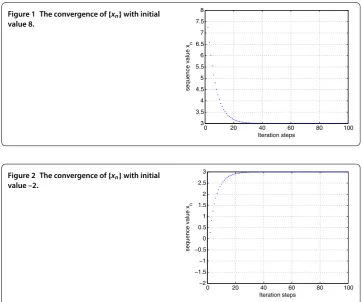
In this section, we consider the following example to illustrate the theoretical result. LetH=H= R with the inner product defined byx,y=xyfor allx,y∈Rand the
standard norm|·|. LetC= [, +∞) andTx=x–+x+for allx∈C. LetQ= R andSx=x+ for allx∈Q. LetAx=xfor allx∈R. Letλn= ,αn=,βn=. Let the sequence{xn}be
generated iteratively by (.), then the sequence{xn}converges to .
Figure 1 The convergence of{xn}with initial
value 8.
Figure 2 The convergence of{xn}with initial
Table 1 The initial value is number 8
n xn
0 8.000000000000000 1 7.232040784873107 2 6.576740838659221 3 6.018450105660861 4 5.543605651619651
. . .
. . .
96 3.000000139089063 97 3.000000115627270 98 3.000000096123055 99 3.000000079908846 100 3.000000066429678
Table 2 The initial value is number –2
n xn
0 –2.000000000000000 1 0.278571428571429 2 0.825823030475218 3 1.240382351822075 4 1.565072721297795
. . .
. . .
96 2.999999933179721 97 2.999999944451085 98 2.999999953821176 99 2.999999961610703 100 2.999999968086279
Solution: It is easy to see thatAis a bounded linear operator with its adjointA∗=A,
Fix(T) = andFix(S) =. It can be observed that all the assumptions of Theorem . are
satisfied. It is also easy to check that={}. We now rewrite (.) as follows: ⎧
⎪ ⎪ ⎪ ⎪ ⎪ ⎪ ⎨ ⎪ ⎪ ⎪ ⎪ ⎪ ⎪ ⎩
yn=PC(xn +),
zn=PC(xn–yn+),
wn=zn+(zn+)–,
xn+=zn+(zn+)+z
n+(zn+)+
–, n≥.
Choosing initial valuesx= andx= – respectively, we see that figures (see Figures
and ) and numerical results (see Tables and ) demonstrate Theorem ..
Competing interests
The authors declare that they have no competing interests.
Authors’ contributions
All authors contributed equally and significantly in writing this paper. All authors read and approved the final manuscript.
Author details
1Department of Mathematics, Shanghai Normal University, Shanghai, 200234, China.2School of Economics and Management, Shanghai University of Political Science and Law, Shanghai, China.
Acknowledgements
Received: 11 June 2015 Accepted: 14 October 2015
References
1. Censor, Y, Elfving, T: A multiprojection algorithm using Bregman projections in a product space. Numer. Algorithms8, 221-239 (1994)
2. Byrne, C: Iterative oblique projection onto convex subsets and the split feasibility problem. Inverse Probl.18, 441-453 (2002)
3. Censor, Y, Bortfeld, T, Martin, B, Trofimov, A: A unified approach for inversion problems in intensity modulated radiation therapy. Phys. Med. Biol.51, 2353-2365 (2006)
4. Censor, Y, Elfving, T, Kopf, N, Bortfeld, T: The multiple-sets split feasibility problem and its applications for inverse problems. Inverse Probl.6, 2071-2084 (2005)
5. Censor, Y, Motova, A, Segal, A: Perturbed projections and subgradient projections for the multiple-sets split feasibility problem. J. Math. Anal. Appl.327, 1244-1256 (2007)
6. Byrne, C: A unified treatment of some iterative algorithm in signal processing and image reconstruction. Inverse Probl.20, 103-120 (2004)
7. Qu, B, Xiu, N: A note on the CQ algorithm for the split feasibility problem. Inverse Probl.21, 1655-1665 (2005) 8. Xu, HK: A variable Krasnosel’skii-Mann algorithm and the multiple-set split feasibility problem. Inverse Probl.22,
2021-2034 (2006)
9. Yang, Q: The relaxed CQ algorithm solving the split feasibility problem. Inverse Probl.20, 1261-1266 (2004) 10. Zhao, J, Yang, Q: Several solution methods for the split feasibility problem. Inverse Probl.21, 1791-1799 (2005) 11. Sezan, M, Stark, H: Applications of convex projection theory to image recovery in tomography and related areas. In:
Stark, H (ed.) Image Recovery Theory and Applications, pp. 415-462. Academic Press, Orlando (1987) 12. Youla, D: Mathematical theory of image restoration by the method of convex projection. In: Stark, H (ed.) Image
Recovery Theory and Applications, pp. 29-77. Academic Press, Orlando (1987)
13. Youla, D: On deterministic convergence of iterations of relaxed projection operators. J. Vis. Commun. Image Represent.1, 12-20 (1990)
14. Combettes, P, Wajs, V: Signal recovery by proximal forward-backward splitting. Multiscale Model. Simul.4, 1168-1200 (2005)
15. Xu, HK: Iterative methods for the split feasibility problem in infinite-dimensional Hilbert spaces. Inverse Probl.26, 105018 (2010)
16. Yu, X, Shahzad, N, Yao, Y: Implicit and explicit algorithm for solving the split feasibility problem. Optim. Lett.6, 1447-1462 (2012)
17. Wang, F, Xu, HK: Approximating curve and strong convergence of the CQ algorithm for the split feasibility problem. J. Inequal. Appl.2010, Article ID 102085 (2010)
18. Ceng, LC, Petru¸sel, A, Yao, JC: Relaxed extragradient methods with regularization for general system of variational inequalities with constraints of split feasibility and fixed point problems. Abstr. Appl. Anal.2013, Article ID 891232 (2013)
19. Yao, Y, Wu, J, Liou, Y: Regularized methods for the split feasibility problem. Abstr. Appl. Anal.2012, Article ID 140679 (2012)
20. Ceng, LC, Ansari, QH, Yao, JC: Relaxed extragradient methods for finding minimum-norm solutions of the split feasibility problem. Nonlinear Anal.75, 2116-2125 (2012)
21. Yao, Y, Postolache, M, Liou, Y: Strong convergence of a self-adaptive method for the split feasibility problem. Fixed Point Theory Appl.2013, Article ID 201 (2013)
22. Korpelevich, G: An extragradient method for finding saddle points and for other problems. Èkon. Mat. Metody12, 747-756 (1976)
23. Ceng, LC, Ansari, QH, Yao, JC: An extragradient method for solving split feasibility and fixed point problems. Comput. Math. Appl.64, 633-642 (2012)
24. Nadezhkina, N, Takahashi, W: Weak convergence theorem by an extragradient method for nonexpansive mappings and monotone mappings. J. Optim. Theory Appl.128, 191-201 (2006)
25. Yao, Y, Agarwal, RP, Postolache, M, Liou, YC: Algorithms with strong convergence for the split common solution of the feasibility problem and fixed point problem. Fixed Point Theory Appl.2014, Article ID 183 (2014)
26. Bertsekas, D, Gafni, E: Projection methods for variational inequalities with applications to the traffic assignment problem. Math. Program. Stud.17, 139-159 (1982)
27. Han, D, Lo, H: Solving non-additive traffic assignment problems: a descent method for co-coercive variational inequalities. Eur. J. Oper. Res.159, 529-544 (2004)
28. Zhou, H: Strong convergence of an explicit iterative algorithm for continuous pseudo-contractives in Banach spaces. Nonlinear Anal.70, 4039-4046 (2009)