R E S E A R C H
Open Access
An iterative algorithm for the generalized
reflexive solutions of the general coupled
matrix equations
Feng Yin
1,2*, Ke Guo
2and Guang-Xin Huang
2*Correspondence: [email protected] 1School of Science, Sichuan
University of Science and Engineering, Zigong, 643000, P.R. China
2Geomathematics Key Laboratory
of Sichuan Province, Chengdu University of Technology, Chengdu, 610059, P.R. China
Abstract
The general coupled matrix equations
q
j=1
AijXjBij=Mi, i= 1, 2,. . .,p
(including the generalized coupled Sylvester matrix equations as special cases) have numerous applications in control and system theory. In this paper, an iterative algorithm is constructed to solve the general coupled matrix equations and their optimal approximation problem over generalized reflexive matrix solution (X1,X2,. . .,Xq). When the general coupled matrix equations are consistent over
generalized reflexive matrices, the generalized reflexive solution can be determined automatically by the iterative algorithm within finite iterative steps in the absence of round-off errors. The least Frobenius norm generalized reflexive solution of the general coupled matrix equations can be derived when an appropriate initial matrix group is chosen. Furthermore, the unique optimal approximation generalized reflexive solution (X1,X2,. . .,Xq) to a given matrix group (X10,X20,. . .,Xq0) in Frobenius
norm can be derived by finding the least-norm generalized reflexive solution (X*
1,X2*,. . .,Xq*) of the corresponding general coupled matrix equations q
j=1AijXjBij=Mi,i= 1, 2,. . .,p, whereXj=Xj–Xj0,Mi=Mi– q
j=1AijXj0Bij. A numerical
example is given to illustrate the effectiveness of the proposed iterative algorithm. MSC: 15A18; 15A57; 65F15; 65F20
Keywords: iterative method; generalized reflexive solution; general coupled matrix equations; optimal approximate solution
1 Introduction
LetP∈Rm×mandQ∈Rn×nbe two real generalized reflection matrices,i.e.,PT=P,P=
Im,QT=Q,Q=In,Indenotes thenorder identity matrix. A matrixA∈Rm×nis called generalized reflexive matrix with respect to the matrix pair (P,Q) if PAQ=A. The set of allm-by-nreal generalized reflexive matrices with respect to a matrix pair (P,Q) is denoted byRm×n
r (P,Q). We denote by the superscriptT the transpose of a matrix. In a matrix spaceRm×n, we define an inner product asA,B=tr(BTA) for allA,B∈Rm×n,
AF represents the Frobenius norm ofA,R(A) represents the column space ofA,vec(·) represents the vector operator,i.e., vec(A) = (aT
(a,a, . . . ,an)∈Rm×n,ai∈Rm,i= , , . . . ,n,A⊗Bstands for the Kronecker product of matricesAandB.
Least-squares-based iterative algorithms are very important in system identification, pa-rameter estimation, and signal processing, including the recursive least squares (RLS) and iterative least squares (ILS) methods for solving the solutions of some matrix equations, for example, the Lyapunov matrix equation, Sylvester matrix equations, and coupled ma-trix equations as well. For example, novel gradient-based iterative (GI) method [–] and least-squares-based iterative methods [, , ] with highly computational efficiencies for solving (coupled) matrix equations are presented and have good stability performances based on the hierarchical identification principle, which regards the unknown matrix as the system parameter matrix to be identified. In this paper, we consider the following two problems.
Problem I LetPj∈Rmj×mjandQj∈Rnj×njbe generalized reflection matrices. For given matrices Aij∈Rri×mj, Bij∈Rnj×si, andMi∈Rri×si, find a generalized reflexive matrix solution group (X,X, . . . ,Xq) withXj∈R
mj×nj
r (Pj,Qj) such that
q
j=
AijXjBij=Mi, i= , , . . . ,p. ()
Problem II When Problem I is consistent, letSEdenote the set of the generalized reflexive solution group of Problem I,i.e.,
SE=
(X,X, . . . ,Xq)
q
j=
AijXjBij=Mi,i= , , . . . ,p,Xj∈R mj×nj
r (Pj,Qj)
.
For a given generalized reflexive matrix group
X,X, . . . ,Xq∈Rm×n
r (P,Q)×Rrm×n(P,Q)× · · · ×R mq×nq
r (Pq,Qq),
find (X,X, . . . ,Xq)∈SEsuch that q
j=
Xj–Xj
= min
(X,X,...,Xq)∈SE q
j=
Xj–Xj
. ()
General coupled matrix equation () (including the generalized coupled Sylvester matrix equations as special cases) may arise in many areas of control and system theory. Problem II occurs frequently in experiment design; see, for instance, [].
Many theoretical and numerical results on Eq. () and some of its special cases have been obtained. Ding and Chen [] presented the gradient-based iterative algorithms by applying the gradient search principle and the hierarchical identification principle for Eq. () with
conjugate gradient method, Dehghan and Hajarian [] constructed an iterative algorithm to solve Eq. () withq=pover generalized bisymmetric matrices. Very recently, Huanget al.[] presented a finite iterative algorithm for the one-sided and generalized coupled Sylvester matrix equations over generalized reflexive solutions. Yinet al.[] presented a finite iterative algorithm for the two-sided and generalized coupled Sylvester matrix equa-tions over reflexive soluequa-tions. Zhouet al.[] gave the gradient based iterative solutions for coupled matrix equation () and a more general case over general solution. Liet al.[] presented a numerical solution to linear matrix equationpj=AjXBj=Cby finite steps iteration. For more results, we refer to [, –]. However, to our knowledge, the gener-alized reflexive solution to the more general coupled matrix equation () and the optimal approximation reflexive solution have not been derived. In this paper, we consider the gen-eralized reflexive solution of Eq. () and the optimal approximation gengen-eralized reflexive solution.
This paper is organized as follows. In Section , we solve Problem I by constructing an it-erative algorithm. The convergence of the proposed algorithm is proved. For an arbitrary initial matrix group, we can obtain a generalized reflexive solution group of Problem I within finite iteration steps in the absence of round-off errors. Furthermore, for a special initial matrix group, we can obtain the least Frobenius norm solutions of Problem I. Then in Section , we give the optimal approximate solution group of Problem II by finding the least Frobenius norm generalized reflexive solution group of the corresponding gen-eral coupled matrix equations. In Section , a numerical example is given to illustrate the effectiveness of our method. Finally, some conclusions are drawn in Section .
2 An iterative algorithm for solving Problem I
In this section, we first introduce an iterative algorithm to solve Problem I, then we prove its convergence. In addition, we give the least-norm generalized reflexive solutions of Problem I when an appropriate initial iterative matrix group is chosen.
Algorithm .
Step : Input matricesAij∈Rri×mj,Bij∈Rnj×si,Mi∈Rri×si, and generalized reflection matricesPj∈Rmj×mjandQj∈Rnj×nj,i= , . . . ,p,j= , . . . ,q;
Step : Choose an arbitrary matrix group
X(),X(), . . . ,Xq()
∈Rm×n
r (P,Q)×Rrm×n(P,Q)× · · · ×R mq×nq
r (Pq,Qq).
Compute
R() =diag
M–
q
l=
AlXl()Bl,M– q
l=
AlXl()Bl, . . . ,Mp– q
l=
AplXl()Bpl
,
Sj() =
p
i=
ATij
Mi– q
l=
AilXl()Bil
BTij+
p
i=
PjATij
Mi–
q
l=
AilXl()Bil
BTijQj
,
k:= ;
Step : Compute
Xj(k) =Xj(k– ) +
R(k– ) F
q
l=Sl(k– )F
Sj(k– ), j= , . . . ,q,
R(k) =diag
M–
q
l=
AlXl(k)Bl,M– q
l=
AlXl(k)Bl, . . . ,Mp– q
l=
AplXl(k)Bpl
=R(k– ) – R(k– ) F
q
l=Sl(k– )F
×diag
q
l=
AlSl(k– )Bl, q
l=
AlSl(k– )Bl, . . . , q
l=
AplSl(k– )Bpl
,
Sj(k) =
p
i=
ATij
Mi– q
l=
AilXl(k)Bil
BTij +
p
i=
PjATij
Mi–
q
l=
AilXl(k)Bil
BTijQj
+ R(k) F
R(k– ) F
Sj(k– );
Step : Go to Step .
Obviously, it can be seen thatXj(k),Sj(k)∈R mj×nj
r (Pj,Qj) for allj= , . . . ,qandk= , , . . . .
Lemma . For the sequences{R(k)},{Sj(k)}(j= , , . . . ,q)generated by Algorithm.,and
m≥,we have
tr R(s)TR(t)= , q
j=
tr Sj(s)
T
Sj(t)
= , s,t= , , . . . ,m,s=t. ()
The proof of Lemma . is similar to that of Lemma . in [] and is omitted.
Lemma . Suppose(X*,X*, . . . ,X*
q)is an arbitrary generalized reflexive solution group of
ProblemI,then for any initial generalized reflexive matrix group(X(),X(), . . . ,Xq()),
we have
q
j=
tr Xj*–Xj(k)
T
Sj(k)
=R(k)F, k= , , . . . , ()
where the sequences{Xj(k)},{Sj(k)}and{R(k)}are generated by Algorithm..
Proof We prove the conclusion by induction for the positive integerk. Fork= , we have that
q
j=
tr Xj*–Xj()
T
Sj()
= q
j= tr
Xj*–Xj()
T
p
i=
ATij
Mi– q
l=
AilXl()Bil
+ p
i=
PjATij
Mi–
q
l=
AilXl()Bil
BTijQj
= q j= tr
Xj*–Xj()
T p i= AT ij Mi–
q
l=
AilXl()Bil
BT ij = p i= tr Mi–
q
l=
AilXl()Bil
Tq
j=
Aij X*j–Xj()
Bij =tr diag M–
q
l=
AlXl()Bl
T ,
M–
q
l=
AlXl()Bl
T , . . . ,
Mp–
q
l=
AplXl()Bpl
T
×diag
q
j=
Aj Xj*–Xj()
Bj,
q
j=
Aj Xj*–Xj()
Bj, . . . ,
q
j=
Apj Xj*–Xj()
Bpj =tr diag M–
q
l=
AlXl()Bl
T ,
M–
q
l=
AlXl()Bl
T , . . . ,
Mp–
q
l=
AplXl()Bpl
T
×diag
M–
q
j=
AjXj()Bj,M– q
j=
AjXj()Bj, . . . ,Mp– q
j=
ApjXj()Bpj
=R().
Assume that () holds fork=m. Whenk=m+ , by Algorithm ., we have that
q
j=
tr Xj*–Xj(m+ )
T
Sj(m+ )
= q j= tr
Xj*–Xj(m+ )
T p i=
ATij
Mi– q
l=
AilXl(m+ )Bil
BTij
+ p
i=
PjATij
Mi–
q
l=
AilXl(m+ )Bil
BTijQj
+R(m+ ) F
R(m)F Sj(m)
= q j= tr
Xj*–Xj(m+ )
T
p
i=
ATij
Mi– q
l=
AilXl(m+ )Bil
BTij
+R(m+ ) F
R(m)F q
j=
tr Xj*–Xj(m+ )
T
Sj(m)
= p i= tr Mi–
q
l=
AilXl(m+ )Bil
Tq
j=
Aij Xj*–Xj(m+ )
Bij
+R(m+ ) F
R(m) F
q
j=
tr Xj*–Xj(m)
T
Sj(m)
– R(m+ ) F
q
j=Sj(m)F q
j=
tr Sj(m)
T
Sj(m)
=tr
diag
M–
q
l=
AlXl(m+ )Bl
T ,
M–
q
l=
AlXl(m+ )Bl
T , . . . ,
Mp–
q
l=
AplXl(m+ )Bpl
T
×diag
q
j=
Aj Xj*–Xj(m+ )
Bj,
q
j=
Aj Xj*–Xj(m+ )
Bj, . . . ,
q
j=
Apj X*j–Xj(m+ )
Bpj
+R(m+ ) F
R(m) F
R(m)F– R(m+ ) F
q
j=Sj(m)F q
j=
Sj(m) F
=tr
diag
M–
q
l=
AlXl(m+ )Bl
T ,
M–
q
l=
AlXl(m+ )Bl
T , . . . ,
Mp–
q
l=
AplXl(m+ )Bpl
T
×diag
M–
q
j=
AjXj(m+ )Bj,M– q
j=
AjXj(m+ )Bj, . . . ,
Mp– q
j=
ApjXj(m+ )Bpj
+R(m+ )F–R(m+ )F
=R(m+ )F.
Therefore, () holds fork=m+ . Thus () holds by the principle of induction. This
com-pletes the proof.
Remark . If there exists a positive numberksuch thatSj(k) = ,j= , , . . . ,q, butR(k)= , then by Lemma ., we have that Eq. () is not consistent over generalized reflexive matrices.
Theorem . Suppose that ProblemIis consistent,then for an arbitrary initial matrix group (X,X, . . . ,Xq) with Xj∈R
mj×nj
r (Pj,Qj), a generalized reflexive solution group of
ProblemIcan be obtained with finite iteration steps in the absence of round-off errors.
Proof If R(k)= , k = , , . . . , m=pi=risi, by Lemma . and Remark ., we have
Sj(k)= for all j= , , . . . ,q and k = , , . . . ,m, then we can compute R(m+ ) and (X(m+ ),X(m+ ), . . . ,Xq(m+ )) by Algorithm ..
By Lemma ., we have
and
tr R(k)TR(l)= , k,l= , , . . . ,m,k=l.
It can be seen that the set ofR(),R(), . . . ,R(m) is an orthogonal basis of the matrix subspace
S=L|L=diag(L,L, . . . ,Lp),Li∈Rri×si,i= , , . . . ,p
,
which implies thatR(m+ ) = ,i.e., (X(m+ ),X(m+ ), . . . ,Xq(m+ )) withXj(m+ )∈ Rmj×nj
r (Pj,Qj) is a generalized reflexive solution group of Problem I. This completes the
proof.
To show the least Frobenius norm generalized reflexive solution of Problem I, we first introduce the following result.
Lemma .(see [, Lemma .]) Suppose that the consistent system of linear equation
Ax=b has a solution x*∈R(AT),then x*is a unique least Frobenius norm solution of the
system of linear equations.
By Lemma ., the following result can be obtained.
Theorem . Suppose that Problem I is consistent. If we choose the initial iterative
matrices Xj() =
p
i=ATijKiBTij +
p
i=PjATijKiBTijQj, j= , , . . . ,q, where Ki∈Rri×si, i= , , . . . ,p are arbitrary matrices, especially, Xj() = ∈Rmj×nj(Pj,Qj),then the solution
group(X*,X*, . . . ,X*q)generated by Algorithm.is the unique least Frobenius norm
gener-alized reflexive solution group of ProblemI.
Proof We know the solvability of Eq. () over generalized reflexive matrices is equivalent to the following matrix equations:
⎧ ⎨ ⎩
q
j=AijXjBij=Mi (i= , , . . . ,p),
q
j=AijPjXjQjBij=Mi (i= , , . . . ,p).
()
Then the system of matrix equations () is equivalent to
⎛ ⎜ ⎜ ⎜ ⎜ ⎜ ⎜ ⎜ ⎜ ⎜ ⎜ ⎝
BT
⊗A · · · BTq⊗Aq ..
. · · · ...
BTp⊗Ap · · · BTpq⊗Apq
BT
Q⊗AP · · · BTqQq⊗AqPq ..
. · · · ...
BT
pQ⊗ApP · · · BTpqQq⊗ApqPq
⎞ ⎟ ⎟ ⎟ ⎟ ⎟ ⎟ ⎟ ⎟ ⎟ ⎟ ⎠
⎛ ⎜ ⎜ ⎝
vec(X) .. . vec(Xq)
⎞ ⎟ ⎟ ⎠=
⎛ ⎜ ⎜ ⎜ ⎜ ⎜ ⎜ ⎜ ⎜ ⎜ ⎜ ⎝
vec(M) .. . vec(Mp) vec(M)
.. . vec(Mp)
⎞ ⎟ ⎟ ⎟ ⎟ ⎟ ⎟ ⎟ ⎟ ⎟ ⎟ ⎠
LetXj() =
p
i=ATijKiBTij+
p
i=PjATijKiBTijQj,j= , , . . . ,q, whereKi∈Rri×siare arbitrary matrices, then
⎛ ⎝
vec(X()) .. . vec(Xq())
⎞ ⎠ = ⎛ ⎜ ⎝
vec(pi=AT iKiBTi+
p
i=PATiKiBTiQ)
.. . vec(pi=AT
iqKiBTiq+
p
i=PqATiqKiBTiqQq)
⎞ ⎟ ⎠ = ⎛ ⎜ ⎝
B⊗AT
· · · Bp⊗ATp QB⊗PAT · · · QBp⊗PATp
..
. · · · ... · · · ...
Bq⊗ATq · · · Bpq⊗ATpq QqBq⊗PqATq · · · QqBpq⊗PqATpq
⎞ ⎟ ⎠ ⎛ ⎜ ⎜ ⎜ ⎜ ⎜ ⎜ ⎜ ⎝
vec(K) .. . vec(Kp) vec(K)
.. . vec(Kp)
⎞ ⎟ ⎟ ⎟ ⎟ ⎟ ⎟ ⎟ ⎠ = ⎛ ⎜ ⎜ ⎜ ⎜ ⎜ ⎜ ⎜ ⎜ ⎝ BT
⊗A · · · BTq⊗Aq ..
. ... ...
BT
p⊗Ap · · · BTpq⊗Apq
BT
Q⊗AP · · · BTqQq⊗AqPq ..
. ... ...
BT
pQ⊗ApP · · · BTpqQq⊗ApqPq
⎞ ⎟ ⎟ ⎟ ⎟ ⎟ ⎟ ⎟ ⎟ ⎠ T⎛ ⎜ ⎜ ⎜ ⎜ ⎜ ⎜ ⎜ ⎝
vec(K) .. . vec(Kp) vec(K)
.. . vec(Kp)
⎞ ⎟ ⎟ ⎟ ⎟ ⎟ ⎟ ⎟ ⎠ ∈R ⎛ ⎜ ⎜ ⎜ ⎜ ⎜ ⎜ ⎜ ⎜ ⎜ ⎝ ⎛ ⎜ ⎜ ⎜ ⎜ ⎜ ⎜ ⎜ ⎜ ⎝ BT
⊗A · · · BTq⊗Aq ..
. ... ...
BT
p⊗Ap · · · BTpq⊗Apq
BT
Q⊗AP · · · BTqQq⊗AqPq ..
. ... ...
BT
pQ⊗ApP · · · BTpqQq⊗ApqPq
⎞ ⎟ ⎟ ⎟ ⎟ ⎟ ⎟ ⎟ ⎟ ⎠ T⎞ ⎟ ⎟ ⎟ ⎟ ⎟ ⎟ ⎟ ⎟ ⎟ ⎠ .
Furthermore, we can see that all generalized reflexive matrix solution groups (X(k),X(k), . . . ,Xq(k)) generated by Algorithm . satisfy
⎛ ⎜ ⎜ ⎝
vec(X()) .. . vec(Xq())
⎞ ⎟ ⎟ ⎠∈R
⎛ ⎜ ⎜ ⎜ ⎜ ⎜ ⎜ ⎜ ⎜ ⎜ ⎜ ⎜ ⎝ ⎛ ⎜ ⎜ ⎜ ⎜ ⎜ ⎜ ⎜ ⎜ ⎜ ⎜ ⎝ BT
⊗A · · · BTq⊗Aq ..
. ... ...
BTp⊗Ap · · · BTpq⊗Apq
BT
Q⊗AP · · · BTqQq⊗AqPq ..
. ... ...
BT
pQ⊗ApP · · · BTpqQq⊗ApqPq
⎞ ⎟ ⎟ ⎟ ⎟ ⎟ ⎟ ⎟ ⎟ ⎟ ⎟ ⎠ T⎞ ⎟ ⎟ ⎟ ⎟ ⎟ ⎟ ⎟ ⎟ ⎟ ⎟ ⎟ ⎠ .
By Lemma . we know that (X*
,X*, . . . ,Xq*) is the least Frobenius norm generalized re-flexive solution group of the system of linear equations (). Since a vector operator is isomorphic, (X*,X*, . . . ,X*
q) is the unique least Frobenius norm generalized reflexive so-lution group of the system of matrix equations (). Thus (X*
,X*, . . . ,Xq*) is the unique least
3 The solution of Problem II
In this section, we show that the optimal approximate generalized reflexive solution group of Problem II to a given generalized reflexive matrix group can be derived by finding the least Frobenius norm generalized reflexive solution group of the corresponding general coupled matrix equations.
When Problem I is consistent, the set of generalized reflexive solution group of Prob-lem I denoted by SE is not empty. For a given matrix pair (X,X, . . . ,Xq) with Xj∈ Rmj×nj
r (Pj,Qj),j= , , . . . ,q, we have
q
j=
AijXjBij=Mi
⇐⇒
q
j=
Aij Xj–Xj
Bij=Mi– q
j=
AijXjBij, i= , , . . . ,p. ()
SetXj=Xj–Xj,Mi=Mi–
q
j=AijXjBij, then solving Problem II is equivalent to find-ing the least Frobenius norm generalized reflexive solution group (X*,X*, . . . ,Xq*) of the corresponding general coupled matrix equations
q
j=
AijXjBij=Mi, i= , , . . . ,p. ()
Let initial iteration matrices be
Xj() =
p
i=
ATijKiBTij+ p
i=
PjATijKiBTijQj, j= , , . . . ,q,
whereKi∈Rri×si,i= , , . . . ,pare arbitrary matrices, especially,Xj() = ∈Rmj×nj(Pj,Qj),
j= , , . . . ,q. By using Algorithm ., we can get the least Frobenius norm generalized re-flexive solution group (X*
,X*, . . . ,X*q) of (). Thus the generalized reflexive solution group of Problem II can be represented as
(X,X, . . . ,Xq) = X*+X,X*+X, . . . ,Xq*+Xq
.
4 A numerical example
In this section, we show a numerical example to illustrate the proposed iterative method. All the tests are performed by MATLAB ..
Example . Consider the generalized reflexive solution of the general coupled matrix equations
⎧ ⎨ ⎩
AXB+AXB=M,
AXB+AXB=M,
where
A=
⎛ ⎜ ⎜ ⎜ ⎜ ⎜ ⎜ ⎜ ⎜ ⎝ – – – – – – – – – – – – – ⎞ ⎟ ⎟ ⎟ ⎟ ⎟ ⎟ ⎟ ⎟ ⎠
, B=
⎛ ⎜ ⎜ ⎜ ⎝ – – – – – – ⎞ ⎟ ⎟ ⎟ ⎠,
A=
⎛ ⎜ ⎜ ⎜ ⎜ ⎜ ⎜ ⎜ ⎜ ⎝ – – – – – – – – – – – ⎞ ⎟ ⎟ ⎟ ⎟ ⎟ ⎟ ⎟ ⎟ ⎠
, B=
⎛ ⎜ ⎜ ⎜ ⎜ ⎜ ⎜ ⎝ – – – – – – ⎞ ⎟ ⎟ ⎟ ⎟ ⎟ ⎟ ⎠ ,
A=
⎛ ⎜ ⎜ ⎜ ⎝ – – – – – – ⎞ ⎟ ⎟ ⎟
⎠, B=
⎛ ⎜ ⎜ ⎜ ⎝ – – – – – – ⎞ ⎟ ⎟ ⎟ ⎠,
A=
⎛ ⎜ ⎜ ⎜ ⎝ – – – – – – ⎞ ⎟ ⎟ ⎟
⎠, B=
⎛ ⎜ ⎜ ⎜ ⎜ ⎜ ⎜ ⎝ – – – – – – – – ⎞ ⎟ ⎟ ⎟ ⎟ ⎟ ⎟ ⎠ ,
M=
⎛ ⎜ ⎜ ⎜ ⎜ ⎜ ⎜ ⎜ ⎜ ⎝ – – –, –, –, –, –, –, , , –, , –, , –, –, , –, ⎞ ⎟ ⎟ ⎟ ⎟ ⎟ ⎟ ⎟ ⎟ ⎠ ,
M=
⎛ ⎜ ⎜ ⎜ ⎝ , , , –, , , , – –, , –, , , , –, , ⎞ ⎟ ⎟ ⎟ ⎠. Let
P=
⎛ ⎜ ⎜ ⎜ ⎜ ⎜ ⎜ ⎝ – – – ⎞ ⎟ ⎟ ⎟ ⎟ ⎟ ⎟ ⎠
, Q=
P=
⎛ ⎜ ⎜ ⎜ ⎝
–
⎞ ⎟ ⎟ ⎟
⎠, Q=
⎛ ⎜ ⎜ ⎜ ⎜ ⎜ ⎜ ⎝
–
⎞ ⎟ ⎟ ⎟ ⎟ ⎟ ⎟ ⎠
be generalized reflection matrices.
We will find the generalized reflexive solution of Eq. () by using Algorithm .. It can be verified that Eq. () is consistent over generalized reflexive matrices and the solutions are
X*=
⎛ ⎜ ⎜ ⎜ ⎜ ⎜ ⎜ ⎝
–
–
–
–
–
⎞ ⎟ ⎟ ⎟ ⎟ ⎟ ⎟ ⎠
, X*=
⎛ ⎜ ⎜ ⎜ ⎝
–
– – –
⎞ ⎟ ⎟ ⎟ ⎠.
Because of the influence of the error of calculation, the residualR(k) is usually unequal to zero in the process of iteration, wherek= , , . . . . For any chosen positive numberε, however small it is,e.g.,ε= .e-, wheneverR(k)<ε, stop the iteration,X(k) andX(k) are regarded to be generalized reflexive solutions of Eq. (). Let the initially iterative matrices be as follows:
X() =
⎛ ⎜ ⎜ ⎜ ⎜ ⎜ ⎜ ⎝
⎞ ⎟ ⎟ ⎟ ⎟ ⎟ ⎟ ⎠
, X() =
⎛ ⎜ ⎜ ⎜ ⎝
⎞ ⎟ ⎟ ⎟ ⎠.
By Algorithm ., we have
X*=X() =
⎛ ⎜ ⎜ ⎜ ⎜ ⎜ ⎜ ⎝
–. . . .
. . . –.
. . –. .
. . . –.
–. . . .
⎞ ⎟ ⎟ ⎟ ⎟ ⎟ ⎟ ⎠
,
X*=X() =
⎛ ⎜ ⎜ ⎜ ⎝
. . –. . .
. . . .
–. –. –. . .
. . . . .
⎞ ⎟ ⎟ ⎟ ⎠,
R()= .e- <ε.
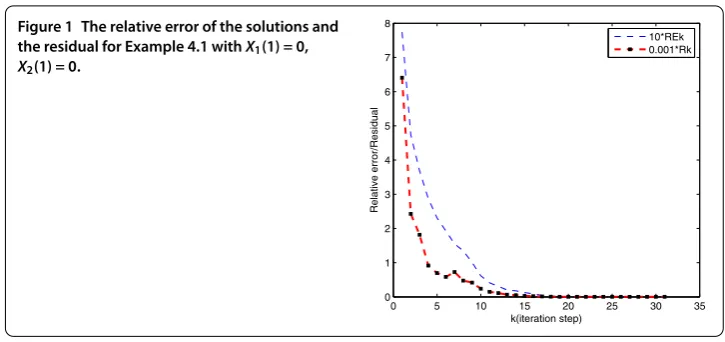
Thus we obtain the reflexive solution of Eq. (). The relative error and the residual of the solution are shown in Figure , where the relative errorREk=X(k)–X*+X(k)–X*
Figure 1 The relative error of the solutions and the residual for Example 4.1 withX1(1) = 0,
X2(1) = 0.
LetSEdenote the set of all generalized reflexive solution group of Eq. (). For two given generalized reflexive matrices
X=
⎛ ⎜ ⎜ ⎜ ⎜ ⎜ ⎜ ⎝
–
–
– – –
– – –
⎞ ⎟ ⎟ ⎟ ⎟ ⎟ ⎟ ⎠
, X=
⎛ ⎜ ⎜ ⎜ ⎝
–
– –
⎞ ⎟ ⎟ ⎟ ⎠,
we will find the optimal approximate generalized reflexive solution group to the given matrix group (X
,X) inSEin Frobenius norm,i.e., find (X,X)∈SEsuch that
X–X+X–X= min (X,X)∈SE
X–X+X–X.
LetX=X–X,X=X–X,M=M–AXB–AXB,M=M–AXB–
AXB. By the method mentioned in Section , we can obtain the least-norm gen-eralized reflexive solution group (X*,X*) of the matrix equationsAXB+AXB=
M,AXB+AXB=Mby choosing the initially iterative matricesX() = and
X() = . Then by Algorithm ., we have that
X*=X() =
⎛ ⎜ ⎜ ⎜ ⎜ ⎜ ⎜ ⎝
–. . . .
–. . . –.
. . –. .
. . –. –.
–. . . .
⎞ ⎟ ⎟ ⎟ ⎟ ⎟ ⎟ ⎠
,
X*=X() =
⎛ ⎜ ⎜ ⎜ ⎝
. . . . .
. . . .
–. –. –. . .
. . –. . .
⎞ ⎟ ⎟ ⎟ ⎠,
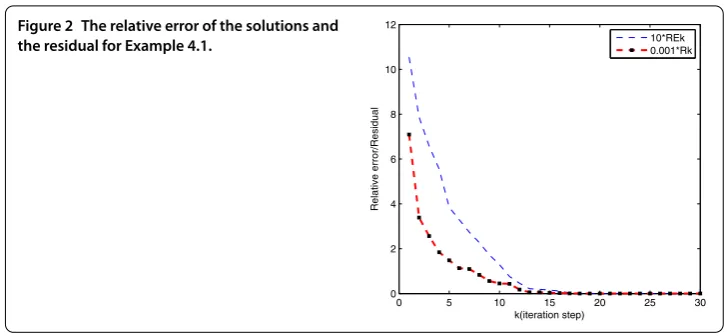
Figure 2 The relative error of the solutions and the residual for Example 4.1.
and the optimal approximate generalized reflexive solution to the matrix group (X ,X) in Frobenius norm is
X=X*+X =
⎛ ⎜ ⎜ ⎜ ⎜ ⎜ ⎜ ⎝
–. . . .
. . . –.
. . –. .
. . . –.
–. . . .
⎞ ⎟ ⎟ ⎟ ⎟ ⎟ ⎟ ⎠
,
X=X*+X=
⎛ ⎜ ⎜ ⎜ ⎝
. . –. . .
. . . .
–. –. –. . .
. . . . .
⎞ ⎟ ⎟ ⎟ ⎠.
The relative error and the residual of the solution are shown in Figure , where the relative errorREk=X(k)+X
–X*+X(k)+X–X*
X*
+X* and the residualRk=R(k).
From Figures and , we can see that the iterative solutions generated by Algorithm . can quickly converge to the exact generalized reflexive solution of Eq. (). This illustrates that our iterative algorithm is quite effective.
5 Conclusions
Competing interests
The authors declare that they have no competing interests.
Authors’ contributions
All authors have the same contributions on this paper. All authors read and approved the final manuscript.
Acknowledgements
The authors are grateful to the anonymous referee for the constructive and helpful comments and Professor R Agarwal for all the communications. This work was partially supported by National Natural Science Fund (41272363), Open Fund of Geomathematics Key Laboratory of Sichuan Province (scsxdz2012001, scsxdz2012002), Key Natural Science Foundation of Sichuan Education Department (12ZA008, 12ZB289) and the young scientific research backbone teachers of CDUT.
Received: 20 October 2012 Accepted: 11 May 2013 Published: 4 June 2013 References
1. Ding, F, Chen, T: On iterative solutions of general coupled matrix equations. SIAM J. Control Optim.44(6), 2269-2284 (2006)
2. Ding, F, Chen, T: Gradient based iterative algorithms for solving a class of matrix equations. IEEE Trans. Autom. Control
50(8), 1216-1221 (2005)
3. Ding, F, Liu, PX, Ding, J: Iterative solutions of the generalized Sylvester matrix equations by using the hierarchical identification principle. Appl. Math. Comput.197(1), 41-50 (2008)
4. Ding, J, Liu, Y, Ding, F: Iterative solutions to matrix equations of the formAiXBi=Fi. Comput. Math. Appl.59(11), 3500-3507 (2010)
5. Xie, L, Ding, J, Ding, F: Gradient based iterative solutions for general linear matrix equations. Comput. Math. Appl.
58(7), 1441-1448 (2009)
6. Ding, F, Chen, T: Iterative least-squares solutions of coupled Sylvester matrix equations. Syst. Control Lett.54(2), 95-107 (2005)
7. Wang, QW: Bisymmetric and centrosymmetric solutions to systems of real quaternion matrix equations. Comput. Math. Appl.49(5-6), 641-650 (2005)
8. Wu, AG, Feng, G, Duan, GR, Wu, WJ: Iterative solutions to coupled Sylvester-conjugate matrix equations. Comput. Math. Appl.60(1), 54-66 (2010)
9. Wu, AG, Li, B, Zhang, Y, Duan, GR: Finite iterative solutions to coupled Sylvester-conjugate matrix equations. Appl. Math. Model.35(3), 1065-1080 (2011)
10. Wu, AG, Feng, G, Duan, GR, Wu, WJ: Finite iterative solutions to a class of complex matrix equations with conjugate and transpose of the unknowns. Math. Comput. Model.52(9-10), 1463-1478 (2010)
11. Jonsson, I, Kågström, B: Recursive blocked algorithms for solving triangular systems - part I: one-sided and coupled Sylvester-type matrix equations. ACM Trans. Math. Softw.28(4), 392-415 (2002)
12. Jonsson, I, Kågström, B: Recursive blocked algorithms for solving triangular systems - part II: two-sided and generalized Sylvester and Lyapunov matrix equations. ACM Trans. Math. Softw.28(4), 416-435 (2002) 13. Dehghan, M, Hajarian, M: The general coupled matrix equations over generalized bisymmetric matrices. Linear
Algebra Appl.432(6), 1531-1552 (2010)
14. Huang, GX, Wu, N, Yin, F, Zhou, ZL, Guo, K: Finite iterative algorithms for solving generalized coupled Sylvester systems - part I: one-sided and generalized coupled Sylvester matrix equations over generalized reflexive solutions. Appl. Math. Model.36(4), 1589-1603 (2012)
15. Yin, F, Huang, GX, Chen, DQ: Finite iterative algorithms for solving generalized coupled Sylvester systems - part II: two-sided and generalized coupled Sylvester matrix equations over reflexive solutions. Appl. Math. Model.36(4), 1604-1614 (2012)
16. Zhou, B, Duan, GR, Li, ZY: Gradient based iterative algorithm for solving coupled matrix equations. Syst. Control Lett.
58(5), 327-333 (2009)
17. Li, ZY, Zhou, B, Wang, Y, Duan, GR: Numerical solution to linear matrix equation by finite steps iteration. IET Control Theory Appl.4(7), 1245-1253 (2010)
18. Cai, J, Chen, GX: An iterative algorithm for the least squares bisymmetric solutions of the matrix equationsA1XB1=C1,
A2XB2=C2. Math. Comput. Model.50(7-8), 1237-1244 (2009)
19. Chen, D, Yin, F, Huang, G: An iterative algorithm for the generalized reflexive solution of the matrix equationsAXB=E,
CXD=F. J. Appl. Math. (2012). doi:10.1155/2012/492951
20. Ding, F, Chen, T: Hierarchical gradient-based identification of multivariable discrete-time systems. Automatica41(2), 315-325 (2005)
21. Ding, F, Chen, T: Hierarchical least squares identification methods for multivariable systems. IEEE Trans. Autom. Control50(3), 397-402 (2005)
22. Ding, F, Chen, T: Hierarchical identification of lifted state-space models for general dual-rate systems. IEEE Trans. Circuits Syst. I, Regul. Pap.52(6), 1179-1187 (2005)
23. Huang, GX, Yin, F, Guo, K: An iterative method for the skew-symmetric solution and the optimal approximate solution of the matrix equationAXB=C. J. Comput. Appl. Math.212(2), 231-244 (2008)
24. Liao, AP, Lei, Y: Least-squares solution with the minimum-norm for the matrix equation (AXB,GXH) = (C,D). Comput. Math. Appl.50(3-4), 539-549 (2005)
25. Peng, ZH, Hu, XY, Zhang, L: An efficient algorithm for the least-squares reflexive solution of the matrix equation
A1XB1=C1,A2XB2=C2. Appl. Math. Comput.181(2), 988-999 (2006)
26. Wang, QW: The general solution to a system of real quaternion matrix equations. Comput. Math. Appl.49(5-6), 665-675 (2005)
27. Wang, QW, Li, CK: Ranks and the least-norm of the general solution to a system of quaternion matrix equations. Linear Algebra Appl.430(5-6), 1626-1640 (2009)
28. Yin, F, Huang, GX: An iterative algorithm for the least squares generalized reflexive solutions of the matrix equations
29. Yin, F, Huang, G: An iterative algorithm for the generalized reflexive solutions of the generalized coupled Sylvester matrix equations. J. Appl. Math.2012, 1-28 (2012)
30. Zhou, B, Li, ZY, Duan, GR, Wang, Y: Weighted least squares solutions to general coupled Sylvester matrix equations. J. Comput. Appl. Math.224(2), 759-776 (2009)
31. Cheng, G, Tan, Q, Wang, Z: Some inequalities for the minimum eigenvalue of the Hadamard product of anM-matrix and its inverse. J. Inequal. Appl.2013, 65 (2013). doi:10.1186/1029-242X-2013-65
32. Liu, Y, Sheng, J, Ding, R: Convergence of stochastic gradient estimation algorithm for multivariable ARX-like systems. Comput. Math. Appl.59(8), 2615-2627 (2010)
33. Liu, Y, Xiao, Y, Zhao, X: Multi-innovation stochastic gradient algorithm for multiple-input single-output systems using the auxiliary model. Appl. Math. Comput.215(4), 1477-1483 (2009)
34. Ding, F, Liu, Y, Bao, G: Gradient based and least squares based iterative estimation algorithms for multi-input multi-output systems. Proc. Inst. Mech. Eng., Part I, J. Syst. Control Eng.226(1), 43-55 (2012)
35. Ding, F, Liu, G, Liu, XP: Parameter estimation with scarce measurements. Automatica47(8), 1646-1655 (2011) 36. Xie, L, Liu, Y, Yang, H: Gradient based and least squares based iterative algorithms for matrix equations
AXB+CXTD=F. Appl. Math. Comput.217(5), 2191-2199 (2010)
doi:10.1186/1029-242X-2013-280