R E S E A R C H
Open Access
Bernoulli numbers, convolution sums and
congruences of coefficients for certain
generating functions
Daeyeoul Kim
1*, Aeran Kim
2and Ayyadurai Sankaranarayanan
3,4*Correspondence:
1National Institute for Mathematical
Sciences, Yuseong-daero 1689-gil, Yuseong-gu, Daejeon, 305-811, South Korea
Full list of author information is available at the end of the article
Abstract
In this paper, we study the convolution sums involving restricted divisor functions, their generalizations, their relations to Bernoulli numbers, and some interesting applications.
MSC: 11B68; 11A25; 11A67; 11Y70; 33E99
Keywords: Bernoulli numbers; generating functions; divisor functions; convolution sums
1 Introduction
The Bernoulli polynomialsBk(x), which are usually defined by the exponential generating function
text
et– =
∞
k= Bk(x)
tk
k!,
play an important role in different areas of mathematics, including number theory and the theory of finite differences. The Bernoulli polynomials satisfy the following well-known identities :
Bk(x+ ) –Bk(x) =kxk–, k≥,
d
dxBk(x) =kBk–(x), k≥,
and
N
j=
jk=Bk+(N+ ) –Bk+()
k+ , k≥.
We setBk=Bk(). It is obvious from the way the polynomialsBk(x) are constructed that all theBkare rational numbers. It can be shown thatBk+= fork≥, and is alternatively
positive and negative for evenk. TheBkare called Bernoulli numbers.
Throughout the paper, we use the following arithmetical functions andq-series (some-times defined by product expressions). For any integerN≥,l,s∈N∪ {}, we define
σl(N) :=
d|N
dl, σs∗(N;p) := d|N
N
d≡ (modp)
ds, σs∗(N) :=σs∗(N; ) = d|N N/dodd
ds,
σs(N) :=
d|N
(–)d–ds, Si(N) := N–
k= ki.
Forq∈Cwith|q|< , we consider theq-series:
A(q) :=
∞
N=
σ∗(N)qN, B(q) :=
∞
N=
σ∗(N)qN, C(q) :=
∞
N=
σ∗(N)qN,
∞
N=
a(N)qN:=q ∞
N=
–qN –qN –qN –qN,
∞
N=
b(N)qN:=q ∞
N=
–qN –qN,
∞
N=
c(N)qN:=q ∞
N=
–qN –qN,
∞
N=
τ(N)qN:=q ∞
N=
–qN,
∞
N=
l(N)qN:=q ∞
N=
–qN –qN –qN.
The exact evaluation of the basic convolution sum
N–
k=
σ(k)σ(N–k)
first appeared in a letter from Besge to Liouville in . The evaluation of such sums also appear in the works of Glaisher, Lahiri, Lehmer, Ramanujan, and Skoruppa. For instance, Ramanujan [] obtained
N–
k=
σ(k)σ(N–k) =
σ(N) + ( – N)σ(N)
and
N–
k=
σ(k)σ(N–k) =
σ(N) + ( – N)σ(N) –σ(N)
()
using only elementary arguments. Fora,b,N∈N, Ramanujan showed that the sum
Sa,b(N) := N–
m=
σa(m)σb(N–m)
can be evaluated in terms of the quantities
for the nine pairs (a,b)∈Nsatisfying
a+b= , , , , , a≤b,a≡b≡ (mod).
For explicit evaluations ofSa,b(N) for different pairs (a,b)∈Nsatisfying the above con-ditions stated, we refer to the papers of Ramanujan [], [], Huardet al.[], Lahiri [], and Glaisher [], respectively. Levit [] showed that the nine arithmetic evaluations ofSa,b(N) (witha,bboth odd) are the only ones using the theory of modular forms. In [], Lahiri has given sums of the form
(m,...,mr)
m+···+nr=N
ma
· · ·marrσb(m)· · ·σbr(mr),
where a, . . . ,ar∈N:=N∪ {}, b, . . . ,br∈N, each of which can be expressed as a fi-nite linear combination ofσ(N),σ(N), . . . ,σb+b+···+br+r–(N) with coefficients which are
polynomials inNof degree at mosta+· · ·+ar+r– with rational coefficients. In , Huardet al.[] extended Melfi’s [] result to
k<N/
σ(k)σ(N– k)
=
σ(N) + σ
N
+( – N) σ(N) –
σ
N
,
k<N/
σ(k)σ(N– k)
=
σ(N) + σ
N
+( – N) σ
N
– σ(N),
()
whereNis an arbitrary positive integer.
Glaisher [, , ] extended Besge’s formula by replacingσ(N) in the convolution sum in
() by other arithmetical functions; for example, he obtained
N–
k=
σ∗(k)σ∗(N–k) = σ(N) – σ N
– Nσ(N) + Nσ N
= σ∗(N) –Nσ∗(N) ()
and
N–
k=
σ∗(k)σ∗(N–k) =
σ∗(N) –Nσ∗(N). ()
Recently, Hahn [] showed that
k<N
σ(k)σ(N–k) = –σ(N) + (N– )σ(N) +σ(N).
appear in the explicit evaluation of certain convolution sums. For instance, Lahiri (see []) proved that
N–
k=
k(N–k)σ(k)σ(N–k) =
Nσ(N) –τ(N)
and from Alaca and Williams (see []), we observe that
(k,m)∈N k+m=N
σ(k)σ(m)
=
σ(N) + σ
N
+ σ
N
+ σ
N
+ –
N
σ N
+ –
N
σ N
–
a(N). ()
In [], Simsek (and also in [, (.)] Simsek along with Ozden and Cagul) has studied other aspects of the arithmetical functionσ(n) in connection with the classical Jacobi and
Euler functions. We also refer to Kim and Lee [, Lemma .] and [].
Thus the study of convolution sums and their applications is classical and they play an important role in number theory. The aim of this article is to first extend and generalize Glaishers formulas (stated in () and ()). We indeed study the sums (in Section )
N–
k=
σ∗mkσ∗n(N–k),
N–
k=
σ∗mkσ∗n(N–k),
N–
k=
σ∗mkσ∗n(N–k) and r+s+t=N
σ∗mrσ∗nsσ∗lt.
Then, we study and evaluate (in Section ) sums of the type
N–
k=
σ∗mk; σ∗n(N–k); and N–
k=
σ∗mk; σ∗n(N–k); .
As applications to our study and evaluations of convolution sums, we show thatA(q),B(q), andC(q) are connected by a second-order differential equation (see Theorem .).
In Section , we also prove some interesting congruence relations involving the coeffi-cients of modular-like functions and divisor functions (see Theorem .). As a sample, we obtain that ifN≡ (mod), then the congruence
τ(N)≡σ(N) (mod,,)
holds.
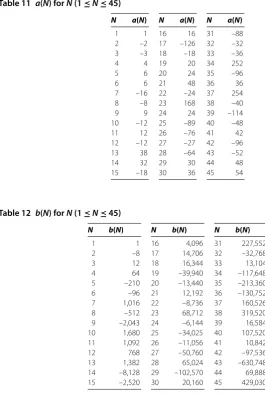
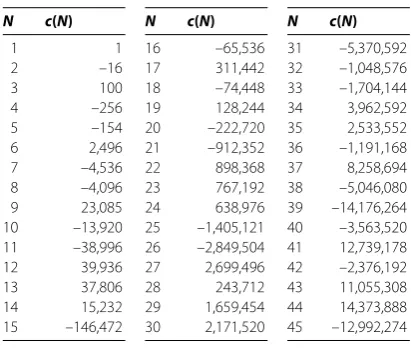
In Section , we present a generalization of Besge’s formula by considering certain com-binatorial convolution sums (see Theorem .). It should be noted that Proposition ., Theorem ., and Remark . exhibit amply the connection between the convolution sums and the Bernoulli numbers. Finally, we record special values ofa(N),τ(N),b(N),c(N), and
2 Some weighted convolution sums
Letf(a)g(b) :={f(a)g(b) +f(b)g(a)}. It is easily checked that
N–
k=
f(k)g(N–k) = N–
k=
f(k)g(N–k).
Lemma . For f,g:N→Cand N∈N,we have
N–
k=
kf(k)g(N–k) =N
N–
k=
f(k)g(N–k).
Proof We observe that
N–
k=
kf(k)g(N–k) =
N–
k=
kf(k)g(N–k) +f(N–k)g(k)
=
N–
k=
(N–k)f(N–k)g(k) +f(k)g(N–k)
= N–
k=
(N–k)f(k)g(N–k).
Hence
N–
k=
kf(k)g(N–k) =N
N–
k=
f(k)g(N–k)
and thus
N–
k=
kf(k)g(N–k) =N
N–
k=
f(k)g(N–k).
Lemma . For f,g:N→Cand N∈N,we have
N–
k=
kf(k)g(N–k) = – N
N–
k=
f(N–k)g(k) +N
N–
k=
kf(N–k)g(k).
Proof We note that
N–
k=
kf(k)g(N–k) = N–
k=
(N–k)f(N–k)g(k)
=N
N–
k=
f(N–k)g(k) – N
N–
k=
kf(N–k)g(k)
+ N
N–
k=
kf(N–k)g(k) – N–
k=
Then, for the second term on the right-hand side of (), we replace k by N–k in Lemma . and obtain
N–
k=
(N–k)f(N–k)g(k) =N
N–
k=
f(N–k)g(k).
This shows that
N–
k=
kf(N–k)g(k) =N
N–
k=
f(N–k)g(k).
So, () can be written as
N–
k=
kf(k)g(N–k) +f(N–k)g(k)
= –N
N–
k=
f(N–k)g(k) + N
N–
k=
kf(N–k)g(k). ()
Here the left-hand side of () is
N–
k=
kf(k)g(N–k) +f(N–k)g(k)
= N–
k= k
f(k)g(N–k) +f(N–k)g(k)+
f(N–k)g(k) +f(k)g(N–k)
= N–
k=
kf(k)g(N–k) +f(N–k)g(k)= N–
k=
kf(k)g(N–k).
Therefore we have
N–
k=
kf(k)g(N–k) = – N
N–
k=
f(N–k)g(k) + N
N–
k=
kf(N–k)g(k).
This completes the proof.
Remark . In general, we can express
N–
k=
kl+f(k)g(N–k) fork∈N∪ {}
as a combination in terms of the sum
N–
k=
kjf(k)g(N–k) withj= , , , . . . ,k
Lemma . For l,N∈Nand f,g:N→C,we have
+ (–)l+ N–
k=
klf(k)g(N–k) = N–
k=
f(N–k)g(k) l–
j= l j
(–)jkjNl–j
.
Proof We note that (forl∈N),
N–
k=
klf(k)g(N–k) = N–
k=
(N–k)lf(N–k)g(k)
= N–
k=
f(N–k)g(k) l
j= l j
(–)jkjNl–j
= (–)l N–
k=
klf(N–k)g(k) + N–
k=
f(N–k)g(k) l–
j= l j
(–)jkjNl–j
.
Observing the fact that
N–
k=
klf(k)g(N–k) = N–
k=
klf(N–k)g(k)
for anyl∈N, we obtain
+ (–)l+ N–
k=
klf(k)g(N–k) = N–
k=
f(N–k)g(k) l–
j= l j
(–)jkjNl–j
.
This proves Lemma ..
Remark . By iteration process, in principle, the convolution sumNk=–klf(k)g(N–k) can be evaluated for any oddl∈N.
Let
f(a)g(b)h(c) :=
f(a)g(b)h(c) +f(a)g(c)h(b) +f(b)g(a)h(c)
+f(b)g(c)h(a) +f(c)g(a)h(b) +f(c)g(b)h(a).
Lemma . For f :N→Cand N∈N.Then we have
(r,s,t)∈N
r+s+t=N
rf(r)f(s)f(t) =N
(r,s,t)∈N
r+s+t=N
f(r)f(s)f(t).
Proof From the cyclic transformation,r→s→t→r, we observe that
(r,s,t)∈N
r+s+t=N
rf(r)f(s)f(t) =
(r,s,t)∈N
r+s+t=N
sf(r)f(s)f(t) =
(r,s,t)∈N
r+s+t=N
Therefore, we have
(r,s,t)∈N
r+s+t=N
Nf(r)f(s)f(t) =
(r,s,t)∈N
r+s+t=N
(r+s+t)f(r)f(s)f(t) =
(r,s,t)∈N
r+s+t=N
rf(r)f(s)f(t).
Now Lemma . follows.
Lemma . For f :N→Cand N∈N.Then we have(with g(m) =mf(m)for all m∈N)
(r,s,t)∈N
r+s+t=N
rf(r)f(s)f(t) =N (r,s,t)∈N
r+s+t=N
f(r)f(s)f(t) + N–
t=
(r,s)∈N
r+s=N–t
g(r)g(s).
Proof As in Lemma ., again by the cyclic transformationr→s→t→r, we observe that
(r,s,t)∈N
r+s+t=N
rf(r)f(s)f(t) =
(r,s,t)∈N
r+s+t=N
sf(r)f(s)f(t) =
(r,s,t)∈N
r+s+t=N
tf(r)f(s)f(t) ()
and
(r,s,t)∈N
r+s+t=N
rsf(r)f(s)f(t) =
(r,s,t)∈N
r+s+t=N
stf(r)f(s)f(t) =
(r,s,t)∈N
r+s+t=N
trf(r)f(s)f(t). ()
Therefore, we get (from () and ())
(r,s,t)∈N
r+s+t=N
nf(r)f(s)f(t) =
(r,s,t)∈N
r+s+t=N
rf(r)f(s)f(t) +
(r,s,t)∈N
r+s+t=N
rsf(r)f(s)f(t)
=
(r,s,t)∈N
r+s+t=N
rf(r)f(s)f(t) + N–
t=
f(t)
(r,s)∈N
r+s=N–t
g(r)g(s),
whereg(m) =mf(m) :N→Cfor allm∈N. This proves Lemma ..
3 The convolution sumNk=1–1
σ
1∗(k)σ
1∗(N–k)and its extensionsProposition . (a) [, Theorem ., p.],we have
k<N/
σ(k)σ(N– k) =
σ(N) + ( – N)σ(N) + σ(N/)
+ ( – N)σ(N/).
(b) [, Theorem ], [, Theorem ., p.],we have
k<N/
σ(k)σ(N– k)
=
σ(N) + ( – N)σ(N) + σ N
+ ( – N)σ N
Proposition . Let s,N∈N.Then we obtain
σs∗(N;p) =σs(N) –σs(N/p).
In particular,we have
σs∗(N) =σs(N) –σs(N/),
which can also be seen in[, p.].
Proof We can know that
σs∗(N;p) := d|N
N
d≡ (modp)
ds=
d|N
ds–
d|N
N
d≡ (modp)
ds=σs(N) –
d|N p
ds=σs(N) –σs(N/p).
Proposition . Let N be any positive integer.For m,n∈N∪ {},where≤m≤n,we have
(a) N–
k=
σ∗mkσ∗n(N–k)= n+m–σ∗(N) –Nσ∗(N).
(b) N–
k=
σ∗mkσ∗n(N–k)= n+m–σ∗(N) –Nσ∗(N).
(c) N–
k=
σ∗mkσ∗n(N–k)= n+m–σ∗(N) –Nσ∗(N).
(d) N–
k=
σ∗mkσ∗n+(N–k)–kσ∗n+(N–k)
= n+m–σ∗(N) –Nσ∗(N).
Proof For the sake of completeness, we just hint the proof of (b). We note thatσk∗(a) = ak. Sinceσk∗is a k-scalar multiplicative function (i.e.,σ∗
k(N) =σk∗()·σk∗(N)), we have
N–
k=
σ∗mkσ∗n(N–k)= m+n N–
k=
σ∗(k)σ∗(N–k) = n+m–σ∗(N) –Nσ∗(N)
by (). The proofs of (a), (c), and (d) are similar to (b).
Remark . Using Eq. () and Lemma ., we obtain
N–
k=
kσ∗(k)σ∗(N–k) =N
N–
k=
σ∗(k)σ∗(N–k) = N
σ∗(N) –Nσ∗(N). ()
Theorem . Let N (≥)be any integer with m,n,l∈N∪ {}.Then we have
r+s+t=N
σ∗mrσ∗nsσ∗lt= m+n+l
Proof Letrl=pmNandl≡ (modp) for somer,l∈Nand primep. Sincepdoes not
dividel, we can writer=pmdfor somed∈N. Therefore, we have
σs∗pmN;p=
r|pmN
pmN
r ≡ (modp)
rs=
d|N
N
d≡ (modp)
pmds
=pms
d|N
N
d≡ (modp)
ds=pmsσ∗
s(N;p). ()
We note that
r+s+t=N
σ∗mrσ∗
nsσ∗
lt
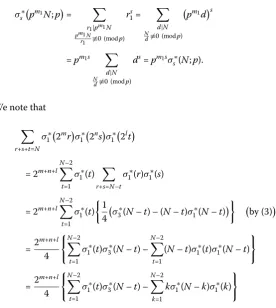
= m+n+l N–
t=
σ∗(t) r+s=N–t
σ∗(r)σ∗(s)
= m+n+l N–
t=
σ∗(t)
σ∗(N–t) – (N–t)σ∗(N–t) by ()
= m+n+l
N–
t=
σ∗(t)σ∗(N–t) – N–
t=
(N–t)σ∗(t)σ∗(N–t)
= m+n+l
N–
t=
σ∗(t)σ∗(N–t) – N–
k=
kσ∗(N–k)σ∗(k)
and hence, we use Eq. () and Eq. () to obtain the result.
Corollary . Let
f(p)∈ p–
k=
σ∗mkσ∗n(p–k), p–
k=
σ∗mkσ∗n(p–k),
r+s+t=p
σ∗mrσ∗nsσ∗lt
,
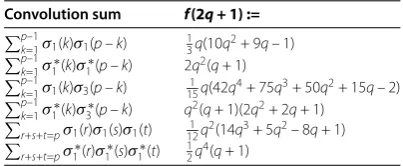
where p= q+ is an odd prime.Then
f(p) =aS(q+ ) +bS(q+ ) +cS(q+ ) +dS(q+ ),
[image:10.595.124.401.122.431.2]where the coefficients a,b,c,d are listed in Table.
Table 1 Coefficients forp= 2q+ 1
f(p) := a b c d
p–1
k=1σ1∗(2mk)σ1∗(2n(p–k)) 0 0 3·2m+n+1 –2m+n+1 p–1
k=1σ1∗(2mk)σ3∗(2n(p–k)) 5·2m+3n+1 –2m+3n+2 5·2m+3n –2m+3n
Table 2 Convolution formulas for primep= 2q+ 1
Convolution sum f(2q+ 1) := p–1
k=1σ1(k)σ1(p–k) 13q(10q2+ 9q– 1) p–1
k=1σ1∗(k)σ1∗(p–k) 2q2(q+ 1) p–1
k=1σ1(k)σ3(p–k) 151q(42q4+ 75q3+ 50q2+ 15q– 2) p–1
k=1σ1∗(k)σ3∗(p–k) q2(q+ 1)(2q2+ 2q+ 1)
r+s+t=pσ1(r)σ1(s)σ1(t) 121q2(14q3+ 5q2– 8q+ 1)
[image:11.595.187.408.215.285.2]r+s+t=pσ1∗(r)σ1∗(s)σ1∗(t) 1 2q4(q+ 1)
Table 3 Convolution formulas
Convolution sum
A(N) :=Nk=1–1σ1(k)σ1(N–k) 121(5σ3(N) + (1 – 6N)σ1(N))
B(N) :=Nk=1–1σ1∗(k)σ1∗(N–k) 14(σ3∗(N) –Nσ1∗(N))
C(N) :=r+s+t=Nσ1(r)σ1(s)σ1(t) 1927 σ5(N) + (965 – 5 32N)σ3(N)
+ (1921 –161N+18N2)σ 1(N)
D(N) :=r+s+t=Nσ1∗(r)σ1∗(s)σ1∗(t) 641(σ5∗(N) – 3Nσ3∗(N) + 2N2σ∗ 1(N))
Remark . Ifp= q+ is any odd prime, then
q
k=
σ∗(k)σ∗(q+ –k)≡
q
k=
σ∗(k)σ∗(q+ –k)
≡
r+s+t=q+
σ∗(r)σ∗(s)σ∗(t)
≡ modS(q+ )
from Table .
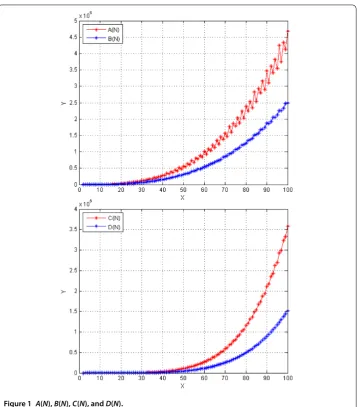
Now, we compare the values of the convolution sums in Table [, p.]. For almost all N∈N, we find thatA(N) >B(N) andC(N) >D(N) (Figure ). As an application to Theorem ., we have the following.
Theorem . The q-seriesA(q),B(q),C(q)are connected by the differential equation,
A(q) =C(q) – qdB(q)
dq + q
dA(q) dq + q
dA(q)
dq , ()
where qdBdq(q)=∞N=Nσ∗(N)qN and qdA(q)
dq =
∞
N=N(N– )σ∗(N)qN.
Proof We note that
A(q) =
∞
l=
σ∗(l)ql
∞
m=
σ∗(m)qm
∞
n=
σ∗(n)qn
=
∞
N=
l+m+n=N
σ∗(l)σ∗(m)σ∗(n)
qN
=
∞
N=
Figure 1 A(N),B(N),C(N), andD(N).
from Theorem .. We note thatσ∗(N) – Nσ∗(N) + Nσ∗
(N) is zero forN= andN= .
Thus the differential Eq. () follows.
Remark . We also note that from Eq. () and Eq. (), we can determine the equations
A(q)B(q) =C(q) –qdB(q)
dq ()
and
A(q) =B(q) –qdA(q)
dq . ()
From () and (), Eq. () can also be deduced. Using [, ()] and (), we also get
℘ τ ,τ
= π A(q) +qdA(q) dq
where
℘(z;τ) =
z +
ω∈τ, ω=
(z–ω) –
ω
andτ =Z+τZ(τ∈Hthe complex upper-half plane) is a lattice andz∈C.
4 The convolution sumNk=1–1
σ
1∗(k; 3)σ
1∗(N–k; 3)and its extensionsTheorem . Let N be a positive integer.And let m,n∈N∪ {}.Then we have
N–
k=
σ∗mk; σ∗n(N–k); = n+m–σ∗(N; ) –Nσ∗(N; ).
Proof From Proposition . and Eq. (), we can deduce that
N–
k=
σ∗mk; σ∗
n(N–k);
= n+m N–
k=
σ(k) –σ k
σ(N–k) –σ N–k
= n+m N–
k=
σ(k)σ(N–k) –
N–
k=
σ(k)σ
N–k
– N–
k=
σ k
σ(N–k) +
N–
k=
σ k
σ N–k
.
Now, we note that
N–
k=
σ(k)σ N–k
=
t<N/
σ(N– t)σ(t),
N–
k=
σ k
σ(N–k) =
t<N/
σ(t)σ(N– t),
N–
k=
σ k
σ
N–k
=
t<N/
σ(t)σ N
–t
.
Therefore, the theorem follows from Eq. () and Proposition .(b).
Theorem . Let N be a positive integer and let m,n∈N∪ {}.Then we have
N–
k=
σ∗mk; σ∗n(N–k);
= m·n
σ∗(N) –σ∗ N
– Nσ∗(N) – Nσ∗(N; ) –a(N)
Table 4 Nk=1–1σ1∗(2mk; 2)σ1∗(3n(N–k); 3) andNk=1–1σ1(2mk)σ1(3n(N–k))
Convolution formula
N–1
k=1σ1∗(2mk; 2)σ1∗(3n(N–k); 3) 2m·3n
120 [36{σ3∗(N) –σ3∗( N
3)}– 20Nσ1∗(N)
– 15Nσ1∗(N; 3) –a(N)]
N–1
k=1σ1(2mk)σ1(3n(N–k)) 2401 [(2m+3– 3)(3n+3– 7)σ3(N)
– 8(2m– 1)(3n+3– 7)σ3(N2)
– 27(2m+3– 3)(3n– 1)σ 3(N3)
+ 216(2m– 1)(3n– 1)σ3(N6)
– 5{3 – 2m+2– 3n+1
+ 6(7·2m·3n– 2·3n– 2m)N}σ 1(N)
+ 20(2m– 1)(2·3n+1N– 1)σ 1(N2)
+ 15(3n– 1)(3·2m+1N– 1)σ1(N3)
[image:14.595.181.417.101.231.2]– 6(2m– 1)(3n– 1)a(N)]
Table 5 Some convolution formulas
Convolution sum Convolution formula
N–1
k=1σ1∗(k)σ5∗(N–k) 1
408{12σ7∗(N) – 17Nσ5∗(N) + 5b(N)} N–1
k=1σ3∗(k)σ3∗(N–k) 1361 {σ7∗(N) –b(N)} N–1
k=1σ1∗(k)σ7∗(N–k) 9921 {17σ9∗(N) – 31Nσ7∗(N) + 448l(N) + 14c(N)} N–1
k=1σ3∗(k)σ5∗(N–k) 4961 {σ9∗(N) – 32l(N) –c(N)} N–1
k=1σ5∗(k)σ5∗(N–k) 1
2,764{σ11∗(N) –τ(N) + 692τ( N 2)} N–1
k=1σ1∗(k)σ9∗(N–k) 1
27,640{310σ11∗(N) – 691Nσ9∗(N) + 381τ(N) + 109,488τ( N 2)} N–1
k=1σ3∗(k)σ7∗(N–k) 1
22,112{17σ11∗(N) – 17τ(N) – 13,112τ( N 2)}
Proof We note that
N–
k=
σ∗mk; σ∗n(N–k);
= m·n N–
k=
σ(k) –σ k
σ(N–k) –σ N–k
= m·n N–
k=
σ(k)σ(N–k) –
k<N/
σ(N– k)σ(k)
–
k<N/
σ(k)σ(N– k) +
k+m=N
σ(k)σ(m)
.
Now, the theorem follows from (), Proposition .(a), (b), and Eq. ().
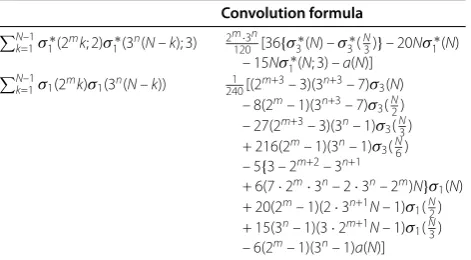
Remark . We can compare the two sums
N–
k=
σ∗mk; σ∗n(N–k); ,
N–
k=
σ
mkσ
n(N–k)
as follows (see Table ). Here we find the formula for the sumNk=–σ(mk)σ(n(N–k))
in a similar way as in Theorem . (see [, Theorem .]).
5 Congruence relations of coefficients of certain modular-like functions
Proof We use Table in the Appendix, and the proof of Lemma . is now similar to the
proof of Theorem ..
Remark . It is easy to observe that
N–
k=
σ∗(k)σ∗(N–k) =
N–
k=
σ∗(k)σ∗(N–k)
whenNis odd.
As an application to the explicit evaluation of convolution sums, using Table we prove the following theorem.
Theorem . If N is odd,then
(a) b(N)≡Nσ(N) (mod).In particularN≡ (mod),we have b(N)≡Nσ(N) (mod).
(b) b(N)≡σ(N) (mod,).In particularN≡ (mod),we have b(N)≡σ(N) (mod,).
(c) τ(N)≡σ(N) (mod,).In particularN≡ (mod),we have
τ(N)≡σ(N) (mod,,).
Proof Since the proofs of (a), (b), and (c) are similar, we only prove (c). WhenNis odd, from Table , we see that
,
N–
k=
σ∗(k)σ∗(N–k) =σ(N) –τ(N). ()
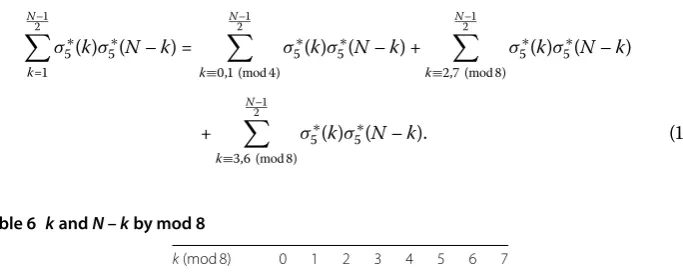
SinceNis odd,k≡N–k(mod), and hence eitherkis even orN–kis even. Then, by (), σ∗(k) = σ∗
(k) orσ∗(N–k) = σ∗(N–k). So, in general,
τ(N)≡σ(N) (mod,).
In particular, forN≡ (mod), we have Table and
N–
k=
σ∗(k)σ∗(N–k) =
N–
k≡, (mod)
σ∗(k)σ∗(N–k) +
N–
k≡, (mod)
σ∗(k)σ∗(N–k)
+
N–
k≡, (mod)
[image:15.595.127.469.585.721.2]σ∗(k)σ∗(N–k). ()
Table 6 kandN–kby mod 8
k(mod 8) 0 1 2 3 4 5 6 7
Ifn≡ (mod), then there exists a primep≡ (mod) satisfyingpi–|nandpin. Thus
σ∗(n) =σ∗ n
pi–
σ∗pi–
=σ∗ n
pi–
+p+p·+· · ·+p(i–)
≡ (mod). ()
Therefore, we obtain
σ∗(k+ )σ∗(k+ )≡σ∗(k+ )σ∗(k+ )
≡ mod.
Arguing in a similar manner as in (), we get
σ∗(k+ )≡ (mod)
and
σ∗(k+ )≡ (mod).
Therefore, we obtain
σ∗(k+ )σ∗(k+ )≡σ∗(k+ )σ∗(k+ )
≡ mod. ()
Usingσ∗(l) = σ∗
(l), (), and Table , we get
N–
k=
k≡, (mod)
σ∗(k)σ∗(N–k)≡ (mod) ()
and
N–
k=
k≡, (mod)
σ∗(k)σ∗(N–k)≡ mod. ()
Therefore, by (), (), and (), we have
τ(N)≡σ(N) (mod,,).
Remark . The same result (c) of Theorem . has been obtained by Lahiri by a different approach considering the Eisenstein series and so on (see [, (.)-(.)], [, p.]).
Corollary . Suppose that N= ,a+b is a prime number with(,,b) = .
Proof Using Mathematica ., we first findb with ≤b< , satisfying (,,
b) = . Then ifN= ,a+bis a prime number, then we find that by Theorem . (c), using Mathematica .,
τ(N)≡σ∗(N)≡b+ ≡ (mod,)
except forb= –. Thus the corollary follows.
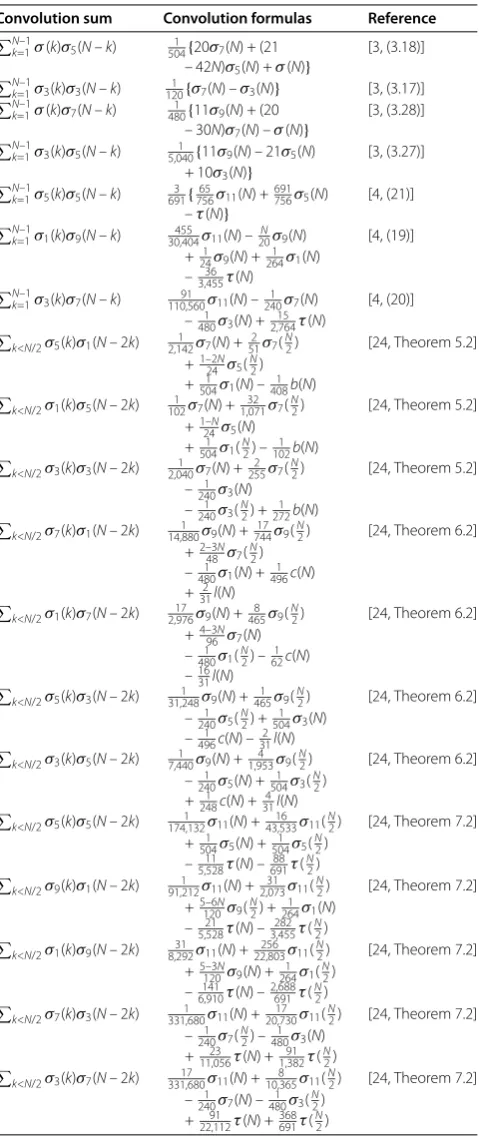
Example . Some values ofb(N),Nσ(N),σ(N),τ(N), andσ(N) are listed in Table .
Corollary . Let N∈N.Then we have Table.
[image:17.595.178.415.326.395.2]In particular,if N is odd,then we have Table.
Table 7 Some values ofb(N),Nσ5(N),σ7(N),τ(N), andσ11(N)
N 3 5 7 9
b(N) 1 12 –210 1,016 –2,043
Nσ5(N) 1 732 15,630 117,656 533,637
σ7(N) 1 2,188 78,126 823,544 4,785,157
τ(N) 1 252 4,830 –16,744 –113,643
[image:17.595.174.424.444.588.2]σ11(N) 1 177,148 48,828,126 1,977,326,744 31,381,236,757
Table 8 Some convolution formulas
Convolution sum Convolution formula
N
k=1σ1(2k– 1)σ5(2N– (2k– 1)) 4081 {768σ7∗(N) + 5b(2N) – 320b(N)} N
k=1σ3(2k– 1)σ3(2N– (2k– 1)) 1361 {64σ7∗(N) –b(2N) + 64b(N)} N
k=1σ1(2k– 1)σ7(2N– (2k– 1)) 4961 {2,176σ9∗(N) + 224d(2N) – 57,344l(N)
+ 7c(2N) – 1,792c(N)}
N
k=1σ3(2k– 1)σ5(2N– (2k– 1)) 4961 {256σ9∗(N) – 32d(2N) + 8,192l(N)
–c(2N) + 256c(N)}
N
k=1σ5(2k– 1)σ5(2N– (2k– 1)) 2,7641 {1,024σ11∗(N) –τ(2N) + 1,716τ(N)
– 708,608τ(N 2)} N
k=1σ1(2k– 1)σ9(2N– (2k– 1)) 27,6401 {317,440σ11∗(N) + 381τ(2N)
– 280,656τ(N) – 112,115,712τ(N2)}
N
k=1σ3(2k– 1)σ7(2N– (2k– 1)) 22,1121 {17,408σ11∗(N) – 17τ(2N) + 4,296τ(N)
+ 13,426,688τ(N 2)}
Table 9 Some convolution formulas for oddN
Convolution sum Convolution formula
N
k=1σ1(2k– 1)σ5(2N– (2k– 1)) 171{32σ7(N) – 15b(N)} N
k=1σ3(2k– 1)σ3(2N– (2k– 1)) 171{8σ7(N) + 9b(N)} N
k=1σ1(2k– 1)σ7(2N– (2k– 1)) 4961 {2,176σ9(N) + 224d(2N) – 57,344l(N) + 7c(2N) – 1,792c(N)} N
k=1σ3(2k– 1)σ5(2N– (2k– 1)) 4961 {256σ9(N) – 32d(2N) + 8,192l(N) –c(2N) + 256c(N)} N
k=1σ5(2k– 1)σ5(2N– (2k– 1)) 6911 {256σ11(N) + 435τ(N)} N
k=1σ1(2k– 1)σ9(2N– (2k– 1)) 6911 {7,936σ11(N) – 7,245τ(N)} N
[image:17.595.145.450.639.732.2]Proof Since the proofs for the convolution sums are similar, we only proveNk=σ(k–
)σ(N– (k– )). We write
N–
k= σ∗(k)σ∗(N–k) as follows:
N–
k=
σ∗(k)σ∗(N–k)
= N
k=
σ∗(k– )σ∗N– (k– )+ N–
k=
σ∗(k)σ∗(N– k)
= N
k=
σ∗(k– )σ∗N– (k– )+ N–
k=
σ∗(k)σ∗(N–k) ()
by (). Also since k– and N– (k– ) are odd, we find that
N
k=
σ∗(k– )σ∗N– (k– )= N
k=
σ(k– )σ
N– (k– ).
So, we obtain the formula forNk=σ(k– )σ(N– (k– )) by () and Table . In
particular, ifNis odd, thenb(N) =b()b(N), becauseb(N) is multiplicative. Therefore
the proof is complete.
By eliminatingb(N),c(N), andl(N) in Table , we can obtain the following example.
Example . LetN∈N. Then fork= , , , we have
k–
s=
k
s+ N–
m=
σ∗k–s–(m)σ∗s+(N–m)
=
σ∗k+(N) –Nσ∗k–(N).
Fork= , we refer to Eq. ().
Now we present some convolution formulas in Table .
6 Certain combinatorial convolution sum
The four basic theta functions are defined below following the notation of Whittaker and Watson [, p.]. Letτ ∈Cbe such thatIm(τ) > . Setq=eπiτ so that|q|< . Forz∈C,
we define (as in [])
θ(z,q) := ∞
N=
(–)N–q(N–) sin(N– )z,
θ(z,q) := ∞
N=
q(N–)cos(N– )z,
θ(z,q) := + ∞
N=
qNcosNz,
θ(z,q) := + ∞
N=
Table 10 Some convolution formulas
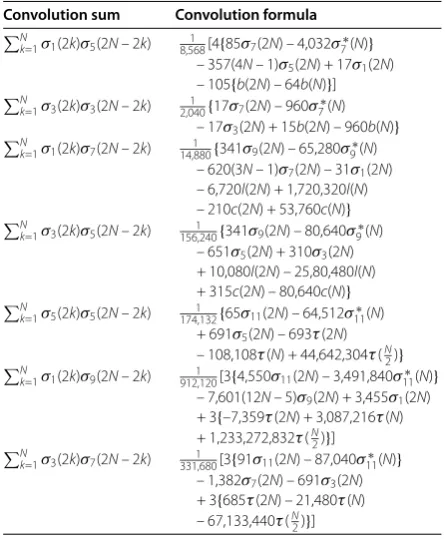
Convolution sum Convolution formula
N
k=1σ1(2k)σ5(2N– 2k) 8,5681 [4{85σ7(2N) – 4,032σ7∗(N)}
– 357(4N– 1)σ5(2N) + 17σ1(2N)
– 105{b(2N) – 64b(N)}]
N
k=1σ3(2k)σ3(2N– 2k) 2,0401 {17σ7(2N) – 960σ7∗(N)
– 17σ3(2N) + 15b(2N) – 960b(N)} N
k=1σ1(2k)σ7(2N– 2k) 14,8801 {341σ9(2N) – 65,280σ9∗(N)
– 620(3N– 1)σ7(2N) – 31σ1(2N)
– 6,720l(2N) + 1,720,320l(N) – 210c(2N) + 53,760c(N)}
N
k=1σ3(2k)σ5(2N– 2k) 156,2401 {341σ9(2N) – 80,640σ9∗(N)
– 651σ5(2N) + 310σ3(2N)
+ 10,080l(2N) – 25,80,480l(N) + 315c(2N) – 80,640c(N)}
N
k=1σ5(2k)σ5(2N– 2k) 174,1321 {65σ11(2N) – 64,512σ11∗(N)
+ 691σ5(2N) – 693τ(2N)
– 108,108τ(N) + 44,642,304τ(N 2)} N
k=1σ1(2k)σ9(2N– 2k) 912,1201 [3{4,550σ11(2N) – 3,491,840σ11∗(N)}
– 7,601(12N– 5)σ9(2N) + 3,455σ1(2N)
+ 3{–7,359τ(2N) + 3,087,216τ(N) + 1,233,272,832τ(N2)}]
N
k=1σ3(2k)σ7(2N– 2k) 331,6801 [3{91σ11(2N) – 87,040σ11∗(N)}
– 1,382σ7(2N) – 691σ3(2N)
+ 3{685τ(2N) – 21,480τ(N) – 67,133,440τ(N2)}]
Jacobi (see [, ]) proved that
θ(,q)θ(,q)θ(z,q)
θ(z,q)
=
∞
m= qm+
–qm+sin(m+ )z ()
and
θ(,q)θ
(,q)θ(z,q)
θ(z,q) =
∞
m= mqm
–qm( –cosmz). ()
From () and (), we deduce that
∞
m= mqm
–qm( –cosmz) =
∞
m= qm+
–qm+sin(m+ )z
. ()
Equating coefficients ofqN(N∈N) on the left- and right-hand sides of () (see [, p.]), then we obtain the arithmetical equality involving the trigonometric functions
m∈N m|N
N m odd
m( –cosmz) =
(a,b,x,y)∈N
ax+by=N a,b,x,yodd
cos(a–b)z–cos(a+b)z. ()
If we expand each cosine in powers ofzusing
–cosz=
∞
k=
(–)k–z
k
and equate coefficients of zkk! (k∈N), then we obtain
m∈N m|N
N m odd
kmk+=
(a,b,x,y)∈N
ax+by=N a,b,x,yodd
(a+b)k– (a–b)k, k,N∈N. ()
A generalized Besge formula due to Liouville is as follows.
Proposition .(See [, Theorem .]) Let k∈Nand N∈N,where k,N≥.Then we have
k–
s=
k
s+ N–
m=
σk–s–(m)σs+(N–m)
=k+
k+ σk+(N) +
k
–N
σk–(N) +
k+
k
j=
k+ j
Bjσk+–j(N),
where Bjis thejth Bernoulli number.
Letσs,oo(N) :=
d|N dodd
n dodd
ds. Now we prove the following lemma.
Lemma . We have
k–
s=
k
s+ N–
m=
σk–s–,oo(m)σs+,oo(N–m) = σ
∗ k+(N).
Proof First we consider
(a,b,x,y)∈N,
ax+by=N,
a≡b≡x≡y≡mod
(a+b)k– (a–b)k
=
(a,b,x,y)∈N,
ax+by=N,
a,b,x,yodd
k
r=
k r
ak–rbr–
k
r=
k r
(–)rak–rbr
=
(a,b,x,y)∈N,
ax+by=N,
a,b,x,yodd k
r=,
rodd
k r
ak–rbr= k–
s=
k
s+
(a,b,x,y)∈N,
ax+by=N,
a,b,x,yodd
ak–s–bs+
= k–
s=
k
s+ N–
m=
a|m,
aodd,
m a odd
ak–s–
b|N–m,
bodd, N–m
b odd
bs+
= k–
s=
k
s+ N–
m=
Now the right-hand side of () is
d∈N,
d|N,
dN
kdk+= k d|N
dk+–
d|N dk+
= k
σk+(N) –σk+ N
= kσ∗k+(N) = σ
∗ k+(N)
by (). Therefore we obtain
k–
s=
k
s+ N–
m=
σk–s–,oo(m)σs+,oo(N–m) = σ
∗
k+(N).
As a consequence of Proposition . and Lemma ., we have the following.
Theorem .
k–
s=
k
s+ N–
m=
σk–s–(m)σs+(N– m)
=k+
k+ σk+(N) – σ
∗
k+(N) + k
– N
σk–(N)
+ k+
k
j=
k+ j
Bjσk+–j(N),
where Bjis thejth Bernoulli number.
Proof From Proposition ., we get
k–
s=
k
s+ N–
m=
σk–s–(m)σs+(N–m)
=k+
k+ σk+(N) +
k
– N
σk–(N)
+ k+
k
j=
k+ j
Bjσk+–j(N) ()
by replacingN→N. From Lemma . we know that
k–
s=
k
s+ N–
m=
σk–s–,oo(m)σs+,oo(N–m) = σ
∗ k+(N)
= k–
s=
k
s+
N
m=
σk–s–(m– )σs+(N– m+ ). ()
Remark . It is well known that
B= , B= –
, B=
, Bj+= (j≥), . . . .
In Proposition ., takingN= , we obtain
=k+ k+ +
k
–
+ k+
k
j=
k+ j
Bj
=
k+ + + k – + k+
k
j=
k+ j
Bj
= k+
k+
B+
k+
k+
B+
k+
k+
B
+ k+
k
j=
k+
j
Bj
and this implies the well-known identity involving the Bernoulli numbersBj
k+
k
j=
k+
j
Bj= . ()
In Theorem ., takingN= , we obtain
= k+ +
+ k++ k – –
+ k–– ·
k+
+ k+
k
j=
k+ j
Bk+–j·
+ k+–j.
Then we have
= k+ +
+ k – + k+
k
j=
k+ j
Bk+–j
+ k+
k++ k– k–+k
·
k–
+ k+
k
j=
k+ j
Bk+–jk+–j– – k–– k–. ()
Using () and (), we get
= k+
k+
k+– k+
k+
k+– –
+ k+
k+
k+–+ k+
k
j=
k+
j