FOR BUILDING WEARABLE COMMUNITIES
by
GERD KORTUEM
A DISSERTATION
Presented to the Department of Computer and Information Science and the Graduate School of the University of Oregon
in partial fulfillment of the requirements for the degree of
“A Methodology and Software Platform for Building Wearable Communities,” a dissertation prepared by Gerd Kortuem in partial fulfillment of the requirements for the Doctor of Philosophy degree in the Department of Computer and Information Science. This dissertation has been approved and accepted by:
Dr. Zary Segall, Chair of the Examining Committee
Date
Committee in charge: Dr. Zary Segall, Chair Dr. Steve Fickas Dr. Daniel Zappalla Dr. John Orbell Dr. Sharad Garg
Accepted by:
An Abstract of the Dissertation of
Gerd Kortuem for the degree of Doctor of Philosophy
in the Department of Computer and Information Science to be taken December 2002 Title: A METHODOLOGY AND SOFTWARE PLATFORM FOR BUILDING
WEARABLE COMMUNITIES
Approved: ____________________________________________________________ Dr. Zary Segall
In recent years, two innovative computing and communication technologies have emerged: wearable computers and wireless personal area networks. Wearable computers advance an innovative form of personal computing based on continuously worn, intelligent assistants that augment memory, intellect, communication, and physical senses. Wireless personal area networks (WPAN) are a new class of wireless networks that provide seamless ad hoc communication over short-range radio links. The convergence of these technologies creates new opportunities for technological support of social interactions and face-to-face communities.
software engineering aspects of such systems. This dissertation aims to remedy this situation by exploring software infrastructure and architectural support for co-present communities. In particular, the goal of this dissertation is to develop a generic wearable software platform that (1) enables spontaneous interactions in face-to-face settings, (2) aids developers in the implementation of ad hoc collaborative applications and (3) supports building of co-present communities.
The contribution of this dissertation is a methodology and software platform for building wearable communities; that is, co-present communities that emerge when enough people use their wearable computers to form webs of personal relationships. Wearable communities are based upon embodied real-world human encounters augmented by wearable computers. The proposed methodology defines a conceptual framework for software support of wearable communities, and specifies a design language and development process. The software platform addresses the information needs of applications and provides developers with high-level programming
CURRICULUM VITAE
NAME OF AUTHOR: Gerd Kortuem
GRADUATE AND UNDERGRADUATE SCHOOLS ATTENDED: University of Oregon
University of Stuttgart, Germany
Johann Wolfgang Goethe-University, Frankfurt am Main, Germany DEGREES AWARDED:
Doctor of Philosophy in Computer and Information Science, 2002, University of Oregon
Master of Science in Computer and Information Science, 1995, University of Oregon
Diploma in Computer Science, 1991, University of Stuttgart, Germany
AWARDS AND HONORS:
ACKNOWLEDGEMENTS
The research behind this dissertation could not have been accomplished without the personal and practical support of numerous people. My sincere gratitude goes foremost to my parents and all my friends for their love, support, and patience over the last few years.
I am appreciative and thankful for the support of my dissertation chair, Dr. Zary Segall. Without his encouragement, trust and support this dissertation would not have been written. I also would like to thank the members of my committee, Dr. Steven Fickas, Dr. Daniel Zappalla, Dr. John Orbell and Dr. Sharad Garg for their support.
Jay Schneider deserves special recognition for his creativity and imagination. He has been an untiring source of inspiration and ideas which I taped into many times.
I would also like to express my thanks and appreciation to the many students who assisted me in the development of the software for this dissertation. These are (in chronological order): Thaddeus G. Cowan Thompson, Jim Suruda, Dustin Preuitt, Jason Prideau, Christian Tan, Wonkey Shin, and Andrew Fortier. That so many of the ideas and concepts described in this dissertation have been realized is because of their enthusiasm and skills.
I would also like to express appreciation to my friend, Lance Barton, who has introduced me to a world beyond the close confines of this research. I am lucky to have met him.
Over the past seven years Cindy has been witness to the many ups and downs of my own dissertation process and no one could ask for a better friend and partner in life than she has been to me.
TABLE OF CONTENTS
Chapter Page
I INTRODUCTION... 1
I.1 Problem Description ... 3
I.2 Contributions ... 4
I.3 Outline ... 5
I.4 Topics Not Covered in This Dissertation... 7
II WEARABLE COMMUNITIES ... 8
II.1 Social Wearable Computing... 9
II.2 Wearable Communities ... 17
II.3 Building Wearable Communities ... 32
II.4 Summary... 43
III BACKGROUND AND RELATED WORK ... 45
III.1 Wireless Ad-Hoc Networking... 45
III.2 Peer-to-Peer Computing... 54
III.3 Communityware... 62
III.4 Systems to Support Face-to-Face Interactions ... 64
III.5 Summary ... 77
IV WEARABLE COMMUNITY METHODOLOGY... 78
IV.1 Conceptual Model... 80
IV.2 Design Language ... 86
IV.3 Development Process... 99
IV.4 Tool Support ... 104
IV.5 Summary ... 108
V.4 Peerlet Controller ... 135
V.5 Summary ... 137
VI THE PEERLET FRAMEWORK ... 138
VI.1 Application Model ... 138
VI.2 Peerlets... 139
VI.3 Peerlet User Interfaces ... 144
VI.4 Application Lifecycle... 146
VI.5 Proem Services... 148
VI.6 Deployment and Distribution... 161
VI.7 Summary ... 161
VII CASE STUDIES: BUILDING WEARABLE COMMUNITY APPLICATIONS 163 VII.1 Overview ... 163
VII.2 FriendFinder ... 165
VII.3 Genie... 171
VII.4 PIRATÉ Collaborative Music Guide... 176
VII.5 mBazaar ... 185
VII.6 WALID: Opportunistic Task Trading ... 193
VII.7 Summary... 203
VIII DISCUSSION... 204
VIII.1 Experiences of Using Proem in Software Engineering Education... 204
VIII.2 Related Software Platforms... 215
VIII.3 Enhancements... 223
VIII.4 Design Principles for Wearable Communities ... 228
VIII.5 Summary ... 231
IX CONCLUSION AND FUTURE WORK ... 233
IX.1 Research Summary ... 233
IX.2 Contributions... 235
IX.3 Future Research Directions... 239
IX.4 Conclusion ... 241
LIST OF TABLES
Table Page
1. Edward T. Hall's spatial zones ... 12
2. Personal wearable computing vs. social wearable computing ... 17
3. Wearable Communities... 23
4. Differences between Groupware and Communityware ... 63
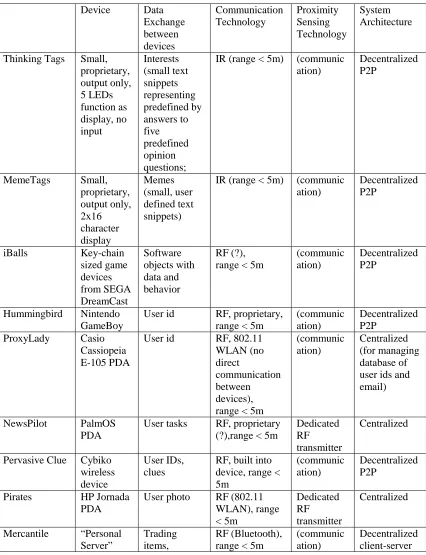
5. Systems to Support Face-to-Face Communication: Overview ... 66
6. Systems to Support Face-to-Face Communication: Technology... 73
7. Main Concepts of the Wearable Community System Model... 85
8. Genie scenario... 89
9. Genie profile template... 91
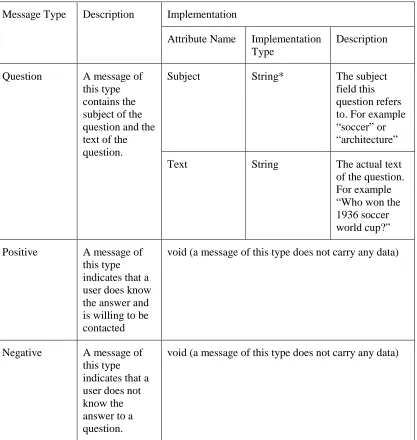
10. Genie vocabulary ... 92
11. Case Studies ... 164
12. FriendFinder Scenario... 167
13. FriendFinder User Profile Template ... 168
14. PIRATÉ scenario ... 179
15. PIRATÉ user profile ... 179
16. PIRATÉ vocabulary ... 181
17. mBazaar Scenario... 186
18. mBazaar vocabulary... 189
19. WALID Scenario ... 193
20. WALID user profile template ... 194
LIST OF FIGURES
Figure Page
1. Augmenting Social Space ... 14
2. Wearable community design problem ... 34
3. The iterative prototyping cycle ... 35
4. Wearable Community System... 37
5. Multi-hop routing in an ad hoc network ... 52
6. Clue Finder... 70
7. WearCoM methodology overview ... 79
8. Scope of a Community Protocol ... 84
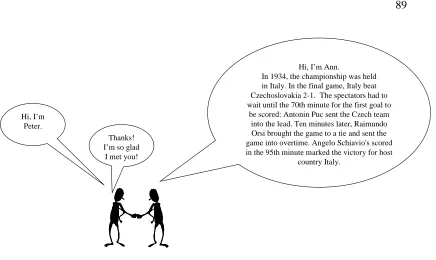
9. Genie wearable community (Step 1)... 88
10. Genie wearable community (Step 2)... 89
11. Sample community protocol diagram ... 94
12. Complex transitions ... 96
13. Genie community CPD ... 98
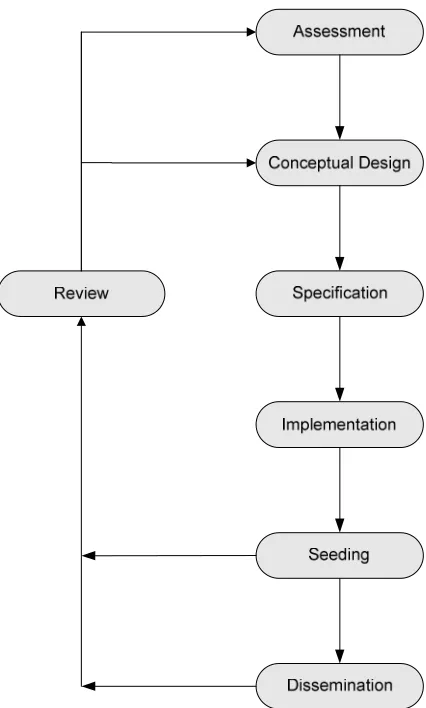
14. Relationship between WearCoM roles, phases and artifacts ... 100
15. Proem Network ... 111
16. Peer Horizon... 112
17. Peers, peerlets, peerlet engines and peerlet protocols ... 113
18. Peerlet Engine Software Architecture ... 118
19. Cooperative Message Delivery ... 126
20. Distribution of Profiles in the Proem Presence Protocol... 129
21. Peerlet controller user interface with one visible panel ... 135
22. Peerlet panel grid... 136
Figure Page
24. FriendFinder user interface ... 169
25. Genie user interface (screen 1)... 172
26. Genie user interface (screen 2)... 172
27. PIRATÉ community protocol ... 180
28. mBazaar community protocol ... 188
29. WALID Task Trading Example... 195
30. WALID Community Protocol Diagram... 198
LIST OF PROGRAMS
Program Page
1. FriendFinder Peerlet... 170
2. Genie Message and User Profile Classes ... 173
3. Genie Peerlet ... 174
4. PIRATÉ message and user profile classes ... 182
5. PIRATÉ Peerlet Class ... 183
6. mBazaar message classes ... 190
7. mBazaar peerlet class... 191
8. WALID Message and User Profile Classes ... 200
Chapter I
INTRODUCTION
Wearable computing advances an innovative form of personal computing brought about by continuously worn, intelligent assistants that augment memory, intellect, communication, and physical senses (Mann 1997; Rhodes 1997; Starner 1999; Starner 2001). As wearable computing technology is taking on a larger role in our daily lives, one the most important questions is how this technology will influence people’s social behavior and change the way wearable computer users interact, cooperate, organize and act collectively. Will it merely make people “smarter” by providing them with seamless, context-aware access to information or will it contribute to rich social interactions? Unfortunately, wearable computing research for the most part ignores the crucial interplay between wearable computing technology and people’s social behaviors. Current systems and applications emphasize intellectual and sensory capabilities over interpersonal interactions and social competence. As we want to advance the wearable computing paradigm as an innovative form of personal computing, we need to carefully consider the social mechanisms, social potential and social constraints of this technology.
Important research questions in this respect are:
• What are the social potentials of wearable computers, if any?
• How can we evaluate the success of failure of these wearable systems?
This dissertation focuses on the second and third question, provides some insights into possible answers for the first question and ignores the last question.
The focus of this dissertation is the combination of wearable devices and wireless personal area networks. Wireless personal area networks, such as Bluetooth, are a new class of wireless networks that enable seamless ad-hoc communication over short-range radio links (typically up to 10 m).
The convergence of wearable devices and wireless personal area networks creates opportunities for a new family of wearable computing applications aimed at fostering human connections, enabling cooperation and collaboration, and supporting natural social behaviors. Such applications hold the potential to modify established social relationships and create new ones. In particular, it provides new opportunities for community-building in the world of face-to-face encounters by bringing together strangers and by enhancing social interactions among acquaintances.
facilitate face-to-face communication among friends and strangers alike and support social practices of sharing, cooperation, learning and story-telling.
While we have at least partial answers to the question of the social potentials of wearable computers, we know almost nothing about the engineering aspects of systems supporting social face-to-face interactions. This dissertation aims to remedy this situation by exploring requirements and architectural support for wearable community
applications.
Wearable community applications are a form of wearable communityware. Communityware (Ishida 1998a, Ishida 1998b) is software that fosters social exchanges and contributes to community building among a loose collection of individuals with shared interests but no common goal. Communityware stands in contrast to groupware, software that enables task-oriented cooperation and collaboration among members of a well-defined group who share a common goal or purpose.
I.1Problem Description
to technical issues of communication and context-awareness in dynamic ad hoc networks.
The fundamental problem in the development of wearable community applications is the semantic gap between the application domain and system layer. As of today, there is no direct support for the variety of features that wearable community applications require. Likewise, there are no programming and building abstractions for developers to leverage off when designing such applications. This results in a lack of generality, requiring each new application to be built from the ground up in a manner dictated by the underlying network technology and device platform.
This set of problems associated with the development of wearable community applications makes it clear that there is a need for the uniform support of the design, implementation and deployment of wearable community applications. Thus, the goal of this dissertation is to develop a conceptual framework and concrete tools to enable rapid development of wearable community applications.
The hypothesis of this dissertation is:
A software platform that provides support for key abstractions together with a
development methodology that defines a systematic, repeatable process will enable
developers to build wearable community applications within a short time frame and
with reduced effort.
I.2Contributions
This dissertation makes three main contributions:
decisions and enables developers to specify key aspects of the application design; and (3) a development process that outlines a sequence of development steps that result in the creation of specific artifacts.
2. The second contribution is the Proem peer-to-peer platform. Proem is designed to tightly integrate with the WearCoM methodology and provides infrastructure and development support required for wearable community applications. The main focus of Proem is the information needs of applications and the provision of high-level programming abstractions. The three main platform components are:
• The Peerlet application framework, a collection of libraries and APIs for the rapid development of wearable community applications.
• The Proem runtime system, a software environment for hosting and executing applications built with the Peerlet framework.
• The Proem protocols, a set of peer-to-peer protocols that define the way in which Proem peers communicate and cooperate over the network.
3. The final contribution of this research is the evaluation of the WearCoM methodology and Proem platform. To address the utility and practicality of the methodology and platform for the development of wearable community applications, we present five case studies and report our experiences of using the methodology in software engineering education.
I.3Outline
This dissertation is structured as follows:
support face-to-face communication. The chapter concludes by identifying the need of and the requirements for a wearable community methodology. The main outcome of this chapter is an understanding of why existing development support for wearable communities is not sufficient.
Chapter III presents background for this work. We summarize the key concepts of the following areas: wearable computing, ad hoc networking, virtual communities and communityware.
Chapter IV introduces the WearCoM methodology. We lay out the underlying conceptual framework and describe the design process and design language. Throughout the chapter we provide example to clarify key concepts. The chapter concludes with a discussion of tool support for the methodology. The outcome of this chapter is an understanding of the key requirements of a wearable community platform. Chapter V and Chapter VI describe the Proem peer-to-peer platform. Chapter V starts by discussing basic assumptions and providing an architectural overview. It then goes on to discuss the set of protocols that lie at the heart of Proem: The Proem Transport Protocol which defines a common messaging layer for ad hoc networks and the Proem Presence Protocol which implements a mechanism for devices and users to announce their presence throughout a network of wearable computers. Chapter VI describes the Peerlet application framework for building presence-aware ad hoc collaborative applications.
Chapter VII presents five wearable community case studies. In each case we follow the whole development process as laid out by the methodology and present design and implementation details. Each of these case studies highlights one particular aspect of the Proem platform.
Chapter IX summarizes the key results of this dissertation and presents directions for future research.
I.4 Topics Not Covered in This Dissertation
Chapter II
WEARABLE COMMUNITIES
This chapter lays the groundwork for this dissertation by presenting a conceptual framework of wearable computing support for social groups and social interactions. In order to highlight our emphasis on social aspects of wearable computers we first introduce the notion of social wearable computing. Social wearable computing is concerned with augmenting every-day social interactions and aims at wearable technology systems that enable collaboration and support natural social behaviors. We then explore wearable communities as a concrete example of the social wearable computing idea. A wearable community is a social network that emerges when enough people use their wearable computers to form webs of personal relationships. Similar to online communities, wearable communities are multiparty conversation organized around affinities and shared interests, bringing together people who do not necessarily know each other personally. Unlike online communities, they are based upon embodied real-world human encounters that are augmented by wearable computing technology. The chapter concludes with a discussion of technological challenges of wearable
community systems, i.e. the hardware and software to facilitate and support wearable
II.1Social Wearable Computing
In recent years, wearable computing has emerged as a new discipline in the field of computer science. The applications of wearable computers are broad and encompass a wide spectrum ranging from personal to professional applications. They include augmented reality (Starner, Mann, Rhodes, Levine, Healey, Kirsch, Picard, and Pentland 1997; Rekimoto et al. 1998; Höllerer, Feiner, and Pavlik 1999; Höllerer, Feiner, Terauchi, Rashid, and Hallaway 1999; Bauer et al. 1998; Kortuem et al. 1998), maintenance (Smailagic et al. 1994; Siewiorek et al. 1998; Siewiorek et al. 1994; Kortuem, Bauer, Heiber and Segall 1999; Bauer et al. 1998; Bauer et al. 1999), personal information management (Rhodes 1997), shopping (Randell and Muller 2000), tourist information and guidance systems (Smailagic and Martin 1997; Höllerer, Feiner, Terauchi, Rashid, Hallaway 1999; Feiner et al. 1997), affective computing (Picard and Healey 1997; Healey and Picard 1998), personal imaging (Mann 1996; Mann 2001b), and video conferencing (Billinghurst et al. 1997; Billinghurst et al. 1998).
performed on a shoulder-worn wearable computer and suggestions are presented on a head-mounted display.
The personal wearable computing idea was inspired in part by the works of two seminal researchers: In 1960, J.C.R. Licklider (1960) published a paper with the title “Man-computer symbiosis” in which he described his vision of real-time cooperation between man and computer. Two years later, Doug Engelbart (1962) wrote a report entitled “Augmenting Human Intellect: A Conceptual Framework” in which he laid down his vision of a synergistic man-machine system for improving the intellectual effectiveness of the individual human. In accordance with Licklider’s and Engelbart’s ideas, personal wearable computing is aimed at assisting the individual and the amplification of his intellectual and sensory capabilities. The most radical expression of this view was formulated by Steve Mann (Mann 2001a) who coined the term “humanistic intelligence”. Humanistic intelligence is a computing style designed to assist human intelligence by augmenting and mediating the human senses. The proposed augmentation and mediation of human senses is enabled and fundamentally depends on body-worn computing devices that are always on and always active.
II.1.1A Social Computing View of Wearable Computing
In this dissertation, we propose an alternative model of wearable computing, called social wearable computing. Social wearable computing defines a research framework that addresses the fact that wearable computing technology is taking on a larger role in human social lives. It is concerned with assisting and augmenting every-day social interactions and aims at wearable technology systems that enable collaboration and support natural social behaviors and compelling and effective social interactions. Social wearable computing is motivated and made possible by the recent emergence of wireless personal area networks (WPAN), a new class of wireless networks that enable seamless ad-hoc communication over short-range radio links (typically up to 10 m). Wireless personal area networks such as Bluetooth make it possible for wearable computers belonging to different individuals to communicate during face-to-face encounters, thus enabling computer-mediated interactions among co-located people.
In contrast to personal wearable computing, social wearable computing focuses on supporting social groups, e.g. families, groups of friends, class mates etc, rather than disconnected individuals. This includes support for group formation processes and activities within already well-established groups. Aspects of social live that fall within the reach of social wearable computing are social awareness, social identity, group belonging and social curiosity.
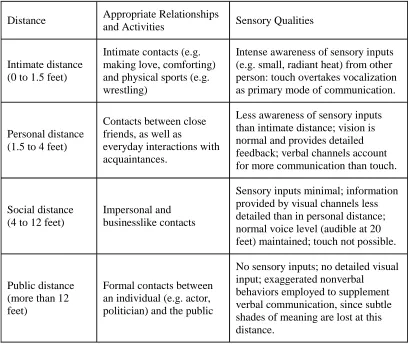
II.1.2Augmenting Social Space
particular relationship with the other (Table 1) (Hall 1966): intimate space – where touch happens – is the closest "bubble" of space surrounding a person; personal space is used for conversations and among friends and family members; social space is the space in which people feel comfortable conducting routine social interactions with acquaintances as well as strangers; and public spaces is the area of space beyond which people will perceive interactions as impersonal and relatively anonymous. The particular zone that we use depends on situational conditions such as our relationship with the others and the activity we are engaged in.
Table 1. Edward T. Hall's spatial zones
Distance Appropriate Relationships
and Activities Sensory Qualities
Intimate distance (0 to 1.5 feet)
Intimate contacts (e.g. making love, comforting) and physical sports (e.g. wrestling)
Intense awareness of sensory inputs (e.g. small, radiant heat) from other person: touch overtakes vocalization as primary mode of communication.
Personal distance (1.5 to 4 feet)
Contacts between close friends, as well as
everyday interactions with acquaintances.
Less awareness of sensory inputs than intimate distance; vision is normal and provides detailed feedback; verbal channels account for more communication than touch.
Social distance (4 to 12 feet)
Impersonal and businesslike contacts
Sensory inputs minimal; information provided by visual channels less detailed than in personal distance; normal voice level (audible at 20 feet) maintained; touch not possible.
Public distance (more than 12 feet)
Formal contacts between an individual (e.g. actor, politician) and the public
No sensory inputs; no detailed visual input; exaggerated nonverbal
Social space varies across individuals according to factors such as culture, age, and gender and is characterized by direct verbal communication, embodied co-presence, mutual awareness and shared artifacts.
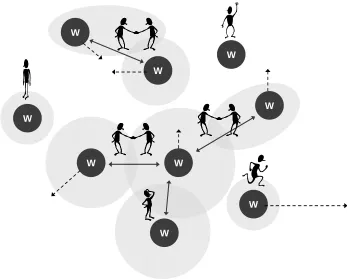
Wireless personal area networks make it possible to augment social space. They generate a sphere-like digital space that envelops a wearable computer and its users. This digital space is filled with information broadcast by the wearable computer. The extension of the space depends on the transmission range of the wireless transceivers and can range from a few inches to several feet. The digital space is invisible to the human eye but can be sensed by wearable computers: as soon as the digital spaces of two wearable computers overlap, they become aware of each other.
Digital interaction Human interaction
Wearable computer
Wearable computer
Figure 1. Augmenting Social Space
II.1.3Wearable Computers
The personal wearable computing model is embodied by a very specific form of wearable computer. Wearable computers are typically composed of a CPU and storage unit attached to a belt or carried in a backpack, see-through head mounted display (HMD), wireless communications hardware and an input device such as touchpad or chording keyboard. Worn on the body, they provide constant access to computing and communications resources. Over the years, there have been many attempts at defining what distinguishes a wearable computer from a simple mobile or handheld device. Rhodes (Rhodes 1997, 3) lists five essential characteristics of wearable computers:
(i) “Portable while operational: The most distinguishing feature of a wearable
is that it can be used while walking or otherwise moving around. This
distinguishes wearables from both desktop and laptop computers.
(ii) Hands-free use: Military and industrial applications for wearables
especially emphasize their hands-free aspect, and concentrate on speech
chording-keyboards, dials, and joysticks to minimize the tying up of a user's
hands.
(iii) Sensors: In addition to user-inputs, a wearable should have sensors for the
physical environment. Such sensors might include wireless communications,
GPS, cameras, or microphones.
(iv) "Proactive": A wearable should be able to convey information to its user
even when not actively being used. For example, if your computer wants to
let you know you have new email and whom it's from, it should be able to
communicate this information to you immediately.
(v) Always on, always running: By default a wearable is always on and
working, sensing, and acting. This is opposed to the normal use of
pen-based PDAs, which normally sit in one's pocket and are only woken up
when a task needs to be done.”
According to Rhodes, the main distinguishing feature of wearable computers is that they are designed to minimize the distraction from the wearer's real-world tasks. A wearable computer is no longer the main center of user attention (as is the case with desktop and handheld computers) but it takes on an active support role. A similar definition was offered by Starner (Starner 1999) who lists the following attributes as necessary requirements for achieving human-computer symbiosis: a wearable computer persists and provides constant access, senses and models context, augments and mediates, and interacts seamlessly with the user by adapting its input and output modalities according to the context.
1. Constant: A wearable computer should be always on and always running, it
should not need to be turned on every time the user wants to use it (this does not exclude the possibility of low-power sleep modes).
2. Presence-aware: A wearable computer should be aware of the presence of
nearby people (i.e. wearable computer users). The term “presence-aware” refers to the acquisition and use of knowledge about the availability and reachability of people.
3. Communicative: Wearable computers should be able to communicate with each
other. Most importantly, wearable computers should be able to communicate with other nearby wearable computers through the use of short-range network technologies like Bluetooth or IEEE 802.15 Personal Area Networks.
4. Proactive: A wearable computer should be able to perform tasks autonomously
and proactively without requiring explicit user intervention (interactivity may also be supported). Most importantly, a wearable computer should be able to interpret and react to changes in its knowledge about the presence of wearable computer users in the immediate environment.
This characterization of a wearable computer is consistent with previous definitions, yet adds further functional requirements: it defines the ability to communicate with nearby devices as important attribute and it replaces the generic term context-awareness with the more specific term presence-awareness.
Table 2. Personal wearable computing vs. social wearable computing
Personal Wearable Computing Social Wearable Computing
Interface Human – computer Human – human
Focus Individuals Social groups
Augmentation intellectual and sensor
capabilities
Interpersonal interactions and social space
Device characteristics Constant, hands-free, sensors, proactive, portable while operational (Rhodes 1997)
Constancy, mediation, augmentation (Mann 2001a)
Persistent and constant, senses and models context, augments and mediates, interacts seamlessly with the user (Starner 1999)
Constant, presence-aware, communicative, proactive
Applications Augmented memory,
augmented reality
Wearable communities
II.2 Wearable Communities
computing holds the potential to modify established social relationships, and create new ones. In particular, it provides new opportunities for community-building in the world of face-to-face encounters by bringing together strangers and by enhancing social interactions among acquaintances. We call the social networks that emerge when enough people use wearable computers throughout their daily lives wearable
communities. A collection of wearable computer users becomes a wearable community
when enough people use their wearable computers to form webs of personal
relationships.
The term community has a long and rich tradition in sociology, anthropology and psychology and in recent times has become popular with the emergence of online or virtual communities (Rheingold 1993). It is thus not surprising that the term “community” has many different uses and connotations. In addition, many different types of communities have been identified over time (e.g., intentional communities, communities of interest, and communities of practice). In the most general terms, Mynatt et al. (1997, 16) define a community as “a social grouping which exhibit in varying degrees: shared spatial relations, social conventions, a sense of membership and boundaries, and an ongoing rhythm of social interaction." With a view towards online communities Howard Rheingold offered in his book, The Virtual Community (Rheingold 1993) the following definition: "Virtual communities are social aggregations that emerge from the Net when enough people carry on those public discussions long enough, with sufficient human feeling, to form webs of personal relationships in cyberspace." Finally, Jennifer Preece (Preece 2000) defines online communities as
• a collection of people
• with a shared purpose,
• guiding policies and
Within the community, people interact with each other and take roles; the shared purpose is a common interest or need that provides a reason for belonging to the community; policies are (implicit or explicit) protocols that guide people's interactions or folklore and rituals that bring a sense of history and accepted social norms (Preece 1999).
An important distinction exists between co-present (or face-to-face) communities (Ostrom 1990) and online communities. Most computer-mediated communities are online communities and are characterized by the fact that members are separated in time and space. On the other hand, most co-present communities are not computer-mediated and are characterized by direct interactions in face-to-face settings. A wearable community is a computer-mediated co-present community. It is defined by the use of a particular technology, namely wearable computers, in the same way an online community is defined by the use of the Internet. Similar to online communities, wearable communities are multiparty conversation organized around affinities and shared interests, bringing together people who do not necessarily know each other personally. Unlike online communities, they are based upon embodied real-world human encounters that are augmented by wearable computing technology. The notion of wearable communities acknowledges and is based on the unique value of random encounters and face-to-face interactions. We believe that fully embodied human moments are essential for community building. While online communities on the Internet have led to a separation of physical place and social space, wearable communities attempt to reunite the two.
II.2.1Examples
University students. There are two important reasons why we choose to focus on students. First, students already form a loosely knit community and are likely to share certain interests. Second, the frequency of random encounters and casual social interactions is relatively high among students. Finally, most of our developers are students themselves and thus have a chance to use and evaluate their own technology. The three wearable community applications we will describe are PIRATÉ, WALID and mBazaar. We will discuss the implementation of these applications in detail in Chapter VII.
PIRATÉ
PIRATÉ (Kortuem et al. 2001) takes ideas from peer-to-peer file sharing applications like Napster and moves them to the wearable domain. PIRATÉ is a collaborative music guide that enables users to exchange MP3 play lists and music recommendations during brief random encounters. The goal of this application is (1) to enable user to discover new music they want to listen to based on the playing habits of the people they most often meet; (2) to provide awareness of the most favorite music titles within the community; and (3) to let users discover with whom they share a common taste in music. These goals are achieved by serendipitously exchanging and accumulating information throughout the day.
PIRATÉ implements the following scenario:
“Kim is a 20 year old architecture student and an ardent music lover. She has
an extensive CD collection and has digitized all of them as MP3s. During most of her
waking hours she can be seen sporting an MP3 player and headsets, especially when
she is working in her studio at school.
As soon as the first generation of Bluetooth-enabled wearable MP3 players
appeared on the market she rushed out to buy one despite its steep price: she knew that
ability to detect other MP3 players in the vicinity and to trade play lists with them. Kim
has set up her player to recognize the MP3 players of all of her music-loving friends
and to automatically trade information about the songs she listens to. So while Kim and
her friends are having lunch or are working in their studio, their MP3 players exchange
play list and generate personalized music recommendations that take into account the
listening habit of the entire social group. Furthermore, she has enabled the privacy
mode of her MP3 player. As a result, her player emits an audible signal every time it is
trading play lists with another device.
After each day at school, Kim downloads the information she collected from her
friends’ players to her laptop computer that is connected to the Internet. She then
downloads freely available samples of the songs her friends listen to and copies some of
them to her MP3 player. On a good day she identifies two or three new CDs she plans
to buy as soon as she has enough money.”
This scenario stresses two important points: first, interactions within wearable communities may be fully automated, not requiring direct interactions between users. The general willingness to share information and the opportunities presented by physical proximity suffice for successful collaboration. Second, existing personal relationships (such as between friends or colleagues) can play an important part in wearable communities.
WALID
world tasks: dropping of someone’s dry cleaning, buying a book of stamps at the post office, or returning a book to the local library.
WALID employs personal agent software to find community members close by and to negotiate the exchange of favors. The agents maintain a user's task list, becoming fully aware of the locations and activities involved. When an encounter occurs, the agents produce a negotiation. If both users approve, a deal is struck. The role of the agent in a negotiation is to evaluate the value of favors and to keep scores. Having to run across town just to drop off someone’s mail, compares unfavorably with buying milk for someone if the grocery store is just a block away. WALID agents employ ideas from game theory to ensure that results of negotiations are mutually beneficial. They cooperate only if there is the opportunity to enhance the users' goals.
WALID illustrates the importance of trust in wearable communities. It is unlikely that people are willing to trade tasks unless they trust each other to a certain extent. Thus, WALID works best for close-knit groups with established trust relationships (for example groups of friends, classmates or colleagues).
mBazaar
The three wearable community applications are summarized in Table 3.
Many other wearable communities can be envisioned: computing communities in which computational resources like network bandwidth and computing cycles are shared; helper communities in which members pledge to assist each other when in distress; bargain-hunter communities in which members collectively search out sale items in local stores; marketplace communities in which goods are exchanged without money; job market communities in which free applications offer their services to passerby’s; knowledge communities in which members collectively accumulate information to create shared understanding; and finally political communities in which members create new forms of spontaneous democracy and local activism.
Table 3. Wearable Communities
PIRATÉ WALID mBazaar
User population Music lovers, groups
of friends, classmates, students, colleagues who frequently listen to music.
Close-knit groups with established trust relationships (for example groups of friends, classmates or colleagues)
Friends, students, colleagues
Purpose (1) To generate
personalized music recommendations based on listening behavior of
community members (2) To discover people with similar music taste
(3) to discover most popular music titles
(1) To strengthen the social ties of a group by
identifying opportunities for mutual assistance (2) to enable users to do daily tasks more efficiently
II.2.2From Online Communities to Wearable Communities
The idea of wearable communities has precursors in other forms of computer-mediated communities. In the following, we will highlight the differences between online, mobile and wearable communities.
Online Communities
The invention of the Internet and the beginning proliferation of personal computers in the early 90ths created a new digital media that almost instantly was adopted by its users as a tool for social interactions. Today, people use the Internet to stay in touch with friends and family by sending greeting cards, sharing vacation photos, and chatting about daily life. One of the most powerful features of the Internet is its ability to enable total strangers to interact on a very personal and sometimes even intimate level. People who have never met in their entire life (and are unlikely to ever do so) use the Internet to discuss personal matters related to health, raising kids, romance and many other topics of shared interest. In effect, the Internet provides the connectivity for the "Global Information Community" envisioned in 1968 by J.C.R. Licklider (Licklider 1968, 2) as being "... not of common location, but of common interest." The fact that the Internet is a place that enables a new type of social network, one mediated by computer terminals and networks, was vividly described by Howard Rheingold who coined the term “Virtual Community” (Rheingold 1993). He defined virtual communities as “social aggregations that emerge from the Internet when enough people carry on public discussions long enough and with sufficient human feeling to form webs of personal relationships.”
Peer-to-Peer Communities
Recently, a new form of online communities has emerged, namely peer-to-peer file sharing communities. Applications like Napster, Gnutella (CLIP2 2002; Kan 2001), Freenet (Clarke et al. 2001) and KaZaA (Sharman Networks 2002) have created communities of users who anonymously trade MP3 files over the Internet. In contrast to traditional web-based online communities which create a centralized shared space for interaction, peer-to-peer file sharing occurs in a decentralized fashion via direct pair-wise interaction between users (Napster uses a centralized directory of available music titles, but file exchanges still occur in a direct peer-to-peer fashion). From a social point of view, peer-to-peer communities can be seen as a special form of online communities with the following unique characteristics: (1) they are very specific in their purpose (trading MP3 files is the only supported activity), (2) they are anonymous (in contrast to most web-based communities, users of peer-to-peer file sharing communities have no (semi-)persistent identities such as user names or handles; exchanges occur between computers with IP addresses but not between users), and (3) there are few guiding policies to resolve conflicts of interests (free-riders, people who download MP3s from others but do not share their own collection, are a constant problem in file sharing communities).
Reuniting Virtual Space and Physical Space
including isolation and depression (Kraut et al. 1998). The lack of fully embodied human moments in such cases may compensate or even reverse the otherwise positive character of online communities.
In face-to-face meetings, vocal inflection and gestures carry significant social cues which are necessarily absent from web-based tools. Thus, numerous attempts have been made to enrich the communication in online communities and to reproduce the physical world’s rich set of social cues in the online world. Still, the vast majority of online communities on the Internet today are text-based.
An interesting attempt to reunite virtual space and physical space was made with the recent launch of the MEETUP web site (Meetup, LCC. 2002). MEETUP provide a service that allows members to set up or find face-to-face meetings of like-minded users in the same area. By telling the site where they are and what they are interested in (quitting smoking, reading books, having pets), users can organize and find meetings of other people in the same area and with the same interest. An important aspect of MEETUP is that the early adopters of this service are people who are already connected to a virtual community. Local meetups have already been scheduled for people from the Slashdot, LiveJournal, and Plastic communities. This indicates how interconnected virtual community members already are, and how much demand there is to meet face-to-face.
Mobile Communities
Asian and European countries, where exchanging SMS text messages via mobile phones has become a major part of adolescent rituals. Simultaneously, some online communities have sprouted mobile extensions by giving users access to community tools from their mobile devices, thereby allowing members to stay in touch with their community at anytime from any place.
Despite their widespread and successful adoption, mobile phones and Internet-enabled PDAs have serious flaws as tools for community building. Mobile phones enable communication over long distances; they do not support many-to-many communication and consequently do not facilitate random encounters (both virtual and real) and anonymous relationships. Using cell phones it is difficult to create new relationships, as they require the caller to have a fairly good idea who the callee is or a good reason (and thus a relationship) to place a call in the first place. Moreover, the use of mobile technology has the potential of decreasing real-world random encounters and face-to-face interactions: by attending to people who are located elsewhere they may reduce the amount of time and attention paid to strangers nearby and activities in public places. All this makes current mobile technology good for maintaining existing community relationships, yet ill suited for creating new ones.
Differences between Virtual, Mobile and Wearable Communities
Wearable communities are different from online and mobile communities. Similar to online and mobile communities, they are webs of relationships that grow from computer-augmented social interactions. Yet, online and mobile communities depend on indirect and remote interactions between users. In contrast, wearable communities are based on direct face-to-face encounters. Thus, interactions in wearable communities are situated and involve a rich social context.
The three wearable community applications described above highlight the differences between traditional computer-mediated communities and wearable communities:
Social context: In a wearable scenario involving WPANs exchanges are only
possible over short distances, that is, when people come face-to-face or are at least within close physical proximity. Consequently, communication partners will be aware of whom they are interacting with and be able to observe important social cues including sex, clothing and gestures. In addition, they might even be able to talk to each other. The addition of social context shapes people’s willingness to engage with strangers and the particular manner in which they interact. For example, politeness and trust are two aspects of human interactions that strongly differ when people interact face-to-face vs. terminal-to-terminal across the Internet.
Usage context: The context in which wearable devices are used is different in
two important respects from using a stationary computer at home or in the office. When wearable devices are involved, user attention is a scarce resource. Instead of sitting in front of a computer where a user can pay full attention to the computer and its operation, wearable computers are used in situations where the user’s attention is occupied by demanding real-world task like driving, operating a machine, or simply conversing with other people.
operation takes just a few seconds or several minutes; they can always shift their attention to another task. This is no longer true if exchanges occur between two wearable devices. Since a connection can only be active while users are close to each other, a lengthy interaction among two wearable computers is less likely to succeed than a brief one.
Technical context: In comparison to wired computers networks, WPANs are
limited in terms of bandwidth and reliability. Using PIRATÉ as an example, this suggests that rather than exchanging large-sized MP3 files, systems should be designed to exchange metainformation, that is, URLs pointing to an MP3 file an a server or recommendations about a song.
These observations make clear that wearable communities are significantly different from traditional computer-mediated communities. Thus it becomes necessary to rethink the whole system design and modify it in accordance with the social, usage, and technical context.
II.2.3Factors that Bind Wearable Communities Together
common, it is not the norm. In particular, when exchanges and transactions are involved, conflicts can arise. How individuals deal with these obstacles and how they adjust their behavior to overcome them makes the difference between a successful and a non-successful community. In the following, we list some of the factors that are relevant for wearable communities:
• Identity: All of our interactions, even those with strangers, are shaped by our
sense of with whom we are interacting. In interactions involving social space, there are a wealth of cues of varying reliability to indicate our identity and our intentions. Our clothes, voices, bodies, and gestures signal messages about status, power, and group membership. We rely on our ability to recognize fellow group members in order to know who we can turn to and what we can expect. Our ability to identify others also allows us to hold individuals accountable for their actions. Wearable technology enables people to define and broadcast digital identities that may or may not be their true identities. In contrast to online communities, these digital identities augment rather than replace a person’s true identity as both are visible at the same time. Because observers can match the digital identity to a person’s appearance and behavior, it is difficult in wearable communities to switch identities at will.
• Privacy: Privacy and identity are two sides of the same coin. Privacy is the right
• Situational Context: Interactions in wearable communities take place within a
rich social and physical context and are thus subject to usual norms. Because interactions occur in the real world, the location and the presence of other people matter just as much as in non-augmented communities. The differences between public and private space, crowded and empty rooms, meeting and party, or intimate conversation and public lecture remain important just as in unmediated situations (but unlike in online communities).
• Historical context: A wearable community is bounded in time and space. It has
a beginning and an end and is located within a limited physical space. Although these boundaries might not be apparent to its members or outsiders, they nevertheless exist. With an extension in time and space, each community has a history and interactions that take place add to this history. In addition, each community member has a very personal interaction history. Having a sense of history and being able to learn from history is an important aspect of a wearable community.
• Risks: As wearable communities are based on interactions taking place in the
real world, risks are real as well. In addition to risks of virtual communities like being verbally assaulted or loosing money, wearable communities also include risks to the person’s life and wellbeing. Fear of being assaulted and injured may make people more careful than in virtual communities.
• Trust: Trust is an aspect of human interactions that strongly differs whether
II.3Building Wearable Communities
How can we build successful wearable communities? The success criteria for wearable communities are not different from those of real world or virtual communities: a wearable community is successful if it creates a rich social environment in which the augmentation of random encounters and social space leads to psychologically satisfying “human moments” and lasting personal relationships. What turns a loose collection of individuals into a community, is persistent and ongoing conversations. Thus a collection of wearable computer users becomes a wearable community when enough people use
their wearable computers to form webs of personal relationships. In other words, we
want wearable communities to foster social interaction and communal spirit. Yet this observation doesn’t make it any clearer how we can achieve this goal. This is because wearable communities, like all communities, are the result of self-organizing behavior of a group of people. They emerge; they cannot be constructed from the outside by following a simple recipe. Referring to online communities, Jennifer Preece expressed this sentiment as follows:
“Software developers design software, thinking that they are designing
communities. Meanwhile, keen-eyed, reflective sociologists describe the emergence of
communities. But communities are neither designed nor do they just emerge. How
software is designed affects community development. The way people interact in a
community strongly contributes to its long-term evolution. People's behavior cannot be
controlled but it can be influenced“. (Preece 1999, 24)
II.3.1An Exploratory Design Approach based on Rapid Prototyping
An important characteristic of wearable communities is that social concerns become difficult to separate from technical practices: social and technical issues interact and co-evolve in such intimate ways that they often merge. Thus in order to design a wearable community, we need to simultaneously design technology and social interactions.
A successful community design often hinges on what Wenger (Wenger 1998) referred to as a “minimalist design”. The idea behind a minimalist design is to create a provisional design and to facilitate the growing of community over time. While doing so, designers must try to identify the attributes that make communities successful and design technology to embody these attributes.
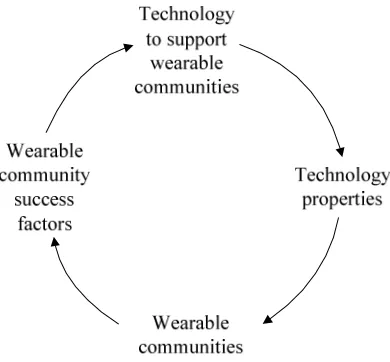
In building wearable communities, we are faced with a chicken-and-egg problem which we refer to as the fundamental problem of wearable communities:
Wearable communities require hardware and software to support them, but
without experiences with actual wearable communities we don’t really know what the
success factors for wearable communities are and how to design systems to embody
them.
Figure 2. Wearable community design problem How can we solve this problem?
One solution is to use an exploratory design approach based on rapid prototyping. Rapid prototyping is a circular design process based on an initial technology prototype followed by repeated evaluation and refinement. The initial prototype represents the designers’ educated best-guess of what the final systems may look like. Its design may be informed by prior experiences with similar systems or theoretical insight.
A rapid prototyping approach can be divided into four distinct activities (Figure 3):
• Planning: this involves understanding the users (including goals, interests, needs, etc.), understanding the available technology, the definition of the overall purpose of a system, and the design of a prototype.
• Implementation. during implementation, a prototype is built
• Measuring: this involves observing the use of the system in a real-world setting with real users. The goal is to identify shortcoming of the prototype.
There can be many reasons that a prototype does not achieve its goals. Sometimes these will be implementation issues, but more often the problem will be an incorrect or insufficient understanding of the users. Thus it is important to go all the way back to planning and to take a fresh look at a system from a user’s perspective. To succeed, prototyping must be iterative and must support rapid creation and modification of prototypes.
Rapid prototyping has successfully been used at Carnegie Mellon University for the development of successive generations of the VuMan wearable computer (Smailagic et al. 1998). Using this approach, interdisciplinary groups of students have again and again succeeded to design and build the hardware and software components of a wearable computer within just one semester.
Planning Implementing
Measuring Learning
Tim e →
II.3.2Wearable Community Systems
Building and maintaining computer-mediated communities involves the design and manipulation of technologies in ways that foster human connection. Technologies to support online communities include hardware (personal computers, networks, and hosts) and software (web servers, email list servers, message boards, chat and instant messaging software, online calendars, web browsers, newsreaders, etc.).
With regard to wearable communities the following questions arise:
• What are the characteristics and components of a wearable community system?
• What are the challenges in developing such systems?
• How can we systematically and rapidly build such systems?
In the remainder of this chapter, we will explore various aspects of wearable community systems and discuss the need for a software infrastructure and architectural support for wearable communities.
A wearable community system is a collection of wearable devices, distributed software infrastructure and application software that enables people to interact with fellow community members. By “system” we refer to software and hardware that sets the context for interaction. The term “wearable” indicates the wearable nature of devices and implies a usage model that is always on, communicate, proactive and presence-aware.
(cpu, storage, input/output, etc.) it consists of system and application-level software that performs functions essential to wearable communities: discovery of nearby devices and users, initiating interactions across wireless links, managing user identities, handling user input and output and much more.
In contrast to online communities, for which a mature and proven technological foundation exists, wearable communities require advanced technologies that are subject to intensive research: this includes wearable devices, wireless ad hoc networks, mechanisms for spontaneous networking, as well as context technologies.
W W
W W
W
W
W W
[image:50.612.144.491.320.599.2]W
The key technical challenges of wearable community systems are the result of the decentralized system architecture and the independence and autonomy of individuals. In the following, we will list the primary challenges of wearable community systems. These are:
1. Creating presence-awareness in dynamic decentralized systems 2. Enabling human-centered communication
3. Enabling trust, cooperation and privacy in an open decentralized environment 4. Striking the balance between proactivity and user control
Creating Presence-Awareness in Dynamic Decentralized Systems
A Wearable community system is a highly dynamic, decentralized and self-organizing network of autonomous, wearable devices. Connectivity is determined by the distance between devices; as devices change their physical location they establish pair-wise communication links based on proximity. Thus, a wearable community system resembles a wireless peer-to-peer system in which human presence is the main resource. Important questions regarding presence-awareness include:
• What kind of personal information will users want to disclose to others?
• How can we support multiple identities for the same person to be used in different contexts?
• How can users determine who is around at a given moment and find out how they can interact with other people?
• How can we distribute presence information in a dynamic decentralized peer-to-peer network efficiently?
Expressiveness: They must allow users to create rich and possibly multiple
digital identities for themselves.
Efficiency: To prevent overloading the algorithms must be efficient and/or
adaptable.
Timeliness: To facilitate interactions among people in movement algorithms
must react fast. For example, if two individuals, each of them carrying a wearable device, walk towards each other with a constant speed of 5 kilometers/hour and network transmission radius is 10 meters, devices will be able to communicate for 15 seconds or less.
Enabling Human-Centered Communication
Traditionally, addressing and naming schemes in distributed systems are designed to enable communication among devices. However, in a wearable community system the ultimate goal is communication among humans. Individuals may own and operate more than one device at different times. In addition, individuals might want to use alternative identities in order to protect their privacy. Thus, we must find answers to the following questions:
• How can we define device-independent identities for users?
• How can we move identities from device to device?
• How can we route a message destined for a particular user to the device he or she is currently using?
• How can we enable multi-hop communication among individuals in a dynamic crowed?
Enabling Trust, Cooperation and Privacy in an Open Decentralized Environment
A wearable community system is an open environment without a well-defined population of individuals and devices. Individuals may join or leave a community at will. Therefore, encounters often occur between strangers who have never met before and might not do so again in the future. There is no a priori agreement among members of a community to cooperate. Instead, cooperation is the result of combined actions taken by independent users in their own interest. Sharing of resources and access must be granted between hosts who are unknown to each other. Developers cannot expect that all hosts and users are benevolent; hosts may attempt to gain access to private data, willingly corrupt data and messages, introduce wrong information or do harm in some other way. One of the main privacy concerns is protecting a user’s anonymity. Monitoring network traffic or gaining access to confidential personal data can compromise a user’s anonymity. Not only must a system prevent spying and monitoring, but users must also given control what information is disclosed, to whom, and when.
In such an environment, we are faced with three related challenges:
• How can we enable users (i.e. devices) to spontaneously and effectively cooperate if users (i.e. devices) are autonomous and non-trusted?
• How can we represent, codify and notions of trust and reputation?
• How can we enable individuals who have met before and have established relationships to form secure trusted groups?
• How can we protect a user’s privacy and protect him/her from malicious community members if we can’t trust anyone?
Striking the Balance between Proactivity and User Control
an application and the many ongoing interactions in real-time. Instead, in order to perform acts of ad hoc cooperation, wearable devices must be able to reach out and negotiate with each other autonomously and proactively, i.e. they must be able to anticipate the requirements of the users and act accordingly. This requires a move from an interactive model of human-computer interaction to a new model based on supervision. Such supervisory interfaces will fundamentally rely on software agents that act in the interest and on behalf of the user.
Some of the challenges of supervisory interfaces are:
• How can we maintain human control over agent-based applications?
• How can we enable users to define and modify their agents’ behavior?
• How should interfaces be designed that enable humans to supervise large numbers of concurrent real-time actions?
In sum, developing wearable community systems is a difficult task that requires highly specialized knowledge in a variety of fields ranging from human-factors issues related to collaboration paradigms based on opportunistic, proximity-based interactions to technical issues related to ad hoc networking and context-awareness.
II.3.3Towards a Wearable Community Methodology
build them rapidly and effectively. In particular, there is no support for the exploratory design approach based on rapid prototyping advocated above.
This dissertation aims to remedy this situation by exploring software infrastructure and architectural support for wearable communities.
As first step towards a solution, we introduce the distinction between wearable
community infrastructure and wearable community applications.
• Wearable community infrastructure comprises system-level software components that are useful and necessary for the support of a large variety of wearable communities. This infrastructure is generic in a sense that it embodies fundamental aspects of the wearable community domain. Among other thing, wearable community infrastructure should include mechanism for distributed communication, discovery and presence-awareness, definition of user identities, situational and historical context and trust (see Chapter II.2.3).
• Wearable community applications are community-specific software applications that are built on top of and make use of functionality provided by wearable community infrastructure. They are installed on and run by users on their wearable computers.
To deal with the intervening technological and social issues of wearable communities we propose a wearable community methodology and associated wearable
community platform. The methodology should incorporate the following parts:
1. A well-defined conceptual framework is required as reliable foundation. It should express the basic concepts and an abstract model of a wearable community system.
2. Description techniques are required that allow designers to capture essential
design elements. They are necessary for communication between the designers and between designers and developers. Examples for description techniques are graphical notations like class diagrams and state transition graphs from modeling languages like UML.
3. Development should be organized according to a process model. Such a process model supports system development by clearly defining individual development tasks, roles and results as well as the relationships between them.
The description techniques and the process model should be directly supported by the associated wearable community platform. The platform realizes a wearable community infrastructure and should provide support for rapid development of wearable community applications. In particular, it must (1) enable spontaneous interactions in face-to-face settings, (2) aid developers in the implementation of ad hoc collaborative applications and (3) support formation of wearable communities.
If successful, the methodology and platform will function as catalyst for wearable community applications and thus wearable communities.
interactions do not have to involve direct person-to-person conversations. Merely being at the same place at the same time can be an important indicator for similarities in taste, interests, preferences, and believes: concerts, street demonstrations, trade shows and social venues like bars are proof of that. Social behavior in public places like coffee shops and sidewalks can take the form of sending non-verbal signals and gestures and making others aware of one’s preferences and personality, as well as observing and interpreting signals from others. To be ‘seen’ and asserting one’s social role and group identity is an important aspect of any community, whether virtual or real. The notion of wearable communities is based on the idea that augmented random encounters and augmented social interactions can nurture social networks. Wearable computers connected by proximity networks increase the bandwidth for social messages. They enable people to send and observe digital signals (in addition to non-digital), allowing new forms of digital curiosity. Most importantly, however, interactions that take place in digital space can facilitate and promote interactions in social space, and can lead to rich human encounters. The assumption of this dissertation is that, if properly designed, wearable technology can indeed beget community.
Chapter III
BACKGROUND AND RELATED WORK
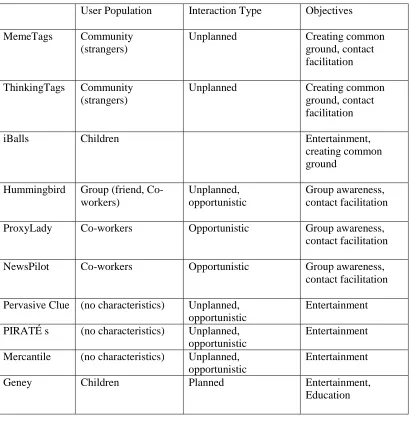
The design and development of wearable community systems touches on a number of research areas including wireless ad hoc networking, peer-to-peer computing, and communityware. This chapter provides an overview of the issues and challenges in these areas as they relate to wearable communities systems. The main contribution of this chapter is a survey of systems to support face-to-face interactions. Although the enabling technologies to support face-to-face interactions among co-located individuals have become available over the last years only a few systems have been realized. The main outcome of this chapter is an understanding of the technical issues of wearable community systems.
III.1Wireless Ad-Hoc Networking