A Survey on Text Localization Method in Natural Scene
Image
Pooja B. Chavre
Pune Institute of Computer Technology. Savitribai Phule Pune University, India.
Archana Ghotkar
Pune Institute of Computer Technology. Savitribai Phule Pune University, India
ABSTRACT
Text information in natural scene images serves as important clues for many computer vision applications such as content-based image retrieval, tourist translator, and assistive navigation. Extraction of such information from natural scene images, involves number of sub stages represented by text information extraction (TIE) system. However, performance of such system is greatly influenced by text localization module. Lots of work has been reported in this field, but it still remained as a challenging problem, due to two main issues: different variety of text patterns like sizes, fonts, orientations, colors, and presence of background outliers similar to text characters, such as windows, bricks. The purpose of this paper is to study and surveyed existing text localization method and challenges for the same.
General Terms
Image processing, Computer vision, Scene analysis.
Keywords
Scene text detection, Scene text localization, Scene text extraction, Connected component (CC)-based approach, CC clustering.
1.
INTRODUCTION
Various applications in field of image processing and computer vision need to extract the content in a given image. Content in an image are mainly divided into two main categories: a) perceptual content and b) semantic content [1]. Perceptual content are the contents which are able to interpret, such content includes attributes such as color, intensity, shape, texture, and their temporal changes, whereas semantic content contributes to various objects, events, and their relations. It deals with the relation between words, phrases, signs, and symbols. In simple manner, semantic refers to the study of meaning. Lots of work has been reported on perceptual content. Semantic image content in the form of text, face, vehicle, and human action are attracted some recent interest.
In this paper, focus has been given on semantic image content in the form of text, because text within an image is of particular interest as: (i)It is very useful for describing the contents of an image; (ii)It can be easily extracted compared to other semantic contents, and (iii)It enables applications such as, vehicle license plate extraction, translators for tourists, information retrieval systems in indoor and outdoor environments, and automatic robot navigation, electricity meters reading, driver aided system, automatic geo coding, landmark recognition.
When OCR is applied to natural scene image, the success rate of OCR drops drastically due to several reasons [2]. First, the majority of OCR engines are designed for scanned text, which uses segmentation to separate out text from background pixels. Second, different variety of text patterns like sizes, fonts, orientations, colors, presence of background outliers
similar to text characters, such as windows, bricks, and character-like texture. Finally, page layout for traditional OCR is simple and structured but in natural scene images there is far less text, and there exists overall structure with high variability both in geometry and appearance.
Because of these issues scene text images usually suffer from photometric degradations as well as geometrical distortion, so that many algorithms faced the accuracy and/or speed (complexity) issue. Therefore, the first task while designing application using text information in natural scene image is to transform the image in a way that current OCR engines are able to manage.
The rest of the paper is organized as follows; section 2 gives possible types of text images and their application. Section 3 gives the general purpose text information extraction system and different methods for each of the stage of system. Section 4 gives an overview of the application domain for TIE in image processing and computer vision. Section 5 depicts various performance evaluation method and 6 gives the discussions and conclusion.
2.
TEXT IMAGE CLASSIFICATION
Images can be broadly classified into document images, caption text images and scene text images [3].
A document image usually consists of text and few graphics components. They are acquired by scanning journal, printed document, degraded document images, handwritten historical document, and book cover etc.
Caption text is also known as overlay text or cut line text. Caption text is artificially superimposed on the video/image at the time of editing and it usually describes or identifies the subject of the image/video content. Such occurrences of text could be automatically detected, segmented, and recognized for indexing, retrieval and summarization. The extractions of
the superimposed text in sports video is very useful for the creation of sports summary and highlights .Some researcher refer caption text as „superimposed text‟ or „artificial text ‟.
Scene text occurs naturally as part of the scene and contains important semantic information such as advertisements that include name of the street, institutions, shop, road sign, traffic information board signs, nameplates, food container, bill board, banner and text on vehicle. Some researcher use the term „graphic text‟ for scene text.
3.
TEXT INFORMATION EXTRACTION
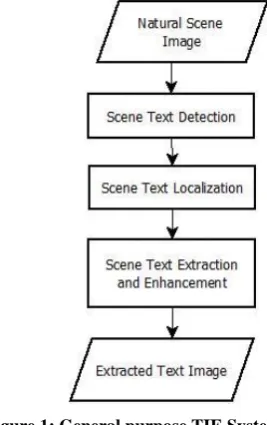
Because of all the possibilities in appearance of text, it is not possible to define exact stages in such system. So it is recommended to refer a general purpose text information extraction system (TIE) [4], show in Figure 1, which will be applicable to all application dealing with semantic image content in the form of text.
Figure 1: General purpose TIE System
A TIE system receives an input in the form of a still image. The TIE problem can be divided into the following sub-problems [4]: detection, localization, extraction and enhancement. Many of the researchers use the term text detection, localization, and extraction interchangeably.
(i)Text detection refers to the determination of the presence of text in a given frame.
(ii)Text localization is the process of determining the location of text in the image and generating bounding boxes around the text.
(iii)Text extraction is the stage where the text components are segmented from the background, in order to facilitate its recognition. Enhancement of the extracted text components is required because the text region usually has low-resolution and is prone to noise.
(iv)The extracted text images can be transformed into plain text using OCR technology. OCR systems have been available for a number of years and the current commercial systems can produce an extremely high recognition rate for machine-printed documents on a simple background. However, it is not easy to use commercial OCR software for recognizing text extracted from images to handle large amount of noise and distortion in TIE applications.
3.1
Text Detection
The text detection stage is closely related to the text localization. The existence or non-existence of text in the image must be determined.
Lim et al. [5] made a simple assumption that text usually has a higher intensity compared to background. Basically they count the number of pixels that are lighter than a pre-defined threshold value and exhibited a significant color difference relative to their neighborhood, and extract a frame with a large number of such pixels as a text frame. This method is extremely fast and simple. However problem can occur with color-reversed text.
However there is no need to give much attention to the text detection stage, mainly because input to system is a natural scene image, which is supposed to include text. Another possibility is if a text localization module can operate in real time; then it can also be used for detecting the presence of text. Zhong et al. [6] and Antani et al. [7] performed text localization on compressed images, which resulted in a faster performance. Therefore, their text localizers could also be used for text detection.
3.2
Text Localization
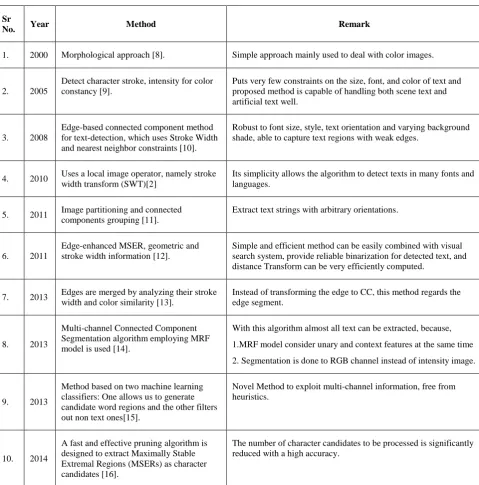
According to the features utilized, text localization methods can be categorized into three types as shown in figure 2: region-based and texture-based[4] and hybrid. Some of the published work on text localization method is presented in table 2.
Figure 2: Classification of Text Localization Method
3.2.1
Region based Text Localization
In this method pixels exhibiting certain properties are grouped together. It uses the properties of colors, edges or intensity similarity. This approach is attractive it can simultaneously detect text at any scale and is not limited to horizontal texts. This method can be further divided into two sub-approaches: edge-based and connected component (CC)-based.
3.2.1.1 Edge-based Methods:
It uses the information of edge to detect text in natural scene and video frames. It identifies the edges of the text boundary and merged them together, then apply several heuristics to alter out the non-text regions. Among the several textual properties edge based method focus on „high contrast between the background and text. Usually, an edge filter (e.g., a Canny edge detector) is used for the edge detection, and then perform a smoothing operation or a morphological technique which are intensive to skew, noise, text orientation.3.2.1.2 Connected Component (CC) based method:
It uses bottom up approach in which grouping of smaller components are done into larger components until all regions are identified in the image. It attempt to use similarity criterions of text, such as edge, color, stroke width, size and gradient information, which gather pixels together and form a connected components and filtered out non-texts CCs with geometric hypothesis or conditional random fields (CRFs).
[image:2.595.317.544.245.384.2]Table 1: Literature survey on region based scene text localization method
Sr
No. Year Method Remark
1. 2000 Morphological approach [8]. Simple approach mainly used to deal with color images.
2. 2005
Detect character stroke, intensity for color constancy [9].
Puts very few constraints on the size, font, and color of text and proposed method is capable of handling both scene text and artificial text well.
3. 2008
Edge-based connected component method for text-detection, which uses Stroke Width and nearest neighbor constraints [10].
Robust to font size, style, text orientation and varying background shade, able to capture text regions with weak edges.
4. 2010 Uses a local image operator, namely stroke width transform (SWT)[2]
Its simplicity allows the algorithm to detect texts in many fonts and languages.
5. 2011 Image partitioning and connected components grouping [11].
Extract text strings with arbitrary orientations.
6. 2011
Edge-enhanced MSER, geometric and stroke width information [12].
Simple and efficient method can be easily combined with visual search system, provide reliable binarization for detected text, and distance Transform can be very efficiently computed.
7. 2013 Edges are merged by analyzing their stroke width and color similarity [13].
Instead of transforming the edge to CC, this method regards the edge segment.
8. 2013
Multi-channel Connected Component Segmentation algorithm employing MRF model is used [14].
With this algorithm almost all text can be extracted, because,
1.MRF model consider unary and context features at the same time
2. Segmentation is done to RGB channel instead of intensity image.
9. 2013
Method based on two machine learning classifiers: One allows us to generate candidate word regions and the other filters out non text ones[15].
Novel Method to exploit multi-channel information, free from heuristics.
10. 2014
A fast and effective pruning algorithm is designed to extract Maximally Stable Extremal Regions (MSERs) as character candidates [16].
The number of character candidates to be processed is significantly reduced with a high accuracy.
3.2.2
Texture based Method
Texture-based methods are based on the observation that text in images is different from background in textural characteristic. In these methods, the image is generally scanned in multi-scales using sliding window, and then texture analysis approaches, such as discrete cosine transform (DCT), Fourier transform, wavelet coefficients, spatial variance and Gabor filters [17] are used to obtain texture information. Then utilized this distinct textural properties of text regions to extract candidate sub-windows and the final outputs are formed by merging these sub-windows.
Angadi et al. [18] used DCT based high pass filter to remove and suppress the constant background. The texture feature matrix was computed on every 50x50 block of processed image. A newly defined discriminant function was used to classify text blocks. The detected text blocks were merged to obtain new text regions.
Wu et al. [19][20] segment an input input image using a multi-scale texture segmentation scheme. It uses a set of Gaussian derivative filters to extract texture features from local image regions. All image pixels are assigned to one of three classes (“text”, “nontext” and “complex background”),with the corresponding filter responses, then clustering and morphological operators are used to group text pixels into text regions This method is insensitive to image resolution.
The limitations of the methods in this category include big computational complexity (i) due to need of scanning the image at several scales. (ii) Problem with the integration of information from different scales and (iii) lack of precision due to the fact that only small texts exhibits the properties required by the algorithm. (iv) Algorithms in this category are typically unable to detect sufficiently slanted texts. There are always some „spurious‟ regions in outputs and they are very time consuming.
3.2.3 Hybrid Method
Hybrid approaches seek to introduce textural property of text regions into region-based approach. These approaches take advantages of both region-based approaches which can closely cover text regions and texture-based approaches which can estimate of the coarse text location in cluttered scenes. Nonetheless, they are time consuming. Lu et al. [23] a hybrid approach to localize scene texts by integrating region information into a robust CC-based method
4.
APPLICATIONS
There are numerous applications of a scene text information extraction system, including: vehicle license plate extraction [24], visual search system have been developed for applications such as product recognition [25][26],landmark recognition [27],aids for visually impaired people, translators for tourists, information retrieval systems in indoor and outdoor environments, automatic robot navigation, electricity meters reading, driver aided system, wearable or portable computer.
However it can be used as travel mate application i.e. translator for tourist, useful for native tourists and travelers who possess Android Smart phones [28][29]. This Application enables travelers and tourists, to understand the native country language, signboards, books pages, hotel menus and banners etc. and translate the same to their own country language. Recognized as well as translated text can be used to search for travel related queries like books, hotels, museums, places, restaurants, culture, etc.
In Indian market it was always a huge demand of such an Android application [30], which would enable a tourist sitting in a restaurant to capture an image, recognize and translate the menu written in one language to in his own country language to order his favorite dish without any need to know the language of menu.
5.
PERFORMANCE EVALUTION
METHOD
There are several performance evaluations methods to estimate the algorithm for text extraction. They are Precision, Recall and F-Score metrics to evaluate the performance of the algorithm [3]. Precision, Recall and F-Score rates are computed based on the number of correctly detected characters (CDC) in an image, in order to evaluate the efficiency and robustness of the algorithm. The performance metrics are as follows:
(i) False Positives (FP): False Positives / False alarms are those regions in the image which are actually not characters of a text, but have been detected by the algorithm as text.
(ii) False Negatives (FN): False Negatives / Misses are those regions in the image which are actually text characters, but have not been detected by the algorithm.
(iii) Precision rate: Precision rate (P) is defined as the ratio of correctly detected characters to the sum of correctly detected characters plus false positives.
(iv) Recall rate: Recall rate (R) is defined as the ratio of the correctly detected characters to sum of correctly detected characters plus false negatives.
(v) F-score: F-Score is the harmonic mean of recall and precision rates.
6.
DISCUSSIONS AND CONCLUSION
This paper discuss about number of method to localize text in natural scene image. All the method takes input as natural scene image having some text component. There are three types of such image-document image, caption text image and scene text image. This survey deal with the scene text image.
As it is not possible to define the exact stages in such system. Therefore, paper considers general purpose text information extraction (TIE) system, which consist of detection, localization, extraction, enhancement, and recognition of the text from a given image. However the performance of such system is greatly influenced by text localization sub stage. This paper provides a survey on each sub stage. For text localization module, all the existing method are classified into three subcategories. They are region based, texture based and hybrid. Region based are further subdivided into edge based and connected component based method. Each of these categories are surveyed in this paper. From the survey it is concluded that region based methods are widely used today and recommended by most of the researcher. However texture based method include big computational capacity due to scanning of image at several times. Numbers of applications are possible with the localization and extraction of text and such an application are widely used today in field of image processing and computer vision.
7.
REFERENCES
[1] H.K. Kim, “Efficient automatic text location method and content-based indexing and structuring of video database,” J. Visual Commun. Image Representation 7 (4),1996, pp.336–344.
[2] B. Epshtein, E. Ofek, and Y. Wexler. “Detecting text in natural scenes with stroke width transform,” CVPR 2010, pp. 2963-2970.
[3] C.P. Sumathi,T. Santhanam and G. Gayathri Devi “A survey on various approaches of text extraction in images,” International journal of computer science & Enginnering Survey, Vol.3,No.4,August 2012.
[4] K. Jung, “Text information extraction in images and video: A survey,” Pattern Recognition., vol. 37, no. 5,May 2004, pp. 977–997.
[5] Y.K. Lim, S.H. Choi, S.W. Lee, “Text extraction in MPEG compressed video for content-based indexing,” Proceedings of International Conference on Pattern Recognition, 2000, pp. 409–412.
[6] Y. Zhong, H. Zhang, A.K. Jain, “Automatic caption localization in compressed video,” IEEE Trans. Pattern Anal. Mach. Intell. 22 (4),2000, pp. 385–392.
[8] Y.M.Y. Hasan, L.J. Karam, “Morphological text extraction from images,” IEEE Trans. Image Process. 9 (11),2000, pp.1978–1983.
[9] K. Subramanian, P. Natarajan, M. Decerbo, D. Castañòn, "Character-Stroke Detection for Text-Localization and Extraction," International Conference on Document Analysis and Recognition (ICDAR), 2005.
[10]A. Srivastav , J. Kumar, “Text detection in scene images using stroke width and nearest-neighbor constraints,” in TENCON 2008 - IEEE Region 10 Conference,2000, pp.1–5.
[11]C. Yi and Y. Tian, “Text string detection from natural scenes by structure-based partition and grouping,” IEEE Trans. ImageProcess., vol. 20, no. 9, Sep 2011,pp. 2594– 2605.
[12]H. Chen, S. Tsai, G. Schroth, D. Chen, R. Grzeszczuk, and B. Girod, “Robust text detection in natural images with edge-enhanced maximally stable extremal regions,” in Proc. IEEE Int. Conf. Image Process., Sep 2011 pp. 2609–2612.
[13]Quan Meng, Yonghong Song, Yuanlin Zhang, Yang Liu “Text Detection in natural scene with edge analysis” IEEE 2013.
[14]Xiaobing Wang, Yonghong Song, Yuanlin Zhang: “Natural Scene Text Detection with Multi-channel Connectet Componen Segmentation”.ICDAR 2013: 1375-1379.
[15]H. Koo and D.H, Kim, “Scene Text Detection via Connected Component Clustering and Nontext Filtering”, IEEE transaction on Image processing, VOL. 22, NO. 6, JUNE 2013.
[16]Xu-Cheng Yin, Xuwang Yin, Kaizhu Huang, and Hong-Wei Hao “Robust Text Detection in Natural Scene Images” IEEE TRANSACTIONS on Pattern Analysis and Machine Intelligence,VOL. 36, NO. 5, MAY 2014.
[17]K. Jung, “Neural network-based text location in color images, Pattern Recognition,” Lett. 22 (14), 2001, pp. 1503–1515.
[18]S. A. Angadi , M. M. Kodabagi(2009) , ”A Texture Based Methodology For Text Region Extraction From Low Resolution Natural Scene Images,“ International Journal Of Image Processing (Ijip),Volume(3), Issue(5).
[19]V. Wu, R. Manmatha, E.M. Riseman, “TextFinder: an automatic system to detect and recognize text in images”, IEEE Trans. Pattern Anal. Mach. Intell. 21 (11), 1999,pp.-1224–1229.
[20]V. Wu, R. Manmatha, E.R. Riseman, “Finding text in images”, Proceedings of ACM International Conference on Digital Libraries, Philadelphia, 1997, pp. 1–10.
[21]H. Li, D. Doerman, O. Kia, “Automatic text detection and tracking in digital video”, IEEE Trans. Image Process. 9 (1),2000,pp. 147–156.
[22]W. Mao, F. Chung, K. Lanm, W. Siu, “Hybrid Chinese/English text detection in images and video frames”, Proceedings of International Conference on Pattern Recognition, Vol. 3,Quebec, Canada,2000, pp. 1015–1018.
[23]Y.-F. Pan, X. Hou, and C.-L. Liu, “A hybrid approach to detect and localize texts in natural scene images,” IEEE Trans. Image Process., Mar. 2011, vol. 20, no. 3.
[24]Kim S, Kim D, Ryu Y, Kim G ” A robust license plate extraction method under complex image conditions”. In Proc. ICPR 2002, pp 216–219.
[25]S. S. Tsai, D. Chen, V. Chandrasekhar, G. Takacs, N. M. Cheung, R. Vedantham, R. Grzeszczuk, and B. Girod, “Mobile product recognition,” in Proc. ACM Multimedia 2010, 2010.
[26]D. Chen, S. S. Tsai, C. H. Hsu, K. Kim, J. P. Singh, and B. Girod, “Building book inventories using smartphones,” in Proc. ACM Multimedia, 2010.
[27]G. Takacs, Y. Xiong, R. Grzeszczuk, V. Chandrasekhar, W. Chen, L. Pulli, N. Gelfand, T. Bismpigiannis, and B. Girod, “Outdoors augmented reality on mobile phone using loxel-based visual feature organization,” in Proc. ACM Multimedia Information Retrieval, pp. 427– 434,2008.
[28]Derek Ma, Qiuhau Lin, Tong Zhang ―”Mobile Camera Based Text Detection and Translation‖ “Stanford University ,Nov 2000.
[29]NitinMishra,CPatvardhan,”ATMA: Android Travel Mate” Application‖, International Journal of Computer Applications (0975 –8887) vol 50 – No.16, July 2012.