2017 3rd International Conference on Electronic Information Technology and Intellectualization (ICEITI 2017) ISBN: 978-1-60595-512-4
Application of the Improved Artificial
Potential Field Method in Obstacle
Avoidance of Robot
Chaochao Zhang, Jiandong Fang and Bajin Li
ABSTRACT
Aiming at the problem that the artificial potential field method is easy to fall into the local minimum and the target unreachable in the process of obstacle avoidance of robot path planning, a fixed path artificial potential field method is proposed. The algorithm first improves the repulsive field function on the basis of the artificial potential field method and then presents a new method of path planning. When the robot moves to a certain range near the obstacle, let it take the obstacle as the center of the robot to the obstacle distance for the radius to do circular motion. After moving the 1/2 circle, let the robot move in the direction of resultant force. In the simulation experiment, the algorithm can effectively avoid the problem of local minimum and improve the efficiency of the algorithm while solving the problem of unreachable target.
INTRODUCTION
With the development of science and technology, the field of intelligent robots has become a hot research field. More and more scholars have been engaged in the research of intelligent robots. Along with the intelligent mobile robot is the path planning problem, how can the intelligent mobile robot motion planning an optimal ________________________
Chaochao Zhang, Electric Engineering College, Inner Mongolia University of Technology, Hohhot 010080, P.R. China
path and become a focus of research. There are many kinds of path planning algorithms, which can be divided into four categories according to the order of development: traditional path planning algorithm, graphics algorithm, intelligent bionics algorithm and other algorithms [1-4]. The traditional algorithm is divided into: artificial potential field method[5-7], simulated annealing algorithm[8], fuzzy algorithm[9]. This study takes the artificial potential field method as the research object to carry on the thorough research. Artificial potential field method has the advantages of good real-time, simple calculation and so on, but at the same time there are local minimum and target unreachable problems, Aiming at the existing problems of artificial potential field method, a method of path determination is proposed, The fixed path method modifies the repulsive force function of the artificial potential field, and specifies the path at the same distance within the influence area of the obstacle, The mobile robot is moved on the path of planning, thus avoiding the problem of local minimum points, and also improving the efficiency and running time of the algorithm.
TRADITIONAL ARTIFICIAL POTENTIAL FIELD METHOD
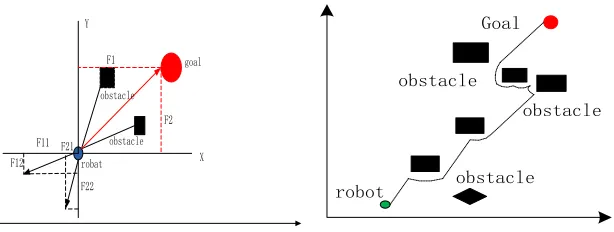
Artificial potential field method was put forward by Khatib in 1986. The basic principle of artificial potential field method is an artificially constructed force field[10-11]. When the mobile robot moves in the path, it is subjected to different forces between the target point and the obstacle respectively. Because the mobile robot in the course of movement is to avoid obstacles to reach the target point, so the target point of force as attractive; this allows the robot to be infinitely close to the target point, In order to avoid obstacles, the force of the robot is set as repulsive force to avoid collisions between the robot and the obstacle. When the algorithm begins, the robot is subjected to the repulsive force and the gravitational force, and the direction of the two is the direction of the movement of the robot, so as to achieve the autonomous path of the robot. The robot force diagram as shown in Figure 1.
The artificial potential method is to calculate the relationship between the mobile robot, the obstacle and the target point as a point, and simplify the position of the mobile robot into a coordinate point X = (x, y), to get the target point of gravitational potential function for robot as shown in formula (1):
21 2
att goal
U K X X (1)
Where k is the position gain coefficient, XXgoal is the relative distance
F U K X X
att att goal
(2)
When X Xgoal
, The attraction of the target point to the robot is zero. The repulsive potential field function of obstacle(3):
2
0 0
0
1
1
1
,
2
0 ,
repU
(3) is Position gain coefficient, is the shortest distance between the robot and
the obstacles in the space. ρ0 is a constant that represents the influence distance of the obstacle, the negative gradient of the potential field function of the obstacle. As shown in the formula (4):
0 2
0
0
1 1 1
,
0,
rep rep
F U x
(4)
x x x
The resultant force of the robot is the direction of motion of the
robot is determined by the resultant force direction.
[image:3.612.142.449.469.585.2]F11 F12 goal obstacle robat X Y obstacle F21 F22 F1 F2 Goal obstacle obstacle obstacle robot
Figure 1. The robot force diagram. Figure 2. Robot motion diagram.
IMPROVED REPULSIVE FORCE FIELD FUNCTION
action of the resultant force, the local minimum point may occur, When the target point of the robot is within the influence range of the obstacle repulsion, By calculating the gravitational and repulsive formulas of the artificial potential field, we can see that the closer the target is, the smaller the gravitational force is, and the closer the obstacle is, the greater the repulsion, In this calculation method, the robot is never reach the target point, which is the so-called local minimal point problem, Therefore, a new repulsive function is proposed to improve the local minimum point problem, The new repulsive function must take into account the distance between the target point and the obstacle, Because when the target point in the range of obstacles, with the rapid movement of the robot will be more and more repulsion, The robot is moving toward the smallest point of force, and the point at this point is that the smallest point of the force is not the target, which causes the robot to stop removing of reaching the target, In order to change this situation, the new repulsive force function must make the robot approach the target point, and the repulsive force of the obstacle will be reduced, so that the problem of local minimum can be avoided effectively, as shown in the formula (5):
2
1 1 1
2 * ,
0 0
0, 0
n
U X X
nrep goal
(5)Where n is an arbitrary real number greater than zero. The repulsive field function is compared with the function of the potential field. The relative distance between the robot and the target is added to ensure that the whole potential field is
only Xgoal at the target point. New repulsive force: as shown in the formula (6) and
(7):
1 2
0
1 1 1 n
goal
F X X
(6)
2 1 2 0 1 1 2 n goal nF X X
(7)
The direction of F1 is from the obstacle to the robot, the direction of F2 is from
the robot to the target.
Next, then we analyze the effect of the potential force on the movement of the robot when the robot approaches the target point when n takes different values.
repulsion force of the obstacle to the robot tends to F1 0; The point of attraction of the robot to the F2 tends to infinity. This will ensure that the robot successfully reach the target point, complete the path planning.
When n=1, X Xgoal tends to 0, When the robot reaches the target point, the
repulsion force of the obstacle to the robot tends to F1 0, and F2 is a constant, the robot tends to the target point.
When n>1, XXgoal
tends to 0, the F1 tends to 0, while the F2 is greater than 0, the robot tends to the target point.
SETTING PATH METHOD
The path method is based on the assumption that the robot, the obstacle, and the target point are assumed to be a point, and then the relationship between the three is calculated. The path is set by calculating the distance between the robot and the obstacle. When the robot starts walking, first check whether there are obstacles around it; if not, move on, and if so, calculate its distance from all obstacles, then compare the minimum distance with the set steering distance. If the calculated distance is greater than the set shift distance, the robot will follow the resultant direction of the potential field. If the calculated distance is less than the distance set to turn, then the manpower to set the force to 0. Let the robot in the absence of external forces to the nearest obstacle n distance for the radius, take the coordinate point of the obstacle n as the center of the circle and start the circular motion of 1/2. While doing 1/2 arc motion, it also detects whether the distance from other obstacles to obstacle m is smaller than that to obstacle n. If there is, it takes the coordinates of the obstacle m as the center of the circle, and the distance from the obstacle m as the radius continues to do the 1/2 arc motion, If there is no distance from the smaller obstacles, then done 1/2 circular motion, and then let it in accordance with the direction of force movement, And so on until avoid obstacles and reach the target point.
EXPERIMENT RESULT AND SIMULATION
In this paper, the traditional potential force function is modified on the basis of the artificial potential field method, and the motion path is defined, and the combination of the two is used to avoid the problem of local minimum point. The specific implementation process is: the gravitational gain coefficient is 15, the repulsive gain coefficient is 5, obstacle repulsion has a radius of 1.5. The number of obstacles is 13, the iteration step is 0.1, the number of iterations is 170 steps; the above parameters are combined with the experimental requirements of their own settings. The specific implementation process is: first set the target point coordinates, and then calculate the direction of force angle, calculate the gravitational force and repulsion to find its resultant force, and finally determine the resultant force and X axis angle. By changing the angle to complete the movement process, post-operation and simulation to achieve. Simulation experiment using MATLAB2014 experimental platform: firstly, the path planning simulation is carried out by using the traditional artificial potential field method, and then the path simulation is carried out by the improved artificial potential field method, and the simulation is compared. The improved artificial potential field method is shown in Figure 3, the traditional artificial potential method is shown in Figure 4.
Figure 3. Improved algorithm graph. Figure 4. Artificial potential field method.
CONCLUSION
In this paper, we modify the repulsive potential field function of the traditional artificial potential field method, and combine with the introduction of the set path, theoretically and experimentally prove that this algorithm can effectively solve the problem of local minimum. Post-robot movement to lay a good foundation. The experimental results show that the proposed method is feasible.
ACKNOWLEDGMENTS
This work is supported by Natural Science Foundation of Inner Mongolia Autonomous Region (No. 2014MS0619), and Inner Mongolia Science and Technology Project (No. 20120304). Its research findings that application system of intelligent decision making technology, by industry innovation talents team of Inner Mongolia Autonomous Region.
REFERENCES
1. A H Zhang, X Y Guo, Q J Chen. Analysis and research of dynamic programming algorithm[J]. Software Guide, 2014, 13(12):68-69.
2. F X Chen, Z W Zhou, J B Zhang. Improved algorithm of vector data compression based on dynamic programming algorithm[J]. Computer application, 2008,(01):168-170.
3. X Fang, D Z Zheng. A Dynamic Programming Algorithm for Mobile Robot Autonomous Route Seeking Obstacle Avoidance[J]. Journal of Agricultural Mechanization, 2015, 45(07):73-78. 4. Abdallah Jarray, Ahmad Nahar Quttoum, Hadi Otrok, Zbignie Dziong. DDP: A Dynamic
Dimensioning and Partitioning model of Virtual Private Networks resources[J]. Computer Communications. 2012 (8):1-2.
5. G L Yang. Research on High Performance Network Simulation Method Based on Topological Abstraction[D]. Jiangnan University, 2014.
6. X Q Deng. Path Planning of Mobile Robot Based on Improved Artificial Potential Field Method[J]. Journal of Shandong University of Technology (Natural Science Edition), 2014, 28(01):38-41. 7. J R Ding, C P Du, Y Zhao. UAV Path Planning Algorithm Based on Improved Artificial Potential
Field Method[J]. Computer Application, 2016, 36(01):287-290.
8. L J Chang, Z P Su, D H Hu. An Audio Watermarking Scheme Based on Heuristic Search[J]. Journal of Applied Science, 2016, 34(04):441-450.
9. W X Wang. Research on Path Planning Based on Dynamic Triangular Mesh and Heuristic Search Algorithm[J]. Modern electronic technology, 2017,40(11):103-106.
10. Y L Wu, Q He. A WSN Path Optimization Algorithm Based on Improved Genetic Simulated Annealing Algorithm[J]. Computer Application Research, 2016, 33(10):2959-2962.