2016 International Conference on Electronic Information Technology and Intellectualization (ICEITI 2016) ISBN: 978-1-60595-364-9
Trust Model for P2P Networks
Yi Ma, Dongqi Wang and Dongming Chen
ABSTRACT
The characteristics of P2P networks which are open, anonymous, and loosely coupled inter-node lead to false resources, malicious evaluation, and syndicates. A related cluster based trust model for P2P networks named RTrust is presented in this paper. Peers gather in clusters according to their interest similarity and communication history. In RTrust, measure of transaction success rate, communications similarity, honesty and timeliness of evaluation are used as parameters to evaluate the credit of peers. Simulative analysis shows that RTrust model has robustness against malicious attacks and provides a higher rate of successful transaction.
INTRODUCTION
There are many ways to disrupt P2P networks for malicious nodes [1-7]. For example, malicious nodes provide false information to normal nodes so that they can't access to the right resources, worms and other malicious code can be hidden in the resource, false evaluation by teamwork can damage the interests of the normal node, too. In order to maintain the safety and health of the P2P networks, an accurate trust evaluation mechanisms need to be established and as the constraints of communication between nodes. In order to solve the problems of trust evaluation of nodes, many scholars have made a lot of research, and trust models are proposed. In global trust models, such as Page rank[8], each node has a global trust value, and according to it, node selects the correspondents. In the global trust models, different nodes have the same trust value with the same target
_________________________
nodes. Without considering the fact that different nodes for the understanding of the same node may not be the same, global trust models can’t distinguish the understanding of the same node between other nodes.
This paper proposes a novel related cluster based trust model for P2P networks named RTrust. In RTrust, nodes gather in cluster according to their characters of interest and the similarity of the communication history.
RTRUST MODEL DEFINITION
Local Trust and Global Trust
Local trust degree Tij is the direct trust degree of node i to node j, the value ranges from -1 to 1.
ij ij ij
T TS TF (1)
T-list is a list used to storage the local trust degree between nodes.
T-list(i) is a set of local trust degree which is stored in node i, it contains all the local trust degree of nodes which node i has communicated with.
( ) { , ,ij ij | i}
Tlist i j S F j I (2)
Node I can obtain all nodes it has communicated with and the evaluation of these nodes by accessing T-list(i).Ti is the global trust degree of node i which node i has communicated with, its value ranges from -1 to 1.
, 0
0, 0
i
mi m I
i i
i i
T
T I
I I
(3)
Calculation of Correlation Between Nodes
The local trust degree Tijin dictates the local trust of node i to node j, and this trust degree is calculated according to the communication history between node i and node j. Two-dimensional matrixS n( n)indicates the correlation between
nodes of the P2P networks with n nodes. The correlation between nodes can be calculated according the matrixS n( n). In this paper, Pearson Product-Moment
The outside correlation r (i,j) of node i and node j can be calculated according to PMCC as follow.
2 2 ( )( ) ( , ) ( ) ( ) ij ij ij
im ix jm jx m I
im ix jm jx m I m I
T T T T
r i j
T T T T
(4)The inside correlation rc (i,j) of node i and node j can be calculated according to PMCC as follow, too.
2 2
( )( )
( , )
( ) ( )
C iji
C iji C iji
im ix jm jx m I
im ix jm jx m I m I
T T T T
rc i j
T T T T
(5)Trust Degree Feedback Calculation Method
Reij is the feedback result from node i to node j, it indicates the dynamic trust feedback from i to j.
*
ij j j
Re T Re (6)
j
Re
is the feedback factor of node j, it dynamically update with number of transactions' increasing.
0.5, 0
1 * (1 )(1 ), 0, 1
* ( 1)(1 ), 0, 1
k
k k k
Re Re Re k
j j j
k k
Re Re k
j j (7) ( ) ( ) jm m m I j
T T I j
(8)* ( , ) (1 )
ij ij ij
RCT T rc i j Re (9)
If node i and node j are in different clusters, then RCTij means the outside trust degree and it can be calculated as follow.
* ( , ) (1 )
ij ij ij
RCT T r i j Re (10)
means the ratios of correlation trust degree and trust degree feedback, it
ranges from 0 to 1.
PERFORMANCE
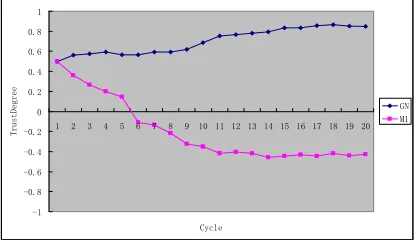
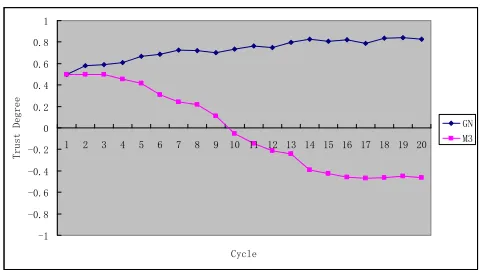
A simulation system was designed to test the anti-attack capability and transaction success rate of RTrustin different contexts. According to the trading behavior of nodes in networks, nodes are divided into 4 types as follow. Normal nodes GN. Normal nodes provide authentic resources, and the description of resource is the same as content of resource. Normal nodes provide an objective evaluation according to the transaction, that is, a positive evaluation will be provided to the successful transaction target, and a negative evaluation will be provided to the false transaction target. Falseresource providing nodes M1. M1 provides false resource, and the description of resource is different from the content of resource, so the other nodes can't get correct resources from M1. Maliciousevaluation nodes M2. Maliciousevaluation nodes M2 provide a false negative evaluation to the normal nodes. Maliciousnodes group M3. Maliciousnodes group M3 provide false resources to normal nodes.
False Resource Providing Nodes M1
Figure 1.
Malicious Evaluation Nodes M2
Figure 2. Trust degree comparison between GN and M2.
In this experiment we test the ability of identifying malicious nodes M2 which provide false evaluation in RTrust. As shown in Figure 2, statistics show that the trust degree of M2 continuously decreases. M2 nodes provide false and negative evaluation to GN nodes, which is obviously contrary to the evaluation of other
GN nodes, so the trust degree feedback Rej gets a negative growth, and the trust
degree of M2 decreases and finally become negative. The trust degree of M2 stays in a stable negative level because less GN nodes initiate transaction with M2.
Malicious Nodes Group M3
As shown inFigure4, statistics show that trust degree of M3 nodes decreases slowly at the beginning, while the transaction cycle is increasing, and trust degree of M3 is decreasing a lot and then reaches a stable negative level. With a negative
-1 -0.8 -0.6 -0.4 -0.2 0 0.2 0.4 0.6 0.8 1
1 2 3 4 5 6 7 8 9 10 11 12 13 14 15 16 17 18 19 20
Cycle
TrustD
egree GN
M1
-1 -0.8 -0.6 -0.4 -0.2 0 0.2 0.4 0.6 0.8 1
1 2 3 4 5 6 7 8 9 10 11 12 13 14 15 16 17 18 19 20
Cycle
Tru
stD
eg
ree
[image:5.612.194.402.311.431.2]trust degree, M3 nodes have little chance of transaction with normal nodes, so the correlation between M3 and GN nodes is decreasing, too.
Figure 3. Trust degree comparison between GN and M3.
CONCLUSION
A novel related cluster based trust model for P2P networks named RTrust was proposed in this paper. In RTrust model, nodes are classified by the similarity of communication history and their correlation is considered in trust degree calculation, trust degree feedback is used to reward the objective evaluation and punish the false evaluation. Experiment result shows that by using this method, malicious nodes will be distinguished from normal nodes, and the transaction success rate is improved.
ACKNOWLEDGEMENTS
This work is supported by the Education Department of Liaoning Foundation of China (No. L2014097).
REFERENCES
1. Jung, Hyun Mi, “A security monitoring method for malicious P2P event detection”, Peer-to-Peer Networking and Applications, June 12, 2015.
2. Ruehrup Stefan, Urbano Pierfrancesco, Berger Andreas, “Botnet detection revisited: Theory and practice of finding malicious P2P networks via Internet connection graphs”, IEEE INFOCOM, pp. 3393-3398, 2013.
3. Yang Hwan-Seok, Sun Jae-Hoon, “A study on hybrid trust evaluation model for identifying malicious behavior in mobile P2P”, Peer-to-Peer Networking and Applications, September 17, 2015.
4. Zhang Feng Li, Bai Yang, Hou Jie, Tan Yuan Wei, “Detecting malicious users in P2P streaming systems by using feedback correlations”, Lecture Notes in Electrical Engineering,
-1 -0.8 -0.6 -0.4 -0.2 0 0.2 0.4 0.6 0.8 1
1 2 3 4 5 6 7 8 9 10 11 12 13 14 15 16 17 18 19 20
Cycle
Trus
t Deg
ree
5. An Do Sik, Jeonju, Ha Byong Lae, Cho Gi Hwan, “A robust trust management scheme against the malicious nodes in distributed P2P network”, International Journal of Security and its Applications, vol. 7, pp. 317-326, 2013.
6. Chen Zhigang, Li Limiao, Gui Jingsong, Deng Xiaoheng, Yuan Lei, “KFTrust: P2P trust model based on evaluation rank using Kalman filter”, International Journal of Autonomous and Adaptive Communications Systems, vol. 8, pp. 268-287, 2015.
7. Xin Liu, Zhaojun Xin, Leyi Shi, “Automatic patching based on social computing in P2P network”, 4th International Conference on Emerging Intelligent Data and Web Technologies, pp. 471-478, 2013.
8. W. Dou, H.M. Wang and Y. Jia. “A recommendation-based peer-to-peer trust model”,