(will be inserted by the editor)
Understanding the Behaviour of Hackers while Performing
Attack Tasks in a Professional Setting and in a Public
Challenge
Mariano Ceccato, Paolo Tonella, Cataldo Basile, Paolo Falcarin, Marco Torchiano, Bart Coppens, Bjorn De Sutter
the date of receipt and acceptance should be inserted later
Abstract When critical assets or functionalities are included in a piece of software accessible to the end users, code protections are used to hinder or delay the extraction or manipulation of such critical assets. The process and strategy followed by hackers to understand and tamper with protected software might differ from program understand-ing for benign purposes. Knowledge of the actual hacker behaviours while performunderstand-ing real attack tasks can inform better ways to protect the software and can provide more realistic assumptions to the developers, evaluators, and users of software protections.
Within Aspire, a software protection research project funded by the EU under framework programme FP7, we have conducted three industrial case studies with the involvement of professional penetration testers and a public challenge consisting of eight attack tasks with open participation. We have applied a systematic qualitative analysis methodology to the hackers’ reports relative to the industrial case studies and the public challenge.
The qualitative analysis resulted in 459 and 265 annotations added respectively to the industrial and to the public challenge reports. Based on these annotations we built a taxonomy consisting of 169 concepts. They address the hacker activities related to
Mariano Ceccato, Paolo Tonella Fondazione Bruno Kessler, Trento, Italy E-mail: ceccato|[email protected]
Cataldo Basile, Marco Torchiano Politecnico di Torino, Italy
E-mail: cataldo.basile|[email protected] Bart Coppens, Bjorn De Sutter
Universiteit Gent, Belgium
E-mail: bart.coppens|[email protected] Paolo Falcarin
(i) understanding code; (ii) defining the attack strategy; (iii) selecting and customizing the tools; and (iv) defeating the protections.
While there are many commonalities between professional hackers and practition-ers, we could spot many fundamental differences. For instance, while industrial profes-sional hackers aim at elaborating automated and reproducible deterministic attacks, practitioners prefer to minimize the effort and try many different manual tasks.
This analysis allowed us to distill a number of new research directions and potential improvements for protection techniques. In particular, considering the critical role of analysis tools, protection techniques should explicitly attack them, by exploiting anal-ysis problems and complexity aspects that available automated techniques are bad at addressing.
1 Introduction
Software running on the client side is increasingly security-critical. Mobile apps are more and more used for sensitive functionalities (e.g., bank account management) and a similar trend can be observed for web apps, due to recent frameworks (e.g., Angular) that move most of the processing to a single page residing in the browser. Among others, the sensitive operations that may run on the client side include authentication, license management, and Intellectual Property Rights (IPR) enforcement.
As a consequence, client apps (and the underlying libraries) contain critical assets that must be secured. The state of the art approach to secure them is software pro-tection. However, software protection is intrinsically a difficult task and the techniques available in practice cannot defeat an attacker with an arbitrarily high amount of time and resources available (e.g., theoretical results [5] show that perfect obfuscation is im-possible in the general case). Hence, the assessment of software protections must take into account an economical trade off between the attack difficulties that protections introduce and the expected remuneration for a successful attack. Effective protections are protections that make such a trade-off not convenient for the attacker.
The EC funded Aspire project (https://aspire-fp7.eu) has developed a software protection tool chain that spans many different categories of techniques, including white box cryptography, diversified cryptographic libraries, data obfuscation, non-standard virtual machines, client-server code splitting, anti-callback stack checks, code guards, binary code obfuscation, code mobility, anti-debugging, and remote attestation1. The authors of this paper are the academic project partners and their task was to investi-gate, develop, and validate novel protection techniques.
The empirical investigation consisted of two experiments. In the first experiment, the three industrial partners of Aspire applied the protection tool chain to their re-spective industrial case studies and evaluated its effectiveness with the help of profes-sional penetration testers. The outcome of this experiment consisted of three reports,
Note on order of authors: The last five authors (in alphabetic order) participated to open coding, conceptualization and paper writing. So did the two first authors, which also designed the qualitative analysis and led the execution thereof. They also led the professional hacking experiment design and process. The last two authors also led the design and execution of the Public Challenge experiment.
1 The glossary in Appendix A presents brief descriptions of these techniques and of concepts
including detailed narrative information about the tasks conducted in the attempt to defeat the Aspire protections. The reports describe the activities carried out during the attacks, the encountered obstacles, the followed strategies, and the difficulty of per-forming each task. They represent a unique opportunity to investigate the behaviour of real-world expert hackers while carrying out an attack.
The second experiment was a Public Challenge. It consisted of eight small applica-tions that were protected by the Aspire tool chain and were published on-line, offering one prize per application to the first attacker able to successfully complete a given attack task. Five applications were successfully broken, as it happened by the same amateur hacker. That winner was interviewed over email to collect, in several itera-tions, detailed information about his attack activities, encountered obstacles, followed strategies, and attack difficulty. The responses in the emails were bundled into a single report concerning general information about the hacker, his general impressions about the challenges, and accounts on the five broken applications, which was then further analysed.
The reports collected in the two experiments include invaluable knowledge on the way hackers understand protected software. We applied a systematic qualitative anal-ysis procedure to the reports. In particular, data from the first experiment with indus-trial hackers were analysed using open coding, conceptualization, and model inference. Instead, data from the second experiment (i.e. the Public Challenge) were analysed with closed coding, conceptualization, and model inference, to extend the taxonomy of concepts related to hackers activities, available after the first experiment.
The overall results of these experiments are a taxonomy of concepts and models of the hacker behaviour that can be used by protection developers as a qualitative support to validate the assumptions under which breakage of a protected asset is deemed eco-nomically disadvantageous. In fact, relevant factors that determine the attack strategies might be overlooked if an idealized hacker model that departs substantially from the reality is assumed. Our model of the hacker behaviour, which is grounded on obser-vations obtained from real attack tasks and supported by evidence collected in the field, provides a solid basis on the expected attacker behaviour to protection develop-ers. Moreover, our work identified a number of research directions and guidelines that could substantially improve the practice of software protection. We have consolidated such lessons learned in the form of a research agenda for software protection.
Despite the execution of multiple experiments in diversified contexts, we acknowl-edge that we did not achieve theoretical saturation. However, this does not undermine the validity of the presented approach, of our implementation, and of the current re-sults. It is anyway the case that theoretical saturation of attacker tasks has a limited temporal validity, because this subject, being an arms race, is a moving target. New stronger attacks are elaborated at a constant pace, and this motivates to conceive brand new protections, that are later subject to even more powerful attacks. Addi-tional experiments are needed to achieve a wider comprehension of this phenomenon and reach saturation regarding the current state of the art, and will be needed in the future to keep up with this evolving topic. The proposed methodology supports the inclusion of data from additional experiments, as this paper already demonstrates with the inclusion of the second experiment.
the preliminary results obtained in our qualitative study are expected to trigger future quantitative studies, with stronger external validity, which may confirm or refute our claims. One contribution of this paper is to set the key research questions, the key concepts and the reference models for such future studies.
This paper extends a conference paper that presented the first experiment with industrial case studies and its results [13]. This paper adds the second experiment, i.e., the public challenge. This extension is important for several reasons. First, it allows us to broaden the coverage of the resulting taxonomy and models to more attack scenarios: to a wider range of attackers, with different levels of expertise and different preferences in terms of attack approaches, to a wider range of assets and protected applications, and to more combinations of deployed protections. These extensions are important because defenders of software assets need to defend against all possible attack paths by all possible attackers at once. Secondly, it allows us studying the differences in behavior observed in the two experiments, and the extent to which the resulting taxonomy and models are impacted by including additional experiments. In addition to the extension towards more attack scenarios, we also extended the original taxonomy with the software elements that the hackers in both experiments considered in their activities. This extension is useful to let defenders focus on the concrete features their protections need to impact.
The paper is organized as follows. The qualitative analysis methodology used to annotate the hacker reports is described in Section 2. The extracted taxonomy and models are presented in Section 3. We discuss the research directions for the improve-ment of existing protections and for the developimprove-ment of new ones that emerged from our studies in Section 4. Section 5 is devoted to related work, while Section 6 concludes the paper and sketches our plans for future work.
2 Qualitative Analysis Method
We have collected qualitative data from two sources: (1) Professional Hackers; (2) Pub-lic Challenge Winner. Professional hackers were involved in the attempt to break the protections of three industrial applications, provided by the three industrial partners of Aspire. The Public Challenge consists of eight small programs protected by some combinations of Aspire protections. Those programs were made available on the chal-lenge website to registered users. For each program, the first hacker able to break it was granted a prize.
Industrial UC Data Anti Remote Code Client-Server Virtualization WBC Binary Diversified Obfusc Debug Attestation Mobility Splitting Obfusc Obfusc Crypto Libs
DemoPlayer × × × × ×
LicenseManager × × × × × ×
[image:5.595.69.422.89.126.2]OTP × × ×
Table 1: Protections applied to each industrial use case.
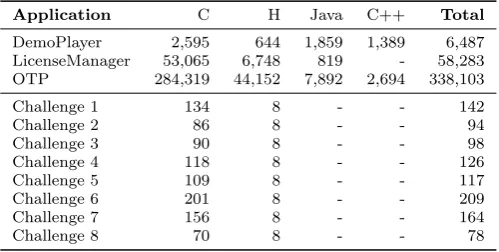
Application C H Java C++ Total
DemoPlayer 2,595 644 1,859 1,389 6,487 LicenseManager 53,065 6,748 819 - 58,283 OTP 284,319 44,152 7,892 2,694 338,103
Challenge 1 134 8 - - 142
Challenge 2 86 8 - - 94
Challenge 3 90 8 - - 98
Challenge 4 118 8 - - 126
Challenge 5 109 8 - - 117
Challenge 6 201 8 - - 209
Challenge 7 156 8 - - 164
Challenge 8 70 8 - - 78
Table 2: Size of industrial case study applications and the Public Challenges applica-tions in SLoC per file type, before the protection tool chain is applied.
hackers: those participating in the public challenge, who are typically non-professional hackers.
2.1 Data Collection from Professional Hackers
[image:5.595.119.369.165.291.2]debugging, tracing and profiling, etc. Moreover, these hackers are able to customize existing tools, to develop and add plug-ins to existing tools, as well as to develop new tools if needed. In our case, external hacker teams have been augmented/complemented with/by internal professional hacker teams, consisting of security analysts employed by the project’s industrial partners. The exact composition of the hacker teams, such as the name and the number of the hacker participants could not be disclosed for confidentiality reasons.
The task for the hacker teams consisted of obtaining access to some sensitive assets secured by the protections. Specifically, the task for the DemoPlayer application was to violate a specific DRM protection; for LicenseManager it was to forge a valid license key; for OTP it was to successfully generate valid one time passwords without valid credentials. For confidentiality reasons on the industrial use cases, programs could not be shared among different companies and each hacker team only attacked the program owned by the corresponding company.
The hacker team activities could not be traced automatically or through question-naires. In fact, such teams ask for minimal intrusion into the daily activities performed by their hackers and are only available to report their work in the form of a final, narra-tive report. For instance, it was not acceptable for security companies to video record industrial hackers while working, or to use screen capturing tools or other intrusive measures to have additional information to compare the results from the reports to.
As a consequence, we had no choice but to adopt a qualitative analysis method. Based on existing qualitative research techniques [17], we defined the qualitative anal-ysis method to be adopted in our study, consisting of the following phases: (1) data collection; (2) open coding; (3) conceptualization; (4) model analysis. Although some of the practices that we have adopted are in common with grounded theory (GT) [18, 37], the following key practices of GT [36] could not be applied: immediate and contin-uous data analysis, theoretical sampling, and theoretical saturation, because we had no option to continue data sampling based on gaps in the inferred theory.
Although the final hacker reports are in a free format, we wanted to make sure that some key information was included, in particular information that can provide clues about the ongoing program comprehension process. Hence, before the involved professional hackers started their task, we shared with them a report template where we have asked them to cover the following points in their final attack report:
1. type of activities carried out during the attack: detailed indications about the type of activities carried out to perform the attack and the proportion of time devoted to each activity.
2. level of expertise required for each activity: which of the successful actions required a lot of expertise, which could be done easily.
3. encountered obstacles: detailed description of the obstacles encountered during the attack attempts. In particular, hackers were asked to report any software protec-tion that they think was put into place to prevent the attack and that actually represented a major obstacle for their work.
4. decisions made, assumptions, and attack strategies: description of the attack strat-egy and how it was adjusted whenever it proved ineffective. Hackers were asked to describe the initial attempts and the decisions (if any) to change the strategy and to try alternative approaches.
in the real world (i.e., on a large scale, on software running on standard devices instead of on lab infrastructure, with other keys, etc.).
6. return / remuneration of the attack effort: quantification of the attack effort, if possible economically, so as to provide an estimate of the kind of remuneration that would justify the amount of work done to carry out the attack.
In particular, the second point refers to thelevelof expertise required by the task, e.g., running an existing attack tool does not require a major expertise, while interpret-ing complex tool output or customizinterpret-ing/extendinterpret-ing the tool requires substantial higher expertise.
Each industrial case study was available to hacker teams for a period of 30 days. During that period they worked full-time on it. At the end of this period, hacker teams delivered their reports. While, in general, attack reports covered the above points, not all of the points are necessarily covered in all attack reports or with the same level of details. In particular, quantitative data, such as the proportion of time devoted to each activity, were never provided, whereas qualitative indications about several of the suggested dimensions are present in all reports, though with different levels of verbosity and detail. The reports themselves cannot be made public because of confidentiality requirements. Only the academic Aspire project partners had access to all three reports.
2.2 Data Collection from Public Challenge Winner
The Public Challenge consisted of a set of eight small applications, written by Aspire project members and protected by eight distinct combinations of Aspire protections. Smaller applications were more appropriate for a public challenge, because we expected mostly practitioners to participate, rather than professional hackers.
The eight applications, hereafter called challenges, have been made available on-line to registered users who could download and attack them. Registration could be done anonymously, as only a valid email address had to be provided. The first three participants to break a challenge had their self-chosen user names listed next to that challenge on the challenge web site, together with the timestamp on which the correct solution was submitted. Furthermore, the first successful attacker of each challenge was rewarded with a monetary prize ofe200. To be eligible for this prize, a participant had to agree to participate (through e-mail) in a post-mortem forensic interview, in which she/he has been asked to describe how the challenge was attacked and broken, which tools were used, what the general attack strategy was, etc. Furthermore, she/he had to reveal her/his real identity to the organizers of the challenge to enable the pay out of the prize. By implementing the Public Challenge in this way, we again aimed for complementing the data collection of the industrial use cases. Whereas the industrial hackers are white-hat professionals, the targeted audience of this Public Challenge and its prize money was the amateur, hobby, and black-hat community. Also in this case, collecting data from multiple types of attackers helps towards building more generally applicable models.
The asset to be protected in all the applications is a random string of 64 characters in length, which we will refer to as thekey. Users received individualized versions of the application, with every generated binary containing a different key, and could request up to three different instances of every challenge. Each instance has a unique key, and the deployed protections are invoked with unique random seeds2where applicable, such that code looks different for each instance. As valid keys can contain both upper and lower case characters and numbers, the search space is large enough that attackers are not able to brute force the correct key. The command-line application checks its first argument against this key, and prints out whether or not the argument matches the key. Thus upon entering the correct key as input, it becomes clear if the attack was successful or not. In seven challenges, the answer appears immediately, in one challenge it appears after days only. The latter case was engineered to force attackers to tamper with the code, such that the anti-tampering protections could be evaluated. The attackers could then submit a combination of the identifier of the attacked binary and the key as a solution to the challenge.
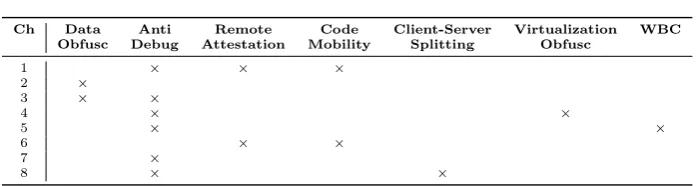
Table 3 provides an overview of deployed protections. Besides the indicated protec-tions, all challenges are protected with randomized control-flow obfuscations (opaque predicates, branch functions and function flattening), anti-callback stack checks, and offline code guards. Table 2 (bottom) shows the eight applications’ source code sizes. Whereas they are small in that respect, the protected binaries were much larger than these source sizes hint at, because those binaries contain protection functionality on top of the protected application code. The code sections in the binaries, from which attackers start their attack, range from approximately 12kb to 5MB. As all code in those sections is mingled by default by the Aspire protection tool chain, the attackers cannot single out the application code from the protection code easily.
Even though the asset is the same in all challenges (i.e., a key with the same function; obviously the key value differs from binary to binary), and the program I/O behaviour is the same in all challenges, we have decided to tailor the source code of each challenge to suit the protections that are applied in each of those challenges. We did so because different protection combinations can trigger different attack paths, and because different code features lend themselves to different forms of protections. Also in this way, we aim to broaden our data collection in order to yield more generally applicable models, in this case by ensuring that different attack paths are included in the data collection.
For each of the challenges summarized in Table 3, the source code characteristics and the challenge-specific protections are the following ones:
Ch 1: In this challenge, an array is constructed by a block of code that is protected with an anti-debugging protection that prevents an attacker from attaching his own debugger to study the internal operation of the program [1]. Next, code mobility [7] is used to protect the XORing of this array with mobile data (i.e., data that is not present in the static program binary, but is downloaded from a secure server at run time). Mobile code also contains the invocation to 2 The random seed was not meant to decide what protection to deploy or in what variant.
Ch Data Anti Remote Code Client-Server Virtualization WBC
Obfusc Debug Attestation Mobility Splitting Obfusc
1 × × ×
2 ×
3 × ×
4 × ×
5 × ×
6 × ×
7 ×
[image:9.595.71.420.82.175.2]8 × ×
Table 3: Protections applied to each challenge (Ch).
the strncmp C function that checks the validity of the key, this hiding that operation.
Ch 2: The key is split into 16 integers, each of which is encoded using Residue Number Coding (RNC) [15]. The input to the program is also split into 16 integers, and these integers are then compared with the RNC-encoded key.
Ch 3: This challenge uses RNC data obfuscation and anti-debugging.
Ch 4: The main function is protected by moving it into a virtual machine (VM): the main function body is translated into bytecode that is interpreted by the VM, instead of being executed directly.
Ch 5: The key is used as ciphertext for White Box Cryptography (WBC) with a fixed key [43]. This is then “decrypted” when a challenge instance is generated, and the decrypted key is stored in the challenge instance. Furthermore, the WBC code has been protected with anti-debugging.
Ch 6: The key is checked in two parts: the first half of the key is checked byte per byte. The code that checks the key performs a very long delay loop (two nested loops, both of which only finish after looping through 264 values) and a sleep of about 11 days after each character is checked. These delays are to encourage the attackers to try to modify the binary to remove or shorten the delay to verify the key, i.e., to tamper with the code, which is protected with Remote Attestation (RA) [30]. The next part of the binary is protected using mobile code, so that if the RA component detects tampering, the protection server can trigger a tamper response in the code mobility component.
Ch 7: This challenge starts from code that has “ugly” control flow at the source level. Then this code has binary control flow obfuscations applied, and is furthermore protected with anti-debugging.
Ch 8: The code is protected with client-server code splitting [12], where each character is sent individually to the server, and the client only asks for the correctness of the next key character if the previous one was correct.
The Public Challenge was advertised on the reverse engineering sub-reddit, on Twitter, in the institutions that partnered in the Aspire project, and in summer schools to which they participated.
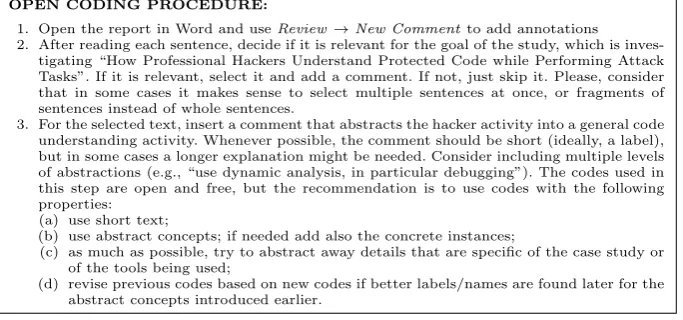
OPEN CODING PROCEDURE:
1. Open the report in Word and useReview→New Comment to add annotations 2. After reading each sentence, decide if it is relevant for the goal of the study, which is
inves-tigating “How Professional Hackers Understand Protected Code while Performing Attack Tasks”. If it is relevant, select it and add a comment. If not, just skip it. Please, consider that in some cases it makes sense to select multiple sentences at once, or fragments of sentences instead of whole sentences.
3. For the selected text, insert a comment that abstracts the hacker activity into a general code understanding activity. Whenever possible, the comment should be short (ideally, a label), but in some cases a longer explanation might be needed. Consider including multiple levels of abstractions (e.g., “use dynamic analysis, in particular debugging”). The codes used in this step are open and free, but the recommendation is to use codes with the following properties:
(a) use short text;
(b) use abstract concepts; if needed add also the concrete instances;
(c) as much as possible, try to abstract away details that are specific of the case study or of the tools being used;
[image:10.595.74.416.93.253.2](d) revise previous codes based on new codes if better labels/names are found later for the abstract concepts introduced earlier.
Fig. 1: Coding instructions shared among coders of the Professional Hackers report
attacks (“how did you find the keys?”, “which tools did you use?”, “how did you ap-proach the different challenges?”, “which difficulties (if any) did you experience and how did you tackle them?”), the interview proceeded with further requests of clarifica-tions and explanaclarifica-tions, based on the hacker’s replies. Examples of follow-up quesclarifica-tions are: “Could you estimate how much effort / time you spent per challenge?”, “How did you know it was WBC?”, “For the seventh and third challenges, apart from the checksums, did you experience any problems when attaching the debugger? If so, how did you circumvent them; if not, which debugger did you use and how did you attach to the program? (Did you notice that there were two processes running?)”, “How did you know where to put the breakpoints?”. The interview was closed when the associated report contained enough information to understand the attack strategy as well as the technical details behind the five successful attacks.
The interview also confirmed that the participant who solved the public challenges was indeed an experienced amateur hacker, with access to advanced, but publicly avail-able tools. This participant, thus, fitted the intended target of the Public Challenge. Considering that this profile differs from the professional hackers involved in the first experiment, we aim for a substantial extension of the initial taxonomy built just on industrial settings, by including data from two diverse settings.
2.3 Open Coding and Conceptualization (Professional Hacker Experiment)
Open coding was applied to the qualitative data collected from the Professional Hack-ers. Open coding of the reports was carried out by each academic institution participat-ing in the Aspire project. Codparticipat-ing by seven different coders was conducted autonomously and independently. Only high level instructions have been shared among coders before starting the coding activity, so as to leave maximum freedom to coders and to avoid the introduction of any bias during coding. These general instructions are reported in Figure 1.
an-notations because we wanted to preserve the viewpoint diversity associated with the involvement of multiple coders operating independently from each other. Unification is one of the main goals of the next phase, conceptualization.
Conceptualization was applied to the annotated data collected from the Profes-sional Hackers. This phase consists of a manual model inference process carried out jointly by all coders. The process involves two steps: (1) concept identification; (2) model inference.
The goal of concept identification is to identify key concepts that coders used in their annotations, to provide a unique label and meaning to such concepts and to organize them into a concept hierarchy. The most important relation identified in this step is the “is-a” relation between concepts, but other relations, such as aggregation or delegation, might emerge as well. In this step, the main focus is a static, structural view of the concepts that emerge from the annotations. The output is thus a so-called “lightweight” ontology (i.e., an ontology where the structure is modelled explicitly, while axioms and logical constraints are ignored).
The goal ofmodel inferenceis to obtain a model with explanation and predictive power. To this aim, the concepts obtained in the previous step are revised and the following relations between pairs of concepts are conjectured, based on considerations or observations formulated by the participants: (1) temporal relations (e.g., before); (2) causal relations (e.g., cause); (3) conditional relations (e.g., condition for); (4) instrumental relation (e.g., used to). Evidence is sought for such conjectures in the annotations. It should be noted that relations are not based on the exact words used in the reports. Concept relations are rather based on the meaning of participants comments, so that a consistent model is inferred even if different participants used different words to mean the same relation. The outcome of this step is a model that typically includes a causal graph view, where edges represent causal, conditional and instrumental relations, and/or a process view, where activities are organized temporally into a graph whose edges represent temporal precedence. This step is deemed concluded when the inferred model is rich enough to explain all the observations encoded in the annotations of the hacker reports, as well as to predict the expected hacker behaviour in a specific attack context, which depends on context factors such as the features of the protected application, the applied protections, the assets being protected, the expected obstacles to hacking.
Correspondingly, two joint meetings (over conference calls) have been organized to carry out the two steps. During each meeting, the report with the merged codes was read sentence by sentence and annotation by annotation. During such reading, abstractions have been proposed by coders either for concept identification (step 1) or for model inference (step 2). The proposed abstractions have been discussed; the discussion proceeded until consensus was reached. During the process, whenever new abstractions were proposed and discussed, the abstractions introduced earlier were possibly revised and aligned with the newly introduced abstractions.
un-CLOSED/OPEN CODING PROCEDURE:
1. Open the report in Word and useReview→New Comment to add annotations 2. After reading each sentence, decide if it is relevant for the goal of the experiment, which is
investigating “How Public Challenge Hackers Understand Protected Code while Performing Attack Tasks”. If it is relevant, select it and add a comment. If not, just skip it. Please, consider that in some cases it makes sense to select multiple sentences at once, or fragments of sentences instead of whole sentences.
3. For the selected text, insert a comment that contains one or more concepts taken from the attack taxonomy produced in the experiment with Professional Hackers. If no concept is applicable, propose one or more new concepts and suggest their position (parents) in the existing taxonomy.
Fig. 2: Coding instructions shared among coders of the Public Challenge report
derstand (and possibly revise/change) the connection between abstractions and initial annotations.
2.4 Taxonomy Extension (Public Challenge Experiment)
The taxonomy extracted from the experiment with Professional Hackers was reused to annotate the report collected from the Public Challenge. It has been extended with new concepts when the existing ones were insufficient for the annotation of the report. The closed/open coding procedure followed to annotate the Public Challenge report is described in Figure 2. Whenever a relevant text fragment could not be annotated by reusing an existing concept (closed coding), the annotator could recommend a new concept for the given text fragment (open coding).
The annotated reports obtained after individual closed/open coding were merged into a single report containing all collected annotations. Two consensus meetings have been carried out over conference calls to reach a consensus on a unified annotation of the Public Challenge report. During each consensus meeting, the report with the merged codes was read sentence by sentence and annotation by annotation. The proposed annotations with existing or new concepts have been discussed and the discussion proceeded until consensus was reached. During the process, whenever new concepts were approved, their position in the existing taxonomy was also discussed and decided as well as their relations with other concepts in the taxonomy.
3 Results
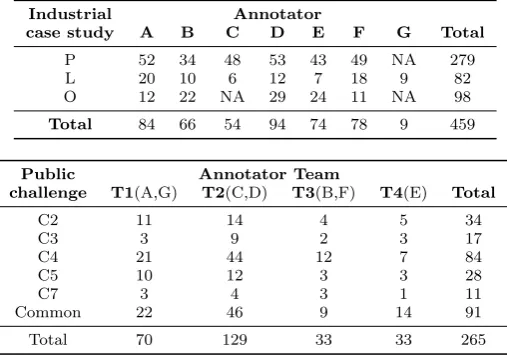
Table 4 shows the number of annotations produced for the Professional Hacker reports (top) and the Public Challenge winner report (bottom). The three case study reports (indicated as P: DemoPlayer; L: LicenseManager; O: OTP) produced by Professional Hackers have been annotated by seven annotators (indicated as A, B, C, D, E, F, G) from the academic partners of Aspire. Each annotation is labelled by a unique identifier having the following structure: [<case study>: <annotator>: <number>]
Table 4: Number of annotations by annotator and by case study report.
Industrial Annotator
case study A B C D E F G Total
P 52 34 48 53 43 49 NA 279
L 20 10 6 12 7 18 9 82
O 12 22 NA 29 24 11 NA 98
Total 84 66 54 94 74 78 9 459
Public Annotator Team
challenge T1(A,G) T2(C,D) T3(B,F) T4(E) Total
C2 11 14 4 5 34
C3 3 9 2 3 17
C4 21 44 12 7 84
C5 10 12 3 3 28
C7 3 4 3 1 11
Common 22 46 9 14 91
Total 70 129 33 33 265
academic institution participating in the Aspire project. The composition of annotator teams is reported in parentheses near to the team name.
In total, 459 annotations have been produced for the Professional Hacker reports. Case study P received considerably more annotations than L and O, mostly because of the amount and richness of the information available in this hacker report. The number of annotations made by different annotators is quite consistent across the case studies (NA =Not Availableindicates that the annotator did not annotate that specific report), with L showing the highest variability (min = 6; max = 20). For the Public Challenge report, 265 annotations have been produced in total by the four teams, with wide variability (min = 33; max = 129) indicating a spectrum of attitudes on the amount of concepts used for each text fragment to be annotated. These 265 annotations clearly form a relevant extension over the 459 annotations considered in our previous work [13].
The Public Challenge annotations have been applied to both text describing a spe-cific challenge and text describing general considerations concerning all the challenges. General considerations cover aspects that are independent of the single challenge, like environment preparation and use of analysis tools. Table 4 reports the number of annotations associated to text of the report that was explicitly referred to a specific challenge. It is possible to see how text concerning individual challenges has been heav-ily annotated. The most complicated challenge to break, i.e., the fourth challenge that used white box crypto, deserved a long description by the hacker and it was annotated by teams with a number of annotations similar to that of the L and O industrial case studies.
annotating the first experiment reports. Teams were used in the second experiment to anticipate some discussion within each team when annotating the reports, to allow for an easier successive plenary meeting in which consensus was aimed for.
3.1 Identified Concepts
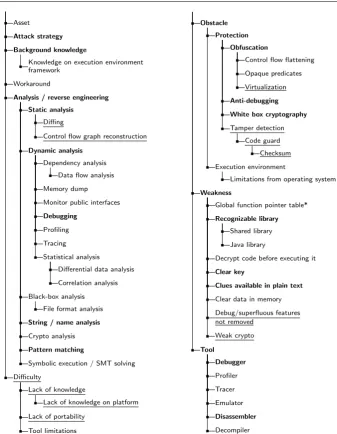
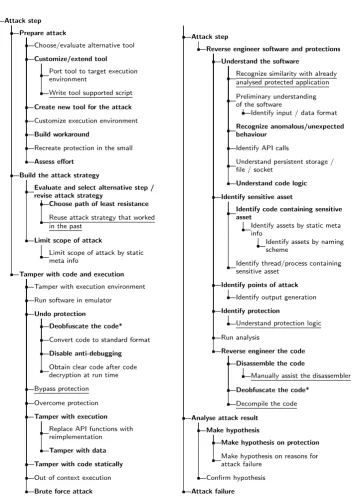
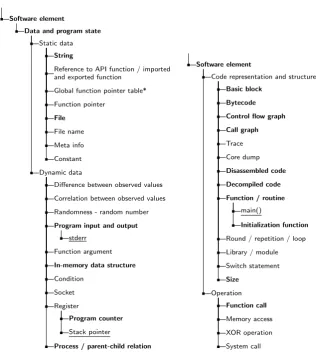
Figures 3 and 4, and 5 show the taxonomy of concepts resulting from the conceptual-ization process carried out by the annotators. New concepts introduced in the Public Challenge experiment are underlined; concepts emerged in both experiments are in boldface.
The top concepts in the taxonomy correspond to the main notions that are useful to describe the hacker activities. These are:Obstacle, Analysis / reverse engineering, Attack strategy, Attack step, Workaround, Weakness, Asset, Background knowledge, Tool, Software elements, Difficulty (the last one,Difficulty, was introduced only when the Public Challenge data have been processed). The taxonomy in OWL format is available online at:http://selab.fbk.eu/ceccato/hacker-study/EMSE2017.owl.
To help readability, in the graphical representation of our taxonomy, concepts are ordered according to possible phases, e.g the preparation comes ideally first, then some code understanding is done, the attack attempt takes place before the evaluation of the attack result. We did not opt for a more formal ordering, such as the number of concepts or the size of reports, because it would have been arbitrary or based on sensitive information that we could not disclose. Moreover, it would be difficult to keep a consistent ordering approach in future experiments, possibly conducted by other researchers, where data sharing might be still difficult because of confidentiality issues.
3.1.1Obstacle
As expected, in the Obstacle hierarchy (Figure 3) we find the protections that are applied to the software to prevent the hacker attacks (under conceptProtection). We observe that this is not the only kind of obstacle reported by hackers.
In particular, theExecution environmentmay also be a major impediment to the completion of an attack. In a report we read “Aside from the [omissis]3 added in-conveniences [due to protections], execution environment requirements can also make an attacker’s task much more difficult. [omissis] Things such as limitations on net-work access and maximum file size limitations caused problems during this exercise”; on this part one coder annotated [P:F:7]: “General obstacle to understanding [by dy-namic analysis]: execution environment (Android: limitations on network access and maximum file size)”.
3.1.2Difficulty
Most difficulties (see Difficulty hierarchy in Figure 3) are problems encountered by the hacker while performing the Public Challenge, due to lack of knowledge (“This
3 With the placeholder “[omissis]” we indicate that a part of the text is not reported either
Asset
Attack strategy
Background knowledge
Knowledge on execution environment framework
Workaround
Analysis / reverse engineering
Static analysis
Diffing
Control flow graph reconstruction
Dynamic analysis
Dependency analysis
Data flow analysis
Memory dump
Monitor public interfaces
Debugging
Profiling
Tracing
Statistical analysis
Differential data analysis
Correlation analysis
Black-box analysis
File format analysis
String / name analysis
Crypto analysis
Pattern matching
Symbolic execution / SMT solving
Difficulty
Lack of knowledge
Lack of knowledge on platform
Lack of portability
Tool limitations
Obstacle
Protection
Obfuscation
Control flow flattening
Opaque predicates
Virtualization
Anti-debugging
White box cryptography
Tamper detection
Code guard
Checksum
Execution environment
Limitations from operating system
Weakness
Global function pointer table*
Recognizable library
Shared library
Java library
Decrypt code before executing it
Clear key
Clues available in plain text
Clear data in memory
[image:15.595.74.412.79.514.2]Debug/superfluous features not removed Weak crypto Tool Debugger Profiler Tracer Emulator Disassembler Decompiler
Fig. 3: Taxonomy of extracted concepts (part I): the analysis methods and tools hackers may use (Analysis / reverse engineering,Tool), weaknesses in design and coding of the application to protect that may help the hacker tasks (Weakness), the difficulty hackers may experience when trying to perform an attack task (Difficulty), the protections a defender can place to limit certain attack steps (Obstacle), and other high-level concepts that characterize the hacking scenarios (Asset,Attack strategy,Background knowledge,
Attack step
Prepare attack
Choose/evaluate alternative tool
Customize/extend tool
Port tool to target execution environment
Write tool supported script
Create new tool for the attack
Customize execution environment
Build workaround
Recreate protection in the small
Assess effort
Build the attack strategy
Evaluate and select alternative step / revise attack strategy
Choose path of least resistance
Reuse attack strategy that worked in the past
Limit scope of attack
Limit scope of attack by static meta info
Tamper with code and execution
Tamper with execution environment
Run software in emulator
Undo protection
Deobfuscate the code*
Convert code to standard format
Disable anti-debugging
Obtain clear code after code decryption at run time
Bypass protection
Overcome protection
Tamper with execution
Replace API functions with reimplementation
Tamper with data
Tamper with code statically
Out of context execution
Brute force attack
Attack step
Reverse engineer software and protections
Understand the software
Recognize similarity with already analysed protected application
Preliminary understanding of the software
Identify input / data format
Recognize anomalous/unexpected behaviour
Identify API calls
Understand persistent storage / file / socket
Understand code logic
Identify sensitive asset
Identify code containing sensitive asset
Identify assets by static meta info
Identify assets by naming scheme
Identify thread/process containing sensitive asset
Identify points of attack
Identify output generation
Identify protection
Understand protection logic
Run analysis
Reverse engineer the code
Disassemble the code
Manually assist the disassembler
Deobfuscate the code*
Decompile the code
Analyse attack result
Make hypothesis
Make hypothesis on protection
Make hypothesis on reasons for attack failure
Confirm hypothesis
[image:16.595.83.438.81.584.2]Attack failure
was my first major encounter with ARM arch and Linux platform”) or portability (“The problem as far as I could gather was insidelibwebsocketsprocessing, probably because of my device setup”). Another difficulty (formerly classified as anObstacle[13]) is represented byTool limitations, for which we can find annotated sentences such as [P:A:33]: “Attack step: overcome limitation of an existing tool by creating an ad hoc communication means” in the professional hacker reports.
3.1.3Analysis / reverse engineering
TheAnalysis / reverse engineeringhierarchy (see Figure 3) is quite rich and interesting. It includes advanced techniques that are part of the state of the art of the research in code analysis, such as Symbolic execution / SMT solving; Dependency analysis; Statistical analysis. Of course, hackers are well aware of the most recent advances in the field of code analysis.
Control flow reconstruction and Diffing were added when processing the report from the Public Challenge. In particular, the Public Challenge hacker compared (using the utilitydiff) the original source code of a publicly available interpreter with the decompiled code obtained from the challenge, to detect any modification that could have been made to that interpreter, that was in fact re-used in the Aspire project to protect the challenge (“I was cross-referencing the original [omissis] source code with challenge’s decompilation to spot the differences in processing [omissis] file”) .
3.1.4Attack step
The central concept that emerged from the hacker reports isAttack step, whose hier-archy is shown in Figure 4. AnAttack steprepresents each single activity that must be executed when implementing a chosenAttack strategy. The top level concepts under
Attack step correspond to the major activities carried out by hackers. Hackers that opted for dynamic attack strategies first of all prepare the attack (conceptPrepare at-tack) to ensure the code can be executed under their control. Then, they usually spend some time understanding the code and its protections by means of a variety of activities that are sub-concepts ofReverse engineer software and protections in the taxonomy. Once they have gained enough knowledge about the software under attack, they build a strategy (conceptBuild attack strategy, they execute any necessary, preliminary task (conceptPrepare attackand they actually execute the attack by manipulating the soft-ware statically or at run time (conceptTamper with code and execution. Finally, they analyse the attack results and decide how to proceed (conceptAnalyse attack result).
static (meta-) information”) and of points of attack (conceptIdentify points of attack; [P:E:14] “Analyse traces to locate output generation”) are other examples of hacking-specific program understanding activities. TheIdentify protectionsub-hierarchy is also unique to code hacking and can take advantage of similarities with previously attacked applications or with manual inspection of the protection logic (“they calculated check-sums of a certain sections of binary and compared it with input (which was divided by dwords)”).
Build attack strategy When iteratively building the attack strategy (conceptBuild attack strategy, Figure 4), it is important to be able to reduce the scope of the attack to a manageable portion of the code. This key activity is expressed through the concept
Limit scope of attack ([O:D:5] “use symbolic operation to focus search”). Within such narrowed scope, hackers evaluate the alternatives and choose the path of least resistance (conceptsEvaluate and select alternative steps / revise attack strategyandChoose path of least resistance; see, e.g., the sentence:“As the libraries are obfuscated, static analysis with a tool such as IDA Pro is difficult at best”, annotated as [P:D:5] “discard attack step/paths”). When possible, they try to reuse an attack strategy that worked in the past (“I used same strategy to extract the key”).
Tamper with code and execution Another remarkable difference from general program understanding is the substantial amount of code and execution manipulation carried out by hackers. Indeed, a core attack step consists of the alteration of the nor-mal flow of execution (conceptTamper with code and execution in Figure 4). This is achieved in many different ways, as apparent from the richness of the hierarchy rooted atTamper with code and execution. Some of them are hacking-specific and reveal a lot about the typical attack patterns. For instance, activityReplace API functions with reimplementation is carried out to work around a protection, by replacing its imple-mentation with a fake impleimple-mentation by the hackers ([P:F:49] “New attack strategy based on protection API analysis: replace API functions with a custom reimplementa-tion to be done within the debugging tool”). ActivityTamper with data is carried out to alter the program state to defeat a protection (sentence“to set a fake value in vir-tual CPU registers in order to deceive the debugged application”, annotated as [O:D:11] “tamper with data to circumvent triggering protection”). Out of context execution is carried out to run the code being targeted by an attack, e.g., a protected function, in isolation, as part of a manually craftedmainprogram (sentence“write own loader for [omissis] library”, annotated as [L:D:20] “adapt and create environment in which to execute targeted code out of context”). Moreover, hackers tamper with the execution to undo the effects of a protection (conceptUndo protection), often to reverse engineer the clear code from the obfuscated one (conceptsDeobfuscate the code,Convert code to standard format, andObtain clear code after code decryption at run time). When possible, they prefer to bypass a protection rather than undoing it (conceptBypass protection used to annotate the following sentences from the Public Challenge report:
“I was successful in overriding checksum mechanism”;”I [omissis] put breakpoints after they executed so I simply caught expected results”).
3.1.5Software elements
pro-Software element
Data and program state
Static data
String
Reference to API function / imported and exported function
Global function pointer table*
Function pointer
File
File name
Meta info
Constant
Dynamic data
Difference between observed values
Correlation between observed values
Randomness - random number
Program input and output
stderr
Function argument
In-memory data structure
Condition
Socket
Register
Program counter
Stack pointer
Process / parent-child relation
Software element
Code representation and structure
Basic block
Bytecode
Control flow graph
Call graph
Trace
Core dump
Disassembled code
Decompiled code
Function / routine
main()
Initialization function
Round / repetition / loop
Library / module
Switch statement
Size
Operation
Function call
Memory access
XOR operation
[image:19.595.78.395.83.436.2]System call
Fig. 5: Taxonomy of extracted concepts (part III): software elements. * indicates mul-tiple inheritance; new concepts added during the second qualitative experiment are underlined; concepts emerged in both experiments are inboldface.
grams, i.e., the structures, components and elements they consider as relevant program aspects to interpret and manipulate in their reverse-engineering and tampering attacks. To that extent, we identified all theSoftware elementsthat the attackers mentioned in their reports and interview responses. Figure 5 provides a taxonomy of the extracted terms, with four top-level concepts.
applica-tion under attack to the size of individual funcapplica-tions) for deciding on the best attack strategy.
Semantics of the code structures in the representations is often derived from, and attached to, specific operations. Four relevant ones are covered by the Operation con-cept. Some are generic, likeFunction call,Memory accessandSystem call.XOR opera-tions are considered specifically in the context of cryptographic primitives and attacks thereon.
While performing dynamic attacks steps, e.g., by observing program execution with a debugger or by analysing execution traces, the attackers observe and track different aspects and features of the dynamic program data and states. Those are covered in the conceptData and program state. Most are generic because they are relevant in almost all programs; other concepts, such as those evolving around differences, correlation, and randomness are again related to cryptography, where those aspects are understood to relate to weaknesses, e.g., with respect to side-channel attacks.
Finally, the conceptStatic data covers all forms of extra information (i.e., not just the actual static code and data that is part of the running program) that attackers can extract from the statically available attack objects, i.e., from the executable files.
3.2 Comparison between Professional Hackers and Public Challenge Winner
Here, we present the differences that we spotted in the concepts identified between the two experiments. As such, this difference should not be interpreted as representative of the general difference between public challenges and professional industrial hackers. Table 5 shows the taxonomy concepts that are used to annotate uniquely the pro-fessional hacker reports, uniquely the public challenge report, or both. The number of concepts is computed by simply counting the leaves in the taxonomy. The numbers indicate a substantial degree of taxonomy reuse in the second experiment (41%), de-spite the completely different setting, which involved small, ad-hoc programs instead of large, industrial applications, and an amateur hacker versus professionals. This means the original ontology, emerged from the first experiment [13], included part of the core concepts required to annotate hacker reports. The second experiment was effective in adding new concepts, missing from the original ontology.
Figures 3, 4 and 5 depict in boldface the 53 concepts common to the two ex-periments. All top level concepts (except Difficulty, which was added in the second experiment as a similar but distinctObstacle) are used to annotate both experiments. This means that several high level categories of activities were identified in both exper-iments, includingAnalysis / reverse engineering, Attack strategy, Attack step, Back-ground knowledge,Tool. Looking deeper into the taxonomy, we can notice that several nested concepts, including several leaf concepts, are shared between the two experi-ments.String / name analysis,Pattern matching,Dynamic analysis and in particular
Debugging are core techniques forAnalysis / reverse engineering that were used in both experiments.
Among theAttack step’s (see Figure 4) sub-concepts, most of the first and second level ones are found in both experiments. Hackers in both experiments performed activities like: Reverse engineer software and protections, Understand the software,
with execution,Tamper with code statically,Brute force attack,Build the attack strategy,
Evaluate and select alternative step / revise attack strategy, Limit scope of attack,
Analyse attack result,Make hypothesis.
Among the deeply nested concepts shared between the two experiments, it is in-teresting to notice the importance of basic, low level binary code analysis techniques (conceptsDisassemble the code,Deobfuscate the code), which are standard toolkit parts in any successful hacker attack. The conceptTamper with data is also interesting. In fact, looking at the text fragments annotated with this concepts, a clear pattern of tampering with the data emerges: hackers set a breakpoint in the binary code and be-fore resuming the execution they alter some critical data (the value of a checksum, of a key, etc.) to test some hypothesis or expose some anomalous behaviour. Breakpoint setting and execution state manipulation seems yet another important basic technique that any hacker is willing to use. Hence the importance ofAnti-debuggingprotections, which hackers tried to defeat in both experiments (see conceptDisable anti-debugging
in Figure 4, anAttack stepcommon to both experiments). From the point of view of the attack strategy, important low level concepts emerged in both experiments, such as
Make hypothesis on protection and Choose path of least resistance. In the attempt to save and optimize the attack effort, hackers speculate on protections even when they have not much evidence about them and choose the attack path that requires minimum effort based on the hypothesized protection.
Table 5 (top) shows the concepts uniquely used to annotate the professional hacker reports. Some quite advanced analysis and reverse engineering techniques have been used only by professional hackers. For instance: Symbolic execution / SMT solving,
Crypto analysis, Data flow analysis,Differential data analysis, Correlation analysis. The explanation for this might be twofold: on one hand, these are techniques that require specialist competences and dedicated tools, which probably are unavailable to the typically non-professional hacker engaged in the Public Challenge. In our case, indeed, the Public Challenge was solved by a practitioner, whose interest in reverse engineering is purely a hobby. On the other hand, the industrial applications protected in the first experiment were much more complex than the small challenges used in the second experiment (see Table 2): they were larger, they consisted of dynamically linked libraries that provided complex functionality to external applications instead of being a main binary that only performs command-line input-output, and more protections were combined in them. Moreover, the assets protected in the industrial applications are substantially different from the asset (a key) protected in the public challenge, since they consist of an entire functionality (e.g., authentication) of the industrial applications. The higher complexity of the software and the assets protected in the first experiment offers another explanation for the need of more sophisticated and advanced tools and techniques.
Among the attack steps uniquely executed by professional hackers, a common fea-ture seems to be the time and effort devoted to preparation activities. Professional hackers performed several attack preparation activities that were not carried out in the public challenge, such as:Prepare the environment,Preliminary understanding of the software,Choose/evaluate alternative tool,Port tool to target execution environment,
Table 5: Comparison of concepts emerged in the two experiments
Unique to professional hackers 76 concepts (45%) Asset, Black-box analysis, Clear data in memory, Code representation and structure, Condition, Confirm hypothesis, Constant, Control flow flattening, Convert code to stan-dard format, Core dump, Correlation analysis, Correlation between observed values, Crypto analysis, Customize execution environment, Data flow analysis, Decrypt code before executing it, Dependency analysis, Difference between observed values, Differ-ential data analysis, Disassembler, Dynamic data, Emulator, Execution environment, File format analysis, File name, Function argument, Function pointer, Global func-tion pointer table, Identify API calls, Identify assets by naming scheme, Identify assets by static meta info, Identify input / data format, Identify output generation, Iden-tify thread/process containing sensitive asset, Java library, Knowledge on execution environment framework, Library / module, Limit scope of attack by static meta info, Limitations from operating system, Make hypothesis on reasons for attack failure, Mem-ory access, MemMem-ory dump, Meta info, Monitor public interfaces, Obtain clear code after code decryption at run time, Opaque predicates, Operation, Out of context execution, Overcome protection, Port tool to target execution environment, Preliminary under-standing of the software, Profiler, Profiling, Randomness - random number, Recreate protection in the small, Reference to API function / imported and exported function, Register, Replace API functions with reimplementation, Round / repetition / loop, Run analysis, Run software in emulator, Shared library, Socket, Static data, Statistical anal-ysis, Switch statement, Symbolic execution / SMT solving, System call, Tamper with execution environment, Tool limitations, Trace, Tracer, Tracing, Understand persistent storage / file / socket, Workaround, XOR operation
Unique to public challenge 23 concepts (14%) Bypass protection, Checksum, Code guard, Control flow graph reconstruction, Debug/-superfluous features not removed, Decompile the code, Decompiler, Difficulty, Diffing, Lack of knowledge, Lack of knowledge on platform, Lack of portability, main(), Man-ually assist the disassembler, Recognize similarity with already analysed protected ap-plication, Reuse attack strategy that worked in the past, Stack pointer, stderr, Tamper detection, Understand protection logic, Virtualization, Weak crypto, Write tool sup-ported script
Both experiments 70 concepts (41%) Analyse attack result, Analysis / reverse engineering, Anti-debugging, Assess effort, At-tack failure, AtAt-tack step, AtAt-tack strategy, Background knowledge, Basic block, Brute force attack, Build the attack strategy, Build workaround, Bytecode, Call graph, Choose path of least resistance, Clear key, Clues available in plain text, Control flow graph, Cre-ate new tool for the attack, Customize/extend tool, Data and program stCre-ate, Debugger, Debugging, Decompiled code, Deobfuscate the code, Disable anti-debugging, Disassem-ble the code, DisassemDisassem-bled code, DisassemDisassem-bler, Dynamic analysis, Evaluate and select alternative step / revise attack strategy, File, Function / routine, Function call, Identify code containing sensitive asset, Identify points of attack, Identify protection, Identify sensitive asset, Initialization function, In-memory data structure, Limit scope of at-tack, Make hypothesis, Make hypothesis on protection, Obfuscation, Obstacle, Pattern matching, Prepare attack, Process / parent-child relation, Program counter, Program input and output, Protection, Recognizable library, Recognize anomalous/unexpected behaviour, Reverse engineer software and protections, Reverse engineer the code, Size, Software element, Static analysis, String, String / name analysis, Tamper with code and execution, Tamper with code statically, Tamper with data, Tamper with execu-tion, Tool, Understand code logic, Understand the software, Undo protecexecu-tion, Weakness, White box cryptography
linked Android libraries in action requires a much more specialized environment than doing the same on a simple command-line Linux application. Whereas a more or less standard Linux setup suffices for the latter, a standard Android setup offers very lit-tle support to attackers. Another explanation might be that professional hackers are used to think in terms of attack automation. They want their attacks to be repeatable deterministically by anyone, rather than being the result of hardly reproducible, man-ually executed steps. Hence, they spend some time preparing tools and environment to achieve such level of reproducibility.
There are also a fewtamperingactivities that were carried out exclusively by profes-sional hackers, among which:Tamper with execution environment,Replace API func-tions with reimplementation, Out of context execution. These are all advanced and sophisticated tasks that require deep knowledge and competence. In fact, tampering with the execution environment often involves patching the operating system kernel or developing a new one. Reimplementing API functions also refers typically to operat-ing system level functions that provide basic services and that the attacker wants to replace. Being able to execute a protection mechanism in isolation requires the capa-bility to isolate some functions, mock (some of) the library calls involved and develop a driver that can run the extracted code in isolation. All these activities may be out of reach for non-professional hackers and may pay off only when complex industrial applications are being attacked.
Regarding the software elements that are uniquely used by the professional hack-ers, it suffices to observe that they mostly correspond to the activities they uniquely reported. Most analysis or tampering techniques target specific kinds of software struc-tures or components. So those strucstruc-tures and components occur in a report when the result or trigger of a discussed attack step is mentioned.
Table 5 (bottom) shows the concepts uniquely used to annotate the public challenge report. A new top level hierarchy emerged, rooted at conceptDifficulty and including among others Lack of knowledge and Lack of portability. This concept indicates a problem encountered by hackers during their work (e.g., due to their limited knowledge about a given platform), rather than an Obstacle placed there by the defenders to protect the applications or known to be part of the environment, which hence provides some implicit form of protection. The higher relevance of difficulties vs. obstacles in the Public Challenge indicates a non-professional, occasional involvement of public the challenge hacker in attack tasks (confirmed in the interview). Indeed, the winner of the public challenges seems to have quite a different profile than professional hackers.
On the other hand, professional hackers work in team, where the lack of knowledge in a specific field may be compensated by some other members. Moreover, professional hackers have been explicitly selected by the industrial partners because of their specific expertise in attacking their applications. A lack of knowledge or lack of portability, which highlights the impossibility to execute the target application on their systems, were inadmissible.
Some obstacles and weaknesses are specific of the challenges designed for the Public Challenge experiment, such as theProtections Virtualization and Checksum, and the
Weaknesses Debug/superfluous features not removed and Weak crypto. That’s why they appear only in the Public Challenge annotations.
function and standard command-line input and output, versus libraries as attacked by the professional hackers.
Some attack steps performed exclusively by the Public Challenge hacker seem to indicate an attempt to minimize the attack effort by performing several attack steps manually, rather than trying to automate them (concept Manually assist the disas-sembler), by using functionalities immediately available from tools (concept Write tool supported script) and by trying to bypass rather than undo the protections (con-ceptBypass protection). This confirms a different attitude of Public Challenge hackers vs. professional hackers with respect to preparation and automation of the attack: the former try to reuse what’s available in tools and compensate for the missing function-alities with manual activities, while the latter spend substantial time preparing the environment and tools for the attack and automating the attack steps. Application size is also a decisive factor that certainly impacted the attack effort minimization choices by the Public Challenge hacker and the professional hackers. The successfully attacked Public Challenge applications were much smaller in size and provided much less functionality than the industrial use cases. This matters because manual and au-tomated attacks scale differently: automation requires a large initial effort to develop tools and scripts. When attacking small applications, in which the occurrences of pro-tection code fragments are by definition limited, the initial automation effort is likely not worthwhile. For small applications, the lack of scalability of manual tampering and information gathering methods is simply not problematic and does not warrant an initial investment in automation.
External factors also affect this different behaviour. Indeed, in the Public Challenge the reward is granted to the first hacker that succeeds in breaking a challenge, therefore, learning and generalizing from the attack tasks and improving their attack arsenal is not their major goal. On the other hand, professional hackers were asked to describe with proper level of details the protection techniques identified and their weaknesses. Moreover, they are usually required (and paid for) writing reports, thus they collect enough information for a complete document. There seems to be also some learning going on for the Public Challenge hacker when moving from one challenge to the next one, as apparent from the following Public Challenge exclusive concepts: Recognize similarity with already analysed protected application,Reuse attack strategy that worked in the past.
3.3 Inferred Models
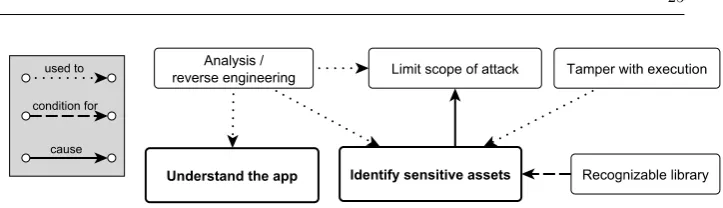
Fig. 6: Model of hacker activities related to understanding the software and identifying sensitive assets
they defeat protections by bypassing them, by building workarounds, by overcoming protections with other means, and by undoing them (Figure 9).
The models produced after the experiment with professional hackers have been compared with the new concepts and annotations created in the Public Challenge ex-periment. It was not necessary to introduce any major change due to the new concepts and annotations, which indicates the general validity and applicability of the original models. A few minor extensions were necessary to accommodate some new concepts introduced after the Public Challenge and relevant for the inferred models. They are commented below at the end of each model description.
3.3.1How hackers understand protected software
Let us consider the first model, shown in Figure 6. Hackers carry out understanding activities with the goal of identifying the sensitive assets in the software that are the target of their attacks. Ultimately, identification of such sensitive assets allows hackers to narrow down the scope of the attack to a small code portion, where their efforts can be focused in the next attack phase (see the“cause” relation in Figure 6). In this process, (static / dynamic) program analysis and reverse engineering play a dominant role. They are used to understand the software, identify sensitive assets, and to limit the scope of the attack (see“used to”relation in Figure 6). For instance, dynamic analysis of IO system calls is used to limit the scope of the attack ([L:D:24] “prune search space for interesting code by studying IO behavior, in this case system calls”), because some IO operations are performed in the proximity of the protected assets. String analysis is used for the same purpose ([L:D:26] “prune search space for interesting code by studying static symbolic data, in this case string references in the code”), because some specific constant strings are referenced in the proximity of sensitive assets. Tampering with the execution is also a way to identify sensitive assets ([O:E:5] “static analysis + dynamic code injection to get the crypto key”). When libraries with well known functionalities are recognized, hackers get important clues on their use for asset protection (“condition for” relation in Figure 6, based on annotations such as [O:E:6] “static analysis: native lib is using java library for persistence giving clues on data stored to attacker”).
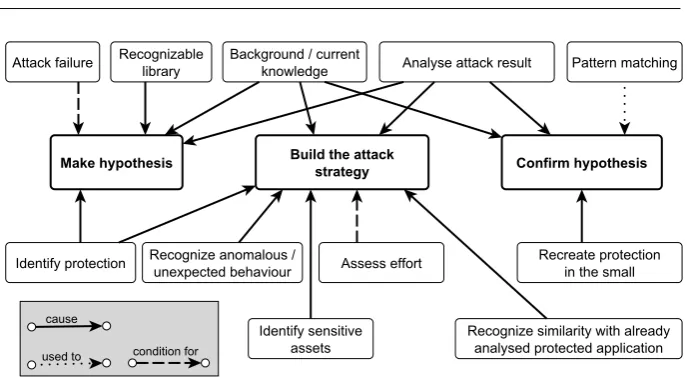
Fig. 7: Model of hacker activities related to making / confirming hypotheses and build-ing the attack strategy
Hiding the libraries that are involved in the protection of the assets, not just the protection itself, seems also important to stop / delay hackers.
3.3.2How hackers build attack strategies
Figure 7 shows a model of how hackers come to the formulation and validation of hypotheses about protections, and how this eventually leads to the construction of their attack strategy. Hypothesis making requires (see“cause” relations in Figure 7) running (static / dynamic) program analyses and interpreting the results by applying background knowledge on how software protection and obfuscation typically work (e.g., [O:E:4] “static analysis to detect anti-debugging protections”). Identifying protections or libraries involved in protections is also an important prerequisite to be able to formulate hypotheses. When an attack attempt fails (see“condition for” relation on the left in Figure 7), the reasons for the failure often provide useful clues for hypothesis making (sentence “As the original process is already being ptraced, this prevents a debugger, which typically uses the ptrace system, from attaching”, annotated as [P:A:50] “Guess: avoid the attachment of another debugger”).
To confirm the previously formulated hypotheses, further analyses are run and in-terpreted based on background knowledge (see“cause” relations connected toConfirm hypothesis). Pattern matching is also useful to confirm hypotheses ([P:F:26] “Repeated execution patterns are identified and matched against repeated computations that are expected to be carried out by the relevant code”; [P:D:25] “mapping of observed (sta-tistical) patterns to a priori knowledge about assumed functionality”). Another activity that contributes to the confirmation of previously formulated hypothesis is the creation of a small program that replicates the conjectured protection ([P:F:47] “Understanding is carried out on a simpler application having similar (anti-debugging) protection”).