3349
ISSN: 2278 – 7798 All Rights Reserved © 2014 IJSETRData Embedding in Scrambled Digital Video
for Data Security & Authentication
Jamna Kaur, Guru Kashi University, Department of CSE, Talwandi Sabo (Bathinda)
Rachna Rajput,Assistant Professor, Department of CSE ,Guru Kashi University, Talwandi Sabo (Bathinda).
Abstract—As a technology advances, multimedia applications increase exponentially in day-to-day life. Multimedia applications such as video telephony, video conferencing, TV, other applications are in demand in video industry. Many different video codec standards such as H.261, MPEG-1, MPEG-2, H.263, and H.264 are implemented. The work of this is to first briefly describe about encoding and decoding process, and then it discusses more details about different modules of encoder and decoder, and the related algorithms. We propose a computationally efficient and secure video encryption logarithm With some selected parameters (Decoding time, PSNR value ,MSE value) In this work video is encoded into different frames, and convert into images where the encoded key is hidden that the private key and security is provided by private key. When the decoding is performed then the encoded frame with private key is automatically selected. Keyword—Discrete Cosine Transform, PSNR, MSE, LSB(Least Significant bit).
I. INTRODUCTION
In various multimedia technologies, security and privacy has become an important. The main goal of cryptography is keeping data secure form unauthorized attackers. Therefore data is encrypted through process of Encryption. Data cryptography mainly is the scrambling of the content of data, such as text, image, audio, video and so forth to make the data unreadable, invisible or unintelligible during transmission or storage called Encryption. The reverse of data encryption is data Decryption, which recuperate the original data. The reverse of data encryption is data decryption with digital video transmission, encryption technologies are needed that can protect digital video from attacks during transmission. Due to the huge size of digital videos, they are usually transmitted in compressed formats such as MPEG.
A . Need of Video Encryption
Requirements of Video Encryption Nowadays there are many traditional cryptography systems that However, most of them are not appropriate for video since the amount of video data is much greater than text, for which
the traditional cryptography systems were originally designed. The performance of video encryption methods must be evaluated from four requirements like security, complexity,compression overhead and format compliance. For preventing unwanted viewing of transmitted video for example from law enforcement video surveillance being relayed back to a central viewing centre. To protect the private multimedia messages that is exchanged over the wireless or wired networks. Video Encryption is helpful in securing videos used in services like video on demand (VOD), Video conferencing- learning.
B. Data Hiding Techniques (LSB)
The least significant bit (in other words, the 8th bit) of some or all of the bytes inside an image is changed to a bit of the secret message. Digital images are mainly of two types
(i) 24 bit images. (ii) 8 bit images.
In 24 bit images we can embed three bits of information in each pixel, one in each LSB position of the three eight bit values. Increasing or decreasing the value by changing the LSB does not change the appearance of the image. so the resultant image looks almost same as the cover image. In 8 bit images, one bit of information can be hidden. The advantages of LSB techniques are: Popularity, Easy to understand and comprehend, High perceptual transparency, Low degradation in the image quality. However, there are few weaknesses of using LSB. It is very sensitive to any kind of filtering or manipulation of the image .Scaling, rotation, cropping, addition of noise, or lossy compression to the stego-image will destroy the message. On the other hand, for the hiding capacity, the size of information to be hidden relatively depends to the size of the cover- image.
II. PARAMETERS USED
A. PSNR (Peak Signal-to-Noise Ratio): A high quality image has small value of Peak Signal to Noise Ratio (PSNR) or PSNR is defined as the ratio of signal power to noise power. It basically obtains the gray value difference between resulting image and original image. PSNR is most commonly used to measure the quality of reconstruction of lossy compression code (for image compression). The
3350
ISSN: 2278 – 7798 All Rights Reserved © 2014 IJSETRsignal in this case is the original data, and the noise is the error introduced by compression.
PSNR is defined as follow:
B. MSE (Mean Square Error): MSE is the sum over all squared value differences divided by image size and by three.
n=size (Input Image); M=n(1);
N=n(2);
MSE = sum(sum((Input Image- Reconstructed Image).^2))/(M*N);
C. Proposed Algorithm Step 1: Start the program.
Step 2: Reads the video and stores it as a image files in a folder
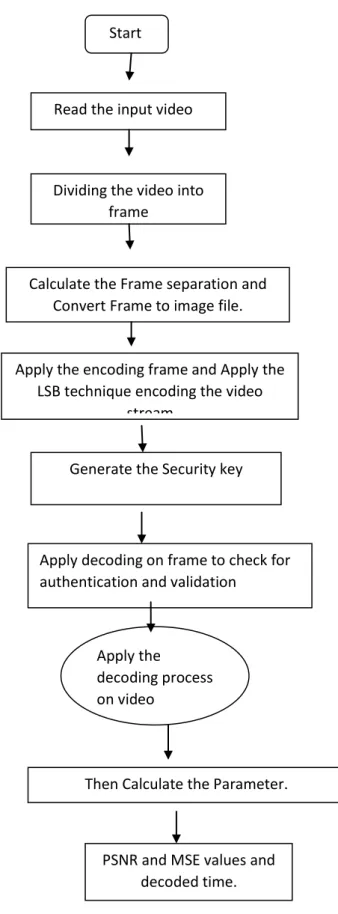
Step 3: Calculate the Frame separation and Convert Frame to image file.
Step 4: Write image file.
Step 5: Apply Encoding on the frames of the video. Apply the LSB technique encoding the video stream after the frame separation.
Step 6: Generate the Hexadecimal key for security. Step7: Apply decoded frame to check for authentication and validation
Step 8: Apply the decoding process on video Step 9: PSNR and MSE values and decoded time. Step 10: Stop.
Figure 2.1: The basic working of the system.
III. RESULT & ANALYSIS
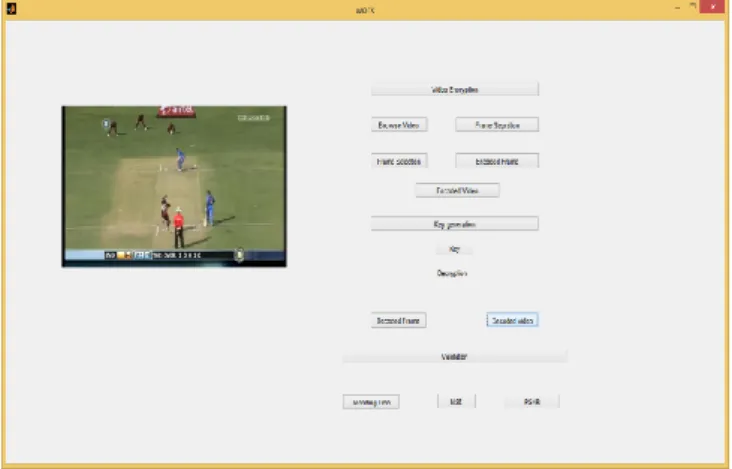
Their are different figures that shows how the video is processed and how the system tools works in MATLAB.In this we upload the digiat video.
Read the input video
Dividing the video into
frame
Apply the encoding frame and Apply the
LSB technique encoding the video
stream
Calculate the Frame separation and
Convert Frame to image file.
PSNR and MSE values and
decoded time.
Apply decoding on frame to check for
authentication and validation
Then Calculate the Parameter.
Generate the Security key
Apply the
decoding process
on video
3351
ISSN: 2278 – 7798 All Rights Reserved © 2014 IJSETRFigure 3.1: First input video that is used to hide the data.
Figure 3.2: Second input video that is used to hide the data.
In this we select the input video and perform frame sepration into 8 8 block .After frame separation number of frames are made .
Figure 3.3: Browsing the Input video .
Figure 3.4: Frame selection of input video
We select a frame from number of frame . After this Encoding is performed frame.
Figure 3.5: Encoding the selected frame
When encoding is perform on frame then we encode the video frame by frame.In this Private Key for video security we Generate By pressing the button Key and this Key is embeded with the encoded frame.
Figure 3:6: Value of Private Key Private Key = 405fdb1a05093b98
Figure 3.7: Decoded the frame.
In this after Private Key Generation.We decoded the frame.
3352
ISSN: 2278 – 7798 All Rights Reserved © 2014 IJSETRFigure 3.8: Decode the video frame by frame.
After this validation is performed .if validation is accurate then calculate the parameter of video.
Figure 3.9:Calculate the Decoding Time, PSNR and MSE value.
In this research work video is encoded into different frames, after encoding the frame is converted into images where the encoded key is hidden that the private key. When the decoding is performed then the encoded frame with private key is automatically selected and gives the original frame of the input video that is shown in above snap shorts.
Result Table 1: Table of Decoding Time, PSNR and MSE value.
In this we calculate decoding time of digital video and also the PSNR and MSE of the digital video after the data scrambling.
IV. LITERATURE SURVEY
There are many algorithms in existence for scrambling of the video frames and to encrypt them. The proposed scheme treats the video as a framing sequence. Secondly an index number is provided for each frame. Then the frames are encrypted to hide the information using thresholding method. Proper keys are used to scramble the frames of the video initially. The content of the frames remains the same. The Grouping Of Pictures (GOP) provides a feature of categorizing the frames and pictures of same size under a particular group.[1].
The watermark embedding is processed in the DCTD. To achieve high performance, the proposed system architecture employs pipeline structure and uses parallelism. This system based watermarking system features low power consumption, low cost implementation, high processing speed, and reliability. In this study we should concentrate on applying the watermarking algorithm to other modern video compression standards, such as MPEG-4/H.264.[2]. In this we focuses on the various methods for video Encryption. For analysis of amongst the all different different approaches. According the analysis of Pure Permutation Algorithm , Zig-Zag Permutation Algorithm, Chaos Based Encryption Algorithms, Deformation & formation Algorithms, Video Encryption algorithm (VEA).This analysis selective encryption takes less time as compared to full encryption. Zigzag method & chaos based method are hot research topics for encryption of video but takes more time. Therefore a encryption algorithm based on I-frames & xor has been defined.[.3].This technique that uses watermark nesting and encryption. Nesting means it embeds an extra watermark into the main watermark and then embeds the main watermark into the cover image. For encryption XOR operation is used. For embedding watermarked in Cover Image by DWT based technique. By using watermark nesting we can embed more number of bits in the cover image as compare to without watermark nesting. Due to nesting feature we can embed some metadata about watermark also. This technique uses encryption, so it increases the security of watermarks. For instance if watermarking key is hacked still the attacker will not be able to identify the watermark because it is encrypted.[5].
V. CONCLUSION
The work in this dissertation in terms of the various parameters that have been considered while scrambling the digital video for security.The fact that the proposed method embeds the data directly in the spatial domain (pixel values) makes it immune to some very common Video Name Decoding
Time PSNR MSE matchvideo.mp4 3.920764 sec 22.2859 384.1368 Pacific Ocean.mp4 14.142753 sec 20.2996 606.9017 Illusion video.mp4 3.833233 sec 5.6684e+03 10.5962
3353
ISSN: 2278 – 7798 All Rights Reserved © 2014 IJSETRerrors, which appear in other competitive data hiding techniques working in the compressed domain. In conclusion, the main advantages of the proposed method are its low complexity and the possibility of using the compressed stream for hiding different data many times, without first decoding and then re-encoding the video sequence. This makes the method appropriate for real-time applications. Future work might involve a real time implementation of the system so that the maximum number of videos is enhanced with the help of different filters. In the future work DWT is implemented with hard and soft threshold for data scrambling in digital videos authentications and security.
REFERENCES
[1] A.Shiva Krishna Reddy ,K. Srimathi, R. Rajalakshmi, “ The Indexing Algorithm for Scrambled Frames in Video Encryption ” International Journal of Advanced Research in Computer
Science and Software Engineering Volume 4,February 2014.
[2] Sivakami, R.Nagakrishnan, Ellammal “A Digital Watermarking System For Video Authentication using DCT ”,Integrated Journal of Engineering Research and Technology (IJERT) Vol 01 Jan-Feb 2014.
[3] Yogita Negi ,”A Survey on Video Encryption Techniques”,
International Journal of Emerging Technology and Advanced Engineering Vol 3, Issue 4, April 2013.
[4] Mayank Arya Chandra, Ravindra Purwar, Navin Rajpal,”A Novel Approach of Digital Video Encryption”, International
Journal of Computer Applications Vol 49, July 2012.
[5] Preeti Gupta,“Cryptography based digital image watermarking algorithm to increase security of watermark data”,
International Journal of Scientific & Engineering Research, Vol
3, September 2012.
[6] G.Madhuri, B.VijayKumar, V. Sudheer Raja, M. Shasidhar “Data Embedding in Scrambled Digital Video for Security”, Int. J. on Recent Trends in Engineering and Technology, Vol. 6, Nov 2011.
[7] Amit Pande, Prasant Mohapatra, Joseph Zambreno,” Using Chaotic Maps for Encrypting Image and Video Content”, IEEE
International Symposium on Multimedia, 2011.
[8] M. Abomhara,, Omar Zakaria, Othman O. Khalifa, “An Overview of Video Encryption Techniques”, International
Journal of Computer Theory and Engineering, Vol. 2, February,
2010.
[9] M. Zeghid, M. Machhout, L. Khriji, A. Baganne, and R. Tourki,” A Modified AES Based for Image Encryption”, World