IJEDR1504143
International Journal of Engineering Development and Research (www.ijedr.org)807
Evaluate spam detection using hybrid technique of
Support Vector Mechine
1
Kishan Thumar
, 2Prof. Dulari Bosamiya
1M.E. Student, 2Assistant ProfessorInformation Technology Department
Shantilal Shah Engineering College, Bhavnagar, Gujarat, India
________________________________________________________________________________________________________
Abstract - Due to the social media, online reviews are widely adopted. They greatly impact consumer’s purchasing decisions. A slight difference in a business rating on a review website can significantly change the reputation of them. Review spamming is quite common on many online shopping platforms like Amazon. In this work a hybrid method is used to detect whether a review is spam or not. From previous studies it is found that SVM(Support Vector Machine) gives comparatively good result for this task. PSO (Particle Swarm Optimization) is the optimization technique which can be used improve the result of SVM. Here duplicate detection is used after preprocessing of data to find if two reviews are same or not. After that feature identification is done and then PSO is used to choose the population and these values are used in SVM to classify reviews. Hence in this work, a Hybrid classifier (SVM+PSO) to classify review as a spam or not spam is used.
Index Terms – Data mining, Web mining, Review Spam, Review Spammer, Support vector machine(SVM), Particle swarm optimization(PSO)
________________________________________________________________________________________________________
1. INTRODUCTION
Spam is an endless repetition of worthless text. Spam may be of many types. It may be image spam, email spam, review spam, social spam, web spam, etc. all of these have their advert effects.
The main are Email spam also called as mail spam or Unsolicited Commercial Email (UCE).And it has become major problem .Because everyday many accounts receives millions of spam to advertise services or products and harmful software.
Web spam: Web spam, also known as search engine spam. They generally refer to any deliberate actions that are “aimed to mislead search engines into ranking some pages higher than they deserve”. Aiming the great benefits of increased rank of websites in search result. Many website owners prefer adopting various web spam tricks to quickly achieve their goal rather than devoting their money and time to consolidate the content and quality of their websites. Web spam can be categorized into two main types: content spam and link spam.
1. Link spam is spam on hyperlinks, which does not exist in reviews as there is usually no link among reviews.
2. Content spam tries to add irrelevant or remotely relevant words in target pages to fool search engines to rank the target pages high.
Review spam: With the explosive of the Internet, increasingly more user contributed data such as online consumer reviews have been posted to e-Commerce Web sites (e.g., amazon.com) or opinion sharing Web sites (e.g., epinions.com). As a matter of fact, existing literatures suggest that online consumer feedback has become one of the most important information sources utilized by consumers or marketers to evaluate a variety of products such as books, electronics, politics or movies. In that spammers gives Positive opinions to target entities and gives sometimes false or negative opinions to damage their reputations.
Here in this study main focus on review spam. As this topic is new no such more work is done in this direction. But now a day many researches are going on and many algorithms are used and many other techniques are being applied in this matter. Many approaches of supervised as well as unsupervised learning are being applied such as Fuzzy, Support Vector Machine, Naïve Bayesian, in regression technique Logistic Regression, Neural Network, KNN classifier, language models and more techniques also Studies show that Support Vector Machine (SVM) gives comparatively good result. SVM is Vector space based machine-learning method aiming to find a decision boundary between two classes that is maximally far from any point in the training data (possibly discounting some points as outliers or noise). Given a set of training examples, each marked as belonging to one of two categories, an SVM training algorithm builds a model that assigns new examples into one category or the other, making it a non-probabilistic binary linear classifier. An SVM model is a representation of the examples as points in space, mapped so that the examples of the separate categories are divided by a clear gap that is as wide as possible.
Particle swarm optimization is one of the optimization techniques used in opinion mining. In this study PSO (Particle Swarm optimization) will be used to optimize with the Support Vector Machine.
IJEDR1504143
International Journal of Engineering Development and Research (www.ijedr.org)808
2. DATA MINING
Data mining is the process of extracting valid, previously unknown, comprehensible, and actionable information from large databases and using it to make crucial business decisions.
2.1 Data Mining Concepts
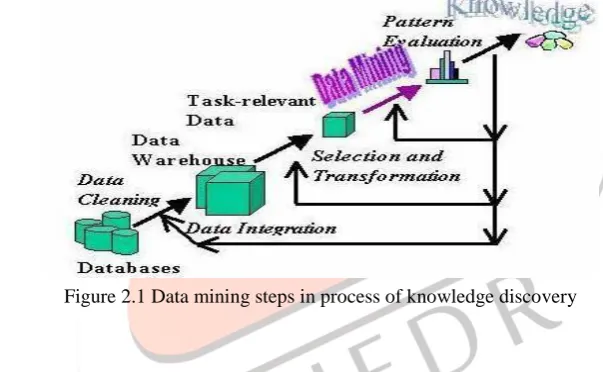
With the enormous amount of data stored in files, databases, and other repositories, it is increasingly important, if not necessary, to develop powerful means for analysis and perhaps interpretation of such data and for the extraction of interesting knowledge that could help in decision-making.Data Mining, also popularly known as Knowledge Discovery in Databases (KDD). The following figure (Figure 2.1) shows data mining as a step in an iterative knowledge discovery process. The iterative process consists of the following steps:
‒ Data cleaning: also known as data cleansing, it is a phase in which noise data and irrelevant data are removed from the
collection.
‒ Data integration: at this stage, multiple data sources, often heterogeneous, may be combined in a common source.
‒ Data selection: at this step, the data relevant to the analysis is decided on and retrieved from the data collection.
‒ Data transformation: also known as data consolidation, it is a phase in which the selected data is transformed into forms appropriate for the mining procedure.
‒ Data mining: it is the crucial step in which clever techniques are applied to extract patterns potentially useful.
‒ Pattern evaluation: in this step, strictly interesting patterns representing knowledge are identified based on given measures.
‒ Knowledge representation: is the final phase in which the discovered knowledge is visually represented to the user. This essential step uses visualization techniques to help users understand and interpret the data mining results.
Figure 2.1 Data mining steps in process of knowledge discovery
3. WEB MINING
3.1 REVIEW SPAM
Opinions from social media are increasingly used by individuals and organizations for making purchase decisions and making choices at elections and for marketing and product design. Opinion spamming about social and political issues can even be frightening as they can warp opinions and mobilize masses into positions counter to legal or ethical mores. It is safe to say that as opinions in social media are increasingly used in practice, opinion spamming will become more and more rampant and also sophisticated.
The key challenge of opinion spam detection is that unlike other forms of spam, it is very hard, if not impossible, to recognize fake opinions by manually reading them, which makes it difficult to find opinion spam data to help design and evaluate detection algorithms. Review spam is what the spammers gives incorrect reviews to the products or places or movies etc.. to promote or damage reputations. Here is type of review spam.
3.1.1 TYPE OF REVIEW SPAM:
Type 1 (fake reviews): These are untruthful reviews that are written not based on the reviewers’ genuine experiences of using the products or services, but are written with hidden motives. They often contain undeserving positive opinions about some target entities (products or services) in order to promote the entities and /or unjust or false negative opinions about some other entities in order to damage their reputations.
Type 2 (reviews about brands only): These reviews do not comment on the specific products or services that they are supposed to review, but only comment on the brands or the manufacturers of the products. Although they may be genuine, they are considered as spam as they are not targeted at the specific products and are often biased. For example, a review for a specific HP printer says “I hate HP. I never buy any of their products.”
IJEDR1504143
International Journal of Engineering Development and Research (www.ijedr.org)809
3.2 CLASSIFICATION
Classification is a two step process: Model construction and Model usage. 1. Model construction: describing a set of predetermined classes.
Each tuple /sample is assumed to belong to a predefined class, as determined by the class label attribute. The set of tuples used for model construction: training set
The model is represented as classification rules or mathematical formulae
2. Model usage: for classifying future or unknown objects Estimate accuracy of the model The known label of test sample is compared with the classified result from the model Accuracy rate is the percentage of test set samples that are correctly classified by the model
Classification and prediction are two form of data analysis that can be used to extract models describing important data classes or to predict future data trends Whereas classification predicts categorical (discrete or unordered) labels, prediction models continuous valued functions.
There are two types of learning methods in classification.
1. Supervised Learning (e.g. classification): The learning of the model is 'supervised' in that it is told to which class each training sample belongs.
2. Unsupervised Learning (e.g. clustering): In which the class labels of the training samples are not known, and the
number or set of classes to be learned may not be known in advance.
3.3 SUPPORT VECTOR MACHINE
3.3.1 INTRODUCTION
Support Vector Machine (SVM) was first introduced by Boser, Guyon, and Vapnik in COLT-92. Support Vector Machines (SVMs) belong to a family of generalized linear classifiers. Bascially, it is a classification and regression prediction tool that uses machine learning theory to maximize predictive accuracy while automatically avoiding over-fit to the data.
The foundations of Support Vector Machines (SVM) have been developed by Vapnik and gained popularity due to many promising features such as better empirical performance.
SVM is a learning machine that may be applied to several pattern classification problems. It has two phases: training and testing, where the first is the most time consuming. In a two class classifier, the training algorithm is performed on a set of T input examples, each one represented as a d-dimensional vector xi with its output yi belonging to {-1, + 1}. Training in SVM has as objective to find an (n-1) dimensional hyper plane that separates the positive from the negative training examples. This requires solving a Quadratic Programming (QP) problem. This problem is transformed using the Lagrange Multipliers theory, and the solution is obtained finding the set of optimal Lagrange coefficients.
According to the separation of data, three cases are identified. The simpler one is known as the linear and separable case, where n=d. Another one is the linear case combined with the non reparability of the input examples. In a more general case, known as the non-linear and non-separable case, the input examples are mapped onto another space of dimension n>d. Many algorithms exist to train Support Vector Machines i.e. Chunking, Decomposition, SMO (which is a special case of Decomposition) and a popular algorithm called SMO type Decomposition.
In recent years, Kernel methods have received major attention, particularly due to the increased popularity of the Support Vector Machine. Kernel functions can be used in many applications as they provide a simple bridge from linearity to non-linearity for algorithms which can be expressed in terms of dot products. The examples of kernels are liner kernel, polynomial kernel, circular kernel etc. Kernel methods are a class of algorithms for pattern analysis or recognition, whose best known element is the support vector machine (SVM). The general task of pattern analysis is to find and study general type of relations (such as clusters, rankings, principal Components, correlations, classifications) in general types of data (such as sequences, text documents, sets of points, vectors, images, graphs, etc) Choosing the most appropriate kernel highly depends on the problem at hand - and fine tuning its parameters can easily become a tedious and cumbersome task.
3.3.2 ADVANTAGES OF SUPPORT VECTOR MACHINE:
1. Highly Accurate in classification: Support vector machine provides high accuracy in classification as compared to other methods for classification like Naïve Bayes, Decision Tree, Artificial Neural Networks and Nearest Neighbors.
2. Able to model complex nonlinear decision boundaries: With the use of kernel functions for mapping input space to higher
dimensional feature space, SVM can handle complex and multidimensional data efficiently.
3. Less prone to over fitting than other methods: Due to better generalization ability SVMs avoid over fitting the data to a greater extent
3.4 PSO (PARTICLE SWARM OPTIMIZATION)
Inspired by the flocking and schooling patterns of birds and fish, Particle Swarm Optimization (PSO) was invented by Russell Eberhart and James Kennedy in 1995. Originally, these two started out developing computer software simulations of birds flocking around food sources, and then later realized how well their algorithms worked on optimization problems. Particle swarm optimization (PSO) is an artificial intelligence (AI) technique that can be used to find approximate solutions to extremely difficult or impossible numeric maximization and minimization problems.
IJEDR1504143
International Journal of Engineering Development and Research (www.ijedr.org)810
than the first, it chirps louder and the others veer over toward him. This tightening pattern continues until one of the birds happens upon the food. It's an algorithm that's simple and easy to implement.The algorithm keeps track of three global variables: Target value or condition
Global best (gBest) value indicating which particle's data is currently closest to the Target Stopping value indicating when the algorithm should stop if the Target isn't found
Each particle consists of:
Data representing a possible solution
A Velocity value indicating how much the Data can be changed
A personal best (pBest) value indicating the closest the particle's Data has ever come to the Target
The particles' data could be anything. In the flocking birds example above, the data would be the X, Y, Z coordinates of each bird. The velocity value is calculated according to how far an individual's data is from the target. Each particle's pBest value only indicates the closest the data has ever come to the target since the algorithm started.The gBest value only changes when any particle's pBest value comes closer to the target than gBest.
4. RELATED WORK
4.1 Analyzing and Detecting Review Spam [1]
The first attempt of detecting review spam was done by this author. It shows that review spam is quite different from web page spam and email spam. In this paper first the categorization of reviews and then proposed several techniques to attempt them. Detection of such spam is done first by detecting duplicate reviews and then detects type-2 and type-3 reviews they have used Logistic Regression to build the model. In this paper they have only proposed the method to detect the review spam which are very helpful in further studies.
4.2 Opinion Spam and Analysis [8]
In this paper they have worked on their previous paper and analyze the results. They studied the review spam by the relation of (1) Number of reviews vs. number of reviewers and (2) Number of reviews vs. number of products. By plotting them in log-log plot. And perform the practical as per the above papers and they showed that the Logistic regression Model was effective. However, to detect type 1 opinion spam, the story is quite different because it is very hard to manually label training examples for type 1 spam. Thus, they proposed to use duplicate spam reviews as positive training examples and other reviews as negative examples to build a model.
4.3 Toward A language Modeling Approach for consumer Review Spam Detection [2]
This paper is to show the trustworthiness of reviews by detecting the review spam. One main contribution of this research work is the development of a novel computational methodology to combat online review spam. Their experimental results confirm that the KL divergence and the probabilistic language modeling based computational model is effective for the detection of untruthful reviews. Moreover, the SVM-based method is also effective for the detection of non-reviews.
4.4 Conceptual level Similarity Measure based Review Spam Detection [14]
This method makes use of duplicate and near duplicate reviews considering them as spam while partially relate and unique reviews as non spam. They experimental result show that there are larger numbers of duplicate spam reviews detected using the conceptual level similarity measure. They also observe that there are large numbers of reviews belonging to non spam review category i.e. partially related and unique reviews.
4.5 Spam Review Detection using a Hybrid Classification Method[6]
In this research work, new hybrid classification method is proposed based on coupling classification methods using arcing classifier and their performances are analyzed in terms of accuracy. A Classifier ensemble was designed using Naïve Bayes (NB), Support Vector Machine (SVM) and Genetic Algorithm (GA). In their results they have shown that the hybrid model shows higher percentage of classification accuracy than the base classifiers and enhances the testing time due to data dimensions reduction. They experimental results lead to the following observations.
SVM exhibits better performance than NB and GA in the importance respects of accuracy.
Comparison between the individual classifier and the hybrid classifier: it is clear that the hybrid classifier show the significant improvement over the single classifiers.
5. CONCLUSION
IJEDR1504143
International Journal of Engineering Development and Research (www.ijedr.org)811
6. REFERENCES
[1] Nitin Jindal and Bing Liu ANALYZING AND DETECTING REVIEW SPAM Seventh IEEE International Conference on Data Mining 2007
[2] c.l. lai, k.q. xu, raymond y.k. lau, y. li, l. jing TOWARD A LANGUAGE MODELING APPROACH FOR CONSUMER REVIEW SPAM DETECTION International Conference on E-Business Engineering 2010
[3] Jakub Piskorski, Marcin Sydow, Dawid Weiss EXPLORING LINGUISTIC FEATURES FOR WEB SPAM DETECTION:A PRELIMINARY STUDY ACM 200x
[4] raymond y. k. lau, s. y. liao, ron chi-wai kwok, kaiquan xu, yunqing xia, yuefeng li TEXT MINING AND PROBABILISTIC LANGUAGE MODELING FOR ONLINE REVIEW SPAM DETECTION ACM Trans. Manag. Inform. Syst. 2, 4, Article 25 (December 2011)
[5] Abd. Samad Hasan Basari, Burairah Hussin, I. Gede Pramudya Ananta, Junta Zeniarja OPINION MINING OF MOVIE REVIEW USING HYBRID METHOD OF SUPPORT VECTOR MACHINE AND PARTICLE SWARM OPTIMIZATION ScienceDirect Malaysian Technical Universities Conference on Engineering & Technology 2012, MUCET 2012.
[6] M.Govindarajan SPAM REVIEW DETECTION USING A HYBRID CLASSIFICATION METHOD International Journal of Advances in Engineering Sciences Vol.4, Issue 2, April , 2014 Print-ISSN: 2231-2013 e-ISSN: 2231-0347 22
[7] Rania Hassan Babak Cohanim Olivier de Weck A COPMARISON OF PARTICLE SWARM OPTIMIZATION AND THE GENETIC ALGORITHM American Institute of Aeronautics and Astronautics(AIAA)
[8] Nitin Jindal and Bing Liu. "OPINION SPAM AND ANALYSIS." Proceedings of First ACM International Conference on Web Search and Data Mining (WSDM-2008), Feb 11-12, 2008, Stanford University, California, USA
[9] Peng Wan, Minoru Uehara SPAM DETECTION USING SOBEL OPERATORS AND OCR 2012 26th International Conference on Advanced Information Networking and Applications Workshops
[10] Loredana Firte Camelia Lemnaru Rodica Potolea SPAM DETECTION FILTER USING KNN ALGORITHM AND RESAMPLING 2010 IEEE
[11] George A. Miller, Richard Beckwith, Christiane Fellbaum, Derek Gross, and Katherine Miller INTRODUCTION TO WORDNET: AN ON-LINE LEXICAL DATABASE Revised August 1993
[12] Fatima Ardjani, Kaddour Sadouni OPTIMIZATION OF SVM MULTICLASS BY PARTICLE SWARM (PSO-SVM) I.J.Modern Education and Computer Science, 2010, 2, 32-38
[13] snehal dixit & a.j.agrawal REVIEW SPAM DETECTION International Journal of Computational Linguistics and Natural Language Processing Vol 2 Issue 6 June 2013 ISSN 2279 – 0756
[14] Siddu P. Algur, Amit P.Patil, P.S Hiremath, S. Shivashankar CONCEPTUAL LEVEL SIMILARITY MEASURE BASED REVIEW SPAM DETECTION 2010 IEEE
[15] Myle Ott, Yejin Choi, Claire Cardie,and Jeff Hancock FINDING DECEPTIVE OPINION SPAM BY ANY STRETCH OF THE IMAGINATION
[16] Guan Wang, Sihong Xie, Bing Liu, Philip S. Yu.Review GRAPH BASED ONLINE STORE REVIEW SPAMMER DETECTION.11th IEEE International Conference on Data Mining 2011.
Link references: