Spectra and decay rates of
b
b
¯
meson using Gaussian wave
func-tion
Ajay Kumar Rai1,a, Nayneshkumar Devlani2,b, and Virendrasinh H. Kher2,c
1Department of Applied Physics , S.V. National Institute of Technology, Surat 395007 Gujarat, INDIA 2Applied Physics Department, Polytechnic, The M.S. University of Baroda, Vadodara 390002, Gujarat, INDIA
Abstract. Using the Gaussian wave function mass spectra and decay rates ofbb¯ me-son are investigated in the framework of phenomenological quark anti-quark potential (coulomb plus power) model consisting of relativistic corrections to the kinetic energy term. The spin-spin, spin-orbit and tensor interactions are employed to obtain the pseu-doscalar and vector meson masses. The decay constantsfP/Vare computed using the wave function at the origin. The di-gamma and di-leptonic decays of thebb¯ meson are investigated using Van-Rayan Weisskopf formula as well as in the NRQCD formalism.
1 Introduction
Now a days, there have been renewed interest in the spectroscopy of the light and heavy flavoured hadrons due to number of experimental facilities CLEO, DELPHI, Belle, BaBar, LHCb etc., which have been continuously providing more accurate and new information about the mesons, baryons and exotic states from light flavour to heavy flavour sector [1–4]. There are many theoretical attempts to understand these states using potential models [5–9]. The success of theoretical model predictions with experiments can provide important information about the quark-antiquark interactions. Such information is of great interest, as it is not possible to obtain theQQ¯ potential starting from the basic principle of the quantum chromodynamics (QCD) at the hadronic scale [5–23].
The new role of the heavy flavour studies as the testing ground for the non-perturbative aspects of QCD, demands extension of earlier phenomenological potential model studies on quarkonium masses to their predictions of decay widths with the non-perturbative approaches like NRQCD [24].
We present details of the semi-relativistic treatment of the heavy quarks along with the computed results in section-2. The decay constants fP,Vofbb¯meson incorporating QCD correction is presented
in section-3. In section-4 we present the details of the computations of the di-gamma decays of pseudoscalar states and the di-leptonic decay widths of the vector states of thebb¯ quarkonia in the frame work of the NRQCD formalism as well as in the conventional Van-Royen Weisskopf formula. Finally we draw our conclusion in section-5.
ae-mail: [email protected] be-mail: [email protected] ce-mail: [email protected] C
2 Theoretical formulation
For the study of thebb¯meson we consider the relativistic Hamiltonian in which motion of the quarks inside the meson is relativistic[25–28]
H=
p2+m2
b+
p2+m2
¯
b+V(r) (1)
wherepis the relative momentum of the quark-antiquark andmb is thebquark mass. The
Hamilto-nian in Eq(1) represents the energy of the meson in the meson rest frame. We expand the kinetic en-ergy(K.E.) part of the Hamiltonian up toOp4andV(r) is the quark-antiquark potential[15, 16, 18],
V(r)=−αc r +Ar
ν+
V0 (2)
Ais the potential parameter,νis a general power index, andV0is a constant. αc = (4/3)αS
M2,
αS M2is the strong running coupling constant. The value of the QCD coupling constantα
s(M2) is
determined through the simplest model with freezing[10, 11], namely
αs(M2)=
4π
11−23nf
lnM2+MB2 Λ2
(3)
whereM=2mbm¯b/mb+mb¯,MB =0.95 GeV[10, 11], andΛ =0.413 GeV[13]. We have used the
gaussian wave function in the present study. The gaussian wave function in position space has the form
Rnl(μ,r)=μ3/2
2 (n−1)!
Γ(n+l+1/2) 1/2
(μr)le−μ2r2/2Lln+−11/2(μ 2
r2); (4)
here,μis the variational parameter andLis Laguerre polynomial. For the present study, we employ the Ritz variational scheme. We obtain the expectation values of the Hamiltonian as
Hψ=Eψ (5)
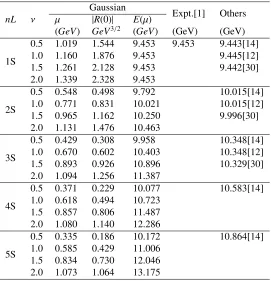
For a chosen value ofνbetween 0.5 to 2.0 the variational parameter,μis determined for each state using the Virial theorem[29]. As the interaction potential assumed here does not contain the spin dependent part, Eq(5) gives the spin averaged masses of the system. The calculated spin averaged mass of the ground state is matched with the experimental spin-averaged mass using the equation
MS A=MP+
3
4(MV−MP) (6)
whereMVandMPare the vector and pseudoscalar meson ground state masses taken from ref [1]. This
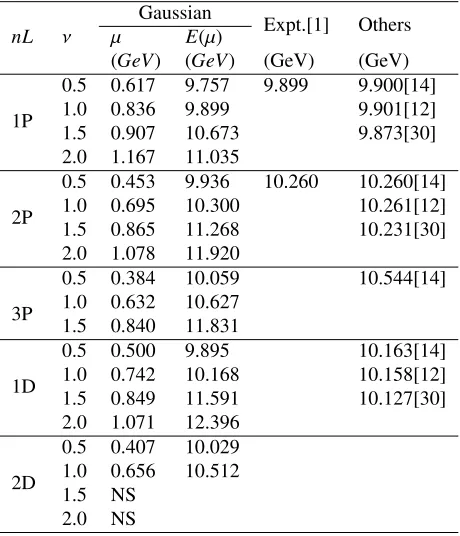
fixes the parameterV0. Using this value ofV0we calculateS,P, andDwave spin-averaged masses ofbb¯mesons which are listed in Tables 1 and 2. For the comparison for thenJstate, we compute the spin-averaged or the center of weight mass from the respective theoretical values as [18]
MCW,n=ΣJ
2(2J+1)MnJ
ΣJ2(2J+1)
(7)
where,MCW,ndenotes the spin-averaged mass of thenstate andMnJrepresents the mass of the meson
Table 1.S-wave spin averaged masses ofbb¯meson.
nL ν
Gaussian
Expt.[1] Others
μ |R(0)| E(μ)
(GeV) GeV3/2 (GeV) (GeV) (GeV)
1S
0.5 1.019 1.544 9.453 9.453 9.443[14]
1.0 1.160 1.876 9.453 9.445[12]
1.5 1.261 2.128 9.453 9.442[30]
2.0 1.339 2.328 9.453
2S
0.5 0.548 0.498 9.792 10.015[14]
1.0 0.771 0.831 10.021 10.015[12]
1.5 0.965 1.162 10.250 9.996[30]
2.0 1.131 1.476 10.463
3S
0.5 0.429 0.308 9.958 10.348[14]
1.0 0.670 0.602 10.403 10.348[12]
1.5 0.893 0.926 10.896 10.329[30]
2.0 1.094 1.256 11.387
4S
0.5 0.371 0.229 10.077 10.583[14]
1.0 0.618 0.494 10.723 1.5 0.857 0.806 11.487 2.0 1.080 1.140 12.286
5S
0.5 0.335 0.186 10.172 10.864[14]
1.0 0.585 0.429 11.006 1.5 0.834 0.730 12.046 2.0 1.073 1.064 13.175
The value of the radial wave functionR(0) for 0−+and 1−−states would be different due to their spin dependent hyperfine interaction. The spin hyperfine interaction of the heavy-heavy flavored mesons is small and this can cause a small shift in the value of the wave function at the origin[18, 31]. The parameters used to calculate the low lying masses of thebb¯ meson areαS = 0.33, A = 0.24
GeV−1,m ¯
b =4.88GeVand the value of the constantV0 =−0.363,−0.370,−0,374 and -0.377 GeV forν=0.5,1.0,1.5 and 2.0 respectively. The spin averaged masses for S, P and D states are tabulated in Tables 1 and 2. It can be observed that the spin-averaged masses obtained are in good agreement with experimental and other theoretical predictions atν=1, but some excited states are over estimated by 100 MeV.
2.1 Excited states
In the case of quarkonia the quark-antiquark bound states are represented byn2S+1L
J, identified with
the JPC values, with→−J =→−L +→−S,→−S = −→S
Q+−→SQ¯, parity P = (−1)L+1 and the charge conjuation C =(−1)L+S with (n,L) being the radial quantum numbers[32]. For computing the mass differences between different degenerateQQ¯ meson states, the spin dependent part of the potential employed is given by
VS D(r)=VS S(r) S (S +1)−
3 2
+VLS(r)
→−
L·→−S
+VT(r)
⎡ ⎢⎢⎢⎢⎢ ⎢⎢⎢⎢⎢
⎣S (S +1)− 3
→−
S · −→r →−S · −→r
r2
Table 2.P and D-wave Spin averaged masses ofbb¯meson.
nL ν
Gaussian
Expt.[1] Others
μ E(μ)
(GeV) (GeV) (GeV) (GeV)
1P
0.5 0.617 9.757 9.899 9.900[14]
1.0 0.836 9.899 9.901[12]
1.5 0.907 10.673 9.873[30]
2.0 1.167 11.035
2P
0.5 0.453 9.936 10.260 10.260[14]
1.0 0.695 10.300 10.261[12]
1.5 0.865 11.268 10.231[30]
2.0 1.078 11.920
3P
0.5 0.384 10.059 10.544[14]
1.0 0.632 10.627 1.5 0.840 11.831
1D
0.5 0.500 9.895 10.163[14]
1.0 0.742 10.168 10.158[12]
1.5 0.849 11.591 10.127[30]
2.0 1.071 12.396
2D
0.5 0.407 10.029 1.0 0.656 10.512 1.5 NS
2.0 NS
whre the spin-orbit, tensor and spin-spin interactions can be written in terms of the vector and scalar parts of theV(r) as
VLS(r)=
1 2mQmQ¯
3dVV
dr − dVS
dr
, (9)
VT(r)=
1 6mQmQ¯
3d
2V
V
dr2 − 1 r
dVV
dr
, (10)
VS S(r)=
1 3mQmQ¯∇
2 VV =
16παS
9mQmQ¯
δ3→−
r, (11)
where
VV =−
4αS
3r and VS =Ar
ν.
(12)
The spin dependent part Eq(8) is added to the Hamiltonian Eq(5) to calculate the excited state masses. Masses are tabulated in Table-3.
3 Decay constants
The decay constants of mesons are important parameters in the study of leptonic or non-leptonic weak decay processes. In the non-relativistic limit, we compute the decay constants using the Van-Royen-Weisskopf formula[33],
f2
P/V =
12ψP/V(0)
2
MP/V
¯ C2(α
Table 3.Masses of thebb¯mesons(in GeV).
States Our Expt.[1] Ref.[5] Ref.[7] Ref.[14] Ref.[12] Ref.[30] 11S
0 9.421 9.391 9.399 9.409 9.398 9.400 9.377
13S
1 9.464 9.460 9.461 9.458 9.460 9.460 9.464
13P
0 9.879 9.859 9.872 9.858 9.859 9.863 9.834
13P
1 9.892 9.893 9.893 9.906 9.892 9.892 9.864
11P
1 9.899 9.898 9.898 9.911 9.900 9.901 9.873
13P
2 9.908 9.912 9.906 9.924 9.912 9.913 9.886
21S
0 10.014 9.969 9.996 9.990 9.993 9.963
23S
1 10.023 10.023 10.006 10.012 10.023 10.023 10.007 13D
1 10.165 10.149 10.149 10.154 10.153 10.120
13D
2 10.168 10.164 10.153 10.154 10.161 10.158 10.126
11D2 10.168 10.154 10.154 10.163 10.158 10.127
13D3 10.171 10.156 10.156 10.166 10.162 10.130
23P0 10.282 10.232 10.238 10.209 10.233 10.234 10.199 23P1 10.294 10.255 10.257 10.250 10.255 10.255 10.224 21P
1 10.300 10.259 10.261 10.254 10.260 10.261 10.231 23P
2 10.307 10.269 10.268 10.265 10.268 10.268 10.242 31S
0 10.400 10.328 10.334 10.329 10.328 10.298
33S
1 10.404 10.355 10.351 10.345 10.355 10.355 10.339 23D
1 10.508 10.447 10.433 10.435
23D
2 10.511 - 10.439 10.443
21D
2 10.512 - 10.439 10.445
23D
3 10.514 - 10.441 10.449
33P
0 10.613 10.527 10.491 10.521
33P
1 10.622 10.544 10.527 10.541
31P
1 10.627 10.548 10.531 10.544
33P2 10.633 10.555 10.541 10.550
41S0 10.720 - 10.612 10.573
43S1 10.723 10.579 - 10.623 10.586
51S
0 11.005 - 10.865 10.851
53S
1 11.007 10.876 - 10.870 10.869
where ¯C(αS) is the QCD correction factor given by[34]
¯ C2(α
S)=1−
2αS
π (14)
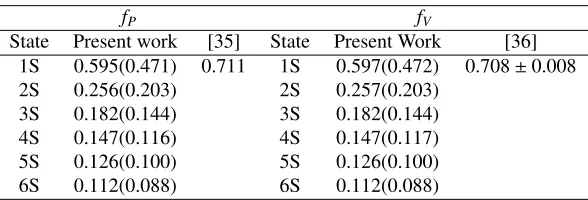
The computed fP and fV for bb¯ meson using equation (13) are tabulated in Table 4. The value in
parenthesis is the decay constant with QCD correction. The Eq. (13) also gives the inequality[29]
√
mvfv≥ √mpfp (15)
Table 4.Decay constants of thebb¯meson(in GeV).
fP fV
State Present work [35] State Present Work [36] 1S 0.595(0.471) 0.711 1S 0.597(0.472) 0.708±0.008
2S 0.256(0.203) 2S 0.257(0.203)
3S 0.182(0.144) 3S 0.182(0.144)
4S 0.147(0.116) 4S 0.147(0.117)
5S 0.126(0.100) 5S 0.126(0.100)
6S 0.112(0.088) 6S 0.112(0.088)
4 Di-gamma and di-leptonic decay rates
The di-gamma decay of1S0state and the di-leptonic decay of3S1state using the conventional Van-Royen Weisskopf formula[33] is
Γ0= 12α2e4
Q
M2
P
R2P(0), (16)
ΓVW=
4α2e4
Q
M2
V
R2V(0) (17)
OmittingOv4Γthe NRQCD formula for the decays can be written as[24]
Γ1
S0→γγ
=2Imfγγ(1S0)
πm2
Q
R1S0 2
−NcImgγγ
1S 0
πm4
Q
ReR¯s∇2¯Rs
(18)
Γ3
S0→e+e−
= NcImfee(3S1)
πm2
Q
R3S1 2
−NcImgee
3S 1
πm4
Q
ReR¯s∇2¯Rs
(19)
The short distance coefficients f’s andg’s computed in the order ofα2as[24]
Imfγγ(1S0)=πQ4α2 (20)
Imgγγ(1S0)=− 4πQ4
3 α
2 (21)
Imfee(3S1)=
πQ2α2
3 (22)
Imgee
3S
1
=−4πQ2α2
9 (23)
where color factorCF =
N2
c−1
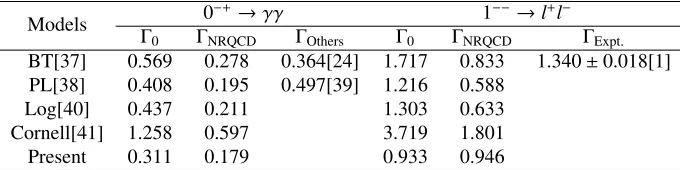
Table 5.0−+→γγand 1−−→l+l−decay rates(in keV).
Models Γ 0−+→γγ 1−−→l+l−
0 ΓNRQCD ΓOthers Γ0 ΓNRQCD ΓExpt.
BT[37] 0.569 0.278 0.364[24] 1.717 0.833 1.340±0.018[1] PL[38] 0.408 0.195 0.497[39] 1.216 0.588
Log[40] 0.437 0.211 1.303 0.633
Cornell[41] 1.258 0.597 3.719 1.801
Present 0.311 0.179 0.933 0.946
5 Conclusion
In present work,bb¯meson is studied in the general frame work of potential model. The mass spectra, decay constants and decay rates are calculated using the Gaussian wave function. The potential model parameters and the masses of thebb¯meson are employed to study their decay properties in the frame work of NRQCD formalism as well as using the conventional Van-Royen-Weisskopf formula.
The mass spectra obtained in the present scheme is reasonably close to experimental values as well other theoretical results. The some excited states like 3S, 4S and 5S are little overestimated. The mass predicted forηb(2S) is very close to the recent measurements of ref[4]. The decay constants of
the pseudoscalar (fP) and the vector meson (fV) are computed with and without QCD corrections, is
found to be 100 MeV offwith the recent predictions [31, 35, 36, 42]. The departure from the predicted fPandfVneed more refined mechanism related to their wave functions incorporating the confinement
and hyperfine splitting. Using the predicted masses and redial wave functions at the origin, the gamma and leptonic, decay rates of bottomonium are studied and tabulated in Table-(5). The di-gamma decay rate calculated using Van-Rayan Weisskopf formula close to the other predicted values, but NRQCD results are well off from others. In the case of the di-leptonic decay both the results are underestimated. For the di-gamma prediction results calculated with potentials [37, 38, 40] are in good agreement with other theoretical predictions. For the di-leptonic decay rates, only Log potential is giving good result [40]. Finally, predicted results suggested that it required relativistic corrections to the potential, which will improve the present results.
Acknowledgements
A. K. Rai acknowledge the financial support extended by D.S.T., India under SERB fast track scheme SR/FTP /PS-152/2012 and also thankful to Sardar Vallabhbhai National Institute of Technology (Institute Research Grant (Dean (R&C)/1488/2013-14)) for providing financial assistance.
References
[1] J. Beringer, et. al., (Particle Data Group) Phys. Rev.D86, 010001 (2012) [2] K.A. Olive, et. al., (Particle Data Group) Chinese Phys.C38, 1 (2014) [3] I. Adachi et al. (Belle Collaboration), Phys. Rev. Lett.108, 032001 (2012) [4] S. Sandilya et al. (Belle Collaboration), Phys. Rev. Lett.111, 112001 (2013) [5] W.W. Repko, M.D. Santia, S.F. Radford, Nucl.Phys.A924, 65 (2014) [6] S.F. Radford, W.W. Repko, M.J. Saelim, Phys. Rev. D80, 034012 (2009)
[8] A.K. Rai, J. Pandya, P. Vinodkumar, Indian J.Phys.A80, 387 (2006) [9] A.K. Rai, J. Pandya, P. Vinodkummar, Nucl.Phys.A782, 406 (2007)
[10] A.M. Badalian, A.I. Veselov, B.L.G. Bakker, Phys. Rev. D70, 016007 (2004) [11] Y.A. Simonov, Physics of Atomic Nuclei58, 107 (1995)
[12] D. Ebert, R. Faustov, V. Galkin, Phys. Rev.D67, 014027 (2003) [13] D. Ebert, R.N. Faustov, V.O. Galkin, Phys. Rev. D79, 114029 (2009) [14] D. Ebert, R. Faustov, V. Galkin, Eur. Phys. J.C71, 1825 (2011)
[15] A.K. Rai, R.H. Parmar, P.C. Vinodkumar, J. Phys. G: Nucl. Part. Phys.28, 2275 (2002) [16] A.K. Rai, J.N. Pandya, P.C. Vinodkumar, J. Phys. G: Nucl. Part. Phys.31, 1453 (2005) [17] A.K. Rai, P. Vinodkumar, Pramana66, 953 (2006)
[18] A.K. Rai, B. Patel, P.C. Vinodkumar, Phys. Rev. C78, 055202 (2008) [19] A.K. Rai, J. Pandya, P. Vinodkumar, Eur.Phys.J.A38, 77 (2008) [20] A.K. Rai, P. Vinodkumar, AIP Conf.Proc.1257, 316 (2010) [21] A.K. Rai, AIP Conf.Proc.1343, 415 (2011)
[22] A.K. Rai, J.Phys.Conf.Ser.374, 012017 (2012) [23] A.K. Rai, N. Devlani, PoSHadron2013, 045 (2013)
[24] G.T. Bodwin, E. Braaten, G.P. Lepage, Phys. Rev. D51, 1125 (1995) [25] N. Devlani, A.K. Rai, Phys. Rev. D84, 074030 (2011)
[26] N. Devlani, A.K. Rai, Eur. Phys. J.A48, 104 (2012) [27] N. Devlani, A.K. Rai, Int. J. Theor. Phys.52, 2196 (2013) [28] N. Devlani, V. Kher, A.K. Rai, Eur. Phys. J.A50, 154 (2014) [29] D.S. Hwang, G.H. Kim, Phys. Rev. D55, 6944 (1997) [30] E.J. Eichten, C. Quigg, Phys. Rev. D49, 5845 (1994) [31] B. Patel, P.C. Vinodkumar, J. Phys. G.36, 035003 (2009)
[32] S. Gershtein, V. Kiselev, A. Likhoded, A. Tkabladze, Phys. Usp.38, 1 (1995) [33] R. Van Royen, V. Weisskopf, Nuovo Cim.A50, 617 (1967)
[34] E. Braaten, S. Fleming, Phys. Rev. D52, 181 (1995) [35] J. Pandya, P. Vinodkumar, Pramana57, 821 (2001)
[36] C.W. Hwang, Z.T. Wei, J. Phys. GG34, 687 (2007),hep-ph/0609036 [37] W. Buchmüller, S.H.H. Tye, Phys. Rev. D24, 132 (1981)
[38] A. Martin, Phys.Lett.B93, 338 (1980)
[39] M. Shah, A. Parmar, P.C. Vinodkumar, Phys. Rev. D86, 034015 (2012) [40] C. Quigg, J.L. Rosner, Phys.Lett.B71, 153 (1977)