STUDENTS PERCEPTION TOWARDS SOCIAL NETWORKING SITES
Cecily Shibi Netto Santhosh T. R
Junior Research Fellow Junior Research Fellow
St. Peter’s College St. Peter’s College
Kolenchery, Kerala Kolenchery, Kerala
Abstract
Social networking sites (SNS) are influencing the day to day life of the people in many ways. It has its own advantages and disadvantages in the life of its users. But it has become indispensable in today’s high tech life style of people. Students/youths are easily affected by social networking sites. The study has incorporated empirical research approach. Samples for the study are selected by using random sampling method. Both Primary data and Secondary data were used for the study. The present study aims to identify the usage pattern of social networking sites by students, to evaluate the attitude of students towards social networking sites and also to analyse the positive and negative effects of social networking sites on student’s life. It was found that there is difference in the mean level of attitude towards SNS between male and female students with respect to opinions regarding sharing experiences and contributing to present knowledge, improving communication skills, and SNS as a means to pass time. Students agreed with the statements that SNS are not safe and it affects the mental health and it promotes cyber bullying. There is also a difference in the mean level of attitude between male and female students on the opinions regarding the necessity of SNS in today’s life and cyber bullying encouragement. There is significant difference between the course of study of students and their attitude towards SNS. It is observed that there is significant difference in the mean rank of positive and negative effect factors of SNS.
Key words: Social Networking Sites, Usage Pattern, Positive and Negative Effects. Introduction:
Social Networking Sites (SNS) are websites which provides its members an online platform for connecting people of their concern and helps in communication and sharing messages, information, knowledge, promoting business etc. among its users. It can be of different types. Social networking sites meant for contacting friends and families, for researchers, for academicians, for women, for professionals etc. Increased innovations in information technology have paved the way for the inevitable use of these social networking sites in today’s world.
social, psychological and physical aspects of its users. Some studies show that these sites have various effects on the life styles especially in the academic performance and the duration of studies of the students. These sites are able to bring so many changes in social and interpersonal relations among people. Studies show that excessive use of these sites can affect not only psyche of students but also physical, mental and social aspects of life. Once they get into this most of them tend to get addicted to it. Social networking sites have helped many students to acquire knowledge from one another over internet without direct communication.On the other hand; social networking sites bring so many problems. Students tend to lose interest in their studies as they spent most of the time on these sites (Kalra & Manani, 2013)3. Thus there is a need to study about the attitude of the students towards the social networking sites, their usage pattern and its positive and negative impact on their academic performance.
Background:
Roy & Chakraborthy (2015)5 discussed the positive and negative impact of Social networks on education of undergraduate level students as well as on their life, depending on one’s interest to use. The study revealed that most of the students are badly affected because of safety and privacy issues and also leads to lack of focus in their studies. Lavy (2014)4 investigated the influence of social networks on educational attainment and non-cognitive behavioral outcomes of children in school. It was observed that the presence of reciprocal friends and followers in class has a positive and significant effect on test scores and the presence of non-reciprocal friends in class has a negative effect on a student’s learning outcomes. It was also observed that various types of social networks have positive effects on non-cognitive behavioral outcomes. Bijaria & et al (2013)1 investigated the effect of social networking site on the academic achievement of students in Birjand University of Medical Sciences. The results indicate that there is a negative relation between use of social networking sites and grade point average. Kalra & Manani (2013)3 studied the effect of social networking sites on academic achievement of the students with reference to their personality. Results revealed that there is no significant difference between academic achievement of users and non-users of Social Networking Sites (SNS). It was also found that even with personality differences among the students there is no significant difference found among extroverts and introvert students using and not using SNS with reference to their academic achievement. Jain & Gupta (2012)2 revealed the level of awareness on the social issues and how far social networking sites awakened today’s youth in expressing their views on current burning issues like corruption, human rights, girls education etc. The study shows that people are feeling free in sharing their thoughts on any issue and even youth is raising their voice against social acts like violation of human rights, corruption etc. Wang & et al (2011)6 explored the advantages and disadvantages of students’ use of social networking. The study indicated that most college students would prefer to use social media and spend many hours checking social media sites and social networking is definitely affecting students’ efficiencies as well as their grades.
studied about students’ perception towards SNS on the basis of gender, age group, place of residence, type of college, course of study etc.
Objectives of the study:
1. To identify the usage pattern of social networking sites among the students. 2. To evaluate the attitude of students towards social networking sites.
3. To analyse the positive and negative effects of social networking sites on the academic performance of the students.
Research Design:
Type of Research: The study has incorporated empirical research approach.
Source of data: Both Primary data and Secondary data were used for the study.
Sample Design:
Population under Study: The population of the study consists of all Arts and Science Colleges consisting of Govt. Colleges, Aided and Un-aided Colleges and a well known University in Kottayam district in Kerala.
Sample Unit: A cross sectional study was conducted which included 100 students (50 Males and 50 Females). Sample composition is portrayed below as follows:
Table 1: Sample composition by gender and type of Institution
Gender University Govt. College Aided College Unaided College Total
Male 20 (40%) 10 (20%) 10 (20%) 10 (20%) 50 (100%)
Female 20 (40%) 10 (20%) 10 (20%) 10 (20%) 50 (100%)
Total 40 (40%) 20 (20%) 20 (20%) 20 (20%) 100 (100%)
Thus the total sample size came to be 112 students. Multiple response questions were asked to students with respect to SNS used, gadgets used to access SNS and purpose of using SNS.
Sampling Method: For this study, random sampling method has been used.
Type of Analysis: Frequency Tables, Cross Tabs, Independent Sample T-test, One Way ANOVA and Friedman Test were used for analysis of data using SPSS.
Outcomes & deliberations:
Kottayam is a town in India which has acquired 100% literacy and thus it is in forefront in terms of literacy and education. A well known university named Mahatma Gandhi University to which all the colleges in the central part of Kerala state are affiliated is situated in Kottayam district. Prominent colleges are also situated in this district. Thus the population of the study comprises of a university and all arts and science colleges in Kottayam district. Out of 50 males and 50 female students 20 students each were selected from the University, 10 each were selected from the govt. Colleges, aided colleges and unaided colleges of Kottayam district of Kerala for the present study so as to keep the sample size equal with respect to gender as well as users of SNS (as per table no. 1). The outcomes of the study are as follows:
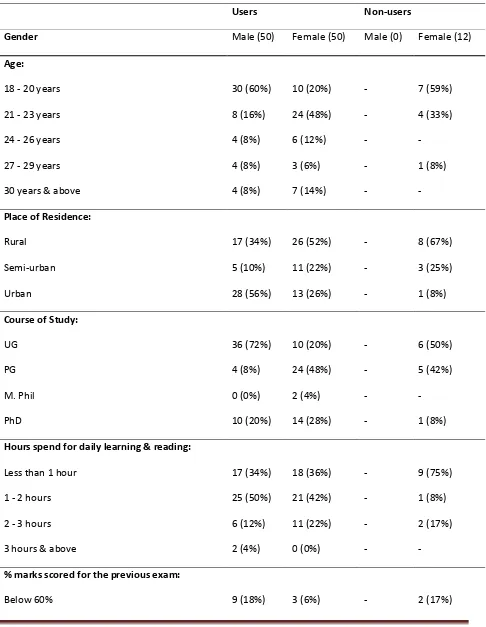
Table 2: General profile of users and non-users of SNS gender-wise
Users Non-users
Gender Male (50) Female (50) Male (0) Female (12)
Age:
18 - 20 years 30 (60%) 10 (20%) - 7 (59%)
21 - 23 years 8 (16%) 24 (48%) - 4 (33%)
24 - 26 years 4 (8%) 6 (12%) - -
27 - 29 years 4 (8%) 3 (6%) - 1 (8%)
30 years & above 4 (8%) 7 (14%) - -
Place of Residence:
Rural 17 (34%) 26 (52%) - 8 (67%)
Semi-urban 5 (10%) 11 (22%) - 3 (25%)
Urban 28 (56%) 13 (26%) - 1 (8%)
Course of Study:
UG 36 (72%) 10 (20%) - 6 (50%)
PG 4 (8%) 24 (48%) - 5 (42%)
M. Phil 0 (0%) 2 (4%) - -
PhD 10 (20%) 14 (28%) - 1 (8%)
Hours spend for daily learning & reading:
Less than 1 hour 17 (34%) 18 (36%) - 9 (75%)
1 - 2 hours 25 (50%) 21 (42%) - 1 (8%)
2 - 3 hours 6 (12%) 11 (22%) - 2 (17%)
3 hours & above 2 (4%) 0 (0%) - -
% marks scored for the previous exam:
60 - 70% 11 (22%) 21 (42%) - 2 (17%)
70 - 80% 19 (38%) 13 (26%) - 3 (25%)
80 - 90% 10 (20%) 11 (22%) - 3 (25%)
90% & above 1 (2%) 2 (4%) - 2 (17%)
Reason for not using SNS:
Not interested in joining - - - 9 (75%)
Didn't enjoyed when joined before - - - 3 (25%)
No privacy - - - 3 (25%)
Source: Primary data
Usage pattern of SNS by students:
As per table no. 2 it can be seen that majority of the students are members of facebook (90%) followed by whatsapp (74%), google+ (47%), twitter (35%), academia.edu (26%) and LinkedIn (20%). Majority of the male students have account in facebook (98%), whatsapp (94%), twitter (46%) and google+ (54%) and majority of the female students have account in linkedIn (22%) and academia.edu (30%).Students also reported that some of them also have account in tango, telegram, vyber, messenger, instagram, soma, skype, hike, IMO, myspace, youtube, research gate, slideshare etc.Thus the study shows that the students are a highly active members of SNS. It may be observed that majority of the male students use smart phones (92%) and majority of female students use both smart phones (58%) and laptop (58%) to access SNS. Out of 50 male students majority of them access SNS to find new friends (67%), to contact current friends (74%), to play games (27%), to get opinion (47%) and for time killing (43%) as the main purposes behind using SNS. Whereas out of 50 female students majority of them access SNS mainly to keep in touch with family and old friends (92%), to share videos, pictures and music (52%), to find information/knowledge (64%) and for educational discussion (40%) as the main purposes behind using SNS. Thus the study shows that female students utilises SNS mainly for maintaining contacts and relationships and also for educational purposes.
not prevent male students from accessing SNS. As regard to total number of friends majority of the male students have 200 and above friends (96%) when compared to female students (46%). Thus the study shows that male students are highly active members of SNS and are very much interested in socialising with their friends and others (Table no. 3).
Table 3: Usage pattern of social networking sites by students on the basis of gender
Gender Male (50) Female (50) Total (100)
Sites used:
Facebook 49 (98%) 41 (82%) 90
Whatsapp 47 (94%) 27 (54%) 74
Twitter 23 (46%) 12 (24%) 35
Google+ 27 (54%) 20 (40%) 47
LinkedIn 9 (18%) 11 (22%) 20
Academia.edu 11 (22%) 15 (30%) 26
Gadgets used to access SNS:
PC 17 (34%) 17 (34%) 34
Laptop 21 (42%) 29 (58%) 50
Smart Phone 46 (92%) 29 (58%) 75
Tablet 7 (14%) 12 (24%) 19
Purpose of using SNS:
To keep in touch with family and friends 44 (88%) 46 (92%) 90
To find new friends 33 (67%) 14 (28%) 47
To contact current friends 36 (74%) 36 (72%) 72
To play games 13 (27%) 11 (22%) 24
To share videos, pictures or music 22 (45%) 26 (52%) 48
To get opinions 23 (47%) 14 (28%) 37
For educational discussions 16 (33%) 20 (40%) 36
Time Killing 21 (43%) 14 (28%) 35
Tenure of Usage of SNS:
Less than a year 1 (2%) 11 (22%) -
1 - 2 years 6 (12%) 6 (12%) -
2 years & above 43 (86%) 33 (66%) -
Time of using SNS:
Day Time 2 (4%) 16 (32%) -
Night Time 2 (4%) 6 (12%) -
Day & Night 46 (92%) 28 (56%) -
Time spend on SNS:
Less than 2 hours 7 (14%) 40 (80%) -
2 - 4 hours 7 (14%) 5 (10%) -
4 hours & above 36 (72%) 5 (10%) -
Time spend during exam days on SNS:
0 hours 8 (16%) 30 (60%) -
Less than 2 hours 19 (38%) 15 (30%) -
2 - 4 hours 3 (6%) 2 (4%) -
4 hours & above 20 (40%) 3 (6%) -
Number of friends in SNS:
Below 100 1 (2%) 14 (28%) -
100 - 200 1 (2%) 13 (26%) -
200 & above 48 (96%) 23 (46%) -
In order to evaluate the attitude of students towards the various aspects of SNS usage, the students recorded their responses in a 5 point scale with 5 indicating highest level of opinion and 1 lowest. 10 statements which are closely related to social networking sites were used to measure the same. Each is analysed with respect to appropriate groups such as gender, age, place of residence, type of college, course of study etc.
Dependence between gender and attitude of the students towards SNS:
H01: There is no difference in the mean level of attitude towards SNS between male and female
students.
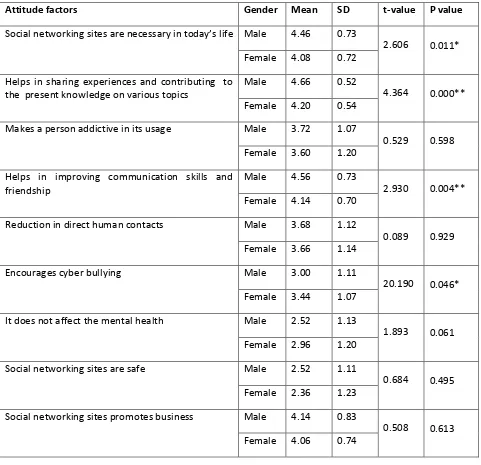
Table 4: Dependence between gender and attitude of the students
Attitude factors Gender Mean SD t-value P value
Social networking sites are necessary in today’s life Male 4.46 0.73
2.606 0.011* Female 4.08 0.72
Helps in sharing experiences and contributing to the present knowledge on various topics
Male 4.66 0.52
4.364 0.000** Female 4.20 0.54
Makes a person addictive in its usage Male 3.72 1.07
0.529 0.598 Female 3.60 1.20
Helps in improving communication skills and friendship
Male 4.56 0.73
2.930 0.004** Female 4.14 0.70
Reduction in direct human contacts Male 3.68 1.12
0.089 0.929 Female 3.66 1.14
Encourages cyber bullying Male 3.00 1.11
20.190 0.046* Female 3.44 1.07
It does not affect the mental health Male 2.52 1.13
1.893 0.061 Female 2.96 1.20
Social networking sites are safe Male 2.52 1.11
0.684 0.495 Female 2.36 1.23
Social networking sites promotes business Male 4.14 0.83
Good way to pass time Male 4.14 0.88
3.539 0.001** Female 3.46 1.03
Source: Primary data, **denotes significant at 1% level, *denotes significant at 5% level
The averages for level of attitude between two groups regarding sharing experiences and contributing to present knowledge, improving communication skills, and SNS as a medium to pass time are approximately equal and the null hypothesis is rejected as the t-value, 4.364, 2.930, and 3.539 are significant at 1% level of significance (p < 0.01). Thus there is difference in the mean level of attitude towards SNS between male and female students with respect to opinion regarding sharing experiences and contributing to present knowledge, improving communication skills, and SNS as a means to pass time.
With respect to averages for level of attitude between two groups regarding its necessity in today’s life and encouraging cyber bullying are approximately equal and the null hypothesis is rejected as the t-value 2.606 and 20.190 are significant at 5% level of significance. Since P value is < 0.05, it is implied that there is difference in the mean level of attitude between male and female students on the necessity of SNS in today’s life and opinion regarding cyber bullying encouragement.
With respect to the averages for level of attitude between male and female students regarding its ability to make a person addictive in its usage, reducing direct contacts with people, affecting the mental health of its users, its safety issues, and promotion of business are approximately equal and the null hypothesis is accepted as the t-value 0.529, 0.089, 1.893, 0.684, and 0.508 are not significant at 5% level. Since p value is > 0.05, it is concluded that there is no difference in the mean level of attitude between male and female students with respect to the opinion regarding its tendency to make a person addictive in its usage, reducing direct human contacts, affecting the mental health of its users, its safety issues, and also opinion regarding promotion of business by SNS. Students have disagreed with the fact that SNS are safe and they agree that SNS affect the mental health of its users (table no. 4).
Dependence between age group and attitude of students:
Among the users of SNS 60% of the male students are between the age group of 18 – 20 years and 48% of the female students are between the age group of 21 – 23 years and majority (59%) of the female non-users of SNS comes under the age group of 18 – 20 years. Thus the study shows that majority of the students who are users and non-users of SNS seem to be on the younger side as per table no. 2. The hypothesis is as follows:
Table 5: Dependence between age group and attitude of students
Age group Mean SD F value P value
18 - 20 years 37.58 3.53 2.217 0.073
21 - 23 years 36.91 3.36
24 - 26 years 35.00 3.33
27 - 29 years 34.43 4.20
30 years & above 35.73 3.29
Source: Primary data
Since P value is > usual threshold value of 0.05, the null hypothesis is accepted at 5% level of significance implying that there is no significant difference between age group and attitude of students towards SNS (as per table no. 5).
Dependence between place of residence and attitude of students:
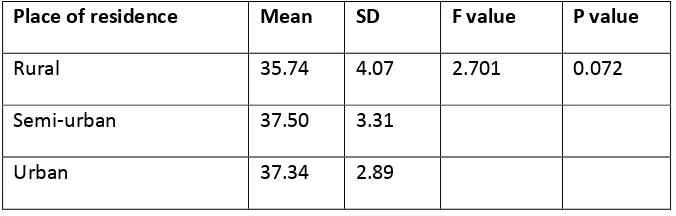
As per table no. 2 majority of the male students belong to urban area (56%) and majority of the female students belong to rural area (52%) with respect to the place of residence of users of SNS. In case of all female non-users most of them belong to rural area (67%). Even though the population of the study is situated in Kottayam district, students residing in other districts also study in these colleges and it may be observed that the students are accessing SNS irrespective of their place of residence. The hypothesis is as follows:
H03: There is no significant difference between place of residence and student’s attitude towards SNS.
Table 6: Dependence between place of residence and attitude of students
Place of residence Mean SD F value P value
Rural 35.74 4.07 2.701 0.072
Semi-urban 37.50 3.31
Urban 37.34 2.89
Source: Primary data
Dependence between type of college and attitude of students:
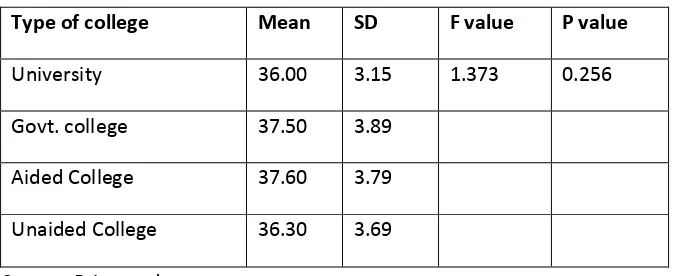
H04: There is no significant difference between type of college and student’s attitude towards SNS.
Table 7: Dependence between type of college and attitude of students
Type of college Mean SD F value P value
University 36.00 3.15 1.373 0.256
Govt. college 37.50 3.89
Aided College 37.60 3.79
Unaided College 36.30 3.69
Source: Primary data
Since P value is > usual threshold value of 0.05, the null hypothesis is accepted at 5% level of significance implying that there is no difference between the type of college and student’s attitude towards SNS (table no. 7).
Dependence between course of study and attitude of students:
Majority of the male students are doing UG (72%) and majority of the female students are doing PG (48%) followed by PhD (28%) in case of users of SNS. In case of female non-users majority of them are UG students. Thus the study shows that females pursue much higher education when compare to males (table no. 1).
H05: There is no significant difference between course of study and student’s attitude towards SNS.
Table 8: Dependence between course of study and attitude of students
Course of study Mean SD F value P value
UG 37.28 3.26 3.602 0.016*
PG 37.43 3.74
M. Phil 33.50 3.54
PhD 34.92 3.39
Source: Primary data, *denotes significant at 5% level
The opinions of the students regarding the positive effects were also asked in a ranking scale by 5 indicating most important and 1 indicating least important. In case of opinions of students regarding the negative effects the students were asked to respond in a ranking scale by 5 indicating least important and 1 indicating most important. Five statements each were used to measure the student’s opinions regarding the positive and negative effects of social networking sites.
Positive effects of SNS on students:
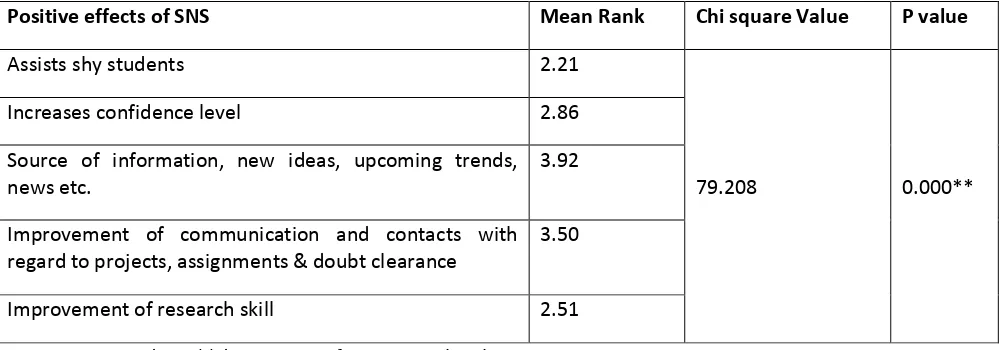
H06: There is no significant difference between mean ranks among the positive effect factors of SNS.
Table 9: Positive effects of SNS
Positive effects of SNS Mean Rank Chi square Value P value
Assists shy students 2.21
79.208 0.000**
Increases confidence level 2.86
Source of information, new ideas, upcoming trends, news etc.
3.92
Improvement of communication and contacts with regard to projects, assignments & doubt clearance
3.50
Improvement of research skill 2.51
Source: Primary data, **denotes significant at 1% level
Since P value is < 0.01 the null hypothesis is rejected at 1% level of significance. Hence it is concluded that there is significant difference between the mean ranks of positive effect factors of SNS. Based on mean rank the most important positive effect factors according to students are that SNS is a source of information, new ideas, upcoming trends, news etc. (3.92) followed by improvement of communication and contacts with regard to projects, assignments and doubt clearance (3.50) and thirdly SNS increases the confidence level of its users (2.86) (table no. 9).
Negative effects of SNS:
H07: There is no significant difference between mean ranks among negative effect factors of SNS.
Table 10: Negative effects of social networking sites
Negative effects of SNS Mean Rank Chi square
Value
P value
Social networking sites reduces learning and thinking capabilities
3.00
grades
Reduces command over language usage and creative writing skills
3.32
Leads to wastage of time on unproductive things 2.44 Effects the physical and mental health of students 3.39 Source: Primary data, **denotes significant at 1% level
Since P value is < 0.01 the null hypothesis is rejected at 1% level of significance. Hence it is concluded that there is significant difference among the mean rank of negative effect factors of SNS. The most important factor as per the mean rank is that the SNS leads to wastage of time on unproductive things (2.44). Other negative effects of SNS includes lack of concentration in learning which leads to low grades (2.85) and SNS reduces learning and thinking capabilities (3.00) as per the opinion of students (table no. 10).
Conclusion:
We are living in an extremely digitised epoch. People can hardly live without computer and Internet. While we are approving the convenience and advantages brought by the internet, there is growing concern about addictive internet usage and SNS among students. In this study we found that SNS have become a part of students’ life irrespective of their personal and geographical differences. It is observed that there is significant difference between usage pattern and percentage of marks scored by the students. The study shows that there is a relation between the marks scored by students and their use and non-use of SNS. There seems to be difference in the mean level of attitude towards SNS among male and female students with respect to opinion regarding sharing experiences and contributing to present knowledge, improving communication skills, and SNS as a means to pass time. There is also a difference in the mean level of attitude among male and female students on the necessity of SNS in today’s life and cyber bullying encouragement. There is no difference in the mean level of attitude among male and female students with respect to its tendency to make a person addictive in its usage, reducing direct human contacts, affecting the mental health of its users, its safety issues, and in promoting business.
References:
Research papers:
1. Bijaria, B., & et.al. (2013). The impact of virtual social networks on students' academic Achievement in Birjand University of Medical Sciences in East Iran. Procedia - Social and Behavioral Sciences, 83, 103 – 106.
2. Jain, M. R., & Gupta, P. (2012). Impact of social networking sites in the changing mindset of youth on social issues - A study of Delhi - NCR youth. Journal of Arts, Science & Commerce, III (1(1)), 36 - 43.
3. Kalra, R. K., & Manani, P. (2013). Effect of Social Networking Sites on Academic Achievement among Introverts and Extroverts. Asian Journal of Social Sciences & Humanities, 2 (3), 401 - 406. 4. Lavy, V. (2014). The Effect of Social Networks on Student’s Academic and Non-Cognitive
Behavioral Outcomes: Evidence from Conditional Random Assignment of Friends in School.
University of Warwick, Hebrew University, and NBER.
5. Roy, S. D., & Chakraborthy, S. K. (2015). Impact of social media/social networks on education and life of undergraduate level students of Karimganj town - A survey. International Research Journal of Interdisciplinary and Multidisciplinary Studies, 1 (1), 141 - 147.
6. Wang, Q., & et.al. (2011). The Effects of Social Media on College Students. MBA Student Scholarship. Paper 5.
Websites:
www.smallbusiness.chron.com
www.edtechreview.in
www.akhmadriyantoblog.wordpress.com
www.zdnet.com/article/cyberbullying
www.puresight.com
www.nobullying.com
www.tnvrstar.hubpages.com
www.adweek.com
www.publipage.com