Ad-Hoc Secure Two-Party Computation on
Mobile Devices using Hardware Tokens
(Full Version)
∗Daniel Demmler, Thomas Schneider, and Michael Zohner
Technische Universit¨at Darmstadt, Germany
{
daniel.demmler,thomas.schneider,michael.zohner
}
@ec-spride.de
July 3, 2014
Abstract
Secure two-party computation allows two mutually dis-trusting parties to jointly compute an arbitrary function on their private inputs without revealing anything but the result. An interesting target for deploying secure compu-tation protocols are mobile devices as they contain a lot of sensitive user data. However, their resource restriction makes the deployment of secure computation protocols a challenging task.
In this work, we optimize and implement the secure computation protocol by Goldreich-Micali-Wigderson (GMW) on mobile phones. To increase perfor-mance, we extend the protocol by a trusted hardware to-ken (i.e., a smartcard). The trusted hardware toto-ken allows to pre-compute most of the workload in an initialization phase, which is executed locally on one device and can be pre-computed independently of the later communication partner. We develop and analyze a proof-of-concept im-plementation of generic secure two-party computation on Android smart phones making use of a microSD smart-card. Our use cases include private set intersection for finding shared contacts and private scheduling of a meet-ing with location preferences. For private set intersection, our token-aided implementation on mobile phones is up to two orders of magnitude faster than previous generic secure two-party computation protocols on mobile phones and even as fast as previous work on desktop computers.
1
Introduction
Secure two-party computation allows two parties to pro-cess their sensitive data in such a way that its privacy
∗Please cite the conference version of this work published at
USENIX Security’14 [DSZ14].
is protected. In the late eighties, Yao’s garbled cir-cuits protocol [Yao86] and the protocol of Goldreich-Micali-Wigderson (GMW) [GMW87] showed the fea-sibility of secure computation. However, secure com-putation was considered to be mostly of theoretical in-terest until the Fairplay framework [MNPS04] demon-strated that it is indeed practical. Since then, many op-timizations have been proposed and several frameworks have implemented Yao’s garbled circuits protocol (e.g., FastGC [HEKM11]) and the GMW protocol (e.g., the framework of [CHK+12]) on desktop PCs.
Motivated by the advances of secure computation on desktop PCs, researchers have started to investigate whether secure computation can also be performed in the mobile domain. Mobile devices, in particular smart-phones, are an excellent environment for secure computa-tion, since they accompany users in their daily lives and typically hold contact information, calendars, and pho-tos. Users also store sensitive data, such as passwords or banking information on their devices. Moreover, typical smartphones are equipped with a multitude of sensors that collect a lot of sensitive information about their users’ contexts. Therefore, it is of special importance to protect the privacy of data handled in the mobile domain.
Moreover, the limited size of the main memory requires the programmer to carefully handle data objects in order to avoid costly garbage collections on Java-based Android smartphones. Network connections of mobile devices are almost exclusively established via wireless connections that have lower bandwidth and higher, often varying la-tency compared to wired connections. Tasks that are computationally intensive or require long send/receive operations should be avoided when a mobile device is running on battery, as such tasks quickly drain the battery charge and thereby reduce the phone’s standby time. In-stead, such operations could be pre-computed when the mobile device is connected to a power source, which usu-ally happens overnight. These limitations pose a big chal-lenge for efficient secure computation and cause generic secure computation protocols to be several hundred times slower on mobile devices than on desktop PCs [HCE11], even in the semi-honest adversary model.
To enable secure two-party computation in the mobile domain, solutions have been developed that outsource secure computation to the cloud, e.g., [KMR12,Hua12,
CMTB13]. However, recent events have shown that cloud service providers can be forced to give away data to third parties that are not necessarily trusted, such as foreign government agencies. Even if the employed protocols en-sure that the cloud provider learns no information about the users’ sensitive data, he can still learn and hence be forced to reveal meta-information such as the frequency of access, communication partners involved, the com-puted function, or the size of the inputs. Moreover, these server-aided approaches require the mobile device to be connected to the Internet which might not be possible in every situation or may cause additional costs.
An alternative solution, which we also use in this work, is to outsource expensive operations to a trusted hardware token that has very limited computational resources and is locally held by one of the communication partners.1Such hardware tokens are increasingly being adopted in prac-tice, e.g., trusted platform modules (TPMs). Their adop-tion is particularly noteworthy on mobile devices in the form of smartcards that are the basis for subscriber iden-tity modules (SIM cards), as well as for mobile payment or ticketing systems. A first approach for outsourcing Yao’s garbled circuits protocol to such a trusted hardware token was proposed in [JKSS10]. However, this protocol requires the function to be known in advance and uses costly symmetric cryptographic operations during the on-line phase. We give an alternative solution that removes these drawbacks.
1This locality is also a security feature, as external adversaries either
need to corrupt the token before it is shipped to the user or later get physical access to break into it.
1.1
Outline and Our Contributions
In this work, we introduce a scheme for token-aided ad-hoc generic secure two-party computation on mobile de-vices based on the GMW protocol. After introducing pre-liminaries (§2) we detail our setting and trust assumptions that are similar to the ones in a TPM scenario (§3). We outline how a trusted hardware token can be used to shift major parts of the workload into an initialization phase that can be pre-computed on the token, independently of the later communication partner (§4), e.g., while the mo-bile device is charging. We thereby obtain a token-aided scheme that is well-suited for efficient and decentralized (ad-hoc) secure computation in the mobile domain. We implement and evaluate our scheme (§5) and demonstrate its performance using typical secure computation appli-cations for mobile devices, such as securely scheduling a meeting with location preferences and privacy-preserving set intersection (§6). We compare our scheme to related work (§7) and conclude and present directions for future work (§8). More detailed, our contributions are as follows.
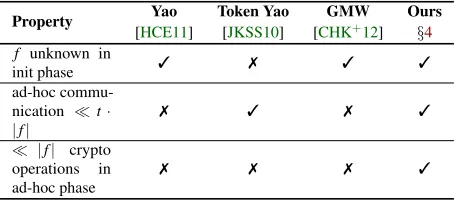
Token-Aided Ad-Hoc Secure Two-Party Computa-tion on Mobile Devices (§4) We develop a token-aided secure computation protocol which offloads the main workload of the GMW protocol to a pre-computation phase by introducing a secure hardware tokenT, held by one partyA(cf.§3).T is issued by a trusted third party and provides correlated randomness [Hua12, Chap. 6] to both parties that is later used in the secure computa-tion protocol. To prepare the secure computacomputa-tion, the other partyBobtains seeds for his part of the correlated randomness fromT via an encrypted channel. To fur-ther increase flexibility, we describe how to make the pre-computation independent of the size of the evaluated function|f|, at the cost of at·log2|f|factor communica-tion overhead betweenT andB, wheretis the symmetric security parameter. In contrast to Yao-based approaches [MNPS04,JKSS10,HCE11,HEK12] and previous realiza-tions of the GMW protocol [CHK+12,SZ13,ALSZ13], our protocol offers several benefits as summarized in Tab.1(cf.§4.5for details).
Table 1: Comparison with related work.
Property Yao Token Yao GMW Ours
[HCE11] [JKSS10] [CHK+12] §4
f unknown in
init phase 3 7 3 3
ad-hoc commu-nication t· |f|
7 3 7 3
|f| crypto operations in ad-hoc phase
Implementation (§5) We implement our token-aided protocol for semi-honest participants and evaluate its performance using two consumer-grade Android smart-phones and an off-the-shelf smartcard. Thereby, we pro-vide an estimate for the achievable runtime of generic secure computation in the mobile domain. Our imple-mentation enables a developer to specify the functionality as a Boolean circuit, which can, for instance, be gener-ated from a high-level specification language. We show that the performance of our token-aided pre-computation phase is comparable to interactively generating the corre-lated randomness using oblivious transfer.
Applications (§6) We demonstrate the practical feasi-bility of the GMW protocol on mobile devices by perform-ing secure two-party computation on two smartphones using various privacy-preserving applications such as availability scheduling (§6.1), location-aware schedul-ing (§6.2), and set-intersection (§6.3). Most notably, for private set-intersection, our token-aided scheme outper-forms related work that evaluates generic secure compu-tation schemes on mobile devices [HCE11] by up to two orders of magnitude and has a performance that is compa-rable with secure computation schemes that are executed in a desktop environment [HEK12].
2
Preliminaries
In the following, we define our notation (§2.1) and the ad-hoc scenario (§2.2), and give an overview of oblivious transfer (§2.3) and the GMW protocol (§2.4). We describe Yao’s garbled circuits in Appendix§A.
2.1
Notation
We denote the two parties that participate in the secure computation asAandB. We use the standard notation for bitwise operations, i.e.,x⊕ydenotes bitwise XOR,
x∧y bitwise AND, andx||y the concatenation of two bit stringsxandy. We refer to the symmetric security parameter astand the function to be evaluated as f.
2.2
Ad-Hoc Scenario
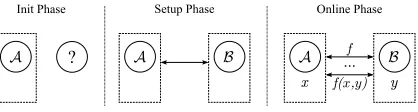
In anad-hocsecure two-party computation scenario, two parties that do not necessarily know each other in advance want to spontaneously perform secure computation of an arbitrary function f on their private inputsxand y. Traditionally, secure computation protocols consist of two interactive phases: thesetup phase(independent ofx
andy) and theonline phase. We extend this setting by a localinit phaseas depicted in Fig.1.
The init phase takes place at any time before the parties have identified each other and is used for pre-processing.
A B
Init Phase Setup Phase Online Phase
A ... B
? A
f(x,y)
x y
f
Figure 1: The three secure computation phases.
In the setup phase, the parties have determined their com-munication partner, establish a comcom-munication channel, and know an upper bound on the function size|f|. In the online phase, the parties provide their private inputsx
andyto the function f that they want to evaluate and begin the secure computation. Thead-hoc timeis the combined time for setup and online phase.
2.3
Oblivious Transfer
Oblivious transfer (OT) is a fundamental building block for secure computation. In an OT protocol [Rab81], the sender inputs two strings(s0,s1). The receiver inputs a bitc∈ {0,1}and obtainsscas output without revealing
to the sender which of the two messages he chose and without the receiver learning any information abouts1−c.
OT protocols, such as [NP01], require public-key cryp-tography and make OT a relatively costly operation. OT extension [IKNP03] allows to increase the efficiency of OT by extending a small number oftbase OTs to a large numberntof OTs whilst only usingO(n)symmetric cryptographic operations. Optimizations to the OT exten-sion protocol of [IKNP03] were suggested in [ALSZ13], which allow the parties to reduce the amount of data sent per OT. Moreover, [ALSZ13] describes a more efficient variant of the OT extension protocol for computing ran-dom OT, where the sender obtains two ranran-dom values as output of the OT protocol.
2.4
The GMW Protocol
In the GMW protocol [GMW87], two (or more) parties compute a functionf, represented as Boolean circuit on their private inputs by secret sharing their inputs using an XOR secret sharing scheme and evaluatingf gate by gate. Each party can evaluate XOR gates locally by com-puting the XOR of the input shares. AND gates, on the other hand, require the parties to interact with each other by either evaluating an OT or by using amultiplication
triple[Bea91] as shown in Appendix§B. Finally, all
Because an interactive OT is required for each AND gate, it was believed that GMW is very inefficient com-pared to Yao’s garbled circuits. However, in [CHK+12] it was shown that by using OT extension [IKNP03] and OT pre-computation [Bea95] many OTs can be pre-computed efficiently in an interactive setup phase. Thereby, all use of symmetric cryptographic operations is shifted to the setup phase, leaving only efficient one-time pad opera-tions for the online phase. Additionally, the setup phase only requires an upper bound on |f| to be known be-fore the secure computation. Follow-up work of [SZ13] demonstrated that, by using OT to pre-compute multipli-cation triples in the setup phase, the online phase can be further sped up. Multiplication triples are random-looking bitsai,bi,andci, fori∈ {A,B}, satisfying(cA⊕cB) = (aA⊕aB)∧(bA⊕bB), that are held by the respective
parties and used to mask private data during the secure computation. This masking is done very efficiently, since no cryptographic operations are required. In [ALSZ13] it was shown that multiplication triples can be generated interactively using two random OTs. [Hua12] proposed to let a trusted server generate the multiplication triples and send(ai,bi,ci)to partyiover a secure channel via
the Internet. In our work, we propose to do this locally, without knowing the communication partner in advance.
3
Our Setting
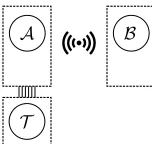
In our setting, depicted in Fig. 2, we focus on ef-ficient ad-hoc secure computation between two semi-honest (cf.§3.1) partiesAandB who each hold a mobile device, which are approximately equally powerful but sig-nificantly weaker than typical desktop computer systems. The parties’ devices are connected via a wireless network and are battery-powered.
T
A B
Figure 2: The parties involved in the secure computation.
Aholds a general-purpose tamper-proof hardware to-kenT that has very few computational resources. T is powered byA, and its functionalities are limited to the standard functionalities described in§3.2. AandT are connected via a physical low-bandwidth connection and communicate via a fixed interface. BandT communi-cate viaA, i.e., every message thatBandT exchange, is seen and relayed byA. Note that this directly requires all communication betweenBandT to be encrypted such
that it cannot be read byA. We assume thatT behaves semi-honestly, and is issued by a third party, external to and trusted by bothAandB(cf.§3.2).
3.1
Adversary Model
We assume that both parties behave semi-honestly in the online phase, i.e., they follow the secure computation pro-tocol, but may try to infer additional information about the other party’s inputs from the observed messages. To the best of our knowledge, all previous work on secure computation between two mobile phones is based on the semi-honest model (cf.§7.1). The semi-honest model is suitable in scenarios where the parties want to prevent inadvertent information leakage and for devices where the software is controlled by a trusted party (e.g., business phones managed by an IT department) or where code attestation can be applied. Moreover, this model gives an estimate on the achievable performance of secure compu-tation. We outline how to extend our protocol to malicious security in Appendix§F.
3.2
Trusted Hardware Token
We use the term trusted hardware tokenT to refer to a tamper-proof, programmable device, such as a Java smart-card, that offers a restricted set of functionalities. Such functionalities include, for instance, hashing, symmetric and asymmetric encryption/decryption, secure storage of private keys, and secure random number generation. A detailed summary of standard smartcard functionalities is given in [HL08]. The hardware token is passive, i.e., it cannot initiate a communication by itself and only re-sponds to queries from its host. It contains both persistent and transient memory.T is physically protected against attacks and is securely erased if it is opened by force. Each token holds an asymmetric key pair, similar to an en-dorsement key used in TPMs [TCG13], where the public key is certified by a known trusted third party and allows unique identification ofT.
reputation loss if it was discovered that they built back-doors into their products. Moreover, we assume that neitherAnorBcolludes with the hardware token man-ufacturer. This non-collusion assumption is a common requirement for outsourced secure computation schemes such as [Hua12,KMR12,CMTB13] and enables the con-struction of efficient protocols. Finally, note that, although
T is inA’s possession,Acannot easily corruptT or ob-tain its internal information, sinceT is assumed to be tamper-proof and does not reveal internal secrets, i.e., the costs of an attack are higher than the benefits from break-ingT’s security. This assumption also holds ifAcolludes with or impersonatesB.
Protection Against Successful Hardware Attacks
A malicious adversary could try to break into the hard-ware token. If such an attack is successful, the following standard countermeasures can be used to prevent further damage: A binding between token and key pair can be re-alized by using techniques such as physically uncloneable functions (PUFs), however, we are not aware of solutions that are available in commercial products. To bind a to-ken to a certain mobile device or person,T’s certificate could be personalized with one or multiple values that are unique per user and that can be verified over an off-band channel, such as the user’s telephone number or the ID of the user’s passport. Another line of defense can be certifi-cate revocation lists (CRLs) that allow the users to check if a token is known to be compromised or malicious.
4
Token-aided Mobile GMW
In the following section, we give details on our token-aided GMW-based protocol on mobile devices. Our goal is to minimize the ad-hoc time, i.e., the time from es-tablishing the communication channel betweenAandB
until receiving the results of the secure computation. We consider the init phase to not be time critical, but we try to keep its computational overhead small.
A A B
InitvPhase
MTvGen.v(§4.1)
SetupvPhase
SeedvTransferv(§4.2)
OnlinevPhase
CircuitvEvaluation
T T T
A ... B
Figure 3: The three phases, workload distribution, and communication in our token-aided scheme.
An overview of our protocol is given in Fig.3. The general idea is to let the hardware token generate mul-tiplication triples from two (or more) seeds in the init phase that are independent of the later communication partner (§4.1). In the setup phase, T then sends one seed toAand the other seed over an encrypted channel toB(§4.2). The token thereby replaces the OT protocol in the setup phase and allows pre-computing the mul-tiplication triples independently of the communication partner. The online phase of the GMW protocol remains unchanged. In order to overcome the restriction that the function size needs to be known in advance, we describe a method that pre-computes several multiplication triple sequences of different size and only adds a small commu-nication overhead in the setup phase (§4.3). Finally, we analyze the security of our protocol (§4.4) and compare its performance to previous solutions (§4.5).
4.1
Multiplication Triple Pre-Computation
in the Init Phase
In the original GMW protocol, Aand B interactively compute their multiplication triples (anA,bnA,cnA) and
(anB,bnB,cnB)in the setup phase using 2nrandom OT ex-tensions (cf.§2.4). Instead, we avoid this overhead in the setup phase and letT pre-compute the multiplication triples in the init phase as shown in Fig.4:T first gener-atesrandom seeds and thenexpandsthese seeds internally into the multiplication triples and sendscnAtoA.
d sB
cn B bn
B an
B
kB sA
bn A an
A
kA cnA
T A
cn A
Seed Expansion
Seed Generation
Figure 4: Multiplication triple pre-generation in the init phase betweenAandT.
Seed Generation In the seed generation step,T gen-erates two seedssA=GkA(d)andsB=GkB(d)using a cryptographically strong Pseudo-Random Generator (PRG)G, two master keyskAandkB, and a state valued,
andkBare constant for all multiplication triple sequences
and have to be generated and stored only once. Thereby,
T has to store only the unique state valuedin its internal memory for every multiplication triple sequence. Note that the only values that will leave the internal memory ofT are the seedssA and sB that will be sent in the
setup phase toAandB, respectively (cf.§4.2). In order to ensure that sB is not sent out twice, we requiresA
to be queried beforesB and delete the state valued as
soon assBhas been sent out over the encrypted channel.
A security analysis of this scheme is given in§4.4.
Seed Expansion The seed expansion step com-putes a valid multiplication triple sequence from the seedssAandsBby computing(anA,bnA) =GsA(dA)and
(an
B,bnB,cnB) =GsB(dB)and setting the remaining value
cn
A= (anA⊕anB)∧(bnA⊕bnB)⊕cnB, wheredAanddBare
publicly known state values of Aand B, respectively. Due to the limited memory of the hardware token, the sequencecnAis computed block-wise such thatT requires only a fixed amount of memory, independently ofn, and each block is sent toA, who stores it locally. Note that the values(anA,bnA,anB,bnB,cnB)do not need to be stored, since they can be expanded fromsAandsB, respectively.
4.2
Seed Transfer in the Setup Phase
In the setup phase, the hardware token sends the seedssA
andsBtoAandB, respectively, and the parties generate
their multiplication triples as depicted in Fig.5.Aobtains his seedsAdirectly fromT and can read the sequence cnA, which was obtained in the init phase, from its internal flash storage. B’s seedsB, on the other hand, cannot
be sent in plaintext fromT toB as the communication between the token andBis relayed overA, which would allow Ato interceptsB and thus break the security of
the scheme. We therefore require the communication betweenBandT to be encrypted andT to authenticate itself toBwith a certificate.
d sB
kB sA
kA
T A
sA bn
A an
A
B
sB bn B an
B cnB
cn A
Figure 5: Seed transfer and seed expansion in the setup phase.sBis sent fromT toBover a secure channel.
An encrypted and one-way authenticated communica-tion channel can be established using a key agreement protocol from a wide variety of choices (cf. [MvOV96]). We choose two protocols that allow us to handle different attacker models: For security against a malicious (ac-tive)Awe useTLS[IET08] (with RSA for public-key crypto, AES for symmetric encryption, and HMAC as message authentication code) and for security against a semi-honest (passive)Awe use KAS1-basic [NIS09] (with AES for symmetric encryption), cf. Appendix§C
for details. Both schemes useT’s public-key certificate that is signed by a trusted third party. For every new connection this certificate is verified byBand optionally checked against a CRL and/or is checked to be consistent withA’s identity over an out-of-band channel to protect against successful hardware attacks (cf.§3.2).
4.3
Multiplication Triple Composition
The multiplication triple generation described until now requires the function sizen=|f|to be known beforehand. While this may be the case for some functions, e.g., for set intersection using bitwise AND (cf.§6.1), the size of other functions depends on the number of inputs, e.g., the number of contacts in the address book (cf.§6.3). The naive solution to not knowingnin advance would be to generate several multiplication triple sequences of fixed size`in the init phase and send theirdn/`eseeds in the setup phase, whennis known. However, on aver-age this approach wastes`/2 multiplication triples and requires to senddn/`emultiplication triple seeds. Thus, a smaller`results in fewer wasted multiplication triples but more communication overhead, while a higher`results in more wasted multiplication triples but less communica-tion. Since typical function sizes in secure computation range from millions [HEKM11] to even a billion AND gates [CMTB13], an appropriate`is difficult to choose.
Instead of generating fixed-length blocks of multipli-cation triple sequences, we propose to generatem mul-tiplication triple sequencess0, ...,sm−1in the init phase, wheresi contains 2i (0≤i<m)multiplication triples.
In the setup phase, we then send a set of multiplication triple seeds{sk|nk=1}, wherenk is thek-th bit ofn.
4.4
Security Analysis
In this section, we briefly analyze the security of our protocol for each of the three secure computation phases.
Init Phase In the init phase no private inputs are in-volved andBis unknown. Therefore,Acan only try to manipulate the token, which is hard since the hardware token is tamper-proof. Moreover,Areceives only itscA
shares that do not reveal anything aboutB’s shares orT’s internal state, due to the cryptographically strong PRG.
Setup Phase The only attack a maliciousAcould play in the setup phase, is to impersonate B. This attack is prevented, since every seed sB can only be queried
once (cf.§4.1). The communication between the hard-ware token andBis done through an encrypted channel, so thatAcannot get access to those messages. For active security, we use TLS and add a MAC to every packet to prevent modifications and avoid replay attacks.Bcannot actively attack the token since all communication to the hardware token is controlled byA. Obviously, any party can drop or ignore messages, but we exclude this simple denial of service attack from our system model since we assume both parties to be willing to participate in the secure computation. The seeds that each party obtains from the hardware token do also not reveal any additional information since they are directly output from a crypto-graphically strong PRG to which the hardware token’s internal state is used as seed.
Online Phase The security for the online phase directly carries over from the GMW protocol, as we do not intro-duce any modifications to this phase.
4.5
Performance Comparison
We show that the asymptotic performance of our protocol improves over existing solutions. A summary is shown in Tab.1on page2and a more detailed comparison is given in Appendix§D. An experimental evaluation of our protocol is provided in§5.4and its performance on applications is evaluated in§6.
Asymptotic Performance The init phase of our proto-col is, unlike [JKSS10], independent of a concrete in-stance of f and can thus be pre-computed without know-ing a communication partner. Durknow-ing the setup phase, the communication complexity of our protocol is only O(t)
(orO(t·log2|f|)if|f|is unknown), which improves upon the communication of Yao’s protocol and the GMW pro-tocol [CHK+12,SZ13,ALSZ13] withO(t· |f|) commu-nication. Both parties have to doO(|f|/b)symmetric
cryptographic operations to expand their seeds.2The on-line phase is the first phase where f needs to be known. Here,AandBsendO(|f|)bits ind(f)rounds, where
d(f)is the depth of f. The parties’ computation com-plexity is negligible, as no cryptographic operations are evaluated. This is the biggest advantage over Yao’s gar-bled circuits protocol [MNPS04,JKSS10,HCE11], where
O(|f|)symmetric cryptographic operations have to be evaluated during the online phase.
Concrete Performance For 80 bit security, the best known instantiation of Yao’s garbled circuits protocol (resp. the GMW protocol) require per AND gate 240 bit (resp. 164 bit) communication and 4+1 (resp. 12+0) evaluations of symmetric cryptographic primitives in the setup+online phase. In comparison, our solution requires only 4 bit communication and 0.04+0 fixed-key AES operations per AND gate.
5
Implementation
This section details the implementation of our scheme. We introduce the smartcard that we use to instantiate the hardware token (§5.1), give an overview of our An-droid implementation (§5.2), outline our benchmarking environment (§5.3), and experimentally compare the OT extension-based multiplication triple generation to our hardware token-based protocol (§5.4).
5.1
G&D Mobile Security Card
In our implementation we instantiate the trusted hardware tokenT with the Giesecke & Devrient (G&D) Mobile Security Card SE 1.0 (MSC). It is embedded into a mi-croSD card that additionally contains 2 GB of separate flash memory. The MSC is based on an NXP SmartMX P5CD080 micro-controller that runs at a maximum fre-quency of 10 MHz, has 6 kB of RAM, 80 kB of persistent EEPROM, and is based on Java Card version 2.2.2. Note that an applet can only use 1,750 Bytes of the 6 kB RAM for transient storage. The MSC has co-processors for 3DES, AES and RSA that can be called from a Java Card applet, as well as native routines for MD5, SHA-1 and SHA256. The MSC runs the operating system G&D Sm@rtCafe Expert 5.0 which manages the installed Java Card applets, personalization data, and communication keys. The communication between the Android operating system and the MSC is done by a separate service via the SIMalliance Open Mobile API.
2In our implementation, we instantiate the PRGGwith
5.2
Architecture
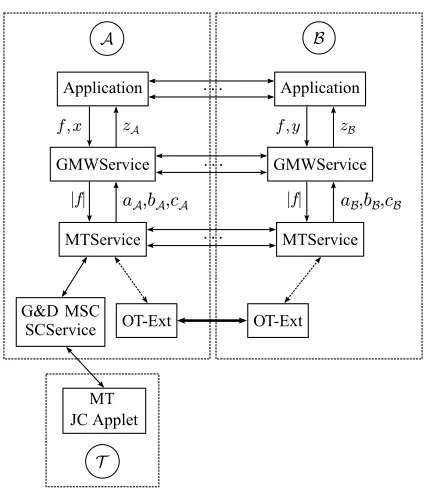
The architecture of our implementation is depicted in Fig.6. To support flexibility and extensibility, our modu-lar architecture consists of theApplicationthat specifies the functionality, theGMWServicethat performs secure computation, and theMTServicethat performs the mul-tiplication triple generation and transfer. All communi-cation betweenAandT is done via the MSC Smartcard Service supplied by G&D. The Application can be im-plemented by a designer and specifies the desired secure computation functionality as a Boolean circuit that can, for instance, be compiled from a high-level circuit de-scription language such as the Secure Function Definition Language (SFDL) [MNPS04,MLB12] or the Portable Circuit Format (PCF) [KMSB13].
The GMWService implements the GMW protocol and performs the secure computation, given a circuit descrip-tion and corresponding inputs. The MTService generates the multiplication triples using either OT extension ( OT-Ext) based on the memory efficient implementation of [HS13] including the optimizations from [ALSZ13] or, if one of the parties holds a hardware token, our token-aided protocol of§4. If a hardware token is present, the MTService manages the multiplication triple generation during the init phase by querying the token and storing the receivedcAsequences. For the MSC, the
multiplica-tion triple generamultiplica-tion onT is performed via a Java Card applet (MT JC Applet) that implements the functionality in§4.1and is accessible through the Java Card interface. Our implementation can be installed as a regular Android app and does not require root access to the smartphone or a custom firmware.
Secure computation is performed by having an Applica-tion running on each smartphone, which specifies the func-tion f both parties want to compute securely. From this function the Application generates a circuit description, which it sends to the GMWService. The GMWService interprets the circuit and queries the MTService for the required number of multiplication triples|f|. The MTSer-vices on both smartphones then communicate with each other and check whether one of the smartphones holds a hardware token (Ain Fig.6). If so, both MTServices perform the seed transfer protocol (cf.§4.2), expand the obtained seeds (Aloads the correspondingcAsequences
obtained in the init phase), and merge the obtained mul-tiplication triple sequences (cf.§4.3). If no hardware token is present, the MTServices generate the multipli-cation triples by invoking OT extension. The MTSer-vice then provides the multiplication triples(ai,bi,ci)for
i∈ {A,B}to the GMWService. Finally, the Applications send their inputsxandy, respectively, to the GMWSer-vice, which performs the secure computation and returns the outputzi=f(x,y).
A B
G&D MSC
SCService OT-Ext
T
. . .
GMWService
MTService
f ; x zA
jfj
Application
aA;bA;cA
GMWService
MTService
OT-Ext
zB
Application
f ; y
jfj aB;bB;cB . . .
MT JC Applet
. . .
Figure 6: Modular architecture design.
5.3
Benchmarking Environment
For our mobile benchmarking environment we use two Samsung Galaxy S3’s, which each have a 1.4 GHz ARM-Cortex-A9 Quad-Core CPU, 1 GB of RAM, 16 GB of internal flash memory, a mircoSD card slot, and run the Android operating system version 4.1.2 (Jelly Bean). For the communication between the smartphones, we use Wi-Fi direct. For the evaluation, we put the smartphones next to each other on a table. The G&D mobile security card is connected to the mircoSD card slot of one of the phones. We use the short-term security setting recommended by NIST [NIS12], i.e., a symmetric key size of 80 bits and a public key size of 1,024 bit with a 160 bit subgroup. We instantiated the pseudo-random generatorGthat is used for seed expansion (cf.§4.1) with AES-128 in CTR mode. The hardware token generates multiplication triple sequences of size 2mfor 11≤m≤24. We usedm=11
as lower bound on the size, since 2,048 is the biggest size we can transfer fromT toAwith a single packet, andm=24 as upper bound, since it was appropriate for our case studies in§6. Finally, we point out that our implementation is single-threaded and utilizes only one of the four available cores of our smartphones. We leave the extension to multiple threads as future work.
5.4
Performance Evaluation
identi-cal single-threaded Java implementation in both domains. The smartphone version is running with 5.5 MB/s while the desktop version achieves 61.1 MB/s. The optimized AES-256 implementation of Truecrypt3, written in C/C++ and assembly, achieves 143.1 MB/s on the same desktop machine, running without parallelization. For compar-ison, the smartcard (cf.§5.1) is running AES-128 at a maximum speed of 16.7 KB/s.
In the following we evaluate the performance of our token-based scheme (cf.§4) on smartphones, using TLS or KAS1-basic as key agreement protocol, and compare it to the OT extension based multiplication triple generation. In our evaluations we only include the time for init and setup phase, since the online phase is identical for both approaches. Results for the online phase are given in§6. All values are averaged over 10 measurements.
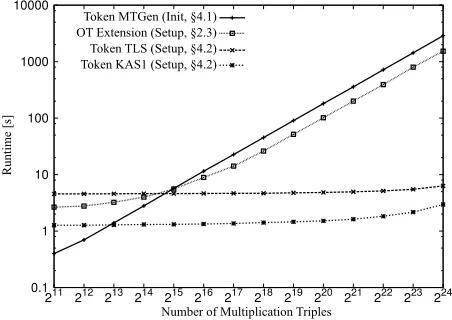
Fig.7gives an overview over the timings for the gen-eration of 2m(11≤m≤24) multiplication triples using either OT extension in the setup phase or the hardware token (§4.1) in the init phase. Additionally, the setup phase using TLS and KAS1-basic is depicted, which in-cludes the seed transfer and the seed expansion of B. We always assume the worst case number of seeds to be transferred, i.e., for 224multiplication triples, we transfer 24−10=14 seeds (cf.§4.3). Both axes in Fig.7are given in a logarithmic scale.
0.1 1 10 100 1000 10000
211 212 213 214 215 216 217 218 219 220 221 222 223 224
Token MTGen (Init, §4.1) OT Extension (Setup, §2.3) Token TLS (Setup, §4.2) Token KAS1 (Setup, §4.2)
Runtime [s]
Number of Multiplication Triples
Figure 7: Performance evaluation of the multiplication triple generation and setup phase.
We observe that OT extension on mobile devices is able to generate 224multiplication triples in 1,529 s, cor-responding to 10,971 multiplication triples per second. We ran the same code on two desktop PCs with a 2.5 GHz Intel Core2Quad CPU and 4 GB RAM, connected via Gi-gabit LAN and were able to compute 224multiplication triples in 139 s, which indicates a performance decrease of factor 11. While the performance decrease on mobile
3http://www.truecrypt.org
devices compared to desktop computers was significantly less than the factor of 1000 observed in [HCE11], it is still insufficient for efficiently computing complex functions such as private set-intersection, which typically requires millions of OTsto be evaluated.
In comparison, the multiplication triple generation of the hardware token during the init phase is able to gener-ate 224multiplication triples in 2,883 s, corresponding to 5,819 multiplication triples per second. For the hardware token-based protocol we observe that the times for send-ing the seeds ussend-ing the TLS and KAS1 key agreement protocols grow very slowly with the number of multipli-cation triples, since the amount of data to be encrypted and sent grows only with log2|f|. Additionally, the TLS-based key agreement protocol (4.6 s for 211multiplication triples) is around factor 3 slower than the KAS1-based key agreement (1.3 s for 211multiplication triples).
The overall computation and communication workload of OT extension is substantially larger than in our token-based scheme, but its multiplication triple generation rate is not much faster. This can be explained by the faster processing power of the smartphones compared to that ofT and the higher bandwidth of Wi-Fi direct compared to the relatively slow communication channel between
AandT. However, OT extension suffers from high en-ergy consumption, due to the CPU utilization incurred by the symmetric cryptographic operations, as well as the Wi-Fi direct communication [PFW11].
We use PowerTutor4to measure the energy consump-tion of the smartphone’s CPU for generating 219 multi-plication triples and compare the interactive evaluation of random OT extensions with our smartcard solution. Note that Fig.8only displays the CPU’s energy consump-tion whereas the energy consumpconsump-tion of Wi-Fi and the smartcard is not included. However, we argue that the en-ergy consumption of the smartcard is not a critical factor, since these operations can be performed when the phone is charging. The Wi-Fi connection, on the other hand, is required for OT during the setup phase, thus increasing the already high battery drain even further. Moreover, the OT computations have to be done on both devices simul-taneously, draining both devices’ batteries. Therefore, our token-based solution is particularly well-suited for the mobile domain, where energy consumption and battery lifetime are critical factors.
6
Applications
To evaluate the performance of our protocols, we use the mobile phones and setting as specified in§5.3and consider the following privacy-preserving applications: availability scheduling (§6.1), location-aware
0 10 20 30 40 50 60 70 80 90
Ener
gy Consumption [Ws]
OT Extension (§2.3) Smartcard (§4.1)
Time [s]
2.5 5.0 7.5 10.0 12.5 15.0 17.5
Figure 8: Accumulated smartphone CPU energy con-sumption during the generation of multiplication triples.
ing (§6.2), and set intersection (§6.3). We implemented the applications and depict the performance results for an average of 10 iterations. We use KAS1-basic (cf.§C) as key authentication scheme. We pre-generated the circuits using the framework of [SZ13], wrote them into a file, and read them on the smartphone. The time for reading the circuit file is included in the setup phase.
6.1
Availability Scheduling
Privacy-preserving availability scheduling is a com-mon example for secure computation on mobile de-vices [HCC+01,BJH+11] and enablesAandBto find a possible time slot for a meeting without disclosing their schedules to each other. To schedule a meeting,AandB
specify a duration and time frame for the meeting. Each partyi∈ {A,B}then divides the time frame when the meeting can take place (e.g., a week) inton time slots
tn
i = (ti,1, ...,ti,n)and denotes each time slotti,j∈ {0,1}
as either free (ti,j=1) or occupied (ti,j=0). The parties
compute their common availabilitytn
Availby computing
the bitwise AND of their time slots, i.e.,tAvailn =tAn ∧tBn. Overall, this circuit hasnAND gates and depth 1. Note that the bitwise AND circuit performs a general function-ality and can, for instance, be used for privacy-preserving set intersection where elements are taken from a small domain [HEK12] or location matching [CADT13]. For our experiments, we set the time frames s.t. meetings can be scheduled between 8 am and 10 pm for one day divided into 15 minute slots (n=56 slots), one week di-vided into 15 minute slots (n=392 slots), and one month divided into 10 minute slots (n=2,604 slots). We depict our results in the upper half of Tab.2.
The multiplication triple generation in the init phase can be performed in several hundred milliseconds, since it requires only one (for 56 and 392 time slots) or two
(for 2,604 time slots) packet transfers betweenT andA. The setup phase, more detailed the seed transfer protocol, is the main bottleneck in this application, asT has to perform asymmetric and symmetric cryptographic opera-tions. Finally, the online phase requires only milliseconds but has a high variance, due to the communication over Wi-Fi direct and the small number of communication rounds that are performed in the online phase.
For comparison, we evaluated the same circuit using the mobile Yao implementation of [HCE11] on the same phones, which took factor 1.6 (for the day time frame) up to factor 12 (for the month time frame) longer, cf. Tab.2.
Table 2: Performance for availability and location-aware scheduling.|f|is the size of the circuit andd(f)its depth. All values measured on smartphones (cf.§5.3).
Time Frame Day Week Month Availability Scheduling§6.1
|f|/d(f) 56 / 1 392 / 1 2,604 / 1 Init [s] 0.37(±1.6%) 0.37(±1.6%) 0.73(±1.0%)
Setup [s] 1.3(±13%) 1.3(±13%) 1.3(±13%)
Online [s] 0.002(±150%) 0.003(±167%) 0.007(±129%)
Ad-Hoc [s] 1.3(±13%) 1.3(±13%) 1.3(±13%)
Mobile Yao [HCE11]
Ad-Hoc [s] 2.14(±7.1%) 3.82(±4.7%) 15.9(±2.7%)
Location-Aware Scheduling§6.2
|f|/d(f) 39,864 / 69 280,605 / 87 1,872,206 / 106 Init [s] 6.9(±0.3%) 48.5(±0.2%) 319.6(±0.5%)
Setup [s] 1.4(±7.1%) 1.8(±7.0%) 4.8(±4.8%)
Online [s] 0.16(±35%) 0.82(±7.4%) 5.9(±18%)
Ad-Hoc [s] 1.5(±8.4%) 2.6(±6.5%) 10.7(±11%)
6.2
Location-Aware Scheduling
In the following we show that our system can be adapted to compute arbitrary and complex functions. We intro-duce the location-aware scheduling functionality which extends the availability scheduling of§6.1, s.t. the dis-tance between the users is considered as well. The location-aware scheduling functionality takes into account the user’s location in a time slot, computes the distance between the users, verifies if a meeting is feasible, and outputs the time slot in which the users have to travel the least distance to meet each other. We argue that this approach is practical, since such position information are often already included in the users’ schedules.
In the location-aware scheduling scheme, we assume that the useri∈ {A,B}also inputs the location of the previous appointmentPiand the next appointmentNiand
the distances that he can reach from his previous appoint-mentpiand from his next appointmentni(cf. Fig.9for
an example). Suchpiandnican be computed in
plain-text using the distance betweenPiandNi, the free time
P
Ap
An
AN
AN
Bn
Bp
BP
BFigure 9: Location-aware scheduling for one time slot ofAandBwith previous locationsPAandPB, reachable
distances from previous appointmentspAandpB, next locationsNAandNBand corresponding reachable distancesnA
andnB. The meeting can be scheduled betweenNAandPBas the reachable ranges overlap.
the reachable ranges forAandBoverlap is selected as final result. If successful, the function outputs the identi-fied time slot and for each user whether he should leave from the location of the previous or next appointment. A detailed description of the functionality is given in Ap-pendix§E. We evaluate the scheme on the same number of time slots used in§6.1(day, week, month) and depict the performance in the lower half of Tab.2.
Compared to availability scheduling, the location-aware scheduling circuit is significantly bigger and re-quires more communication rounds. When performing the scheduling for a month, the circuit consists of 1.8 mil-lion instead of 2,604 AND gates for availability schedul-ing. The time for the init phase increases linearly with the number of AND gates and requires 319 s when perform-ing schedulperform-ing for a month. The time for the setup phase is increased less, since the seed transfer grows only logarith-mically in|f|and the seed expansion is done efficiently. The online phase is also slowed down substantially (6 s for a month time frame), but is still practical.
6.3
Private Set Intersection
Private set intersection (PSI) is a widely studied problem in secure computation and can be used for example to find common contacts in users’ address books [HCE11]. It enables two parties, each holding a setSAandSBwith
elements represented asσ-bit strings to determine which elements both have in common, i.e.,SA∩SB, without
disclosing any other contents of their sets. While many special-purpose protocols for PSI exist, e.g., [CT10,
CT12,CADT13], generic protocols mostly build on the work of [HEK12], where the Sort-Compare-Shuffle (SCS) circuit was outlined. The idea is to have both parties
lo-cally pre-sort their elements, privately merge them, check adjacent values for equality, and obliviously shuffle the resulting values to hide their order.
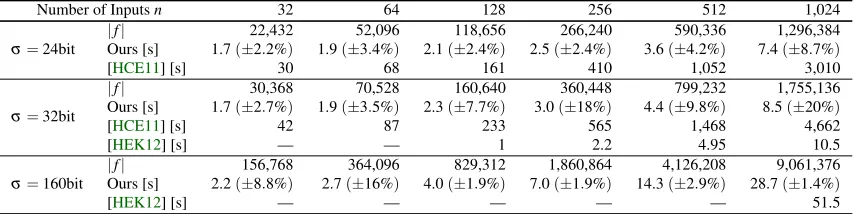
We implement the SCS-WN circuit of [HEK12] which uses a Waksman permutation network to randomly shuffle the resulting elements. We perform the comparison for bit sizesσ∈ {24,32,160}and compare the ad-hoc runtime of our protocol to the implementation of [HCE11] forσ∈
{24,32}. The results from [HEK12] are compared to ours forσ∈ {32,160}. The results are given in Fig.10and in Tab.3. Note that [HCE11] and [HEK12] implement Yao’s garbled circuits protocol using pipelining, whereas we use the GMW protocol.
1 10 100
128 256 512 1024 2048 4096
Ad-HocDRuntimeD[s]
NumberDofDInputs [HEK12]DSCS-WND(Desktop)
§4DTokenDAd-HocD(Phone)
Figure 10: Private set intersection runtime forσ=32 bit elements using our token-based protocol on two smart-phones (§5.3) and [HEK12] on two desktop PCs.
approximate speedup of factor 2 compared to the measure-ments from their paper, that were made on older hardware (two Google Nexus One phones). Note that our perfor-mance results, as well as the values for the implemen-tation of [HCE11] are benchmarked on mobile devices connected via Wi-Fi Direct, while [HEK12] is bench-marked on two desktop PCs (two Core2Duo E8400 3GHz PCs connected via 100 Mbps LAN).
From Fig.10we observe that, due to the seed transfer in our setup phase (cf.§4.2), the Yao’s garbled circuits implementation of [HEK12] is faster for up to 256 in-puts. However, the seed transfer time amortizes for larger inputs and our token-based scheme outperforms the imple-mentation of [HEK12], even though our implementation runs on substantially slower mobile phones while theirs is evaluated on two desktop PCs. From Tab.3we observe that our scheme outperforms the Yao’s garbled circuits implementation of [HCE11], evaluated on identical mo-bile phones, by factor 18 for 32 inputs withσ=24 bit and by up to factor 550 for 1,024 inputs withσ=32 bit. Finally, we compare the performance of our protocol to the PSI protocol of [CADT11,CADT13]. We use their reported numbers for pre-computed PSI on 20 input values and set the bit sizeσ=160 in our protocol.5The protocol of [CADT11,CADT13] needs 3.7 s, while our ad-hoc runtime is only 2.1 s(±4.8%). Note, however, that their approach has only a constant number of rounds and can be sped up using multiple cores.
7
Related Work
We classify related work into three categories: secure function evaluation (§7.1), server-aided secure function evaluation (§7.2), and token-based cryptography (§7.3).
7.1
Generic Secure Function Evaluation
The foundations for secure function evaluation (SFE) were laid by Yao [Yao86] and Goldreich et al. [GMW87] who demonstrated that every function that is efficiently representable as Boolean circuit can be computed securely in polynomial time with multiple parties.
SFE Compiler A first compiler for specific secure two-party computation functionalities was presented in [MOR03]. The Fairplay framework [MNPS04] was the first efficient implementation of Yao’s garbled circuits protocol [Yao86] for generic secure two-party compu-tation and enabled a user to specify the function to be computed in a high-level language. The FastGC frame-work [HEKM11] improved on the results of Fairplay by
5Note that [CADT11,CADT13] also support bigger bit sizes, since
they operate on 1,024-bit ElGamal ciphertexts.
evaluating functions with millions of Boolean gates in mere minutes using optimizations such as the free XOR technique [KS08] and pipelining. The FastGC framework has been used to implement various functions such as privacy-preserving set intersection [HEK12], genomic se-quencing, or AES [HEKM11], and was optimized with respect to a low memory footprint in [HS13].
Next to Yao’s garbled circuits protocol, the GMW pro-tocol [GMW87] recently received increasing attention. The work of [CHK+12] efficiently implemented GMW in a setting with multiple parties. Subsequently, [SZ13] op-timized GMW for the two-party setting and showed that GMW has advantages over Yao’s garbled circuits protocol as it allows to pre-compute all symmetric cryptographic operations in a setup phase and that the workload can be split evenly among both parties.
SFE on Mobile Devices A recent line of research aims at making SFE available on mobile devices, such as smart-phones. In [HCE11] the authors port the FastGC frame-work [HEKM11] to smartphones and observe a substan-tial performance reduction when compared to the desk-top environment. They identify the slower processing speed and the high memory requirements as the main bottlenecks. Similarly, [CMSA12] ported the Fairplay framework [MNPS04] to smartphones. A compiler with smaller memory constraints than Fairplay was presented in [MLB12]. We emphasize that previous works on generic SFE on mobile devices use Yao’s garbled circuits protocol, whereas our approach is based on GMW.
Several special-purpose protocols for mobile de-vices using homomorphic encryption were proposed in [BJH+11] (activity scheduling), [CDA11] (scheduling, interest sharing), and [CADT11,CADT13] (comparison, location-based tweets, common friends). In contrast to generic solutions, such custom-tailored protocols can be more efficient, but are restricted to specific functionalities. Their extension to new use cases is complex and usually requires new security proofs.
7.2
Server-Aided SFE
Table 3: Ad-hoc runtime of private set intersection where each party inputsnvalues ofσbits, measured on identical mobile phones (§5.3). [HEK12] results are on PCs and taken from the paper (— indicates that no numbers were given).
Number of Inputsn 32 64 128 256 512 1,024
σ=24bit
|f| 22,432 52,096 118,656 266,240 590,336 1,296,384
Ours [s] 1.7(±2.2%) 1.9(±3.4%) 2.1(±2.4%) 2.5(±2.4%) 3.6(±4.2%) 7.4(±8.7%)
[HCE11] [s] 30 68 161 410 1,052 3,010
σ=32bit
|f| 30,368 70,528 160,640 360,448 799,232 1,755,136
Ours [s] 1.7(±2.7%) 1.9(±3.5%) 2.3(±7.7%) 3.0(±18%) 4.4(±9.8%) 8.5(±20%)
[HCE11] [s] 42 87 233 565 1,468 4,662
[HEK12] [s] — — 1 2.2 4.95 10.5
σ=160bit
|f| 156,768 364,096 829,312 1,860,864 4,126,208 9,061,376 Ours [s] 2.2(±8.8%) 2.7(±16%) 4.0(±1.9%) 7.0(±1.9%) 14.3(±2.9%) 28.7(±1.4%)
[HEK12] [s] — — — — — 51.5
at least one party to be a machine with more computing power than a mobile phone as it evaluates multiple garbled circuits. [Hua12] proposes that a trusted server generates multiplication triples that are sent to both parties over a secure channel, requiringO(|f|)bits communication. Instead, we propose to replace the server with a trusted hardware token and show that the communication to one party can be reduced to sub-linear complexity. Moreover, they achieve security against malicious adversaries based on [NNOB12]; we sketch how to extend our work to malicious security in Appendix§F.
We consider this line of research as orthogonal to ours, since it focuses on outsourcing secure computations to a powerful but untrusted cloud server. In contrast, we focus on secure computation between two mobile devices where computations are outsourced to a trusted, but resource constrained smartcard locally held by one party.
7.3
Token-Based Cryptography
Another approach is to outsource computations to trusted hardware tokens, such as smartcards. These tokens are typically resource-constrained, but have the advantage of offering a tamper-proof trusted execution environment.
Setup Assumptions for UC Hardware tokens can be used as setup assumption for Canetti’s universal compos-ability (UC) framework, as they allow to construct UC commitments, with which in turn any secure computa-tion funccomputa-tionality can be realized, e.g., [Kat07,DNW09,
DKMQ11]. These works are mainly feasibility results and have not been implemented yet.
SFE in Plaintext As discussed in [HL08], the trivial solution to performing SFE using hardware tokens would be to have each party send its inputs over a secure channel to the token, which evaluatesf and returns the output. A similar approach with multiple tokens, which additionally provides fault tolerance was given in [FFP+06].
When using the hardware token for plaintext evalua-tion, the performance of the time-critical online phase is limited by the performance of the token, which is typi-cally very low. Moreover, this requires the token to hold all input values in memory, which quickly exceeds its very limited resources.6Alternatively, the token could use external secure memory to store inputs and interme-diate values, e.g., [IS05,IS10], but this would require symmetric cryptographic operations in the online phase. Additionally, each new functionality would have to be implemented on the token, whereas our scheme is imple-mented only once and supports arbitrary functionalities.
Specific Functionalities An efficient protocol for pri-vate set-intersection using smartcards was presented in [HL08]. This protocol was extended to multiple un-trusted hardware tokens in [FPS+11]. An anonymous credential protocol was presented in [BCGS09].
Outsourcing Oblivious Transfer There are several works that use hardware tokens to compute oblivious transfer (OT): [GT08] implemented non-interactive OT using an extension of a TPM, [Kol10] proposed OT se-cure in the malicious model using a stateless hardware token, and [DSV10] provided non-interactive OT in the malicious model using two hardware tokens.
We outsource the setup phase of the GMW protocol, which previously was done via OT, to the hardware token. Previous works on outsourcingnOTs require the hard-ware token to evaluateO(n)symmetric (or even asym-metric) cryptographic operations in the ad-hoc phase. In comparison, our scheme requiresT to evaluateO(n/t)
symmetric cryptographic operations in the init phase and onlyO(log2n)symmetric cryptographic operations in the setup phase (cf. Tab.4on p.19).
6The smartcard we use in our experiments has 1,750 Bytes of RAM,
8
Conclusion and Future Work
In this work, we demonstrated that generic ad-hoc secure computation can be performed efficiently on mobile de-vices when aided by a trusted hardware token. We showed how to extend the GMW protocol by such a token, similar to a TPM, to which most costly cryptographic operations can be outsourced. Our scheme pre-computes most of the workload of GMW in an initialization phase, which is per-formed independently of the later communication partner and without knowing the function or its size in advance. This is particularly desirable as the pre-computation can happen at any time, e.g., when the device is connected to a power source, which happens regularly with modern smartphones. The remaining interactive ad-hoc phase is very efficient and can be executed in a few seconds, even for complex functionalities. We implemented sev-eral privacy-preserving applications that are typical for mobile devices (availability scheduling, location-aware scheduling, and set-intersection) on off-the-shelf smart-phones using a general-purpose smartcard and showed that their execution times are truly practical. We found that the performance of our scheme is two orders of mag-nitude faster than that of other generic secure two-party computation schemes on mobile devices and comparable to the performance of similar schemes in the semi-honest adversary model implemented on desktop PCs.
We see several interesting directions for future research. As our scheme is based on the GMW protocol, it can easily be extended to more than two parties, e.g., for securely scheduling a meeting, cf. [CHK+12]. More-over, our scheme can be modified to also provide security against malicious parties, cf. [Hua12] (we provide more details in Appendix§F). Another direction might be equip-ping both mobile devices with a hardware token to further improve efficiency and/or security.
Acknowledgements
We thank the anonymous reviewers of USENIX Security 2014 for their helpful comments on our paper. We also thank Giesecke & Devrient for providing us with multi-ple smartcards and the authors of [HCE11] for sharing their code with us. This work was supported by the Ger-man Federal Ministry of Education and Research (BMBF) within EC SPRIDE, by the Hessian LOEWE excellence initiative within CASED, and by the European Union Sev-enth Framework Program (FP7/2007-2013) under grant agreement n. 609611 (PRACTICE).
References
[ALSZ13] G. Asharov, Y. Lindell, T. Schneider, M. Zohner. More efficient oblivious transfer
and extensions for faster secure computation.
InComputer and Communications Security
(CCS’13), p. 535–548. ACM, 2013.
[BCGS09] P. Bichsel, J. Camenisch, T. Groß, V. Shoup. Anonymous credentials on a standard Java card. InComputer and Communications
Security (CCS’09), p. 600–610. ACM, 2009.
[Bea91] D. Beaver. Efficient multiparty protocols using circuit randomization. InAdvances in
Cryptology – CRYPTO’91, volume 576 of
LNCS, p. 420–432. Springer, 1991.
[Bea95] D. Beaver. Precomputing oblivious transfer.
InAdvances in Cryptology – CRYPTO’95,
volume 963 ofLNCS, p. 97–109. Springer, 1995.
[BHKR13] M. Bellare, V. Hoang, S. Keelveedhi, P. Ro-gaway. Efficient garbling from a fixed-key blockcipher. InSymposium on Security and
Privacy (S&P’13), p. 478–492. IEEE, 2013.
[BJH+11] I. Bilogrevic, M. Jadliwala, J.-P. Hubaux, I. Aad, V. Niemi. Privacy-preserving activ-ity scheduling on mobile devices. InACM Data and Application Security and Privacy
(CODASPY’11), p. 261–272. ACM, 2011.
[CADT11] H. Carter, C. Amrutkar, I Dacosta, P. Traynor. Efficient oblivious computation techniques for privacy-preserving mobile ap-plications. Technical report, Georgia Insti-tute of Technology, 2011.
[CADT13] H. Carter, C. Amrutkar, I. Dacosta, P. Traynor. For your phone only: Custom protocols for efficient secure function evalu-ation on mobile devices.Journal of Security
and Communication Networks (SCN), 2013.
[CDA11] E. D. Cristofaro, A. Durussel, I. Aad. Re-claiming privacy for smartphone applica-tions. InPervasive Computing and
Com-munications (PerCom’11), p. 84–92. IEEE,
2011.
[CHK+12] S. G. Choi, K.-W. Hwang, J. Katz, T. Malkin, D. Rubenstein. Secure multi-party compu-tation of Boolean circuits with applications to privacy in on-line marketplaces. In Cryp-tographers’ Track at the RSA Conference
(CT-RSA’12), volume 7178 ofLNCS, p. 416–
[CMSA12] G. Costantino, F. Martinelli, P. Santi, D. Amoruso. An implementation of secure two-party computation for smartphones with application to privacy-preserving interest-cast. In Privacy, Security and Trust
(PST’12), p. 9–16. IEEE, 2012.
[CMTB13] H. Carter, B. Mood, P. Traynor, K. Butler. Secure outsourced garbled circuit evaluation for mobile phones. InUSENIX Security’13, p. 289–304. USENIX, 2013.
[CT10] E. De Cristofaro, G. Tsudik. Practical pri-vate set intersection protocols with linear complexity. InFinancial Cryptography and
Data Security (FC’10), volume 6052 of
LNCS, p. 143–159. Springer, 2010.
[CT12] E. De Cristofaro, G. Tsudik. Experimenting with fast private set intersection. InTrust
and Trustworthy Computing (TRUST’12),
volume 7344 ofLNCS, p. 55–73. Springer, 2012.
[DKMQ11] N. D¨ottling, D. Kraschewski, J. M¨uller-Quade. Unconditional and composable se-curity using a single stateful tamper-proof hardware token. InTheory of
Cryptogra-phy Conference (TCC’11), volume 6597 of
LNCS, p. 164–181. Springer, 2011.
[DNW09] I. Damg˚ard, J. B. Nielsen, D. Wichs. Uni-versally composable multiparty computation with partially isolated parties. In Theory
of Cryptography Conference (TCC’09),
vol-ume 5444 ofLNCS, p. 315–331. Springer, 2009.
[DSV10] M. Dubovitskaya, A. Scafuro, I. Visconti. On efficient non-interactive oblivious trans-fer with tamper-proof hardware. Cryptol-ogy ePrint Archive, Report 2010/509, 2010. http://eprint.iacr.org/2010/509.
[DSZ14] D. Demmler, T. Schneider, M. Zohner. Ad-hoc secure two-party computation on mobile devices using hardware tokens. InUSENIX
Security’14. USENIX, 2014.
[FFP+06] M. Fort, F. C. Freiling, L. D. Penso, Z. Be-nenson, D. Kesdogan. TrustedPals: Secure multiparty computation implemented with smart cards. InEuropean Symposium on
Re-search in Computer Security (ESORICS’06),
volume 4189 ofLNCS, p. 34–48. Springer, 2006.
[FPS+11] M. Fischlin, B. Pinkas, A.-R. Sadeghi, T. Schneider, I. Visconti. Secure set inter-section with untrusted hardware tokens. In
Cryptographers’ Track at the RSA
Confer-ence (CT-RSA’11), volume 6558 ofLNCS, p.
1–16. Springer, 2011.
[GMW87] O. Goldreich, S. Micali, A. Wigderson. How to play any mental game or a completeness theorem for protocols with honest major-ity. InSymposium on Theory of Computing
(STOC’87), p. 218–229. ACM, 1987.
[GT08] V. Gunupudi, S. R. Tate. Generalized non-interactive oblivious transfer using count-limited objects with applications to secure mobile agents. InFinancial Cryptography
and Data Security (FC’08), volume 5143 of
LNCS, p. 98–112. Springer, 2008.
[HCC+01] T. Herlea, J. Claessens, D. De Cock, B. Pre-neel, J. Vandewalle. Secure meeting schedul-ing with agenTa. InCommunications and
Multimedia Security (CMS’01), volume 192
ofIFIP Conference Proceedings, p. 327–
338. Kluwer, 2001.
[HCE11] Y. Huang, P. Chapman, D. Evans. Privacy-preserving applications on smartphones. In
Hot topics in security (HotSec’11). USENIX,
2011.
[HEK12] Y. Huang, D. Evans, J. Katz. Private set inter-section: Are garbled circuits better than cus-tom protocols? InNetwork and Distributed
Security Symposium (NDSS’12). The
Inter-net Society, 2012.
[HEKM11] Y. Huang, D. Evans, J. Katz, L. Malka. Faster secure two-party computation using garbled circuits. InUSENIX Security’11, p. 539–554. USENIX, 2011.
[HL08] C. Hazay, Y. Lindell. Constructions of truly practical secure protocols using standard smartcards. InComputer and
Communica-tions Security (CCS’08), p. 491–500. ACM,
2008.
[HS12] A. Herzberg, H. Shulman. Oblivious and fair server-aided two-party computa-tion. InAvailability, Reliability and Security
(ARES’12), p. 75–84. IEEE, 2012.
[HS13] W. Henecka, T. Schneider. Faster secure two-party computation with less memory. In
Communications Security (ASIACCS’13), p. 437–446. ACM, 2013.
[Hua12] Y. Huang.Practical Secure Two-Party
Com-putation. PhD dissertation, University of
Virginia, 2012.
[IET08] IETF. The Transport Layer Security (TLS) Protocol Version 1.2. Technical report, Inter-net Engineering Task Force (IETF), 2008.
[IKNP03] Y. Ishai, J. Kilian, K. Nissim, E. Petrank. Extending oblivious transfers efficiently. In
Advances in Cryptology – CRYPTO’03,
vol-ume 2729 ofLNCS, p. 145–161. Springer, 2003.
[IS05] A. Iliev, S. Smith. More efficient secure function evaluation using tiny trusted third parties. Technical report, Dartmouth Col-lege, Computer Science, 2005.
[IS10] A. Iliev, S. W. Smith. Small, stupid, and scalable: secure computing with Faerieplay.
InWorkshop on Scalable Trusted Computing
(STC’10), p. 41–52. ACM, 2010.
[JKSS10] K. J¨arvinen, V. Kolesnikov, A.-R. Sadeghi, T. Schneider. Embedded SFE: Offloading server and network using hardware tokens.
InFinancial Cryptography and Data
Secu-rity (FC’10), volume 6052 ofLNCS, p. 207–
221. Springer, 2010.
[Kat07] J. Katz. Universally composable multi-party computation using tamper-proof hard-ware. InAdvances in Cryptology –
EURO-CRYPT’07, volume 4515 ofLNCS, p. 115–
128. Springer, 2007.
[KMR12] S. Kamara, P. Mohassel, B. Riva. Salus: a system for server-aided secure function eval-uation. InComputer and Communications
Security (CCS’12), p. 797–808. ACM, 2012.
[KMSB13] B. Kreuter, B. Mood, A. Shelat, K. Butler. PCF: a portable circuit format for scalable two-party secure computation. InUSENIX
Security’13, p. 321–336. USENIX, 2013.
[Kol10] V. Kolesnikov. Truly efficient string obliv-ious transfer using resettable tamper-proof tokens. InTheory of Cryptography
Confer-ence (TCC’10), volume 5978 ofLNCS, p.
327–342. Springer, 2010.
[KS08] V. Kolesnikov, T. Schneider. Improved garbled circuit: Free XOR gates and ap-plications. In International Colloquium on Automata, Languages and Programming
(ICALP’08), volume 5126 ofLNCS, p. 486–
498. Springer, 2008.
[MLB12] B. Mood, L. Letaw, K. Butler. Memory-efficient garbled circuit generation for mo-bile devices. InFinancial Cryptography
and Data Security (FC’12), volume 7397
ofLNCS, p. 254–268. Springer, 2012.
[MNPS04] D. Malkhi, N. Nisan, B. Pinkas, Y. Sella. Fairplay – a secure two-party computation system. InUSENIX Security’04, p. 287–302. USENIX, 2004.
[MOR03] P. MacKenzie, A. Oprea, M. K. Reiter. Auto-matic generation of two-party computations.
InComputer and Communications Security
(CCS’03), p. 210–219. ACM, 2003.
[MvOV96] A. Menezes, P. C. van Oorschot, S. A. Van-stone.Handbook of Applied Cryptography. CRC Press, 1996.
[NIS09] NIST. NIST Special Publication 800-56b, Recommendation for Pair-Wise Key Estab-lishment Schemes Using Integer Factoriza-tion). Technical report, National Institute of Standards and Technology (NIST), 2009.
[NIS12] NIST. NIST Special Publication 800-57, Recommendation for Key Management Part 1: General (Rev. 3). Technical report, Na-tional Institute of Standards and Technology (NIST), 2012.
[NNOB12] J. B. Nielsen, P. S. Nordholt, C. Orlandi, S. S. Burra. A new approach to practical active-secure two-party computation. InAdvances
in Cryptology – CRYPTO’12, volume 7417
ofLNCS, p. 681–700. Springer, 2012.
[NP01] M. Naor, B. Pinkas. Efficient oblivious trans-fer protocols. InACM-SIAM Symposium On
Discrete Algorithms (SODA’01), p. 448–457.
Society for Industrial and Applied Mathe-matics, 2001.
[NPS99] M. Naor, B. Pinkas, R. Sumner. Privacy preserving auctions and mechanism design.
InElectronic Commerce (EC’99), p. 129–
[PFW11] G. P. Perrucci, F. H. P. Fitzek, J. Widmer. Survey on energy consumption entities on the smartphone platform. InVehicular
Tech-nology Conference (VTC’11), p. 1–6. IEEE,
2011.
[Rab81] M. O. Rabin. How to exchange secrets
with oblivious transfer, TR-81 edition, 1981.
Aiken Computation Lab, Harvard Univer-sity.
[SZ13] T. Schneider, M. Zohner. GMW vs. Yao? Efficient secure two-party computation with low depth circuits. InFinancial
Cryptog-raphy and Data Security (FC’13), volume
7859 ofLNCS, p. 275–292. Springer, 2013.
[TCG13] TCG. TCG TPM specifications 2.0, 2013. Trusted Computing Group.
[Yao86] A. C. Yao. How to generate and exchange secrets. InFoundations of Computer Science
(FOCS’86), p. 162–167. IEEE, 1986.
A
Yao’s Garbled Circuits Protocol
In Yao’s garbled circuits protocol, one party, called the creator, generates a Boolean circuit of the function f and garbles the circuit by assigning symmetric keys to the input wires of the circuit and recursively encrypting every possible output wire key of a Boolean gate using its input wire keys. The creator then sends the garbled circuit together with the wire keys that correspond to his input bits to the other party, called evaluator. Both parties run OT s.t. the evaluator obtains the wire keys that correspond to his input bits. The evaluator then decrypts the garbled circuit gate by gate using the input keys to each gate to obtain the output key. Depending on which party is supposed to obtain the output, the evaluator either sends the resulting keys to the creator or the creator provides a mapping from output keys to their plaintext equivalents. Several improvements have been proposed for Yao’s garbled circuits protocol, and today’s most efficient tech-niques provide free XOR gates [KS08], send 3tbits per AND gate over the network using the garbled row reduc-tion technique [NPS99], perform four/one fixed-key AES evaluation per AND gate when creating/evaluating the garbled circuit [BHKR13], and allow the garbled circuit generation and evaluation to be pipelined [HEKM11].
Related Work [IS05,IS10] extended Yao’s garbled cir-cuits protocol with an efficient secure array access by employing a secure coprocessor that uses the client as se-cure external storage. Outsourcing Yao’s garbled circuits protocol to a hardware token was discussed in [JKSS10],
where the authors proposed to let the hardware token generate the garbled circuit, which reduces the communi-cation complexity.
These schemes that utilize hardware tokens to increase the performance of Yao’s garbled protocol require one party to evaluate the garbled circuit, which requires|f|
symmetric cryptographic operations during the online phase. As outlined by [HCE11], the resource limitation of mobile devices results in substantial performance penal-ties when evaluating symmetric cryptographic operations.
B
Evaluation of AND Gates in GMW
In the GMW protocol, the evaluation of XOR gates does not require communication between the parties, but AND gates must be evaluated interactively. The AND gate evaluation can be realized with an OT pro-tocol to obliviously obtain the gate’s output [CHK+12]. Alternatively, the parties can use (pre-generated) multi-plication triples, which are random-looking bitsai,bi,
andci, that are held by the respective partiesi∈ {A,B}
and satisfy(cA⊕cB) = (aA⊕aB)∧(bA⊕bB).
Multipli-cation triples can be generated in an interactive way using OT [SZ13,ALSZ13], by a trusted server [Hua12], or by a trusted token, which we propose in our work.
The evaluation of an AND gate with inputsxandy, which are shared between the parties asx=xA⊕xBand y=yA⊕yB, is performed as follows: First, the parties
mask the sharesxi andyiwith the multiplication triple
sharesaiandbifori∈ {A,B}and send the masked inputs
to their communication partner.
A → B:dA=xA⊕aA, eA=yA⊕bA
B → A:dB=xB⊕aB,eB=yB⊕bB
The variablesd=dA⊕dBande=eA⊕eBare then
calculated locally by both parties.
d=xA⊕aA⊕xB⊕aB=x⊕a
e=yA⊕bA⊕yB⊕bB=y⊕b
zAandzBare the private output shares of the AND gate
and locally calculated by each party:
A: zA=de⊕dbA⊕eaA⊕cA
B: zB=dbB⊕eaB⊕cB
Correctness By calculatingzA⊕zBthe AND gate
out-put can be reconstructed. Note thatc=cB⊕cA=ab,
according to the definition of multiplication triples. Thus