PRIDE
Qianqian Yang1,2,3, Lei Hu1,2, Siwei Sun1,2, Kexin Qiao1,2, Ling Song1,2, Jinyong Shan1,2, Xiaoshuang Ma1,2
1State Key Laboratory of Information Security, Institute of Information Engineering,
Chinese Academy of Sciences, Beijing 100093, China 2Data Assurance and Communication Security Research Center,
Chinese Academy of Sciences, Beijing 100093, China 3University of Chinese Academy of Sciences, Beijing 100049, China
November 25, 2014
Abstract. In CRYPTO 2014 Albrechtet al.brought in a 20-round it-erative lightweight block cipher PRIDE which is based on a good linear layer for achieving a tradeoff between security and efficiency. A recent analysis is presented by Zhaoet al.. Inspired by their work, we use an au-tomatic search method to find out 56 iterative differential characteristics of PRIDE, containing 24 1-round iterative characteristics, based on three of them we construct a 15-round differential and perform a differential attack on the 19-round PRIDE, with data, time and memory complexity of 262, 263 and 271 respectively.
Keywords: Block Cipher, PRIDE, Differential attack, Active S-box, Automatic Method
1
Introduction
PRIDE [1] is a 20-round iterative lightweight block cipher designed by Albrecht et al. in CRYPTO 2014, which is based on a good linear layer for achieving a tradeoff between security and efficiency and going to both software-friendly and hardware-friendly. A recent analysis is presented by Zhaoet al.[4]. They utilized the weaknesses of the S-box and the linear layer to find out 16 different 2-round iterative differential characteristics and construct several 15-round differentials, and based on one of the differential characteristics, they launched a differen-tial attack on the 18-round PRIDE with data, time and memory complexity of 260,266 and 264, respectively.
2
Description of Block Cipher PRIDE
2.1 Notations
The following notations are used in this paper:
Ir the input of ther-th round
Xr the state after the key addition layer of ther-th round Yr the state after the Sbox layer of ther-th round input Zr the state after the P permutation layer of ther-th round Wr the state after the matrix layer of ther-th round
Or the output of ther-th round
C the ciphertext of block cipher PRIDE
∆X the XOR difference ofX and X0
⊕ bitwise exclusive OR (XOR)
x||y bit string concatenation ofxandy
? a bit with uncertain value
X[n1, n2, ...] then1,n2,...-th nibbles of stateX, 1≤n1< n2< ...≤16
X{b1, b2, ...}theb1,b2,...-th bits of stateX, 1≤b1< b2< ...≤64, numbered from the left to right
2.2 Description of PRIDE
PRIDE is an FX-structure block cipher with 64-bit blocks and 128-bit keys. The 128-bit master key is composed of the subkeyk1 and the pre-whitening keyk0 which is equal to the post-whiteningk2, i.e.,
k=k0||k1 with k2=k0.
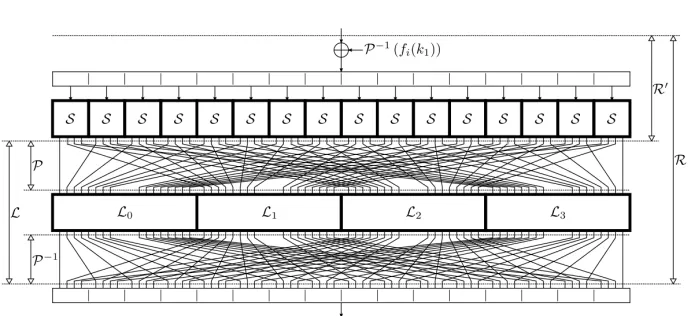
The cipher has an iterations of 20 rounds, of which the first 19 are identical. The structure of the cipher is depicted in Fig.1, which is redrawn from [1].
Fig. 1: Overall Structure of the PRIDE
The round functionR of PRIDE is an SPN structure: The state is XORed with the round key, fed into 16 parallel 4-bit S-boxes and then permuted and processed by the linear layer, see Fig.2, which is also redrawn from [1].
The S-box of PRIDE is given in Table 1, and the linear layer is defined as
M :=L0×L1×L2×L3
L:=P−1◦M ◦P,
where detailed definitions of Li, i ∈ {0,1,2,3} are given in Appendix A. The
Fig. 2: Round FunctionR of PRIDE
Table 1: S-box of PRIDE
x 0x0 0x1 0x2 0x3 0x4 0x5 0x6 0x7 0x8 0x9 0xa 0xb 0xc 0xd 0xe 0xf S(x) 0x0 0x4 0x8 0xf 0x1 0x5 0xe 0x9 0x2 0x7 0xa 0xc 0xb 0xd 0x6 0x3
3
Differential Attack on 19-Round PRIDE
In this section, we describe our differential attack on the 19-round PRIDE. We first give 24 1-round iterative characteristics, and then construct a 15-round distinguisher by concatenation. Finally we perform a key recovery procedure on the 19-round PRIDE.
3.1 Differential Characteristic of Block Cipher PRIDE
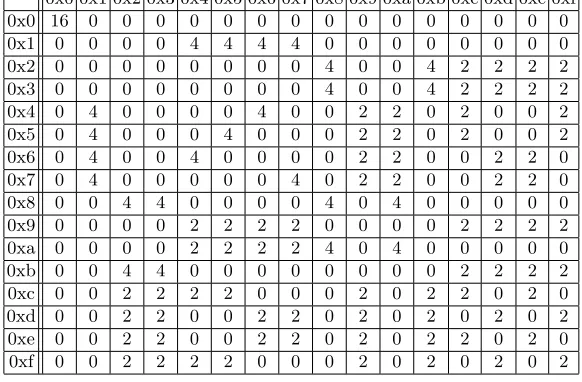
The XOR difference distribution table of the S-box in PRIDE is listed in Table 2. Our attack utilize a table look-up method to recover nibbles of key, thus a concrete difference distribution table with its entries being the specific pairs of input-output values is preferred.
We apply sun et al’s automatic search methods [2, 3] to the block cipher PRIDE and find out 56 iterative differential characteristics, which includes 24 1-round characteristics with input(output) hamming weight 2, 16 2-round char-acteristics with input(output) hamming weight 3 and 16 same 2-round charac-teristics with input(output) hamming weight 1 as ones described in [4]. We only show the 24 1-round iterative characteristics in Table 3.
Table 2: XOR Difference Distribution Table for the S-box of PRIDE 0x0 0x1 0x2 0x3 0x4 0x5 0x6 0x7 0x8 0x9 0xa 0xb 0xc 0xd 0xe 0xf 0x0 16 0 0 0 0 0 0 0 0 0 0 0 0 0 0 0 0x1 0 0 0 0 4 4 4 4 0 0 0 0 0 0 0 0 0x2 0 0 0 0 0 0 0 0 4 0 0 4 2 2 2 2 0x3 0 0 0 0 0 0 0 0 4 0 0 4 2 2 2 2 0x4 0 4 0 0 0 0 4 0 0 2 2 0 2 0 0 2 0x5 0 4 0 0 0 4 0 0 0 2 2 0 2 0 0 2 0x6 0 4 0 0 4 0 0 0 0 2 2 0 0 2 2 0 0x7 0 4 0 0 0 0 0 4 0 2 2 0 0 2 2 0 0x8 0 0 4 4 0 0 0 0 4 0 4 0 0 0 0 0 0x9 0 0 0 0 2 2 2 2 0 0 0 0 2 2 2 2 0xa 0 0 0 0 2 2 2 2 4 0 4 0 0 0 0 0 0xb 0 0 4 4 0 0 0 0 0 0 0 0 2 2 2 2 0xc 0 0 2 2 2 2 0 0 0 2 0 2 2 0 2 0 0xd 0 0 2 2 0 0 2 2 0 2 0 2 0 2 0 2 0xe 0 0 2 2 0 0 2 2 0 2 0 2 2 0 2 0 0xf 0 0 2 2 2 2 0 0 0 2 0 2 0 2 0 2
3.2 Differential Analysis on Block Cipher PRIDE
In this subsection, we put our 15-round differential characteristic from the 3rd to the 17th round of PRIDE, extending 2 rounds backward and forward respec-tively. The description is given in Table 4. We find that the hamming weight of ∆Y2 is one less than that of∆Y1 in [4] and the hamming weight of ∆X18 is one less than that of ∆X17 in [4]. Additionally, we notice that when the input difference of the S-box is 1000, the output difference must be ?0??, and when the output difference is 1000, the input difference must be ?0??(the authors of [4] seemed to miss this point). Due to the above two rules, we can extend 2 rounds backward and forward respectively to achieve the differential attack on the 19-round PRIDE. Consequently the 1-round iterative characteristics is more appropriate than the 2-round iterative characteristics in [4].
-Data Collection Phase.Choose 225.65structures, in each of which, plaintexts fix in nibbles 4, 6, 8, 11, 12, 15, 16 and traverse in nibbles 1, 2, 3, 5, 7, 9, 10, 13, 14. There are 236 plaintexts and their corresponding ciphertexts which consist of 271 pairs. There are 16 possible values for∆X
2 since only 4 different input differences of S-box can result in output difference 1000 and the probability is 2−2. Thus, the probability that a pair of plaintexts in a structure can result in the expected input difference of the distinguisher is 16/236×2−4= 2−36.
Table 3: 1-round iterative characteristics of PRIDE
1 1000 0000 0000 0000 1000 0000 0000 0000 0000 0000 0000 0000 0000 0000 0000 0000 2 1000 0000 0000 0000 0000 0000 0000 0000 1000 0000 0000 0000 0000 0000 0000 0000 3 1000 0000 0000 0000 0000 0000 0000 0000 0000 0000 0000 0000 1000 0000 0000 0000 4 0000 0000 0000 0000 1000 0000 0000 0000 1000 0000 0000 0000 0000 0000 0000 0000 5 0000 0000 0000 0000 1000 0000 0000 0000 0000 0000 0000 0000 1000 0000 0000 0000 6 0000 0000 0000 0000 0000 0000 0000 0000 1000 0000 0000 0000 1000 0000 0000 0000 7 0000 1000 0000 0000 0000 1000 0000 0000 0000 0000 0000 0000 0000 0000 0000 0000 8 0000 1000 0000 0000 0000 0000 0000 0000 0000 1000 0000 0000 0000 0000 0000 0000 9 0000 1000 0000 0000 0000 0000 0000 0000 0000 0000 0000 0000 0000 1000 0000 0000 10 0000 0000 0000 0000 0000 1000 0000 0000 0000 1000 0000 0000 0000 0000 0000 0000 11 0000 0000 0000 0000 0000 1000 0000 0000 0000 0000 0000 0000 0000 1000 0000 0000 12 0000 0000 0000 0000 0000 0000 0000 0000 0000 1000 0000 0000 0000 1000 0000 0000 13 0000 0000 1000 0000 0000 0000 1000 0000 0000 0000 0000 0000 0000 0000 0000 0000 14 0000 0000 1000 0000 0000 0000 0000 0000 0000 0000 1000 0000 0000 0000 0000 0000 15 0000 0000 1000 0000 0000 0000 0000 0000 0000 0000 0000 0000 0000 0000 1000 0000 16 0000 0000 0000 0000 0000 0000 1000 0000 0000 0000 1000 0000 0000 0000 0000 0000 17 0000 0000 0000 0000 0000 0000 1000 0000 0000 0000 0000 0000 0000 0000 1000 0000 18 0000 0000 0000 0000 0000 0000 0000 0000 0000 0000 1000 0000 0000 0000 1000 0000 19 0000 0000 0000 1000 0000 0000 0000 1000 0000 0000 0000 0000 0000 0000 0000 0000 20 0000 0000 0000 1000 0000 0000 0000 0000 0000 0000 0000 1000 0000 0000 0000 0000 21 0000 0000 0000 1000 0000 0000 0000 0000 0000 0000 0000 0000 0000 0000 0000 1000 22 0000 0000 0000 0000 0000 0000 0000 1000 0000 0000 0000 1000 0000 0000 0000 0000 23 0000 0000 0000 0000 0000 0000 0000 1000 0000 0000 0000 0000 0000 0000 0000 1000 24 0000 0000 0000 0000 0000 0000 0000 0000 0000 0000 0000 1000 0000 0000 0000 1000
more than 17 except for 21. There are 109 situations totally. Because of the 5th and the 6th differentials in Table 3 forming the same structures, we use the three differentials to recovery the information about the key. The expected number of right pairs is 225.65+71×2−36×2−60× 109
162 ×3 = 2. The data complexity is 225.65×236≈261.65.
After 19-round encryption, the ciphertext difference should satisfy∆C[3,4,6,
7,11,12,14,15,16] = 0,which makes only 260.65pairs left.
-Key Recovery Phase.For the appointed differential, we recover these bits of key, which correspond to (k0⊕P−1(f1(k1)))[1,2,3,5,7, 9,10,13,14] in the 1st round,k0[1,2,5,8,9,10,13] of the post-whitening, 8 bits (M◦P)−1(f19(k1))[5,9] in the last 2nd round and 8 bits P−1(f2(k1))[5,9] in the 2nd round.
We choose one of the 109 situations that∆Y1= 1000001000100000000100000 010000010110010000000001001001000000000 and ∆X19= 001000100000000010 0000000000001010000010000000000000000000000000. Since the 13th nibble of
Table 4: Differential Analysis on 19-round PRIDE
∆I1 ???? ???? ???? 0000 ???? 0000 ???? 0000 ???? ???? 0000 0000 ???? ???? 0000 0000
∆X1 ???? ???? ???? 0000 ???? 0000 ???? 0000 ???? ???? 0000 0000 ???? ???? 0000 0000
∆Y1 ?00? 00?0 00?0 0000 ?00? 0000 00?0 0000 ?0?? 00?0 0000 0000 ?00? 00?0 0000 0000
∆Z1 ?000 ?000 ?000 ?000 0000 0000 0000 0000 0??0 00?0 ??00 0?00 ?000 ?000 ?000 ?000
∆W1 0000 ?000 ?000 0000 0000 0000 0000 0000 0000 ?000 ?000 0000 0000 ?000 ?000 0000
∆I2 0000 0000 0000 0000 ?0?? 0000 0000 0000 ?0?? 0000 0000 0000 0000 0000 0000 0000
∆X2 0000 0000 0000 0000 ?0?? 0000 0000 0000 ?0?? 0000 0000 0000 0000 0000 0000 0000
∆Y2 0000 0000 0000 0000 1000 0000 0000 0000 1000 0000 0000 0000 0000 0000 0000 0000
∆Z2 0000 1000 1000 0000 0000 0000 0000 0000 0000 0000 0000 0000 0000 0000 0000 0000
∆W2 0000 1000 1000 0000 0000 0000 0000 0000 0000 0000 0000 0000 0000 0000 0000 0000
∆I3 0000 0000 0000 0000 1000 0000 0000 0000 1000 0000 0000 0000 0000 0000 0000 0000
∆X18 0000 0000 0000 0000 1000 0000 0000 0000 1000 0000 0000 0000 0000 0000 0000 0000
∆Y18 0000 0000 0000 0000 ?0?? 0000 0000 0000 ?0?? 0000 0000 0000 0000 0000 0000 0000
∆Z18 0000 ?000 ?000 0000 0000 0000 0000 0000 0000 ?000 ?000 0000 0000 ?000 ?000 0000
∆W18 ?000 ?000 ?000 ?000 0000 0000 0000 0000 ??00 000? ??00 0000 ?000 ?000 ?000 ?000
∆I19 ?0?? 00?0 0000 0000 ?00? 0000 0000 00?0 ?0?? 00?0 0000 0000 ?00? 0000 0000 0000
∆X19 ?0?? 00?0 0000 0000 ?00? 0000 0000 00?0 ?0?? 00?0 0000 0000 ?00? 0000 0000 0000
∆Y19 ???? ???? 0000 0000 ???? 0000 0000 ???? ???? ???? 0000 0000 ???? 0000 0000 0000
∆O19 ???? ???? 0000 0000 ???? 0000 0000 ???? ???? ???? 0000 0000 ???? 0000 0000 0000
256.65×(4/16)4×(6/16)10×8/16≈233.50pairs left. Next we use the method of table look-up to recovery these bits of key.
– Step 1. Firstly, we recover the values of (k0 ⊕P−1(f1(k1)))[1]. For each remaining pair of plaintexts, look up the concrete difference distribution table by its input difference in the first nibble and output difference 1000, we get 4 candidates for (k0⊕P−1(f1(k1)))[1] and then store the values in a table, say Table D. The time complexity is about 233.50× 1
16× 1 19 ≈2
25.25.
– Step 2. For each pair of plaintexts associated with each of its corresponding candidates for (k0⊕P−1(f1(k1)))[1], look up the concrete difference distri-bution table by its input difference in the 13th nibble and output difference 1001, we get 2 candidates for (k0⊕P−1(f1(k1)))[13]. Again we store the val-ues in Table D. The time complexity is no more than 233.50×4× 1
16× 1 19 ≈ 227.25.
– Step 3. Similar to Step 2, for each pair of texts associated with each of its cor-responding candidates for previously recovered key bits, look up the concrete difference table, we get the candidates for (k0⊕P−1(f1(k1)))[2,3,5,7,9,10,14] andk0[1,2,8,9,10,5] successively. The time complexity is about 254.65×161 ×
1 19 ≈2
46.40.
– Step 4. Because the value of∆X2 and ∆Y18 are fixed, in order to get the information of (M◦P)−1(f
– Step 5. Repeating the same process 109×3 times for different characteristics, we get Table D containing 256.65×28×27×3≈270.99candidates for at least 68 bits of key. The most frequently appeared candidate serves as the right one and it cost 256.65×28×27×3× 1
16× 1 19 ≈2
62.74 to find it by common method.
– Step 6. For the rest of the no more than 60 bits, we perform an exhaustive search.
In summary, we achieve that the data, time and memory complexities are 262, 263 and 271, respectively.
4
Conclusion
In this paper, we proposed an improved differential attack on the 19-round PRIDE by utilizing new 1-round iterative differential characteristics which is found by automatic search methods. The differential characteristics we used are suitable for extending 4 rounds to launch the differential attack. The data, time and memory complexities of our attack are 262, 263and 271 respectively. More-over, if more differentials can be used at the same time, it may be possible to lunch an attack on the full-round PRIDE.
References
1. Albrecht, M.R., Driessen, B., Kavun, E.B., Leander, G., Paar, C., Yalcin, T.: Block Ciphers - Focus On The Linear Layer (feat. PRIDE). Pre-proceeding of CRYPTO (2014)
2. Sun, S., Hu, L., Wang, M., Wang, P., Qiao, K., Ma, X., Shi, D., Song, L.: Auto-matic Enumeration of (Related-key) Differential and Linear Characteristics with Predefined Properties and Its Applications. Cryptology ePrint Archive (2014),
http://eprint.iacr.org/2014/747
3. Sun, S., Hu, L., Wang, P., Qiao, K., Ma, X., Song, L.: Automatic Security Evalu-ation and (Related-key) Differential Characteristic Search: ApplicEvalu-ation to SIMON, PRESENT, LBlock, DES(L) and Other Bit-oriented Block Ciphers. In: Advances in Cryptology-ASIACRYPT 2014. pp. 158–178. Springer (2014)
Appendix A
L0=L−01=
0 0 0 0 1 0 0 0 1 0 0 0 1 0 0 0 0 0 0 0 0 1 0 0 0 1 0 0 0 1 0 0 0 0 0 0 0 0 1 0 0 0 1 0 0 0 1 0 0 0 0 0 0 0 0 1 0 0 0 1 0 0 0 1 1 0 0 0 0 0 0 0 1 0 0 0 1 0 0 0 0 1 0 0 0 0 0 0 0 1 0 0 0 1 0 0 0 0 1 0 0 0 0 0 0 0 1 0 0 0 1 0 0 0 0 1 0 0 0 0 0 0 0 1 0 0 0 1 1 0 0 0 1 0 0 0 0 0 0 0 1 0 0 0 0 1 0 0 0 1 0 0 0 0 0 0 0 1 0 0 0 0 1 0 0 0 1 0 0 0 0 0 0 0 1 0 0 0 0 1 0 0 0 1 0 0 0 0 0 0 0 1 1 0 0 0 1 0 0 0 1 0 0 0 0 0 0 0 0 1 0 0 0 1 0 0 0 1 0 0 0 0 0 0 0 0 1 0 0 0 1 0 0 0 1 0 0 0 0 0 0 0 0 1 0 0 0 1 0 0 0 1 0 0 0 0
L1=
1 1 0 0 0 0 0 0 0 0 0 1 0 0 0 0 0 1 1 0 0 0 0 0 0 0 0 0 1 0 0 0 0 0 1 1 0 0 0 0 0 0 0 0 0 1 0 0 0 0 0 1 1 0 0 0 0 0 0 0 0 0 1 0 0 0 0 0 1 1 0 0 0 0 0 0 0 0 0 1 0 0 0 0 0 1 1 0 1 0 0 0 0 0 0 0 0 0 0 0 0 0 1 1 0 1 0 0 0 0 0 0 1 0 0 0 0 0 0 1 0 0 1 0 0 0 0 0 1 0 0 0 0 0 0 0 0 0 0 1 1 0 0 0 0 1 0 0 0 0 0 0 0 0 0 0 1 1 0 0 0 0 1 0 0 0 0 0 0 0 0 0 0 1 1 0 0 0 0 1 0 0 0 0 0 0 0 0 0 0 1 1 0 0 0 0 1 0 0 0 1 0 0 0 0 0 0 1 0 0 0 0 0 1 0 0 1 1 0 0 0 0 0 0 0 0 0 0 0 0 1 0 0 1 1 0 0 0 0 0 0 0 0 0 0 0 0 1 0 0 1 1 0 0 0 0
L2=
0 0 0 0 1 1 0 0 0 0 0 0 0 0 0 1 0 0 0 0 0 1 1 0 1 0 0 0 0 0 0 0 0 0 0 0 0 0 1 1 0 1 0 0 0 0 0 0 1 0 0 0 0 0 0 1 0 0 1 0 0 0 0 0 1 1 0 0 0 0 0 0 0 0 0 1 0 0 0 0 0 1 1 0 0 0 0 0 0 0 0 0 1 0 0 0 0 0 1 1 0 0 0 0 0 0 0 0 0 1 0 0 0 0 0 1 1 0 0 0 0 0 0 0 0 0 1 0 0 0 0 0 1 0 0 0 1 0 0 0 0 0 0 1 0 0 0 0 0 1 0 0 1 1 0 0 0 0 0 0 0 0 0 0 0 0 1 0 0 1 1 0 0 0 0 0 0 0 0 0 0 0 0 1 0 0 1 1 0 0 0 0 1 0 0 0 0 0 0 0 0 0 0 1 1 0 0 0 0 1 0 0 0 0 0 0 0 0 0 0 1 1 0 0 0 0 1 0 0 0 0 0 0 0 0 0 0 1 1 0 0 0 0 1 0 0 0 0 0 0 0 0 0 0 1 1
L3=L−31=
1 0 0 0 1 0 0 0 0 0 0 0 1 0 0 0 0 1 0 0 0 1 0 0 0 0 0 0 0 1 0 0 0 0 1 0 0 0 1 0 0 0 0 0 0 0 1 0 0 0 0 1 0 0 0 1 0 0 0 0 0 0 0 1 1 0 0 0 1 0 0 0 1 0 0 0 0 0 0 0 0 1 0 0 0 1 0 0 0 1 0 0 0 0 0 0 0 0 1 0 0 0 1 0 0 0 1 0 0 0 0 0 0 0 0 1 0 0 0 1 0 0 0 1 0 0 0 0 0 0 0 0 1 0 0 0 1 0 0 0 1 0 0 0 0 0 0 0 0 1 0 0 0 1 0 0 0 1 0 0 0 0 0 0 0 0 1 0 0 0 1 0 0 0 1 0 0 0 0 0 0 0 0 1 0 0 0 1 0 0 0 1 1 0 0 0 0 0 0 0 1 0 0 0 1 0 0 0 0 1 0 0 0 0 0 0 0 1 0 0 0 1 0 0 0 0 1 0 0 0 0 0 0 0 1 0 0 0 1 0 0 0 0 1 0 0 0 0 0 0 0 1 0 0 0 1
L−1 1 =
0 0 0 0 0 0 1 1 0 0 0 0 0 0 1 0 1 0 0 0 0 0 0 1 0 0 0 0 0 0 0 1 1 1 0 0 0 0 0 0 1 0 0 0 0 0 0 0 0 1 1 0 0 0 0 0 0 1 0 0 0 0 0 0 0 0 1 1 0 0 0 0 0 0 1 0 0 0 0 0 0 0 0 1 1 0 0 0 0 0 0 1 0 0 0 0 0 0 0 0 1 1 0 0 0 0 0 0 1 0 0 0 0 0 0 0 0 1 1 0 0 0 0 0 0 1 0 0 0 0 0 1 0 0 0 0 0 0 0 1 1 0 0 0 0 0 0 0 1 0 0 0 0 0 0 0 1 1 0 0 0 0 0 0 0 1 0 0 0 0 0 0 0 1 1 0 0 0 0 0 0 0 1 0 0 0 0 0 0 0 1 1 0 0 0 0 0 0 0 1 1 0 0 0 0 0 0 1 1 0 0 0 0 0 0 0 1 1 0 0 0 0 0 0 0 1 0 0 0 0 0 0 0 1 1 0 0 0 0 0 0 0 1 0 0 0 0 0 0 0 1 1 0 0 0 0
L−1 2 =
0 0 1 1 0 0 0 0 0 0 1 0 0 0 0 0 0 0 0 1 1 0 0 0 0 0 0 1 0 0 0 0 0 0 0 0 1 1 0 0 0 0 0 0 1 0 0 0 0 0 0 0 0 1 1 0 0 0 0 0 0 1 0 0 0 0 0 0 0 0 1 1 0 0 0 0 0 0 1 0 1 0 0 0 0 0 0 1 0 0 0 0 0 0 0 1 1 1 0 0 0 0 0 0 1 0 0 0 0 0 0 0 0 1 1 0 0 0 0 0 0 1 0 0 0 0 0 0 0 0 0 0 0 0 0 1 1 0 0 0 0 0 0 1 1 0 0 0 0 0 0 0 1 1 0 0 0 0 0 0 0 1 0 0 0 0 0 0 0 1 1 0 0 0 0 0 0 0 1 0 0 0 0 0 0 0 1 1 0 0 0 0 0 0 0 1 0 0 0 0 0 0 0 1 1 0 0 0 0 0 0 0 1 0 0 0 0 0 0 0 1 1 0 0 0 0 0 0 0 1 0 0 0 0 0 0 0 1 1 0 0 0 0 0 0 0 1 0 0 0 0 0 0 0 1 1