PPS: Privacy-Preserving Statistics using RFID Tags
Erik-Oliver Blass Kaoutar Elkhiyaoui Refik Molva
EURECOM, Sophia Antipolis, France {blass|elkhiyao|molva}@eurecom.fr
Abstract. As RFID applications are entering our daily life, many new security and privacy challenges arise. However, current research in RFID security focuses mainly on simple authentication and privacy-preserving identification. In this pa-per, we widen the scope of RFID security and privacy by introducing a new ap-plication scenario. The suggested apap-plication consists of computing statistics on private properties of individuals stored in RFID tags. The main idea is to compute global statistics while preserving the privacy of individual readings.PPSassures the privacy of properties stored in each tag through the combination of homomor-phic encryption and aggregation at the readers. Re-encryption is used to prevent tracking of users. The readers scan tags and forward the aggregate of their en-crypted readings to the back-end server. The back-end server then decrypts the aggregates it receives and updates the global statistics accordingly. Therewith, PPS is provably privacy-preserving. Moreover, tags can be very simple since they are not required to perform any kind of computation, but only to store data.
1
Introduction
In Radio Frequency IDentification (RFID), tags are transponders that reply to reader queries and send their identifiers. Being cost effective, tags are deployed on a large scale and typically used for identification of goods or even individuals. However, such a deployment comes with new security and privacy threats such as impersonation on the one hand, and tracking of tags and therewith individuals on the other hand. The cost effectiveness also implies strong limitation of computational capabilities of the tags. Current passive RFID tags can hardly afford for security mechanisms relying on complex cryptographic operations to counter the security and privacy threats.
Revisiting security problems such as authentication and privacy preserving iden-tification in the highly constrained setting of RFID tags has given rise to a number of research activities, focusing on lightweight authentication, identification schemes, and formal security and privacy properties thereof, e.g., see Ateniese et al. [1], Bringer and Chabanne [5], Bringer et al. [6], Dimitrou [11], Pietro and Molva [22], Tsudik [26], Vaudenay [27], Weis et al. [28].
In the paper at hand, we introduce a new application scenario, raising new require-ments beyond the classical authentication and identification issues. The target scenario is the collection of statistics over privatepropertiesof a large population of individuals. Due to RFID users’ demands and due to regulatory matters, the main challenge in this scenario is topreserve the privacyof these individuals with respect to their properties.
such as a server, to compute global statistics. For example, the distribution over the properties held by a group of individuals might be of interest, but without disclosing the attributes of individuals to any party involved in the collection of these statistics.
Hence, we suggest a scheme calledPPS(“Privacy-Preserving Statistics”) that as-sures privacy of individual attributes in this scenario. In PPS, intermediate parties called readers collect encrypted properties from tags, compute aggregates over encrypted readings without decrypting them, and periodically forward the result of such aggre-gation operations to theback-end server. The server is then able to compute a global aggregate in cleartext based on the aggregates of the encrypted readings transmitted by readers.
The main challenge in this scenario is to allow the readers to perform the aggrega-tion over encrypted attribute values from which the server can derive global statistics in cleartext. We address this problem through homomorphic encryption. Another threat to the privacy of the tag holders is the tracing of tags by readers. In order to circum-vent this threat, we use re-encryption mechanisms. However, the scarcity of resources in tags prohibits the assignment of complex operations to tags. Therefore, the readers will perform re-encryption of the ciphertexts stored on the tags. Thus, tags do not have to perform any cryptographic operations.
Themajor contributionsof PPS are:
– contrary to related work on privacy preserving tag identification, such as Ateniese et al. [1], PPS provides an RFID-based mechanism to collect statistics over a set of properties in a privacy-preserving manner.
– formal proofs ofprivacyandunlinkability against external eavesdroppers, mali-cious readers, and curious back-end servers.
– minimal hardware requirements resulting in cheap tags: PPS does not require tags to doany cryptographic computation, tags are passive, i.e., battery-less and only require data storage functions. Contrary to related work, PPS’ storage-only require-ments enable implementations on today’s available EPC class1 Gen2 tags.
– data integrity: tampering with data stored on tags can be detected.
The sequel of this paper is organized as follows. In Section 2, we present a typical scenario for our application, we state the problem, and we derive the requirements for the solution. In Section 4, we present the building blocks of PPS. In Section 3, we define the notion of privacy and unlinkability in the context of our application, and we present the adversary model. Section 5 gives the formal analysis of the protocol. Finally, related work is presented in Section 7.
2
Problem statement
2.1 Application scenario
The solution we propose targets applications involving a central organization that wants to collect statistics on a given population. This population will be equipped with RFID tags that will be read by readers managed by intermediary entities that are independent from the central organization.
We can imagine a scenario where a shopping mall wants to compare the activity of the shops it hosts or which type of clients it attracts the most throughout the year. The shops will deploy readers at the cashiers. The visitors of the shopping mall are provided with RFID tags. To give an incentive to the visitors of shopping malls to carry their tags, we embed RFID tags into loyalty cards that allow tag owners to have discounts or privileged access to parking, restaurants, etc.
Such an incentive requires binding the RFID tag to the identity of the tag owner to ensure that the RFID tag is being used by its owner when scanned. Cheap RFID tags that are the target technology of PPScannotafford cryptographic authentication. Therefore, we use an out of band authentication such as a printed picture on the loyalty card to verify the identity of the tag holder at payment for instance.
Associating the RFID tag only with the picture of its owner assures that the holder of the tag will be the actual owner while preserving his anonymity with respect to the mall he is visiting.
The RFID tag encodes the private properties of the tag holder, for example gender, age, profession etc. When the tag holder enters a shop for instance, the encrypted prop-erties on the tag will be scanned by a reader. Each reader will aggregate the encrypted data it collects during a period such as a day. At the end of each period, each reader will forward the aggregate data to a server managed by the mall. The server will then update the overall statistics based on the aggregate values sent by the readers.
Thekey requirementin this scenario is preserving privacy: a solution should allow the server to compute global statistics over private properties of visitors while assuring the privacy of individual properties with respect to the readers and the server.
2.2 System model
PPS is the solution we propose to collect privacy preserving statistics. A typical appli-cation scenario for PPS involves several parties as follows:
– IssuerI: the issuer initializes each tag by writing into the tag’s memory an en-crypted representation of the properties of the tag holder.
– Tags{Ti}: each tag stores an encrypted representation of the properties of the tag
holder. The encrypted representation ofpproperties in each tag consists of{Pi,
1≤i≤p}wherePiis set to “true” if the tag holder possesses the corresponding
property.
– Readers{Ri}: readers are in charge of collecting properties stored on tags. They
read the data stored on each tag and forward the result of these readings to the back-end server.
The issuer and the back-end server can be managed by independent parties. For in-stance, in a typical scenario, social security could act as an issuer, whereas the back-end server would be managed by the shopping mall.
2.3 Requirements: Privacy & Unlinkability
The basic requirement forSis to count the number of tag holders satisfying each prop-erty Pi for all the properties. The main concern is to gather statistics such as counts
about each propertyPi, while preserving theprivacyof tag holders. Neither readers
nor the back-end server should be able to disclose the values of a tag holder’s proper-ties. To ensure privacy in our scheme, we propose a solution that combines encryption and aggregation. In that solution, the listωiof the tag holder properties are encrypted
asE(ωi)and stored on the tag. Through subsequent readings of tags in its range, the
reader computes the aggregate of the ciphertexts received from the tags,P
E(ωi), and
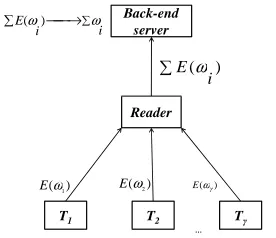
periodically forwards the encrypted aggregate value to the back-end server as shown in Fig. 1.
Back-end server ∑
→
∑
i i E(ω) ω
∑ ( )
i E ω
T1 T2 Tγ Reader
…
) (ω2
E
) (ω1
E E(ωγ)
Fig. 1.Aggregation in an RFID-based system
The back-end serverS is the only entity that can decrypt ciphertexts. To enforce privacy againstS, readers must aggregate the ciphertexts received from the tags in their range before forwarding the encrypted data toS. If the readers forward data without aggregation to the back-end serverS, the latter can always tell which properties the tag holders satisfy. Nonetheless, forwarding each individual reading to the server would strongly overload typically embedded, low capacity readers.
3
Adversary & Privacy Models
In this section, we introduce the adversary model and define the notions of privacy and unlinkability for the proposed application.
3.1 Adversary model
PPS protects against two different categories of adversaries,
1. ADV1, external adversaries and malicious readers, 2. ADV2, a malicious back-end server.
ADV1does not collude withADV2.
ADV1: Borrowing notions from Cramer and Damg˚ard [9], we assume arushing,
ac-tiveadversary who has full control over all communication between tags and readers. He can not only eavesdrop messages, but also intercept, modify, and even initiate com-munication. For example, the adversary might impersonate a tag and communicate with the reader or read-out tags. He might even replace a tag’s content by re-writing it. How-ever, re-writing tags has some special implications on PPS’s security, so we discuss this issue separately in Section 6. Finally, the adversary might compromise readers, read-out and tamper with their memory and program – consequently, malicious readers might not behave in protocol compliant manner. This adversary corresponds in real world, to a reader that is located near or in the shopping mall for instance. This adversary aims at tracking tag holders and disclosing some of the properties that the tag holders satisfy.
ADV2: The end server might be under the control of the adversary. The
back-end server is passive in the sense that it only receives aggregates from readers. It cannot initiate communication with tags or readers.
Limitations:We conjecture that there might be scenarios where back-end servers have full control over all communication and might collude with compromised readers, e.g., envisioning an extreme scenario whereby the mall would also control the readers of all shops it hosts. We clearly state that PPS will not provide privacy in such scenarios. As motivated in the introduction, the adversary’s primary goal in any case, i.e., ADV1 orADV2, is to gain some knowledge about sensitive information, in this case individual tag holders’ properties, as formalized in the following privacy models.
3.2 Privacy Models
PPS privacy notions are direct adaptations of privacy definitions originally proposed by Ateniese et al. [1], Golle et al. [15], and experiment-based definitions by Juels and Weis [17].
Tc← Opick;
fori:= 1totdo READ(Tc);
EXECUTE(Tc);
end
fori:= 1tor−1do
(Ti, Si)← Oselect;
forj:= 1tosdo READ(Ti);
WRITE(Ti);
EXECUTE(Ti);
end end
Algorithm 1:Learning phase ofADV1
Pi←PICKPROPERTY;
OUPUTb;
Algorithm 2:Challenge phase ofADV1
in breaking privacy or unlinkability than simple guessing. The following oracle-like constructions exist:
Opickis an oracle that randomly selects a tagTifrom all thentags in the system.
Oselectis an oracle that randomly returns a tagTifrom all thentags in the system
along the listSiof propertiesPjthat tagTisatisfies.
Oflipis an oracle that, provided with two tagsT0, T1, randomly choosesb∈ {0,1} and returnsTb.
Oaggregatecomputes a total ofsaggregatesAgg1,Agg2,. . .,Aggs, each time by
randomly choosing a set ofγ tags:Agg1 is computed using tags (T1
1, T12, . . . , T γ 1), Agg2is computed using(T21, T22, . . . , T2γ),. . .,Aggsis computed using(Ts1, Ts2, . . . , Tsγ). The sets of tags are chosen randomly, but there is at least one tag that is an element of two different sets, i.e., used in the computation of two different aggregates. Finally, OaggregatereturnsAgg1,Agg2,. . .,Aggs.
Privacy againstADV1 An adversary breaks the privacy of PPS, if given a tagTand
a propertyPi, he can decide if a tagT satisfies the propertyPior not.
To that effect, an adversaryADV1has access to tags in two phases. In a learning phase (Algorithm 1),ADV1is provided with a challenge tagTcfrom the oracleOpick. He can read fromTcfor a maximum ofttimes.Oselectgivesr−1tags toADV1along with the listSiof propertiesPjthat each tagTisatisfies.ADV1can read and write into
Tifor a maximum ofstimes. After each read or write access to a tag in the learning
phase, the tag is allowed to interact with a legitimate reader by a normal PPS protocol run, cf., “EXECUTE”.
In the second phase, a challenge phase (Algorithm 2),ADV1 picks a propertyPi
by calling a function PICKPROPERTY. Given the results of the different readings and
Tc,ADV1outputs a bitb, such thatb= 1if he guesses thatTcsatisfiesPi, andb= 0
otherwise.
ADV1succeeds, if his guess is right.
Definition 1. PPS is said to be privacy-preserving with respect to ADV1, if for all
fori:= 1tordo Ti← Opick;
forj:= 1tosdo READ(Ti);
WRITE(Ti);
EXECUTE(Ti);
end end
Algorithm 3:Learning phase ofADV1
T0← Opick;
T1← Opick;
fori:= 0to1do forj:= 1totdo
READ(Ti);
WRITE(Ti);
EXECUTE(Ti);
end end
EXECUTE(T0);
EXECUTE(T1);
(T0, T1)→ Oflip;
Tb← Oflip;
OUTPUTb;
Algorithm 4:Challenge phase ofADV1
Privacy againstADV2 As assumed above,ADV2, i.e., a malicious back-end server, only receives aggregates from readers. In any case, there is no relation between tags, and therewith tag holders, andADV2. In conclusion,ADV2simply cannot learn anything about properties of tags.
While we do not target a formal proof, privacy againstADV2 is furthermore dis-cussed and additional reasoning is given in the according security analysis section 5.1.
Unlinkability againstADV1 The tags targeted in this paper only feature storage
ca-pabilities. Hence, tags cannot update the content of their memory themselves after a read and, therefore, the content of a tag’s memory does not change between two pro-tocol executions. In the face of an overwhelmingly powerful adversary who can eaves-drop all communications between tags and readers, tags would be trivially linkable. However, we conjecture that it is fair to assume that an adversary in the real world can-not continuously monitor tags and that there is at least one protocol execution that is “un-observed” by the adversary. Once a tagT is re-written outside the range of the ad-versary, the adversary should not be able to link the previous interactions he has seen to tagT. In accordance with notions of related work such as:insubvertible encryptionby Ateniese et al. [1],backward securityby Dimitrou [11], andprivacy against anonymiz-ersby Sadeghi et al. [23], we assume that there is at least one protocol execution that takes place outside the range of the adversary. Under this assumption, neither external adversaries nor readers should be able to link two responses from the same tag once it is re-written outside their range.
More formally, in a learning phase (Algorithm 3),ADV1is provided withrrandom tags fromOpick.ADV1 canreadfrom and writeinto thertags for a maximum ofs times. After each read or write access, the tags interact with legitimate readers by a PPS execution, cf., “EXECUTE”.
In the challenge phase (Algorithm 4),ADV1is provided with two challenge tags
Then,T0andT1are re-encryptedoutside the range of ADV1by calling the func-tion EXECUTE. Finally,Oflipis queried withT0andT1andOflipprovidesADV1with
Tb. Given the results of the previous readings andTb, the adversaryADV1guesses the value ofb∈ {0,1}. He succeeds, if his guess is right.
Definition 2. PPS is said to provide unlinkability with respect toADV1, if for all
ad-versaries of categoryADV1,Pr[ADV1succeeds]≤12+,such thatis negligible.
Unlinkability againstADV2 An adversaryADV2should not be able to link aggre-gates to aggreaggre-gates it has received before. More precisely, a malicious back-end server should not tell, whether a received aggregate involves a tag that was involved in another aggregate received earlier.ADV2has access to the system in two phases. During learn-ing (Algorithm 5),OaggregateprovidesADV2withsaggregatesAgg1,. . .,Aggsthat
he could decrypt.
In the challenge phase (Algorithm 6),ADV2outputs a pairb, b0 ∈ {1, . . . , s}and therewithAggbandAggb0.
fori:= 1tosdo
Aggi← Oaggregate;
end
Algorithm 5:Learning phase ofADV2
OUTPUT(b, b0)
Algorithm 6:Challenge phase ofADV2
ADV2succeeds, ifAggbandAggb0have been computed byOaggregatewith at least one tag in both aggregates.
Definition 3. PPS is said to provide unlinkability with respect toADV2, if for all
ad-versaries of categoryADV2,Pr[ADV2succeeds]≤s(s1−1)+,such thatis
negligi-ble.
4
PPS
Plain encryption of the properties of the tag holders ensures privacy of the data sent to readers. However, encryption prevents aggregation. Conversely, if readers decrypt the data sent by the tag at every reading, the privacy of the tag holder against readers would not be assured. Hence, we suggest to use a standard multiplicative homomorphic encryption scheme, Elgamal [13], in order to allow the aggregation of encrypted data without decryption. Homomorphic encryption allows the back-end server to derive the valuePω
iin cleartext from the aggregate of encrypted valuesPE(ωi). Furthermore,
be performed by tags, as they are completely passive, therefore, it will be performed by readers. The readers on the other hand, should not be able to decrypt the ciphertexts they receive, otherwise, they can always learn the properties a tag holder satisfies. To tackle this problem, we use an asymmetric encryption that is homomorphic.
As a well studied homomorphic asymmetric encryption scheme, Elgamal [13] meets the requirements of our application, and we use it as the underlying technique. In addi-tion to its homomorphism, Elgamal supports re-encrypaddi-tion. The target scenario for our application calls for an additive homomorphism. However, Elgamal is multiplicatively homomorphic and thus falls short of suiting the target application. To cope with this limitation, the last component of the solution is a special property encoding technique based onG¨odel encoding[14].1
4.1 Elgamal Cryptosystem
– Setup:the system outputs two large primeP andQsuch thatQdivides(P−1) and|P| = τ. Here,τ represents the security parameter of Elgamal. Let G be a subgroup ofZ∗Pof orderQ, andg be a generator ofG. All arithmetic operations
will be performed modP.
– Key generation:the secret keyskisx∈ZQ. The public keypkisy=gx. – Encryption:to encrypt a messageω∈ G, one randomly selectsr∈ZQand
com-putes(u, v) = (gr, yrω). The ciphertext isc= (u, v).
– Decryption:to decrypt a ciphertextc= (u, v), one computesω= uvx.
Elgamal encryption is multiplicatively homomorphic:
∀ω1, ω2∈ G, E(ω1)·E(ω2) =E(ω1·ω2)
To adapt Elgamal to our scheme, we encode the properties using G¨odel encoding before encryption as follows.
4.2 G¨odel Property Encoding
In order to collect statistics on pproperties Pi, we assign to each property a prime
number pi. Without loss of generality the first prime number p1 will correspond to the propertyP1, the second prime numberp2 will correspond toP2and so on. Both, properties Pi and primespi are publicly known. If the holder of a tag satisfies two
propertiesPi,Pjthis will be represented by{pipj}. More formally:
– Setup:letPi,1≤i ≤p, be thepproperties the back-end server is interested in,
andpiare p primes. Each propertyPiwill be mapped to prime numberpi. – Encoding:letmbe the vector(ν1, ..., νp)such thatνi = 1, if the tagT fulfills
the propertyPi, otherwiseνi = 0. The encoding of the properties of the tagT is
defined asΩ(m) =Qp
i=1p νi i .
1Note that additively homomorphic encryptions such as Paillier [21] or Naccache-Stern [20]
4.3 Protocol
In PPS, the tags are initialized once by the issuer. Whenever a tagTis read by a reader
R, the reader aggregates the ciphertextc= (u, v)it receives fromT, then it re-encrypts the ciphertextcand writes the new ciphertext intoT. Periodically, readers in the system forward their aggregates to the back-end server. The latter decrypts and decodes the aggregates and computes the statistics it is interested in.
We assume that the system comprises, for ease of understanding, a single reader, and it hasγtags in its range.
– System setup:letG be a group in which the discrete logarithm is intractable,ga generator ofG,Qthe order ofGandPithepproperties of the system. The output
of the setup operation is a pair of keys(pk, sk):(y=gx, x),x∈
ZQ, andpprimes
pi such that the propertyPi corresponds to prime numberpi. Elgamal secret key
sk=xis known by both the issuer and the back-end server. Generatorg, the public keypk=yand thepprimes are made public.
– Tag initialization:the input comprises the vectorm= (ν1, ..., νp), the public key
y, thepprimespi, and a random numberr∈ZQ. The issuer of the tag encodes the
vectormfollowing the G¨odel encoding and computesω = Ω(m). The output of the initialization operation is a ciphertext(u, v) = (gr, yrω).
– Aggregation:the input is a set ofγciphertexts(ui, vi),1≤i≤γ, received by the
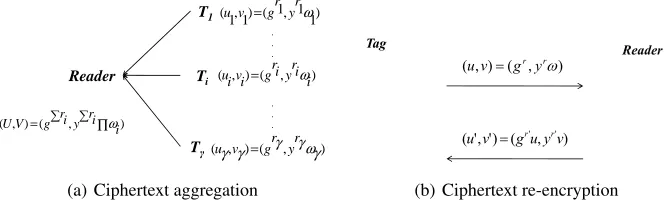
reader from the tags in its range. The reader outputs theaggregate, a new ciphertext (U, V) = (Qγ
i=1ui, Qγ
i=1vi), cf., Fig. 2(a).
T1(1,1) ( 1, 1ω1) r y r g v u = . . . Reader ) , ( ) ,
(UV=g∑riy∑ri∏ωi
Ti
Tγ (γ,γ) ( γ, γωγ) r y r g v u = ) , ( ) ,
(uivi=griyriωi
.
.
. .
(a) Ciphertext aggregation
Tag ReaderReader
) , ( ) ,
(uv = gr yrω
) , ( ) ' ,'
(u v = gr'uyr'v
(b) Ciphertext re-encryption
Fig. 2.Aggregation and re-encryption in PPS
– Re-encryption:the input of re-encryption is a ciphertext(u, v) = (gr, yrω) re-ceived by the reader from a tagT,gthe generator ofG, the public keyy, and a ran-dom numberr0∈ZQ. The output is a new ciphertext(u0, v0) = (g(r+r
0)
, y(r+r0)ω), cf., Fig. 2(b).
On a side note, the valueyrω = 0modP is considered as “forbidden”. When a
– Decryption and decoding:the input is a ciphertext(U, V) = (Qγ
i=1ui,Q γ i=1vi)
received from the reader, the secret keyx, and thepprimespi. The back-end server
computesW = UVx and factorizesW. This factorization is easily feasible, as the
back-end server knows the primespi. Given that this factorization is unique, the
back-end server getsΩ−1(W) = (ν1, ..., νp). The respectiveνicorresponds to the
number of tags satisfying the propertyPithat have been read by the reader.
To get the total number of tags satisfying a propertyPiin the case ofmultiple readers,
the back-end server sums theνifor all the readers in the system.
Aggregation under restrictions: In order to ensure the correctness of statistics ob-tained by the back-end server, we cannot allow the readers to aggregate an infinite number of ciphertexts. They are only allowed to aggregate up to a thresholdγ of ci-phertextsci=E(ωi)at a time, such thatQ
γ
i=1ωi< P.
Evaluation: Typically,|P|= 1024bits and|Q|= 160bits.
GivenppropertiesPi andpprime numberspi, the thresholdγcould be defined as |P|
log2( Qp
i=1pi). If a reader hasσtags in its range, it will aggregate ciphertexts by bunches
of size at mostγ. Instead of forwarding one aggregate, the reader forwardsbσ γc+ 1
aggregates to the back-end server.
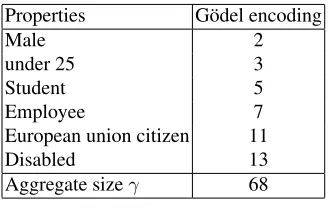
Furthermore, if the readers send to the back-end server the number of tags they read, we can reduce the number of prime numbers used in the G¨odel encoding to represent the different properties, cf. Table 1. This applies in the case we have complementary properties, for instance,(P1, P2) = (male, f emale). Given the total number of tags read and the number of tag holders satisfying the propertyP1, we deduce the number of tag holders satisfying the propertyP2. Using this fact leads to a more efficient property encoding and thus a larger aggregate sizeγwhich improves the privacy of PPS against the back-end server as discussed in Section 5.2.
Table 1.Example properties and their encoding
Properties G¨odel encoding
Male 2
under 25 3
Student 5
Employee 7
European union citizen 11
Disabled 13
5
Privacy analysis
This section providesformal proofsfor PPS’s privacy and unlinkability as defined in the models of Section 3.2.
In this section, we use two additional oracles:
Osemanticwhen provided with two plaintextsω0, ω1, randomly choosesb∈ {0,1}, encryptsωbusing Elgamal and public keypk, and returns the resulting ciphertextcb.
Osemantic−rewhen provided with two Elgamal ciphertextsc0, c1, randomly chooses
b∈ {0,1}, re-encryptscbusing public keypk, and returns the resulting ciphertextc0b.
5.1 Privacy
Privacy againstADV1
Theorem 1. PPS is privacy-preserving with respect toADV1under the DDH
assump-tion overG.
Proof. Assume we have an adversaryA ∈ ADV1who breaks the privacy experiment. We build an adversary A0 that executes A as a subroutine and breaks the semantic security of Elgamal which leads to a contradiction under DDH. In this proof, we make use of the fact that a tagT satisfies a propertyPi,iffthe corresponding prime number
pidivides the plaintext underlying the ciphertext stored onT.
− A0picksppropertiesP
ithat he maps topdistinct primespi. Then,A0computes
nG¨odel encodingsωj using the primespi. Finally, he encryptsωj using Elgamal and
getsnciphertexts that he stores on the tags. − A0 specifies two plaintextsω
0 =Qp ν0,i
i ≤P−1andω1 =Qp ν1,i
i ≤P−1,
such that∀i,1 ≤i ≤p, andb0 ∈ {0,1}:νb0,i ∈ {0,1}andν0,i+ν1,i = 1. In terms
of propertiesPi, this means that tagT0, storing plaintextω0, and tagT1, storingω1, do not have a property in common.
The adversaryA0should specifyω
0andω1such thatν0,i+ν1,i = 1. Otherwise,
Acould choose a challenge propertyPi that bothω0andω1encode. In this case, the output of Aabout Pi will not provide the necessary information to A0 to break the
semantic security of Elgamal. The same holds ifAchooses a propertyPi that neither
ω0norω1encode. − A0transmits{ω
0, ω1}to the oracleOsemantic.
− Osemanticreturns the encryptioncbof one of the plaintextsω0, ω1toA0. − A0writesc
binto a challenge tagTc. Then,A0 calls the adversaryAthat enters
the learning phase. SimulatingOselect,A0 providesAwithr−1tags along with the list of properties they are satisfying.Ais allowed to read and write into these tags for a maximum ofstimes.A0providesAas well with the challenge tagT
c.Ahas only read access toTcand he is allowed to read it for a maximum ofttimes. Tags are required to interact with a legitimate reader through the functionEXECUTEafter being read or written into. Aspkis public,A0can simulate successfully
EXECUTE.
− Aselects a propertyPiand outputs 1, ifTcsatisfiesPiand 0 otherwise.
IfAoutputs 1, this implies that the prime numberpicorresponding toPidividesωb.
By construction,ω0andω1 do not have any prime divisor in common, and therefore,
IfAoutputs 0, this implies thatpidoes not divideωband by constructionpidivides
ω1−b. Therefore,ωbis the plaintext that is not dividable bypi.
A0 can tell which plaintextω
bcorresponds tocb. This breaks the semantic security
of Elgamal ensured under the DDH assumption [25], which leads to a contradiction.
Privacy against ADV2 As stated in Section 3.1,ADV2 receives only aggregated ciphertexts. Still, given the aggregates,ADV2can learn some information about the properties of tags read by readers, but is never able to tellwhich tag, and therewith whichholder satisfieswhichproperty.
For instance, ifADV2 receives an encrypted aggregate from a readerR, and de-crypts it toAgg = Qp
i=1p νi
i , and∃j such thatνj = 0after factorization,ADV2can learn that all the tags that were read byRdo not satisfy the propertyPj.
However, asADV1andADV2do not collude,ADV2cannot tellwhichtag satisfies or does not satisfy a certain propertyPi.
5.2 Unlinkability
Unlinkability againstADV1
Theorem 2. PPS provides tag unlinkability againstADV1under the DDH assumption
overG.
Proof. The semantic security property of Elgamal encryption can be extended to the semantic security of Elgamal under re-encryption [15]. Let A0 be an adversary that chooses two ciphertextsc0andc1,A0then sends{c0, c1}toOsemantic−re.Osemantic−re flips a coinb, re-encryptscbtoc0band returnsc
0 btoA
0. The semantic security of Elgamal
under re-encryption entails that guessing the value ofbis as difficult as DDH, see Golle et al. [15].
Now, assume we have an adversaryA ∈ ADV1whose advantage to break the un-linkability experiment is non negligible. We construct a new adversaryA0that executes Aand breaks Elgamal’s semantic security under re-encryption.
− A0picksppropertiesp
i,1≤i≤pthat he maps topdistinct primespi,1≤i≤
p. Then, he initializesntags.
− A0calls the adversaryAthat enters the learning phase.A0 simulatesO pickand providesAwithrtags.Ais allowed to read and write into these tags for a maximum ofstimes. After each reading,A0simulates EXECUTEand re-encrypts the ciphertexts, aspkis public.
− Aenters the challenge phase:A0simulatesO
pickand submits tagsT0andT1to the adversaryA.Awrites into and reads fromT0andT1for a maximum ofttimes.A0 can simulate successfully the functionEXECUTEaspkis public.
− A0reads the data stored onT
0andT1. Without loss of generality, letc0(c1resp.) denotes the ciphertext stored onT0(T1resp.). Then,A0transmitsc0andc1to the oracle Osemantic−re.
− Osemantic−rereturns the resultc0b of re-encrypting one of the two ciphertexts to
A0.A0writesc0
− A0callsAand provides him withT, simulatingO
flip. Then,Aoutputs his guess for the value ofb.
SinceA’s advantage in the unlinkability experiment is non negligible,Acan tell which tag corresponds to the new ciphertextc0b. IfAoutputs 0, this means thatc0b is re-encryption ofc0, otherwisec0bis a re-encryption ofc1. Therefore,A0 can break the semantic security under re-encryption of Elgamal that is ensured under the DDH as-sumption [15], again leading to a contradiction.
Unlinkability againstADV2
Theorem 3. PPS provides unlinkability of tags againstADV2for largeγ.
Proof (Sketch). An aggregate Agg = Qp i=1p
νi
i is called completely blinded, iff ∀i,
1 ≤i ≤p:νi >0. Now, given a sufficiently largeγ, the aggregates received by the
back-end server will be completely blinded with high probability.
Therefore, the back-end server cannot distinguish between the tags involved in the aggregates. Moreover, using a largesin the learning phase would not give the adversary ADV2a greater advantage in guessing(b, b0).
In the following, we compute an upper bound of the advantageofADV2in the unlinkability experiment.
Let E be the event that aggregate Agg is completely blinded, so ∀i,1 ≤ i ≤ p :
νi>0. Letγbe the number of ciphertexts participating in the aggregate, andπiis the
probability that a tag holder satisfies propertyPi. Without loss of generality, we assume
π1≤π2 ≤. . .≤πp. Then, the probability thatνi = 0isP r(νi = 0) = (1−πi)γ ≤
(1−π1)γ.
LetEbe the complementary event ofE. Therefore,P r(E) =P r(ν1 = 0∨ν2= 0. . .∨νp= 0)
P r(E)≤Pp
i=1P r(νi= 0)≤p(1−π1)γ.
= P r(E) is the advantage ofADV2 in the unlinkability experiment which is negligible inγ. Therefore, we say that PPS is-unlinkable againstADV2, such that
≤p(1−π1)γ.
Note that the advantage of ADV2 heavily depends on the probability π1. If π1 is very small, i.e., representing a rareproperty such as being disabled, PPS cannot provide unlinkability againstADV2. In such a case, the back-end server can link tags to aggregates. For instance, if the back-end server sees two aggregates where the property “disabled” is satisfied, it can guess with a non negligible probability that these two aggregates have one tag in common.
6
Security Analysis
Tags in our scheme have a writable memory, where the ciphertext is stored every time it is re-encrypted by readers. As there is no access control on tags to check the authenticity of readers, our scheme is vulnerable to “malicious writing”.
– Writing an invalid ciphertext (“garbage”) into the tag:this attack can be de-tected at the back-end server, as decryption and G¨odel decoding will not succeed. Moreover, if the adversary writes the value 0 into the tag, this will be detected at the next honest reader to read the tag.
– Writing a valid ciphertext into the tag:a malicious reader could try to alter statis-tics. The simplest way to implement such an attack is by copying the content of a tag into another one (“cloning”). Moreover, given that Elgamal is malleable and that the adversary knows the primes, the adversary can generate a set of valid ci-phertexts from a ciphertext he has seen [12]. Since the ciphertext written into the tag is a valid one, this type of attack cannot directly be detected at decryption, and we will tackle it in the following.
Malicious writing affects the correctness of the results obtained at the back-end server. Given that access control is not feasible in our read-write only tags, this attack cannotbe prevented. However, we propose the following solution todetectciphertexts written by an adversary at the back-end server.
Instead of one ciphertext, each tag stores two ciphertexts(c, cID). The first
cipher-textcencrypts the properties of the tag holder as described in the previous section. The second ciphertextcIDencrypts a unique ID of the tag using standard Elgamal
encryp-tion. After a tag is scanned by a reader, the reader re-encrypts both ciphertextscandcID
and writes the new ciphertexts into the tag. The reader aggregatescand keeps a record ofcID. During decryption at the back-end server, if the back-end server suspects that a
received aggregate is not correct, he contacts a “trusted third party”. This trusted third party (TTP) checks the recordscIDstored at the readers. TTP decrypts these ciphertexts
and gets the IDs of the tags that were scanned along with the corresponding properties of their holders. In this manner, the TTP detects tag cloning as the ID of the cloned tag will be repeated several times.
Furthermore, in order to detect tag tampering, the tag issuer should keep a database of the tag IDs and their corresponding properties and reveal it to the TTP. Therewith, the TTP can compare the decrypted properties and the actual properties stored in the issuer database. If there is a discrepancy between the properties corresponding to the same tag ID, the TTP reports a fraud. Meanwhile, the TTP does not reveal the records of the IDs stored on the readers either to the back-end server or to the readers.
We clearly acknowledge that readers can fake statistics. However, the readers could be provided with an incentive to encourage them to ensure the integrity of the results obtained at the back-end server and therefore not to tamper with tags’ content or fake statistics. For instance, the statistics could be used by the shops to define their marketing strategy. As mentioned before, PPS focuses on privacy and unlinkability of tag holders.
7
Related work
special re-encryption without knowing the public key initially used to encrypt the plain-texts. While this protocol provides key privacy, it fails at providing unlinkability after malicious writing. An adversary can write his own messageminto a tag and encrypt it under its public key. Therewith, the adversary can always link the tag.
Ateniese et al. [1] tackle the above problems by proposinginsubvertible encryption, i.e., universal re-encryption and randomized certificates. If the certificate is valid, the ciphertext stored on the tag will be re-encrypted. Otherwise, it will be replaced by a dummy encryption. Ateniese et al. [1] aim at privacy preservingidentification, but not privacy preserving statistics collection which is the focus of PPS. Also, Ateniese et al. [1], as well as the results presented by Blundo et al. [4], require special message encod-ings to map messages to points on elliptic curves. However, currently known efficient encoding schemes fail at preserving the homomorphic properties that are the essential prerequisite for PPS.
Camenisch and Groß [7] propose an attribute encoding for anonymous credentials. The scheme allows users to prove the possession of an attribute with a given value while preserving the privacy of the users. While such an approach could be used to “emulate” privacy-preserving computation of statistics, the main drawback is the requirement for complex interactive proofs between tags and readers– infeasible in our setting with storage-only tags.
Han et al. [16] present a protocol to estimate the total number of tags in the vicinity of a reader. The main idea is to infer this number by examining the number of empty and collision slots in the framed slotted Aloha protocol used for communication. Although [16] enables estimating the total number of tags anonymously, it does not lend itself to collect statistics on tag properties as targeted in the paper at hand.
Kerschbaum et al. [19] propose to privately compute performance properties of an RFID supply chain using data stored on tags. However, this work focuses on comput-ing these metrics without leakcomput-ing sensitive information of the supply-chain’s parties. Kerschbaum et al. [19] use additive homomorphic encryption that does not support col-lecting statistics on multiple properties and consequently cannot be as efficient as PPS.
Relation to voting:Note that, at first glance, PPS appears to be similar to voting, cf., Benaloh and Tuinstra [3], Sako and Kilian [24]. Instead of counting the number of tag holders satisfying a propertyPi, we count the number of voters voted for a given
candidate. However, the RFID settings considered in this paper are very constrained regarding a secure voting application. In secure voting, the voters are required to per-form additional complex operations such as public key encryption and zero knowledge proofs to ensure not only privacy and correctness of the votes, but also other sophisti-cated properties such asreceipt freeness, anduniversal verifiability, cf., Baudron et al. [2], Benaloh and Tuinstra [3], Cramer et al. [10], Sako and Kilian [24]. Clearly, these operations cannot be performed by read/write only tags.
8
Conclusion
pri-vacy problems. PPS does not require tags to perform any (cryptographic) computation. Instead, tags only need to feature some cheap storage. All computations within PPS are solely performed by readers. PPS provably ensures theprivacyof tags and therewith holders’ properties as well as their unlinkability: tag holders can be sure that neither RFID readers, nor a back-end system can reveal the properties stored on their tags. Ad-ditionally, if scanned at different readers on different occasions, tag holders can be sure that these occasions cannot be linked.
References
[1] Giuseppe Ateniese, Jan Camenisch, and Breno de Medeiros. Untraceable rfid tags via in-subvertible encryption. InCCS ’05: Proceedings of the 12th ACM conference on Computer and communications security, pages 92–101, New York, NY, USA, 2005. ACM. ISBN 1-59593-226-7.
[2] Olivier Baudron, Pierre-Alain Fouque, David Pointcheval, Jacques Stern, and Guillaume Poupard. Practical multi-candidate election system. InPODC ’01: Proceedings of the twentieth annual ACM symposium on Principles of distributed computing, pages 274–283, New York, NY, USA, 2001. ACM. ISBN 1-58113-383-9.
[3] Josh Benaloh and Dwight Tuinstra. Receipt-free secret-ballot elections (extended abstract). InSTOC ’94: Proceedings of the twenty-sixth annual ACM symposium on Theory of com-puting, pages 544–553, New York, NY, USA, 1994. ACM. ISBN 0-89791-663-8.
[4] Carlo Blundo, Angelo De Caro, and Giuseppe Persiano. Untraceable tags based on mild assumptions. Cryptology ePrint Archive, Report 2009/380, 2009. http://eprint. iacr.org/.
[5] Julien Bringer and Herv´e Chabanne. Trusted-HB: A low-cost version of HB + secure against man-in-the-middle attacks.IEEE Transactions on Information Theory, 54(9):4339– 4342, 2008. ISSN 0018-9448.
[6] Julien Bringer, Herv´e Chabanne, and Emmanuelle Dottax. HB++: a lightweight authenti-cation protocol secure against some attacks. InSecPerU, pages 28–33, 2006. ISBN 0-7695-2549-0.
[7] Jan Camenisch and Thomas Groß. Efficient attributes for anonymous credentials. InCCS ’08: Proceedings of the 15th ACM conference on Computer and communications security, pages 345–356, New York, NY, USA, 2008. ACM. ISBN 978-1-59593-810-7.
[8] Christy Chatmon, Tri van Le, and Mike Burmester. Secure anonymous RFID authentica-tion protcols. Technical report, Florida State University, Department of Computer Sci-ence, Tallahassee, Florida, USA, 2006. http://www.cs.fsu.edu/∼burmeste/ TR-060112.pdf.
[9] Ronald Cramer and Ivan Damg˚ard. Introduction to secure multi-party computations. In Contemporary Cryptology: Advanced Courses in Mathematics, pages 41–87. Birkhauser, 2005. ISBN 3-7643-7294-X.
[10] Ronald Cramer, Rosario Gennaro, and Berry Schoenmakers. A secure and optimally ef-ficient multi-authority election scheme. InAdvances in Cryptology – EUROCRYPT ’97, Lecture notes in computer science, pages 103–118. Springer-Verlag, 1997. ISBN 978-3-540-62975-7.
[11] Tasso Dimitrou. rfidDOT: RFID delegation and ownership transfer made simple. In Pro-ceedings of International Conference on Security and privacy in Communication Networks, Istanbul, Turkey, 2008. ISBN 978-1-60558-241-2.
[12] Danny Dolev, Cynthia Dwork, and Moni Naor. Non-malleable cryptography. InSTOC ’91: Proceedings of the twenty-third annual ACM symposium on Theory of computing, pages 542–552, New York, NY, USA, 1991. ACM. ISBN 0-89791-397-3.
[14] Kurt G¨odel. ¨uber formal unentscheidbare s¨atze der principia mathematica und verwandter systeme i.Monatsheft f¨ur Mathematik und Physik, 38:173–198, 1931. ISSN 0026-9255. [15] Philippe Golle, Markus Jakobsson, Ari Juels, and Paul Syverson. Universal re-encryption
for mixnets. InIn Proceedings of the 2004 RSA Conference, Cryptographer’s track, pages 163–178. Springer-Verlag, 2002.
[16] Hao Han, Bo Sheng, Chiu C. Tan, Qun Li, Weizhen Mao, and Sanglu Lu. Counting RFID tags efficiently and anonymously. InProceeding of IEEE Infocom, San Diego, USA, 3 2010. [17] Ari Juels and Stephen A. Weis. Defining strong privacy for RFID. InPERCOMW ’07: Proceedings of the Fifth IEEE International Conference on Pervasive Computing and Com-munications Workshops, pages 342–347, Washington, DC, USA, 2007. IEEE Computer Society. ISBN 0-7695-2788-4.
[18] Ari Juels, Ravikanth Pappu, and Thingmagic Llc. Squealing euros: Privacy protection in rfid-enabled banknotes. InFinancial Cryptography’03, pages 103–121. Springer-Verlag, 2002. ISBN 978-3-540-40663-1.
[19] F. Kerschbaum, N. Oertel, and L. Weiss Ferreira Chaves. Privacy-preserving computation of benchmarks on item-level data using rfid. In3rd ACM conference on Wireless network security, pages 105–110, New York, USA, 2010.
[20] D. Naccache and J. Stern. A new public key cryptosystem based on higher residues. InACM conference on Computer and communications security, pages 59–66, New York, 1998. [21] Pascal Paillier. Public-key cryptosystems based on composite degree residuosity classes. In
Advances in Cryptology EUROCRYPT’99, pages 223–238. Springer-Verlag, 1999. ISBN 3-540-65889-0.
[22] Roberto Di Pietro and Refik Molva. Information confinement, privacy, and security in RFID systems. InLecture Notes in Computer Science, Volume 4734, pages 187–202, 2007. ISBN 978-3-540-74834-2.
[23] Ahmad-Reza Sadeghi, Ivan Visconti, and Christian Wachsmann. Anonymizer-Enabled Se-curity and Privacy for RFID. In8th International Conference on Cryptology And Network Security – CANS’09, Kanazawa, Ishikawa, Japan, December 2009. Springer. ISBN 978-3-642-10432-9.
[24] Kazue Sako and Joe Kilian. Secure voting using partially compatible homomorphisms. InCRYPTO ’94: Proceedings of the 14th Annual International Cryptology Conference on Advances in Cryptology, pages 411–424, London, UK, 1994. Springer-Verlag. ISBN 3-540-58333-5.
[25] Yiannis Tsiounis and Moti Yung. On the security of elgamal based encryption. InPKC’98, LNCS 1431, pages 117–134. Springer-Verlag, 1998. ISBN 978-3-540-64693-8.
[26] Gene Tsudik. YA-TRAP: yet another trivial RFID authentication protocol. In Proceed-ings of International Conference on Pervasive Computing and Communications Workshops, Pisa, Italy, 2006. ISBN 0-7695-2520-2.
[27] Serge Vaudenay. On privacy models for RFID. InAdvances in Cryptology - Asiacrypt 2007, Lecture Notes in Computer Science, pages 68–87. Springer-Verlag, 2007. ISBN 978-3-540-76899-9.