Efficient Zero-Knowledge Proofs for Commitments
from Learning With Errors over Rings
?Fabrice Benhamouda1, Stephan Krenn2, Vadim Lyubashevsky1,3, Krzysztof Pietrzak4 1
D´epartement d’Informatique, ´Ecole Normale Sup´erieure, Paris, France
2
IBM Research Zurich – R¨uschlikon, Switzerland
Inria, France
IST Austria, Klosterneuburg, Austria
Abstract. We design an efficient commitment scheme, and companion zero-knowledge proofs of knowledge, based on the learning with errors over rings (RLWE) problem. In particular, for rings in which almost all elements have inverses, we construct a perfectly binding commitment scheme whose hiding property relies on theRLWEassumption. Our scheme maps elements from the ring (or equivalently,nelements fromFq) to a small constant number of ring elements. We then constructΣ-protocols for proving, in a zero-knowledge manner, knowledge of the message contained in a commitment. We are able to further extend our basic protocol to allow us to prove additive and multiplicative relations among committed values.
Our protocols have a communication complexity ofO(M nlogq) and achieve a negligible knowledge error in one run. HereMis the constant from a rejection sampling technique that we employ, and can be set close to 1 by adjusting other parameters. Previously knownΣ-protocols for LWE-related languages either relied on “smudging” out the error (which necessitates working over large fields, resulting in poor efficiency) or only achieved a noticeable or even constant knowledge error (thus requiring many repetitions of the protocol).
Keywords. Commitment Schemes, Ring Learning with Errors, Zero-Knowledge Proofs of Knowledge
1
Introduction
Commitment schemes are among the most widely used cryptographic primitives. They allow one party, the committer, to commit to a message m to another party. At a later point in time, the committer may revealm byopening the commitmentc. The scheme is said to be secure if it isbinding andhiding. The former property says that the committer cannot open c to a message different from m, and the latter ensures that only knowingcgives no information about m to the receiver.
When used as building blocks for higher-level protocols, it is often necessary to prove properties of a message m contained in a commitment, without revealing any additional information about m. This is done via so-calledzero-knowledge proofs of knowledge (ZK-PoK). These are two-party protocols which allows a prover to convince a verifier that it knows some secret piece of information, without revealing anything else than what is already revealed by the claim itself [GMR85]. Zero-knowledge proofs can be generically built using constructions of zero knowledge proofs of knowledge for all ofNP
[GMW86, GMR85]. However, these constructions are too inefficient, and a large amount of research effort has been expended in improving the efficiency of such protocols for concrete proof goals. In this paper we construct a special commitment scheme together with efficient zero-knowledge protocols.
?Parts of this work was done while the second author was at IST Austria. This work was partly funded by the European
Our constructions are proved secure under the learning with errors over rings (RLWE) assumption. Informally, it says that tuples (a, a.s+e)∈R2
q are computationally indistinguishable from (a, u)∈R2q,
where a, s, u are uniformly random in Rq and e is drawn according to some low-weight distribution
χ. We use Rq = Zq[x]/hxn+ 1i, which as a vector space is isomorphic to Znq (one can identify a =
a1+a2x+· · ·+anxn−1 ∈Rqwith (a1, . . . , an)∈Znq). For appropriately chosen parameters there exists
a quantum reduction from certain worst-case problems on ideal lattices to theRLWE-problem [LPR10].
1.1 Our Contributions
In this paper is to construct efficient commitments and zero-knowledge proofs from theRLWE-assumption:
– Efficient Commitment Schemes from RLWE. We first construct a perfectly binding and com-putationally hiding string commitment scheme. Committing to a message is done as in Xie et al. [XXW13], but we relax requirements on valid openings to be able to realize better ZK proofs while still preserving the binding property of the scheme.
– Efficient ZK-PoK for Committed Values. We then give a simple and efficient zero-knowledge protocol for proving knowledge of committed values. The protocol differs substantially from previous protocols for RLWE, and improves over them in the following ways: On the one hand, our protocol already achieves a negligible knowledge error in a single run. Previous protocols only achieved a noticeable knowledge error, e.g., Ling et al. [LNSW13] or Xie et al. [XXW13], and thus many repetitions are required to get meaningful security, resulting in a low efficiency. On the other hand, we only require that the modulus is polynomially larger than the error in the RLWE problem. Other constructions [AJLA+12] relied on “smudging out” (or “drowning”) the error, which required stronger assumptions as the modulus-error ration had to be super-polynomial.
Our protocols can be turned into concurrently zero-knowledge arguments of knowledge without any additional computational costs.
– Efficient ZK-PoK for Relations. Starting from our basic ZK-PoK we then construct protocols for proving that committed valuesm1, m2, m3 ∈Rq satisfym3=m1+m2 as well asm3=m1m2.
1.2 Related Work
At Asiacrypt’12, Jain et al. [JPT12] presented a commitment scheme whose hiding property relies on the learning parity with noise (LPN) assumption, which is defined like LWE but over bits, i.e., for q = 2. Similar to this paper, [JPT12] gives a Σ-protocol to prove any relation among committed values. A single run of their preimage proof requires onlyO(nlogn) bits of communication, where each committed message is from{0,1}n. Unfortunately, their protocols only achieve a knowledge error of 2/3, and thus reaching a success probability of a malicious prover negligible in k, requires O(knlogn) bits of communication. The main open problem of [JPT12] was to find a commitment scheme and protocols whose security is based onLPNor a related problem, and which avoids the dependency on k.
Xie et al. [XXW13] generalized the commitment scheme from Jain et al. [JPT12] fromLPNtoRLWE, and gave companion protocols for their scheme. However, their zero-knowledge proofs still require Stern-like techniques [Ste93], and therefore only achieve a knowledge error of 2/3. Our commitment scheme is very closely related to theirs, and may be seen as a generalization as we relax the requirements on valid openings of a commitment. In their construction, a commitment c to a message m can be opened by revealingrand a shorte such thatc=am+br+e, wherea,b,c,e∈Rkq andm, r∈Rq. Getting a bit
ahead, we relax the openings such that we also accept openings of the formc=am+br+f−1e, where
f ∈Rq is an additional small polynomial. We will prove that commitments are still binding, and show
that this relaxation allows us to overcome the constant knowledge-error “barrier” for the commitment scheme by employing rejection sampling techniques introduced by Lyubashevsky [Lyu09,Lyu12].
commitment schemes, it is worthwhile comparing their result to ours. They gave a protocol for proving relations of the formy=as+e(fory, a, s, e∈Rq ands, eshort) that has a knowledge error of 1/(2n),
where n is the dimension of the ring, and thus also overcomes the above barrier. Because our proof does not need to prove that anything is short, we are able to give a protocol that achieves negligible knowledge error, rather than just 1/(2n), in just one run. On the other hand, our protocol requires the ringRq to have a large subring that is a field, whereas the protocol in [BCK+14] does not intrinsically
requireRq to have such a property.
Asharov et al. [AJLA+12] constructed Σ-protocols for several specific languages related to the
standard LWE-problem. However, they do not give (efficient, i.e., direct) constructions for proving relations among LWE-secrets. Furthermore, their protocols have a super-polynomial knowledge-gap, i.e., the norm of the error known to a potentially malicious prover can only be guaranteed to be super-polynomially larger than that known to an honest party, while this gap is only polynomial in our case. This allows us to prove the security of our scheme under weaker assumptions, and to use a smaller modulus in theRLWE-problem, giving better efficiency.
Apart from these very closely related works, a large number of cryptographic applications based on theLWE-assumption has been proposed, starting with the work of Regev [Reg05]. This includes (fully homomorphic) encryption [BV11a,Gen09,LP11,LPR10,Reg05], signature schemes [DDLL13,GPV08,
Lyu09,Lyu12,R¨uc10], pseudorandom functions [BPR12] and hash functions [KV09,PR06]. Similarly, efficient (non-)interactive zero-knowledge proofs and arguments have been a vivid topic of research, see, e.g., [AJLA+12, BDP00, CD97, CD98, CD09, DaPSZ12, GS08, IKOS07, KR06, KMO90, KP98] and the references therein. Finally, starting with a different motivation, the idea of committing to the first message in a Σ-protocol was also used by Damg˚ard [Dam00], where it was shown how to obtain concurrent zero-knowledge for any Σ-protocol. We commit to the first message to get zero-knowledge in the first place, and we will discuss how the concurrency results also apply to our constructions in Section4.1.
1.3 Roadmap
In Section2 we recap some basic definitions on ZK proofs andLWE. Then, in Section3 we present our commitment scheme, and give protocols for proving knowledge of, and relations among, the contents of commitments in Section 4. We finally briefly conclude in Section 5.
2
Preliminaries
We denote vectors by bold lower-case letters (a,b, . . .) and algorithms by sans-serif letters (A,B, . . .). We write a ←$ A for a set A if a was uniformly drawn from A, a ←$ D for a distribution D if a was drawn according toD, and a←$ Aifa is the output of a randomized algorithm A.
For two distributions D, E, we write D ∼c E, if D and E are computationally indistinguishable. Furthermore, we use the notation Pr[E : Ω] to denote the probability of event E over the probability space Ω. For instance, Pr[x = y : x, y ←$ D] denotes the probability that x = y if x, y were drawn according to a distributionD.
The language induced by a binary relation Ris defined as L(R) ={c : ∃w such that (c, w)∈ R}. We finally assume that elements of Zq (q odd) are represented by elements from
n
−q−21, . . . ,q−21o.
2.1 Commitment Schemes
We now formally define commitment schemes.
Definition 2.1. A commitment scheme consists of three algorithms (KGen,Com,Ver) such that:
– The commitment algorithm Com takes as inputs a message m from a message space M and a commitment key pk, and outputs a commitment/opening pair (c, d).
– The verification algorithm Ver takes a key pk, a messagem, a commitmentc and an openingdand outputs accept or reject.
A commitment scheme has to satisfy the following security requirements:
– Correctness:Ver outputs acceptwhenever the inputs were computed by an honest party, i.e.,
Pr[Ver(pk, m, c, d) =accept:pk←$ KGen(1`), m∈ M,(c, d)←$ Com(m, pk)] = 1.
– Binding: A commitment cannot be opened to different messages. A scheme is said to beperfectly binding if this holds unconditionally, i.e., with overwhelming probability over the choice of the public key pk←$ KGen(1`) we have that:
(Ver(pk, m, c, d) =accept)∧(Ver(pk, m0, c, d0) =accept)
⇒m=m0.
On the other hand, a scheme is said to be computationally binding if no PPT adversary can come up with a commitment and two different openings, i.e., for every PPT adversary A there exists a negligible function neglsuch that:
Pr
h
Ver(pk, m, c, d) =Ver(pk, m0, c, d0) :pk←$ KGen(1`),(c, m, d, m0, d0)←$ A(pk) i
≤negl(n).
– Computational hiding: A commitment computationally hides the committed message: for every probabilistic polynomial time (PPT) adversaryA there is a negligible function neglsuch that:
Pr
"
b=b0 : pk $
←KGen(1`),(m
0, m1,aux) $
←A1(pk), b $
← {0,1},
(c, d) =Com(mb, pk), b0
$
←A2(c,aux)
#
≤ 1
2+negl(n).
A scheme is called a trapdoor commitment scheme, if KGenadditionally outputs a trapdoor td for the public key, such that there exists an efficient algorithm taking (c, d) =Com(m, pk),m,tdand m0 ∈ M
as inputs, that outputsd0 such thatVer(pk, m0, c, d0) =accept. Note that trapdoor commitment schemes can only be computationally binding. See, e.g., Fischlin [Fis01] for a detailed discussion of such schemes.
For the sake of simplicity, we will not state pk explicitly as an input in the following.
2.2 Zero-Knowledge Proofs and Σ-Protocols
Informally, a zero-knowledge proof of knowledge is a two party protocol between a prover and a verifier, which allows the former to convince the latter that it knows some secret piece of information, without revealing anything about the secret apart from what the claim itself already reveals. For a formal definition we refer to Bellare and Goldreich [BG93]. The ZK proofs constructed in this paper will be instantiations of the following definition, which is a straightforward generalization of the standard notion ofΣ-protocols [Cra97,Dam10]:
Definition 2.2. Let (P,V) be a two-party protocol, whereV is PPT, and letR,R0 be a binary relation such that R ⊆ R0. Then (P,V) is called a Σm0 -protocol for R,R0 with challenge set C, public input c
and private inputw, if and only if it satisfies the following conditions:
– 3-move form: The protocol is of the following form:
• The prover P computes a commitment t and sends it to V.
• The verifier V draws a challenged← C$ and sends it to P.
• Depending on the protocol transcript(t, d, s), the verifier accepts or rejects the proof. The protocol transcript (t, d, s) is called accepting, if the verifier accepts the protocol run.
– Completeness:Whenever (c, w)∈ R, the verifier V accepts with probability at least1−α.
– Special soundness: There exists a PPT algorithm E (the knowledge extractor) which takes m
accepting transcripts (t, d1, s1), . . . ,(t, dm, sm) satisfying di 6=dj for i6=j as inputs, and outputs w0
such that (c, w0)∈ R0.
– Special honest-verifier zero-knowledge:There exists a PPT algorithmS(the simulator) taking
c ∈ L(R) and d∈ C as inputs, that outputs triples (t, d, s) whose distribution is (computationally) indistinguishable from accepting protocol transcripts generated by real protocol runs.
We now discuss some additional points regarding Definition 2.2. First, the standard definition for
Σ-protocols found in the literature considers the case wherem= 2,R=R0andα= 0. In this case, it is
well known that the protocol is also a proof of knowledge for the same relationRwith knowledge error 1/|C|[Dam10]. However, it can be seen that the proof given there also generalizes to other constantsm
with a knowledge error of (m−1)/|C|if 1−α >(m−1)/|C|, and special cases of this result were already used implicitly in previous work, e.g., [JPT12,Ste93]. Second, the modification thatR ⊆ R0 means that the protocol is honest-verifier zero-knowledge and complete whenever the prover uses a secret witness
w such that (c, w) ∈ R, but the verifier is only ensured that the prover supplied a witness w0 such that (c, w0)∈ R0. For many interesting relations this gap allows for much more efficient protocols, e.g., Fujisaki et al. [FO97, DF02] or Benhamouda et al. [BCK+14]. If this gap is reasonably small, as is the case in the protocols we present, one still obtains sufficient security guarantees from the protocol. Finally, the above definition only guarantees privacy to the prover against honest-but-curious verifiers, i.e., verifiers not deviating from the protocol. This issue can be solved generically using techniques of, e.g., Damg˚ard et al. [DGOW95] or Fiat and Shamir [FS87]; furthermore, for our concrete protocols it can be solved without any extra costs, cf. Lemma4.3.
2.3 Learning with Errors
The learning with errors (LWE) problems was first introduced by Regev [Reg05]. Informally, it asks to distinguish slightly perturbed random linear equations from truly random ones. LWE has been shown to be as hard as certain worst-case problems on lattices, and has served as a basis for a large variety of cryptographic schemes. Unfortunately, schemes built uponLWEare inherently inefficient due to a large overhead in the use of the problem. This drawback has been resolved by Lyubashevsky et al. [LPR10] by introducing the ring learning with noise problem, which still enjoys strong hardness guarantees. The following formulation is a special case of the problem restricted to the ring Z[x]/hxn+ 1i, with n a
power of two:
Definition 2.3. Let R =Z[x]/hxn+ 1i and Rq =R/qR, and let χ be a distribution over R.
The (decisional) ring learning with errors assumption (denoted by RLWEq,χ) states that:
{(ai, ai·s+ei)} c
∼ {(ai, ui)} ,
for any polynomial number of samples, where ai
$
←Rq, ei
$
←χ, ui
$
←Rq, and s
$
←Rq is secret.
We further recapitulate the definition of Normal distributions:
Definition 2.4. The continuous Normal distributiononRm centered at v with standard deviationσ is
defined by the density functionρm
v,σ(x) = ( √
2πσ)−mexp(−kx2−σv2k2). We avoid the subscript vifv = 0m. The discrete Normal distribution on Zm centered at v with standard deviation σ is defined by
the density function Dvm,σ(x) = ρmv,σ(x)/ρσ(Zm), where ρσ(Zm) = Pz∈Zmρ m
σ(z) is the scaling factor
For convenience, sampling the normal distribution over a ring R, we will still write Dv,σ even
though it is not a 1-dimensional distribution. Lyubashevsky et al. [LPR10] showed the search and the decisional version ofRLWEq,χare polynomially related, and that there exists a quantum reduction from the worst-case approximate shortest vector problem on ideal lattices to RLWEq,χ.5
2.4 Rejection Sampling
For proving the zero-knowledge property of our protocol, it is essential that all the responses of the prover can be simulated without knowing the secret key. We thus need that the response elements are from a distribution which is independent of the secret key. In our protocol, however, all the potential responses will be from a shifted distributionD`v,σ for`=knand some vectorv depending on the secret key. To correct for this, we employ rejection sampling [Lyu09, Lyu12], where a potential response is only output with a certain probability, and otherwise the protocol is aborted.
Informally, the following theorem states that if σ ∈Θ˜(kvk), then the rejection sampling procedure will result in a distribution statistically close toD`σ, which is independent ofvas required. The technique only requires a constant number of iterations before a value is output, and furthermore the output is also statistically close for every v0 with norm at most kvk. For concrete parameters we refer to the original work of Lyubashevsky [Lyu12].
Theorem 2.5 ([Lyu12]). Let V be a subset of Z` in which all elements have norms less than T, and
let h be a probability distribution overV. Then, for any constant M, there exists a σ= ˜Θ(T) such that the output distributions of the following algorithmsA,F are statistically close:
A:
v←$ h; z←$ D`v,σ;
output (z,v) with probability minexp−2hz,2vσi2+kvk2
,1
F:
v ←$ h; z←$ Dσ`;
output (z,v) with probability M1 Moreover, the probability thatA outputs something is exponentially close to that of F, i.e., 1/M. In [Lyu12], it is also shown that ifσ =αT for a positiveα, thenM =e12/α+1/(2α2), the output of Ais within a statistical distance of 2−100M of the output ofF, and the probability that Aoutputs something is at least 1−2M−100.
3
Commitments from Ring-LWE
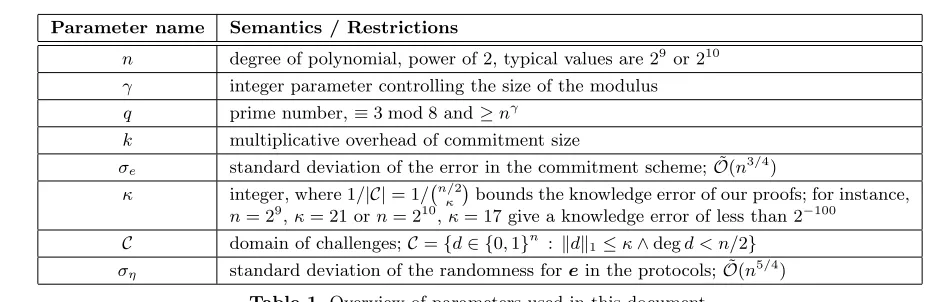
Parameter name Semantics / Restrictions
n degree of polynomial, power of 2, typical values are 29 or 210
γ integer parameter controlling the size of the modulus q prime number,≡3 mod 8 and≥nγ
k multiplicative overhead of commitment size
σe standard deviation of the error in the commitment scheme; ˜O(n3/4) κ integer, where 1/|C|= 1/ n/κ2
bounds the knowledge error of our proofs; for instance, n= 29,κ= 21 orn= 210,κ= 17 give a knowledge error of less than 2−100
C domain of challenges;C={d∈ {0,1}n : kdk1≤κ∧degd < n/2}
ση standard deviation of the randomness forein the protocols; ˜O(n5/4)
Table 1.Overview of parameters used in this document.
In the following we describe our commitment scheme. Table 1 lists the parameters being used and the requirements we pose on them.
5
– KGen: The public commitment key pk = (a,b) is computed as a,b ←$ (Zq[x]/hxn + 1i)k, where
q ≡3 mod 8 is prime, andn is a power of 2.
– Com: To commit to a messagem∈Zq[x]/hxn+1i, the commitment algorithm drawsr←$ Zq[x]/hxn+ 1i and e←$ Dσke conditioned on kek∞≤n, and outputs
c=am+br+e,
and the opening information forc is given by (m, r,e,1).
– Ver: Given a commitmentc, a messagem0, a randomnessr0, as well ase0 andf0, the verifier accepts, if and only if
am0+br0+f0−1e0 =c ∧ ke0k∞<
$
n4/3 2
%
∧ kf0k∞≤1 ∧ degf0 < n
2.
The scheme above is a generalization of that by Xie et al. [XXW13], as we allow for the additional small polynomial f in valid openings. While an honest party can always set f = 1 when opening c
and therefore the completeness property is not affected by this relaxation, the immediate question arises whether the given construction is still binding, i.e., whether a malicious user still cannot open a commitment to two different messages. We give a formal security proof in the following.
We want to stress that the above modification will be at the heart for the construction of efficient zero-knowledge proofs of the contained message in Section4.
Theorem 3.1. Let γ >6 and q, k be polynomial inn such that the following is satisfied:
q ≥nγ≥n6 and k > 18γ
3γ−16. (1)
Then, under theRLWE-assumption, the above scheme is a computationally hiding and perfectly binding commitment scheme with overwhelming probability over the choices of the public commitment key.
Proof. We will prove completeness as well as perfect binding and computational hiding properties. Correctness.This is trivial.
Computational blinding. First note that by, e.g., [Lyu12, Lemma 4.4], the probability that e ←$ Dσke
haskek∞> n is negligible, and thus the conditional distribution ofein Comis statistically close to a
discrete Normal distribution. Now, by theRLWE-assumption,br+eis pseudorandom, and thus so isc. Binding.For the binding property, we have to show that
c=am0+br0+f0−1e0 =am00+br00+f00−1e00
implies that m0 = m00, if ke0k∞,ke00k∞ < n4/3/2, kf0k∞,kf00k∞ ≤ 1, and degf0,degf00 < n/2, or,
alternatively, that
am+br=f0−1e0−f00−1e00
implies thatm= 0 with overwhelming probability over the choices ofa,b.
Assume by contradiction that this holds for some fixedm, r, e0, e00, f0, f00withm6= 0 ande0, e00, f0, f00
being sufficiently small. Because of the assumption on n and q, we have that xn+ 1 splits into two irreducible factors α(x), β(x) [SSTX09, Lemma 3]. Now, since m6= 0 mod (xn+ 1), we also have that
m 6= 0 modα(x) or m 6= 0 modβ(x), and thus aim takes at least qn/2 different values. We then have
that
Pr
a1m+b1r .. .
akm+bkr
=
f0−1e01−f00−1e001
.. .
f0−1e0k−f00−1e00k
: a,b
$
←(Zq[x]/hxn+ 1i)k,
≤
1
P[c;m, r,e] V[c]
µ, ρ←$ Zq[x]/hxn+ 1i
η←$ Dσkη
t=aµ+bρ+η
(caux, daux) =aCom(t) caux - d
$ ← C
sm=µ+dm d
sr=ρ+dr se=η+de
abort-checks forse daux,t, sm, sr, se
- aVer(caux, daux,t) ?
=accept
t+dc=? asm+bsr+se
ksek∞≤ b? n4/3/4c
Protocol 4.1: Simple preimage proof. The verifier accepts, iff all conditions marked with “?” are satisfied.
Now, taking a union bound over all m, r, e0, e00, f0, f00 we get that the overall probability that there exists such an m6= 0 is at most
q2n(n4/3)2kn32n/2
qkn/2 ≤
q2n(q4/(3γ))2kn32n/2
qkn/2 = 3
nq(2+(38γ−1 2)k)n.
This is negligible in nif 3q2+(8/(3γ)−1/2)k≤1/2, which holds if the requirements from (1) are satisfied.
u t
4
Zero-Knowledge of Proofs of Knowledge
In this section we first present a protocol for proving knowledge of valid openings of commitments as defined in the previous section. We then give protocols which allow one to prove that the messages
m1, m2, m3 contained in commitments c1,c2,c3 satisfy m3 = m1+m2 or m3 = m1m2, respectively. Together this allows one to prove knowledge of arbitrary algebraic circuits.
In this entire section we let (aKGen,aCom,aVer) be an arbitrary auxiliary string commitment scheme. For simplicity, the reader may think of it as the scheme from Section 3, or as well just as a random oracle. We write (caux, daux) =aCom(s), where caux is the commitment anddauxis the opening of caux.
4.1 Preimage Proofs
The protocol depicted in Protocol 4.1is a Σ20-protocol for showing knowledge of a valid opening for a single commitment. It is honest-verifier zero-knowledge whenever the commitment was honestly com-puted, and is sound with respect to valid openings. In particular, whenever a potentially malicious prover can make the verifier accept with more than negligible probability, it must know a valid opening of c. We stress that this gap between the zero-knowledge and the soundness property is in line with previous protocols, e.g., for discrete logarithms in groups of hidden order [DF02], where the prover is also guaranteed security only for a subset of valid openings. However, this gap is meaningful, as our commitment scheme is still perfectly binding also for the larger set of valid openings, and so the proof still guarantees knowledge of theunique valid opening ofc.
Theorem 4.2. If the auxiliary commitment scheme is perfectly binding, then Protocol4.1is an honest-verifier zero-knowledge proof of knowledge with knowledge error1/ n/κ2 for the following relations:
RLW E={((a,b,c),(m, r,e)) : c=am+br+e ∧ kek∞≤n} and
R0LW E=n((a,b,c),(m, r,e, f)) : c=am+br+f−1e ∧ kek∞≤ bn4/3/2c,kfk∞≤1,degf < n
2 o
Proof. The theorem is proved by showing that the protocol is aΣ20-protocol for the given relation. The claim then follows directly from the discussion in Section2.2.
While the 3-move-form is obvious, we will now prove the remaining properties:
Completeness.An honest prover responses with a probability close to M1 . In this case we get:
t+dc=aµ+bρ+η+dam+dbr+de=a(µ+dm) +b(ρ+dr) + (η+de) =asm+bsr+se.
Furthermore, we have that with overwhelming probability ksek∞ = kη+dek∞ ≤ kηk∞+κkek∞ ≤ bn4/3/4c, as the standard deviations ofDσe, Dση are significantly smaller thann
4/3.
Special soundness. Let be given two accepting protocol transcripts (caux, d0,(d0aux,t0, s0m, s0r, s0e)) and
(caux, d00,(d00aux,t00, s00m, s00r, s00e)), where d0 6= d00. By the perfect binding property of aCom we get that
t0=t00 =t. By subtracting the verification equations performed by the verifier we then obtain:
∆dc=a∆m+b∆r+∆e,
where we set ∆d=d0−d00, and similar for∆m, ∆r, and∆e. As deg∆d< n/2, we also have that∆d is
invertible inRq. We get the witness (∆−d1∆m, ∆−d1∆r, ∆d, ∆e), wherek∆dk∞≤1 andk∆ek ≤ bn4/3/2c.
Honest-verifier zero-knowledge. Taking a challenge d as an input, the simulator first draws uniformly random elements s0m, s0r ←$ Zq[x]/hxn+ 1i, and s0e to be ⊥ with probability 1−1/M and distributed
according toDση with probability 1/M. Ifs 0
e6=⊥, it computes (c0aux, d0aux) =aCom(t0 =as0m+bs0r+s0e− dc) and outputs (c0aux, d,(d0aux,t0, s0m, s0r, s0e)). (Note that s0i and duniquely determine t0 in the protocol and in the simulation.) Otherwise the simulator sets (c0aux, d0aux) =aCom(0) and outputs (c0aux, d,⊥).
It follows from Theorem 2.5 that the distribution conditioned on the prover not outputting ⊥ is indistinguishable from real protocol runs. From the same theorem, it follows that aborts occur with probability 1−1/M for every value ofde. In case of an abort, the indistinguishability follows from the hiding property ofaComand the fact that for every d, there is an equal chance of an abort happening.
u t
Lemma 4.3. If the auxiliary commitment scheme is a trapdoor commitment scheme, then Protocol4.1
is a concurrently secure zero-knowledge argument of knowledge with knowledge error 1/ n/κ2 for the relation specified in Theorem4.2:
Proof. Soundness against computationally bounded adversaries follows directly from the computational binding property of the commitment scheme and the same arguments as in the proof of Theorem4.2.
The zero-knowledge property can be seen as follows: The simulator first sets up the public parameters of the auxiliary commitment scheme, keeping the trapdoor td secret. It then sends caux=aCom(0) to the verifier, receiving a challenged. It now runs the simulator for the honest verifier, and, if it does not abort, uses td to open caux to the correct value. As this does not require to rewind the verifier, it also
gives security in the concurrent setting. ut
Note that this result is very similar to Damg˚ard [Dam00] who gives a generic construction to achieve concurrent ZK for anyΣ-protocol. However, our technique had a slightly different origin as our protocols are inherently based on the auxiliary commitment scheme to achieve honest-verifier zero-knowledge. The lemma literally also applies for the subsequent protocols.
On the abort probability.From Theorem2.5and [Lyu12] it follows that the probability that the prover does not abort is exponentially close to M1 , where M ∈ O(exp(kdσek
η )). Thus, on average M repetitions
of the protocol are required. By choosingση sufficiently large,M can be made arbitrarily small at the
cost of requiring larger parameters, see also Lyubashevsky [Lyu12].
of Damg˚ard et al. [DaPSZ12], who compute many independent first messages and send a Merkle-tree commitment of those in the first step. While on average requiring more computation on the prover side, this approach gives a constant 3-round protocol.
4.2 Proving Linear Relations
Protocol 4.4 allows one to prove knowledge of messages m1, m2, m3 contained inc1,c2,c3, where the
mi additionally satisfy a linear relation of the form m3 = x1m1 +x2m2 for arbitrary public xi ∈ Zq[x]/hxn+ 1i. The construction uses a standard technique: Three instances of Protocol4.1are run in
parallel form1, m2, m3 using the same challenge, but instead of choosing the randomnessµ3 for m3 in the prover’s first step at random, it is computed such thatµ1, µ2, µ3 satisfy the claimed linear relation. Verifying now whether thesmi also satisfy that linear relation is enough for the verifier to be guaranteed
that the supplied messages have the correct form.
P[ci;mi, ri,ei] V[ci]
µ1, µ2, ρ1, ρ2, ρ3 $
←Zq[x]/hxn+ 1i µ3=x1µ1+x2µ2
η1,η2,η3 $ ←Dk
ση
ti=aµi+bρi+ηifori= 1,2,3
(caux, daux) =aCom(t1,t2,t3) caux - d
$ ← C
smi=µi+dmifori= 1,2 d sri=ρi+drifori= 1,2,3
sei=ηi+deifori= 1,2,3
abort-checks forsej
daux,ti, smi, sri, sei
- aVer(caux, daux,(t1,t2,t3)) ?
=accept
sm3=x1sm1+x2sm2
ti+dci
?
=aismi+bsri+sei fori= 1,2,3
sei ?
≤ bn4/3/4cfori= 1,2,3
Protocol 4.4: Proving linear relations. The abort-checks are as in Protocol4.1and Theorem2.5.
Theorem 4.5. If the auxiliary commitment scheme is perfectly binding, then Protocol4.4is an honest-verifier zero-knowledge proof of knowledge with knowledge error1/ n/κ2
for the following relations:
RLLW E =
(
((a,b, x1, x2,c1,c2,c3),(m1, m2, m3, r1, r2, r3,e1,e2,e3)) :
3 ^
i=1
(ci=ami+bri+ei ∧ keik∞≤n) ∧ m3=x1m1+x2m2 )
,
and R0LLW E is defined accordingly.
Proof. The theorem is proved by showing that the protocol is aΣ20-protocol for the given relation. The claim then follows directly from the discussion in Section2.2.
The proof is essentially a straightforward adaption of that of Theorem4.2. Completeness.This follows directly from the completeness of Protocol 4.1and:
x1sm1+x2sm2 =x1(µ1+dm1) +x2(µ2+dm2) = (x1µ1+x2µ2) +d(x1m1+x2m2) =µ3+dm3 =sm3,
Special soundness.Given two accepting transcripts, we can extract witnesses (∆mi, ∆ri, ∆d, ∆ei) for ci
∆m3 =x1∆m1+x2∆m2 is indeed satisfied. This can be seen as follows:
∆m3 =s
0 m3 −s
00
m3 = (x1s
0
m1 +x2s
0
m2)−(x1s
00
m1+x2s
00 m2) =x1(s0m1−s
00
m1) +x2(s
0 m2−s
00
m2) =x1∆m1 +x2∆m2.
Special honest-verifier zero-knowledge.The simulator is essentially given by three independent instances of that for Protocol4.1, except thats0m3 =x1s0m1 +x2s
0
m2. The correctness of this simulation is shown
by a standard argument, cf., e.g., [BGK+09,JPT12]. ut
Proving inhomogeneous relations. As for, e.g., DLOG based protocols, inhomogeneous relations like
m3 =x1m1+x2m2+x3 can be proved by first removing the inhomogeneity: If ci is a commitment to
mi, both parties first computec03 =c3−ax3, and the prover setsm03=m3−x3. The parties then perform Protocol4.4forc1,c2,c03 and m1, m2, m03 and the homogeneous linear relation m03 =x1m1+x2m2.
4.3 Proving Multiplicative Relations
In this section we show how one can prove knowledge ofmi, ri,ei,i= 1,2,3 such thatci =ami+bri+ei,
and additionallym3=m1·m2. We begin by giving the intuition behind the protocol.
(i) The prover first proves knowledge of the contents ofc1,c2,c3by running 3 instances of Protocol4.1. (ii) Similar to Protocol 4.4, the verifier will check the multiplicative relation by combining the re-sponses for m1, m2, m3 accordingly. Unfortunately, in contrast to linear proofs where we have
sm1 +sm2 =sm3 for an honest prover, we have that sm1sm2 6=sm3. We tackle this problem by letting the prover commit to the arising cross-termsµ1m2+µ2m1 and µ1µ2 in a second part. The according commitments are denoted byc+and c×. Again using two instances of Protocol4.1, the
prover now proves that it knows the openings of those two commitments.
(iii) The third part of the proof now establishes the multiplicative relation. It is based on the following observation: from (i) and (ii) it follows that:
˜
c=asm1sm2 −d 2c
3−c×−dc+= a µ1µ2−m×+d(µ1m2+µ2m1−m+) +d2(m1m2−m3) +b(−d2r3−r×−dr+) + (−d2e3−e×−de+),
for somem×, m+. Note here that the error term (−d2e3−e×−de+) of ˜c has small norm, because
e3,e×,e+ have small norm andkdk1 ≤κ.
Now, for an honest prover it can easily be seen that ˜c=b˜r+˜efor ˜rand ˜eas defined in the protocol, i.e., ˜cis a commitment to 0. On the other hand, if a prover can prove that for at least three different challenges d, the multiplicative relation follows. This can be seen as follows. If the coefficient of
ais equal to 0 for three different values of d, this coefficient must be the zero-polynomial (in the indeterminate d), and thus m3 =m1m2. This is because a quadratic polynomial in Rq can only
have at most two distinct roots inC. The proof of this claim is straightforward and thus omitted.
Theorem 4.6. If the auxiliary commitment scheme is perfectly binding, then Protocol4.7is an honest-verifier zero-knowledge proof of knowledge with knowledge error2/ n/κ2 for the following relations:
RM LW E = (
((a,b, x1, x2,c1,c2,c3),(m1, m2, m3, r1, r2, r3,e1,e2,e3)) :
3 ^
i=1
(ci=ami+bri+ei ∧ keik∞≤n) ∧ m3=m1m2 )
,
P[ci;mi, ri,ei] V[ci]
(i) µ1, µ2, µ3, ρ1, ρ2, ρ3 $
←Zq[x]/hxn+ 1i
η1,η2,η3 $ ←Dkση
ti=aµi+bρi+ηifori= 1,2,3
(ii) m+=µ1m2+µ2m1
m×=µ1µ2
r+, r×←$ Zq[x]/hxn+ 1i
e+,e×←$ Dσke
c+=am++br++e+
c×=am×+br×+e×
µ+, µ×, ρ+, ρ× $
←Zq[x]/hxn+ 1i
η+,η× $ ←Dk
ση
t+=aµ++bρ++η+
t×=aµ×+bρ×+η×
(iii) ˜ρ←$ Zq[x]/hxn+ 1i ˜
η←$ Dkση ˜
t=bρ˜+ ˜η
(caux, daux) =aCom(t+,t×,ti,˜t,c+,c×)
caux
- d
$ ← C
d
(i) + (ii)smi=µi+dmi fori= 1,2,3,+,×
sri=ρi+drifori= 1,2,3,+,×
sei =ηi+deifori= 1,2,3,+,×
(iii) sr˜= ˜ρ+d˜r
˜
e=−d2e
3−e×−de+
˜
r=−d2r3−r×−dr+
se˜= ˜η+de˜
abort-checks forse, se˜ j
caux,t+,t×,ti,˜t,c+,c×,
smi, sri, sei, sr, s˜ ˜e
- aVer(caux, daux,(t+,t×,ti,˜t,c+,c×)) ?
=accept
(i) + (ii)ti+dci
?
=aismi+bsri+sei fori= 1,2,3,+,×
sei≤ b? n4/3/4cfori= 1,2,3,+,×
(iii) ˜c=asm1sm2−d 2
c3−c×−dc+
˜t+d˜c ?
=bs˜r+se˜
s˜e
?
≤ bn4/3/4c
Protocol 4.7: Proving multiplicative relations. The abort-checks are as in Protocol4.1and Theorem2.5.
Proof. The theorem is proved by showing that the protocol is aΣ30-protocol for the given relation. The claim then follows directly from the discussion in Section2.2.
Completeness.It is easy to see thatV accepts with overwhelming probability whenP does not abort. Special soundness.This follows from the soundness of Protocols4.1and4.4and the above considerations. Special honest-verifier zero-knowledge. The intuition is the following: By the hiding property of our commitment scheme, c+ and c× computationally do not reveal any information about the secrets.
Furthermore, as Protocol4.1is zero-knowledge,sm1, sm2 and consequently ˜cdo not reveal anything to the verifier either. The claim then follows from the proof of Theorem4.2.
More formally, the simulator first computes ˜c0 as a commitment to 0, and similarly forc0+. It then runs the simulator for c1,c2,c3 and, assuming that no aborts happened, computes c0× = ˜c0+d2c3−
therefore that even though the error distributions of ˜c0 and ˜c (and of c0× and c×, respectively) are not
identical, the resulting commitments cannot be distinguished under theRLWE-assumption. ut
5
Conclusion
We presented a simple and efficient string commitment scheme whose security is based on the hardness of the RLWE-problem, or, equivalently, on the hardness of solving certain problems on ideal lattices. Additionally we gave constructions for zero-knowledge proofs of knowledge of valid openings of such commitments, and for proving arbitrary relations among such messages. By achieving a negligible knowledge error in our protocols, we solve an open problem stated in previous work, e.g., Jain et al. [JPT12].
References
AJLA+12. G. Asharov, A. Jain, A. L´opez-Alt, E. Tromer, V. Vaikuntanathan, and D. Wichs. Multiparty Computa-tion with Low CommunicaComputa-tion, ComputaComputa-tion and InteracComputa-tion via Threshold FHE. In D. Pointcheval and T. Johansson, editors,EUROCRYPT 2012, volume 7237 ofLNCS, pages 483–501. Springer, 2012.
BCK+14. F. Benhamouda, J. Camenisch, S. Krenn, V. Lyubashevski, and G. Neven. Better Zero-Knowledge Proofs for Lattice Encryption and Their Application to Group Signatures. InASIACRYPT 2014, LNCS. Springer, 2014. (to appear).
BDP00. J. Boyar, I. Damg˚ard, and R. Peralta. Short Non-Interactive Cryptographic Proofs. Journal of Cryptology, 13(4):449–472, 2000.
BG93. M. Bellare and O. Goldreich. On Defining Proofs of Knowledge. In E. F. Brickell, editor,CRYPTO 92, volume 740 ofLNCS, pages 390–420. Springer, 1993.
BGK+09. E. Bangerter, E. Ghadafi, S. Krenn, A.-R. Sadeghi, T. Schneider, N. P. Smart, J.-K. Tsay, and B. Warinschi.
Final Report on Unified Theoretical Framework of Efficient Zero-Knowledge Proofs of Knowledge, 2009. CACE Project Deliverable.
BLP+13. Zvika Brakerski, Adeline Langlois, Chris Peikert, Oded Regev, and Damien Stehl´e. Classical hardness of
learning with errors. In Symposium on Theory of Computing Conference, STOC’13, Palo Alto, CA, USA, June 1-4, 2013, pages 575–584, 2013.
BPR12. A. Banerjee, C. Peikert, and A. Rosen. Pseudorandom Functions and Lattices. In D. Pointcheval and T. Jo-hansson, editors,EUROCRYPT 2012, volume 7237 ofLNCS, pages 719–737. Springer, 2012.
BV11a. Z. Brakerski and V. Vaikuntanathan. Fully Homomorphic Encryption from Ring-LWE and Security for Key Dependent Messages. In P. Rogaway, editor,CRYPTO 2011, volume 6841 ofLNCS, pages 505–524. Springer, 2011.
BV11b. Zvika Brakerski and Vinod Vaikuntanathan. Efficient fully homomorphic encryption from (standard) LWE. InFOCS, 2011.
CD97. R. Cramer and I. Damg˚ard. Linear Zero-Knowledge - A Note on Efficient Zero-Knowledge Proofs and Argu-ments. In F. T. Leighton and P. W. Shor, editors,STOC 97, pages 436–445. ACM, 1997.
CD98. R. Cramer and I. Damg˚ard. Zero-Knowledge Proofs for Finite Field Arithmetic; or: Can Zero-Knowledge Be for Free? In H. Krawczyk, editor,CRYPTO 98, volume 1462 ofLNCS, pages 424–441. Springer, 1998. CD09. R. Cramer and I. Damg˚ard. On the Amortized Complexity of Zero-Knowledge Protocols. In S. Halevi, editor,
CRYPTO 2009, volume 5677 of LNCS, pages 177–191. Springer, 2009.
Cra97. R. Cramer. Modular Design of Secure yet Practical Cryptographic Protocols. PhD thesis, CWI and University of Amsterdam, 1997.
Dam00. I. Damg˚ard. Efficient Concurrent Zero-Knowledge in the Auxiliary String Model. In B. Preneel, editor, EUROCRYPT 2000, volume 1807 ofLNCS, pages 418–430. Springer, 2000.
Dam10. I. Damg˚ard. On Σ-Protocols. Lecture on Cryptologic Protocol Theory; Faculty of Science, University of Aarhus, 2010.
DaPSZ12. I. Damg˚ard, V. Pastro andN. P. Smart, and S. Zakarias. Multiparty Computation from Somewhat Homomor-phic Encryption. In R. Safavi-Naini and R. Canetti, editors, CRYPTO 2012, volume 7417 of LNCS, pages 643–662. Springer, 2012.
DDLL13. L. Ducas, A. Durmus, T. Lepoint, and V. Lyubashevsky. Lattice Signatures and Bimodal Gaussians. In R. Canetti and J. A. Garay, editors,CRYPTO 2013, volume 8042 ofLNCS, pages 40–56. Springer, 2013. DF02. I. Damg˚ard and E. Fujisaki. A Statistically-Hiding Integer Commitment Scheme Based on Groups with Hidden
DGOW95. I. Damg˚ard, O. Goldreich, T. Okamoto, and A. Wigderson. Honest Verifier vs Dishonest Verifier in Public Coin Zero-Knowledge Proofs. In D. Coppersmith, editor,CRYPTO 95, volume 963 ofLNCS, pages 325–338. Springer, 1995.
Fis01. M. Fischlin. Trapdoor Commitment Schemes and Their Applications. PhD thesis, Johann Wolfgang Goethe-Universit¨at Frankfurt am Main, 2001.
FO97. E. Fujisaki and T. Okamoto. Statistical Zero Knowledge Protocols to Prove Modular Polynomial Relations. In B. Kaliski, editor,CRYPTO 97, volume 1294 ofLNCS, pages 16–30. Springer, 1997.
FS87. A. Fiat and A. Shamir. How to Prove Yourself: Practical Solutions to Identification and Signature Problems. In A. M. Odlyzko, editor,CRYPTO 86, volume 263 ofLNCS, pages 186–194. Springer, 1987.
Gen09. C. Gentry. Fully Homomorphic Encryption Using Ideal Lattices. In M. Mitzenmacher, editor,STOC 2009, pages 169–178. ACM, 2009.
GMR85. S. Goldwasser, S. Micali, and C. Rackoff. The Knowledge Complexity of Interactive Proof-Systems (Extended Abstract). InSTOC, pages 291–304, 1985.
GMW86. O. Goldreich, S. Micali, and A. Wigderson. How to Prove all NP-Statements in Zero-Knowledge, and a Methodology of Cryptographic Protocol Design. In A. M. Odlyzko, editor,CRYPTO 86, volume 263 ofLNCS, pages 171–185. Springer, 1986.
GPV08. C. Gentry, C. Peikert, and V. Vaikuntanathan. Trapdoors for Hard Lattices and New Cryptographic Con-structions. In C. Dwork, editor,STOC 2008, pages 197–206. ACM, 2008.
GS08. J. Groth and A. Sahai. Efficient Non-interactive Proof Systems for Bilinear Groups. In N. P. Smart, editor, EUROCRYPT 2008, volume 4965 ofLNCS, pages 415–432. Springer, 2008.
IKOS07. Y. Ishai, E. Kushilevitz, R. Ostrovsky, and A. Sahai. Zero-knowledge from secure multiparty computation. In D. S. Johnson and U. Feige, editors,STOC 2007, pages 21–30. ACM, 2007.
JPT12. A. Jain, S. Krenn K. Pietrzak, and A. Tentes. Commitments and Efficient Zero-Knowledge from Learning Parity with Noise. In X. Wang and K. Sako, editors,ASIACRYPT 2012, volume 7658 ofLNCS, pages 663–680. Springer, 2012.
KMO90. J. Kilian, S. Micali, and R. Ostrovsky. Minimum Resource Zero-Knowledge Proofs (Extended Abstract). In G. Brassard, editor,CRYPTO 89, volume 435 ofLNCS, pages 545–546. Springer, 1990.
KP98. J. Kilian and E. Petrank. An Efficient Noninteractive Zero-Knowledge Proof System for NP with General Assumptions. Journal of Cryptology, 11(1):1–27, 1998.
KR06. Y. T. Kalai and R. Raz. Succinct Non-Interactive Zero-Knowledge Proofs with Preprocessing for LOGSNP. InFOCS 2006, pages 355–366. IEEE Computer Society, 2006.
KV09. J. Katz and V. Vaikuntanathan. Smooth Projective Hashing and Password-Based Authenticated Key Exchange from Lattices. In M. Matsui, editor,ASIACRYPT 2009, volume 5912 ofLNCS, pages 636–652. Springer, 2009. LNSW13. S. Ling, K. Nguyen, D. Stehl´e, and H. Wang. Improved Zero-Knowledge Proofs of Knowledge for the ISIS Problem, and Applications. In K. Kurosawa and G. Hanaoka, editors,PKC 2013, volume 7778 ofLNCS, pages 107–124. Springer, 2013.
LP11. R. Lindner and C. Peikert. Better Key Sizes (and Attacks) for LWE-Based Encryption. In A. Kiayias, editor, CT-RSA 2011, volume 6558 ofLNCS, pages 319–339. Springer, 2011.
LPR10. V. Lyubashevsky, C. Peikert, and O. Regev. On Ideal Lattices and Learning with Errors over Rings. In H. Gilbert, editor,EUROCRYPT 2010, volume 6110 ofLNCS, pages 1–23. Springer, 2010.
LS12. Adeline Langlois and Damien Stehl´e. Hardness of decision (R)LWE for any modulus.IACR Cryptology ePrint Archive, 2012, 2012.
Lyu09. V. Lyubashevsky. Fiat-Shamir with Aborts: Applications to Lattice and Factoring-Based Signatures. In M. Matsui, editor,ASIACRYPT 2009, volume 5912 of LNCS, pages 598–616. Springer, 2009.
Lyu12. V. Lyubashevsky. Lattice Signatures without Trapdoors. In D. Pointcheval and T. Johansson, editors, EU-ROCRYPT 2012, volume 7237 ofLNCS, pages 738–755. Springer, 2012.
PR06. C. Peikert and A. Rosen. Efficient Collision-Resistant Hashing from Worst-Case Assumptions on Cyclic Lat-tices. In S. Halevi and T. Rabin, editors,TCC 2006, volume 3876 ofLNCS, pages 145–166. Springer, 2006. Reg05. O. Regev. On Lattices, Learning with Errors, Random Linear Codes, and Cryptography. In STOC 2005,
pages 84–93. ACM, 2005.
R¨uc10. M. R¨uckert. Lattice-Based Blind Signatures. In M. Abe, editor,ASIACRYPT 2010, volume 6477 ofLNCS, pages 413–430. Springer, 2010.
SSTX09. D. Stehl´e, R. Steinfeld, K. Tanaka, and K. Xagawa. Efficient Public Key Encryption Based on Ideal Lattices. In M. Matsui, editor,ASIACRYPT 2009, volume 5912 ofLNCS, pages 617–635. Springer, 2009.
Ste93. J. Stern. A New Identification Scheme Based on Syndrome Decoding. In D. R. Stinson, editor,CRYPTO 93, volume 773 ofLNCS, pages 13–21. Springer, 1993.