Design of an Improved DEC Protocol for
Wireless Sensor Networks
Gurjit Kaur1, Shweta Rani2, Sushil Kakkar3
M. Tech Student, Dept. of ECE, BGIET, Sangrur, Punjab, India1
Associate Professor, Dept. of ECE, BGIET, Sangrur, Punjab, India2
Assistant Professor, Dept. of ECE, BGIET, Sangrur, Punjab, India3
ABSTRACT: Wireless Sensor Networks (WSN) approach have been exploited for checking purposes in different spaces from designing industry to our surroundings because of their sufficiency to powerfully screen remote areas such as process management, agriculture farm lands, disaster prone areas etc. DEC (Deterministic Energy Efficient Clustering) protocol is active and composes toward individual and more productive as far as continuity than other of the current protocols. Simulation results shows a better performance in comparison to other protocols like original DEC, LEACH, E-SEP with respect to energy utilization. Further when Improved DEC (I-DEC) protocol has been used than it was measured that the system life time has been improved by 132 rounds in comparison to the original DEC protocol. This analysis shows that the approach used in this research, provides an unimpeachable ideal solution for balanced energy consumption in hierarchical wireless sensor networks.
KEYWORDS: Wireless Sensor Networks, Clustering Protocol, DEC, Energy- Efficient, WSN Lifetime, Cluster Head.
I.INTRODUCTION TO WIRELESS SENSOR NETWORKS
A Wireless sensor network (WSN) is a remote system that comprises of distributed sensors to screen certain conditions at different areas. A WSN are regularly illustrated as a system comprises of low-size and low-complex gadgets defined as sensor nodes that may sense the earth or surroundings to monitor certain conditions like temperature, humidity, air pollution, forest fire, land slide detection etc. at different locations [1], [2]. In WSN, Sensor nodes are energy-constrained electrical devices so it is very important to design an algorithm that organizes sensors in cluster to reduce the energy which is used to communicate information from all nodes to the base station [3].
One of the main attributes of these protocols such as Low-Energy Adaptive Clustering Hierarchy (LEACH) [4] protocol is that they utilize clustering schemes to come together among the sensors in the network and that has been proven to enhance the WSN performance. Main limitation of LEACH is uncertainties in the election process of cluster head. Several studies [5], [6] have used clustering to manage WSN. Stable Election Protocol (SEP) [7] is a further modification to the LEACH protocol. In SEP, the election of cluster heads among the two types of nodes is not effective, which results that the nodes that are a long way from the power full nodes will die first which is main limitations of this protocol.
ISSN (Print) : 2320 – 3765 ISSN (Online): 2278 – 8875
I
nternational
J
ournal of
A
dvanced
R
esearch in
E
lectrical,
E
lectronics and
I
nstrumentation
E
ngineering
(An ISO 3297: 2007 Certified Organization)
Vol. 5, Issue 4, April 2016
II.WIRELESS SENSOR NETWORK PROTOCOLS MODEL
One of the main advantages of wireless sensor networks is their ability to operate abandoned in such environments which is rigid, rusty. Designing and operating such large networks would require scalable architecture and management system. The sensors in such networks are energy embarrassed and their batteries cannot be charged [9]. Therefore, designing energy aware protocols which results to increasing the stability of the network and also become more important factor for increasing the lifetime of sensors [10], [11].
In the design of a distributed energy-efficient clustering algorithm for heterogeneous wireless sensor networks [12] that minimizes the vitality scattering in remote sensor networks. LEACH [13] is one of the first progressive steering approaches for sensor systems. There are some problems occurred in LEACH protocol because the cluster head is selected randomly so each node in cluster has same probability to become cluster head after large number rounds the node with higher remaining energy and node with low remain energy has same probability of becoming cluster heads if the node with low reaming energy is chosen as cluster head it will run out of energy and die quickly which effects network lifetime. Stable Election protocol (SEP) [14] is the improvement of the LEACH protocol. In the Stable Election Protocol two types of node and two level hierarchies are considered. It is based on weighted electron probability of each node to become cluster head according to remaining energy in each node. The limitation of SEP is that election of cluster heads among of two types of node is not dynamic, which results that the nodes that are far away from the powerful nodes will die first. Further the modification of SEP protocol is introduced in [15].
Design of a deterministic energy-efficient clustering algorithm for heterogeneous wireless sensor network [8], [15] uses an improved methodology which minimizes computational overhead-cost to self-arrange the sensor system. In DEC cluster head selection algorithm can perform a probabilistic- based algorithm in terms of energy consumption. DEC protocol is an absolutely deterministic model which employs clustering to organize WSN. The design of this protocol is simple i.e. to minimize computational overhead cost to self-admiration the network. DEC protocol used residual energy of each node in the cluster for election process of cluster head. The uncertainties in the cluster-head elections have been minimized in DEC which is main drawback LEACH protocol [15].
However, there are some problems associated with DEC protocol i.e. if number of rounds would increase then the nodes deployed in the network become dead earlier than LEACH or SEP protocol. Therefore, in DEC protocol it is difficult to maintain a balance between maximum number of rounds a network survive and stability of the network. To overcome the limitations of DEC protocol, an I-DEC protocol is designed which shows a superior execution as for energy utilization. In I-DEC protocol system lifetime is increased in heterogeneous settings when contrasted with current protocols. It is deserving of note that our methodology approximates a perfect answer for adjusted energy utilization in progressive remote sensor networks.
III. IMPROVED DEC PROTOCOL
In this scheme, by using these studies, Improved Deterministic Energy-Efficient Clustering (I-DEC) protocol defined that it can gives a more stability which increases the lifetime of the network and guaranteed the node with the largest residual energy will get elected as the cluster head. So in I-DEC protocol a fixed number of cluster heads per round can be chosen which provides a more ideal solution for energy consumption in WSNs. I-DEC shows better results due to following observance which makes this protocol more desirable;
i) In I-DEC the cluster head election is decided on the basic of residual energy of each node and each round is independent to their subsequent round.
ii) I-DEC ensures that every node has a chance to become the cluster head if its residual energy is higher than other nodes.
iii) In I-DEC every cluster head has enough energy to do its work, until at least the end of the network lifetime. iv) I-DEC also guarantees that fixed number of cluster- heads can be chosen per rounds.
Fig. 1 Behaviour of node energy consumption in comparison to rounds [15]
IV.SIMULATION AND ANALYSIS OF RESULT
Simulation set up :
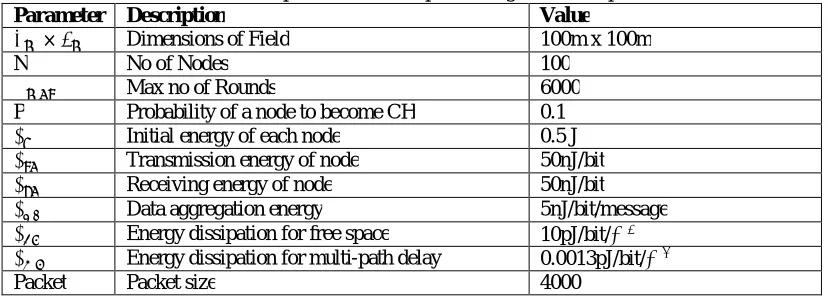
The initial parameters taken to implement the I-DEC protocol are mentioned in Table 1.In the implementation procedure, a multilevel clustering model is employed in which the nodes with different energy levels are randomly deployed within a space region called field. The values of initial parameters are shown in table 1.
Table 1 Initial parameters for implementing the I-DEC protocol
Parameter Description Value
× Dimensions of Field 100m x 100m
N No of Nodes 100
Max no of Rounds 6000
P Probability of a node to become CH 0.1
Initial energy of each node 0.5 J
Transmission energy of node 50nJ/bit
Receiving energy of node 50nJ/bit
Data aggregation energy 5nJ/bit/message
Energy dissipation for free space 10pJ/bit/
Energy dissipation for multi-path delay 0.0013pJ/bit/
Packet Packet size 4000
ISSN (Print) : 2320 – 3765 ISSN (Online): 2278 – 8875
I
nternational
J
ournal of
A
dvanced
R
esearch in
E
lectrical,
E
lectronics and
I
nstrumentation
E
ngineering
(An ISO 3297: 2007 Certified Organization)
Vol. 5, Issue 4, April 2016
Table 2 Types of nodes along with their configurations
Types of nodes
Symbol of Node No. of Nodes in %age No. of Nodes
Normal Node 70% 1 to 70
Intermediate Node
9% 71 to 79
Advance Node
8% 80 to 87
Super Node 7% 88 to 94
Ultra Super Node
6% 95 to 100
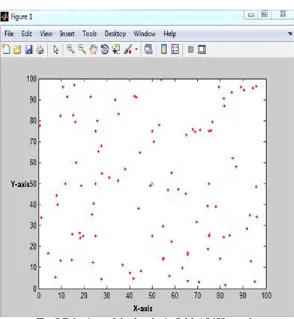
As defined there are five types of nodes that are Normal nodes, Intermediate nodes, advanced nodes, Super nodes and Ultra Super nodes. These nodes are spread in the field whose dimensions are 100m& 100m on x & y-axis respectively as shown in fig. 2.
Fig. 3 Behaviour of dead nodes in field at 2482 rounds
Fig. 3 shows all nodes in the dead condition, all the nodes have consumed their energy levels as they are not rechargeable nodes [9] so after completing their rounds they come to a situation when they completely discharges their energy and called as dead nodes.
Results and Comparisons:
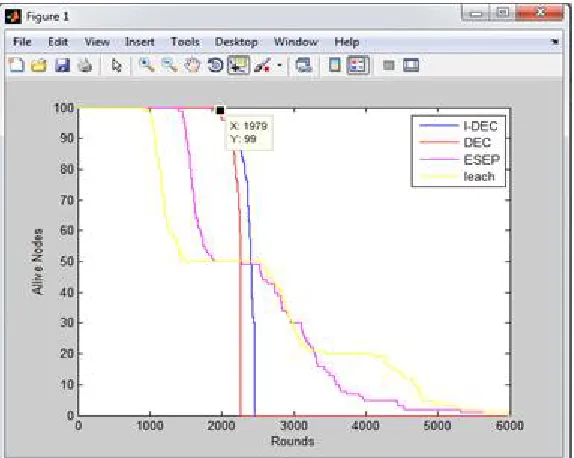
Improved DEC (I-DEC) protocol is verified using simulations and its performance is compared with existing protocols i.e. LEACH, E-SEP and existing DEC. Table3 shows comparison of existing protocols with the proposed I-DEC protocol. It can be seen from the comparison that proposed I-DEC performed better than other existing protocols in most of aspects.
Table 3 Comparison of existing protocols with the I-DEC protocol
PROTOCOL First Node
Dead(Rounds)
Last Node Dead(Rounds)
LEACH[15] 995 4585
E-SEP[15] 1450 3751
DEC[15] 1839 2350
Proposed I-DEC 1979 2482
ISSN (Print) : 2320 – 3765 ISSN (Online): 2278 – 8875
I
nternational
J
ournal of
A
dvanced
R
esearch in
E
lectrical,
E
lectronics and
I
nstrumentation
E
ngineering
(An ISO 3297: 2007 Certified Organization)
Vol. 5, Issue 4, April 2016
Fig. 4 Packets sends to base station in I-DEC, DEC, E-SEP & LEACH protocol
Fig. 5 shows the performance of alive nodes vs. rounds of proposed I-DEC protocol with the existing protocols i.e. LEACH, E-SEP & DEC. In the original DEC protocol the First Node Dead is at 1839 rounds and in the I-DEC protocol the First Node Dead is at 1979 rounds, which shows I-DEC protocol is more stable in comparison to original DEC protocol, LEACH & E-SEP. I-DEC also gives better results in terms of stability i.e. I-DEC protocol is stable up to 1979 rounds which is increased by 140 rounds when compared with DEC protocol i.e. shown Fig. 5.
It was also noticed that the energy management of I-DEC is also better than Original DEC which states that the I-DEC is more energy- efficient than original DEC protocol. Fig. 6 shows the comparison between original DEC and I-DEC in terms of total energy versus number of rounds.
Fig. 6 Comparison between original DEC and proposed I-DEC in terms of energies
ISSN (Print) : 2320 – 3765 ISSN (Online): 2278 – 8875
I
nternational
J
ournal of
A
dvanced
R
esearch in
E
lectrical,
E
lectronics and
I
nstrumentation
E
ngineering
(An ISO 3297: 2007 Certified Organization)
Vol. 5, Issue 4, April 2016
V.CONCLUSION
In this paper an improved DEC protocol is presented that better uses the most profitable system energy in wireless sensor networks. The proposed I-DEC protocol beats the probabilistic-based models by ensuring that a settled number of cluster heads are chosen at every round. At diverse rounds cluster heads are chosen utilizing the nearby data of their remaining energies inside every group to pick the suitable cluster heads. The attributes of I-DEC protocol is extremely attractive as it is near to a perfect arrangement. It has been experimentally verified that the I-DEC protocol improves by 132 rounds in terms of network lifetime when compared with original DEC protocol. Further it was also noticed that I-DEC protocol is stable up to 1979 rounds which is increased by 140 rounds in comparison I-DEC protocol.
REFERENCES
[1] P. Garg, K. Saroha and R. Lochab, “Review of Wireless Sensor Networks- Architecture and Applications.” IJCSMS International Journal of Computer Science & Management Studies, vol. 11, issue 01, May 2011.
[2] G. Anastasi, M. Conti, M.D. Francesco and A. Passarella, “Energy Conservation in Wireless Sensor Networks.”A survey in Computer Networks, Elsevier, vol. 7, issue 3, pp. 537-568, May 2009.
[3] S. Bandyopadhyay and E. coyle, “An Energy Efficient Hierarchical Clustering Algorithm for Wireless Sensor Networks.” IEEE, pp 1713-1723,2003.
[4] W. R. Heinzelman, A. Chandrakasan and H. Balakrishnan, “An Application-Specific Protocol Architecture for Wireless Sensor Networks.” IEEE Transaction on Wireless Communication, pp. 660-670, 2002.
[5] C. Li, M. Ye and G. Chen, “An Energy-Efficient Unequal Clustering Mechanism for Wireless Sensor Networks.” In Proceeding of IEEE MASS05, pp. 3-17, 2005.
[6] A. Thakkar and K. Kotecha,“ Cluster Head Election for Energy and Delay Constraint Application of Wireless Sensor Network.” Sensor Journal IEEE, vol.14, Issue.8, pp. 2658-2664, 2014.
[7] G. Smaragdakis, I.Matta and A. Bestavros, “SEP: A Stable Election Protocol Clustered Heterogeneous Wireless Sensor Network.” In Proceeding of International Workshop on SANPA, 2004.
[8] S. Meelu and M. Katiyar, “Efficient Cluster Head Selection Scheme for Wireless Sensor Network using Deterministic Protocol.” IOSR Journal of Computer Engineering (IOSR-JCE), vol. 16, issue 3, pp. 62-67, 2014.
[9] D. Muruganathan, C.F. Daniel, R.I. Bhasin and A.O. Fapojuwo, “A centralized Energy-Efficient Routing Protocol for Wireless Sensor Network.” IEEE radio Communications, pp. S8-S13, 2005.
[10] SK. Singh, MP. Singh and DK. Singh, “A Survey of Energy-Efficient Hierarchical Cluster-Based Routing in Wireless Sensor Networks.” International journal ofadvanced networking and applications, vol.02, issue.02, pp. 570-580, 2010.
[11] L. Qing, Q. Zhu and M. Wang, “Design of a distributed energy-efficient clustering algorithm for heterogeneous wireless sensor networks.”Computer Communication,Elsevier, vol.29, pp. 2230-2237, 2006.
[12] O. Younis and S. Fahmy, “HEED: A Hybrid, Energy-Efficient, Distributed Clustering Approach for Ad Hoc Sensor Networks.” IEEE Transactions on Mobile Computing, vol.3, pp. 366-379, 2004.
[13] M. Hasse and D. Timmermann, “Low energy adaptive clustering hierarchy with deterministic cluster-head selection.”IEEE conference on Mobile and Wireless Communications Networks (MWCN), pp. 368-372, 2002.
[14] B. Mostafa, C.Saadand and H. Abderrahmane, “Fuzzy Logic Approach to Improving Stable Election Protocol for Clustered Heterogeneous Wireless Sensor Networks”, International Journal of Computer Science and Network Security (IJCSNS), VOL.14 No.1, January 2014. [15] F. Aderohunmu, J. Deng and M. Purvis, “A Deterministic Energy-Efficient Clustering Protocol for Wireless Sensor Networks.” IEEE,