Western University Western University
Scholarship@Western
Scholarship@Western
Electronic Thesis and Dissertation Repository
2-6-2014
Functional Transformations and Octatonality in Selected Works by
Functional Transformations and Octatonality in Selected Works by
George Crumb
George Crumb
Peter Lea
The University of Western Ontario
Supervisor
Dr. John Cuciurean
The University of Western Ontario Graduate Program in Music
A thesis submitted in partial fulfillment of the requirements for the degree in Doctor of Philosophy
© Peter Lea 2014
Follow this and additional works at: https://ir.lib.uwo.ca/etd
Part of the Music Theory Commons
Recommended Citation Recommended Citation
Lea, Peter, "Functional Transformations and Octatonality in Selected Works by George Crumb" (2014). Electronic Thesis and Dissertation Repository. 1893.
https://ir.lib.uwo.ca/etd/1893
This Dissertation/Thesis is brought to you for free and open access by Scholarship@Western. It has been accepted for inclusion in Electronic Thesis and Dissertation Repository by an authorized administrator of
Functional Transformations and Octatonality in Selected Works by George Crumb
(Thesis format: Monograph)
by
Peter Lea
Graduate Program in Music
A thesis submitted in partial fulfillment of the requirements for the degree of
Doctor of Philosophy
The School of Graduate and Postdoctoral Studies The University of Western Ontario
London, Ontario, Canada
Abstract
The music of George Crumb has been analyzed using a variety of analytic methods
including pitch-class set theory, transformational theory, intertextual analyses, and various
tonal and Schenkerian approaches. The results of these types of analyses invariably identify
certain consistencies in Crumb’s compositional style within a single work or volume of
similar works, but often are unable to relate or compare procedures between different works.
In the present study, I propose a transformational model that accounts for
characteristic gestures in numerous works by Crumb. Unlike many transformational models
of twentieth-century music, the proposed model does not require significant alterations for
each work, and is able to model transformations between sets with a cardinality of three
through twelve. Because of the relatively stable nature of this model, it is possible to
compare gestures within and between different works in a manner analogous to comparisons
of functional progressions in tonal music.
In the introductory chapter, the basis for a functional model of Crumb’s music is
introduced, and the scope of the study is defined. In the second chapter, certain
characteristics of Crumb’s music identified by other scholars such as trichordal structures,
referential collections, and the principles of opposition and completion are discussed. Based
upon these characteristics, the model of octatonality is proposed and defined in the third
chapter. The fourth and fifth chapters include analyses of Crumb’s A Haunted Landscape
(1984) and “Come Lovely and Soothing Death...” from Apparition (1980) as representative
included to provide support for segmentation as well as octatonic considerations. In the
concluding sixth chapter, the functional designs of these examples are compared.
The generic model, divorced from the octatonic collection, offers a method to
compare different works at various functional levels where the intervallic components of the
music, a limited pitch-class set vocabulary, and an underlying functionality are perceived as
fundamental features of the music. The utility of the generic model in analyzing Crumb’s
non-octatonic works is demonstrated and an extension of the generic model for the analysis
of music by other composers is suggested.
Keywords
George Crumb, Crumb, octatonic, octatonality, function, diatonic, tonal, referential
collection, transformational theory, neo-Riemannian, K-net, set-theory, intertextuality, A
Haunted Landscape, Come Lovely and Soothing Death, Apparition, Gargoyles,
Makrokosmos, Music of the Starry Night, Music of Shadows, Litany of the Galactic Bells,
Pastoral, Primeval Sounds, Processional, Whitman, Lorca, Paisaje, Siguiriya, Cante Jondo,
Acknowledgments
I wish to thank my advisor, Dr. John Cuciurean, for his inspiring class, which fostered
my interest in George Crumb’s music. His helpful suggestions, encouragement, and general
guidance have been indispensible throughout the course of this project and beyond. For his
constructive criticism, keen editorial eye, and timely feedback on the final draft of this
dissertation, I am indebted to Dr. Peter Franck.
I would like to extend my sincerest thanks to Dr. Catherine Nolan for her carefully
considered suggestions in this and other related projects, as well as her stimulating class in
transformational theory. I am grateful to Dr. Robert C. Cook (University of Iowa) for his
willingness to discuss his research and helpful recommendations. I would like to express my
appreciation to Dr. Leslie Kinton for his comments on the final version of this dissertation
and for reminding me of the intuitive aspect of Crumb’s music. I would like to thank Dr.
Steven Bruns (University of Colorado Boulder), who directed me to, and advised me of,
Crumb’s sketches at the Library of Congress. I would like to acknowledge Dr. Richard Parks
and Dr. Richard Semmens, who served on my advisory committee, for their valuable
feedback and for subtly guiding me in the right direction. To all my friends and colleagues
around the world, I cherish our stimulating conversations in the office, classroom, or hallway
at a conference, and I look forward to many more.
I would like to thank Western University and the Don Wright Faculty of Music for
their generous financial support, which enabled me to concentrate on my studies, allowed me
to present stages of this research at conferences, and, through the Western Graduate Research
John Doerksen for his thoughtful comments and suggestions throughout my time at Western,
including his review of this dissertation, as well as his financial generosity that supported my
research at the Library of Congress.
I wish to thank the staff at the Music Division of the Library of Congress who
facilitated the retrieval of Crumb’s sketch materials and directed me to other important
documents that I may not have otherwise considered. I would also like to thank the C.F.
Peters Corporation for granting me permission to reproduce elements of Crumb’s published
works. My sincerest gratitude is extended to George Crumb for his interest in this project and
consent to reproduce his sketch materials in this dissertation.
Finally, I wish to acknowledge the ongoing support of my family. I would like to
thank my parents, Gordon and Pauline, and siblings, Hiram, Megan, and Sharon, for their
encouragement as well as their roles in fostering a musical environment at home. I am
thankful to my mother- and father-in-law, Beth and Bill, for welcoming me into the family
and providing much-needed babysitting services. My heartfelt gratitude seems inadequate to
describe my wife Alison’s unwavering support, patience, and confidence throughout my
studies. My wife and son, Grayson, are an inspiration to me and remind me daily of how
Table of Contents
Abstract ... ii
Acknowledgments... v
List of Tables ... ix
List of Figures ... x
List of Appendices ... xiii
1 Introduction ... 1
2 Recurring Aural Signatures in George Crumb’s Music ... 6
2.1 Trichordal Structures ... 6
2.2 Referential Collections ... 18
2.3 The Principle of Opposition ... 37
2.4 The Principle of Completion ... 44
2.5 Toward a New Tonality ... 60
3 A Model of Octatonality ... 62
3.1 Models and Metaphors ... 64
3.2 Chords ... 69
3.3 Modes, Keys, and Key Areas ... 81
3.4 Hybrid Chords and Families ... 87
3.5 T Transformations ... 93
3.6 ROT Transformations ... 98
3.7 Hierarchical Functions ... 101
3.8 Hyper-T Transformations ... 108
3.9 Application ... 112
4 A Haunted Landscape ... 113
4.1 Formal Design ... 115
4.2 Key ... 125
4.3 Introduction Section ... 135
4.4 Transition to Section A ... 140
4.5 Section A ... 144
4.6 Retransition to Section A1 ... 155
4.7 Section A1 (Coda) ... 160
4.8 Octatonic Functional Design ... 166
4.9 Significance ... 169
5 Come Lovely and Soothing Death ... 170
5.1 Formal Design ... 177
5.5 Section B1 ... 209
5.6 Section A2 ... 211
5.7 Section B2 ... 214
5.8 Coda ... 217
5.9 Octatonic Functional Design ... 218
5.10 Significance ... 220
6 Conclusions ... 221
6.1 Comparison of A Haunted Landscape and “Come Lovely” ... 221
6.2 Applicability to Other Works by Crumb ... 223
6.3 Considerations for Future Research ... 231
Bibliography ... 233
Primary Literature ... 233
Secondary Literature ... 236
Appendices ... 252
Appendix 1: Naming Conventions of Pitch-Class Collections ... 252
Appendix 2: Definitions ... 254
Appendix 3: <54> Rotations of the Octatonic Modes ... 258
Appendix 4: Correlation between Hybrid Families and Set-class Inclusion ... 259
Appendix 5: Hybrid Families... 262
Appendix 6: Key Areas in “Come Lovely” ... 287
List of Tables
Table 2.1. Set-class occurrences in “God-music” ... 9
Table 2.2. Set correlations in “God-music” ... 9
Table 2.3. Identification of collection by subset ... 24
Table 2.4. Correspondence of functional harmonies and octatonic collections ... 49
Table 3.1. Rings of the Oct1 helix ... 71
Table 3.2. Ordered arrays of the Oct1, Oct2, and Oct3 models ... 76
Table 3.3. Positions of trichords in the octatonic model... 78
Table 3.4. Positions of tetrachords in the octatonic model ... 79
Table 3.5. Two diatonic collections arranged within a heptagonal segment ... 88
Table 4.1. Formal structure of A Haunted Landscape ... 123
Table 4.2. Tabular representation of the chords, modes, and key areas of the introduction 137 Table 4.3. Tabular representation of the hybrid chords and key areas of the transition ... 142
Table 4.4. Tabular representation of the chords, modes, and key areas of the A section ... 147
Table 4.5. Tabular representation of the hybrid chords and key areas of the retransition .... 158
Table 4.6. Tabular representation of the chords of the a2 section in A1 ... 162
Table 4.7. Hierarchical octatonic functions in A Haunted Landscape ... 167
Table 5.1. Comparison of Whitman’s 28th verse of “Lilacs” and Crumb’s setting ... 172
Table 5.2. Correspondence of fictional times and motives in Crumb’s “Come Lovely” ... 184
Table 5.3. Formal structure of “Come Lovely” ... 190
Table 5.4. Hierarchical octatonic functions in the lower natural-cyclic time stream ... 219
Table 6.1. Comparison of A Haunted Landscape and “Come Lovely” ... 222
Table 6.2. Rings of an F5 helix ... 227
List of Figures
Figure 1.1. Crumb, Apparition, “Come Lovely,” p. 12, s. 3–p. 13, s. 1. ... 3
Figure 2.1. Crumb, Black Angels, “God-music,” reduction of the accompaniment ... 7
Figure 2.2. Crumb, Makrokomos II, “Gargoyles,” mm. 12–14. ... 10
Figure 2.3. Crumb, Makrokosmos I, “Pastorale,” mm. 1–5. ... 11
Figure 2.4. Crumb, A Haunted Landscape, mm. 23–27. ... 13
Figure 2.5. Crumb, A Haunted Landscape, mm. 141–144 ... 13
Figure 2.6. Crumb, Apparition, “Come Lovely,” p. 12, s. 2–p. 13, s. 1. ... 15
Figure 2.7. K-net interpretation of the "Come Lovely" trichordal progression ... 18
Figure 2.8. Crumb, Makrokosmos I, “Music of Shadows.” ... 20
Figure 2.9. Crumb, Makrokosmos II, “Gargoyles,” mm. 9–10. ... 23
Figure 2.10. Crumb, Processional, reduction of the opening section... 27
Figure 2.11. Crumb, Processional, reduction of the first segment of the middle section. ... 28
Figure 2.12. Crumb, Makrokosmos I, “Primeval Sounds,” opening ... 30
Figure 2.13. Stravinsky, Petrushka, Second Tableau, R. 49 ... 30
Figure 2.14. Inversional relationship between the Petrushka and Primeval chords ... 30
Figure 2.15. Crumb, Makrokosmos I, “Primeval Sounds,” p. 1, s. 2–3. ... 31
Figure 2.16. Crumb, Makrokosmos I, “Primeval Sounds,” p. 1, s. 3–4. ... 33
Figure 2.17. Crumb, Makrokosmos I, “Primeval Sounds,” p. 2, s. 1–3. ... 34
Figure 2.18. Crumb, Apparition, “Come Lovely,” trichordal progressions. ... 36
Figure 2.19. Crumb, Night of the Four Moons, IV. ... 39
Figure 2.20. Crumb, Makrokosmos II, “Litany of the Galactic Bells,” opening. ... 40
Figure 2.21. Crumb, Music for a Summer Evening, “Starry Night.” ... 41
Figure 2.22. Bach, Das Wohltemperierte Clavier, Vol. II, VIII, mm. 1–9 ... 50
Figure 2.23. Bach, Das Wohltemperierte Clavier, Vol. II, VIII, mm. 9–12 ... 51
Figure 2.24. Crumb, Music for a Summer Evening, “Starry Night,” p. 20, s. 2. ... 52
Figure 2.25. Crumb, Music for a Summer Evening, “Starry Night,” p. 24, s. 1–2. ... 52
Figure 2.26. Crumb, Music for a Summer Evening, “Starry Night,” p. 18, s. 2. ... 54
Figure 2.29. Bach, Das Wohltemperierte Clavier, Vol. II, VIII, mm. 27–30 ... 58
Figure 2.30. Crumb, Music for a Summer Evening, “Starry Night,” p. 20, s. 1. ... 58
Figure 3.1. Three-dimensional representation of an Oct1 helix ... 70
Figure 3.2. Skeletal view of the octatonic model... 74
Figure 3.3. A T10 transformation ... 95
Figure 3.4. A T1−1 transformation ... 95
Figure 3.5. A T101 transformation... 96
Figure 3.6. A T−10−1 transformation... 97
Figure 3.7. Generic interpretation of an applied dominant ... 102
Figure 3.8. Functional relationships within octatonality ... 104
Figure 3.9. Functional relationships within the key of C major ... 105
Figure 4.1. Crumb’s simultaneous compositional process. ... 114
Figure 4.2. Formal sketch of A Haunted Landscape with triadic refrains notated. ... 116
Figure 4.3. Transcription of the triadic-refrain formal sketch of A Haunted Landscape ... 116
Figure 4.4. Formal sketch of A Haunted Landscape with highest pitches ... 117
Figure 4.5. Transcription of the formal sketch of A Haunted Landscape... 118
Figure 4.6. Multi-movement form versus arch-form sketch of A Haunted Landscape. ... 120
Figure 4.7. Transcription of the multi-movement form versus arch-form sketch ... 120
Figure 4.8. Formal sketch of the middle section of A Haunted Landscape. ... 121
Figure 4.9. Transcription of the middle-section formal sketch of A Haunted Landscape .... 121
Figure 4.10. Final formal sketch of A Haunted Landscape. ... 122
Figure 4.11. Transcription of the final formal sketch of A Haunted Landscape ... 122
Figure 4.12. Crumb, “The Night in Silence,” Apparition ... 126
Figure 4.13. Crumb, “The Night in Silence,” reduction and analysis of the sketch ... 127
Figure 4.14. Crumb, “The Night in Silence,” Apparition, revised sketch ... 129
Figure 4.15. Crumb, “The Night in Silence,” reduction and analysis of the revised sketch 130 Figure 4.16. Crumb, “The Night in Silence,” Apparition, alternate revised sketch ... 131
Figure 4.17. Octatonic progressions of the “string chords” ... 132
Figure 4.18. Octatonic analysis of the introduction. ... 136
Figure 4.19. Crumb, A Haunted Landscape, mm. 20–22. ... 141
Figure 4.22. Octatonic analysis of the A section. ... 146
Figure 4.23. Crumb, A Haunted Landscape, mm. 29–31. ... 149
Figure 4.24. Interaction of the woodwind and brass layers in the first transition, m. 30. .... 150
Figure 4.25. Languid chords from the c section of A Haunted Landscape, mm. 50–52. ... 151
Figure 4.26. Crumb, A Haunted Landscape, m. 52. ... 152
Figure 4.27. Octatonic analysis of the transition to the A1 section. ... 157
Figure 4.28. Octatonic analysis of the a2 section in A1. ... 161
Figure 5.1. Early movement structure of Apparition. ... 171
Figure 5.2. Transcription of an early movement structure of Apparition ... 171
Figure 5.3. The musical setting of “Come Lovely” with words from Lorca’s “Paisaje.” .... 175
Figure 5.4. Bird-song components ... 178
Figure 5.5. Bird-song components in Crumb’s “Come Lovely.” ... 180
Figure 5.6. Tonal vestiges in Crumb’s “Come Lovely.” ... 182
Figure 5.7. Historical narrative time symbols in Crumb’s “Come Lovely.” ... 183
Figure 5.8. Formal sketch of “Come Lovely.” ... 185
Figure 5.9. Elegy theme as a germinal idea. ... 186
Figure 5.10. Transcription of the sketch of the elegy theme as a germinal idea ... 186
Figure 5.11. Overlay of “falling tonality.” ... 187
Figure 5.12. Formal sketch of Apparition with reference to multiple dimensions ... 187
Figure 5.13. Transcription of formal sketch referencing multiple dimensions ... 188
Figure 5.14. Formal sketch of Elegy theme and four-dimensional tesseract. ... 189
Figure 5.15. Octatonic analysis of the A section. ... 194
Figure 5.16. Comparison of the three iterations of Undulate. ... 198
Figure 5.17. Octatonic analysis of the B section. ... 202
Figure 5.18. Sketch of the Elegy theme with indistinct pitch overlay. ... 203
Figure 5.19. Transcription of Elegy theme sketch with indistinct pitch overlay ... 204
Figure 5.20. Octatonic analysis of the A1 section. ... 207
Figure 5.21. Octatonic analysis of the B1 section. ... 210
Figure 5.22. Octatonic analysis of the A2 section. ... 213
Figure 5.23. Octatonic analysis of the B2 section. ... 215
List of Appendices
Appendix 1: Naming Conventions of Pitch-Class Collections ... 252
Appendix 2: Definitions ... 254
Appendix 3: <54> Rotations of the Octatonic Modes ... 258
Appendix 4: Correlation between Hybrid Families and Set-class Inclusion ... 259
Appendix 5: Hybrid Families... 262
1
Introduction
Within George Crumb’s music there often seems to be a balance between tonal
and post-tonal elements. In “Litany of the Galactic Bells” from Crumb’s Makrokosmos II,
music that does not sound tonal—despite the pronounced usage of a major-minor seventh
sonority—interrupts a quotation of an excerpt from Beethoven’s “Hammerklavier”
Sonata, Op. 106, accompanied by the marking “abrupt, intrusive!” Crumb inscribes the
performance direction “wistfully elegant” above a passage from Chopin’s
Fantaisie-Impromptu in “Dream Images (Love-Death Music)” from Makrokosmos I,which follows
a passage of music that is not tonal. Richard Bass has characterized such music as
“neither consistently tonal in a conventional sense, nor designedly atonal.”1
In his essay
“Music: Does It Have a Future?” Crumb asserts his admiration for tonality noting, “Not
only is the question of tonality still unresolved but we have not yet invented anything
comparable to the sure instinct for form which occurs routinely in the best traditional
music. Instead, each new work seems to require a special solution, valid only in terms of
itself.”2
Later in the essay he continues:
In general, I feel that the more rationalistic approaches to pitch-organization, including specifically serial technique, have given way, largely, to a more intuitive approach. There seems to be a growing feeling that we must somehow evolve a new kind of tonality. Probably the ideal solution, anticipated, it seems to
1
Richard W. Bass, “Models of Octatonic and Whole-Tone Interaction: George Crumb and His Predecessors,” Journal of Music Theory 38 (1994): 156.
2
me, by Bartók, is to combine the possibilities of our chromatic language—which is so rich and expressive in its own right—with a sense of strong tonal focus.3
Although Crumb seems to be addressing composers in general, reference to his own
compositional agenda is thinly veiled. Crumb often mentions that his music contains a
certain “natural acoustic” because of growing up in an Appalachian river valley in West
Virginia.4 Such elusive rhetoric—couched in intuition and myth—is how Crumb
routinely describes his compositional process.5 The definition of Crumb's “natural
acoustic” is difficult to pinpoint, but it appears that Crumb believes that this acoustic
forms the basis for his style, which appears to be influenced by both the common-practice
tonal tradition as well as his geographical environment.6
The chord progression illustrated in Figure 1.1 is an example of a progression that
contains both tonal and post-tonal elements. The bass line projects an ascending Ef-major
3
Ibid.
4
See Robert B. Shuffet, “The Music, 1971–1975, of George Crumb: A Style Analysis,” (D.M.A. thesis, Peabody Institute, 1979), 432; Crumb, “Music: Does It Have a Future?” 121; Cole Gagne and Tracy Caras, “George Crumb,” in Soundpieces:Interviews with American Composers (Metuchen: Scarecrow Press, 1982), 121; Edward Strickland, “George Crumb,” in American Composers:Dialogues on
Contemporary Music (Bloomington: Indiana University Press, 1991), 163; West Virginia Public
Broadcasting, “A Conversation with George Crumb,” YouTube (Dec 21, 2007): 4:07,
http://www.youtube.com/watch?v=5xo8SHjTxpc (accessed February 10, 2014); Paul Steenhuisen, “George Crumb,” in Sonic Mosaics: Conversations with Composers (Edmonton: The University of Alberta Press, 2009), 108; Bálint András Varga, Three Questions for Sixty-Five Composers (Rochester: University of Rochester Press, 2011), 50.
5
See Shuffet, “The Music,” 445; Geoff Smith and Nicola W. Smith, “George Crumb,” American
Originals: Interviews with 25 Contemporary Composers (London: Faber and Faber, 1994), 97; Young Gee
Shim, “A Study on A Little Suite for Christmas, A.D. 1979 by George Crumb,” (Ph.D. diss., Temple University, 1997), 134.
6
scale; the first three chords prolong tonic harmony with the second-inversion sub-mediant
chord substituting for a typical first-inversion tonic chord. The fourth chord might be
analyzed as a predominant chord with an unresolved 4–3 suspension; however, it is at
this point that a tonal reading becomes untenable. In the fifth and sixth chords, the tenor
and alto voices deviate from the diatonic model: the tenor introduces a Gf on the fifth
chord and the alto includes both an Ff and Gf on the fifth and sixth chords respectively.
Within a tonal framework, it may be possible to view both chords as applied dominants;
however, they do not resolve as one might expect. Alternatively, if the tenor and alto
voices were considered separately, the tenor projects an incomplete pentatonic scale and
the alto, except for the first pitch, consists of a whole-tone scale. As is the case in this
initial interpretation of the progression, Bass suggests that studies of such music usually
examine either “the relationship between one of these collections and an overarching
tonal structure, treating the octatonic or whole-tone elements as chromatic inflections or E¨: I V34 vi
4 6
IV4 V
5 6
V
5 6
V
5 6
¨VI ¨VII
Figure 1.1. Crumb, Apparition, “Come Lovely,” p. 12, s. 3–p. 13, s. 1. Copyright © 1980
tonally deviant intrusions within a diatonic framework” or “the special properties and
applications of the individual collections themselves.”7
Passages that draw upon tonal and post-tonal elements are prevalent in Crumb’s
music and scholars approach it in a variety of ways. In the second chapter, I will lay the
foundation for a functional octatonic model using both existing and original analyses of
various works. In sections 2.1 and 2.2, I discuss the correlation between specific trichords
within and between works and the ability of these trichords, as well as tetrachords, to
identify specific transpositions of a referential collection. Both trichordal structures and
referential collections are important aspects of the octatonic model, and lay the
foundation for the transformational component of the model. Sections 2.3 and 2.4, which
examine the principles of opposition and completion respectively, are pertinent for the
functional aspect of octatonality. As I argue, the principle of opposition introduces
tension whereas the principle of completion conveys resolution.
The model of octatonality is presented in the third chapter, which integrates the
observations of the second chapter. In section 3.1, the metaphorical transfer of tonal and
post-tonal concepts to the octatonic model is explored in detail; which was implicit in the
discussion of the principles of opposition and completion in the second chapter. Within
each of the following sections, which deal with core aspects of the model, the
implications of the metaphorical transfers are made explicit. This is most noticeable in
section 3.7 where hierarchical functions in octatonality are proposed, which is reliant
upon the metaphorical transfer of tonal functionality to the model of octatonality.
Although the material is presented in a linear format, each aspect of the model is
interrelated and predicated upon observations of a number of Crumb’s works. For these
reasons, as well as to mitigate the abstract presentation of the model, the reader may find
it useful to preview the analyses presented in the fourth and fifth chapters before reading
sections 3.2–3.8.
The fourth and fifth chapters include analyses of Crumb’s A Haunted Landscape
(1984) and “Come Lovely and Soothing Death” from Apparition (1980) as representative
examples of octatonality. Sketch materials are used to demonstrate the
interconnectedness of the two works as well as provide support for interpretation of form,
segmentation, determination of referential collections, and evidence of Crumb’s new
tonality.
In the final chapter, the functional design of A Haunted Landscape and “Come
Lovely” are compared. In addition, a non-octatonic portion of Crumb’s Processional is
analyzed using a similar model but Messiaen’s fourth mode of limited transposition is
substituted for the octatonic collection. As is demonstrated, the generic
functional-yet-transformational model, divorced from the octatonic collection, offers a method to
compare works at various functional levels where the intervallic components of the
music, a limited pitch-class set vocabulary, and an underlying functionality are perceived
2
Recurring Aural Signatures in George Crumb’s Music
In this chapter, I will explore various analytic methods utilized to describe
Crumb’s music and demonstrate the consistent emphasis on and correlation between
triadic structures, referential collections and symmetry, opposition, and completion.
These attributes will provide the foundation for the proposed octatonic model and
illuminate aspects of Crumb’s stated desire for a “more organic and well-ordered
procedure.”1
2.1
Trichordal Structures
Crumb’s music is saturated with triadic structures, many of which are
recognizable as major or minor triads.2 In his essay, “Music: Does It Have a Future?”
Crumb wished for a new kind of tonality that could combine the chromaticism of present
resources with a strong sense of tonal focus.3 In “God-music” from Black Angels, Crumb
describes a sustained B-major tonality throughout the movement (see Figure 2.1).4 In
Figure 2.1, the set-class (sc) membership of the major and minor triads are identified on
1
Crumb, “Music: Does It Have a Future?” 117.
2
Numerous scholars have looked at the intertextual relationships of the new merging with old. For a brief survey see Joseph N. Straus, Remaking the Past: Musical Modernism and the Influence of the
Tonal Tradition (Cambridge: Harvard University Press, 1990); Martha M. Hyde, “Neoclassic and
Anachronistic Impulses in Twentieth-Century Music,” Music Theory Spectrum 18 (1996): 200–35; and Michael L. Klein, Intertextuality in Western Art Music (Bloomington: Indiana University Press, 2005).
3
Crumb, “Music: Does It Have a Future?” 120.
4
(037) (014) (037) (014) (037) (037) B {125} B {125} B F
A
( 037) (014) (037) (037) (037) (037) (037) (014) B {9A1} B F B F B {9A1} 3
( 037) (014) (037) (014) (037) (014) d {B23} d {B23} d {B23} 5
(037) (037) (014) (037) (037) (037) (014) (037) F B {9A1} B F B {9A1} B 7
(026) (016) (026) (014) (026) (026) (016) (026) {680} {892} {680} {589} {680} {9B3} {056} {9B3}
B 9
(016) (026) (026) (026) (016) (026) (026) (026) (037) {056} {9B3} {680} {9B3} {B45} {8A2}{7B1} {8A2} B¨ 11
(037) (037) (037) (037) (037) (037) (037) B F B F B d B
A1 14
Figure 2.1. Crumb, Black Angels, “God-music,” reduction of the accompaniment
the first line and the triadic roots on the second line.5 The normal form of the trichords
{125} and {9A1} are used because they are distinctly post-tonal constructs.
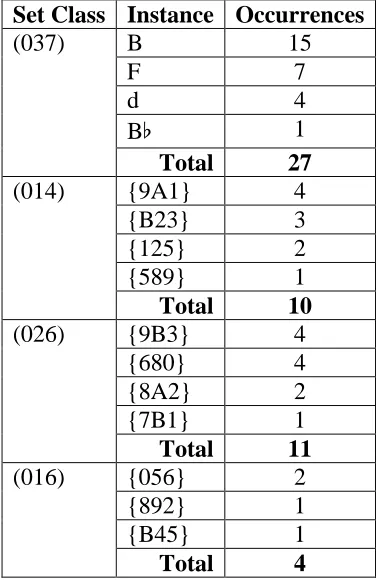
The sheer repetition of the B-major triads in “God-music,” as compared to other
sets, is one aspect that contributes to Crumb’s sense of a B-major tonality (see Table
2.1).6 Moreover, the relationship between the sets also implies a functional design (see
Table 2.2). An entry in Table 2.2 represents the number of times the trichord in the
corresponding column-header immediately follows the trichord in the corresponding
row-header.7 For example, the numeral 3 in the B column indicates that a B-major triad
happens three times after the corresponding {9A1} trichord. The most significant finding
is that the F-major triad only occurs before a B-major triad. In addition, the B- major triad
moves to the F-major triad six times and the F-major triad moves to the B- major triad
seven times; a correlation suggestive of a routine procedure.8
5
In this dissertation, pitches enclosed within parentheses will denote a set-class, pitches enclosed within braces will denote a particular instance of a set-class in normal form, and pitches enclosed within angle brackets will denote a specific order of pitch classes. Pitch-class (pc) 0 will represent pc C and rise incrementally up the chromatic scale. Pitch-classes A and B will represent the pc numerals 10 and 11 respectively.
6
Some pitches have been enharmonically respelled and shifted to a different register in Figure 2.1 to highlight the abstract voice-leading relationships. Voice-leading and metric placement are important factors contributing to the sense of a B-major tonality but are beyond the scope of the current discussion. These elements are discussed in Blair Johnston’s “Between Romanticism and Modernism and
Postmodernism: George Crumb’s Black Angels,” Music Theory Online 18, no. 2 (2012), para. 16–18, 31.
7
The correlation between a chord that ends a section and the chord that begins a new section has not been included.
8
Table 2.1. Set-class occurrences in “God-music”
Set Class Instance Occurrences
(037) B 15
F 7
d 4
B¨ 1
Total 27
(014) {9A1} 4
{B23} 3
{125} 2
{589} 1
Total 10
(026) {9B3} 4
{680} 4
{8A2} 2
{7B1} 1
Total 11
(016) {056} 2
{892} 1
{B45} 1
Total 4
Table 2.2. Set correlations in “God-music”
037 014 026 016
B F d B¨ 9A1 B23 125 589 9B3 680 8A2 7B1 056 892 B45
037
B 6 1 4 2
F 7
d 1 3
B¨
014
9A1 3 1
B23 1 2
125 2
589 1
026
9B3 1 2 1
680 1 2 1
8A2 1
7B1 1
016
056 2
892 1
In “God-music,” instances of sc (016) and sc (026) are the most common set
classes of the entire B section; the only sets that are not members of these set classes are
{589}, {B4}, and the final Bb-major triad. This correlation between instances of sc (016)
and sc (026) is also featured in “Gargoyles” from Makrokosmos II, where a (016) ostinato
accompanies linear instances of sc (026) (see Figure 2.2).9 In mm. 12–14, semi-tone or
whole-tone transpositions of the vertical (016) trichordal ostinato is contrasted with
instances of sc (026) in a higher register. In “God-music,” instances of sc (026) and sc
(016) acted as neighbour chords within an entire section but in “Gargoyles,” the instances
of sc (026) trichords behave differently, but are still in close proximity to instances of sc
(016).
9
In his analysis of this piece, Bass notes, “(016) and (0167) pc sets are the dominant constructional units in most of the individual figures and lend a distinctive consistency to the music of ‘Gargoyles.’ The T-levels of simultaneities often produce (025) and (026) trichords as linear formations and whole-tone organization is prominently featured throughout much of the piece.” See Richard W. Bass, “Pitch Structure in George Crumb’s Makrokosmos, Volumes I and II,” (Ph.D. diss., University of Texas at
(016)
etc.
(026)
In Crumb’s “Pastorale” from Makrokosmos I, instances of scs (016) and (026) are
again found in close proximity and include instances of sc (025) (see Figure 2.3).10 Bass
highlights the importance of the rising minor second from the first pitch of m. 1 (pc A) to
the last pitch of m. 2 (pc B) and the falling minor second from the first pitch of m. 3 (pc
A) to the last pitch of m. 5 (pc 9) as well as the descending major-second transposition of
the (016) trichords in m. 3.11 The melodic material fuses with the harmonic material
through the minor- and major-second motives and emphasizes the interconnectedness of
the three different set classes.
10
As the title of the volume suggests, homage is paid to Bartók: more explicitly, the scotch-snap rhythm of the opening (025) and (016) trichords in “Pastorale,” as well as the presence of a perfect fourth or fifth in these trichords, suggests a relationship to Bartók’s Concerto for Orchestra (1943). See the movement Eligia, mm. 30–33, mm. 34–61, and 84–100.
11
Bass, “Pitch Structure,” 107–10.
(025) (016) (026)
(025) (016) (016) (026)
pt.
pt. pt.
In A Haunted Landscape Crumb makes use of alternating major and minor triads
(see Figure 2.4). In addition, although not notated in Figure 2.4, there is a Bf pedal in the
lower register held throughout the entire piece.12 In Figure 2.4, the progression is
modeled by a series of compound neo-Riemannian operations.13 The actual progression is
notated in whole notes, and the imaginary transformational path of the compound
operations is notated with filled-in note heads. The transformations that relate the first
chord to the second chord and the third chord to the fourth chord are identical <PRP>
transformations. In addition, the relationship of the final chord of the first progression
(B-minor) to the first chord of the second progression (Ef-major, not shown) would be
<PLP>—the foil of <PRP>, which linked the first-two and last-two chords of each
progression.
When this progression is recapitulated, there is an important difference: the piano
part introduces another pitch to the triads as an insistent repeated-note motive (see Figure
2.5).In Figure 2.5, a filled-in note head represents the repeated note, which has been
12
This pedal is one reason Charles Benesh argues for tonal centrism within the work. See Charles W. Benesh, “Tonal Centrism and Symmetrical Pitch Relationships in George Crumb’s A Haunted
Landscape,” (Ph.D. diss., University of California, Los Angeles, 2005), 11–12. Benesh’s definition of tonal
centrism is largely based upon Wallace Berry’s interpretation of tonality as defined in Structural Functions in Music, (Englewood Cliffs: Prentice-Hall, 1976). In particular, Benesh cites Berry’s classification of a “primitive (‘pedal’) tonality” and “tonal flux within broad, prevailing tonal unity” (Benesh, 12n; Berry, 172).
13
There are three standard operations: the Parallel (P) transformation inverts the triad around the shared perfect fifth; the Leading-tone exchange (L) transformation inverts the triad around the shared minor third; the Relative (R) transformation inverts the triad around the shared major third. See Brian Hyer, “Tonal Intuitions in Tristan und Isolde,” (Ph.D. diss., Yale University, 1989), 162–210. I have chosen not
confined to one register to highlight the abstract parsimonious voice leading. The
repeated note supplies the seventh to the first and third chords, transforming them into
major-minor seventh chords; however, the second and fourth chords do not correspond to
a typical tonal chord. Neither a contextually inverted neo-Riemannian transformation nor
a four-node Klumpenhouwer network (K-net) can model the transformation of one
tetrachord to the next.
The relationship between the trichords and tetrachords is apparent. A common
interval in each of these chords is the perfect fifth formed between the root and the fifth
of the original triad. Omitting the “third” of both the major and minor tetrachords obtains
sc (025) and sc (016) respectively. In “God-music,” instances of sc (016) separated
instances of sc (026), which is a subset of sc (0258) (cf. Figure 2.1). In “Pastorale” an
instance of sc (026) transformed into an instance of sc (025); both sets are subsets of sc
B¨7 {1478} A¨7 {B256}
(0258) (0147) (0258) (0147)
Figure 2.5. Crumb, A Haunted Landscape, mm. 141–144
B¨ c© A¨ b
P R P P L R P R P
(0258) (cf. Figure 2.3). The interaction between instances of the above-mentioned set
classes is because of their shared membership in a specific referential collection, which
will be discussed in the next section.
The appearance of the first major chord in “Come Lovely” is symbolic of the
death’s arrival, anticipated by the preceding text “serenely arriving, arriving” (see Figure
2.6). This is a distinctive arrival point and, as Straus suggests, “When triads occur in
contexts other than the traditionally tonal one, careful critical attention must be paid.”14
Tonality’s association with death here is quite clear; not only does a major triad
accompany the arrival of death but also the beginning of the progression appears to be
tonal. The first three chords take part in a tonic prolongation moving from tonic to the
submediant through a passing dominant. A functionally suspicious subdominant chord
with an unresolved 4–3 suspension begins to veil the sense of tonality, which then leads
to a series of whole-tone related incomplete applied dominants. It is noteworthy that the
final chord of this progression is the dominant of Ef major.Within a short span of seven
chords, tonality is born (initial tonic prolongation), dies (subdominant and subsequent
non-functional applied dominants) and is reborn (the final dominant).15 Not only is this
14
Joseph N. Straus, Introduction to Post-Tonal Theory, 3rd ed. (Upper Saddle River: Pearson Prentice Hall, 2005): 74.
15
view of death consistent with Whitman’s text, but also with Crumb’s regret over the loss
of a tonal analogue in the twentieth century.16
In “Come Lovely,” tonality’s arrival also signals the death of tonality. As Crumb
stated, “Perhaps we have come to think of ourselves as philosophically contemporaneous
16
Kathy Rugoff observes that “Whitman reveals the song of the bird to be at the heart of his self-concept as a poet; his awareness of the unity of life and death is associated with the song of the bird mourning the loss of his mate.” See Kathy Rugoff, “Three American Requiems: Contemplating ‘When Lilacs Last in the Dooryard Bloom’d’,” in Walt Whitman and Modern Music: War, Desire, and the Trials
of Nationhood, ed. Lawrence Kramer (New York: Garland Publishing, 2000), 134.
V34 vi 4
6 IV4 V 5
6 V 5
6 V 5 6
¨VI ¨VII (025) (037) (016) (026) (026) (026)
E¨: I (037) (014) (014) (014)
se-rene-ly ar-riv-ing, ar - riv-ing,
with all earlier cultures. And it could be that today there are more people who see culture
evolving spirally rather than linearly. With the concentric circles of the spiral, the points
of contact and the points of departure in music can be more readily found.”17
The arrival
of the major chord thus represents life and death—a point of contact and departure. This
progression is repeated twice, transposed down a whole-step with subsequent iterations,
and in this way one could imagine the cycle of life and death, or death and life, repeated
ad infinitum. Tonality flows to post-tonality and back again cyclically. In “Come
Lovely,” neither idiom is considered contemporaneous with the other but simply part of
musical culture’s ebb and flow.
The close proximity of different chords in “Come Lovely” is similar to those
demonstrated in earlier examples. In “God-music,” instances of sc (014) acted as
neighbour chords to instances of sc (037) and in “Come Lovely” three instances of sc
(014) prepare the arrival of the first major chord, an instance of sc (037) (cf. Figure 2.1).
In the second section of “God-music,” instances of sc (016) alternated with instances of
sc (026) and in “Come Lovely,” an instance of sc (016) led to three instances of sc (026).
An instance of sc (016) separated instances of sc (025) and sc (026) in “Pastorale,” while
in “Come Lovely,” the IV
chord, an instance of sc (016), acted as a divider between the
opening tonic prolongation and the final three trichords, all instances of sc (026) (cf.
Figure 2.3). Furthermore, in “Pastorale,” an instance of sc (026) was transformed into an
instance of sc (025) and in the tonal analysis of “Come Lovely” both of these set classes
were interpreted as incomplete dominant-seventh chords. In A Haunted Landscape, the
major-minor seventh chords and alternating instances of sc (0147) tetrachords are
supersets of the trichords already discussed (cf. Figure 2.5).
Whereas in A Haunted Landscape the initial triadic sequence could be modeled
using neo-Riemannian operations, the same is not possible in “Come Lovely;” however,
the entire progression may be graphed as K-nets (see Figure 2.7).18In Figure 2.7, a pivot
is shown because not all of the triads share a common interval—graph 4a shares a perfect
fifth with the triads preceding it and graph 4b shares a tritone with the triads following it.
This network expresses some of the relationships heard but not all; the segregation of the
first four chords from the last four reflects the shift to a post-tonal space but does not
mimic the voice leading of the example except in the bass voice, which is represented as
the lowest node of each graph. As has been demonstrated, the close proximity of select
pitch-class sets in Crumb’s music suggests at the minimum an instinctual gravitation to
certain intervallic configurations and, at the maximum, an innovation that routinely
utilizes characteristic gestures, not unlike tonality.
18
2.2
Referential Collections
Responding to a question about how committed he was to using certain referential
collections, Crumb replied:
“How committed are you to whole tones?” Debussy would probably say, “Oh, it’s a valuable addition to the vocabulary. I’ll move in and out of whole tones. Whole tones will be followed by diatonic functional harmony. That’ll be followed by modality” [laughs heartily]. I feel the same way! You can create almost a prismatic sense by going from one to the other. I’m not a purist at all. I’m very sloppy about these things.19
This supposed sloppiness can be challenging for the analyst for a number of reasons: the
boundaries between collections may become blurred because of shared subsets; operative
collections are difficult to distinguish if they are incomplete; interactions between foreign
19 A 7 3 T7 I5 IA 1 A 8 5 T5 I6 I1 2 0 3 7 T5 I3 IA 3 3 2 8 T7 I5 IA 4a 2 3 8 T6 I5 IB 4b 4 6 A T6 IA I4 5 6 8 0 T6 I2 I8 6 8 A 2 T6 I6 I0 7 < IB > < T9 > < I8 >
collections may be difficult to model; and layered collections obfuscate the perception of
a distinct collection. These difficulties will be discussed in the following analyses.
“Music of Shadows” from Makrokosmos I is an example of Crumb’s prismatic
technique of moving between different collections (see Figure 2.8). As Bass argues, “The
importance of symmetry and transpositional projections in Crumb's works can hardly be
overstated. Crumb routinely achieves clarity through the manipulation of a limited
number of pitch constructions within some large-scale symmetrical progression.”20 In
particular, Bass’s analysis of “Music of Shadows” is a prime example. Figure 2.8
replicates many aspects of Bass’s analysis. The octatonic and whole-tone subsets, which
Bass describes in his article, are indicated directly below the staff following the label ⊆.21
Below this, the pitch-class intersection, ∩, between each chord is indicated; an underlined
pitch class indicates that the melody note in the higher stratum is required to account for
the pitch-class intersection between collections. For example, the pitch-class intersection
between the third and fourth pentachords in B is [06] but pc 0 is only found in the higher
stratum of the final pentachord. Finally, Bass’s formal divisions are indicated above each
system in bold font.22 In addition to Bass’s observations, a whole-step motive is
20
Bass, “Models of Octatonic and Whole-Tone Interaction,” 176.
21
I have included a complete list of all labeling conventions for various referential collections in Appendix 1. The alphabetic abbreviation refers to the collection (D = diatonic, Hm = harmonic minor, Mm = melodic minor, F = Messiaen’s fourth mode of limited transposition, Oct = octatonic, WT = whole-tone) and the superscript differentiates between instances of the collection.
22
annotated with a bracketed x or -x to differentiate between the motive’s ascending or
descending form respectively.
The invariant tetrachord, {56B0}, in the middle section is labeled as
representative of Oct2. The reasons for this include: the prevalence of complete octatonic
Introduction A
⊆: Oct1 WT2 Oct3 Oct2 WT1 Oct3 WT1 Oct2 ∩: [139] [15B] [15B] [06] [248] [24A] [026]
-x -x
x x x
B B1
Oct3 Oct2 Oct2 Oct1 Oct2 Oct1 Oct2 Oct1 Oct2 Oct1 Oct2
[268] [06] [06] [39] [39] [39] [39] [9] [9] Oct2-pedal
-x
-x -x
-x -x x
A1
Oct2 WT2 Oct3 WT2 Oct2 [39] [15B] [17B] [39B]
x x
x x
collections in Crumb’s music; the opening, middle, and closing sections each end with a
subset of the same octatonic collection and thus provide some coherence; and the
prevailing collection in this movement is Oct2. Additional relationships emerge if the
pitch classes that are missing—those that are required to complete the parent collection—
are considered. The missing pitch class of each whole-tone subset is supplied in the
highest voice of the consequent hexachordal octatonic subset in both the opening and
closing sections (the bracketed pitches in Figure 2.8). The relationship between the
highest notes in these adjacent chords again reflects the pervasive whole-step motive. In
addition, the invariant tetrachordal pedal supplies the missing pitch classes from the first
hexachordal octatonic subset of the piece, {06}, and the missing pitch classes from the
chord which conclude the A section and begin the A1 section, {5B}.
The form of “Music of Shadows” resembles a variation of binary form.
Analogous to tonal archetypes, the material of the digression (the B and B1 section) is
less stable—less pitch class intersection and greater variability in the highest stratum—
and the whole-step motive unifies the digression with the A and A1 sections.23 In
addition, the invariant tetrachord in the B and B1 sections might be construed as a
dominant pedal. Instead of “standing on the dominant,” the digression “stands on Oct2 .”
In an interview, Crumb acknowledged his admiration of tonality:
I love tonality. I feel that what happened with Schoenberg and others was in a way
an aberration and not an entirely successful one, philosophically or simply musically. My ear rejects that sort of symmetry. Melody itself is based on asymmetry, and therefore our inner ear is asymmetrically constructed. That’s
23
another reason I admire composers like Bartók, who avail themselves of all the rich new possibilities while retaining the tonal principle as the spine of the music.24
In “Music of Shadows” the spine, or tonal principle, appears to be the form, which is
emphasized by the interaction between octatonic and whole-tone collections.
Although the hexachords in “Music of Shadows” were analyzed as representative
of an octatonic collection, they also constitute the well-known Petroushka collection, sc
(013679). Dimitri Tymoczko takes issue with numerous scholars who, in the music of
Stravinsky, have taken surface-level octatonicism and promoted it so that it informs deep
level structures.25 Instead, he suggests that “many instances of purported octatonicism
actually result from two other compositional techniques: modal use of non-diatonic minor
scales, and superimposition of elements belonging to different scales.”26
Consider the
short segment from Crumb’s “Gargoyles” illustrated in Figure 2.9. The collection to
which each vertical trichord belongs is indicated below the staff and the transpositions of
the linear whole-tone scale is indicated to the right of the staff.27
Although the pool of representative collections used to analyze the short segment
was limited to those listed in Appendix 1, the number of potential representative
collections is quite extensive. To determine the operative referential collection, I believe
24
Strickland, “George Crumb,” 171.
25
Dmitri Tymoczko, “Stravinsky and the Octatonic: A Reconsideration,” Music Theory Spectrum
24 (2002): 68.
26
Ibid.
27
that specificity is an important criterion.28 For example, given a C major triad progressing
to a G major triad, one is likely to assume a diatonic key area given no additional
information. In a tonal system, this ambiguity can be dispelled by either adding more
functionally related triads or through adding a minor seventh to either one of the two
triads creating a dominant-seventh chord.
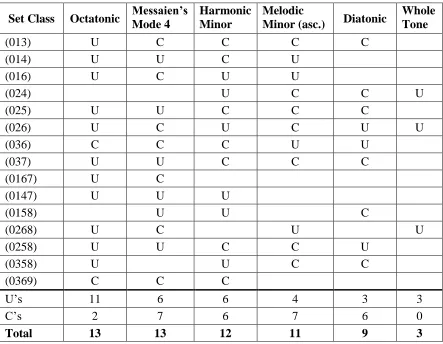
A tabulation of prominent collections and subsets found in Crumb’s music is
illustrated in Table 2.3. Instances of sc (024) can be found in four different collections;
however, set {024} can be found in only one transposition of a unique whole-tone or
28
This is similar in many respects to John Doerksen’s exclusivity index, which in conjunction with Forte’s theory of class genera, “models a class’s power of generic association: the fewer a set-class’s genera memberships, the greater its power to engage a particular genus; the greater its number of genera memberships, the lesser its power to engage one specific genus.” See John Doerksen, “A Theory of Set-Class Salience for Post-tonal Music, with Analyses of Selected Lieder by Anton Webern,” (Ph.D. diss., The University of Western Ontario, 1994): 39; Allen Forte, “Pitch-Class Set Genera and the Origin of Modern Harmonic Species.” Journal of Music Theory 32 (1988): 187–270.
Oct1 Mm9 Hm4 F0,4,5 Oct2 MmB Hm6 F0,1,2 Oct3 Mm1 Hm8 F2,3,4 Oct1 Mm3 HmA F0,4,5 Oct2 Mm5 Hm0 F0,1,2 Oct3 Mm7 Hm2 F2,3,4 WT1 WT2 WT2 aggregate completion
Table 2.3. Identification of collection by subset
Set Class Octatonic Messaien’s Mode 4
Harmonic Minor
Melodic
Minor (asc.) Diatonic
Whole Tone
(013) U C C C C
(014) U U C U
(016) U C U U
(024) U C C U
(025) U U C C C
(026) U C U C U U
(036) C C C U U
(037) U U C C C
(0167) U C
(0147) U U U
(0158) U U C
(0268) U C U U
(0258) U U C C U
(0358) U U C C
(0369) C C C
U’s 11 6 6 4 3 3
C’s 2 7 6 7 6 0
Total 13 13 12 11 9 3
harmonic minor collection. This property is identified with “U” in the corresponding
column in Table 2.3, which represents its ability to identify a Unique instance of a set
from a set class. On the other hand, {024} is a subset of three different transpositions of
the diatonic collection—D4, D6,and DB—and is identified with “C” in the corresponding
column, which represents its Commonality with other transpositions. A blank cell
indicates that the set class is not found in the corresponding collection.
In Table 2.3 a particular instance of sc (037), (0258), or (0358) can identify a
from C {047} to d7 {9025} to G7 {B257} as an octatonic progression, it would pass
through Oct1 to Oct2 to Oct3. While the specificity of chords that point to a unique
collection is important, it is also imperative that all such chords belong to as few
collections as possible. The choice of referential collection should also weigh the ability
of the collection to represent all of the objects that appear in the piece, but not entail
many objects that do not appear.29 In the above case, all the chords belong to only one
diatonic collection but to three octatonic progressions; therefore, the diatonic progression
is preferred.
Returning to the excerpt from “Gargoyles” shown in Figure 2.9, one could
eliminate some of the vertical interpretations of the chords. A member of sc (016) does
not identify a unique instance of Messiaen’s fourth mode and although the trichords can
distinguish between transpositions of the other collections, the harmonic- and
melodic-minor interpretations cycle through half of the twelve possible unique collections from
their respective parent collections. The octatonic interpretation cycles through all the
possible unique octatonic collections and corresponds with the notated articulations.
Although the octatonic, harmonic minor and melodic minor collections encompass all the
chords of the excerpt, the octatonic collection is minimal because all the unique instances
of the collection are represented in the music.
29
Ciro Scotto investigates the interaction between diatonic and chromatic
collections and the procedures used to organize pitch content in Crumb’s Processional.30
In particular, Scotto shows how the diatonic collection and various TINV collections
interact through an exchange of object and process. Two interesting features of
Processional are the notated key signatures of the opening and closing sections and the
corresponding diatonic collections in the music (see Figure 2.10). The opening
hexachord, shown as a vertical simultaneity in Figure 2.10, implies membership in either
D0 or D5. The pitches that would confirm or deny one of the two collections are the two
pitches that form the inversional axis between the right- and left-hand trichords of the
hexachord, C or Cb.31 As Scotto points out, the final pitch to enter, which completes the
aggregate, is the only pitch that invades the center registral stream—the area between the
right- and left-hand trichords of the hexachord—and the pitch that confirms the D0
collection implied by the key signature.32 Using Scotto’s registral streams concept,
parsing the last six notes of each aggregate (enclosed within large boxes) and either the
lowest or highest note of the opening hexachord reveal two other diatonic collections,
which are indicated by dashed boxes and arrows in Figure 2.10.33
30
Ciro G. Scotto, “Transformational Networks, Transpositional Combination, and Aggregate Partitions in Processional by George Crumb,” Music Theory Online 8, no. 3 (2002).
31
Ibid., para. 8.
32
Ibid., para. 10.
33
On a larger scale, the diatonic collections occupying the middle register of each
segment (D0, D3, D6, DA), might be expressed as {A036}, using the index number of each
collection, which is a member of sc (0258).34 The (0258) structure that ties the four
segments of the opening section together is particularly interesting in a piece that
alternates between diatonic and chromatic passages. From the collections listed in Table
2.3, an instance of sc (0258) can uniquely identify a particular octatonic collection,
Messiaen’s fourth mode of limited transposition, and the diatonic collection.
Figure 2.11 is a reduction of the opening portion of the middle section of
Processional.35 Although each diatonic hexachord could belong to two unique diatonic
collections, the collection that corresponds to its counterpart in the opening section was
34
Using the same procedure, the collections in the first segment (D6, DB, D0) might be expressed as {6B0}, a member of sc (016) and an important trichord discussed in section 2.1.
35
In the score the diatonic segments alternate between a wide and a narrow registral spacing but in the reduction are represented within a narrow registral space to underscore the relationship of these segments to the first hexachord of the opening section.
D0 D3 D
6 DA
DB
D6
D2
D9
D5
D0
D9
chosen based upon the left- and right-hand trichordal pairings and the interval-class 3 gap
between the hands. Transpositional relationships between collections are indicated below
the staff, many of which conform to a T(0369) schema.36 The transpositions in Figure 2.11
are represented in a slightly different manner than the way in which Scotto presents them:
the combined tetrachords that complete instances of Messiaen’s fourth mode are merged
into octachords and the F3 collection completes the hyperaggregate of the tetrachordal
structures. Considering the last two mode-4 collections, F3 and F4, the individual
tetrachords within each collection exhibit a T(0167) schema comprised of two overlapping
T(016) patterns. These overlapping patterns are reminiscent of the interlocking diatonic
collections shown in Figure 2.10, and thus forge a connection between the different
referential collections of the opening and middle sections.
36
Scotto points out that considering the tetrachords alone, all twelve transpositions are included
F2 F5 D9 D3 F4 F1
T(0369) T(06) T(0369)
F0 F3 F4
D7 D1 D4 DA
T(0369) T(0369)
T(0167) T(016)
T(016)
“Primeval Sounds,” the first movement of Crumb’s Makrokosmos legacy,
summarizes many of the issues discussed so far (see Figure 2.12). David Lewin describes
this opening as an example of up-shift voice leading in which “fundamental-position
triads, whose basses are related by step . . . move the upper three voices, in contrary
motion to the bass, to the next available notes of the new harmony.”37 It is clear that
Lewin is considering the left- and right-hand minor triads in their own streams: the roots
of the right-hand triads descend by semitone from F while the roots of the left-hand triads
descend by semitone from B. Bass acknowledges these triads, and the tritone registral
exchange indicated with arrows in Figure 2.12, but prefers to conceptualize the
vertically-aligned triads in the upper and lower staves as hexachords.38 The grace-note connection
between triads supports this reading: each pair of triads is held for three seconds and the
sustain pedal is held for the passage’s duration. Regardless of the interpretation chosen,
triadic or hexachordal, each vertical chord can uniquely identify a specific octatonic or
Messiaen’s mode-4 collection. The tritone relationship between the roots of the first and
last chord in each hand, as well as the tritone relationship between the left- and right-hand
chords, exudes a symmetry that is common in Crumb’s music. Crumb’s predilection for
borrowing is thinly veiled here: two tritone-related minor triads are comparable to the
two tritone-related major triads that constitute the Petrushka chord (see Figure 2.13).
Rewriting each of the constituent triads of the Petrushka chord so that they are in root
37
David Lewin, “Some Ideas about Voice-Leading between PCSets,” Journal of Music Theory 42 (1998): 72.
38
Petrushka Primeval
Figure 2.14. Inversional relationship between the Petrushka and Primeval chords Figure 2.13. Stravinsky, Petrushka, Second Tableau, R. 49
1st aggregate 2nd aggregate
Oct2 Oct3 Oct1 Oct2 Oct3 Oct1 Oct2 F5 F4 F3 F2 F1 F0 F5
position and inverting around each triad’s root obtains the opening two chords of
“Primeval Sounds” (see Figure 2.14).
The next section of “Primeval Sounds” provides additional support for an
octatonic interpretation (see Figure 2.15). Whereas the first two trichords in Figure 2.15
belong to F1, the first seven trichords all belong to Oct3. In addition, the octatonic
collection is completed on the fourth trichord, the central trichord of the seven. A similar
configuration occurs with the final seven trichords, indicated with a dotted arrow above
the staff in Figure 2.15. The central seven chords complete the arch design alternating
between subsets of Oct1, Oct2 and Oct1. After the first three trichords of the central seven,
only pc 4 is required to complete the Oct1 collection, but the Oct2 collection disrupts this.
The missing pc 4 of the Oct1 collection is finally obtained in the lowest voice of the first
chord in the closing Oct3 collection. The insistent repeated notes occurring above the
trichords are beamed together and represented with a single note.39
39
The repeated-note motive is a member of sc (026), which is a subset of all six collections listed in Table 2.3. It can uniquely identify transpositions of four of those collections—no other trichord or tetrachord is as versatile.
Oct1 (missing pc 4) Oct
2 Oct1 (missing pc 4)
Oct3 Oct3
After a reiteration of the opening four trichords and a completion of Oct2, two
opposing whole-tone collections are presented (see Figure 2.16). Crumb’s
self-proclaimed sloppiness, or prismatic sense of moving between collections, is highlighted
throughout this passage. Each vertical dyad’s octatonic membership is indicated below
the whole-tone interpretation, highlighting another symmetrical arch progression. While
the supposition that a dyad could be representative of a collection four times larger than
itself might seem unduly promiscuous, the boundary semi-tonal interval-class is
reminiscent of the earlier (014) progressions in the piece (see Figure 2.15). The possible
notes, which would create a vertical (014) trichord between the whole-tone scales, are
notated as x-note heads.40
The end of this section features a seven-second tremolo divided between the right
and left hands. The right-hand tremolo is a subset of either WT1 or Oct2 while the
left-hand tremolo is a subset of either WT2 or Oct1; however, the most complete and minimal
referential collection would be the F3 collection. This interpretation is justifiable since it
would be virtually impossible to distinguish between the two tetrachords because of the
low and similar register, rapid oscillation between the same notes, and the pitches being
sustained by the sustain pedal.
A return is achieved with some slight changes (see Figure 2.17). The first four
dyads in Figure 2.17 all belong to F1 while the next four dyads all belong to F4. This
observation reinforces the interpretation of the previous tremolo as F3. At the same time,
40
the odd-numbered dyads belong to Oct3 and the even-numbered dyads belong to Oct1,
each completing their respective collection by the fourth dyad (indicated by a dotted
arrow in Figure 2.17). Following this overlap of collections, a forceful Oct2 pedal is
established, which resonates throughout the segment while chords from the other
octatonic collections are played in a higher register. This is similar to the Oct2 pedal used
in “Music of Shadows,” which was silently depressed and held with the sostenuto pedal,
which enables sympathetic resonance with the other octatonic collections that were also
played in a higher register (cf. Figure 2.8). What might have been considered a segment
comprised of Messiaen’s fourth mode following the tremolo, becomes distinctly
octatonic following the Oct2 pedal. The upper-beamed dyads and trichords, which belong
to Oct3 at the beginning of the excerpt in Figure 2.17, replicate the opening melodic
Oct3 Oct2
WT1 or Oct2
WT2 or Oct1 Oct1 Oct2 Oct3 Oct1 Oct2 Oct3 Oct2 Oct1 Oct3 Oct2 Oct1
Oct1 F3
WT1
WT2
phrase following the introductory minor chord progression of the piece (cf. Figure 2.15).
Following the Oct2 pedal, the pattern of the opening section is maintained more-or-less
faithfully. The repeated-note trichord’s extension across the section and inclusion as a
subset in the pivotal tremolo chords underscores its significance and enables a prismatic
sense of moving between collections.
The frequent recurrence of, and correlation between, certain pc sets in Crumb’s
music, as demonstrated in section 2.1, coincides with shared membership in a select WT2
WT1
F3
Oct1
Oct2 (Oct2 cont.)
WT2 or Oct2
WT1 or Oct1 Oct3
Oct3
Oct3
F1 F4
Oct2
Oct1 Oct2 Oct1 Oct2-pedal